I-601A Provisional Waiver in Florida
Learn about the I-601A provisional waiver process in Florida and how it can help you avoid separation from your family. Contact us at 1-844-967-3536.

- Eligibility depends on demonstrating 'extreme hardship'.
- Applicable for those with unlawful presence of over 180 days.
- Filing is done in the U.S. before consular processing abroad.
Introduction
Imagine living in Orlando, Florida, and facing the profound fear of being separated from your family due to complex immigration challenges. The I-601A provisional waiver stands as a crucial lifeline for countless individuals in this emotionally taxing situation, offering a pathway to legal residency without enduring prolonged separation from their loved ones. This waiver is specifically designed to mitigate the harsh consequences of certain immigration hurdles, primarily unlawful presence, by allowing applicants to address these issues before departing the U.S. for their visa interview.
For families across Florida, from Miami to Jacksonville, the thought of an uncertain future due to immigration status can be overwhelming. The I-601A waiver provides a beacon of hope, enabling individuals to pursue their immigrant visas while minimizing the time spent apart from their U.S. citizen or lawful permanent resident spouses and parents. This article will delve deep into the intricacies of the I-601A waiver process, outlining its requirements, the critical role of demonstrating extreme hardship, and common pitfalls to avoid. Understanding this complex legal pathway is paramount for a successful outcome.
Navigating U.S. immigration law can be daunting, with ever-changing regulations and strict evidentiary standards. That's why expert guidance is not just beneficial, but often essential. We encourage anyone considering this vital step to reach out for professional assistance. Call Florida Immigration Lawyers at 1-844-967-3536 for a free consultation to discuss your specific circumstances and determine the best course of action.
Understanding the I-601A Provisional Waiver
The I-601A provisional waiver is designed for individuals who are in the U.S. and need to overcome the unlawful presence ground of inadmissibility. It is especially relevant for those in Florida who have accrued unlawful presence by remaining in the U.S. without authorization for more than 180 days.
This waiver is available only to those who can demonstrate that their U.S. citizen or lawful permanent resident spouse or parent would suffer extreme hardship if they had to leave the U.S. for consular processing. The aim is to minimize family separation time by allowing the waiver process to occur before the applicant leaves the U.S.
The I-601A provisional waiver is a pivotal immigration mechanism specifically crafted for individuals present in the U.S. who face a significant obstacle to obtaining their immigrant visa: the unlawful presence ground of inadmissibility. This ground applies to those who have remained in the U.S. without authorization for a cumulative period of more than 180 days, triggering either a three-year or ten-year bar from re-entry upon departure. For many in Florida, who may have overstayed a visa or entered without inspection, this waiver offers a critical opportunity to regularize their status without facing a lengthy separation from their families.
What makes the I-601A truly "provisional" is its unique structure: it allows applicants to apply for and receive a decision on their waiver while still residing within the United States. This innovative approach dramatically reduces the uncertainty and emotional strain associated with traditional waivers, where applicants would have to leave the U.S. and potentially face a long wait abroad before knowing if their waiver was approved. The primary goal is to minimize the duration of family separation, ensuring that individuals only depart for their consular interview once their waiver has been provisionally approved, thereby streamlining the path to their green card.
Crucially, eligibility for the I-601A hinges on demonstrating "extreme hardship" to a qualifying U.S. citizen (USC) or Lawful Permanent Resident (LPR) spouse or parent. This is not a simple standard; it requires compelling evidence that the qualifying relative would suffer more than the usual discomfort or inconvenience inherent in family separation. Hardship can be financial, medical, psychological, educational, or a combination of these factors. For instance, a USC spouse with a severe medical condition requiring constant care, or an LPR parent who is the sole financial provider for the family, could be strong candidates for demonstrating extreme hardship. Building a robust case is essential, and Florida Immigration Lawyers can help you gather and present the necessary documentation effectively.
Step-by-Step Guide to Filing
Navigating the I-601A provisional waiver process requires meticulous attention to detail and a thorough understanding of each step. This comprehensive guide outlines the critical stages involved, from initial eligibility assessment to receiving a final decision. Each phase is interconnected, and a misstep in one can significantly impact the overall outcome, potentially leading to delays or even denial.
- Eligibility Check: Ensure you are eligible by verifying your relationship with a U.S. citizen or lawful permanent resident and the extreme hardship criteria. Before embarking on this journey, a rigorous self-assessment of your eligibility is paramount. This involves confirming your qualifying relationship – you must be the spouse or child of a U.S. citizen or lawful permanent resident, or the parent of a U.S. citizen (for certain categories). Furthermore, you must meet specific criteria related to your unlawful presence, ensuring you are not subject to other grounds of inadmissibility that cannot be waived. It's also crucial to verify that you are the beneficiary of an approved I-130, I-140, or I-360 petition.
- Gather Evidence: Collect evidence of hardship, including medical records, financial documents, and affidavits from family members. This step is arguably the most critical. The success of your I-601A waiver hinges on your ability to persuasively demonstrate "extreme hardship" to your qualifying U.S. citizen or LPR spouse or parent. Comprehensive evidence is key. This includes detailed medical records highlighting any conditions requiring your care, extensive financial documents illustrating dependence or severe economic impact, psychological evaluations detailing emotional distress, educational records if a disruption would cause significant harm, and compelling affidavits from family members, friends, and professionals. Consider how your absence would uniquely affect your qualifying relative beyond typical separation.
- Complete Form I-601A: Fill out the form accurately, ensuring all personal and hardship details are included. Accuracy and completeness are non-negotiable when filling out Form I-601A, Application for Provisional Unlawful Presence Waiver. Every section must be addressed truthfully and precisely. Errors or omissions can lead to Requests for Evidence (RFEs), significant delays, or outright denial. Ensure all personal details, dates, and responses align with your supporting documentation. It is highly recommended to seek legal counsel from Florida Immigration Lawyers to review your application before submission, ensuring it is free from errors and strategically prepared.
- Submit Application: File the application with the appropriate fee to USCIS, making sure to keep copies of all documents. Once the form is meticulously completed and all supporting evidence is compiled, the application must be filed with the appropriate fee to USCIS. Always use a trackable mailing service and retain copies of the entire submission package for your records. This includes the completed Form I-601A, all supporting documents, and proof of payment. Keeping copies is vital for future reference, especially if USCIS requests additional information or if there are any discrepancies.
- Attend Biometrics Appointment: After submission, attend the biometrics appointment as scheduled by USCIS. Following the submission of your application, USCIS will issue an appointment notice for biometrics collection. This typically involves fingerprinting, photographs, and a signature. It's a standard and mandatory part of the process, used for background checks and identity verification. Missing this appointment without proper rescheduling can lead to the denial of your application, so ensure you attend on the scheduled date with your appointment notice and valid photo identification.
- Await Decision: Monitor the status through the USCIS case status tool and await the decision, which can take several months. The period awaiting a decision can be the most anxious part of the process. Processing times for I-601A waivers can vary significantly, often ranging from several months to over a year. While waiting, you can monitor your case status online through the USCIS website using your receipt number. It's important to remain patient and avoid making travel plans until a decision is rendered. If your waiver is provisionally approved, you will then proceed with your consular interview abroad.
Throughout this entire process, maintaining meticulous records and understanding the nuances of immigration law is crucial. Enlisting the expertise of Florida Immigration Lawyers can provide invaluable support, helping you navigate each step with confidence and precision.
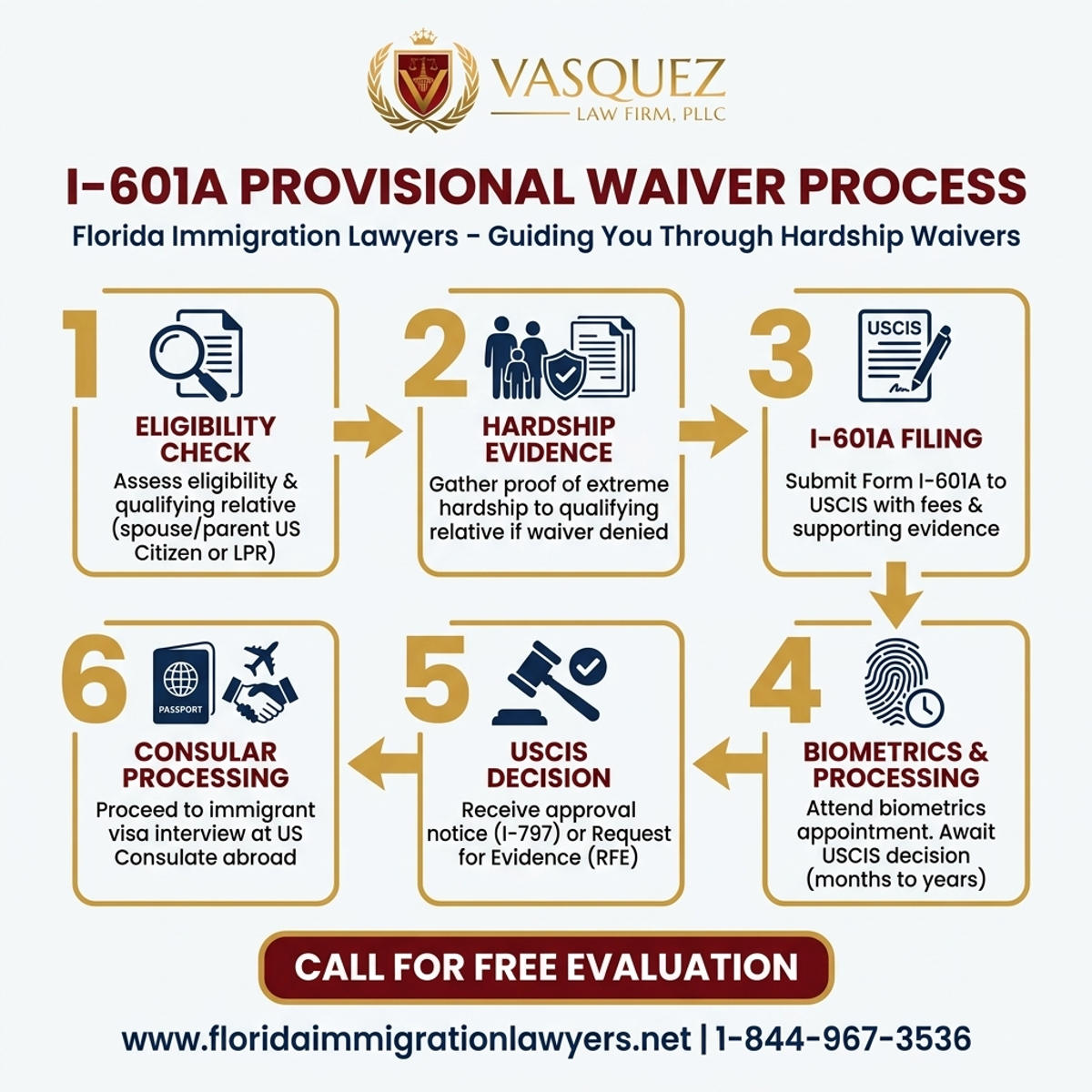
Step-by-Step Process — I-601A Provisional Waiver in Florida
Document Checklist
A well-organized and comprehensive document submission is fundamental to the success of your I-601A provisional waiver application. Think of your documentation as telling a compelling story to USCIS about your case and the hardship your qualifying relative would face. Missing or incomplete documents are among the most common reasons for delays or rejections, making this checklist indispensable.
- Completed Form I-601A (Application for Provisional Unlawful Presence Waiver), signed and dated.
- Proof of relationship to qualifying relative: This includes marriage certificates, birth certificates, and adoption decrees, clearly establishing your legal relationship to your U.S. citizen or lawful permanent resident spouse or parent.
- Proof of extreme hardship: This category is broad and requires extensive documentation. It can include detailed medical records and doctor's letters, financial statements, tax returns, utility bills, mortgage statements, psychological evaluations, school records, employment letters, and affidavits from family members, friends, and community leaders. Each piece of evidence should directly link to the specific hardships your qualifying relative would endure.
- Copies of all immigration documents: This includes copies of your passport, visa stamps, I-94 records, previous immigration applications (approved or denied), and any other relevant immigration history documents.
- Biometrics appointment notice: While this comes after initial submission, it’s a crucial document to keep track of for your appointment.
- Proof of approved immigrant petition: This typically refers to an approved Form I-130, Petition for Alien Relative, which establishes your eligibility for an immigrant visa.
Organizing these documents systematically, perhaps with tabs and a detailed table of contents, can significantly aid USCIS in reviewing your application. Florida Immigration Lawyers specializes in helping clients compile robust and persuasive evidentiary packages, ensuring every detail supports your claim of extreme hardship.
Timeline and Processing Expectations
The I-601A waiver process can take several months, often between 6 to 12 months, depending on the complexity of the case and USCIS workload. It's crucial to prepare thoroughly to avoid delays. In Florida, processing times may vary slightly, and it's essential to stay updated through official channels like the USCIS website.
Managing expectations regarding the timeline and processing of an I-601A waiver is vital for applicants and their families. While the average processing time often falls within a range of 6 to 12 months, it's important to understand that this is an estimate, not a guarantee. Several factors can influence the actual duration, including the current workload at USCIS service centers, the complexity of your individual case, and whether USCIS issues a Request for Evidence (RFE) or a Notice of Intent to Deny (NOID). A meticulously prepared application, free from errors and supported by comprehensive evidence, is your best defense against unnecessary delays.
For individuals in Florida, processing times generally align with national averages, but local factors can sometimes play a minor role. It is imperative to regularly check the USCIS website for the most up-to-date processing times for Form I-601A, as these figures are updated periodically. Beyond the initial waiver approval, applicants must also factor in the time required for National Visa Center (NVC) processing and the scheduling of their consular interview abroad, which can add additional months to the overall journey. Patience and proactive monitoring are key throughout this extended period.
To mitigate potential delays, ensure all forms are filled out accurately, all required documentation is included, and any requests from USCIS are responded to promptly and thoroughly. Any misstep, such as an incomplete form or insufficient evidence, can trigger an RFE, adding several months to the processing time. Consulting with experienced professionals like Florida Immigration Lawyers can help streamline the process, ensuring your application is as strong and complete as possible from the outset, thus minimizing the chances of administrative setbacks.
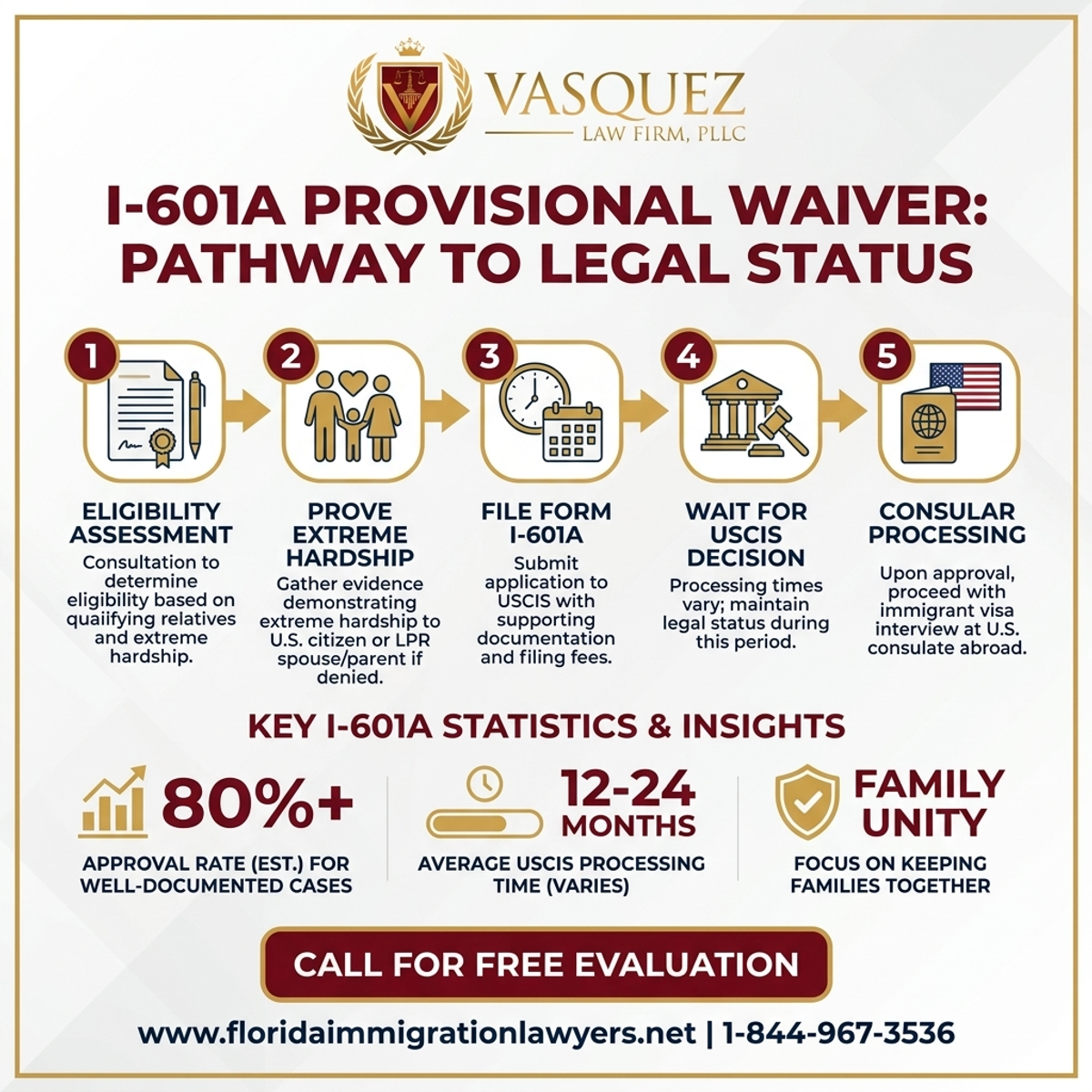
Key Statistics — I-601A Provisional Waiver in Florida
Cost Factors and Fee Breakdown
While filing fees for the I-601A waiver can vary, applicants should be prepared for additional costs related to legal assistance, gathering evidence, and biometrics. Consulting with a lawyer can help clarify these costs and ensure all requirements are met efficiently.
Do not navigate this process alone. Contact Florida Immigration Lawyers today.
Understanding the financial commitment involved in the I-601A provisional waiver process is crucial for effective planning. Beyond the mandatory USCIS filing fee for Form I-601A, which is subject to change and should be verified on the official USCIS website, applicants must anticipate a range of other expenses. These can include the biometrics fee, which is typically a separate charge, and the filing fee for the underlying immigrant petition (Form I-130, I-140, or I-360) if it hasn't already been paid. These government fees are non-refundable, regardless of the outcome of your application.
However, the costs extend well beyond government fees. A significant portion of the overall expense often relates to gathering comprehensive evidence to support the extreme hardship claim. This might involve fees for obtaining medical records, psychological evaluations, expert opinions, document translations if original documents are not in English, and potentially travel costs for interviews or to gather specific documentation. Investing in professional psychological evaluations or detailed medical reports can significantly strengthen a case, but these services come with their own costs.
Perhaps the most valuable investment, though, is in experienced legal counsel. While attorney fees vary depending on the complexity of the case and the services provided, engaging Florida Immigration Lawyers can save you time, reduce stress, and significantly increase your chances of a successful outcome. A lawyer helps in strategizing the hardship argument, compiling a robust evidence package, preparing forms accurately, and responding to any USCIS inquiries. This legal expertise helps navigate the intricate legal landscape, ensuring all requirements are met efficiently and effectively, ultimately protecting your long-term immigration goals. Do not navigate this process alone. Contact Florida Immigration Lawyers today for a free consultation to understand the full scope of potential costs and how we can assist you.
Common Mistakes to Avoid
The I-601A provisional waiver process is fraught with potential pitfalls that can jeopardize an otherwise strong case. Awareness of these common errors is the first step towards a successful application. Avoiding these missteps can save you significant time, money, and emotional distress, ensuring your journey towards a green card is as smooth as possible.
- Incomplete Applications: Missing information can lead to rejections or delays. Submitting an application with missing information or unsigned forms is a primary reason for rejection or requests for evidence (RFEs). USCIS will not process incomplete submissions, leading to immediate delays. Double-check every field and ensure all required signatures are present.
- Insufficient Hardship Evidence: Failing to provide comprehensive evidence of hardship can result in denial. This is perhaps the most critical mistake. Simply stating that your qualifying relative will miss you is not enough. You must provide robust, well-documented, and persuasive evidence demonstrating "extreme hardship" beyond typical separation. This requires a strategic approach to evidence gathering, often involving medical records, financial statements, psychological evaluations, and detailed affidavits.
- Ignoring Deadlines: Missing deadlines for biometrics or additional information requests can jeopardize approval. USCIS operates on strict timelines. Missing deadlines for biometrics appointments, responding to RFEs, or submitting additional requested information can lead to the denial of your application without further consideration. Always mark deadlines and respond promptly.
- Misunderstanding Eligibility: Misinterpreting eligibility criteria may lead to ineligibility. The I-6
Sources and References
- U.S. Citizenship and Immigration Services (USCIS)
- Executive Office for Immigration Review (EOIR)
- U.S. Department of State - Bureau of Consular Affairs
- Immigration and Nationality Act (INA), 8 U.S.C. Chapter 12
Do Not Navigate This Process Alone
Our experienced immigration attorneys are ready to fight for you. Get a free, confidential consultation today.
Se Habla Español
Or leave your details and we’ll call you:
Free Evaluation in 24 Hours
Or talk to us right now

AI voice assistant — available 24/7
FreeFrequently Asked Questions

William J. Vásquez
Founding Attorney · Vasquez Law Firm
U.S. Air Force veteran and immigration attorney with years of hands-on U.S. immigration experience. J.D., NCCU School of Law. AILA member. Admitted to the 4th, 5th, and 11th Circuit Courts.
Available 24/7 - Free Evaluations
Reviewed for legal accuracy by William J. Vásquez
Licensed in North Carolina; U.S. immigration is federal practice.
Related Legal Services
Our Florida immigration attorneys can help you with deportation defense, citizenship and naturalization and family immigration services. Call today at 1-844-967-3536 for a free consultation.
Related Links
Related Topics
Free Legal Consultation
Discuss your case with our experienced attorneys. We're available 24/7.
Se Habla Español - Estamos aquí para ayudarle.
Related Articles
STEM OPT Immigration Lawyer: Florida Guidance
Explore the STEM OPT extension for Florida graduates. Understand eligibility, application steps, and common mistakes. Consult Florida Immigration Lawyers for guidance.
TPS Honduras Extension 2026: What Florida Residents Need
For thousands of Honduran nationals in Florida, the Temporary Protected Status (TPS) extension through 2026 offers crucial temporary relief from deportation and the ability to work legally. This comprehensive guide, from Florida Immigration Lawyers, details everything about the TPS Honduras extension 2026, including eligibility requirements, the mandatory re-registration process, and critical timelines. We explain the necessary forms like I-821 and I-765, outline the associated USCIS filing fees, and discuss potential fee waivers. Learn about the importance of continuous physical presence and residence, and discover common mistakes to avoid during your application. Additionally, we explore potential pathways to permanent residency and emphasize when it's essential to seek legal counsel to navigate complex situations. Serving all of Florida, our firm offers expert guidance to ensure your status is protected.
"Narrative of Fear" Asylum I-589 in Florida: 2026 Guide
Preparing for your asylum interview in Florida, particularly when your I-589 application hinges on a "narrative of fear," is a pivotal moment in your journey towards protection. This comprehensive guide, relevant for 2026, details how to meticulously prepare your personal testimony and gather crucial evidence. Learn about the specific requirements for proving a well-founded fear of persecution based on protected grounds, and understand the interview process at the Miami Asylum Office serving Fort Lauderdale. We cover essential documents, potential costs, and common mistakes to avoid. Florida Immigration Lawyers offers expert guidance to strengthen your case and navigate the complexities of U.S. asylum law, ensuring your story is heard effectively.
Immediate Relative Petition Tampa: A Florida Guide for 2026
Navigating an immediate relative petition in Tampa, Florida, offers U.S. citizens a direct path to sponsor spouses, unmarried children under 21, and parents for a Green Card. This comprehensive guide, updated for 2026, details the Form I-130 process, eligibility requirements, necessary documentation, and typical timelines. Unlike other family-based categories, immediate relatives are exempt from annual visa quotas, potentially speeding up their journey to permanent residency. However, the process is intricate, demanding precise form completion, thorough evidence of a bona fide relationship, and adherence to strict legal guidelines. We cover common pitfalls to avoid, such as incomplete forms or insufficient financial sponsorship, which can lead to significant delays or denials. Understanding when to seek expert legal assistance is crucial, especially for cases involving complex relationship dynamics, prior immigration violations, or criminal histories. Florida Immigration Lawyers provides dedicated support to families in Gainesville, Tampa, and across Florida, ensuring a smooth and successful application process. We offer free consultations to help you understand your options and navigate the complexities of U.S. immigration law.