I-601 Waiver Florida Guide 2026: Overcoming Inadmissibility
For Florida residents facing immigration inadmissibility, the I-601 waiver offers a critical pathway to legal status. This 2026 guide explains the I-601 waiver process, detailing who is eligible, how to prove "extreme hardship" to a U.S. citizen or LPR spouse or parent, and what documentation is required. We cover application steps, processing timelines, and cost factors, emphasizing the need for meticulous preparation. Learn about common mistakes to avoid and understand when legal counsel from Florida Immigration Lawyers is essential to navigate the complexities of immigration law and secure your family's future in the United States. Get a free consultation today.
An I-601 waiver, officially known as the Application for Waiver of Grounds of Inadmissibility, is a crucial legal tool for individuals seeking to immigrate to the United States but who are deemed inadmissible under U.S. immigration law. This waiver allows certain applicants, often those with U.S. citizen or lawful permanent resident spouses or parents, to overcome grounds of inadmissibility such as past criminal offenses, immigration violations, or misrepresentation. To be approved, applicants must demonstrate that their qualifying relative would suffer "extreme hardship" if the applicant were denied admission or adjustment of status. The process is complex and demands thorough documentation, making legal guidance essential.
- The I-601 waiver helps overcome specific grounds of inadmissibility to the U.S.
- It requires proving "extreme hardship" to a U.S. citizen or LPR spouse or parent.
- Common grounds for inadmissibility include criminal history, unlawful presence, or fraud.
- The application involves extensive documentation and a detailed legal argument.
- Legal assistance significantly increases the chances of approval.
Navigating the complex landscape of U.S. immigration law can feel like an uphill battle, especially when you or a loved one faces the daunting challenge of inadmissibility. For many families in Florida, particularly in diverse communities like Homestead and Miami-Dade County, the dream of living together in the United States can be jeopardized by past mistakes or unforeseen circumstances. If you are applying for an immigrant visa or adjustment of status but have been found inadmissible to the U.S., the I-601 waiver may be your pathway to a brighter future.
This comprehensive guide, updated for 2026, will demystify the I-601 waiver process, explain who needs it, how to prove the critical element of "extreme hardship," and what to expect during the application journey. We will delve into common pitfalls to avoid and highlight why experienced legal counsel from a firm like Florida Immigration Lawyers is indispensable. Understanding your options is the first step towards securing your immigration goals. Do not face this complex legal challenge alone. Call Florida Immigration Lawyers at 1-844-YO-PELEO for a free consultation today.
What is the I-601 Waiver and Who Needs It in Florida?
The I-601 waiver, formally known as the Application for Waiver of Grounds of Inadmissibility, is a legal mechanism that allows certain individuals who are otherwise barred from entering or remaining in the United States to overcome specific reasons for their inadmissibility. It is a critical form for many immigrants in Florida who, despite having a qualifying family relationship, face obstacles due to past issues.
Under the Immigration and Nationality Act (INA) Section 212(a), numerous grounds can render a person inadmissible. These include, but are not limited to, certain criminal convictions, misrepresentation or fraud in seeking an immigration benefit, unlawful presence in the United States, drug trafficking, and certain health-related grounds. For instance, an individual in Homestead, Florida, who overstayed a visa by more than 180 days and then left the country might be subject to a 3-year or 10-year bar, requiring an I-601 waiver to return.
Generally, an I-601 waiver is sought by individuals who are applying for an immigrant visa at a U.S. embassy or consulate abroad, or those applying for adjustment of status within the United States. The waiver is typically available to applicants who have a qualifying U.S. citizen or lawful permanent resident (LPR) spouse or parent. In some specific cases, a U.S. citizen son or daughter can be a qualifying relative, but this is less common for I-601s. The purpose of the waiver is to demonstrate that the positive factors in the applicant's case, particularly the extreme hardship to their qualifying relative, outweigh the negative grounds of inadmissibility. This is a crucial distinction, as not all grounds of inadmissibility can be waived, and specific waivers apply to different situations. Understanding your specific ground of inadmissibility is the first step in determining if an I-601 is the appropriate remedy for your situation.
How Do I Prove "Extreme Hardship" for an I-601 Waiver in 2026?
Proving "extreme hardship" is the cornerstone of a successful I-601 waiver application. It means demonstrating that your qualifying U.S. citizen or lawful permanent resident spouse or parent would suffer significantly more than the usual emotional and financial difficulties if you were denied admission to the U.S. or if they had to relocate to your home country.
As of 2026, USCIS adjudicators continue to scrutinize extreme hardship claims meticulously. They consider a wide range of factors, evaluating the cumulative effect of hardship rather than focusing on a single issue. These factors include the qualifying relative's health (physical and mental), financial burdens, educational disruption for children, family ties in the U.S., and country conditions in the applicant's native country. For example, a U.S. citizen spouse in Florida with a severe medical condition requiring specialized care unavailable in their partner's home country would likely face extreme hardship if forced to choose between separation and relocation. Similarly, a qualifying parent in Homestead relying on their adult child's financial and emotional support due to age or disability would present a strong case.
Building a compelling case requires comprehensive documentation and a detailed narrative. You must provide evidence such as medical records, psychological evaluations, financial statements, tax returns, property deeds, school records, expert opinions on country conditions, and affidavits from friends, family, and employers. The hardship must be clearly articulated and directly linked to the absence or relocation of the applicant. The more specific and well-documented your evidence, the stronger your argument for extreme hardship. Our family immigration attorneys can help you gather and present this crucial evidence effectively.
What is the I-601 Waiver Application Process in Florida?
The I-601 waiver application process involves several critical steps, from determining eligibility to submitting a comprehensive package of evidence to USCIS. For residents of Florida, understanding the specific requirements and preparing a meticulously documented application is paramount to success.
Step-by-Step Guide to Filing Your I-601 Waiver:
- Determine Eligibility: First, confirm that an I-601 waiver is the correct form for your specific ground of inadmissibility and that you have a qualifying U.S. citizen or lawful permanent resident spouse or parent. Understand the specific INA section under which you are inadmissible.
- Gather Evidence of Extreme Hardship: This is the most crucial step. Collect all documents proving the extreme hardship your qualifying relative would endure. This includes medical records, psychological evaluations, financial statements, employment letters, property documents, and detailed affidavits.
- Complete Form I-601: Accurately fill out Form I-601, Application for Waiver of Grounds of Inadmissibility. Ensure all questions are answered truthfully and completely. Any errors or omissions can lead to delays or denial.
- Prepare Supporting Documents: Organize all evidence into a clear, concise, and well-indexed package. Include a cover letter outlining the grounds for the waiver and summarizing the extreme hardship. All foreign language documents must be translated into English by a certified translator.
- File with USCIS: The filing location depends on your specific immigration process. If you are applying for an immigrant visa abroad, you will typically file the I-601 with USCIS after an initial finding of inadmissibility by a consular officer. If you are adjusting status in the U.S. and are found inadmissible, you would file with the appropriate USCIS service center. Always check the USCIS website for the most current filing instructions.
- Attend Interview (if required): While not always required for I-601 waivers, USCIS may request an interview to clarify information or assess the credibility of your extreme hardship claim. Thorough preparation is essential.
- Receive Decision: USCIS will send a written decision. If approved, your immigration process can continue. If denied, you may have options for appeal or refiling, depending on the reasons for denial.
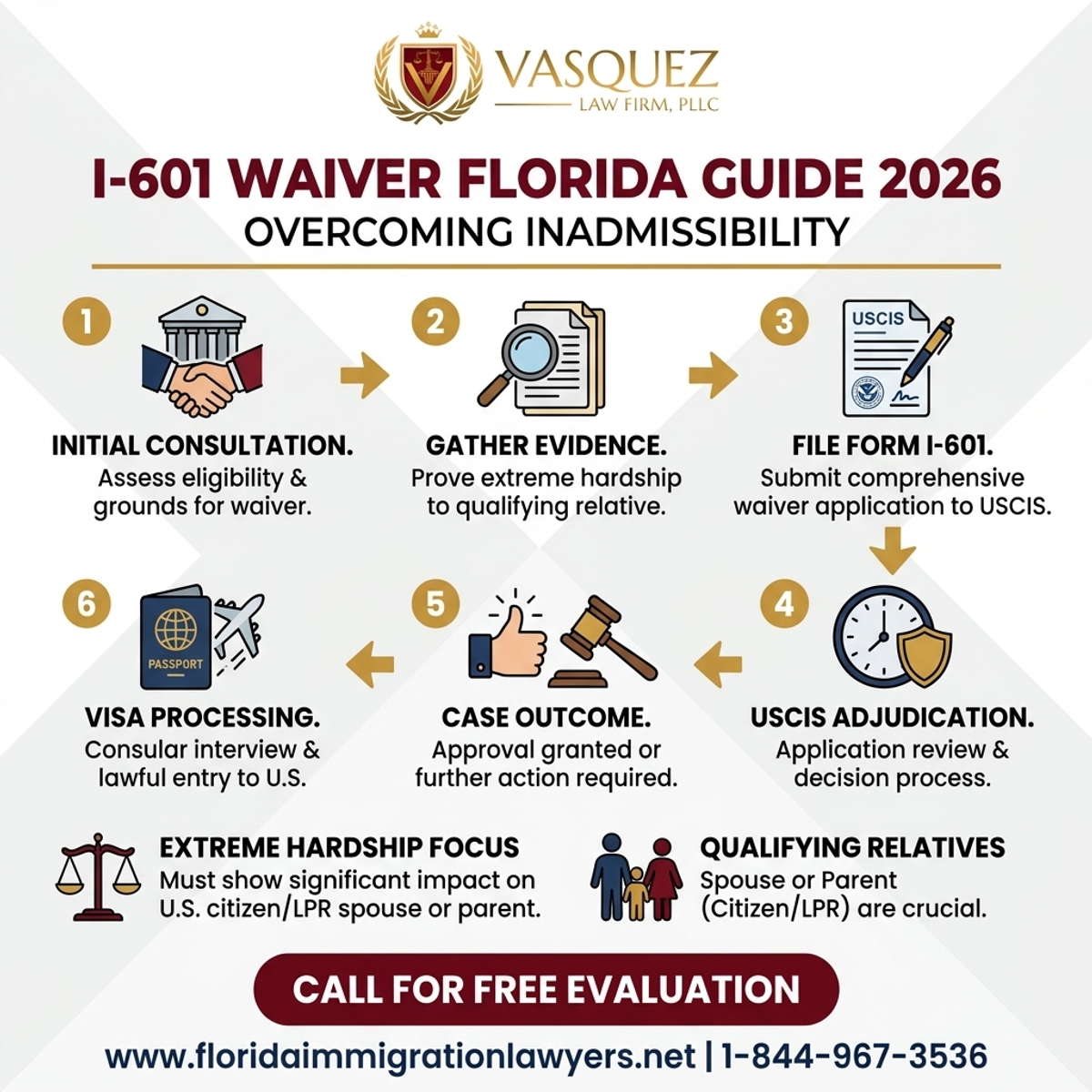
Step-by-Step Process — I-601 Waiver Florida Guide 2026: Overcoming Inadmissibility
Essential Document Checklist for Your I-601 Waiver:
- Completed and signed Form I-601.
- Proof of qualifying relationship (marriage certificate, birth certificates).
- Proof of U.S. citizenship or LPR status for the qualifying relative (passport, green card).
- Detailed personal statement from the qualifying relative describing extreme hardship.
- Affidavits from family members, friends, employers, and community leaders supporting the hardship claim.
- Medical records, diagnoses, treatment plans, and letters from doctors for any health-related hardship.
- Psychological evaluations or therapy records for any mental health-related hardship.
- Financial documents: tax returns, pay stubs, bank statements, mortgage/rent agreements, evidence of debt.
- Education records for children or qualifying relative demonstrating disruption.
- Evidence of country conditions in the applicant's home country (reports, articles, expert opinions).
- Police clearances from all countries resided in.
- Copies of all immigration documents (visas, I-94s, previous applications).
- Any other evidence demonstrating the unique hardship to the qualifying relative.
What are the Current I-601 Waiver Processing Times and Fees in 2026?
As of 2026, I-601 waiver processing times can vary significantly depending on the USCIS service center, the complexity of the case, and current caseloads. While USCIS strives for efficiency, applicants should prepare for a potentially lengthy waiting period. Fees are also subject to change and should always be verified directly with USCIS.
It is crucial to monitor the USCIS website for the most up-to-date information on processing times, which are often listed by form type and service center. Typically, these waivers can take anywhere from several months to over a year to process. Factors such as requests for evidence (RFEs) or an interview requirement can extend these timelines. Planning ahead and submitting a complete, well-organized application from the outset can help minimize delays. For personalized guidance on current processing trends, consider speaking with our legal team at Florida Immigration Lawyers. You can contact us for more information.
I-601 Waiver Timeline and Processing Expectations (As of 2026)
| Stage | Typical Timeframe | Notes |
|---|---|---|
| Application Submission to USCIS | Immediate confirmation | Receive Form I-797, Notice of Action. |
| Initial Review & Biometrics | 1-3 months | USCIS verifies application, schedules biometrics appointment. |
| Request for Evidence (RFE) (if applicable) | Varies (response time + re-review) | USCIS may request additional documentation. Respond promptly. |
| Interview (if applicable) | Varies (after initial review) | Not all I-601 waivers require an interview. |
| Decision Notification | 6-18 months (or more) | Timeframes are estimates and subject to change. Check USCIS online tool. |
Cost Factors and Fee Breakdown for I-601 Waiver (As of 2026)
| Item | Typical Fee | Notes |
|---|---|---|
| USCIS Filing Fee for Form I-601 | (Varies, check USCIS) | Fees are non-refundable and subject to change by USCIS. |
| Attorney Legal Fees | (Varies significantly) | Covers legal advice, document preparation, strategy, and representation. |
| Translation Services | (Varies by document volume) | Required for any non-English documents. Must be certified. |
| Medical Examinations | (Varies by provider) | If required for health-related inadmissibility. |
| Psychological Evaluations | (Varies by provider) | Often crucial for extreme hardship claims. |
| Expert Witness Fees | (Varies by expert) | For country conditions reports or specialized opinions. |
| Mailing/Courier Costs | (Minor, but adds up) | For secure submission of documents. |
Always verify the most current USCIS filing fees directly on the official USCIS website before submitting your application. Legal fees will depend on the complexity of your case and the services required. A free consultation with Florida Immigration Lawyers can provide clarity on potential costs.
Navigating I-601 Waivers for Unlawful Presence in Florida
Unlawful presence is one of the most common grounds of inadmissibility, particularly for individuals in Florida who may have overstayed their visas or entered the U.S. without inspection. The I-601 waiver can be used to overcome unlawful presence bars, but it's essential to understand the distinction between the I-601 and the I-601A Provisional Unlawful Presence Waiver. The I-601 is typically filed by individuals who are already outside the U.S. and have been found inadmissible by a consular officer, or by those adjusting status within the U.S. who do not qualify for the I-601A.
For many in Florida seeking to adjust their status or obtain an immigrant visa, the I-601A is often the preferred route for unlawful presence. This provisional waiver allows certain eligible individuals to apply for the waiver while still in the United States, before departing for their immigrant visa interview abroad. This significantly reduces the time spent outside the U.S. and minimizes the risk of being barred from re-entry. However, the I-601A has strict eligibility requirements, and not everyone qualifies. For instance, if an individual has other grounds of inadmissibility beyond unlawful presence (e.g., certain criminal convictions or misrepresentation), they would likely need to file the traditional I-601 waiver. Understanding which waiver is appropriate for your specific circumstances is critical, as filing the wrong form can lead to delays or denial. Cases involving unlawful presence, especially when combined with other issues, can be highly complex and often require experienced legal guidance to navigate successfully. Our asylum and deportation defense attorneys also have experience with complex inadmissibility cases.
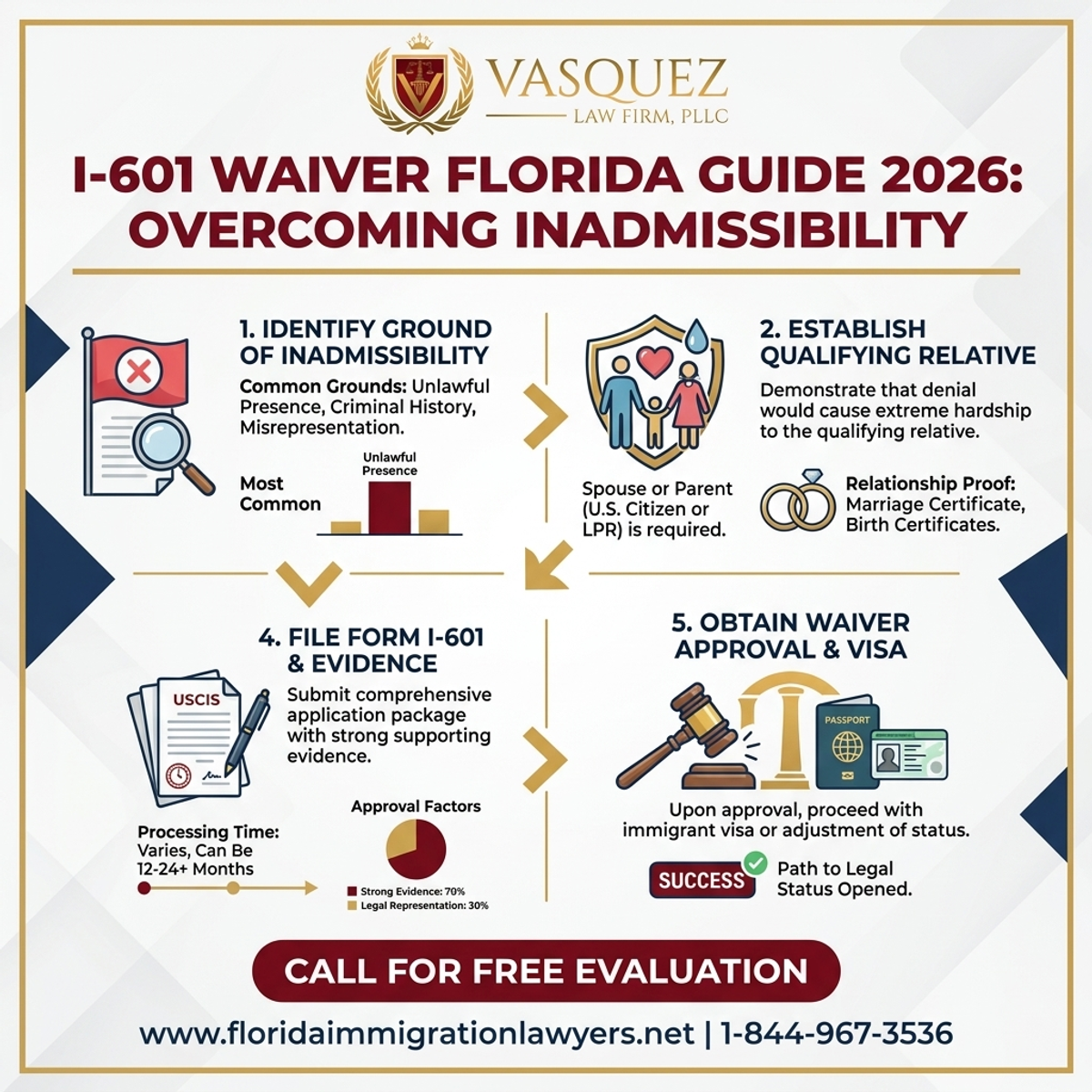
Key Statistics — I-601 Waiver Florida Guide 2026: Overcoming Inadmissibility
Special Considerations for I-601 Waivers in Florida
Florida's unique demographics and geographic location present specific considerations for I-601 waiver applicants. As a state with a large and diverse immigrant population, including significant communities from Latin America, the Caribbean, and other regions, immigration cases here often involve distinct cultural, linguistic, and socio-economic factors. For example, applicants from countries experiencing political instability or natural disasters may present stronger extreme hardship arguments related to country conditions, which can be particularly relevant for Floridians with ties to these regions.
The presence of various USCIS field offices and immigration courts across Florida, including those serving the greater Miami-Dade area and Homestead, means that local procedures and adjudicator tendencies can sometimes influence case outcomes. While federal law applies nationwide, a local attorney familiar with the nuances of Florida's immigration landscape can offer invaluable insights. Furthermore, Florida's role as a major port of entry can lead to unique scenarios involving individuals who may have entered without inspection or faced specific issues at the border, potentially impacting their inadmissibility grounds. Applicants undergoing consular processing abroad, especially those from Caribbean nations, will interact with U.S. Consulates, whose specific requirements and processing times are also relevant. The U.S. Department of State website provides detailed information on consular processes. Navigating these regional specificities requires a deep understanding of both federal immigration law and the practical realities on the ground in Florida.
Do not navigate this process alone. The complexities of immigration law, especially concerning waivers, demand expert attention. Contact Florida Immigration Lawyers today for a free consultation to discuss your I-601 waiver case.
Common Mistakes to Avoid with Your I-601 Waiver
Applying for an I-601 waiver is a detailed and often challenging process. Even minor errors can lead to significant delays, requests for evidence (RFEs), or outright denial. Being aware of these common pitfalls can help you avoid costly mistakes:
- Filing the Wrong Waiver Form: Mistaking Form I-601 for Form I-601A (Provisional Unlawful Presence Waiver) or other waivers can waste time and money. Each waiver addresses specific grounds of inadmissibility.
- Incomplete Application or Missing Documents: Submitting an application with missing signatures, unanswered questions, or absent required documents is a leading cause of delays and RFEs. USCIS will not process incomplete applications.
- Insufficient Evidence of Extreme Hardship: This is the most critical mistake. Many applicants fail to provide enough compelling evidence or adequately articulate how their qualifying relative would suffer *extreme* hardship, beyond normal separation. Generic statements are not enough.
- Failing to Address All Grounds of Inadmissibility: If you have multiple grounds of inadmissibility, you must seek a waiver for each one. Overlooking even one can result in denial.
- Missing Deadlines: Strict deadlines apply to responses for RFEs and other USCIS communications. Missing these can lead to automatic denial or abandonment of your application.
- Misrepresenting Facts or Providing False Information: Any attempt to deceive USCIS will result in a denial and can lead to permanent bars from future immigration benefits. Honesty and accuracy are paramount.
- Not Seeking Legal Counsel: Attempting to navigate the complex I-601 process without an experienced immigration attorney significantly reduces your chances of success. An attorney understands legal precedents and how to build a strong case.
- Assuming "Extreme Hardship" is Obvious: What seems like extreme hardship to you might not meet USCIS's strict legal definition. A lawyer can help you frame your case within the established legal framework.
- Lack of Expert Opinions: For complex medical or psychological hardship claims, not including evaluations from licensed professionals can weaken your case considerably.
- Poor Organization of Documents: USCIS officers review thousands of applications. A disorganized submission can make it difficult for them to find key evidence, potentially leading to an RFE or an unfavorable decision.
- Failure to Update USCIS on Changes: If your contact information, qualifying relative's status, or other relevant details change during the process, you must notify USCIS promptly.
- Not Preparing for a Potential Interview: While not always required, if an interview is scheduled, being unprepared or inconsistent in your answers can jeopardize your application.
When to Call a Lawyer for Your I-601 Waiver in Florida
The I-601 waiver process is notoriously complex, and the stakes are incredibly high. While it might be tempting to attempt the application on your own, the consequences of a denial can be devastating, potentially leading to deportation or long-term separation from your family. Knowing when to seek professional legal help from Florida Immigration Lawyers is crucial for increasing your chances of success.
You should strongly consider calling an attorney if:
- You have a criminal record: Certain criminal convictions can be particularly challenging to waive, and a lawyer can assess eligibility and strategy.
- You have multiple grounds of inadmissibility: If your case involves more than just unlawful presence, a comprehensive legal strategy is essential.
- You've previously been denied an immigration benefit: Past denials indicate complexities that require expert review and a new approach.
- Your extreme hardship claim is not straightforward: If your qualifying relative's hardship isn't immediately obvious or involves nuanced medical, psychological, or financial factors, an attorney can help build a strong, well-documented case.
- You have a history of misrepresentation or fraud: These grounds are very difficult to waive, and require a highly skilled attorney.
- You are unsure which waiver to file: Distinguishing between I-601, I-601A, and other waivers can be confusing; a lawyer ensures you choose the correct path.
- You receive a Request for Evidence (RFE): An RFE means USCIS needs more information, and a lawyer can help you provide a complete and persuasive response.
- You need to gather extensive documentation: An attorney can guide you through collecting and organizing the vast amount of evidence required, including expert opinions.
Florida Immigration Lawyers has extensive experience in handling complex I-601 waiver cases throughout Florida. We understand the specific challenges faced by immigrants in Homestead, Miami, and beyond. Our team can provide the strategic guidance and meticulous preparation needed to present the strongest possible case, helping you navigate the system and protect your family's future. From initial assessment to final decision, we are here to advocate for you.
About Florida Immigration Lawyers
Florida Immigration Lawyers is an immigration law firm dedicated to serving individuals and families across the entire state of Florida. With a deep understanding of U.S. immigration law and a compassionate approach, our experienced attorneys are committed to providing exceptional legal representation to our diverse client base. We understand that immigration matters are not just legal cases; they are about people's lives, families, and futures.
Our firm focuses on a wide range of immigration services, including complex family-based immigration, deportation defense, asylum claims, citizenship applications, and, crucially, helping clients navigate challenging inadmissibility issues through waivers like the I-601. We pride ourselves on offering personalized attention, clear communication, and strategic advice tailored to each client's unique circumstances. We are available 24/7 to address your concerns and offer free consultations to help you understand your legal options without financial commitment. Choose Florida Immigration Lawyers for dedicated advocacy and a steadfast commitment to achieving your immigration goals. Visit our attorneys page to learn more about our team.
Sources and References
- U.S. Citizenship and Immigration Services (USCIS)
- USCIS Form I-601, Application for Waiver of Grounds of Inadmissibility
- Executive Office for Immigration Review (EOIR)
- U.S. Department of State
- Immigration and Nationality Act (INA) Section 212(a) - Grounds of Inadmissibility
- 8 U.S. Code Chapter 12 - Immigration and Nationality Act
- 8 Code of Federal Regulations (CFR) Part 212 - Documentary Requirements: Nonimmigrants; Waivers; Admission of Certain Inadmissible Aliens; Parole
- USCIS Policy Manual, Volume 9 - Waivers
Related services: immigration practice areas, citizenship and naturalization, business immigration.
This article provides general legal information and is not intended as legal advice. Every case is unique, and outcomes depend on specific facts and circumstances. Contact an attorney for advice about your particular situation.
The journey through immigration law can be complex and emotionally taxing, but you don't have to face it alone. If you are in Florida and need assistance with an I-601 waiver or any other immigration matter, Florida Immigration Lawyers is here to help. Our dedicated team is ready to provide the compassionate and legal support you deserve. Contact us today for a free consultation at 1-844-YO-PELEO. Se Habla Espanol - Estamos aqui para ayudarle.
If you need legal assistance, learn more about learn about our immigration practice, or call us at 1-844-YO-PELEO for a free consultation.
Do Not Navigate This Process Alone
Our experienced immigration attorneys are ready to fight for you. Get a free, confidential case review today.
Se Habla Español
Or leave your details and we’ll call you:
Free Evaluation in 24 Hours
Or talk to us right now
AI voice assistant — available 24/7
FreeFrequently Asked Questions

William J. Vásquez
Founding Attorney · Vasquez Law Firm
U.S. Air Force veteran and immigration attorney with years of hands-on U.S. immigration experience. J.D., NCCU School of Law. AILA member. Admitted to the 4th, 5th, and 11th Circuit Courts.
Available 24/7 - Free Evaluations
Reviewed for legal accuracy by William J. Vásquez
Licensed in North Carolina; U.S. immigration is federal practice.
Related Legal Services
Our Florida immigration attorneys can help you with immigration practice areas, free immigration consultation and business immigration. Call today at 1-844-YO-PELEO for a free case review.
Related Links
Related Topics
Free Legal Case Review
Discuss your case with our experienced attorneys. We're available 24/7.
Se Habla Español - Estamos aquí para ayudarle.
Related Articles
DUI Immigration Consequences in Florida 2026
A DUI conviction in Florida can have severe immigration consequences, potentially leading to inadmissibility, deportation, or denial of immigration benefits. For non-citizens, a DUI is not just a traffic offense but a serious criminal matter that federal immigration law scrutinizes closely. Factors like multiple offenses, injury, or property damage can escalate a simple DUI to a Crime Involving Moral Turpitude (CIMT) or even an aggravated felony, triggering mandatory detention and removal proceedings. Understanding the specific nature of your Florida conviction and its interpretation under the Immigration and Nationality Act (INA) is crucial. This article outlines how DUIs impact immigration status, the grounds for inadmissibility and deportation, a step-by-step guide to navigating the process, essential documentation, and expected timelines for 2026. We also highlight common mistakes to avoid and when to seek legal counsel from an experienced immigration attorney. Florida Immigration Lawyers offers comprehensive support for individuals facing these challenging situations, providing expert guidance through complex legal landscapes.
Dual Citizenship Lawyer in Florida: What You Need to Know
For Florida residents, the concept of dual citizenship, or holding two passports, offers a compelling blend of opportunities and challenges. While the U.S. generally permits dual nationality, the path to achieving this status requires a meticulous understanding of both U.S. immigration laws and the citizenship policies of your country of origin. This guide explores the definition of dual citizenship, the detailed step-by-step process for U.S. naturalization, and the significant benefits and potential pitfalls involved. We cover essential documentation, typical timelines, and cost considerations for 2026, providing crucial insights for anyone in Orlando, Miami, or across Florida considering this important legal step. Learn about common mistakes to avoid and understand when to seek professional legal counsel to navigate this complex process successfully. Florida Immigration Lawyers is here to provide expert, bilingual support for your dual citizenship journey.
EAD Advance Parole Combo Card in Florida: What You Need
An EAD advance parole combo card allows individuals with pending adjustment applications to both work and travel abroad without jeopardizing their green card application. Learn how to apply in Florida, what documents you need, and common mistakes to avoid.
EAD Advance Parole Combo Card in Florida 2026
For individuals with a pending Form I-485, Application to Register Permanent Residence or Adjust Status, the EAD Advance Parole Combo Card is an essential document. This single card combines the authorization to work legally in the U.S. (Employment Authorization Document - EAD) with permission to travel internationally and re-enter without abandoning your green card application (Advance Parole). This guide from Florida Immigration Lawyers provides a comprehensive overview for applicants in Florida in 2026, covering eligibility, the step-by-step application process, required documents, expected processing times, and associated costs. We also highlight common mistakes to avoid and when to seek legal counsel to ensure a smooth and successful immigration journey. Understanding this vital card is key to maintaining stability while awaiting your permanent residency approval.