I-360 Widow Petition Florida: Self-Petitioning After Loss
Losing a U.S. citizen spouse can be devastating, but an I-360 widow petition offers a compassionate path to permanent residency for eligible surviving spouses in Florida. This self-petition allows you to seek a green card without your spouse's sponsorship, provided you meet specific criteria like filing within two years of their death and proving a good faith marriage. The process involves meticulous documentation, adherence to strict deadlines, and careful navigation of USCIS requirements. Florida Immigration Lawyers focuses on guiding individuals through this complex journey, offering legal advice and compassionate support. Learn about eligibility, required documents, timelines, and common pitfalls to avoid. Our firm is dedicated to helping you secure your future in the United States, offering free consultations across Florida.
An I-360 widow petition allows certain surviving spouses of U.S. citizens to self-petition for a green card, even after their spouse's death. This critical immigration pathway ensures that individuals, often in Florida, who were married to a U.S. citizen for at least two years and meet other specific criteria, are not left without a path to permanent residency due to an unforeseen tragedy. The process involves demonstrating a good faith marriage, timely filing, and proving the U.S. citizen spouse's death. Understanding the detailed requirements and deadlines is crucial for a successful application.
- You may self-petition if your U.S. citizen spouse died within two years of filing.
- The marriage must have been entered into in good faith, not solely for immigration.
- You must not have remarried since your spouse's death.
- An approved I-360 allows you to proceed with adjustment of status or consular processing.
- Seeking legal guidance from Florida Immigration Lawyers is highly recommended.
Losing a loved one is an incredibly difficult experience, filled with grief and uncertainty. When your spouse was a U.S. citizen and your pathway to immigration was tied to that marriage, their death can feel like a double blow, threatening your future in the United States. Many individuals across Florida, from Hollywood to Miami and Orlando, find themselves in this heartbreaking situation, wondering if their dreams of permanent residency are now shattered. Fortunately, U.S. immigration law provides a compassionate avenue for surviving spouses: the I-360 widow petition.
This self-petition allows eligible widows or widowers of U.S. citizens to pursue a green card without needing a petition from their deceased spouse. It's a vital protection designed to prevent a tragic loss from also leading to forced separation from your life and community in Florida. The process, while complex, offers hope and a path forward. Understanding the specific requirements, deadlines, and documentation needed is paramount to success. This comprehensive guide from Florida Immigration Lawyers will walk you through the intricacies of the I-360 widow self-petition, helping you navigate this challenging time with clarity and confidence. Don't face this alone; call Florida Immigration Lawyers at 1-844-YO-PELEO for a free consultation and let our experienced team provide the support you need.
Understanding the I-360 Widow Petition in Florida
The I-360 Petition for Amerasian, Widow(er), or Special Immigrant is a crucial form for several unique immigration categories, including surviving spouses of U.S. citizens. Specifically, the I-360 widow petition provision allows an eligible widow or widower to 'self-petition' for classification as an immediate relative. This means you do not need a U.S. citizen spouse to file Form I-130 on your behalf, as you would in a typical marriage-based green card process. This provision is enshrined in immigration law, specifically under Section 204(a)(1)(A)(ii) of the Immigration and Nationality Act (INA), and further detailed in 8 CFR 204.2(b).
For individuals residing in Florida, such as those in the vibrant communities of Hollywood, Fort Lauderdale, or Tampa, this pathway is especially important. Florida hosts a significant immigrant population, and tragedies can strike anywhere. USCIS processing centers handle these petitions from across the country, but local support from a Florida immigration lawyer can be invaluable. The purpose of this petition is to acknowledge the severe hardship a surviving spouse would face if they were forced to leave the U.S. after building a life here with their citizen partner. It offers a chance to continue pursuing permanent residency, allowing you to remain in your home and community.
An approved I-360 petition classifies you as an immediate relative, which is a highly favorable immigration category because there are no annual numerical limits on visas for immediate relatives. This typically means a faster path to a green card once the petition is approved. However, eligibility is strict and time-sensitive. You must meet all criteria, including the critical two-year filing window after your spouse's death. Missing this deadline can have severe consequences, potentially closing off this specific immigration avenue. Our firm understands the emotional toll and legal complexities involved, and we are here to guide you through every step.
Eligibility Requirements for an I-360 Widow Self-Petition
To successfully file an I-360 widow petition, you must meet several stringent eligibility criteria. These requirements are designed to confirm the legitimacy of the marriage and your status as a genuine surviving spouse. First and foremost, you must have been legally married to a U.S. citizen at the time of their death. This means your marriage must have been valid in the place where it occurred, and you must provide a valid marriage certificate. Importantly, your U.S. citizen spouse must have been a U.S. citizen, not just a lawful permanent resident, throughout the marriage.
A crucial time limit applies: you must file your Form I-360 petition within two years of your U.S. citizen spouse's death. This deadline is strictly enforced by USCIS. If you miss this window, you generally lose eligibility for this specific self-petition category, although other immigration options might exist depending on your circumstances. Furthermore, you must not have remarried since the death of your U.S. citizen spouse. Remarriage, even to another U.S. citizen, will disqualify you from filing as a widow(er) under this provision. This rule is in place to ensure the petition is based on the original marriage that ended tragically.
You must also demonstrate that your marriage was entered into in good faith, not solely for immigration purposes. This is a critical aspect that USCIS scrutinizes heavily. You will need to provide substantial evidence of a bona fide marital relationship, such as joint bank accounts, shared property, insurance policies naming each other as beneficiaries, shared utility bills, photographs, and affidavits from friends and family. If you have any children with your deceased U.S. citizen spouse, they can often be included in your petition as derivative beneficiaries, provided they are unmarried and under 21 years old. Understanding these complex requirements is where the expertise of Florida Immigration Lawyers becomes invaluable.
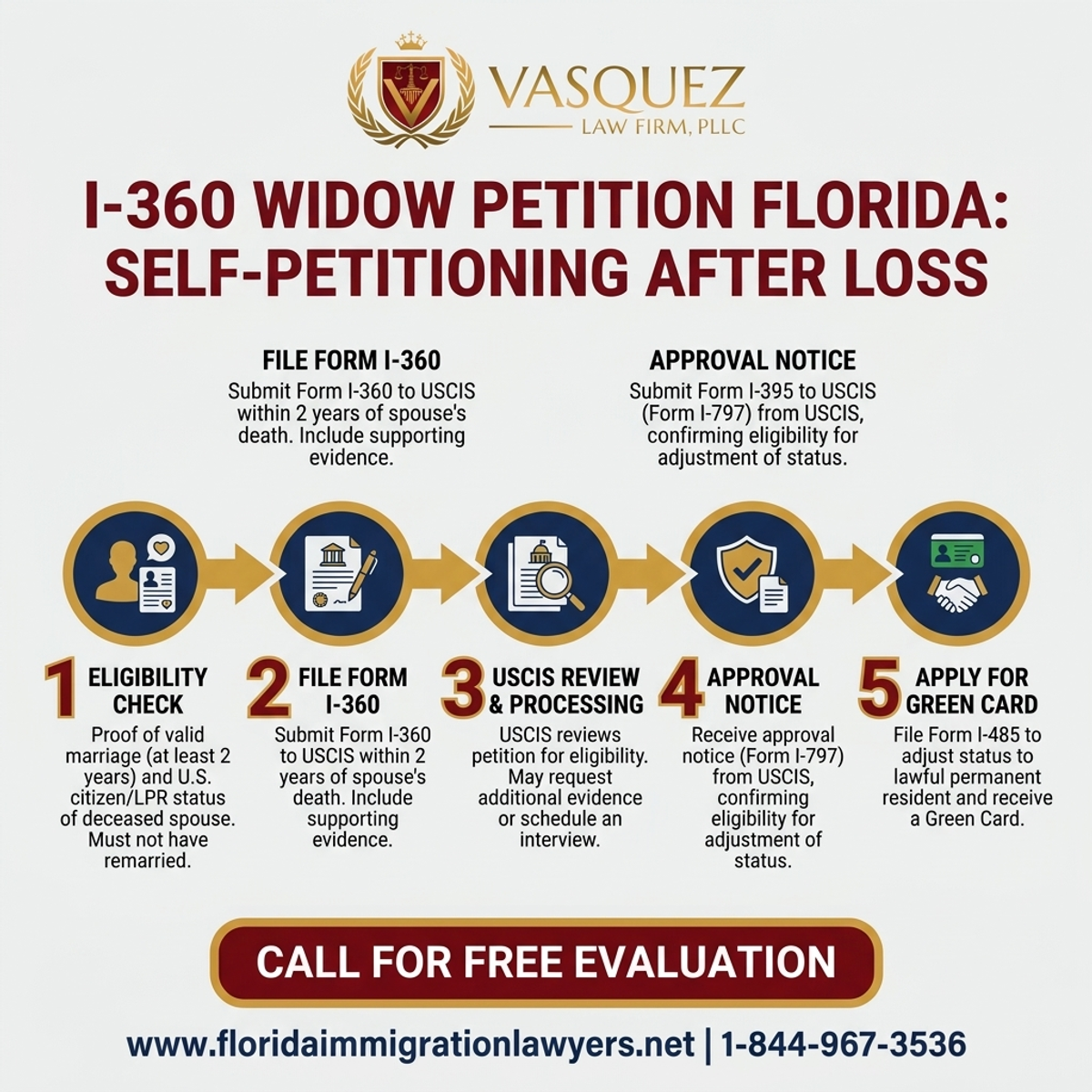
Step-by-Step Guide: Filing Your I-360 Widow Petition
Navigating the I-360 widow petition process can seem daunting, but breaking it down into manageable steps can help. Here is a general guide to help you understand what to expect. Each step requires careful attention to detail and accurate documentation, particularly for those in Florida seeking to ensure their future in the U.S.
-
Determine Eligibility and Gather Initial Documents: Before filing, ensure you meet all the criteria: U.S. citizen spouse, death within the last two years, good faith marriage, and no remarriage. Begin collecting essential documents such as your spouse's death certificate, your marriage certificate, and proof of your spouse's U.S. citizenship (e.g., birth certificate, naturalization certificate, U.S. passport). This foundational step is critical for a strong petition.
-
Complete Form I-360, Petition for Amerasian, Widow(er), or Special Immigrant: Fill out the form accurately and completely. Pay close attention to sections requesting details about your marriage, your deceased spouse, and your children (if any). Any inconsistencies or omissions can lead to delays or requests for evidence. Ensure you select the correct category for a widow(er) self-petition.
-
Compile Supporting Evidence for a Bona Fide Marriage: This is arguably the most crucial part. Gather extensive evidence proving your marriage was genuine. This includes joint financial records (bank statements, tax returns), shared property deeds or leases, utility bills in both names, insurance policies, birth certificates of children born to the marriage, photographs, and affidavits from people who knew you as a couple. The more comprehensive your evidence, the stronger your case.
-
File Your Petition with USCIS: Mail the completed Form I-360, all supporting documents, and the required filing fee to the appropriate USCIS Lockbox facility. The filing location depends on where you reside. For Florida residents, this will typically be a lockbox in Chicago or Dallas, as specified in the Form I-360 instructions. Always make copies of everything you send for your records. You can find detailed filing instructions and addresses on the official USCIS website.
Step-by-Step Process — I-360 Widow Petition Florida: Self-Petitioning After Loss
-
Respond to Requests for Evidence (RFEs) or Notices of Intent to Deny (NOIDs): After filing, USCIS may send an RFE if they need more information or clarification. A NOID indicates they intend to deny your petition unless you provide compelling contrary evidence. Responding thoroughly and on time is vital. This is often where legal counsel from Florida Immigration Lawyers proves indispensable, as crafting a strong response requires deep legal knowledge.
-
Attend an Interview (If Required): While many I-360 widow petitions are approved without an interview, USCIS reserves the right to schedule one. If an interview is required, it will typically be at a local USCIS field office, such as the one in Orlando or Miami, Florida. Be prepared to answer questions about your marriage and provide original documents.
-
Adjustment of Status or Consular Processing: If your I-360 is approved, you can then apply for a green card. If you are in the U.S., you'll typically file Form I-485, Application to Register Permanent Residence or Adjust Status. If you are outside the U.S., you will go through consular processing at a U.S. embassy or consulate abroad via the Department of State. Our firm can assist with either pathway to ensure a seamless transition to lawful permanent residency.
Essential Documents for Your I-360 Self-Petition
Assembling a complete and accurate set of documents is critical for a successful I-360 widow petition. Missing or incorrect documentation is a common reason for delays, RFEs, or even denials. Be prepared to provide both original documents (which will be returned) and copies as requested by USCIS. When working with Florida Immigration Lawyers, we help you organize and present your evidence effectively.
Here is a comprehensive checklist of documents you will typically need:
- Form I-360, Petition for Amerasian, Widow(er), or Special Immigrant: The completed and signed form itself.
- Copy of your U.S. citizen spouse's death certificate: This is proof of their passing and the date.
- Copy of your marriage certificate: Proving the legal validity of your marriage.
- Proof of your deceased spouse's U.S. citizenship: This could be a copy of their U.S. birth certificate, naturalization certificate, or U.S. passport.
- Proof of your identity: Copy of your passport, birth certificate, or other government-issued ID.
- Evidence of a bona fide marriage: This is the most extensive part and may include:
- Joint bank account statements.
- Joint tax returns (IRS transcripts preferred).
- Copies of deeds or leases showing joint ownership or tenancy of property.
- Utility bills in both names at the same address.
- Life insurance policies, wills, or trusts naming each other as beneficiaries.
- Affidavits from friends, family, and employers attesting to the legitimacy of your marriage.
- Photographs of you and your spouse together, with family and friends, over time.
- Birth certificates of children born to you and your deceased spouse.
- Travel itineraries or tickets showing trips taken together.
- Correspondence (letters, emails, texts) between you and your spouse.
- Copies of any previous divorce decrees or death certificates: For both you and your deceased spouse, proving the termination of any prior marriages.
- If applicable, birth certificates for any derivative children: To include them in your petition.
- Translations: Any documents not in English must be accompanied by a certified English translation.
Organizing these documents can be overwhelming, especially during a time of grief. Our team at Florida Immigration Lawyers is here to help you compile and present a robust application. We understand the specific requirements of the USCIS field offices in Florida and can ensure your petition is as strong as possible.
Processing Timelines and Expectations for I-360 Petitions
Understanding the processing timelines for an I-360 widow petition is crucial for managing expectations. Immigration processes are rarely quick, and the time it takes for USCIS to adjudicate petitions can vary significantly based on several factors, including the specific service center handling your case, the volume of applications, and the completeness of your initial submission. While there are no guarantees, typical processing times for Form I-360 can range from several months to over a year. You can check current processing times on the USCIS website by selecting Form I-360 and the appropriate service center.
After filing, you will first receive a Receipt Notice (Form I-797C) within a few weeks, confirming that USCIS has received your petition. This notice will also provide a receipt number, which you can use to track your case online. The next communication you might receive could be a Request for Evidence (RFE) or a Notice of Intent to Deny (NOID). Responding promptly and thoroughly to these is critical and can prevent further delays. Failing to respond or submitting insufficient evidence will almost certainly lead to a denial. For Florida residents, your case will be handled by one of the national service centers, not a local field office initially.
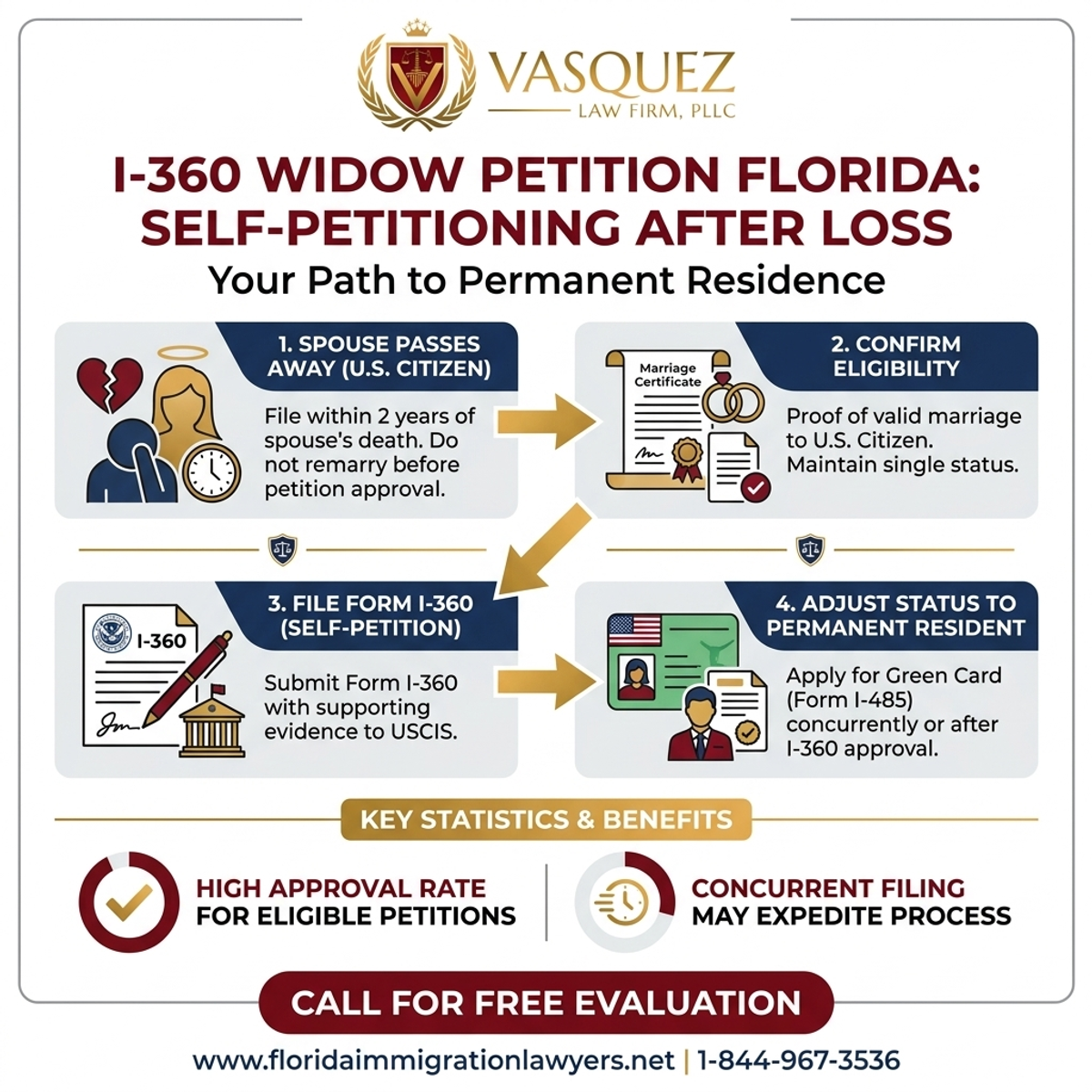
Key Statistics — I-360 Widow Petition Florida: Self-Petitioning After Loss
If your I-360 petition is approved, you will receive an Approval Notice (Form I-797). This signifies that USCIS has recognized you as an immediate relative. The next step depends on whether you are adjusting status within the U.S. or going through consular processing abroad. Adjustment of status (Form I-485) can add another several months to over a year, involving an interview at a local USCIS office in Florida (e.g., Miami, Orlando, Jacksonville) and potentially a medical exam. Consular processing, handled by the Department of State, also has its own timelines for visa interviews and issuance. Maintaining patience and having legal guidance from Florida Immigration Lawyers throughout this entire journey is key to navigating these complex timelines successfully.
Cost Factors and Fees for I-360 Widow Self-Petitions
Understanding the financial aspects of an I-360 widow petition is an important part of planning your immigration journey. The total cost involves several components, including government filing fees and potentially legal fees for attorney representation. It is crucial to note that government filing fees are set by USCIS and are subject to change. Always refer to the official USCIS website or Form I-360 instructions for the most current fee schedule.
Currently, there is no USCIS filing fee for Form I-360 when filed as a widow(er) of a U.S. citizen. This is a significant relief for many applicants experiencing financial hardship after a spouse's death. However, this waiver only applies to the I-360 itself. If you are adjusting status concurrently or subsequently, you will incur fees for Form I-485, Application to Register Permanent Residence or Adjust Status, as well as biometric services fees. There may also be fees for mandatory medical examinations, which must be performed by a USCIS-approved civil surgeon in Florida. These medical exams typically cost several hundred dollars, varying by provider.
Beyond government fees, legal fees for retaining an experienced immigration attorney are a significant consideration. While not mandatory, legal representation from Florida Immigration Lawyers can dramatically improve your chances of success and alleviate the stress of the process. Our firm offers transparent fee structures, often on a flat-fee basis for specific stages of the process, ensuring you understand the costs upfront. Legal fees cover services such as preparing the petition, compiling evidence, responding to RFEs, and preparing you for interviews. Investing in legal counsel can save you time, prevent costly mistakes, and provide peace of mind during an already difficult period. We encourage you to discuss your specific situation and our fee options during a free consultation.
Do not navigate this process alone. The complexities of immigration law, especially during a time of personal loss, can be overwhelming. Contact Florida Immigration Lawyers today to ensure your I-360 widow petition is handled with the experience and compassion you deserve. We serve clients across Florida, including Orlando, offering dedicated legal support.
Common Mistakes to Avoid in Your I-360 Widow Petition
Filing an I-360 widow petition is a detailed legal process where even small errors can lead to significant delays or outright denial. Being aware of common pitfalls can help you avoid them. Here are some of the most frequent mistakes applicants make:
-
Missing the Two-Year Filing Deadline: This is perhaps the most critical mistake. You must file Form I-360 within two years of your U.S. citizen spouse's death. Filing even one day late will result in denial, unless specific exceptions apply. Many people, overwhelmed by grief, miss this crucial window.
-
Insufficient Evidence of a Bona Fide Marriage: USCIS scrutinizes the legitimacy of the marriage. Failing to provide ample evidence of a good faith relationship (e.g., joint finances, shared residence, photos, affidavits) can lead to an RFE or denial. Simply submitting a marriage certificate is not enough.
-
Remarrying Before Filing the I-360: Any remarriage, even after your U.S. citizen spouse's death but before your I-360 is filed and approved, will disqualify you from this specific self-petition category. This rule is absolute.
-
Incorrectly Filling Out Form I-360: Errors, omissions, or inconsistencies on the form itself can trigger RFEs and significantly delay processing. Double-checking every section and ensuring all questions are answered accurately is vital.
-
Failing to Prove Spouse's U.S. Citizenship: You must provide clear, undeniable proof that your deceased spouse was a U.S. citizen at the time of death, not just a green card holder. A birth certificate or naturalization certificate is usually required.
-
Not Responding to RFEs or NOIDs on Time: If USCIS requests additional evidence or signals an intent to deny, you must respond comprehensively and within the specified deadline. Ignoring these notices or submitting inadequate responses can lead to an unfavorable decision.
-
Submitting Uncertified Translations: Any document not in English must be accompanied by a complete and certified English translation. Uncertified translations are not accepted and will result in an RFE.
-
Failing to Keep Copies of All Submitted Documents: Always make and keep copies of your entire petition package before mailing it to USCIS. This protects you in case documents are lost or if you need to reference them later.
-
Not Disclosing All Prior Marriages: You must disclose all previous marriages for both you and your deceased spouse, along with proof of their legal termination (divorce decrees, death certificates). Hiding this information can lead to severe penalties.
-
Attempting to Navigate the Process Without Legal Counsel: While not a legal requirement, the complexity of immigration law means that attempting to self-file without an attorney can significantly increase the risk of errors and denial. An experienced lawyer understands the nuances and can prevent common mistakes.
When to Call a Lawyer for Your I-360 Widow Petition
While the option to self-petition exists, the complexities of immigration law, coupled with the emotional toll of losing a spouse, make professional legal guidance highly advisable. Knowing when to call a lawyer for your I-360 widow petition can make a critical difference in the outcome of your case. Florida Immigration Lawyers are here to provide assistance, particularly in scenarios where the process might be more challenging.
You should consider contacting an attorney immediately if you are approaching the two-year filing deadline for your I-360 petition. Time is of the essence, and an attorney can help you quickly gather documents and prepare a robust application. If your marriage involved unusual circumstances, such as a short duration, a significant age difference, or if you and your spouse lived separately for periods, proving a bona fide marriage can be more difficult. An attorney can help you strategize and present compelling evidence to overcome potential scrutiny from USCIS, which operates field offices across Florida, including Miami, Orlando, and Jacksonville.
Furthermore, if you have any prior immigration history issues, such as previous visa overstays, denials, or removal proceedings (handled by the Executive Office for Immigration Review), an attorney's expertise is essential. These factors can complicate your eligibility and require specialized legal arguments. If you receive a Request for Evidence (RFE) or a Notice of Intent to Deny (NOID) from USCIS, it is a strong indicator that your case needs immediate legal intervention. Our lawyers are adept at crafting detailed, legally sound responses that address USCIS concerns effectively. Don't risk your future; let Florida Immigration Lawyers provide the peace of mind and professional representation you need for your family immigration journey.
About Florida Immigration Lawyers
At Florida Immigration Lawyers, we understand that navigating the U.S. immigration system can be one of the most challenging experiences of your life, especially when compounded by personal loss. As an immigration law firm serving all of Florida, including Hollywood, Miami, Orlando, and Tampa, we are dedicated to providing compassionate, effective, and results-oriented legal representation. Our team of experienced attorneys focuses on a wide array of immigration matters, including family-based petitions like the I-360 widow petition, asylum, deportation defense, citizenship, and business immigration.
We pride ourselves on our client-focused approach, ensuring that every individual receives personalized attention and strategic advice tailored to their unique circumstances. We are available 24/7 to address your urgent concerns and offer free consultations to help you understand your legal options without financial commitment. Our bilingual team, fluent in English and Spanish, ensures clear and comprehensive communication throughout your case. We are committed to upholding the highest standards of legal ethics and professionalism, advocating tirelessly for our clients' rights and futures in the United States. When you choose Florida Immigration Lawyers, you choose a partner dedicated to your success.
Sources and References
- U.S. Citizenship and Immigration Services (USCIS)
- Executive Office for Immigration Review (EOIR)
- U.S. Department of State
- 8 U.S.C. Chapter 12 - Immigration and Nationality Act (INA)
- INA Section 204(a)(1)(A)(ii) - Widowers of U.S. Citizens
- 8 CFR 204.2(b) - Petitions for widows or widowers of U.S. citizens
Related services: family petition process, family-based green cards, fiancé visa (K-1), marriage-based immigration.
This article provides general legal information and is not intended as legal advice. Every case is unique, and outcomes depend on specific facts and circumstances. Contact an attorney for advice about your particular situation.
Navigating the I-360 widow petition process requires not only a deep understanding of immigration law but also a compassionate approach to guide you through a difficult time. Florida Immigration Lawyers are here to offer that support and experience. Don't face this journey alone. Call us today at 1-844-YO-PELEO for a free, confidential consultation. Se Habla Espanol - Estamos aqui para ayudarle.
If you need legal assistance, learn more about family immigration lawyers in Florida, or call us at 1-844-YO-PELEO for a free consultation.
Do Not Navigate This Process Alone
Our experienced immigration attorneys are ready to fight for you. Get a free, confidential case review today.
Se Habla Español
Or leave your details and we’ll call you:
Free Evaluation in 24 Hours
Or talk to us right now
AI voice assistant — available 24/7
FreeFrequently Asked Questions

William J. Vásquez
Founding Attorney · Vasquez Law Firm
U.S. Air Force veteran and immigration attorney with years of hands-on U.S. immigration experience. J.D., NCCU School of Law. AILA member. Admitted to the 4th, 5th, and 11th Circuit Courts.
Available 24/7 - Free Evaluations
Reviewed for legal accuracy by William J. Vásquez
Licensed in North Carolina; U.S. immigration is federal practice.
Related Legal Services
Our Florida immigration attorneys can help you with deportation defense, family immigration services and immigration lawyer cost in Florida. Call today at 1-844-YO-PELEO for a free case review.
Related Links
Related Topics
Free Legal Case Review
Discuss your case with our experienced attorneys. We're available 24/7.
Se Habla Español - Estamos aquí para ayudarle.
Related Articles
DUI Immigration Consequences in Florida 2026
A DUI conviction in Florida can have severe immigration consequences, potentially leading to inadmissibility, deportation, or denial of immigration benefits. For non-citizens, a DUI is not just a traffic offense but a serious criminal matter that federal immigration law scrutinizes closely. Factors like multiple offenses, injury, or property damage can escalate a simple DUI to a Crime Involving Moral Turpitude (CIMT) or even an aggravated felony, triggering mandatory detention and removal proceedings. Understanding the specific nature of your Florida conviction and its interpretation under the Immigration and Nationality Act (INA) is crucial. This article outlines how DUIs impact immigration status, the grounds for inadmissibility and deportation, a step-by-step guide to navigating the process, essential documentation, and expected timelines for 2026. We also highlight common mistakes to avoid and when to seek legal counsel from an experienced immigration attorney. Florida Immigration Lawyers offers comprehensive support for individuals facing these challenging situations, providing expert guidance through complex legal landscapes.
Dual Citizenship Lawyer in Florida: What You Need to Know
For Florida residents, the concept of dual citizenship, or holding two passports, offers a compelling blend of opportunities and challenges. While the U.S. generally permits dual nationality, the path to achieving this status requires a meticulous understanding of both U.S. immigration laws and the citizenship policies of your country of origin. This guide explores the definition of dual citizenship, the detailed step-by-step process for U.S. naturalization, and the significant benefits and potential pitfalls involved. We cover essential documentation, typical timelines, and cost considerations for 2026, providing crucial insights for anyone in Orlando, Miami, or across Florida considering this important legal step. Learn about common mistakes to avoid and understand when to seek professional legal counsel to navigate this complex process successfully. Florida Immigration Lawyers is here to provide expert, bilingual support for your dual citizenship journey.
Immigration Lawyer Orlando Free Consultation in Florida
For individuals and families in Orlando, Florida, navigating the complexities of U.S. immigration law requires expert guidance. An immigration lawyer in Orlando offers crucial support for everything from visa applications and green card processes to naturalization and deportation defense. This comprehensive guide details what a free consultation covers, providing a step-by-step overview of immigration pathways, essential document checklists, and expected timelines in 2026. We also highlight common mistakes to avoid, discuss the critical role of legal counsel in deportation and asylum cases, and explain why choosing a local Orlando immigration attorney is beneficial. Florida Immigration Lawyers is dedicated to serving the diverse community of Orlando with compassionate, effective legal solutions, ensuring you receive personalized advice and robust representation for a successful immigration journey.
EAD Advance Parole Combo Card in Florida 2026
For individuals with a pending Form I-485, Application to Register Permanent Residence or Adjust Status, the EAD Advance Parole Combo Card is an essential document. This single card combines the authorization to work legally in the U.S. (Employment Authorization Document - EAD) with permission to travel internationally and re-enter without abandoning your green card application (Advance Parole). This guide from Florida Immigration Lawyers provides a comprehensive overview for applicants in Florida in 2026, covering eligibility, the step-by-step application process, required documents, expected processing times, and associated costs. We also highlight common mistakes to avoid and when to seek legal counsel to ensure a smooth and successful immigration journey. Understanding this vital card is key to maintaining stability while awaiting your permanent residency approval.