2026 H-4 & I-539 Processing Times for EAD Spouses
For H-4 dependent spouses in Florida, understanding H-4 EAD (Employment Authorization Document) eligibility and processing times is crucial for securing work authorization. This guide details the 2026 H-4 and I-539 processing times, particularly at the Texas Service Center, which can range from several months to over a year. We cover the specific requirements for H-1B spouses, a step-by-step application process, essential document checklists, and a breakdown of associated costs. Learn how to navigate the complexities, avoid common mistakes, and when to seek expert legal assistance from Florida Immigration Lawyers to ensure a smooth application journey for your H-4 EAD in Jacksonville and across Florida.

For 2026, H-4 and I-539 processing times, especially for H-4 EAD spouses, can vary significantly by USCIS service center and case complexity. While the Texas Service Center, among others, processes these applications, current estimates suggest timelines ranging from several months to over a year, particularly for form I-539 (Application to Extend/Change Nonimmigrant Status). An approved I-539 is often a prerequisite for H-4 EAD eligibility, making its processing crucial. It is essential for applicants in Florida to monitor official USCIS processing times and prepare comprehensive documentation to avoid delays.
- H-4 EAD eligibility requires the H-1B spouse to have an approved I-140 or be in specific per-country limit extensions.
- I-539 processing can directly impact H-4 EAD approval timelines.
- Applying concurrently for I-539 and I-765 (EAD) is common.
- Delays can occur due to RFE requests or service center backlogs.
- Consulting a Florida immigration lawyer is vital for navigating these complex processes.
Navigating the complex world of U.S. immigration law can feel overwhelming, especially when your family's future and ability to work are at stake. For many H-1B visa holders and their families in Florida, securing an H-4 EAD (Employment Authorization Document) for a spouse is a critical step towards financial stability and integration into American life. This work authorization allows eligible H-4 dependent spouses to pursue employment, contributing significantly to their household and the local economy, including vibrant areas like Jacksonville.
This comprehensive guide will break down everything you need to know about H-4 EADs in 2026, focusing on eligibility requirements, the application process, and crucial processing times for forms like I-539. We will delve into the specifics that impact families living in Florida, from understanding USCIS procedures to avoiding common pitfalls. Our goal is to provide clear, actionable information to help you and your family successfully secure H-4 work authorization. Do not navigate this intricate process alone; call Florida Immigration Lawyers at 1-844-YO-PELEO for a free consultation and personalized guidance today.
Understanding H-4 EAD Eligibility for Spouses in Florida
The H-4 EAD program offers a vital pathway for certain H-4 dependent spouses of H-1B nonimmigrants to obtain work authorization in the United States. This provision, established in 2015, recognizes the significant contributions of H-1B workers and aims to reduce the economic burden on their families. Eligibility is not automatic for all H-4 visa holders; specific conditions must be met by the primary H-1B visa holder.
As of 2026, the primary H-1B spouse must meet one of two key criteria. Firstly, they must be the principal beneficiary of an approved Form I-140, Immigrant Petition for Alien Worker. This indicates that their green card process has begun and is progressing. Secondly, the H-1B spouse must have been granted an extension of H-1B status under sections 106(a) and (b) of the American Competitiveness in the Twenty-first Century Act of 2000 (AC21). This typically applies to H-1B visa holders who are seeking extensions beyond the six-year limit due to per-country quota backlogs in their green card applications. Understanding these requirements is the first critical step for any H-4 spouse in Florida seeking work authorization.
It is important to note that the H-4 EAD is specifically for spouses. Children holding H-4 status are not eligible for this work authorization. Furthermore, the H-4 EAD is tied directly to the H-1B spouse's status. If the H-1B spouse loses their status or their I-140 is withdrawn, the H-4 EAD may be revoked or expire. This interdependence underscores the need for careful planning and continuous monitoring of both statuses. For families in Jacksonville, Orlando, or Miami, ensuring continuous eligibility is paramount for maintaining work authorization.
Key Requirements for H-4 EAD Application
- The H-1B principal must be the beneficiary of an approved Form I-140.
- Alternatively, the H-1B principal must have received an H-1B extension beyond the six-year limit under AC21.
- The H-4 applicant must maintain valid H-4 nonimmigrant status.
- The application must include proof of the H-1B spouse's status and eligibility.
- All required forms, including Form I-765 and often Form I-539, must be correctly filed.
2026 Texas Service Center I-539 H-4 Processing Time Months: What to Expect
As of 2026, processing times for Form I-539 (Application to Extend/Change Nonimmigrant Status) for H-4 dependents at the Texas Service Center, and other USCIS service centers, can range from approximately 6 to 18 months, or even longer in some complex cases. These estimates are fluid and subject to change based on application volume, staffing levels, and policy updates. It is crucial to check the official USCIS website for the most current processing times.
The I-539 form is often filed concurrently with Form I-765 (Application for Employment Authorization) for H-4 EAD applicants. An H-4 spouse typically needs an approved I-539 to extend their H-4 status before their EAD can be approved, unless they are applying for an initial EAD concurrently with an H-4 change of status. Delays in I-539 processing can directly impact the ability to obtain or renew an H-4 EAD, leading to potential gaps in employment authorization for H-4 spouses in Florida. USCIS has made efforts to streamline processing, but backlogs persist. For instance, the Executive Office for Immigration Review (EOIR) also faces its own backlogs, which can indirectly affect overall immigration processes.
The Texas Service Center is one of several USCIS centers responsible for processing these applications. Other centers, such as the California Service Center, also handle I-539 and I-765 forms. Processing times can vary significantly between centers, so it is important to know which center is handling your case. The receipt notice (Form I-797C) will indicate the service center. Applicants should monitor the USCIS website's 'Check Case Status' tool regularly. For families in Florida, understanding these timelines is essential for planning their professional and personal lives.
Factors Influencing Processing Times
- Service Center Workload: High volumes of applications at a specific center can cause delays.
- Application Completeness: Incomplete applications or those requiring a Request for Evidence (RFE) will experience significant delays.
- Policy Changes: New immigration policies or regulations can impact processing speeds across the board.
- Biometrics Appointments: I-539 applications typically require a biometrics appointment, which adds a step to the timeline.
- Concurrent Filings: Filing I-539 and I-765 together can sometimes expedite processing or at least ensure they move through the system in tandem.
Step-by-Step Guide to Applying for H-4 EAD in Florida
Applying for an H-4 EAD involves several critical steps, requiring meticulous attention to detail and a thorough understanding of USCIS requirements. For H-4 spouses in Florida, following this guide carefully can help streamline the process and minimize potential delays.
-
Determine Eligibility: First, confirm that the H-1B principal spouse meets the eligibility criteria (approved I-140 or AC21 extension). Gather all supporting documents related to the H-1B spouse's status, including their I-797 approval notices and I-140 approval notice if applicable. This foundational step is crucial before proceeding.
-
Complete Form I-765, Application for Employment Authorization: This is the primary form for the H-4 EAD. Fill out Form I-765 accurately and completely. Ensure you select the correct eligibility category, which for H-4 EAD is typically (c)(26). Any errors or omissions can lead to RFEs or even denial. Pay close attention to all sections.
-
Complete Form I-539, Application to Extend/Change Nonimmigrant Status (if necessary): If your H-4 status is expiring soon or has already expired, you will need to file Form I-539 to extend your H-4 nonimmigrant status. This form is often filed concurrently with Form I-765. Ensure all family members included in the I-539 are listed correctly. This step is vital for maintaining continuous legal status.
-
Gather Supporting Documentation: Collect all necessary documents for both forms. This includes copies of passports, visas, I-94 records, marriage certificates, birth certificates, H-1B approval notices (I-797), I-140 approval notice (if applicable), and previous EAD cards. For Florida residents, having notarized translations of foreign documents is crucial. Ensure all copies are clear and legible.
-
Pay Filing Fees: As of 2026, there are separate filing fees for Form I-765 and Form I-539. These fees are subject to change by USCIS. You can pay by money order, personal check, cashier's check, or by credit card using Form G-1450, Authorization for Credit Card Transactions. Verify the current fees on the USCIS website before submitting. Do not send cash.
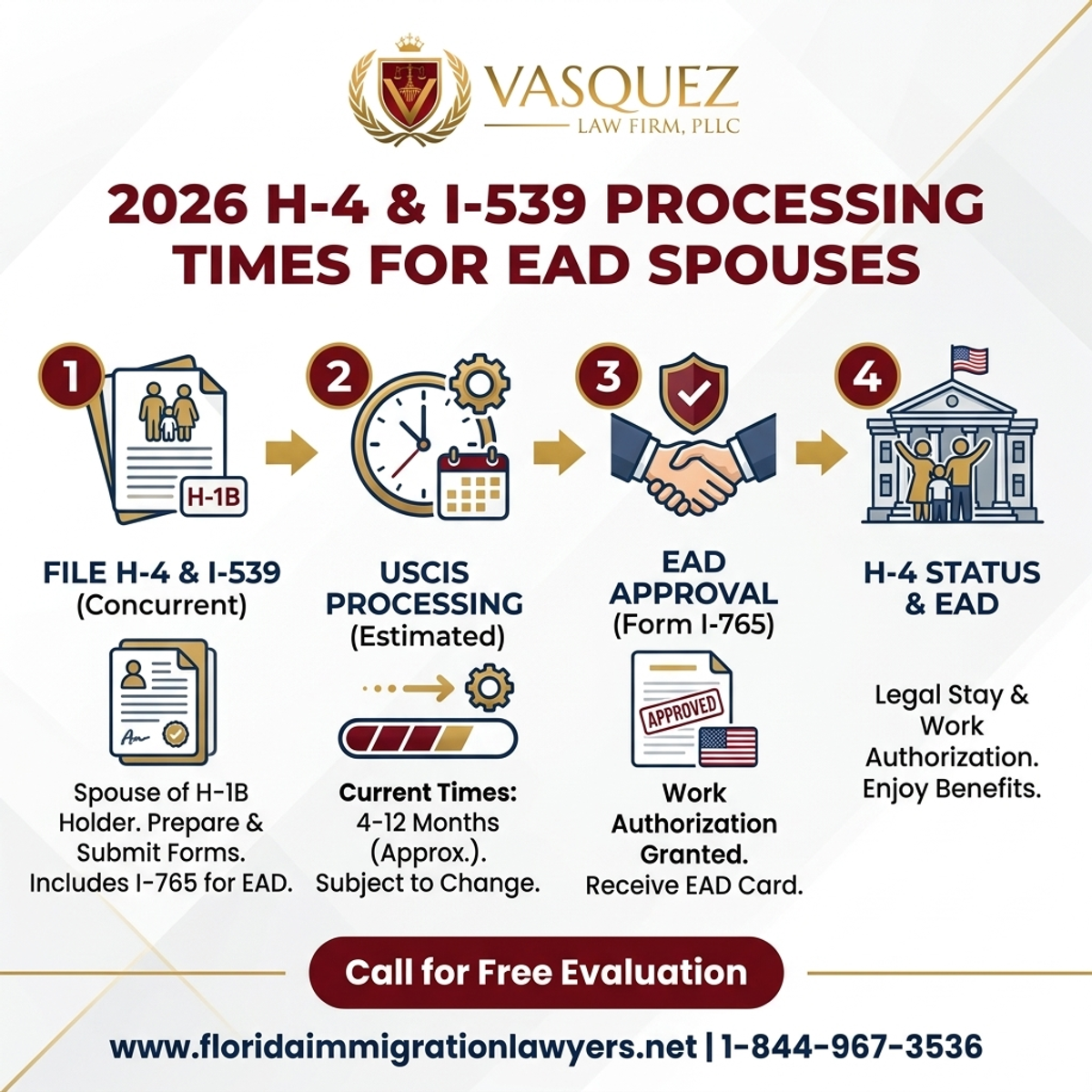
Step-by-Step Process — 2026 H-4 & I-539 Processing Times for EAD Spouses
-
Mail the Application Package: Send the completed forms and all supporting documents to the correct USCIS Lockbox facility. The filing address depends on the forms you are filing and where you reside. For most Florida residents, the filing address will be listed on the USCIS website for Forms I-765 and I-539. Use a traceable mailing service for proof of submission.
-
Attend Biometrics Appointment (if required): After filing Form I-539, USCIS will send an appointment notice for biometrics (fingerprints and photo) at an Application Support Center (ASC). Failure to attend this appointment can lead to denial. For applicants in Florida, the closest ASC might be in Jacksonville, Orlando, or Miami, depending on your address. Be sure to bring the appointment notice and a valid photo ID.
-
Monitor Case Status: Use the receipt number provided by USCIS to track your application's status online via the USCIS website's 'Case Status Online' tool. Be prepared to respond promptly to any Requests for Evidence (RFEs) or other notices from USCIS. This proactive monitoring is key to a smooth process.
Essential Document Checklist for H-4 EAD Applicants
A complete and accurate submission of documents is paramount for a successful H-4 EAD application. Missing or incorrect documents are a leading cause of delays, RFEs (Requests for Evidence), and even denials. This checklist outlines the essential documents you will need to prepare for your application.
- Completed Form I-765, Application for Employment Authorization (signed and dated).
- Completed Form I-539, Application to Extend/Change Nonimmigrant Status (if extending H-4 status, signed and dated).
- Copies of the H-4 applicant's most recent I-94 Arrival/Departure Record.
- Copies of the H-4 applicant's passport (biographic page, visa stamp, and entry stamp).
- Copies of the H-4 applicant's previous H-4 approval notices (Form I-797, if applicable).
- Copy of the H-4 applicant's marriage certificate (with certified English translation if not in English).
- Copies of the H-1B principal's most recent I-94 Arrival/Departure Record.
- Copies of the H-1B principal's passport (biographic page, visa stamp, and entry stamp).
- Copies of the H-1B principal's current and previous H-1B approval notices (Form I-797).
- Copy of the H-1B principal's approved Form I-140, Immigrant Petition for Alien Worker (if applicable).
- If H-1B status was extended under AC21, documentation demonstrating such extension.
- Two identical passport-style photos of the H-4 applicant taken within 30 days of filing.
- Copy of previous EAD card (front and back), if renewing.
- Filing fee for Form I-765 (check or money order payable to 'U.S. Department of Homeland Security').
- Filing fee for Form I-539 (if applicable, separate check or money order).
- Form G-1450, Authorization for Credit Card Transactions (if paying by credit card).
H-4 EAD Processing Timeline and Expectations in Florida (2026)
Understanding the typical timeline for H-4 EAD applications is crucial for planning your life and career in Florida. While USCIS processing times fluctuate, this table provides a general overview of what applicants can expect as of 2026. These estimates are based on current trends and may vary based on the specific service center and individual case factors.
| Stage | Typical Timeframe (2026) | Notes |
|---|---|---|
| Application Preparation | 2-4 weeks | Gathering documents, completing forms, obtaining translations. |
| USCIS Receipt Notice (I-797C) | 1-3 weeks after filing | Confirmation that USCIS has received your application. |
| Biometrics Appointment (for I-539) | 3-8 weeks after receipt | Scheduled at a local Application Support Center (ASC) in Florida. |
| I-539 Processing (H-4 Extension/Change of Status) | 6-18+ months | Varies significantly by service center. Can be filed concurrently with I-765. |
| I-765 Processing (H-4 EAD) | 6-18+ months | Often processed concurrently with I-539. Approval depends on H-4 status approval. |
| EAD Card Delivery | 1-2 weeks after approval | Once approved, the EAD card is mailed to the applicant's address. |
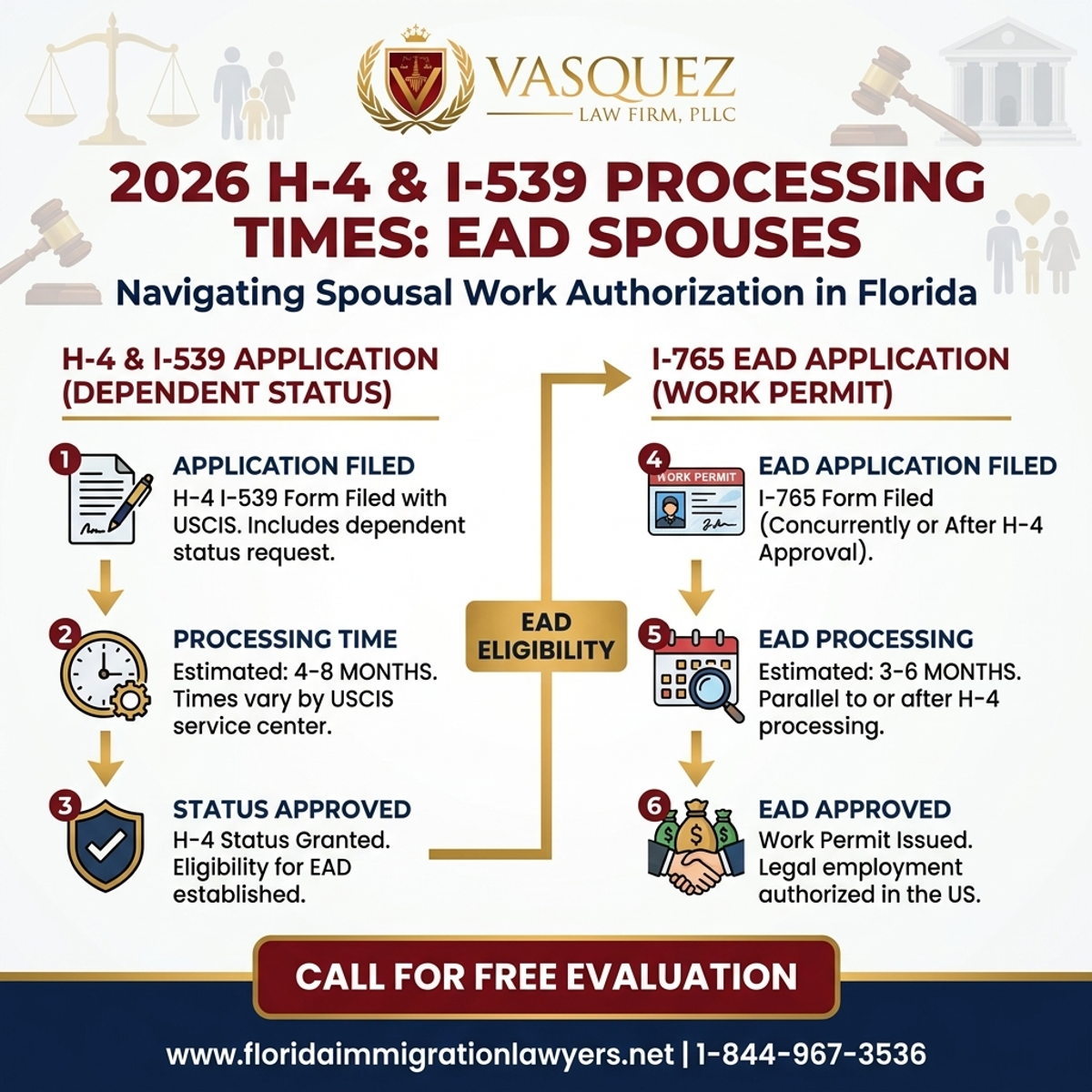
Key Statistics — 2026 H-4 & I-539 Processing Times for EAD Spouses
It is important to manage expectations regarding these timelines. USCIS processing can be unpredictable, and external factors, such as government shutdowns or increased application volumes, can cause further delays. For those facing expiring EADs, it is highly recommended to file for renewal at least 6 months before expiration to minimize potential gaps in work authorization. Florida Immigration Lawyers can help track your case and advise on proactive steps to take.
Cost Factors and Fee Breakdown for H-4 EAD Applications
Understanding the financial aspects of applying for an H-4 EAD is an important part of the planning process. The total cost typically involves USCIS filing fees and potential legal fees. These fees are subject to change, so always verify the most current amounts on the official USCIS website before submitting your application. As of 2026, the general breakdown is as follows:
| Item | Typical Fee (2026) | Notes |
|---|---|---|
| Form I-765 (EAD Application) | USCIS Filing Fee | Required for all H-4 EAD applicants. Check USCIS website for current amount. |
| Form I-539 (H-4 Extension/Change of Status) | USCIS Filing Fee | Required if extending H-4 status. Check USCIS website for current amount. Includes biometrics fee. |
| Legal Consultation & Representation | Varies by firm | Highly recommended for complex cases, RFEs, or to ensure accuracy. Florida Immigration Lawyers offers free consultations. |
| Translations & Notarizations | Varies | If documents are not in English, certified translations are required. |
| Passport Photos | Minor cost | Two identical passport-style photos are needed. |
| Postage/Shipping | Minor cost | Using a trackable mailing service is advisable. |
It is important to budget for both the government filing fees and potential legal costs. While legal representation is an additional expense, the expertise of an immigration attorney can save significant time and stress, and help prevent costly errors that could lead to delays or denials. For families in Florida, particularly in areas like Jacksonville where immigration services are in demand, having a clear understanding of these costs upfront is beneficial. Florida Immigration Lawyers provides transparency in our fee structures and offers a free initial consultation to discuss your specific needs without obligation.
Do not navigate this process alone. Contact Florida Immigration Lawyers today at 1-844-YO-PELEO for a free consultation to discuss your H-4 EAD application and ensure a smooth process.
Common Mistakes to Avoid in Your H-4 EAD Application
Applying for an H-4 EAD involves detailed forms and strict requirements. Even minor errors can lead to significant delays, Requests for Evidence (RFEs), or even denial of your application. Avoiding these common mistakes can save you time, stress, and money.
-
Failing to Check H-1B Eligibility: One of the most frequent errors is applying for an H-4 EAD when the H-1B principal spouse does not meet the core eligibility criteria (approved I-140 or AC21 extension). Always confirm this first. Consequences: Automatic denial of the I-765.
-
Incorrectly Filling Out Forms: Missing signatures, incorrect dates, or choosing the wrong eligibility category on Form I-765 (e.g., not (c)(26)) are common. Incomplete sections or illegible handwriting can also cause issues. Consequences: RFE, rejection of application, or significant delays.
-
Submitting Incomplete Documentation: Failing to include copies of essential documents like marriage certificates, H-1B approval notices, or I-94 records will lead to an RFE. Not providing certified translations for foreign language documents is also a common oversight. Consequences: Delays, RFE, or potential denial.
-
Incorrect Filing Fees: Sending the wrong fee amount, an expired check, or an incorrectly addressed payment can lead to the rejection of your entire package. USCIS fees change periodically. Consequences: Application rejection, requiring refiling and further delays.
-
Ignoring Biometrics Appointments: If you filed Form I-539, you will receive a biometrics appointment notice. Failing to attend this appointment without rescheduling can result in the denial of your I-539 and, consequently, your I-765. Consequences: Denial of H-4 status extension and EAD.
-
Failing to Renew in Time: For renewals, waiting until your current EAD is about to expire can lead to gaps in employment authorization. USCIS recommends filing at least 180 days before expiration. Consequences: Loss of work authorization, potential job loss, and loss of income.
-
Providing Outdated Information: Submitting old versions of forms or documents that are no longer valid (e.g., an expired passport) can cause problems. Always use the most current forms from the USCIS website. Consequences: RFE or rejection.
-
Not Keeping Copies of Everything: It is crucial to make and keep a complete copy of your entire application package before mailing it. This includes all forms, documents, and proof of payment. Consequences: Inability to respond accurately to RFEs or reconstruct your application if lost.
-
Assuming Automatic Approval: Even if you meet all criteria, approval is not guaranteed. The process requires careful attention at every step. Consequences: Unrealistic expectations leading to stress and lack of preparedness for potential issues.
-
Not Updating Address with USCIS: If you move after filing, you must notify USCIS of your new address promptly. Failure to do so means you might miss important notices, including RFEs or approval notices. Consequences: Missed deadlines, application abandonment, or denial.
-
Misunderstanding Concurrent Filings: While often recommended, concurrent filing of I-539 and I-765 does not guarantee they will be processed together or at the same speed. Understand that I-539 approval is usually a prerequisite for I-765 approval. Consequences: EAD approval delayed pending H-4 status approval.
-
Not Seeking Legal Counsel: Attempting to navigate the complex H-4 EAD application process without professional legal advice, especially with unique circumstances or previous immigration issues, can be a major mistake. Consequences: Increased risk of errors, delays, or denial due to lack of expertise.
When to Call a Florida Immigration Lawyer for H-4 EAD Assistance
While this guide provides comprehensive information, the H-4 EAD application process can be intricate and fraught with potential challenges. There are specific scenarios where the expertise of a seasoned Florida immigration lawyer becomes invaluable, ensuring your application is handled efficiently and accurately. Florida Immigration Lawyers are here to assist you through every step.
You should consider contacting an attorney if your H-1B spouse's eligibility is complex, such as unusual AC21 extensions, or if there are any doubts about the approved I-140 status. If you have a history of immigration issues, past denials, or concerns about maintaining your H-4 status, a lawyer can assess your situation and advise on the best course of action. Furthermore, if you receive a Request for Evidence (RFE) from USCIS, a lawyer can help you understand the request and prepare a robust response, significantly increasing your chances of approval. Navigating an RFE alone can be daunting and often leads to further complications.
For those facing expiring H-4 status or EADs, especially with current processing delays, an attorney can help strategize timely renewals and address potential gaps in employment authorization. If you are experiencing unusually long processing times, beyond the published USCIS estimates, a lawyer can inquire with USCIS on your behalf. Our firm, Florida Immigration Lawyers, offers comprehensive services for H-4 EAD applications, including initial eligibility assessments, meticulous document preparation, RFE responses, and ongoing case monitoring. We serve clients across Florida, including Orlando, providing peace of mind during this critical process. Our team is well-versed in the latest immigration policies and can offer tailored advice for your unique situation.
About Florida Immigration Lawyers
Florida Immigration Lawyers is a leading law firm dedicated to providing exceptional immigration legal services across the entire state of Florida. With a deep understanding of U.S. immigration law and a commitment to our clients, we strive to achieve the best possible outcomes for individuals, families, and businesses navigating the complex immigration system. Our team of experienced attorneys offers personalized attention and strategic advice, ensuring that every case is handled with the utmost care and professionalism.
We specialize in a broad range of immigration matters, including family-based petitions, employment visas, asylum claims, deportation defense, and naturalization. Our firm is proud to offer bilingual services, with a dedicated team fluent in English and Spanish, ensuring clear communication and culturally sensitive representation. We understand the unique challenges faced by immigrant communities in Florida, from Jacksonville to Miami, and are passionate about protecting their rights and helping them achieve their American dreams. At Florida Immigration Lawyers, we are available 24/7 to answer your questions and provide support. We offer free, no-obligation consultations to discuss your case and explore your legal options.
Sources and References
- U.S. Citizenship and Immigration Services (USCIS)
- USCIS Processing Times
- USCIS Form I-765, Application for Employment Authorization
- Executive Office for Immigration Review (EOIR)
- 8 U.S.C. § 1101 et seq. - Immigration and Nationality Act (INA)
- 8 CFR § 274a.12(c)(26) - Classes of aliens authorized to work (H-4 EAD)
- American Competitiveness in the Twenty-first Century Act of 2000 (AC21)
Related services: family petition process, family-based green cards, fiancé visa (K-1), marriage-based immigration.
This article provides general legal information and is not intended as legal advice. Every case is unique, and outcomes depend on specific facts and circumstances. Contact an attorney for advice about your particular situation.
Ready to take the next step towards securing your H-4 EAD? Do not leave your future to chance. Contact Florida Immigration Lawyers today at 1-844-YO-PELEO for a free consultation. Se Habla Español - Estamos aquí para ayudarle.
If you need legal assistance, learn more about our family immigration services, or call us at 1-844-YO-PELEO for a free consultation.
Do Not Navigate This Process Alone
Our experienced immigration attorneys are ready to fight for you. Get a free, confidential case review today.
Se Habla Español
Or leave your details and we’ll call you:
Free Evaluation in 24 Hours
Or talk to us right now
AI voice assistant — available 24/7
FreeFrequently Asked Questions

William J. Vásquez
Founding Attorney · Vasquez Law Firm
U.S. Air Force veteran and immigration attorney with years of hands-on U.S. immigration experience. J.D., NCCU School of Law. AILA member. Admitted to the 4th, 5th, and 11th Circuit Courts.
Available 24/7 - Free Evaluations
Reviewed for legal accuracy by William J. Vásquez
Licensed in North Carolina; U.S. immigration is federal practice.
Related Legal Services
Our Florida immigration attorneys can help you with deportation defense, family immigration services and immigration lawyer cost in Florida. Call today at 1-844-YO-PELEO for a free case review.
Related Links
Related Topics
Free Legal Case Review
Discuss your case with our experienced attorneys. We're available 24/7.
Se Habla Español - Estamos aquí para ayudarle.
Related Articles
EAD Advance Parole Combo Card in Florida 2026
For individuals with a pending Form I-485, Application to Register Permanent Residence or Adjust Status, the EAD Advance Parole Combo Card is an essential document. This single card combines the authorization to work legally in the U.S. (Employment Authorization Document - EAD) with permission to travel internationally and re-enter without abandoning your green card application (Advance Parole). This guide from Florida Immigration Lawyers provides a comprehensive overview for applicants in Florida in 2026, covering eligibility, the step-by-step application process, required documents, expected processing times, and associated costs. We also highlight common mistakes to avoid and when to seek legal counsel to ensure a smooth and successful immigration journey. Understanding this vital card is key to maintaining stability while awaiting your permanent residency approval.
Immigration Lawyer Orlando Free Consultation in Florida
For individuals and families in Orlando, Florida, navigating the complexities of U.S. immigration law requires expert guidance. An immigration lawyer in Orlando offers crucial support for everything from visa applications and green card processes to naturalization and deportation defense. This comprehensive guide details what a free consultation covers, providing a step-by-step overview of immigration pathways, essential document checklists, and expected timelines in 2026. We also highlight common mistakes to avoid, discuss the critical role of legal counsel in deportation and asylum cases, and explain why choosing a local Orlando immigration attorney is beneficial. Florida Immigration Lawyers is dedicated to serving the diverse community of Orlando with compassionate, effective legal solutions, ensuring you receive personalized advice and robust representation for a successful immigration journey.
STEM OPT Extension Immigration Lawyer: Florida 2026 Guide
For F-1 students in Florida with STEM degrees, the 24-month Optional Practical Training (OPT) extension is a critical step towards building a career in the U.S. This comprehensive guide covers everything from eligibility requirements and the step-by-step application process to essential documentation, processing timelines, and associated costs as of 2026. We delve into specific challenges faced by Florida graduates, such as navigating E-Verify employers and understanding evolving federal policies. Learn how to avoid common mistakes that can jeopardize your application, like late filing or incomplete paperwork. Discover when it's crucial to consult an experienced STEM OPT extension immigration lawyer to ensure your application is robust and compliant, protecting your F-1 status and future in Florida. Florida Immigration Lawyers offers expert guidance and free case reviews to help you succeed.
Citizenship Delay in Florida: N-400 Processing Times 2026
Deciding to apply for U.S. citizenship is a significant milestone for many in Florida, often for family reasons. However, the path to naturalization can sometimes be hindered by unexpected delays in N-400 processing. Factors such as increased USCIS caseloads, administrative processing requirements, and individual application complexities contribute to these citizenship delays. As of 2026, applicants in Florida's busy field offices, including Orlando and Miami, may experience varying processing times. This comprehensive guide from Florida Immigration Lawyers explores the common causes of these delays, provides insight into current N-400 processing times, and outlines actionable steps to address prolonged waits. We cover essential documentation, potential costs, and crucial mistakes to avoid, all designed to help you navigate the system effectively. If you are facing a citizenship delay or have questions about your naturalization application, our experienced attorneys are available 24/7 for a free case review.