H-2A Visa Guide for Florida Agricultural Workers | VLF Flori
Explore how the H-2A visa supports Florida's agricultural sector, especially in St. Petersburg. Learn the application process, common mistakes, and when to seek legal aid.

- H-2A visas are for temporary agricultural workers.
- Florida's climate requires year-round farm labor.
- St. Petersburg growers benefit significantly from H-2A workers.
Introduction
In sunny St. Petersburg, Florida, agriculture remains a crucial part of the economy. With the H-2A visa program, local growers can meet their labor needs by hiring foreign workers temporarily. This blog explores everything from eligibility to application processes for the H-2A visa, focusing on the unique aspects of farming in Florida. Call Florida Immigration Lawyers at 1-844-967-3536 for a free consultation.
Florida's agricultural landscape is incredibly diverse, supporting a wide array of crops that contribute billions to the state's economy annually. From citrus groves to vegetable farms and nurseries, the demand for skilled and dedicated labor is constant, often peaking during harvest seasons. The H-2A program acts as a vital bridge, connecting Florida's growers with the workforce necessary to cultivate, harvest, and process these essential crops, especially when domestic labor is scarce.
Specifically in regions like St. Petersburg and surrounding areas, growers face unique challenges and opportunities. The favorable climate allows for multiple growing cycles, intensifying the need for a reliable and flexible workforce throughout the year. Understanding the intricacies of the H-2A visa is not just about compliance; it's about ensuring the continuity and profitability of agricultural operations that feed the nation. Our team at Florida Immigration Lawyers is dedicated to helping you navigate this complex process, ensuring your farm's success.
Understanding the H-2A Visa Program
The H-2A visa allows U.S. agricultural employers to hire foreign workers for temporary agricultural jobs. This visa is critical for Florida, where the agriculture industry thrives year-round due to its favorable climate. The U.S. Department of Agriculture highlights the importance of this program, noting Florida's dependence on seasonal workers to sustain its agricultural output.
Florida's diverse crops, from oranges to tomatoes, require different types of labor throughout the year. The H-2A visa helps address labor shortages, ensuring that farms can operate efficiently during peak seasons.
The "temporary" nature of the H-2A visa is a key distinction. It's designed for jobs that are either seasonal, peakload, intermittent, or one-time occurrences, meaning the employer typically would not need the workers year-round. However, Florida's unique agricultural calendar often means that while specific crop cycles are temporary, the overall need for H-2A workers across different crops can be continuous. This distinction requires careful planning and adherence to Department of Labor (DOL) regulations to ensure proper certification and avoid potential issues.
Beyond meeting immediate labor needs, the H-2A program plays a significant role in the economic stability of Florida's rural communities. It allows growers to maintain competitive pricing for their produce, supports related industries such as transportation and processing, and helps prevent crop loss due to insufficient labor. For St. Petersburg growers, leveraging the H-2A program means securing their harvest and contributing to the broader economic health of the region. Florida Immigration Lawyers assists employers in understanding these broader implications and structuring their H-2A petitions effectively.
Step-by-Step Guide to Applying for an H-2A Visa
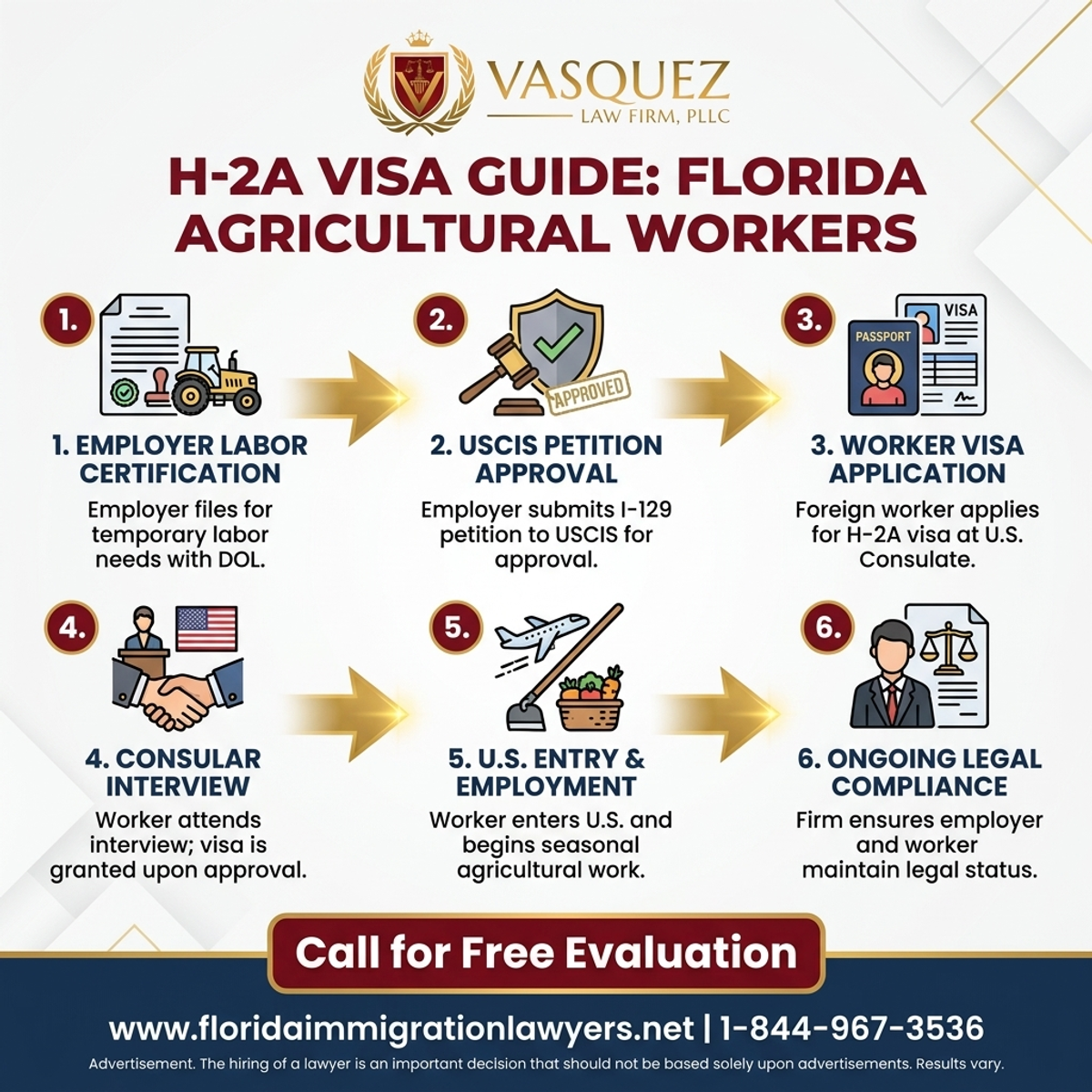
- Employer Application: The employer must first file Form I-129 with the USCIS and obtain a temporary labor certification from the Department of Labor.
- Recruitment: Employers must demonstrate efforts to recruit U.S. workers before hiring foreign nationals.
- Visa Application: Prospective workers apply for the H-2A visa at a U.S. consulate abroad.
- Entry to U.S.: Once approved, workers can enter the U.S. for the duration of their contract.
- Return Home: Upon contract completion, workers must return to their home country.
Step-by-Step Process — H-2A Visa Guide for Florida Agricultural Workers
The initial step of obtaining a temporary labor certification from the Department of Labor (DOL) is often the most intricate. It requires employers to clearly define the job duties, wages, and working conditions, and to attest that there are not enough U.S. workers who are able, willing, qualified, and available to perform the temporary agricultural labor. This certification is a prerequisite for filing Form I-129, Petition for a Nonimmigrant Worker, with U.S. Citizenship and Immigration Services (USCIS).
Recruitment efforts are thoroughly scrutinized by the DOL. Employers must advertise the job opportunity in various venues, including state workforce agencies and local newspapers, to ensure U.S. workers have a fair chance to apply. Documenting these efforts meticulously is crucial, as any perceived failure to recruit domestically can lead to delays or denial of the labor certification. This phase often benefits significantly from the guidance of an experienced immigration law firm like Florida Immigration Lawyers, who can help ensure all requirements are met.
Once the labor certification and USCIS petition are approved, the focus shifts to the individual workers. They must apply for their H-2A visas at a U.S. embassy or consulate in their home country. This involves interviews, biometric data collection, and demonstrating their intent to return home after their contract. The entire process, from initial DOL filing to workers' entry into the U.S., demands precision and foresight, highlighting why many Florida growers choose to partner with legal experts to streamline their H-2A applications.
Document Checklist for H-2A Visa Applicants
- Valid passport
- Form DS-160 confirmation page
- Receipt of visa fee payment
- Proof of employment (contract or offer letter)
- Temporary Labor Certification
Beyond the basic checklist, it's vital for applicants to understand the significance of each document. A valid passport is not just a travel document; it verifies identity and nationality. The Form DS-160, the Online Nonimmigrant Visa Application, must be completed accurately and thoroughly, as any discrepancies can lead to delays or even refusal. Ensuring all visa fee payments are properly documented with receipts is also critical for a smooth application process.
The proof of employment, typically a detailed contract or offer letter, is perhaps the most important document for the worker. It outlines the terms and conditions of their temporary agricultural employment, including wages, job duties, duration, and housing arrangements. This document must align perfectly with the Temporary Labor Certification approved by the Department of Labor, which the employer provides. Any inconsistencies can raise red flags during the consular interview.
For St. Petersburg growers and their prospective H-2A workers, meticulous preparation of these documents is paramount. It’s not uncommon for minor errors or missing information to cause significant setbacks. Florida Immigration Lawyers can provide invaluable assistance in reviewing all documentation, ensuring accuracy and completeness, thereby minimizing the risk of delays and ensuring a higher chance of approval for the H-2A visa.
Timeline and Processing Expectations
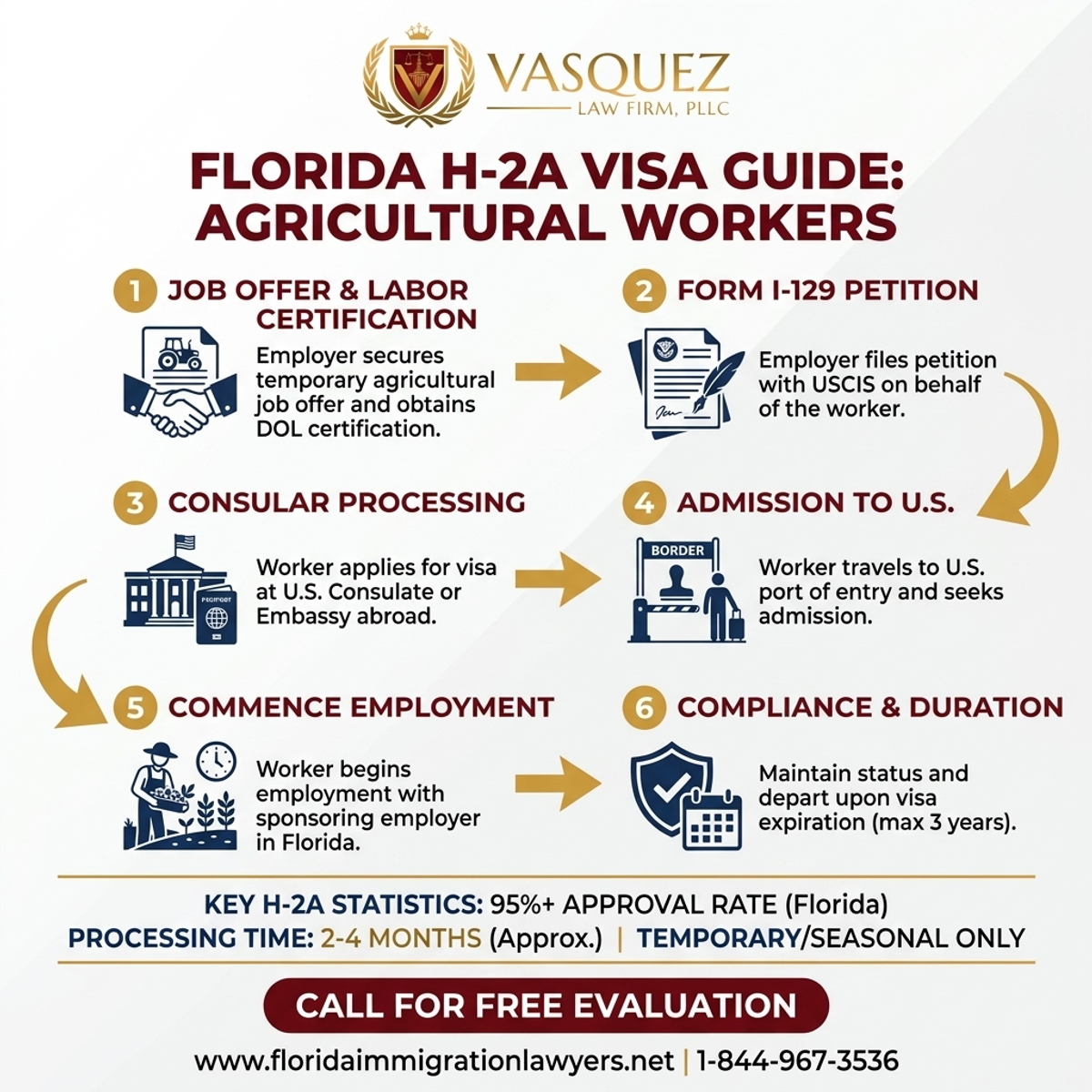
Processing times for H-2A visas can vary, typically taking several months. Employers should plan ahead and account for potential delays at USCIS and the Department of Labor. Generally, the application process should begin at least 60-90 days before the workers are needed.
Florida's agricultural demand peaks during specific seasons, making timely processing crucial for meeting labor needs. Delays can impact farm operations, emphasizing the importance of early application.
Key Statistics — H-2A Visa Guide for Florida Agricultural Workers
The 60-90 day recommendation is often a minimum, especially for new employers or those with complex labor needs. The Department of Labor’s certification process alone can take several weeks, followed by USCIS petition processing, and then consular interviews abroad. Unexpected requests for evidence (RFEs) from USCIS or audits from the DOL can significantly extend these timelines. A proactive approach, starting the process even earlier, perhaps 120-150 days before the anticipated start date, provides a crucial buffer.
For Florida growers, whose livelihoods depend on precise timing for planting and harvesting, these delays can be catastrophic. Imagine a citrus grower in St. Petersburg needing workers for a critical harvest, only to have their H-2A petition delayed by a month. The financial losses from unpicked crops or missed market opportunities can be substantial. This underscores the importance of not only early application but also meticulous preparation and robust legal support throughout the entire process.
Working with experienced legal professionals, such as Florida Immigration Lawyers, can help mitigate these risks. Our team understands the nuances of H-2A processing and can help anticipate potential hurdles, ensuring your application is as strong and complete as possible from the outset. We actively monitor processing updates and can advise on strategies to keep your application on track, aiming for a timely arrival of your essential workforce.
Cost Factors and Fee Breakdown
The cost of obtaining an H-2A visa includes various fees, such as filing fees for Form I-129 and visa application fees. Employers must also cover transportation and housing costs for workers, ensuring they comply with U.S. labor laws. It’s essential for employers to budget for these expenses to avoid financial strain.
Florida growers might face additional costs related to recruitment and legal assistance, but these investments ensure compliance and smooth operation.
A detailed breakdown of costs typically includes the Department of Labor filing fee (if applicable, for certain types of applications), the USCIS Form I-129 petition fee, and the H-2A visa application fee paid by each worker at the consulate. However, the employer is generally responsible for reimbursing the worker for the visa application fee and any related costs. Furthermore, employers must cover the cost of inbound and outbound transportation for workers, provide compliant housing at no cost to the worker, and furnish necessary tools and equipment.
Beyond government fees and direct worker expenses, employers should budget for mandatory workers' compensation insurance, payroll taxes, and, importantly, legal fees for expert immigration counsel. While these costs represent a significant investment, they are critical for ensuring full compliance with complex federal and state labor laws, preventing costly penalties, and securing a reliable workforce. For St. Petersburg growers, understanding this comprehensive financial picture is vital for sustainable farm management.
Engaging Florida Immigration Lawyers from the outset can help employers understand the full scope of financial obligations. We provide transparent advice on all associated costs, helping you budget effectively and avoid unexpected expenses. Our goal is to ensure that your investment in the H-2A program yields the necessary labor without unforeseen financial burdens, allowing you to focus on your agricultural operations.
Do not navigate this process alone. Contact Florida Immigration Lawyers today.
Common Mistakes to Avoid
Navigating the H-2A visa program can be complex, and even minor missteps can lead to significant delays, denials, or costly penalties. Understanding and actively avoiding common pitfalls is crucial for Florida growers seeking a reliable agricultural workforce.
- Failing to file Form I-129 early enough, leading to processing delays.
- Insufficient recruitment efforts for U.S. workers, risking application denial.
- Non-compliance with housing requirements, which can result in penalties.
- Incorrect or incomplete documentation, delaying the application process.
- Misunderstanding labor certification requirements, causing unnecessary expenses.
- Overlooking the need for workers to return home after the visa period.
- Ignoring state-specific labor regulations, which vary across Florida.
- Not consulting with an immigration lawyer, risking non-compliance.
Proactively addressing these potential issues is key to a successful H-2A application. Many of these mistakes stem from a lack of familiarity with intricate immigration and labor laws. Partnering with a knowledgeable legal team, such as Florida Immigration Lawyers, can provide the expertise needed to navigate these complexities, ensuring your application is robust and compliant from start to finish.
When to Call a Lawyer
If you're navigating the H-2A visa process, consider seeking legal assistance if you face any of the following scenarios:
- Complex legal questions about compliance and labor laws
- Uncertainty about application requirements and documentation
- Experiencing delays or denials from USCIS
Florida Immigration Lawyers are here to guide you through the H-2A visa process, ensuring compliance and minimizing risks.
Beyond these specific scenarios, engaging legal counsel proactively can save time and resources in the long run. For instance, understanding the nuances of adverse effect wage rates (AEWR), specific housing standards, or the intricacies of the recruitment process can prevent costly errors before they occur. A lawyer can help draft robust job orders, prepare for potential audits, and advise on best practices for employer-employee relations under H-2A regulations.
Consider a St. Petersburg grower facing an unexpected audit from the Department of Labor regarding their H-2A housing. Without expert legal guidance, responding correctly and promptly to such an audit can be overwhelming and lead to severe penalties. Similarly, if USCIS issues a Request for Evidence (RFE) for your I-129 petition, a skilled immigration attorney can formulate a comprehensive and persuasive response, significantly increasing the chances of approval. Don't wait for a crisis; reach out to Florida Immigration Lawyers at 1-844-967-3536 for peace of mind and expert support.
About Florida Immigration Lawyers
At Florida Immigration Lawyers, we specialize in immigration law with a focus on agricultural visas. We provide comprehensive legal services to farmers and agricultural workers throughout Florida. Our team is available 24/7 to provide guidance and support. Call us at 1-844-967-3536 or visit our website at www.floridaimmigrationlawyers.net for a free consultation.
Our commitment extends to ensuring that Florida's vital agricultural sector has the labor it needs to thrive, while also protecting the rights of temporary workers. We pride ourselves on our deep understanding of both federal immigration statutes and the specific agricultural landscape of Florida, offering tailored solutions to meet your unique needs.
Sources and References
- U.S. Citizenship and Immigration Services (USCIS)
- Executive Office for Immigration Review (EOIR)
- 8 U.S.C. Chapter 12 - Immigration and Nationality Act
Related services: immigration practice areas, family immigration services, citizenship and naturalization, deportation defense.
This article provides general legal information and is not intended as legal advice. Every case is unique, and outcomes depend on specific facts and circumstances. Contact an attorney for advice about your particular situation.
Call Florida Immigration Lawyers at 1-844-967-3536 for a free consultation. Se Habla Español - Estamos aquí para ayudarle.
If you need legal assistance, learn more about immigration case consultation, or call us at 1-844-967-3536 for a free consultation.
Do Not Navigate This Process Alone
Our experienced immigration attorneys are ready to fight for you. Get a free, confidential consultation today.
Se Habla Español
Frequently Asked Questions
Florida Immigration Lawyers
Immigration Attorney | Founder, Vasquez Law Firm
U.S. Air Force veteran and immigration attorney with thousands of cases resolved. J.D., NCCU School of Law. AILA member. Admitted to the 4th, 5th, and 11th Circuit Courts.
Available 24/7 - Free Evaluations
Related Legal Services
Our Florida immigration attorneys can help you with immigration practice areas, free immigration consultation and experienced immigration attorneys. Call today at 1-844-967-3536 for a free consultation.
Related Links
Related Topics
Free Legal Consultation
Discuss your case with our experienced attorneys. We're available 24/7.
Se Habla Español - Estamos aquí para ayudarle.
Related Articles
EB-5 Investor Green Card in Florida: Key Insights | VLF Florida
Explore how the EB-5 investor green card program can help you start a new life in Florida. Learn about the benefits, processes, and common pitfalls of this investment immigration path. Call 1-844-967-3536 for expert guidance.
E-2 Visa for Florida Business Investors | VLF Florida
Learn how the E-2 investor visa can help you start a business in Naples, Florida. We cover eligibility, application steps, common mistakes, and when to seek legal help. Contact Florida Immigration Lawyers for a free consultation.
VAWA Immigration Relief: Support in Florida | VLF Florida
Explore VAWA immigration relief options for abuse victims in Hollywood, Florida. Learn about eligibility, application steps, and common mistakes to avoid. Contact Florida Immigration Lawyers for a free consultation.
EB-5 Investor Green Card in Florida: A Comprehensive Guide
Learn how the EB-5 investor green card program can help you gain U.S. residency through investment in Florida. Discover key steps, common mistakes, and when to seek legal advice. Call Florida Immigration Lawyers at 1-844-967-3536 for a free consultation.
