H-2A Visa Guide for Florida Agricultural Workers
Discover how the H-2A visa program can assist Florida growers in hiring temporary agricultural workers. Learn about eligibility, application process, and legal support available. Contact Florida Immigration Lawyers for a free consultation.

H-2A Visa Guide for Florida Agricultural Workers | VLF Florida
Florida's agricultural sector is a cornerstone of its economy, relying heavily on a dedicated workforce to cultivate and harvest its abundant crops. For many employers facing labor shortages, the H-2A temporary agricultural program offers a vital solution, allowing them to bring nonimmigrant foreign workers to the U.S. to perform agricultural labor or services of a temporary or seasonal nature. This comprehensive guide from VLF Florida aims to demystify the H-2A visa process, providing essential information for both employers and agricultural workers in the Sunshine State.
Understanding the intricacies of the H-2A visa is crucial for ensuring compliance, protecting worker rights, and maintaining the smooth operation of agricultural businesses. From eligibility requirements and application procedures to worker protections and potential challenges, we delve into every aspect of this critical immigration pathway. Our goal is to empower you with the knowledge needed to navigate the H-2A program successfully, contributing to Florida's agricultural prosperity.
What is the H-2A Visa Program?
The H-2A visa program is a federal initiative designed to address temporary labor shortages in the U.S. agricultural sector. It permits U.S. employers or U.S. agents who meet specific regulatory requirements to bring foreign nationals to the United States to fill temporary agricultural jobs. These jobs are typically seasonal, lasting less than one year, and involve tasks such as planting, cultivating, harvesting, and preparing agricultural products for market. The program is vital for Florida, where the demand for agricultural labor often exceeds the available domestic workforce during peak seasons.
Unlike some other visa categories, the H-2A program is specifically tailored to the unique needs of agriculture, recognizing the cyclical nature of farming and the necessity of a reliable, temporary workforce. Employers must demonstrate that there are not enough U.S. workers who are able, willing, qualified, and available to do the temporary work, and that employing H-2A workers will not adversely affect the wages and working conditions of similarly employed U.S. workers. This dual requirement underscores the program's intent to supplement, not supplant, the domestic labor force.
Eligibility Requirements for Employers
For Florida agricultural employers considering the H-2A program, meeting stringent eligibility criteria is the first step. Employers must:
- Demonstrate a Temporary Need: The job must be temporary or seasonal, typically lasting no longer than one year. This means the employer does not have a permanent need for the labor.
- Lack of U.S. Workers: The employer must prove that there are not enough U.S. workers who are able, willing, qualified, and available to perform the work. This involves a rigorous recruitment process, including advertising the jobs to U.S. workers.
- Offer Fair Wages and Conditions: Employers must offer H-2A workers the higher of the prevailing wage, the Adverse Effect Wage Rate (AEWR), the federal minimum wage, or the state minimum wage. They must also provide housing at no cost to the worker, and transportation to and from the worksite.
- Provide Transportation: Employers must provide or pay for the worker's transportation and subsistence from their home country to the place of employment in the U.S., and back again upon completion of the contract.
- Comply with Regulations: Adherence to all Department of Labor (DOL) and U.S. Citizenship and Immigration Services (USCIS) regulations is mandatory, including filing a job order with the State Workforce Agency (SWA) and obtaining a temporary labor certification.
The process is complex and requires meticulous documentation and adherence to deadlines. Errors can lead to significant delays or denials, impacting crucial harvest schedules. Seeking expert guidance from an immigration law firm like VLF Florida can be invaluable in navigating these requirements.
Eligibility Requirements for Workers
For foreign nationals seeking to work in Florida's agriculture sector via an H-2A visa, the requirements are straightforward:
- Nonimmigrant Intent: Applicants must intend to return to their home country upon the expiration of their H-2A visa. The H-2A visa is for temporary work, not permanent residency.
- Job Offer: Workers must have a legitimate job offer from a U.S. employer that has received an approved temporary labor certification from the Department of Labor and an approved H-2A petition from USCIS.
- Nationality: Workers must be citizens of countries designated by the Department of Homeland Security as eligible for the H-2A program. This list is updated periodically.
- Meet Job Qualifications: Workers must meet the minimum job qualifications specified in the temporary labor certification, such as physical ability or prior experience in agricultural tasks.
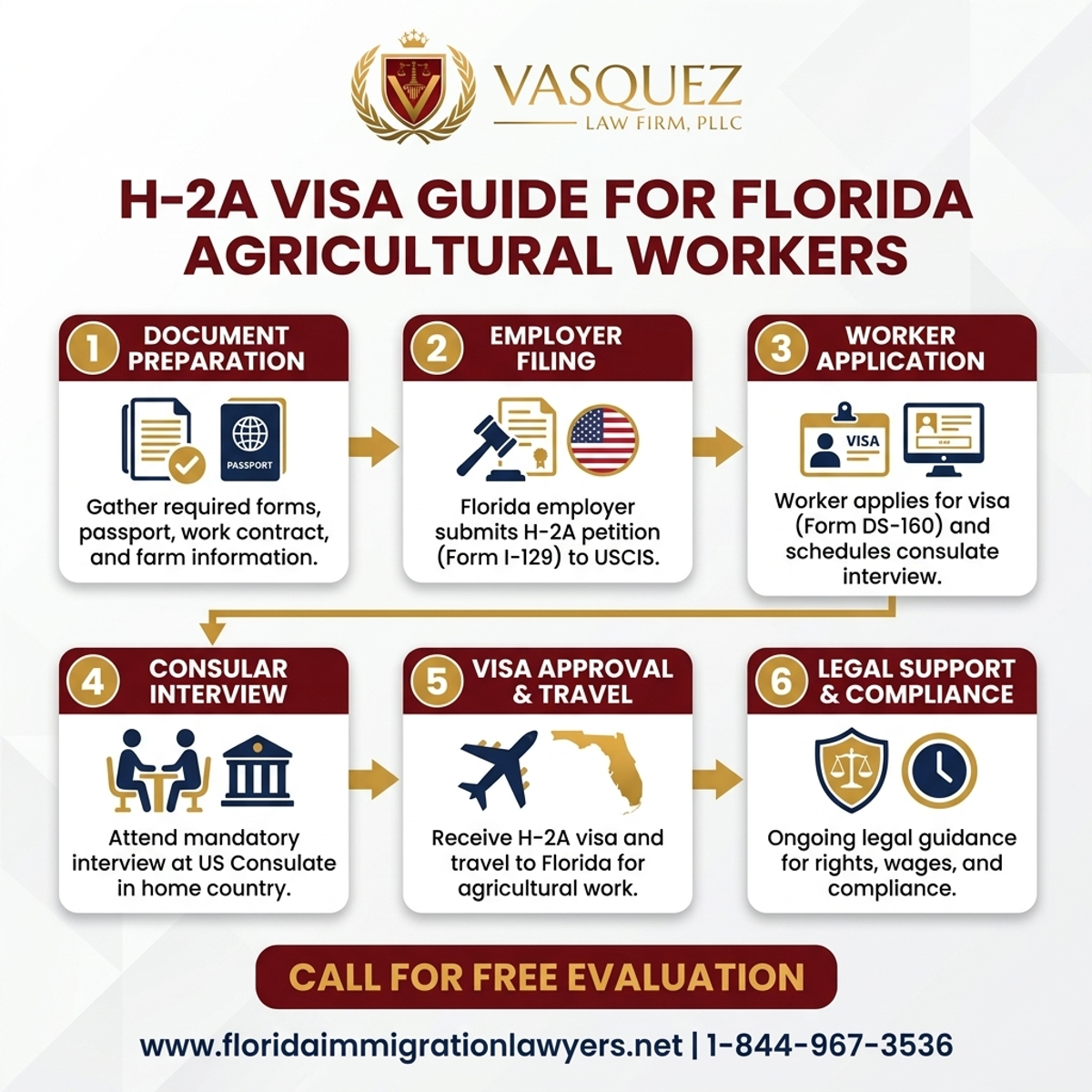
Step-by-Step Process — H-2A Visa Guide for Florida Agricultural Workers | VLF Florida
It is important for prospective H-2A workers to understand their rights and responsibilities under the program, ensuring they are not exploited and receive the fair treatment guaranteed by U.S. law. Workers should never pay recruitment fees to obtain an H-2A job.
The H-2A Application Process: A Step-by-Step Guide
The H-2A application process is multi-faceted, involving several government agencies and strict timelines. Understanding each stage is crucial for a successful outcome.
Step 1: Temporary Labor Certification from the Department of Labor (DOL)
The employer initiates the process by filing a Form ETA-9142A, Application for Temporary Employment Certification, with the Department of Labor. This application must be filed between 60 and 90 calendar days before the employer's date of need. Simultaneously, the employer must submit a job order to the State Workforce Agency (SWA) in Florida, describing the job duties, wages, and working conditions. The DOL reviews the application to ensure that the employer has met all requirements, including the recruitment of U.S. workers and offering the Adverse Effect Wage Rate (AEWR). This involves:
- Pre-filing Recruitment: Employers must attempt to recruit U.S. workers by placing job advertisements in local newspapers and contacting former U.S. employees.
- Housing and Transportation Attestations: Employers must attest to providing free housing that meets federal and state safety standards, and free transportation to and from the worksite.
- Wage Offer: The wage offered must meet or exceed the AEWR for Florida, the federal minimum wage, the state minimum wage, or the prevailing wage, whichever is highest.
Once the DOL is satisfied that all requirements are met and there are indeed insufficient U.S. workers available, it issues a Temporary Labor Certification.
Step 2: Petition Filing with U.S. Citizenship and Immigration Services (USCIS)
With the certified ETA-9142A in hand, the employer then files Form I-129, Petition for a Nonimmigrant Worker, with U.S. Citizenship and Immigration Services (USCIS). This petition requests approval for the H-2A workers. The employer must include the approved labor certification and other supporting documentation, such as evidence of the employer's ability to pay the wages offered and a list of the prospective H-2A workers (if known). USCIS reviews the petition to ensure the employer meets all immigration eligibility requirements and that the petition is properly filed. This step typically takes several weeks to process, though premium processing is available for an additional fee to expedite the decision.
Step 3: Visa Application at a U.S. Embassy or Consulate
Once the I-129 petition is approved by USCIS, prospective H-2A workers located outside the U.S. must apply for an H-2A visa at a U.S. Embassy or Consulate in their home country. This involves:
- Completing Form DS-160: The online Nonimmigrant Visa Application.
- Scheduling an Interview: Attending a visa interview with a consular officer.
- Providing Documentation: Submitting a valid passport, the approved Form I-797 (Notice of Action) from USCIS, and any other required documents.
During the interview, the consular officer will verify the worker's eligibility, confirm their nonimmigrant intent, and ensure they are not inadmissible to the U.S. If approved, the visa will be affixed to the worker's passport.
Step 4: Admission into the United States
Upon arrival at a U.S. port of entry, H-2A workers are inspected by U.S. Customs and Border Protection (CBP) officers. CBP officers will review the worker's visa and other travel documents to determine admissibility. Once admitted, workers are typically granted admission for the period authorized on the temporary labor certification, plus an additional 10 days before and 10 days after the employment period to allow for travel.
The entire process demands careful planning and execution. Any misstep can lead to significant delays, which can be devastating for agricultural operations dependent on timely labor. For comprehensive assistance with this complex process, consider reaching out to our experienced team at VLF Florida. We specialize in immigration law and can guide both employers and workers through every stage.
Rights and Protections for H-2A Workers
H-2A workers are afforded significant rights and protections under U.S. law, designed to prevent exploitation and ensure fair treatment. These include:
- Guaranteed Wages: Workers must be paid at least the Adverse Effect Wage Rate (AEWR) or the prevailing wage, whichever is higher, for all hours worked.
- Housing: Employers must provide free, safe, and sanitary housing for workers who cannot reasonably return to their permanent residence each day.
- Transportation: Employers must provide or reimburse transportation costs from the worker's home country to the job site and back, and transportation between housing and the worksite.
- Work Contract: Workers must be provided with a copy of their work contract, outlining job duties, wages, hours, and other terms of employment, in a language they understand.
- Three-Fourths Guarantee: Employers must guarantee to offer each worker employment for at least three-fourths of the workdays specified in the contract period.
- No Fees: Workers should not pay any recruitment fees or other fees related to obtaining the H-2A job.
- Access to Legal Aid: H-2A workers have the right to seek legal assistance and report violations without fear of retaliation.
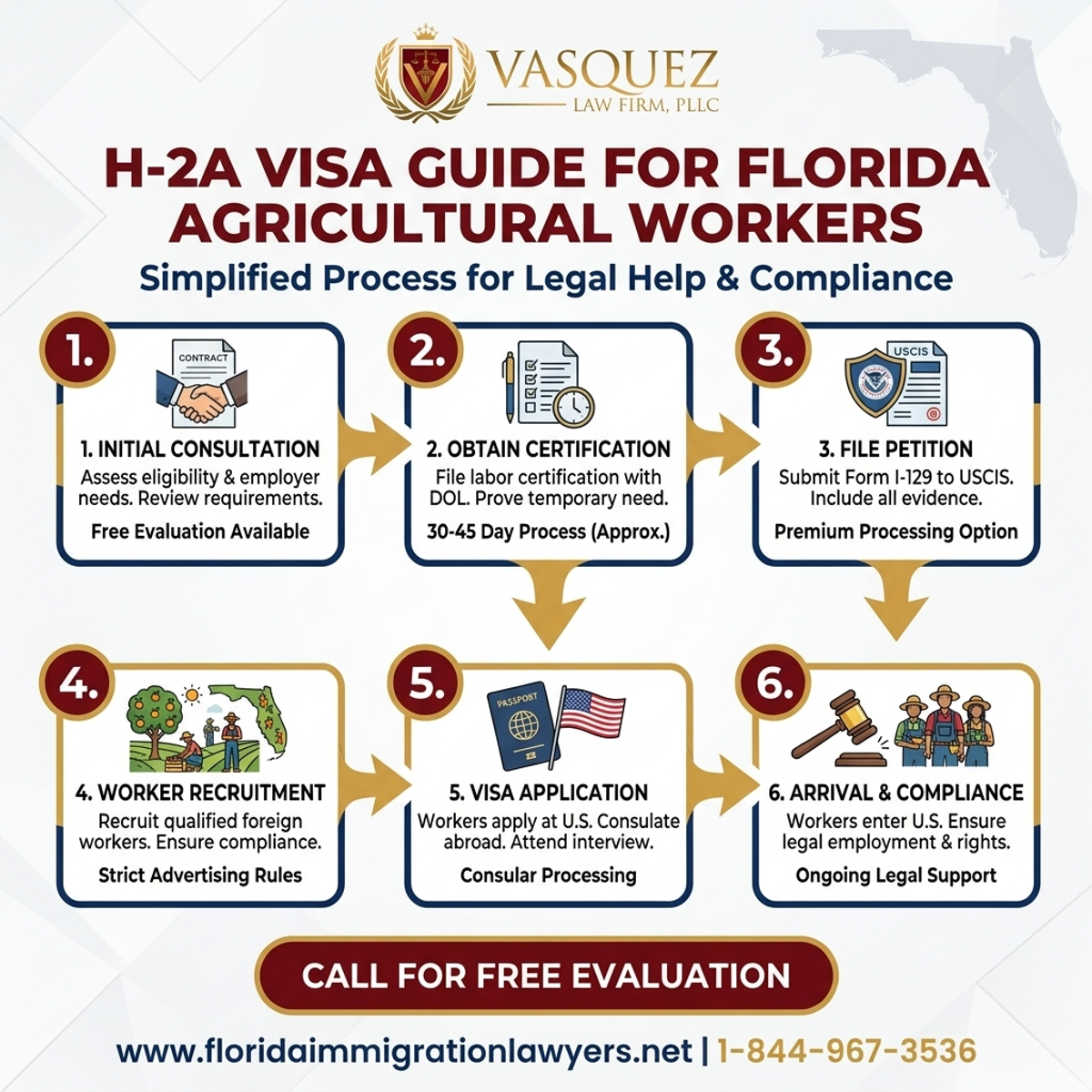
Key Statistics — H-2A Visa Guide for Florida Agricultural Workers | VLF Florida
These protections are enforced by various government agencies, including the Department of Labor and the Department of Homeland Security. If workers believe their rights are being violated, they should seek immediate legal counsel. Our firm is dedicated to upholding the rights of all workers, and we offer consultations to address concerns related to employment and immigration matters.
Navigating Common Challenges and Ensuring Compliance in the H-2A Program
While the H-2A program offers a vital lifeline to Florida's agricultural industry, it is not without its challenges. Both employers and workers can face hurdles that require careful navigation and expert legal insight. For employers, maintaining strict compliance with all DOL and USCIS regulations is paramount. This includes meticulous record-keeping, ensuring timely wage payments, providing adequate housing and transportation, and adhering to all recruitment obligations. Failure to comply can result in severe penalties, including fines, debarment from the program, and even criminal charges. The dynamic nature of agricultural work, with its unpredictable weather and market fluctuations, can sometimes make it difficult to adhere to every contractual detail, highlighting the need for flexible yet compliant strategies.
Workers, on the other hand, may face challenges related to language barriers, understanding their rights, or potential exploitation. While the program has robust protections, isolated incidents of abuse can occur. Knowing where to turn for help and having access to reliable legal counsel is critical. Furthermore, the temporary nature of the visa means workers must be prepared for their return home, and any desire for a different immigration status requires a separate, often complex, legal process. The complexities of the H-2A program underscore the value of proactive legal guidance. Our team at VLF Florida assists both employers in developing robust compliance programs and workers in understanding and asserting their rights. We understand that issues can arise, and we are here to provide strategic advice to resolve disputes and ensure all parties operate within the bounds of the law. Should you encounter any difficulties or have questions about your obligations or rights, do not hesitate to contact us for a consultation.
Beyond the H-2A: Understanding Other Immigration Pathways
While the H-2A visa is specifically designed for temporary agricultural work, it's important to recognize that the broader landscape of U.S. immigration law offers various pathways for individuals with different needs and circumstances. For some, the H-2A visa might be a temporary solution, but long-term goals could involve other non-immigrant or immigrant visas. Our firm handles a wide array of immigration cases beyond H-2A, including family-based petitions, employment-based visas, and humanitarian relief. For instance, individuals facing persecution in their home countries may be eligible to seek asylum in the U.S., a process distinct from temporary work visas. Similarly, those who find themselves in removal proceedings or facing the threat of deportation can benefit from skilled deportation defense, which requires a deep understanding of immigration court procedures and legal strategies. Understanding the full spectrum of immigration options is crucial, and our dedicated attorneys are equipped to provide comprehensive legal advice tailored to individual situations, guiding clients through the complexities of the U.S. immigration system.
The Economic Impact of H-2A Workers in Florida
The contribution of H-2A workers to Florida's economy cannot be overstated. They fill critical labor gaps, ensuring that crops are planted, tended, and harvested efficiently, preventing significant economic losses due to unpicked produce. Florida's agricultural output, which includes citrus, tomatoes, strawberries, and various other fruits and vegetables, is a multi-billion dollar industry that relies heavily on this seasonal workforce. Without H-2A workers, many farms would struggle to meet consumer demand, potentially leading to higher food prices, reduced agricultural output, and a decline in the state's overall economic health.
Beyond direct labor, H-2A workers contribute to local economies by spending their wages on goods and services, supporting small businesses in rural communities. Their presence allows Florida farms to remain competitive in national and international markets, preserving jobs for other agricultural support staff, such as packing house workers, truck drivers, and administrative personnel. The H-2A program is therefore not just about temporary workers; it's about sustaining an entire ecosystem of agricultural production and economic activity that benefits all Floridians.
Why Choose VLF Florida for Your H-2A Needs?
Navigating the H-2A visa program requires more than just filling out forms; it demands a deep understanding of constantly evolving immigration laws, meticulous attention to detail, and strategic foresight. At VLF Florida, our experienced immigration attorneys are dedicated to providing comprehensive and effective legal solutions for both employers and agricultural workers in Florida.
We offer:
- Expert Guidance: Our team possesses extensive knowledge of H-2A regulations, ensuring your application is accurate, complete, and compliant.
- Personalized Service: We understand that every case is unique. We provide tailored advice and support, addressing your specific needs and concerns.
- Proactive Problem Solving: We anticipate potential challenges and develop strategies to mitigate risks, minimizing delays and maximizing the chances of success.
- Commitment to Rights: We are passionate about protecting the rights of both employers and workers, ensuring fair processes and outcomes.
Whether you are an agricultural employer seeking to secure a vital workforce or a worker looking to understand your rights and opportunities, VLF Florida is your trusted partner. We are committed to fostering a thriving agricultural sector in Florida through ethical and efficient immigration practices. For a free consultation to discuss your H-2A visa needs or any other immigration matter, please contact us today.
Frequently Asked Questions (FAQs) About H-2A Visas
Here are answers to some common questions regarding the H-2A visa program:
1. What types of agricultural jobs qualify for the H-2A visa?
The H-2A visa covers a wide range of temporary or seasonal agricultural labor, including planting, cultivating, harvesting, packing, and processing of agricultural commodities. It can also include certain forestry and logging operations.
2. How long can an H-2A visa holder stay in the U.S.?
H-2A visas are typically granted for the period of the temporary labor certification, usually up to one year. They can be extended in increments of up to one year, for a maximum total stay of three years. After three years, H-2A workers must depart the U.S. for an uninterrupted period of three months before they can seek readmission as an H-2A worker.
3. Can H-2A workers bring their families to the U.S.?
No, the H-2A visa does not allow for dependents (spouses or children) to accompany the primary visa holder. Dependents may be eligible for an H-2B visa if the primary worker holds an H-2B, but H-2A is solely for the worker.
4. What is the Adverse Effect Wage Rate (AEWR)?
The AEWR is the minimum hourly wage rate that employers must offer and pay H-2A workers in a specific state or region. It is set by the Department of Labor annually to ensure that the employment of H-2A workers does not adversely affect the wages of similarly employed U.S. workers.
5. What happens if an H-2A worker leaves their job early?
If an H-2A worker leaves their job before the contract ends without a valid reason, they may be considered in violation of their visa terms. This could impact their ability to obtain future U.S. visas. In some cases, the employer may be relieved of their obligation to pay for return transportation.
6. Can an H-2A worker change employers?
An H-2A worker is authorized to work only for the employer who sponsored their visa petition. To change employers, a new H-2A petition must be filed by the new employer and approved by USCIS, and the worker may need to obtain a new visa.
7. What are an employer's responsibilities regarding worker housing?
Employers must provide free housing that meets federal and state safety and health standards. This includes ensuring adequate space, sanitation, cooking facilities, and utilities. Inspections are often required to verify compliance.
8. Where can H-2A workers report problems or violations?
H-2A workers can report wage and hour violations to the Department of Labor's Wage and Hour Division. Other concerns, such as human trafficking or unsafe working conditions, can be reported to various federal and state agencies, including USCIS and local law enforcement. Legal assistance from an immigration attorney is also a crucial resource.
Sources and References
- U.S. Citizenship and Immigration Services (USCIS)
- Executive Office for Immigration Review (EOIR)
- U.S. Department of State - Bureau of Consular Affairs
- Immigration and Nationality Act (INA), 8 U.S.C. Chapter 12
Do Not Navigate This Process Alone
Our experienced immigration attorneys are ready to fight for you. Get a free, confidential consultation today.
Se Habla Español
Or leave your details and we’ll call you:
Free Evaluation in 24 Hours
Or talk to us right now

AI voice assistant — available 24/7
FreeFrequently Asked Questions

William J. Vásquez
Founding Attorney · Vasquez Law Firm
U.S. Air Force veteran and immigration attorney with years of hands-on U.S. immigration experience. J.D., NCCU School of Law. AILA member. Admitted to the 4th, 5th, and 11th Circuit Courts.
Available 24/7 - Free Evaluations
Reviewed for legal accuracy by William J. Vásquez
Licensed in North Carolina; U.S. immigration is federal practice.
Related Legal Services
Our Florida immigration attorneys can help you with family immigration services, immigration practice areas and free immigration consultation. Call today at 1-844-967-3536 for a free consultation.
Related Links
Related Topics
Free Legal Consultation
Discuss your case with our experienced attorneys. We're available 24/7.
Se Habla Español - Estamos aquí para ayudarle.
Related Articles
Stem OPT Immigration Lawyer: 2026 Florida Guide
For F-1 students in Florida, the STEM OPT extension offers a vital 24-month work authorization after their initial OPT. This guide, updated for 2026, covers eligibility, the step-by-step application process, required documents, and critical timelines. Graduates from Florida universities in STEM fields must navigate strict USCIS regulations, including the E-Verify employer requirement. Learn how to avoid common mistakes and when to seek professional legal assistance from a dedicated stem OPT immigration lawyer to ensure a successful application and continued career growth in the U.S. Florida Immigration Lawyers offers expert guidance for students across the state.
Dual Citizenship Lawyer: Navigating Delays in Florida
Facing citizenship delays in Florida can be challenging, but understanding the process and knowing your options is key. Learn how a dual citizenship lawyer can assist you in navigating N-400 processing and USCIS backlogs in Hialeah.
"ina § 208(a)(2)" One-Year Filing Deadline: Florida Asylum
Discover the importance of the "ina § 208(a)(2)" one-year filing deadline for asylum seekers in Florida. Learn about the steps, documents needed, and common mistakes to avoid in your asylum application process.
DV-2027 Registration Period: Your Green Card Lottery Guide
The DV-2027 Diversity Visa (DV) lottery offers a unique pathway to permanent residency for individuals from countries with historically low immigration rates to the U.S. Expected to open in Fall 2025, the registration period requires strict adherence to eligibility criteria, including country of birth and specific education or work experience. This guide from Florida Immigration Lawyers covers the step-by-step application process, essential documents, critical timelines, and associated costs. We highlight common mistakes to avoid and explain when legal counsel is indispensable, especially for residents in Florida. Understanding the nuances of the green card lottery is vital for a successful application. Contact us for expert guidance on your DV-2027 journey.