H-1B Visa for Florida Employers: Your 2026 Guide
For Florida employers looking to hire skilled foreign professionals, the H-1B visa program is a critical pathway. This comprehensive 2026 guide details the complex process, from understanding eligibility requirements for both the company and the prospective employee to navigating the annual H-1B cap and lottery system. We provide a step-by-step overview, a detailed document checklist, and transparent information on associated costs and processing timelines. Learn how to avoid common pitfalls that can lead to delays or denials, and understand when it's crucial to seek expert legal assistance. Florida Immigration Lawyers offers dedicated support to businesses throughout Central Florida, ensuring compliance and maximizing your chances of securing the talent you need. Contact us for a free case review and expert guidance on your H-1B sponsorship journey.
Sponsoring an H-1B visa in Florida for foreign professional workers involves navigating a complex, multi-step process with strict deadlines, particularly for cap-subject petitions. As of 2026, employers must understand the eligibility criteria for both the company and the prospective employee, prepare extensive documentation, and participate in the annual H-1B lottery if applicable. This guide provides a comprehensive overview of the requirements, timelines, and costs involved, emphasizing the need for meticulous preparation and expert legal guidance to ensure compliance with USCIS regulations and to successfully secure a work visa for talented individuals.
- H-1B visas are for specialty occupations requiring a bachelor's degree or its equivalent.
- Employers must complete a Labor Condition Application (LCA) and file Form I-129.
- The annual H-1B cap and lottery system are significant considerations for most petitions.
- Processing times and fees vary depending on premium processing and specific case details.
- Expert legal assistance is crucial for navigating complex regulations and avoiding common pitfalls.
Florida's dynamic economy, particularly in tech, healthcare, and tourism sectors, consistently attracts global talent. For many businesses in Orlando and across Central Florida, securing a highly skilled foreign professional often means navigating the intricate H-1B visa program. This non-immigrant work visa Florida employers utilize allows U.S. companies to temporarily employ foreign workers in specialty occupations, which generally require a bachelor's degree or higher in a specific field. Understanding the nuances of this program is critical for any employer looking to enhance their workforce with international expertise.
The H-1B visa process, particularly for an employer sponsor H-1B petition, is highly regulated and can be challenging without proper guidance. From determining eligibility to navigating the annual cap and lottery, employers face numerous hurdles. This comprehensive guide, updated for 2026, will walk you through the essential steps, requirements, costs, and timelines involved in sponsoring an H-1B visa for your prospective employees in Florida. We aim to provide clarity on this vital aspect of immigration Florida employers should be aware of, helping you make informed decisions.
Do not let the complexity of immigration law deter you from securing the talent your business needs. For personalized advice and a free case review, call Florida Immigration Lawyers at 1-844-YO-PELEO today. We are here to help your Florida business thrive with the right legal support.
What are the H-1B Visa Requirements for Employers in Florida?
To sponsor an H-1B visa in Florida, both the employer and the position must meet specific criteria set by U.S. Citizenship and Immigration Services (USCIS). The position must qualify as a specialty occupation, meaning it requires a theoretical and practical application of a body of highly specialized knowledge and a bachelor's degree or higher in a specific field as a minimum for entry. The employer must also be a legitimate U.S. entity with an Employer Identification Number (EIN) and demonstrate the ability to pay the prevailing wage to the H-1B worker.
As of 2026, employers in Florida must ensure their job offer aligns with the H-1B program's intent. This means the position must genuinely require a degree, and the employee must possess that degree or its equivalent through work experience. For instance, a tech company in Orlando seeking a software engineer would likely meet this criterion. The employer must also attest to several conditions on the Labor Condition Application (LCA), including paying the H-1B worker at least the prevailing wage for the occupation in the area of intended employment or the actual wage paid to other employees with similar experience and qualifications, whichever is higher. They must also confirm that the employment of the H-1B worker will not adversely affect the working conditions of similarly employed U.S. workers.
Specific requirements for the employer include having an established business in the U.S. and offering a bona fide job in a specialty occupation. For the employee, they must hold a bachelor's degree or its equivalent, or possess a license in a specialty occupation field, or have work experience equivalent to a bachelor's degree. This equivalency is typically calculated as three years of progressive work experience for every one year of college education. Furthermore, the employer must maintain a public access file containing information about the LCA, which is crucial for compliance. Understanding these fundamental requirements is the first step in a successful H-1B visa petition.
How Does the H-1B Cap-Subject Petition Process Work and How Long Does it Take?
The H-1B cap-subject petition process is highly competitive and begins with an electronic registration period, typically in March, where employers register prospective beneficiaries with USCIS. If selected in the lottery, the employer then has a specific window to file the full H-1B petition (Form I-129) with all supporting documentation. The process can take several months, from registration to final approval, and is heavily influenced by the annual H-1B cap and USCIS processing times.
As of 2026, the annual H-1B cap remains at 85,000 visas, with 20,000 reserved for those with a U.S. master's degree or higher. For most Florida businesses, the H-1B lottery is a critical hurdle. The process generally involves these stages:
- H-1B Electronic Registration: Employers register prospective employees with USCIS during a designated period, usually in early March. A non-refundable fee per registration is required.
- Lottery Selection: If more registrations are received than available visas, USCIS conducts a lottery. Selected registrations are notified, typically by the end of March.
- Petition Filing (Form I-129): For selected registrations, employers have a specific window (usually 90 days, starting April 1st) to file the complete Form I-129, Petition for a Nonimmigrant Worker, along with the certified LCA and all supporting evidence.
- USCIS Processing: USCIS reviews the petition. This can take several months, depending on the service center workload and whether premium processing is requested.
- Approval and Status Change/Consular Processing: Upon approval, if the beneficiary is in the U.S., their status changes to H-1B. If outside the U.S., they must undergo consular processing at a U.S. embassy or consulate abroad, such as in their home country, to obtain the visa stamp.
The overall timeline for an H-1B petition can vary significantly, especially for cap-subject cases. Here is a typical timeline for 2026:
| Stage | Typical Timeframe (2026) | Notes |
|---|---|---|
| H-1B Electronic Registration | Early March (e.g., March 6-22) | Employer submits beneficiary information and registration fee. |
| Lottery Selection Notification | Late March (e.g., March 27) | USCIS notifies employers of selected registrations. |
| Petition Filing Window | April 1 - June 30 | Selected employers file Form I-129 with supporting documents. |
| Regular Processing (USCIS) | 6-12+ months | Varies by service center; no guaranteed timeframe. |
| Premium Processing (USCIS) | 15 calendar days | Expedited processing for an additional fee. |
| Consular Processing (Outside U.S.) | Weeks to months post-approval | Interview scheduling and processing times vary by consulate. |
| H-1B Start Date | October 1 | Earliest date H-1B status can begin for cap-subject petitions. |
It's important to note that these timelines are estimates and can change based on USCIS workload, policy updates, and individual case complexities. For Florida employers, particularly those in high-demand sectors, planning well in advance is crucial.
What are the Costs Associated with Sponsoring an H-1B Visa?
Sponsoring an H-1B visa involves various fees, including government filing fees, attorney fees, and potentially other costs like prevailing wage determination or educational evaluations. These costs can range significantly, typically from a few thousand dollars to over ten thousand, depending on the size of the employer, whether premium processing is utilized, and the complexity of the case. Employers are generally responsible for most of the government filing fees.
As of 2026, the various fees associated with an H-1B visa petition can be substantial. Employers must budget for these expenses carefully. Here's a breakdown of typical costs:
| Item | Typical Fee (2026) | Notes |
|---|---|---|
| H-1B Registration Fee | $10 | Non-refundable fee per beneficiary for the lottery. |
| USCIS Form I-129 Filing Fee | $460 | Base fee for the petition. |
| American Competitiveness and Workforce Improvement Act (ACWIA) Fee | $750 (for employers with 1-25 FTEs) $1,500 (for employers with 26+ FTEs) |
Mandatory fee, paid by employer, used for training U.S. workers. |
| Fraud Prevention and Detection Fee | $500 | Mandatory fee for initial H-1B petitions and first transfers. |
| Public Law 114-113 Fee (for employers with 50+ employees, over 50% on H-1B/L-1) | $4,000 | Applicable to specific employers, often large tech companies. |
| Premium Processing Fee (Form I-907) | $2,805 | Optional fee to expedite USCIS processing to 15 calendar days. |
| Attorney Fees | Varies ($2,000 - $5,000+) | Covers legal services for preparing and filing the petition. |
| Educational Evaluation (if needed) | $100 - $300 | Required if the foreign degree needs U.S. equivalency assessment. |
| Translation Costs (if needed) | Varies | For documents not in English. |
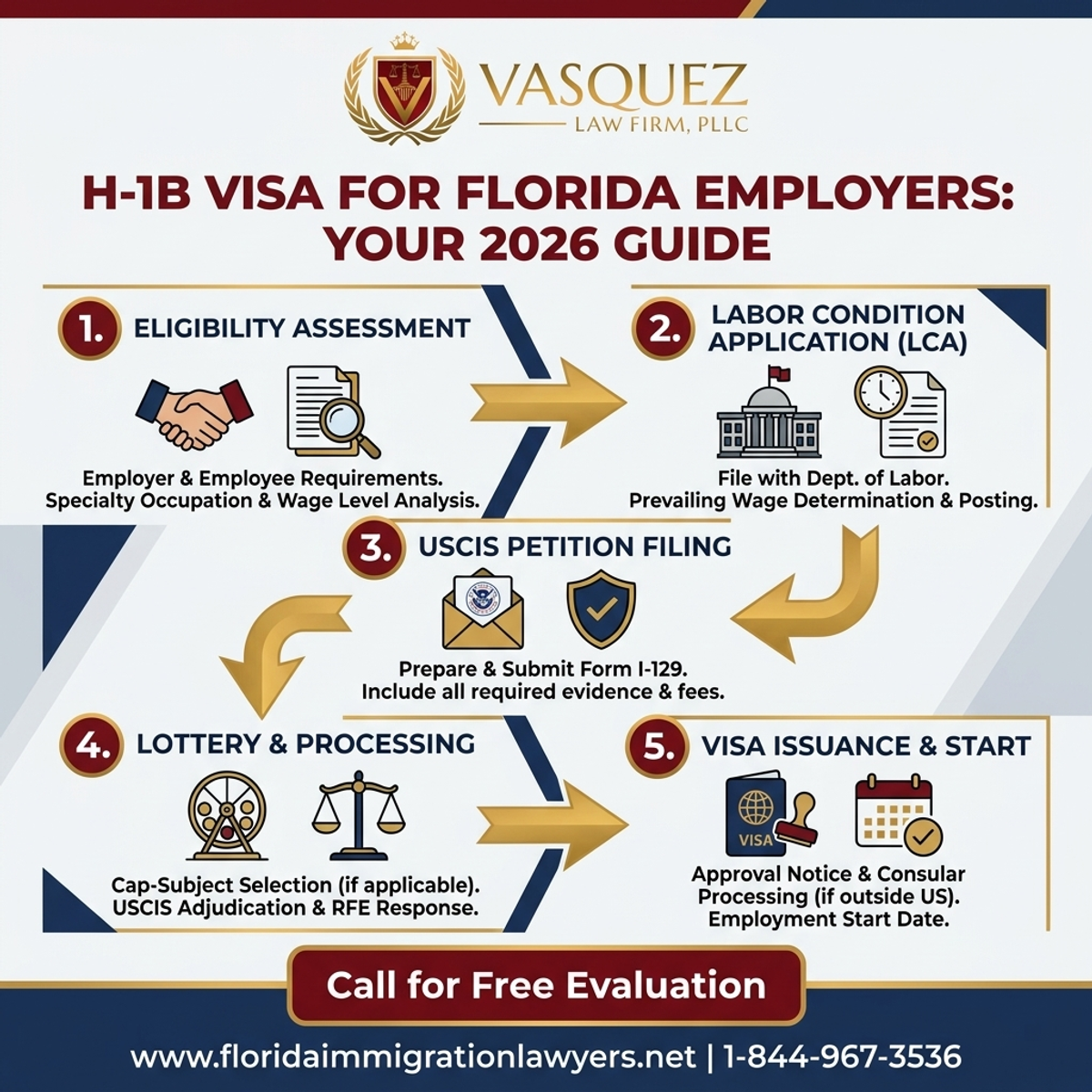
Step-by-Step Process — H-1B Visa for Florida Employers: Your 2026 Guide
It is important for employers to understand that most of these fees are the responsibility of the sponsoring employer and cannot be passed on to the employee, with the exception of premium processing fees if the employee requests it for their own benefit. Failing to cover these costs can lead to legal complications and potential penalties. Consulting with an immigration attorney from Florida Immigration Lawyers can help your business accurately budget for these expenses and ensure compliance.
H-1B Visa Eligibility and Documentation Checklist for Florida Employers
To successfully obtain an H-1B visa for a prospective employee, both the employer and the beneficiary must meet specific eligibility criteria, and a comprehensive set of documents must be prepared. The documentation checklist is extensive and requires meticulous attention to detail to avoid delays or requests for evidence (RFEs) from USCIS. Ensuring all documents are accurate, complete, and properly translated is paramount for a smooth process.
Employer Eligibility & Documentation:
- Employer Identification Number (EIN): Proof of legitimate U.S. business entity.
- Business Description: Information about the company's operations, products, and services.
- Financial Documentation: Tax returns, financial statements, or annual reports demonstrating the ability to pay the prevailing wage.
- Offer Letter: Detailed job offer specifying the specialty occupation, salary, and terms of employment.
- Labor Condition Application (LCA) (Form ETA-9035): Certified by the Department of Labor, attesting to prevailing wage and working conditions.
- Company Structure: Organizational charts, list of employees, and details about the supervisory structure for the H-1B worker.
- Public Access File: Maintained on-site for public inspection, containing LCA details and wage information.
Beneficiary Eligibility & Documentation:
- Passport: Valid passport copy, ensuring it is current and has sufficient validity.
- Educational Degrees and Transcripts: Bachelor's degree or higher, relevant to the specialty occupation. Foreign degrees may require an evaluation to determine U.S. equivalency.
- Work Experience Letters: If relying on work experience for degree equivalency, detailed letters from previous employers.
- Resume/CV: Comprehensive overview of professional background and skills.
- Professional Licenses: Any required licenses for the specialty occupation in Florida.
- Prior Immigration Documents: Copies of previous visas, I-94 records, I-20s, EADs, etc., if applicable.
- Birth Certificate & Marriage Certificate: If applying for H-4 dependents.
- Photographs: Passport-style photographs meeting USCIS specifications.
It is crucial that all foreign language documents are accompanied by a certified English translation. USCIS is very particular about the format and content of these translations. Additionally, employers in Florida should be prepared to provide evidence of the beneficiary's qualifications and how the offered position meets the definition of a specialty occupation. This might include detailed job descriptions, organizational charts, and expert opinion letters if the specialty nature of the occupation is not immediately clear. Adherence to these strict documentation guidelines is essential for a successful H-1B visa petition.
Navigating the H-1B Cap and Lottery System in 2026
The H-1B cap and lottery system represent one of the most significant challenges for Florida employers seeking to hire foreign talent, especially for those not exempt from the annual cap. With demand consistently outstripping the available 85,000 visas, the lottery determines which employers can proceed with filing their petitions. Understanding how this system works in 2026 is crucial for strategic planning.
Each fiscal year, USCIS accepts a maximum of 65,000 H-1B visas for general petitions and an additional 20,000 for beneficiaries with a U.S. master's degree or higher (the master's cap). Institutions of higher education, non-profit research organizations, and government research organizations are generally exempt from this annual cap. For all other Florida businesses, participation in the electronic registration process and the subsequent lottery is mandatory for cap-subject petitions. The registration period typically opens in early March, and employers must submit basic information about the company and the prospective employee. In recent years, the number of registrations has significantly exceeded the available visas, making the lottery highly competitive. For example, in the past, USCIS has received hundreds of thousands of registrations for only 85,000 slots.
If your registration is selected in the lottery, USCIS will notify you, and you will then have a 90-day window to file the complete H-1B petition. If not selected, you must wait until the next fiscal year's lottery. This unpredictability underscores the importance of having alternative strategies or considering cap-exempt options if available. For Florida employers, particularly those located near universities like the University of Central Florida, exploring partnerships or employment with cap-exempt institutions could be a viable alternative for certain roles. Staying informed about USCIS announcements and potential policy changes regarding the H-1B cap is vital for any employer planning to utilize this work visa Florida program.
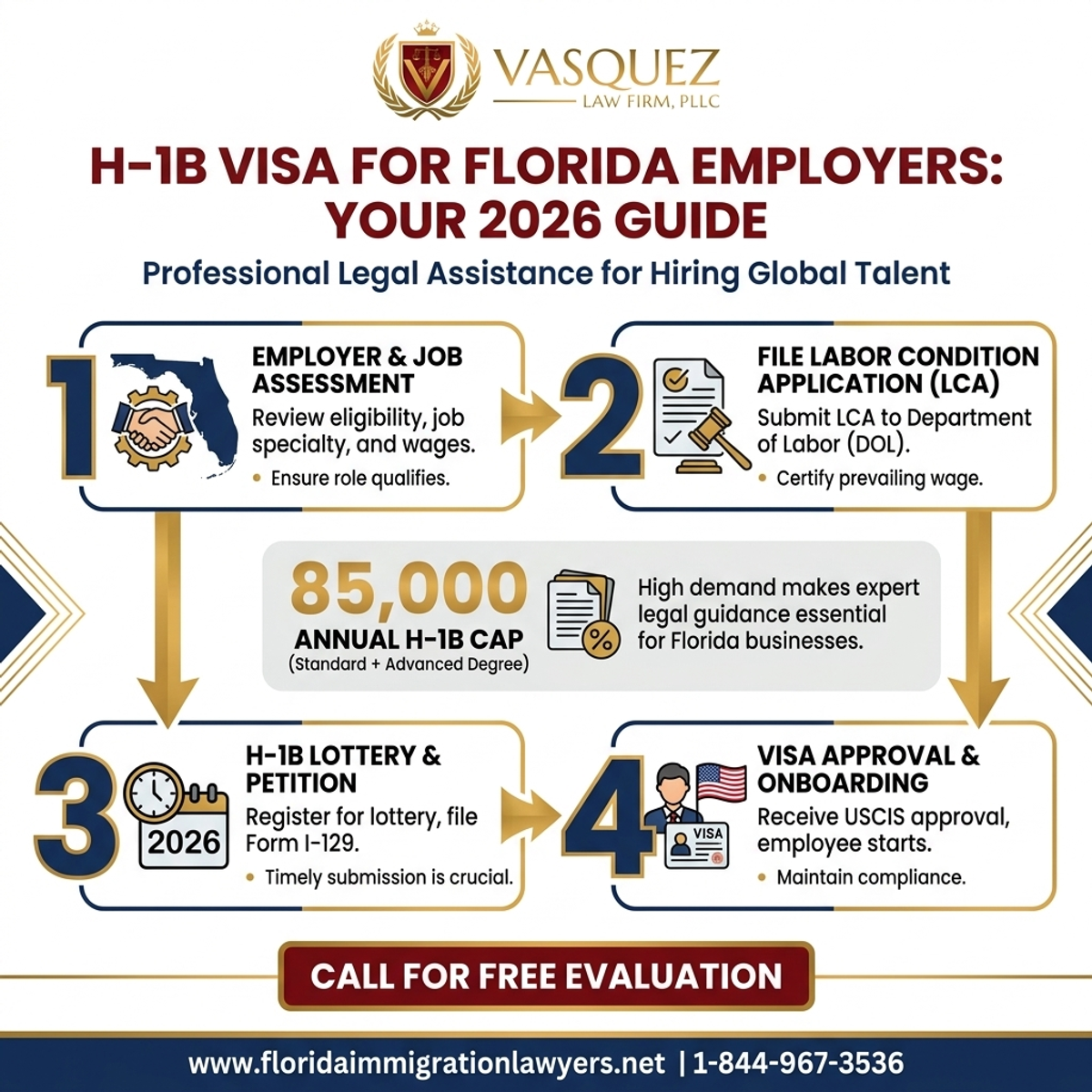
Key Statistics — H-1B Visa for Florida Employers: Your 2026 Guide
Do not navigate this process alone. Contact Florida Immigration Lawyers today for expert guidance on your H-1B visa petition. We offer comprehensive support to employers across Florida.
Common Mistakes to Avoid When Sponsoring an H-1B Visa
Navigating the H-1B visa process can be fraught with potential missteps that can lead to delays, denials, or even long-term complications. Florida employers must be vigilant to avoid these common mistakes:
- Failing to Meet the Specialty Occupation Requirement: The job must genuinely require a bachelor's degree in a specific field. Offering an H-1B for a position that does not meet this standard is a common reason for RFE or denial.
- Incorrect Prevailing Wage Determination: Not paying the H-1B worker at least the prevailing wage for the occupation in the geographic area of employment (e.g., Orlando, FL) can result in an RFE or audit.
- Incomplete or Inaccurate LCA (Labor Condition Application): Errors on the LCA, or failure to certify it properly with the Department of Labor, can invalidate the entire H-1B petition.
- Missing H-1B Lottery Registration Deadline: For cap-subject petitions, missing the short electronic registration window means waiting another year. This is a critical, immutable deadline.
- Insufficient Documentation: Submitting a petition without all required evidence, such as educational transcripts, experience letters, or financial statements, will almost certainly lead to an RFE.
- Incorrectly Calculating Degree Equivalency: If the beneficiary's foreign education or work experience is being used to equate to a U.S. bachelor's degree, precise calculation and expert evaluation are essential.
- Not Maintaining a Public Access File: Employers are legally required to maintain a public access file for each H-1B worker. Failure to do so can result in penalties.
- Assuming Automatic Approval After Lottery Selection: Selection in the lottery only grants the right to file. The petition still needs to be thoroughly prepared and approved by USCIS.
- Failing to Respond to RFEs on Time: If USCIS issues a Request for Evidence, a timely and comprehensive response is critical. A firm that has gone quiet on you after an RFE may jeopardize your case; seeking new counsel promptly is essential.
- Not Considering Visa Portability: For H-1B workers already in the U.S., employers can often file for a transfer, allowing the employee to start working for the new employer upon filing, rather than waiting for approval.
- Lack of Attorney Review: Attempting to navigate the complex H-1B process without experienced legal counsel significantly increases the risk of errors and denials.
When to Call a Florida Immigration Lawyer for H-1B Sponsorship
The H-1B visa process is intricate, with numerous legal requirements and strict deadlines that can easily overwhelm even experienced HR departments. Engaging a Florida immigration lawyer is not just advisable; it's often essential for ensuring a successful outcome and maintaining compliance. You should consider calling an attorney from Florida Immigration Lawyers at several key junctures.
Firstly, if you are a Florida employer considering sponsoring an H-1B visa for the first time, or if your business has unique circumstances, such as being a startup or having an unusual specialty occupation, legal counsel is invaluable. An attorney can help you assess eligibility, determine the correct prevailing wage, and strategize for the H-1B lottery. Secondly, if you receive a Request for Evidence (RFE) or a Notice of Intent to Deny (NOID) from USCIS, immediate legal intervention is critical. These notices indicate that USCIS has concerns about your petition, and a skilled attorney can help formulate a robust and timely response. If you just received an RFE and your current firm has gone quiet on you, or you need a firm that can take the case over and respond within the deadline, contacting us immediately is crucial.
Furthermore, if you are dealing with complex H-1B transfers, amendments due to changes in employment, or if an H-1B employee is facing deportation defense issues, an experienced immigration lawyer is indispensable. Our team at Florida Immigration Lawyers specializes in business immigration and is well-versed in the latest H-1B regulations and USCIS policies, including those affecting workers in Central Florida. We can provide the expertise needed to navigate these challenges, offering peace of mind and protecting your business interests. Don't risk costly delays or denials; let us guide you through every step of the H-1B sponsorship process.
About Florida Immigration Lawyers
Florida Immigration Lawyers is a leading law firm dedicated to providing exceptional immigration services to individuals and businesses across all of Florida. With our deep understanding of U.S. immigration law and a commitment to client success, we stand ready to assist employers in Orlando and throughout Central Florida with their complex H-1B visa sponsorship needs. Our experienced attorneys offer personalized legal strategies, meticulous case preparation, and zealous advocacy to help you navigate the intricacies of the immigration system.
We pride ourselves on being available 24/7 for our clients, offering free case reviews to discuss your specific situation and outline the best path forward. Whether you are a large corporation or a growing small business, our team at Florida Immigration Lawyers is equipped to handle all aspects of H-1B petitions, from initial eligibility assessment and lottery registration to RFE responses and visa interviews. We are fluent in both English and Spanish, ensuring clear communication and culturally sensitive support. Call us today at 1-844-YO-PELEO to experience dedicated and effective legal representation for all your immigration matters.
Sources and References
- U.S. Citizenship and Immigration Services (USCIS)
- U.S. Department of State
- Executive Office for Immigration Review (EOIR)
- Immigration and Nationality Act (INA), 8 U.S.C. § 1101 et seq.
- 8 CFR Part 214 - Nonimmigrant Classes
- 20 CFR Part 655 - Labor Condition Applications and Requirements for Employers Seeking to Employ Nonimmigrant Workers in Specialty Occupations and as Fashion Models
Related services: H-1B specialty occupation visas, L-1 intracompany transfer visas, work visas for professionals, investment and entrepreneur visas.
This article provides general legal information and is not intended as legal advice. Every case is unique, and outcomes depend on specific facts and circumstances. Contact an attorney for advice about your particular situation.
Don't leave your H-1B visa sponsorship to chance. Secure expert legal representation for your Florida business. Call Florida Immigration Lawyers now at 1-844-YO-PELEO for your free consultation. Se Habla Espanol - Estamos aqui para ayudarle.
Do Not Navigate This Process Alone
Our experienced immigration attorneys are ready to fight for you. Get a free, confidential case review today.
Se Habla Español
Or leave your details and we’ll call you:
Free Evaluation in 24 Hours
Or talk to us right now
AI voice assistant — available 24/7
FreeFrequently Asked Questions

William J. Vásquez
Founding Attorney · Vasquez Law Firm
U.S. Air Force veteran and immigration attorney with years of hands-on U.S. immigration experience. J.D., NCCU School of Law. AILA member. Admitted to the 4th, 5th, and 11th Circuit Courts.
Available 24/7 - Free Evaluations
Reviewed for legal accuracy by William J. Vásquez
Licensed in North Carolina; U.S. immigration is federal practice.
Related Legal Services
Our Florida immigration attorneys can help you with citizenship and naturalization, immigration practice areas and free immigration consultation. Call today at 1-844-YO-PELEO for a free case review.
Related Links
Related Topics
Free Legal Case Review
Discuss your case with our experienced attorneys. We're available 24/7.
Se Habla Español - Estamos aquí para ayudarle.
Related Articles
Certificate of Eligibility for Expungement in Florida 2026
For non-U.S. citizens in Florida, understanding how a state expungement impacts immigration status is critical. A certificate of eligibility for expungement in Florida allows a criminal record to be sealed or expunged under state law. However, federal immigration agencies often disregard such state-level relief, still considering the original criminal offense as a conviction for immigration purposes. This can have severe implications for visa applications, green card eligibility, naturalization, and even lead to deportation. This guide clarifies the Florida expungement process, its limited effect on federal immigration law, and key steps to protect your status in 2026. Learn about common mistakes, required documents, timelines, and when to seek expert legal counsel from Florida Immigration Lawyers to navigate these complex issues effectively.
Immigration Lawyer Orlando Free Consultation in Florida
For individuals and families in Orlando, Florida, navigating the complexities of U.S. immigration law requires expert guidance. An immigration lawyer in Orlando offers crucial support for everything from visa applications and green card processes to naturalization and deportation defense. This comprehensive guide details what a free consultation covers, providing a step-by-step overview of immigration pathways, essential document checklists, and expected timelines in 2026. We also highlight common mistakes to avoid, discuss the critical role of legal counsel in deportation and asylum cases, and explain why choosing a local Orlando immigration attorney is beneficial. Florida Immigration Lawyers is dedicated to serving the diverse community of Orlando with compassionate, effective legal solutions, ensuring you receive personalized advice and robust representation for a successful immigration journey.
Immigration Backlog Solutions in Florida for 2026
Explore the immigration backlog solutions in Florida. Understand USCIS delays, processing times, and how to navigate this complex system effectively. Call Florida Immigration Lawyers at 1-844-YO-PELEO for a free consultation.
Citizenship Test Preparation in Florida: Key Steps
Applying for U.S. citizenship in Florida? Discover essential steps for preparing for the citizenship test, including what documents you'll need, typical timelines, and common mistakes to avoid. Whether you're in Orlando or other parts of the state, understanding this process can ease your path to becoming a naturalized citizen. Contact Florida Immigration Lawyers for personalized assistance.