H-1B Fraud Prevention Detection Fee 2026: Florida Impact
The H-1B Fraud Prevention and Detection Fee for 2026 is a critical aspect of U.S. immigration compliance for employers. This fee supports efforts to combat fraud, a serious issue that can lead to inadmissibility for individuals. For those in Florida facing a finding of fraud or misrepresentation, an I-601 waiver offers a pathway to overcome inadmissibility by demonstrating extreme hardship to a qualifying U.S. citizen or LPR relative. This article provides a detailed guide to understanding the H-1B fee, the definition and consequences of immigration fraud, the eligibility requirements and step-by-step process for an I-601 waiver, including document checklists, typical costs, and processing times. We also highlight common mistakes to avoid and when to seek professional legal assistance from Florida Immigration Lawyers to navigate these complex challenges successfully.
The H-1B Fraud Prevention and Detection Fee for 2026 is a mandatory fee paid by employers filing H-1B petitions, primarily to fund USCIS efforts to combat fraud and misrepresentation within the H-1B program. While directly related to H-1B visas, this fee underscores the broader U.S. immigration system's commitment to integrity, a principle that also governs situations requiring a fraud waiver like the I-601. For individuals in Florida facing inadmissibility due to past misrepresentation, understanding these fraud prevention measures is crucial, as is knowing how to seek a waiver to overcome such bars to immigration.
- The H-1B Fraud Prevention and Detection Fee helps fund anti-fraud initiatives.
- It is a mandatory fee for most new and some transfer H-1B petitions.
- Immigration fraud can lead to severe consequences, including inadmissibility.
- An I-601 waiver may be available for certain types of past misrepresentation.
- Legal guidance is essential for both H-1B compliance and fraud waiver applications.
Introduction: Navigating Immigration Integrity in Florida
Immigration law in the United States is complex, with stringent rules designed to maintain the integrity of the system. For employers in Florida, including those in dynamic areas like Hialeah, understanding fees like the H-1B Fraud Prevention and Detection Fee for 2026 is vital for compliance. This fee is a direct reflection of the government's ongoing commitment to identify and prevent immigration fraud. However, what happens when an individual has already been found to have committed fraud or misrepresentation in a past immigration application? This often leads to inadmissibility, a serious hurdle to obtaining a visa or green card.
This comprehensive guide from Florida Immigration Lawyers will delve into the H-1B Fraud Prevention and Detection Fee, its purpose, and its implications for employers. More importantly, we will explore the critical process of obtaining a fraud waiver, specifically the I-601 waiver, for individuals in Florida who are deemed inadmissible due to past misrepresentation. We will cover eligibility, the application process, required documentation, potential costs, and crucial timelines, offering actionable insights for those navigating these challenging circumstances. Understanding these provisions is key to safeguarding your immigration journey or that of your employees.
Do not let the complexities of immigration law or past issues of misrepresentation deter your future. For personalized guidance and a free consultation, call Florida Immigration Lawyers at 1-844-YO-PELEO today. We are here to help you understand your options and pursue the best path forward.
What is the H-1B Fraud Prevention and Detection Fee for 2026?
As of 2026, the H-1B Fraud Prevention and Detection Fee is a specific charge assessed by U.S. Citizenship and Immigration Services (USCIS) on certain H-1B petitions. This fee is designed to fund investigations into potential fraud and misrepresentation in the H-1B visa program, ensuring that only legitimate petitions are approved. It was established under the H-1B Visa Reform Act of 2004 and has been a cornerstone of efforts to maintain the integrity of the H-1B program ever since.
The fee applies to initial H-1B petitions for new employment, H-1B petitions for concurrent employment, and H-1B petitions filed by a new employer for an H-1B worker already in the U.S. (a "cap-exempt" transfer). It does not typically apply to H-1B extensions with the same employer. The amount of the fee is subject to change based on legislative action, but its purpose remains constant: to provide resources for USCIS and Department of Labor (DOL) to conduct site visits, verify information, and investigate suspicious activities related to H-1B employment. This proactive measure reflects the U.S. government's broad strategy to prevent immigration fraud, which extends beyond H-1B visas to all immigration benefits.
Understanding Immigration Fraud and Misrepresentation in Florida
Immigration fraud and misrepresentation are serious offenses under U.S. immigration law, specifically outlined in Section 212(a)(6)(C)(i) of the Immigration and Nationality Act (INA). This section states that any alien who, by fraud or willfully misrepresenting a material fact, seeks to procure (or has sought to procure or has procured) a visa, other documentation, or admission into the United States or other benefit provided under the INA is inadmissible. A "material fact" is generally one that would have influenced the decision of the immigration officer.
The consequences of such a finding are severe, often resulting in permanent inadmissibility to the U.S., denial of current and future immigration benefits, and even deportation. For individuals living in Florida, especially in areas with large immigrant populations like Hialeah, Miami, and Orlando, understanding what constitutes fraud or misrepresentation is crucial. USCIS offices in Florida, such as those in Miami and Orlando, and immigration courts across the state, including the Miami Immigration Court, regularly deal with cases involving allegations of fraud. The government's increased focus on immigration enforcement, as highlighted by recent trends in federal correctional control and detention policies, means that allegations of fraud are investigated rigorously, making it imperative for individuals to seek experienced legal counsel immediately if such an issue arises. An allegation of fraud can arise from something as seemingly minor as a misstated date or an omission on an application, emphasizing the need for precision and honesty in all immigration matters.
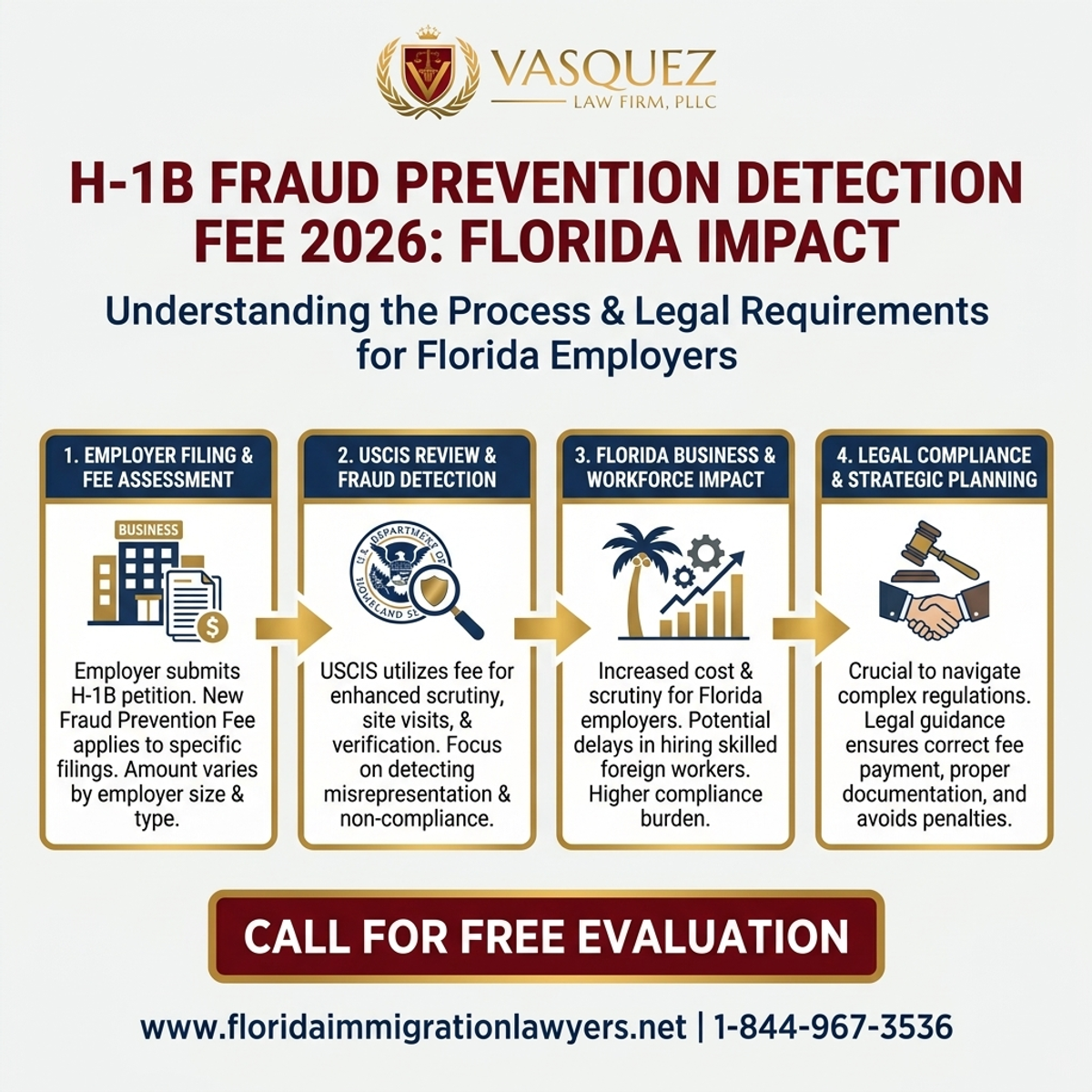
Step-by-Step Process — H-1B Fraud Prevention Detection Fee 2026: Florida Impact
What is an I-601 Fraud Waiver and Who is Eligible?
An I-601 fraud waiver, formally known as an Application for Waiver of Grounds of Inadmissibility, is a crucial legal pathway for individuals who have been found inadmissible to the United States due to certain grounds, including a finding of fraud or willful misrepresentation of a material fact under INA 212(a)(6)(C)(i). This waiver allows an otherwise inadmissible individual to overcome this bar and proceed with their immigration process, typically for a green card or visa.
Eligibility for an I-601 fraud waiver is highly specific and primarily hinges on demonstrating "extreme hardship" to a qualifying U.S. citizen or lawful permanent resident (LPR) relative. A qualifying relative can be a U.S. citizen or LPR spouse or parent. Importantly, a U.S. citizen or LPR child is generally not considered a qualifying relative for this specific waiver. The applicant must prove that their qualifying relative would suffer extreme hardship if the applicant were denied admission to the U.S. or if the qualifying relative had to relocate to the applicant's home country. This "extreme hardship" goes beyond the normal difficulties associated with family separation and must be thoroughly documented. For families across Florida, from Jacksonville to the Keys, who are facing this challenging situation, understanding the strict requirements for extreme hardship is the first critical step.
The Step-by-Step Process for Filing an I-601 Waiver in 2026
Filing an I-601 waiver is a detailed and often lengthy process that requires meticulous preparation. As of 2026, the general steps remain consistent, though processing times and specific evidentiary requirements can evolve. Navigating this process successfully, especially for those in Florida, demands careful attention to detail and a thorough understanding of immigration law. Here's a general outline of the steps:
-
Determine Inadmissibility and Eligibility: Before filing, you must first be found inadmissible (e.g., by USCIS or a Consular Officer) and confirm that an I-601 waiver is the appropriate remedy for your specific ground of inadmissibility, which in this context is fraud or misrepresentation. You must also identify a qualifying U.S. citizen or LPR spouse or parent who would suffer extreme hardship.
-
Gather Comprehensive Evidence of Extreme Hardship: This is the most critical step. You must collect extensive documentation proving that your qualifying relative would suffer extreme hardship if you were denied admission or if they had to move abroad. This includes medical records, financial documents, psychological evaluations, educational impacts, country conditions reports, and affidavits.
-
Complete Form I-601, Application for Waiver of Grounds of Inadmissibility: Accurately fill out the form, ensuring all sections are completed and signed correctly. Any errors or omissions can lead to delays or denial. The form must be accompanied by the appropriate filing fee, which, as with all USCIS fees, is subject to change.
-
Prepare a Detailed Legal Brief: Your attorney will prepare a persuasive legal brief that synthesizes all the evidence, articulates the extreme hardship argument, and references relevant legal statutes and precedents (e.g., INA 212(a)(6)(C)(i), 8 CFR 212.7). This brief is crucial for effectively presenting your case to USCIS.
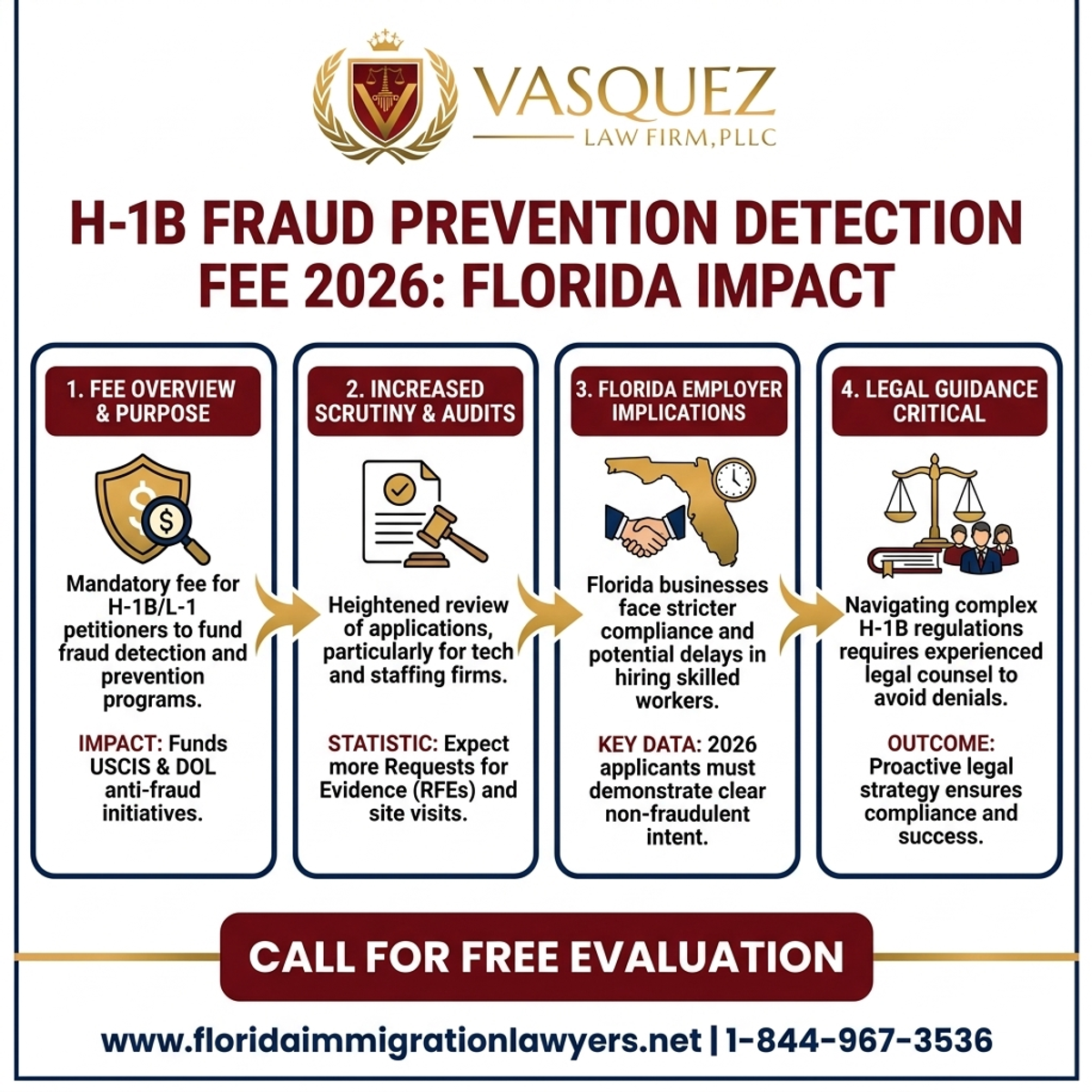
Key Statistics — H-1B Fraud Prevention Detection Fee 2026: Florida Impact
-
File the Application with USCIS: The filing location depends on whether you are applying from within the U.S. (e.g., as part of an adjustment of status application) or from abroad (e.g., after an immigrant visa interview at a U.S. consulate). For those in Florida, if applying domestically, it would typically be filed with the appropriate USCIS lockbox facility.
-
Attend Biometrics Appointment: After filing, you will receive a notice for a biometrics appointment at a local Application Support Center (ASC), such as those in Hialeah or Fort Myers, where your fingerprints, photograph, and signature will be collected for background checks.
-
Await Decision: USCIS will review your application and evidence. They may issue a Request for Evidence (RFE) if more information is needed. A decision can take many months, or even over a year, depending on the service center's workload and the complexity of the case. Be prepared for a potentially long waiting period.
Required Documents for a Successful Fraud Waiver Application
A successful I-601 fraud waiver application hinges on submitting a comprehensive and compelling package of evidence. The burden of proof lies entirely with the applicant to demonstrate extreme hardship to their qualifying relative. Here is a checklist of typical documents and evidence required, applicable to applicants across Florida and beyond:
- Completed and signed Form I-601, Application for Waiver of Grounds of Inadmissibility.
- Proof of relationship to the qualifying U.S. citizen or LPR spouse or parent (e.g., marriage certificate, birth certificate).
- Affidavits from the qualifying relative detailing the extreme hardship they would suffer.
- Affidavits from other individuals (e.g., family, friends, employers, medical professionals) corroborating the hardship claims.
- Medical records and evaluations for the qualifying relative, detailing any physical or mental health conditions that would be exacerbated by separation or relocation.
- Financial documents, including tax returns, pay stubs, mortgage statements, utility bills, and proof of debts, to demonstrate financial hardship.
- Evidence of the qualifying relative's responsibilities for dependents, aging parents, or special needs children.
- Psychological evaluations for the qualifying relative, demonstrating severe emotional or psychological distress.
- Country conditions reports for the applicant's home country, detailing any safety, economic, medical, or political instability that would make relocation difficult or dangerous for the qualifying relative.
- Educational records for the qualifying relative or their dependents, showing disruption to schooling.
- Proof of the applicant's rehabilitation or positive contributions to the community, if applicable.
- Any other evidence that supports the claim of extreme hardship, tailored to the specific circumstances of the case.
Organizing these documents thoroughly and presenting them clearly is essential for a strong application. An experienced immigration attorney can help you identify, gather, and present the most relevant and persuasive evidence for your unique situation.
What are the Typical Costs and Processing Times for an I-601 Waiver?
Understanding the financial and temporal commitments involved in an I-601 fraud waiver application is crucial for planning. As of 2026, these factors can vary significantly based on individual circumstances and USCIS processing loads. While specific filing fees are set by USCIS and are subject to change, attorney fees depend on the complexity of the case and the legal services required. It is always best to check the official USCIS website for the most current fee schedule.
Typical Fee Breakdown for I-601 Waiver (as of 2026)
| Item | Typical Fee (Estimate) | Notes |
|---|---|---|
| USCIS I-601 Filing Fee | $930 (subject to change) | Mandatory government fee for processing the application. |
| Attorney Fees | Varies significantly ($4,000 - $10,000+) | Depends on complexity, evidence gathering, legal research, brief writing, and firm's expertise. |
| Psychological Evaluation | $500 - $2,000+ | Often crucial for extreme hardship claims; fee for licensed professional. |
| Translation Services | Varies ($25 - $50 per page) | Required for any document not in English. |
| Postage/Courier Fees | Minimal | For sending application package securely. |
Typical Processing Times for I-601 Waiver (as of 2026)
| Stage | Typical Timeframe | Notes |
|---|---|---|
| Preparation & Evidence Gathering | 2-6 months | Highly dependent on applicant's ability to collect documents and lawyer's guidance. |
| USCIS Receipt Notice | 2-4 weeks after filing | Confirmation that USCIS received your application. |
| Biometrics Appointment | 1-2 months after receipt | Scheduled at a local Application Support Center (ASC) in Florida. |
| USCIS Processing Time | 12-36 months (or more) | Varies significantly by service center and individual case complexity. Check USCIS processing times for current estimates. |
| Decision | Upon completion of processing | Approval, denial, or Request for Evidence (RFE). |
These timeframes are estimates. The actual processing time can be influenced by the completeness of your application, the volume of cases at USCIS, and any unforeseen issues. Patience and diligent follow-up are essential throughout this process. For current processing times, always consult the official USCIS website.
Navigating Complex Fraud Allegations and Appeals in Florida
Dealing with a finding of immigration fraud or misrepresentation can be one of the most challenging aspects of immigration law. The stakes are incredibly high, as such findings often lead to permanent inadmissibility and can derail an individual's entire immigration journey. In Florida, where a significant portion of immigration cases are handled, navigating these complex allegations requires a deep understanding of legal nuances, including the specific grounds for inadmissibility under the INA and the various avenues for relief.
If USCIS denies an I-601 waiver, or if a consular officer finds you inadmissible for fraud, you may have options for appeal or reconsideration. The Board of Immigration Appeals (BIA), an administrative body within the Executive Office for Immigration Review (EOIR), reviews appeals of decisions made by immigration judges and certain decisions made by DHS. For denials from USCIS, depending on the context, there might be options for a motion to reopen or reconsider, or in some limited circumstances, federal court review. The legal landscape surrounding fraud allegations is continuously evolving, with new precedents and policy updates issued regularly. This complexity underscores why having a skilled immigration attorney is not just beneficial, but often indispensable, especially when facing a formal finding of fraud or misrepresentation. They can assess the strength of the evidence against you, identify potential defenses, and formulate the most effective strategy to challenge the findings or pursue all available waivers and appeals.
Do not navigate this process alone. Contact Florida Immigration Lawyers today at 1-844-YO-PELEO for a free consultation.
Common Mistakes to Avoid in Fraud Waiver Applications
Applying for an I-601 fraud waiver is fraught with potential pitfalls. Avoiding these common mistakes can significantly improve your chances of a successful outcome:
-
Underestimating "Extreme Hardship": Many applicants fail to provide sufficient evidence that their qualifying relative would suffer "extreme hardship" beyond normal separation. This is the most common reason for denial. You must demonstrate hardship that is truly exceptional and goes beyond typical emotional or financial difficulties.
-
Failing to Prove Materiality: Sometimes, an applicant might concede misrepresentation but fail to argue that the misrepresented fact was not material to the immigration benefit sought. This is a complex legal argument that requires expert analysis.
-
Incomplete or Inconsistent Documentation: Submitting an application with missing forms, unsigned documents, or inconsistencies between different pieces of evidence can lead to RFEs, delays, or outright denial. Every detail matters.
-
Lack of Corroborating Evidence: Relying solely on your own statements or those of your qualifying relative without independent corroborating evidence (e.g., medical records, financial statements, expert evaluations) weakens your case considerably.
-
Failing to Disclose All Relevant Information: Attempting to hide past issues or provide incomplete information, even if unintentional, can be perceived as further misrepresentation, severely jeopardizing your case and potentially leading to permanent bars.
-
Not Addressing the Fraud Finding Directly: Some applicants focus only on hardship without adequately addressing the original finding of fraud or misrepresentation. A strong application acknowledges and rebuts the fraud finding where possible, or clearly explains the circumstances.
-
Submitting a Generic Application: Each I-601 waiver case is unique. Using generic templates or failing to tailor the application to your specific facts and circumstances will result in a weak submission that is unlikely to succeed.
-
Missing Deadlines: Failing to respond to Requests for Evidence (RFEs) or other USCIS notices by the specified deadline will almost certainly lead to a denial of the application.
-
Not Seeking Legal Counsel: Attempting to navigate the complexities of fraud waivers without an experienced immigration attorney is a significant risk. Attorneys understand the legal standards, evidentiary requirements, and procedural nuances.
-
Ignoring Country Conditions: For cases involving relocation hardship, failing to provide detailed and current country conditions reports that demonstrate the specific difficulties the qualifying relative would face abroad can undermine the extreme hardship claim.
When to Call a Lawyer for Immigration Fraud and Waiver Cases
The moment you suspect an issue related to immigration fraud or misrepresentation, or if you are considering applying for an I-601 waiver, it is imperative to contact an experienced immigration attorney. These cases are among the most challenging in immigration law, with severe, often permanent, consequences for errors. You should call Florida Immigration Lawyers immediately if:
- You have been accused of fraud or misrepresentation by USCIS, a consular officer, or an immigration judge.
- You have received a Request for Evidence (RFE) or Notice of Intent to Deny (NOID) related to fraud or inadmissibility.
- You were denied a visa or green card due to a finding of fraud or misrepresentation.
- You believe you may be inadmissible to the U.S. due to past actions or statements and need to determine if a waiver is an option.
- Your qualifying relative (U.S. citizen or LPR spouse/parent) is experiencing or would experience extreme hardship if you were denied admission.
- You are an employer in Florida facing compliance issues or audits related to the H-1B Fraud Prevention and Detection Fee.
- You need to appeal a denial of an I-601 waiver or an inadmissibility finding.
Florida Immigration Lawyers focuses on complex waiver cases and can provide the strategic guidance needed to build a strong defense or waiver application. We understand the local context of immigration challenges in Florida, including the specific requirements and procedures at USCIS offices and immigration courts in areas like Hialeah, Miami, and Orlando. Our team is dedicated to protecting your rights and fighting for your ability to remain in or come to the United States.
About Florida Immigration Lawyers
Florida Immigration Lawyers is an immigration law firm dedicated to serving individuals, families, and businesses across the entire state of Florida. With a deep understanding of U.S. immigration laws and policies, our experienced attorneys provide compassionate, effective, and strategic legal representation. We pride ourselves on offering personalized attention, ensuring every client's unique situation is thoroughly understood and addressed. From complex fraud waivers and deportation defense to family-based petitions, asylum claims, and business immigration, we handle a comprehensive range of immigration matters.
Our firm is committed to empowering our clients with knowledge and advocating tirelessly on their behalf. We offer free consultations to discuss your case and are available 24/7 to provide support when you need it most. Choose Florida Immigration Lawyers for dedicated advocacy, clear communication, and a steadfast commitment to achieving the strongest possible outcome for your immigration journey. Contact us today at 1-844-YO-PELEO or visit www.floridaimmigrationlawyers.net.
Sources and References
- U.S. Citizenship and Immigration Services (USCIS)
- Executive Office for Immigration Review (EOIR)
- U.S. Department of State (Travel.State.Gov)
- Immigration and Nationality Act (INA) Section 212(a)(6)(C)(i) - Misrepresentation
- 8 U.S.C. Chapter 12 - Immigration and Nationality Act
- 8 CFR 212.7 - Waiver of certain grounds of inadmissibility
- H-1B Visa Reform Act of 2004
- USCIS Policy Manual
Related services: immigration practice areas, family immigration services.
This article provides general legal information and is not intended as legal advice. Every case is unique, and outcomes depend on specific facts and circumstances. Contact an attorney for advice about your particular situation.
Secure Your Immigration Future Today
Navigating the intricacies of immigration law, whether it involves H-1B fees or complex fraud waivers, requires legal assistance. Do not leave your future to chance. The dedicated team at Florida Immigration Lawyers is ready to provide the experienced guidance and representation you need. Contact us for a free consultation and let us help you achieve your immigration goals. Call 1-844-YO-PELEO now. Se Habla Español - Estamos aqui para ayudarle.
If you need legal assistance, learn more about Florida immigration legal team, or call us at 1-844-YO-PELEO for a free consultation.
Do Not Navigate This Process Alone
Our experienced immigration attorneys are ready to fight for you. Get a free, confidential case review today.
Se Habla Español
Or leave your details and we’ll call you:
Free Evaluation in 24 Hours
Or talk to us right now

AI voice assistant — available 24/7
FreeFrequently Asked Questions

William J. Vásquez
Founding Attorney · Vasquez Law Firm
U.S. Air Force veteran and immigration attorney with years of hands-on U.S. immigration experience. J.D., NCCU School of Law. AILA member. Admitted to the 4th, 5th, and 11th Circuit Courts.
Available 24/7 - Free Evaluations
Reviewed for legal accuracy by William J. Vásquez
Licensed in North Carolina; U.S. immigration is federal practice.
Related Legal Services
Our Florida immigration attorneys can help you with free immigration consultation, business immigration and deportation defense. Call today at 1-844-YO-PELEO for a free case review.
Related Links
Related Topics
Free Legal Case Review
Discuss your case with our experienced attorneys. We're available 24/7.
Se Habla Español - Estamos aquí para ayudarle.
Related Articles
Immigration Lawyer Orlando Free Consultation in Florida
For individuals and families in Orlando, Florida, navigating the complexities of U.S. immigration law requires expert guidance. An immigration lawyer in Orlando offers crucial support for everything from visa applications and green card processes to naturalization and deportation defense. This comprehensive guide details what a free consultation covers, providing a step-by-step overview of immigration pathways, essential document checklists, and expected timelines in 2026. We also highlight common mistakes to avoid, discuss the critical role of legal counsel in deportation and asylum cases, and explain why choosing a local Orlando immigration attorney is beneficial. Florida Immigration Lawyers is dedicated to serving the diverse community of Orlando with compassionate, effective legal solutions, ensuring you receive personalized advice and robust representation for a successful immigration journey.
EAD Advance Parole Combo Card in Florida 2026
For individuals with a pending Form I-485, Application to Register Permanent Residence or Adjust Status, the EAD Advance Parole Combo Card is an essential document. This single card combines the authorization to work legally in the U.S. (Employment Authorization Document - EAD) with permission to travel internationally and re-enter without abandoning your green card application (Advance Parole). This guide from Florida Immigration Lawyers provides a comprehensive overview for applicants in Florida in 2026, covering eligibility, the step-by-step application process, required documents, expected processing times, and associated costs. We also highlight common mistakes to avoid and when to seek legal counsel to ensure a smooth and successful immigration journey. Understanding this vital card is key to maintaining stability while awaiting your permanent residency approval.
Consular Processing Lawyer for Florida Applicants
Consular processing is crucial for Florida applicants seeking immigrant visas. This guide covers every step from submitting an application to attending the embassy interview. Learn about document requirements, timelines, and common mistakes to avoid. Consult a lawyer for personalized assistance.
Immigration Rights: Know Your Legal Protections in Florida
Navigating immigration law in Florida requires a thorough understanding of your legal rights, especially when facing potential interactions with ICE. This guide from Florida Immigration Lawyers provides crucial information on constitutional protections, what to do during an ICE encounter, and the steps involved in the deportation process. Learn about your right to remain silent, the importance of legal counsel, and how to prepare essential documents. We also cover common mistakes to avoid, timelines for immigration court, and the costs associated with legal representation. Empower yourself with knowledge and ensure your family's safety by understanding your legal standing in Florida. Our firm offers dedicated support and free case reviews for residents across the state.