H-2B Visa for Hospitality in Florida: A 2026 Guide
Discover how the H-2B visa supports Florida's hospitality industry by allowing employers to hire foreign workers for seasonal jobs. Learn about the application process, timelines, and common pitfalls to avoid.

The H-2B visa is crucial for Florida's hospitality industry, allowing employers to hire foreign seasonal workers for non-agricultural jobs. Key points include:
- The H-2B visa supports non-agricultural seasonal work.
- Ideal for Florida's hospitality sector.
- 2026 updates include new processing timelines.
- Employers must demonstrate a lack of U.S. workers.
- Contact Florida Immigration Lawyers for assistance.
Introduction
Imagine a bustling Jacksonville hotel, fully booked for the summer, struggling to find enough staff to meet customer demands. This scenario is common in Florida, where the hospitality industry plays a vital role in the economy. The H-2B visa program helps bridge this employment gap by allowing employers to hire foreign seasonal workers for non-agricultural jobs. This guide will provide an in-depth look at the H-2B visa process, focusing on its application within Florida's hospitality sector.
Florida's vibrant tourism sector, from the theme parks of Orlando to the pristine beaches of Miami, relies heavily on a robust workforce to maintain its world-class service standards. However, the seasonal nature of this demand often creates significant staffing challenges for hotels, resorts, restaurants, and other hospitality businesses. The H-2B visa offers a critical solution, allowing these businesses to supplement their workforce during peak seasons when domestic labor is insufficient.
Understanding the intricacies of the H-2B program is paramount for Florida employers looking to leverage this vital resource. The regulations are complex and constantly evolving, with new processing timelines and eligibility requirements, especially as we look towards 2026. This guide aims to demystify the process, offering practical insights and highlighting the importance of expert legal counsel to ensure compliance and success.
Call Florida Immigration Lawyers at 1-844-967-3536 for a free consultation.
What is the H-2B Visa and Who Qualifies?
The H-2B visa allows U.S. employers to bring foreign nationals to the United States for temporary non-agricultural work. As of 2026, the program is essential for industries like hospitality, construction, and landscaping.
To qualify, employers must prove there are not enough U.S. workers who are able, willing, qualified, and available to do the temporary work. The employment must be temporary in nature, such as a one-time occurrence, seasonal need, peak load need, or intermittent need.
For Florida's hospitality sector, the 'seasonal need' and 'peak load need' categories are particularly relevant. For instance, a beachfront resort in South Florida may experience a massive influx of tourists during the winter months and spring break, requiring a temporary surge in housekeeping, culinary, and guest services staff. Similarly, a theme park might need additional ride operators and concession workers exclusively during the summer vacation period. The H-2B visa is designed precisely for these predictable, recurring periods of increased demand.
Employers must meticulously document their efforts to recruit U.S. workers for these positions. This often involves advertising the jobs through various channels, collaborating with state workforce agencies, and demonstrating that despite these efforts, a sufficient number of qualified U.S. workers could not be found. This rigorous recruitment process is a cornerstone of the H-2B program, ensuring that foreign workers are only hired when a genuine labor shortage exists.
Eligibility Criteria
Employers must demonstrate the temporary nature of the job. Workers must be from a country that the U.S. government has deemed eligible for the H-2B program. For a list of eligible countries, visit the USCIS website.
Beyond the temporary nature of the job, employers must also meet specific criteria, including offering prevailing wages for the occupation and geographical area, and providing working conditions that do not adversely affect U.S. workers. This ensures fair competition and prevents the exploitation of foreign labor. The Department of Labor (DOL) plays a crucial role in certifying these conditions, reviewing wage offers, and overseeing the recruitment process to protect both domestic and foreign workers.
For the foreign national, eligibility primarily hinges on having a job offer from a U.S. employer that has successfully navigated the H-2B petition process. Additionally, workers must meet general admissibility requirements to the U.S., which include passing background checks and demonstrating an intent to return to their home country upon the completion of their temporary employment. Consulting with Florida Immigration Lawyers can help both employers and prospective workers understand these complex eligibility requirements.
How to Apply for an H-2B Visa for Hospitality in Florida?
Applying for an H-2B visa involves several steps, starting with the employer. As of 2026, the process includes obtaining a temporary labor certification from the U.S. Department of Labor (DOL).
- Employers file a temporary labor certification application with the DOL.
- Once certified, they submit Form I-129 to USCIS.
- After approval, prospective workers apply for the visa at a U.S. embassy or consulate.
It's important to follow each step carefully to avoid delays. Consult with an attorney to ensure compliance with all regulations.
The first step, obtaining the Temporary Labor Certification from the DOL, is arguably the most critical and time-consuming. This involves filing Form ETA-9142B, which initiates a rigorous recruitment process. Employers must advertise the job openings, engage with state workforce agencies, and actively recruit U.S. workers for a specified period. Only after demonstrating that no qualified and available U.S. workers were found for the positions can the DOL certify the temporary labor need, allowing the employer to proceed to the next stage.
Once the DOL certification is secured, the employer then files Form I-129, Petition for a Nonimmigrant Worker, with U.S. Citizenship and Immigration Services (USCIS). This petition requests approval for the specific foreign workers or a number of unnamed workers. USCIS reviews the employer's eligibility, the temporary nature of the work, and the approved labor certification. Proper documentation, including detailed job descriptions, proof of temporary need, and the DOL certification, is essential for a smooth approval process.
Finally, upon USCIS approval of the I-129 petition, the prospective H-2B workers abroad can apply for their visas at a U.S. embassy or consulate in their home country. This stage typically involves an interview where applicants must demonstrate their eligibility, including their intent to return home after their temporary work in Florida. Working with experienced legal counsel like Florida Immigration Lawyers throughout this multi-stage process significantly increases the chances of a successful outcome and helps navigate any potential challenges.
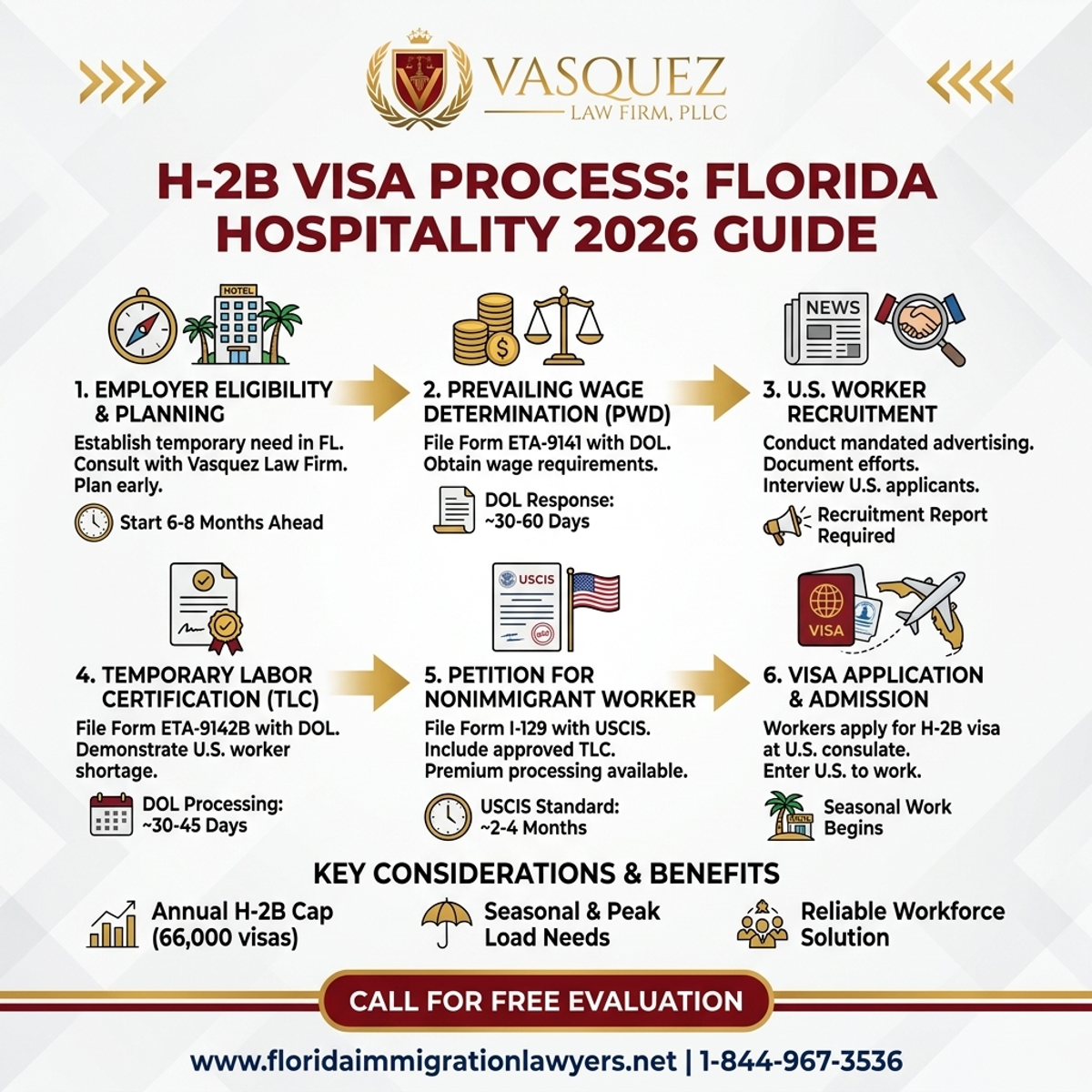
Step-by-Step Process — H-2B Visa for Hospitality in Florida: A 2026 Guide
Document Checklist
- Temporary Labor Certification
- Form I-129
- Proof of the temporary need for workers
- Job offer details
Timeline and Processing Expectations for H-2B Visas
Processing times for H-2B visas can vary. As of 2026, employers can expect the following timelines:
| Stage | Typical Timeframe | Notes |
|---|---|---|
| Labor Certification | 3-4 months | Includes filing and processing |
| USCIS Petition | 2-3 months | Depends on case complexity |
| Visa Application | 1-2 months | Depends on embassy workload |
Expedited Processing
Premium processing is available for an additional fee, which can significantly reduce wait times. Check with USCIS for the latest fees and processing times.
It's crucial for Florida hospitality businesses to plan well in advance, often 6-9 months before their anticipated start date for workers. The H-2B program operates under a statutory cap, limiting the number of visas issued each fiscal year. This cap is often met early, especially for the first half of the fiscal year (October 1 to March 31) and the second half (April 1 to September 30). Missing filing windows due to delays can mean missing out on critical seasonal staff.
For example, a hotel preparing for the busy spring break season in March would ideally begin its labor certification process in August or September of the previous year. Any delays in recruitment or documentation at the DOL stage can push back the entire timeline, potentially impacting the hotel's ability to adequately staff its operations during its peak revenue period. Proactive planning and meticulous attention to deadlines are non-negotiable for H-2B success.
While premium processing can expedite the USCIS petition stage, it does not apply to the DOL labor certification process, which remains the longest and most variable part of the journey. Employers should factor in potential government backlogs, requests for evidence (RFEs) from USCIS, and varying embassy workloads when setting their timelines. Consulting with Florida Immigration Lawyers can help create a realistic timeline and strategy for your specific hiring needs.
Costs and Fees for H-2B Visa Applications
Understanding the costs associated with the H-2B visa is crucial for budgeting. Here is a breakdown of typical fees as of 2026:
| Item | Typical Fee | Notes |
|---|---|---|
| Labor Certification | Varies | Fees depend on case specifics |
| Form I-129 Filing | Varies | Check USCIS for latest fees |
| Visa Application | Varies | Consulate-specific fees |
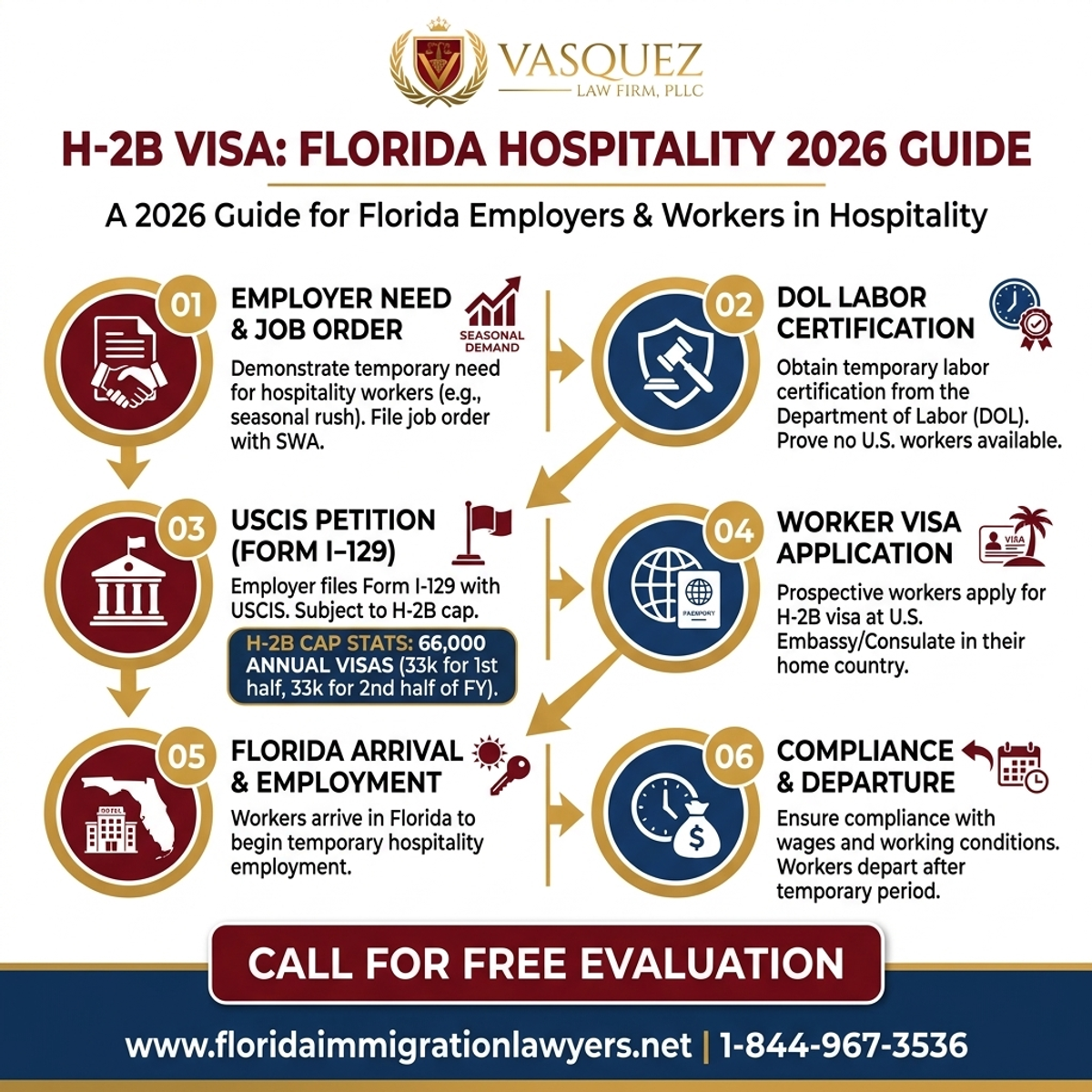
Key Statistics — H-2B Visa for Hospitality in Florida: A 2026 Guide
Employers may also incur additional costs for recruitment and compliance efforts.
Beyond the government filing fees for Form I-129 (which can range from several hundred dollars to over a thousand, plus potential premium processing fees), employers must account for other significant expenses. These include mandatory recruitment advertising costs, which can vary widely depending on the chosen platforms and duration. There are also potential costs associated with obtaining a prevailing wage determination from the DOL, which ensures workers are paid fairly compared to U.S. counterparts in similar roles and regions.
Furthermore, employers often bear the burden of transportation costs for workers traveling to the U.S. and returning home, as well as potential housing assistance or arrangements. Legal fees for experienced immigration counsel, such as Florida Immigration Lawyers, are also a critical investment, ensuring the entire process is handled correctly from start to finish, minimizing risks of denial and costly delays. While these costs can seem substantial, many Florida hospitality businesses find the investment worthwhile to secure reliable seasonal staff and maintain high service standards.
A comprehensive budget should be prepared well in advance, outlining all potential expenses, including government fees, recruitment costs, legal counsel, and any worker support services. This proactive financial planning helps avoid unexpected outlays and ensures that the H-2B program remains a viable and sustainable staffing solution for your business. For precise and up-to-date fee schedules, always refer to the official USCIS and Department of State websites, or consult with an immigration attorney.
Middle CTA
Do not navigate this process alone. Contact Florida Immigration Lawyers today.
Common Mistakes to Avoid in the H-2B Visa Process
Navigating the H-2B visa process can be fraught with potential pitfalls that can lead to significant delays, denials, or even legal repercussions. Employers in Florida's hospitality sector, eager to secure their seasonal workforce, must exercise extreme caution and precision at every stage. Awareness of common mistakes is the first step toward a successful application.
- 1. Improper Documentation: Failing to provide complete and accurate documentation can lead to delays or denials.
- 2. Timing Errors: Missing filing deadlines can result in missed opportunities for hiring workers.
- 3. Inadequate Recruitment: Not demonstrating a thorough effort to recruit U.S. workers can lead to application denial.
- 4. Misunderstanding Temporary Need: Misclassifying the nature of employment can result in denial.
- 5. Ignoring Legal Advice: Not consulting with an immigration lawyer can lead to mistakes that are easily avoidable.
- 6. Overlooking Compliance: Failing to adhere to all employment regulations can result in penalties.
- 7. Incorrect Fee Calculations: Miscalculating fees can result in application delays.
One critical error often involves the recruitment phase for the Temporary Labor Certification. Employers sometimes underestimate the rigor required to prove a lack of U.S. workers, leading to insufficient advertising or documentation of recruitment efforts. Another frequent mistake is misinterpreting the temporary nature of the job, attempting to use H-2B for year-round or permanent positions, which is strictly prohibited and will result in denial. Such errors highlight the importance of meticulous preparation and understanding of the program's core principles.
To mitigate these risks, Florida hospitality businesses should establish a robust internal process for H-2B applications, including dedicated personnel responsible for document collection and deadline tracking. More importantly, partnering with experienced immigration attorneys like Florida Immigration Lawyers can provide an invaluable safeguard. Their expertise ensures that all documentation is accurate, deadlines are met, and the application strategy aligns perfectly with current regulations, significantly reducing the likelihood of common, costly errors.
When to Call a Lawyer for H-2B Visa Issues
While it is possible to apply for an H-2B visa without legal assistance, there are critical situations where a lawyer's help is invaluable. If you face complex situations or legal challenges, such as prior denials or compliance issues, consult a professional immediately.
Beyond initial application challenges, legal counsel becomes indispensable when dealing with Requests for Evidence (RFEs) from USCIS, which often require detailed legal arguments and additional documentation. Similarly, if your application faces a Notice of Intent to Deny (NOID) or an outright denial, an attorney can help you understand the reasons and strategize for an appeal or reapplication. Navigating these complex administrative hurdles without expert guidance can be overwhelming and often unsuccessful.
Furthermore, an immigration lawyer is crucial for ongoing compliance. H-2B employers are subject to various regulations concerning wages, working conditions, and record-keeping. An attorney can help conduct internal audits, ensure adherence to all Department of Labor and USCIS requirements, and represent your business during government audits or investigations. Proactive legal advice from Florida Immigration Lawyers can prevent costly penalties and maintain your eligibility for future H-2B petitions.
Contact Florida Immigration Lawyers at 1-844-967-3536 for expert guidance and support.
About Florida Immigration Lawyers
Florida Immigration Lawyers is a leading immigration law firm dedicated to serving clients across Florida. We specialize in various immigration services, including H-2B visas, family immigration, and deportation defense. Our experienced attorneys provide personalized legal solutions to ensure the best possible outcomes for our clients.
Our firm understands the unique challenges faced by Florida's businesses, particularly within the dynamic hospitality sector. We pride ourselves on offering comprehensive support, from the initial assessment of your temporary labor needs to the successful placement of H-2B workers. Our team stays abreast of the latest immigration policies and cap updates, providing strategic advice that helps employers plan effectively and avoid common pitfalls.
We have a proven track record of assisting numerous Florida businesses in securing their seasonal workforce through the H-2B program. Our commitment extends beyond just filing paperwork; we offer ongoing compliance guidance, audit support, and robust representation in complex cases. When you partner with Florida Immigration Lawyers, you gain a dedicated advocate focused on achieving your staffing goals efficiently and compliantly, allowing you to focus on your core business operations.
Phone: 1-844-967-3536
Website: https://www.floridaimmigrationlawyers.net
Available 24/7, free consultations, serving all of Florida.
Sources and References
- U.S. Citizenship and Immigration Services (USCIS)
- Executive Office for Immigration Review (EOIR)
- 8 U.S.C. Chapter 12 - Immigration and Nationality Act
Related services: immigration practice areas, family immigration services, citizenship and naturalization.
This article provides general legal information and is not intended as legal advice. Every case is unique, and outcomes depend on specific facts and circumstances. Contact an attorney for advice about your particular situation.
Se Habla Espanol - Estamos aqui para ayudarle.
If you need legal assistance, learn more about speak with an immigration lawyer, or call us at 1-844-967-3536 for a free consultation.
Do Not Navigate This Process Alone
Our experienced immigration attorneys are ready to fight for you. Get a free, confidential consultation today.
Se Habla Español
Or leave your details and we’ll call you:
Free Evaluation in 24 Hours
Or talk to us right now
AI voice assistant — available 24/7
FreeFrequently Asked Questions

William J. Vásquez
Founding Attorney · Vasquez Law Firm
U.S. Air Force veteran and immigration attorney with years of hands-on U.S. immigration experience. J.D., NCCU School of Law. AILA member. Admitted to the 4th, 5th, and 11th Circuit Courts.
Available 24/7 - Free Evaluations
Reviewed for legal accuracy by William J. Vásquez
Licensed in North Carolina; U.S. immigration is federal practice.
Related Legal Services
Our Florida immigration attorneys can help you with immigration practice areas, free immigration consultation and experienced immigration attorneys. Call today at 1-844-967-3536 for a free consultation.
Related Links
Related Topics
Free Legal Consultation
Discuss your case with our experienced attorneys. We're available 24/7.
Se Habla Español - Estamos aquí para ayudarle.
Related Articles
K-3 Visa Timeline in Florida: What to Expect
Learn the K-3 visa timeline process in Florida, including steps, costs, and documentation. Understand your options in 2026 with guidance from Florida Immigration Lawyers.
Military Naturalization Expedited in Florida Bases
Explore military naturalization options for families at Florida bases, including parole in place benefits in Miami. Learn how to expedite your application with expert guidance from Florida Immigration Lawyers.
Finding Immigration Legal Help in North Florida
Discover how to find an immigration lawyer in Orlando offering a free consultation. Understand the services available and why choosing Florida Immigration Lawyers can make a difference in your case.
Why is Form N-600 Taking So Long in Florida?
Form N-600 delays are a common challenge for parents seeking citizenship certificates for their children in Florida. Learn about the causes of these delays, ways to expedite the process, and when to seek legal assistance.