H-1B Visa Fee Increase in Florida: What You Need to Know...
The landscape of H-1B visas is evolving, particularly with the recent H-1B visa fee increase set for 2026. This change significantly impacts businesses and foreign professionals across Florida, including Kissimmee. Navigating these new regulations and increased costs can be challenging. Our comprehensive guide explains the latest fee adjustments, their implications, and how to prepare. We cover everything from the updated registration process to the final application steps, ensuring you have the necessary information. Florida Immigration Lawyers are here to provide expert assistance, helping you understand and comply with all new requirements.

The **H-1B visa fee increase**, effective 2026, significantly raises costs for U.S. employers sponsoring foreign workers in specialty occupations. These changes impact registration, petition filing, and premium processing. Understanding these updates is crucial for compliance, especially for businesses and professionals across Florida. Early preparation and expert legal guidance are vital for navigating these new financial and procedural landscapes successfully.
- New fee structure applies to H-1B cap registration and petition filing.
- Premium processing fees also saw an adjustment.
- Increased costs affect Florida-based employers and foreign professionals.
- Early preparation and legal guidance are vital for success.
- Consult an immigration lawyer for personalized advice on these changes.
H-1B Visa Fee Increase in Florida: What You Need to Know in 2026
Imagine your thriving business in Kissimmee, Florida, relies on highly skilled professionals from around the globe. Suddenly, significant changes to the H-1B visa program, particularly a substantial **H-1B visa fee increase**, challenge your talent acquisition strategy. These adjustments, set to take effect in 2026, demand careful attention from employers and prospective H-1B workers across the Sunshine State.
This comprehensive guide breaks down the recent **H-1B visa fee increase**, its implications for businesses and professionals in Florida, and how to navigate the updated process. We will cover the new fee structure, procedural changes, and vital steps to ensure compliance in 2026 and beyond. Our aim is to equip you with the knowledge needed to confidently plan your H-1B strategy.
Do not face these complex changes alone. The intricacies of immigration law, especially with new fee structures, can be overwhelming. Call Florida Immigration Lawyers at 1-844-967-3536 for a free consultation and expert guidance tailored to your specific situation.
Understanding the H-1B Visa Fee Increase for Florida Businesses and Professionals
The H-1B visa program is a cornerstone for U.S. companies seeking to employ foreign workers in specialty occupations. These roles typically require a bachelor's degree or higher in a specific field. For years, businesses in Florida's booming tech, healthcare, and tourism sectors, particularly around Orlando and Kissimmee, have relied on H-1B visas to fill critical talent gaps.
The U.S. Citizenship and Immigration Services (USCIS) has implemented a significant **H-1B visa fee increase**, effective March 5, 2026. This adjustment aims to modernize USCIS operations, recover increased operational costs, and fund necessary improvements to the immigration system. While the intent is to enhance service, the immediate impact is a higher financial burden on petitioning employers.
This increase affects various components of the H-1B application process, including the initial registration fee and the primary petition filing fee. For Florida businesses, this means re-evaluating budgets and talent acquisition strategies. The new fee structure applies to all H-1B petitions, whether they are subject to the annual cap or are cap-exempt.
Florida's economy is incredibly diverse, with a strong demand for skilled labor in industries like aerospace in Brevard County, finance in Miami, and medical research in Gainesville. The **H-1B visa fee increase** will be felt across these sectors, necessitating careful planning. Understanding these changes is the first step towards successful H-1B sponsorship.
For more detailed information on general immigration pathways and requirements, please visit our Immigration Practice Area page. Our firm is dedicated to helping Florida employers and professionals navigate these evolving landscapes.
Step-by-Step Guide to the H-1B Visa Process with New Fees in 2026
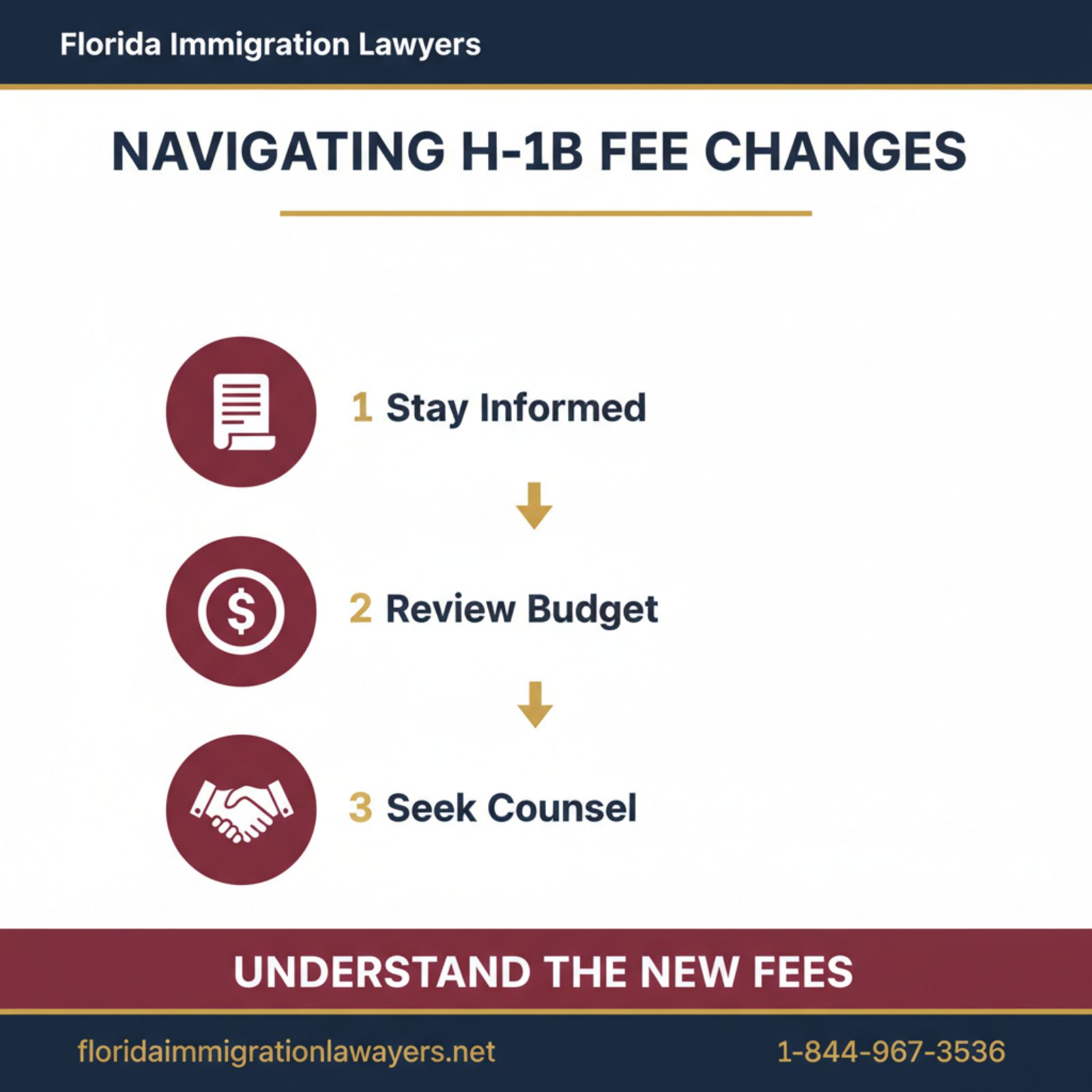
The H-1B visa process, already intricate, now includes updated fees and potentially revised procedures for 2026. Here is a step-by-step guide to help you understand the journey, factoring in the **H-1B visa fee increase**.
-
Employer Registration and Lottery (If Applicable): The process begins with electronic registration for H-1B cap-subject petitions. Employers must register each beneficiary electronically during a designated period, typically in March. USCIS then conducts a lottery if the number of registrations exceeds the annual cap. This initial step now includes a significantly increased registration fee per beneficiary. This change impacts the overall cost of H-1B cap registration.
-
Labor Condition Application (LCA) Filing: If selected in the lottery, or for cap-exempt petitions, the employer must file a Labor Condition Application (Form ETA-9035) with the U.S. Department of Labor (DOL). This document attests that the employer will pay the H-1B worker at least the prevailing wage for the occupation in the area of employment and will provide working conditions that will not adversely affect other workers. The LCA must be certified by the DOL before the H-1B petition can be filed. This ensures fair treatment for both U.S. and foreign workers.
-
Form I-129 Petition Filing: Once the LCA is certified, the employer files Form I-129, Petition for a Nonimmigrant Worker, with USCIS. This is the core of the H-1B application. This petition must be submitted within the filing period specified by USCIS, usually starting April 1st for cap-subject petitions. This step involves several fees, including a significantly increased base filing fee, the American Competitiveness and Workforce Improvement Act (ACWIA) fee, a fraud prevention and detection fee, and potentially a Public Law 114-113 fee for employers with a certain number of U.S. employees and H-1B workers. The **H-1B visa fee increase** is most pronounced here.
-
Premium Processing (Optional): Employers can opt for premium processing by filing Form I-907 and paying an additional, now adjusted, fee. This guarantees USCIS will take action on the petition within 15 calendar days. This option is valuable for businesses needing faster adjudication, but it adds substantially to the overall cost.
-
Biometrics (If Applicable): In some cases, USCIS may require the beneficiary to attend a biometrics appointment to provide fingerprints and photographs. A separate biometrics services fee may apply depending on the specific case type or policy. This step helps verify identity and conduct background checks.
-
Interview and Visa Stamping: For beneficiaries outside the U.S., the final step involves attending an interview at a U.S. embassy or consulate in their home country. If approved, the visa is stamped in their passport. Beneficiaries already in the U.S. and applying for a change of status will receive an I-797 approval notice. This final stage confirms the H-1B status.
Navigating these steps, especially with the updated fee structure, requires meticulous attention to detail. For businesses seeking to sponsor foreign talent, understanding these changes is vital. Our Business Immigration Practice Area offers comprehensive support for employers throughout Florida.
Essential Document Checklist for Your H-1B Visa Application
A successful H-1B visa application hinges on submitting a complete and accurate set of documents. Even with the **H-1B visa fee increase**, a poorly prepared petition can lead to delays or denial. Here is a general checklist of essential documents for both the employer and the beneficiary. Remember that specific requirements may vary based on individual circumstances and USCIS requests.
- Employer-Specific Documents:
- Employer Identification Number (EIN) confirmation.
- Company financial statements, tax returns, and business licenses.
- Organizational chart and details of the employer's business operations.
- Copies of certified Labor Condition Application (LCA).
- Detailed job description for the specialty occupation position.
- Evidence of ability to pay the proffered wage.
- Copies of all required fee payments (checks, money orders, or credit card authorizations).
- Beneficiary-Specific Documents:
- Copy of valid passport (all pages, including blank ones).
- Copies of all academic degrees, diplomas, and transcripts (translated if not in English).
- Foreign credential evaluations (if degree is from outside the U.S.).
- Professional licenses or certifications (if applicable).
- Detailed resume/CV highlighting relevant work experience.
- Letters of experience from previous employers.
- Copies of any previous U.S. visas, I-94 records, and immigration documents (e.g., I-20, DS-2019, EAD).
- Marriage certificate and birth certificates for dependents (H-4 visa applicants).
- Petition-Specific Documents:
- Completed and signed Form I-129, Petition for a Nonimmigrant Worker.
- Supporting letter from the employer explaining the specialty occupation, the beneficiary's qualifications, and the terms of employment.
- Evidence that the position qualifies as a specialty occupation (e.g., industry standards, expert opinions).
- Proof of H-1B cap registration selection (if applicable).
Step-by-Step Process Guide
All documents must be meticulously prepared and organized. As per 8 CFR Part 214.2(h), all petitions must clearly establish eligibility. Missing or incorrect documentation is a common reason for RFEs or denials. This is particularly critical in the context of the **H-1B visa fee increase**, as re-filing can incur substantial additional costs.
H-1B Visa Timeline and Processing Expectations in Florida (2026)
Understanding the H-1B visa timeline is crucial for both employers and beneficiaries, especially with the updated fee structure and potential for increased application volume. The H-1B cap season typically follows a predictable schedule, though processing times can vary significantly based on USCIS workload, policy changes, and the specific service center handling the petition.
For cap-subject H-1B visas, the electronic registration period usually opens in early March. Selections are then announced by the end of March. Petitioning employers whose registrations are selected must file their Form I-129 petitions during a specific window, typically starting April 1st and lasting 90 days. This means employers in Florida, from Tampa to Jacksonville, need to be prepared well in advance.
After the petition is filed, USCIS processing times can range from several months to over a year for regular processing. The **H-1B visa fee increase** might influence processing times, as USCIS aims to improve efficiency with additional funding. However, increased application volume could also create backlogs. You can check current processing times on the USCIS website.
Premium processing, while costly due to the adjusted fee, guarantees an adjudication within 15 calendar days. This option is often vital for businesses that need immediate staffing solutions. For those undergoing consular processing, additional time must be factored in for visa interviews at U.S. Embassies or Consulates abroad, which can also have varying wait times. Florida residents applying for a change of status will receive their approval directly.
Factors like Requests for Evidence (RFEs) can significantly extend the timeline. An RFE requires the petitioner to submit additional documentation or clarification, adding weeks or even months to the process. Careful preparation and expert legal guidance can help minimize the risk of RFEs and keep your timeline on track. The impact of the **h-1b visa fee increase** on processing efficiency remains to be fully seen, but proactive planning is always best.
Cost Factors and Fee Breakdown for the H-1B Visa
The **H-1B visa fee increase** for 2026 introduces a new financial landscape for employers and beneficiaries. It is essential to understand all potential costs associated with the H-1B process. These fees are typically paid by the employer, though some exceptions apply.
The primary fees include:
- H-1B Registration Fee: This is a per-beneficiary fee for the electronic registration process for cap-subject petitions. This fee saw a significant increase.
- Base Form I-129 Filing Fee: The main fee for filing the Petition for a Nonimmigrant Worker. This is one of the most substantial increases.
- American Competitiveness and Workforce Improvement Act (ACWIA) Fee: An additional fee, varying based on the employer's size (25 or fewer full-time equivalent employees vs. 26 or more). This fee supports U.S. worker training and education programs.
- Fraud Prevention and Detection Fee: A fee designed to combat fraud in visa petitions.
- Public Law 114-113 Fee: Applies to employers with 50 or more employees, where more than 50% of their U.S. workforce are H-1B or L-1 nonimmigrants.
- Premium Processing Fee (Optional): For expedited processing within 15 days. This fee also increased.
- Biometrics Services Fee (If Applicable): A separate fee if biometrics are required.
It is important to note that specific fee amounts are subject to change by USCIS and should always be verified on the official USCIS Our Fees page. We do not provide specific dollar amounts here to avoid outdated information. The overall impact of the **H-1B visa fee increase** means a significantly higher investment for companies seeking H-1B talent.
Beyond USCIS filing fees, other potential costs include attorney fees for legal representation, which are highly recommended given the complexity of the process. Employers may also incur costs for credential evaluations, document translations, and travel expenses for consular interviews. Engaging an experienced employment immigration lawyer can help you anticipate and manage these costs effectively.
Do not navigate this complex process alone. The **H-1B visa fee increase** and updated regulations demand careful attention. Contact Florida Immigration Lawyers today to ensure your application is flawless and compliant. Our team is ready to assist you.
Common Mistakes to Avoid in Your H-1B Visa Application
The H-1B visa process is fraught with potential pitfalls, and with the recent **H-1B visa fee increase**, making a mistake can be even more costly. Avoiding these common errors is crucial for a successful application, especially for those in Florida's competitive job market.
-
Missing the H-1B Cap Registration Deadline: The electronic registration period is short and strict. Missing it means your petition cannot be considered for that fiscal year's cap. This results in a lost opportunity and a year-long delay for the beneficiary.
-
Incorrectly Filing the LCA: Errors on the Labor Condition Application (LCA) can lead to delays, denials, or even debarment for employers. The DOL carefully reviews these forms for accuracy and compliance with prevailing wage requirements.
-
Inadequate Evidence for Specialty Occupation: USCIS scrutinizes whether the proposed position truly qualifies as a specialty occupation. Failing to provide sufficient evidence, such as detailed job duties and industry requirements, can lead to a Request for Evidence (RFE) or outright denial.
-
Failure to Pay Correct Fees: With the **H-1B visa fee increase**, ensuring all fees are correctly calculated and submitted is more critical than ever. Incorrect payments will lead to the rejection of your petition, causing significant delays and requiring re-submission.
-
Not Proving Employer-Employee Relationship: For certain business models, especially those involving third-party placements, USCIS may question whether a legitimate employer-employee relationship exists. Insufficient evidence can lead to RFEs or denials, impacting Florida's consulting firms.
-
Ignoring Prevailing Wage Requirements: Employers must pay the H-1B worker at least the prevailing wage for the position in the geographic area of employment. Failure to comply can result in severe penalties, back wages, and even debarment from sponsoring future H-1B visas.
-
Submitting Incomplete Documentation: USCIS requires a comprehensive set of documents. Submitting an incomplete package is a primary cause of RFEs, which prolong the process and add stress. Every item on the checklist matters.
-
Waiting Until the Last Minute: The H-1B process is complex and time-consuming. Rushing the preparation can lead to errors, missed deadlines, and a higher chance of denial. Early planning is key to a smooth application.
-
Misunderstanding the H-1B Cap Exemption Rules: Not all H-1B petitions are subject to the annual cap. Misfiling a cap-exempt petition as cap-subject, or vice-versa, can lead to denial. This often applies to non-profit research organizations or universities in Florida.
-
Not Consulting an Experienced Attorney: Attempting to navigate the H-1B process without legal counsel significantly increases the risk of errors and missed opportunities. An attorney provides invaluable expertise and ensures compliance.
-
Failing to Track USCIS Updates: Immigration laws and policies, including fees, are subject to change. Not staying informed about the latest USCIS announcements, like the **H-1B visa fee increase**, can lead to non-compliance. Regular checks of official sources are essential.
When to Call a Lawyer for Your H-1B Visa in Florida
While this guide provides comprehensive information, the H-1B visa process, particularly with the new **H-1B visa fee increase** and evolving regulations, is profoundly complex. There are specific scenarios where engaging an experienced immigration attorney becomes not just beneficial, but essential. Florida Immigration Lawyers are here to provide the expertise you need.
You should consider calling a lawyer if:
- Your Case is Complex: If you or your beneficiary have a prior visa denial, a criminal history, or unique employment circumstances, legal counsel is critical. These factors can significantly complicate the petition and require expert handling.
- You are an Employer Unfamiliar with the H-1B Process: First-time H-1B petitioners, or businesses with limited HR resources, greatly benefit from legal guidance. An attorney can ensure compliance with all DOL and USCIS regulations from start to finish.
- You Receive a Request for Evidence (RFE) or Notice of Intent to Deny (NOID): These notices indicate that USCIS has concerns about your petition. Responding effectively to an RFE or NOID requires deep legal knowledge and strategic thinking to avoid denial.
- You Need Strategic Planning: Whether it's planning for concurrent H-1B employment, navigating changes of employer, or understanding long-term immigration goals, an attorney can provide tailored strategies. This is especially true for businesses in Florida looking to retain top talent.
- You Want to Ensure Compliance with New Fees and Regulations: The **H-1B visa fee increase** and related policy adjustments mean that previous knowledge may be outdated. A lawyer ensures your application adheres to the very latest requirements, minimizing the risk of costly errors.
Florida Immigration Lawyers understands the unique challenges faced by employers and professionals in Florida. We offer comprehensive services for business immigration, including H-1B visas. Our attorneys are well-versed in the latest regulations and can provide the strategic advice you need. Visit our attorneys page to learn more about our team, or contact us directly to discuss your H-1B needs.
About Florida Immigration Lawyers
Florida Immigration Lawyers is a premier immigration law firm dedicated to serving individuals and businesses across the entire state of Florida. With a deep understanding of U.S. immigration law and a commitment to client success, we provide compassionate and effective legal representation for a wide range of immigration matters. Our team of experienced attorneys is passionate about helping our clients achieve their American dreams.
We specialize in various practice areas, including general immigration, family-based visas, business immigration (including H-1B visas), deportation defense, asylum, and citizenship. We understand the complexities and emotional toll that immigration processes can take, and we are here to guide you every step of the way.
Why choose Florida Immigration Lawyers? Our firm stands out due to our personalized approach, meticulous attention to detail, and unwavering advocacy for our clients. We pride ourselves on clear communication, transparent processes, and a track record of achieving favorable outcomes. We are available 24/7 to address your urgent concerns and offer free consultations to help you understand your options.
Whether you are an employer navigating the **H-1B visa fee increase** in Kissimmee, a family seeking reunification in Miami, or an individual facing deportation in Tampa, Florida Immigration Lawyers is your trusted partner. Call us today at 1-844-967-3536 or visit our website at https://www.floridaimmigrationlawyers.net to schedule your free consultation. Se Habla Español.
Sources and References
- U.S. Citizenship and Immigration Services (USCIS) - H-1B Specialty Occupations
- U.S. Citizenship and Immigration Services (USCIS) - Our Fees
- Executive Office for Immigration Review (EOIR)
- 8 U.S.C. Chapter 12 - Immigration and Nationality Act (INA) - Specifically 8 U.S.C. § 1184(g) regarding H-1B numerical limitations.
- 8 CFR Part 214.2(h) - Petitions for Nonimmigrant Workers (H-1B classification).
- USCIS Policy Manual - Volume 2, Part H, Chapter 1 (H-1B Requirements).
This article provides general legal information and is not intended as legal advice. Every case is unique, and outcomes depend on specific facts and circumstances. Contact an attorney for advice about your particular situation.
The **H-1B visa fee increase** marks a significant change in U.S. immigration policy. Do not let these new complexities jeopardize your immigration goals or business operations in Florida. For comprehensive legal support and peace of mind, contact Florida Immigration Lawyers today at 1-844-967-3536. Our dedicated team is ready to provide the expert guidance you deserve. Se Habla Español - Estamos aquí para ayudarle.
Do Not Navigate This Process Alone
Our experienced immigration attorneys are ready to fight for you. Get a free, confidential consultation today.
Se Habla Español
Frequently Asked Questions
Florida Immigration Lawyers
Immigration Attorney | Founder, Vasquez Law Firm
U.S. Air Force veteran and immigration attorney with thousands of cases resolved. J.D., NCCU School of Law. AILA member. Admitted to the 4th, 5th, and 11th Circuit Courts.
Available 24/7 - Free Evaluations
Related Legal Services
Our Florida immigration attorneys can help you with family immigration services, immigration practice areas and free immigration consultation. Call today at 1-844-967-3536 for a free consultation.
Related Links
Related Topics
Free Legal Consultation
Discuss your case with our experienced attorneys. We're available 24/7.
Se Habla Español - Estamos aquí para ayudarle.
Related Articles
Understanding the I-864 Affidavit of Support in Florida
Learn about the I-864 Affidavit of Support and how it affects sponsorship in Florida. Understand the requirements and common pitfalls. Contact Florida Immigration Lawyers for expert guidance.
Refugee Resettlement in Florida: Key Steps | VLF Florida
Discover the essential steps for refugee resettlement in Florida, focusing on areas like Hollywood. Learn about the process, common mistakes, and when to seek legal advice. Call Florida Immigration Lawyers at 1-844-967-3536 for a free consultation.
Immediate Relative Petition in Florida: What to Know
Learn how to file an immediate relative petition in Florida with ease. Our guide covers eligibility, steps, and common mistakes. Contact Florida Immigration Lawyers for expert advice.
Understanding the Public Charge Rule in Florida | VLF Florida
Explore the public charge rule affecting immigrants in Florida, especially in Tampa. Learn how this rule impacts green card eligibility and the importance of proper preparation. Florida Immigration Lawyers can help guide you through this complex process. Call us today for a free consultation.