Green Card Through Marriage in Florida
Learn how to obtain a green card through marriage in Florida, with a focus on West Palm Beach. Understand the process, avoid common mistakes, and know when to seek legal help. Contact Florida Immigration Lawyers for personalized assistance.

- Eligibility depends on marriage validity and documentation.
- Interview is a critical step.
- Processing time varies.
Introduction
Imagine starting your new life with your spouse in West Palm Beach, Florida, and pursuing a green card through marriage. This process can be complex, but understanding the steps can make it manageable. This article covers everything you need to know about obtaining a green card through marriage in Florida. Call Florida Immigration Lawyers at 1-844-967-3536 for a free consultation.
Navigating the U.S. immigration system can feel daunting, especially when your future and the ability to build a life with your loved one are at stake. Florida, with its diverse communities and growing population, is a common destination for couples seeking to establish permanent residency through marriage. While the journey requires careful attention to detail and adherence to strict regulations, millions of couples have successfully achieved their dreams of living together permanently in the United States.
This comprehensive guide aims to demystify the process, offering clear, step-by-step instructions, practical tips, and crucial insights into common pitfalls. Whether you're just beginning to explore your options or are deep into the application process, our goal is to equip you with the knowledge needed to proceed with confidence. Remember, personalized legal advice is invaluable, and Florida Immigration Lawyers are here to provide the expert guidance you need every step of the way.
Understanding Green Card Through Marriage
A green card obtained through marriage allows you to live and work in the U.S. as a permanent resident. This process requires proving the legitimacy of your marriage and fulfilling other legal requirements. In Florida, particularly in areas like West Palm Beach, it's crucial to be familiar with local immigration offices and courts.
The U.S. government grants green cards through marriage to ensure family unity, but it also has stringent measures to prevent marriage fraud. Therefore, the core of your application will revolve around demonstrating that your marriage is genuine, or 'bona fide,' and not entered into solely for immigration benefits. This means providing substantial evidence of shared life, commitment, and mutual intent to build a future together.
It's also important to understand the distinction between conditional and permanent green cards. If you have been married for less than two years at the time your green card is approved, you will initially receive a conditional green card, valid for two years. Before this two-year period expires, you and your spouse must file a separate petition (Form I-751) to remove the conditions and obtain a 10-year permanent green card. This step further reinforces the requirement to prove the ongoing legitimacy of your marriage. If you've been married for two years or more at the time of approval, you'll typically receive a 10-year permanent green card directly.
Step-by-Step Guide
- File Form I-130: The U.S. citizen or permanent resident spouse must file this petition to establish the relationship.
- Submit Form I-485: If the spouse is already in the U.S., they can apply for adjustment of status.
- Attend Biometrics Appointment: Both spouses may need to provide fingerprints and photographs.
- Prepare for the Interview: The couple must attend an interview to demonstrate the marriage's authenticity.
- Receive Decision: USCIS will decide based on the submitted evidence and interview results.
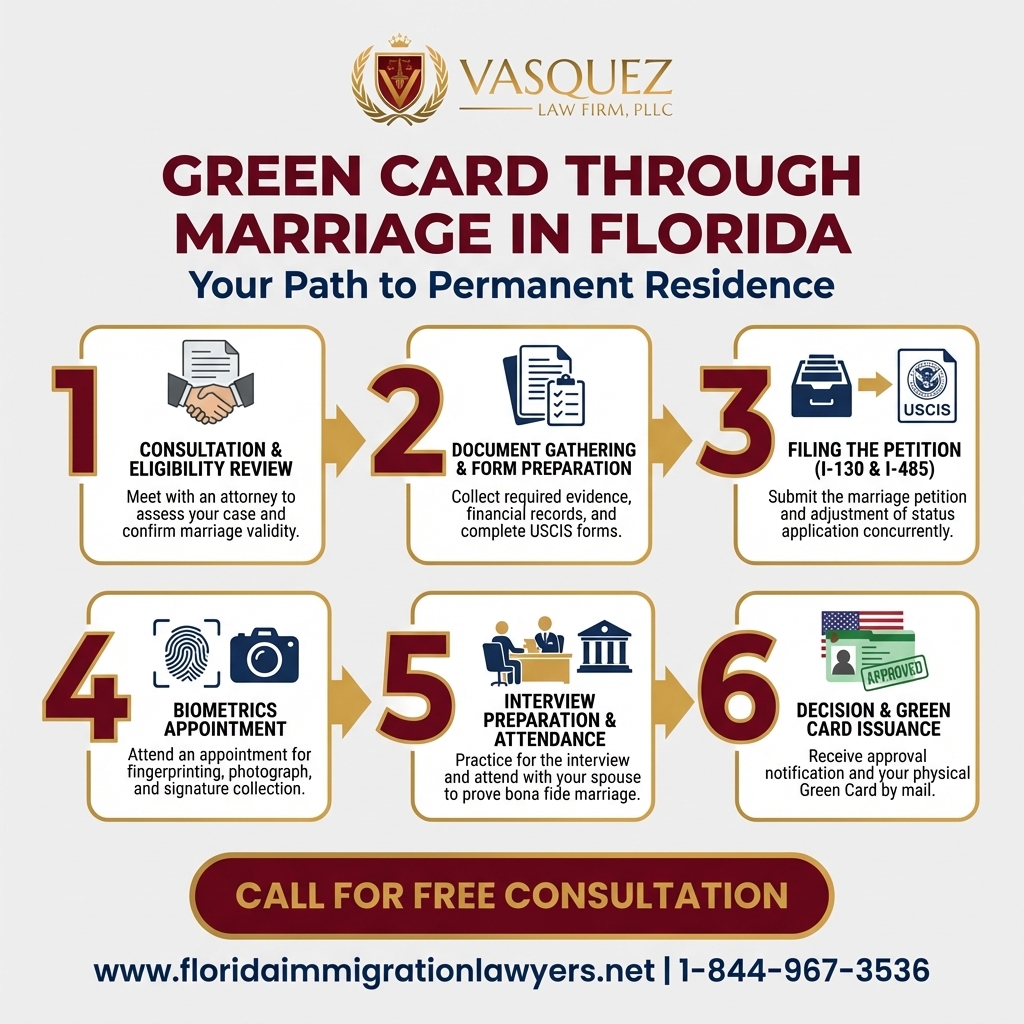
Step 1: Filing Form I-130, Petition for Alien Relative
The journey officially begins when the U.S. citizen or lawful permanent resident spouse (the petitioner) files Form I-130, Petition for Alien Relative, with U.S. Citizenship and Immigration Services (USCIS). This form establishes the legal relationship between you and your spouse. Along with the form, you'll need to submit supporting documents, such as your marriage certificate, proof of the petitioner's U.S. citizenship or permanent residency, and evidence that any previous marriages for either spouse have been legally terminated.
For spouses already present in the U.S. who entered legally, concurrent filing is often an option. This means you can file Form I-130 and Form I-485 (Application to Register Permanent Residence or Adjust Status) simultaneously. This can significantly streamline the process and potentially reduce overall processing time. However, it's crucial to ensure all eligibility requirements for adjustment of status are met before pursuing concurrent filing. Consulting with Florida Immigration Lawyers can help determine if this is the best path for your specific situation.
Step 2: Submitting Form I-485, Application to Register Permanent Residence or Adjust Status
If the foreign national spouse is already in the U.S. and eligible to adjust their status, they will file Form I-485. This form is their actual application for a green card. Along with Form I-485, several other forms are typically filed concurrently, including Form I-765 (Application for Employment Authorization) and Form I-131 (Application for Travel Document, also known as Advance Parole). These allow the applicant to work and travel internationally while the green card application is pending, which can be invaluable during the often lengthy processing period.
A critical component of this step is the medical examination. The foreign national spouse must undergo a medical exam performed by a USCIS-approved civil surgeon. The results, documented on Form I-693, Report of Medical Examination and Vaccination Record, must be submitted in a sealed envelope. This exam checks for certain communicable diseases, drug abuse, and ensures the applicant has received required vaccinations. Failure to submit this form correctly or undergoing the exam with a non-approved doctor will lead to delays.
Step 3: Attending the Biometrics Appointment
After filing your applications, USCIS will send an appointment notice for a biometrics appointment. Both spouses may need to attend, though typically it's the applicant (the foreign national spouse) who must go. At this appointment, USCIS collects fingerprints, photographs, and a signature. These biometrics are used to conduct essential background checks and security clearances. It's a relatively quick appointment, but missing it without proper rescheduling can severely jeopardize your application. Ensure you bring the appointment notice and a valid photo ID.
Step 4: Preparing for and Attending the Interview
The marriage-based green card interview is arguably the most critical step in the entire process. Both spouses are required to attend an interview with a USCIS officer, usually at a local field office (for Florida residents, this might be in West Palm Beach, Orlando, or Miami). The purpose of the interview is to verify the authenticity of your marriage and to confirm the information provided in your application forms. The interviewing officer will ask questions about your relationship, how you met, your daily life together, and your future plans.
Preparation is key. You should bring all original documents that were submitted with your application, plus any new evidence that further proves your bona fide marriage. This can include updated bank statements, utility bills, insurance policies, photos, joint lease agreements, and affidavits from friends and family. Be honest, consistent, and confident in your answers. In some cases, if the officer suspects marriage fraud or finds inconsistencies, they may conduct a 'Stokes interview,' where each spouse is interviewed separately with identical questions to compare answers. Such situations highlight the importance of thorough preparation and potentially having legal representation from Florida Immigration Lawyers.
Step 5: Receiving a Decision and Understanding Conditional Residency
Following the interview, USCIS will make a decision on your application. If approved, the foreign national spouse will receive their green card. As mentioned earlier, if you have been married for less than two years at the time of approval, you will be granted a conditional green card, valid for two years. This is known as a CR1 visa (Conditional Resident). You and your spouse must then file Form I-751, Petition to Remove Conditions on Residence, within the 90-day period before your conditional green card expires.
The I-751 process requires you to submit further evidence that your marriage remains bona fide and ongoing. This typically involves providing updated joint financial documents, proof of shared residence, and other evidence of your continued life together. If you fail to file Form I-751 on time, your conditional green card will expire, and you could face removal proceedings. If your marriage has ended due to divorce or death, or if you've experienced abuse, there are waivers available for the joint filing requirement, but these are complex and necessitate expert legal advice from Florida Immigration Lawyers.
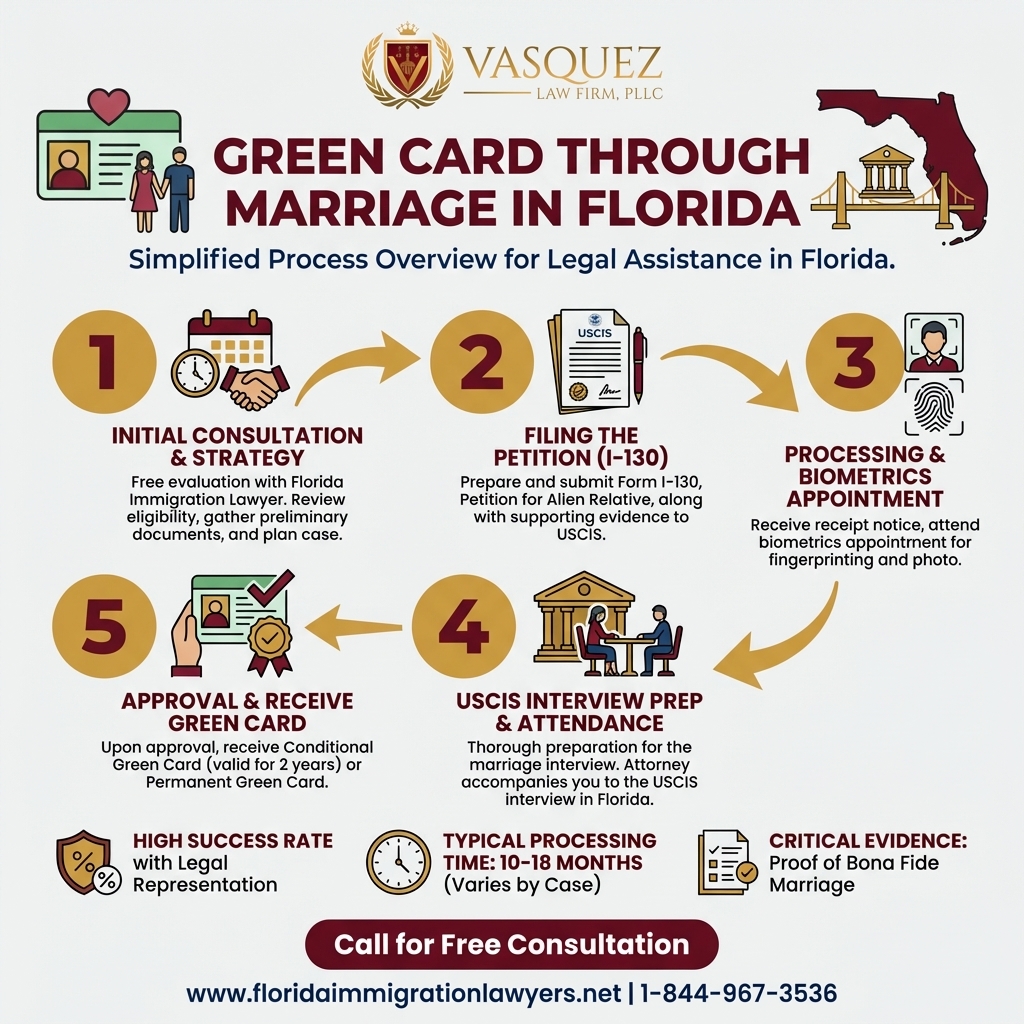
Document Checklist
- Marriage certificate
- Proof of U.S. citizenship or permanent residency
- Evidence of shared financial responsibilities
- Photos together
- Letters from family and friends
A meticulously organized and complete set of documents is the backbone of a successful green card application. Any missing or incorrect documentation can lead to Requests for Evidence (RFEs), significant delays, or even denial. Here's an expanded look at the essential documents you'll need:
Essential Identity and Relationship Documents
- Marriage Certificate: The official document proving your legal marriage.
- Birth Certificates: For both the U.S. citizen/permanent resident spouse and the foreign national spouse.
- Passports: Valid passports for both spouses.
- Divorce Decrees or Death Certificates: If either spouse was previously married, you must provide proof that all prior marriages were legally terminated.
Proof of U.S. Citizen or Permanent Resident Spouse's Status
- U.S. Birth Certificate: If born in the U.S.
- U.S. Passport: A valid U.S. passport.
- Certificate of Naturalization: If a naturalized U.S. citizen.
- Form I-551 (Green Card): If a lawful permanent resident.
Evidence of a Bona Fide Marriage
This category is crucial for demonstrating the legitimacy of your relationship. The more diverse and compelling the evidence, the stronger your case. USCIS looks for commingling of assets, shared responsibilities, and public recognition of your relationship. Examples include:
- Shared Financial Responsibilities: Joint bank accounts, joint credit card statements, joint tax returns, joint utility bills (electricity, water, internet), joint lease agreements or mortgage statements, joint insurance policies (health, auto, life), and any evidence of joint investments or property ownership.
- Proof of Shared Residence: Lease agreements, mortgage statements, utility bills addressed to both spouses at the same address, driver's licenses showing the same address.
- Children's Birth Certificates: If you have children together, their birth certificates are very strong evidence of a bona fide marriage.
- Photos Together: A variety of photos from different times and events (wedding, holidays, family gatherings, vacations) to show the progression and reality of your relationship. Include photos with family and friends.
- Letters from Family and Friends (Affidavits): Sworn statements from people who know you as a couple, attesting to the legitimacy and nature of your relationship. These should be notarized and include the affiant's contact information.
- Travel Itineraries and Tickets: Proof of joint vacations or trips.
- Correspondence: Emails, text messages, cards, or letters exchanged between spouses, especially from before marriage, demonstrating the development of the relationship.
Medical Examination (Form I-693)
As mentioned, the foreign national spouse must undergo a medical examination by a USCIS-approved civil surgeon. The sealed envelope containing Form I-693 must be submitted with your application or brought to your interview.
Financial Support Documents (Form I-864)
The U.S. citizen or permanent resident spouse (petitioner) must file Form I-864, Affidavit of Support, to demonstrate they can financially support the immigrant spouse and prevent them from becoming a public charge. This requires proving income at or above 125% of the federal poverty guidelines. You will need to provide tax returns, W-2s, and pay stubs. If the petitioner's income is insufficient, a joint sponsor may be required.
Timeline and Processing Expectations
Processing times can vary significantly based on the applicant's location and USCIS workload. Generally, it can take several months to over a year, especially in busy areas like West Palm Beach.
Several factors influence the overall timeline for a marriage-based green card. These include the specific USCIS service center handling your I-130 petition, the local USCIS field office where your interview will take place, the volume of applications, and how quickly you respond to any Requests for Evidence (RFEs). For instance, applications processed in high-volume areas like Florida's West Palm Beach or Miami field offices might experience longer wait times compared to less populated regions.
You can monitor current processing times on the USCIS website by selecting the form type and the relevant service center or field office. While these times provide an estimate, individual cases can vary. For example, a case with a complex history or one that requires additional review might take longer. Proactive preparation, submitting a complete and well-organized application, and promptly responding to any USCIS requests are the best ways to help keep your application on track. Florida Immigration Lawyers can assist in tracking your case status and addressing any unexpected delays.
Cost Factors and Fee Breakdown
While exact fees can change, expect costs related to filing forms, biometrics, and legal assistance. We recommend consulting with an attorney to understand the current fees.
Obtaining a green card through marriage involves several fees that applicants must budget for. These fees are subject to change by USCIS, so it's always best to check the official USCIS website or consult with an immigration attorney for the most up-to-date information. Typically, the main costs include the filing fee for Form I-130, the filing fee for Form I-485 (which usually includes the biometrics fee), and the cost of the mandatory medical examination (Form I-693) by a USCIS-approved civil surgeon.
Beyond government filing fees, applicants should also consider potential costs for obtaining necessary documents, such as birth certificates or marriage certificates, and translation services if any documents are not in English. Furthermore, legal fees for professional assistance from Florida Immigration Lawyers can be a significant but worthwhile investment. While these fees can add up, they often provide peace of mind, ensure accuracy, and increase the likelihood of a smooth process. In certain low-income situations, applicants may be eligible for fee waivers, which can significantly reduce the financial burden, but eligibility criteria are strict and require careful application.
Do not navigate this process alone. Contact Florida Immigration Lawyers today.
Common Mistakes to Avoid
- Not providing sufficient evidence: Insufficient documentation can lead to delays or denial.
- Missing deadlines: Late submissions can jeopardize your case.
- Incorrectly filling forms: Errors can lead to processing delays.
- Skipping the interview: Missing the interview can result in denial.
- Ignoring legal advice: Professional guidance is crucial for success.
- Failing to update address: Keeping your address current with USCIS is essential.
- Not understanding conditional residency: If married less than two years, you receive a conditional green card and must apply to remove conditions.
Avoiding common pitfalls can save you significant time, stress, and potential heartbreak. The immigration process is unforgiving of errors, and even small mistakes can have major consequences.
Insufficient or Disorganized Evidence
One of the most frequent reasons for delays or denials is a lack of compelling evidence to prove a bona fide marriage. USCIS requires robust proof that your marriage is real and not just for immigration purposes. Simply providing a marriage certificate and a few photos is often not enough. You need to demonstrate a commingling of finances, shared responsibilities, and a life together. Organize your evidence clearly, perhaps with tabs or a table of contents, to make it easy for the USCIS officer to review. Florida Immigration Lawyers can help you compile and present your evidence effectively.
Missing Deadlines and Incomplete Forms
Every form has specific instructions and deadlines. Failing to submit required documents by the due date or leaving sections of forms blank (unless truly not applicable) can lead to a Request for Evidence (RFE) or outright denial. RFEs add significant time to your processing, often several months. Always double-check forms for accuracy and completeness, and ensure all supporting documents are attached as requested. A common mistake is not signing forms in all the required places, which can lead to the entire application being rejected.
Misrepresenting Facts or Concealing Information
Honesty is paramount in all immigration matters. Providing false information, even inadvertently, or attempting to conceal relevant facts (such as previous immigration violations, criminal history, or prior marriages) can lead to severe penalties, including a permanent bar from the U.S. Always be truthful and transparent. If you have any concerns about your history, it is crucial to discuss them openly with an experienced attorney from Florida Immigration Lawyers before filing, as they can help you navigate complex issues legally and ethically.
Traveling Without Advance Parole
If you are applying for adjustment of status (Form I-485) from within the U.S., leaving the country without obtaining an Advance Parole document (Form I-131) can be considered an abandonment of your application. This can result in your application being denied, and you may be unable to re-enter the U.S. It is vital to wait for your Advance Parole to be approved before making any international travel plans. Always consult with your attorney before planning any travel while your green card application is pending.
Not Understanding Conditional Residency Requirements
If you receive a conditional green card because you were married for less than two years at the time of approval, it is crucial to understand that it is only valid for two years. Many couples mistakenly believe it's a permanent green card. You must file Form I-751, Petition to Remove Conditions on Residence, within the 90-day window before your conditional green card expires. Failure to do so will result in the expiration of your green card status and can lead to removal proceedings. This step requires submitting further evidence of your ongoing marriage, similar to the initial application but focusing on the period since your green card was granted.
When to Call a Lawyer
Complex situations, such as previous immigration violations or criminal records, require legal assistance. Florida Immigration Lawyers can help you navigate these issues and ensure compliance with all requirements.
While some straightforward cases might be manageable without legal counsel, the immigration process is rarely without its complexities. There are many scenarios where the expertise of an immigration attorney is not just helpful, but essential. For instance, if the foreign national spouse has ever overstayed a visa, entered the U.S. without inspection, has a history of criminal offenses (even minor ones), or has faced previous deportation proceedings, legal counsel is indispensable. These issues can trigger inadmissibility grounds that require waivers, a highly intricate part of immigration law.
Furthermore, if you receive a Request for Evidence (RFE) or a Notice of Intent to Deny (NOID) from USCIS, it's a clear signal that your application needs immediate professional attention. An RFE means USCIS believes you haven't provided enough information or evidence, while a NOID indicates they intend to deny your application. In these critical moments, an experienced attorney from Florida Immigration Lawyers can help you formulate a robust response, ensuring all legal arguments and supporting documents are properly presented. Even in seemingly simple cases, having an attorney review your application before submission can prevent costly mistakes and provide peace of mind, ensuring your journey to a green card is as smooth as possible.
About Florida Immigration Lawyers
Florida Immigration Lawyers is dedicated to helping clients with immigration issues, offering services in West Palm Beach and throughout Florida. Our team provides expert guidance and personalized attention. Call us at 1-844-967-3536 or visit our website for a free consultation, available 24/7.
At Florida Immigration Lawyers, we understand that pursuing a green card through marriage is not just a legal process; it's a deeply personal journey towards building a future with your loved one. Our team of compassionate and knowledgeable attorneys is committed to providing comprehensive legal support, from the initial consultation to the final approval of your green card. We pride ourselves on clear communication, thorough preparation, and unwavering advocacy for our clients.
With offices serving West Palm Beach and the broader Florida region, we are intimately familiar with local immigration procedures and the specific challenges faced by couples in our community. We handle a wide range of family-based immigration matters, including fiancé visas, adjustment of status, consular processing, and the removal of conditions on residency. Let us put our expertise to work for you, ensuring that every detail of your application is handled with precision and care. Don't hesitate to reach out for a free consultation; our team is ready to assist you in English or Spanish, 24/7.
Sources and References
- U.S. Citizenship and Immigration Services (USCIS)
- Executive Office for Immigration Review (EOIR)
- 8 U.S.C. Chapter 12 - Immigration and Nationality Act
Related services: family petition process, family-based green cards, fiancé visa (K-1), marriage-based immigration.
This article provides general legal information and is not intended as legal advice. Every case is unique, and outcomes depend on specific facts and circumstances. Contact an attorney for advice about your particular situation.
Call Florida Immigration Lawyers at 1-844-967-3536 for a free consultation. Se Habla Español - Estamos aquí para ayudarle.
If you need legal assistance, learn more about family immigration lawyers in Florida, or call us at 1-844-967-3536 for a free consultation.
Do Not Navigate This Process Alone
Our experienced immigration attorneys are ready to fight for you. Get a free, confidential consultation today.
Se Habla Español
Frequently Asked Questions

William J. Vásquez
Founding Attorney · Vasquez Law Firm
U.S. Air Force veteran and immigration attorney with thousands of cases resolved. J.D., NCCU School of Law. AILA member. Admitted to the 4th, 5th, and 11th Circuit Courts.
Available 24/7 - Free Evaluations
Related Legal Services
Our Florida immigration attorneys can help you with deportation defense, citizenship and naturalization and family immigration services. Call today at 1-844-967-3536 for a free consultation.
Related Links
Related Topics
Free Legal Consultation
Discuss your case with our experienced attorneys. We're available 24/7.
Se Habla Español - Estamos aquí para ayudarle.
Related Articles
E-2 Visa for Florida Business Investors | VLF Florida
Learn about the E-2 investor visa for Florida business opportunities, tailored for Fort Lauderdale entrepreneurs. Discover the process, requirements, and common pitfalls. Contact Florida Immigration Lawyers for expert assistance.
Immigration Documents Checklist for Florida | VLF Florida
Navigating immigration processes in Florida requires a comprehensive checklist of documents. This guide helps you gather all necessary paperwork to ensure a successful application. Consult Florida Immigration Lawyers for personalized assistance.
Immigration Attorney West Palm Beach Guide | VLF Florida
Navigate the complexities of immigration in West Palm Beach with a trusted attorney. Learn what to expect, common pitfalls, and how to choose the right legal help.
Dual Citizenship in Florida: What You Need to Know
Explore dual citizenship in Florida, understand the process, and learn how to apply. Discover the benefits and complexities involved with having two passports and navigating immigration laws. Call Florida Immigration Lawyers for expert guidance.
