Understanding Florida Wrongful Death Survivor Damages
Explore Florida's wrongful death statutes §§ 768.16–768.21 to understand survivor damages. Learn about eligibility, filing processes, and common pitfalls. Contact Florida Immigration Lawyers at 1-844-967-3536 for a free consultation.

- Eligibility of survivors for damages
- Types of compensable losses, such as emotional and financial support
- Legal processes involved in filing claims
Introduction
Facing the loss of a loved one is never easy, especially when their death is due to someone else's negligence. In Florida, the wrongful death statutes §§ 768.16–768.21 provide a legal pathway for survivors to seek compensation. These laws are crucial for families in Coral Springs and throughout Florida to understand when pursuing justice. This article will guide you through the legal framework, processes, and potential damages available to survivors. Call Florida Immigration Lawyers at 1-844-967-3536 for a free consultation.
The emotional and financial toll of such a tragedy can be overwhelming, making it difficult for families to focus on legal matters. However, understanding your rights under Florida law is the first step toward achieving some measure of justice and financial stability in the wake of an unimaginable loss. Our firm, Florida Immigration Lawyers, is committed to providing compassionate and clear guidance during these challenging times.
Our goal is to demystify the complex legal landscape surrounding wrongful death claims, empowering you with the knowledge needed to make informed decisions. We believe that no family should bear the burden of another's negligence alone, and the Florida statutes are designed to offer a crucial avenue for accountability and relief.
Overview of Florida's Wrongful Death Statutes
Florida's wrongful death statutes are designed to compensate the survivors of a deceased individual whose death was caused by negligence or a wrongful act. The statutes, particularly §§ 768.16–768.21, define who can file a claim and what damages can be pursued.
Survivors, such as spouses, children, and parents, may be eligible to recover damages for loss of support, companionship, and mental pain. These laws ensure that the responsible parties are held accountable for their actions, providing some financial relief to the families affected.
In Coral Springs, and across Florida, it's essential for survivors to understand these statutes to effectively navigate their legal options.
The legislative intent behind these statutes is not to punish the wrongdoer, but rather to compensate the surviving family members for the losses they have suffered due to the untimely death. This includes both tangible financial losses and intangible emotional damages. For instance, if a loved one passes away due to a distracted driver's negligence, the statutes allow the surviving family to seek compensation for the financial support the deceased would have provided, as well as for their own mental pain and suffering.
Navigating these complex laws requires a deep understanding of legal principles and precedents. Florida Immigration Lawyers possesses the expertise to interpret these statutes and apply them effectively to your specific case, ensuring that all eligible claims are identified and pursued vigorously.
Understanding the Types of Damages Available
When a wrongful death claim is filed in Florida, survivors may be eligible to recover various types of damages, each designed to address specific losses resulting from the death. These damages are broadly categorized into pecuniary (economic) and non-pecuniary (non-economic) losses, with the potential for punitive damages in certain egregious cases.
Pecuniary Damages aim to compensate for financial losses. This can include the loss of support and services the deceased would have provided to their family. For example, a spouse may claim for lost income, household contributions, and childcare services. Another significant component is the loss of prospective net accumulations, which represents the amount the deceased would have earned and saved over their lifetime, benefiting their estate and survivors. Additionally, medical expenses incurred between the time of injury and death, as well as funeral and burial expenses, are recoverable.
Non-Pecuniary Damages address the intangible losses suffered by survivors. These often include mental pain and suffering experienced by the surviving spouse, minor children, and sometimes dependent adult children or parents. Loss of companionship, instruction, guidance, and protection are also compensable, particularly for children who lose a parent. While these damages are harder to quantify, they are critical for acknowledging the profound emotional void left by the deceased.
In cases where the defendant's conduct was particularly reckless, wanton, or intentional, Florida law may also allow for Punitive Damages. These are not meant to compensate the survivors but rather to punish the wrongdoer and deter similar conduct in the future. Proving eligibility for punitive damages requires a high legal standard, often demonstrating gross negligence or malice. An experienced attorney from Florida Immigration Lawyers can assess whether punitive damages might be applicable in your specific circumstances and guide you through the process of pursuing them.
Who is Considered an Eligible Survivor?
Florida's wrongful death statutes precisely define who can be considered an eligible survivor entitled to claim damages. This clarity is essential to prevent disputes and ensure that compensation reaches those most directly affected by the loss. Generally, the primary eligible survivors include the deceased's spouse, minor children (typically under the age of 25, though this can vary), and parents of a deceased minor child.
Beyond these immediate family members, certain other individuals may also qualify as survivors if they can demonstrate dependency on the deceased. This can include adult children who were financially dependent on their parent, or parents of an adult child if they were dependent on that child for support. Establishing dependency often requires detailed financial records and other evidence to prove the reliance on the deceased's contributions.
It's important to note that unmarried partners, even those in long-term relationships, typically do not qualify as eligible survivors under Florida's current wrongful death statutes. Step-children may qualify if they were legally adopted by the deceased or if they were financially dependent and treated as a child of the deceased. The specific nuances of eligibility can be complex and depend heavily on the unique circumstances of each family. Consulting with a knowledgeable attorney at Florida Immigration Lawyers can help clarify who qualifies in your specific situation and ensure all eligible parties are included in the claim.
The Role of a Personal Representative
A crucial element in any Florida wrongful death claim is the appointment of a Personal Representative (PR). This individual is legally mandated by the court to represent the deceased's estate and file the wrongful death lawsuit on behalf of all eligible survivors. The PR acts as the central figure in the legal process, making decisions and managing the claim for the benefit of all beneficiaries.
The court typically appoints a PR based on the deceased's will, if one exists, or according to Florida's intestacy laws if there is no will. Common choices for a PR include the surviving spouse, an adult child, or another close family member. In some cases, if no suitable family member is available or willing, the court may appoint a neutral third party, or even the attorney handling the case, to serve in this capacity.
The duties of a Personal Representative are extensive and carry significant legal responsibility. These duties include gathering necessary documents, communicating with attorneys, insurance companies, and the court, making decisions regarding settlement offers, and ultimately distributing any recovered damages to the eligible survivors. Given the legal complexities and fiduciary responsibilities involved, selecting an appropriate and responsible Personal Representative is paramount to the success of a wrongful death claim. Florida Immigration Lawyers can provide guidance on the appointment process and help the chosen PR understand and fulfill their critical role.
Step-by-Step Guide to Filing a Wrongful Death Claim
- Determine Eligibility: Identify eligible survivors, such as spouses, children, and other dependents.
- Appoint a Personal Representative: The court must appoint a personal representative to file the claim on behalf of the survivors.
- Gather Evidence: Collect evidence of negligence or wrongful act that led to the death.
- File the Claim: Submit the wrongful death claim through the appropriate Florida court, adhering to specific timelines.
- Negotiate Settlement: Engage in settlement negotiations with the defendant's insurance company or legal team.
- Proceed to Trial: If no settlement is reached, prepare for trial to present the case before a judge or jury.
Each step in the wrongful death claim process is critical and requires careful attention to detail. Initially, determining eligibility involves a thorough review of family relationships and dependency, often requiring legal interpretation of Florida statutes. An attorney from Florida Immigration Lawyers can meticulously assess your family's situation to ensure all rightful survivors are identified and included.
The appointment of a Personal Representative by the court is a formal legal procedure that establishes who has the authority to act on behalf of the deceased's estate and the survivors. This individual will be the primary point of contact for legal proceedings and plays a vital role in decision-making throughout the claim.
Gathering comprehensive evidence is paramount. This includes not only police reports and witness statements but also medical records, accident reconstruction reports, expert testimonies, and financial documents that establish both negligence and the extent of damages. A skilled legal team will conduct a thorough investigation to build the strongest possible case.
Filing the claim involves drafting and submitting a formal complaint to the appropriate Florida court, detailing the facts of the case, the negligence involved, and the damages sought. Adhering to strict procedural rules and deadlines, particularly the statute of limitations, is essential to avoid having your case dismissed.
Most wrongful death cases are resolved through settlement negotiations rather than going to trial. This phase involves back-and-forth discussions with the defendant's insurance company or legal team, often including mediation. Your attorney will advocate for your family's best interests, evaluating settlement offers to ensure they adequately compensate for all losses.
If a fair settlement cannot be reached, preparing for trial becomes necessary. This is a complex and demanding process involving extensive legal preparation, presenting evidence, questioning witnesses, and making arguments before a judge or jury. Having experienced trial attorneys, like those at Florida Immigration Lawyers, by your side is crucial for navigating the courtroom effectively and fighting for the justice your family deserves.
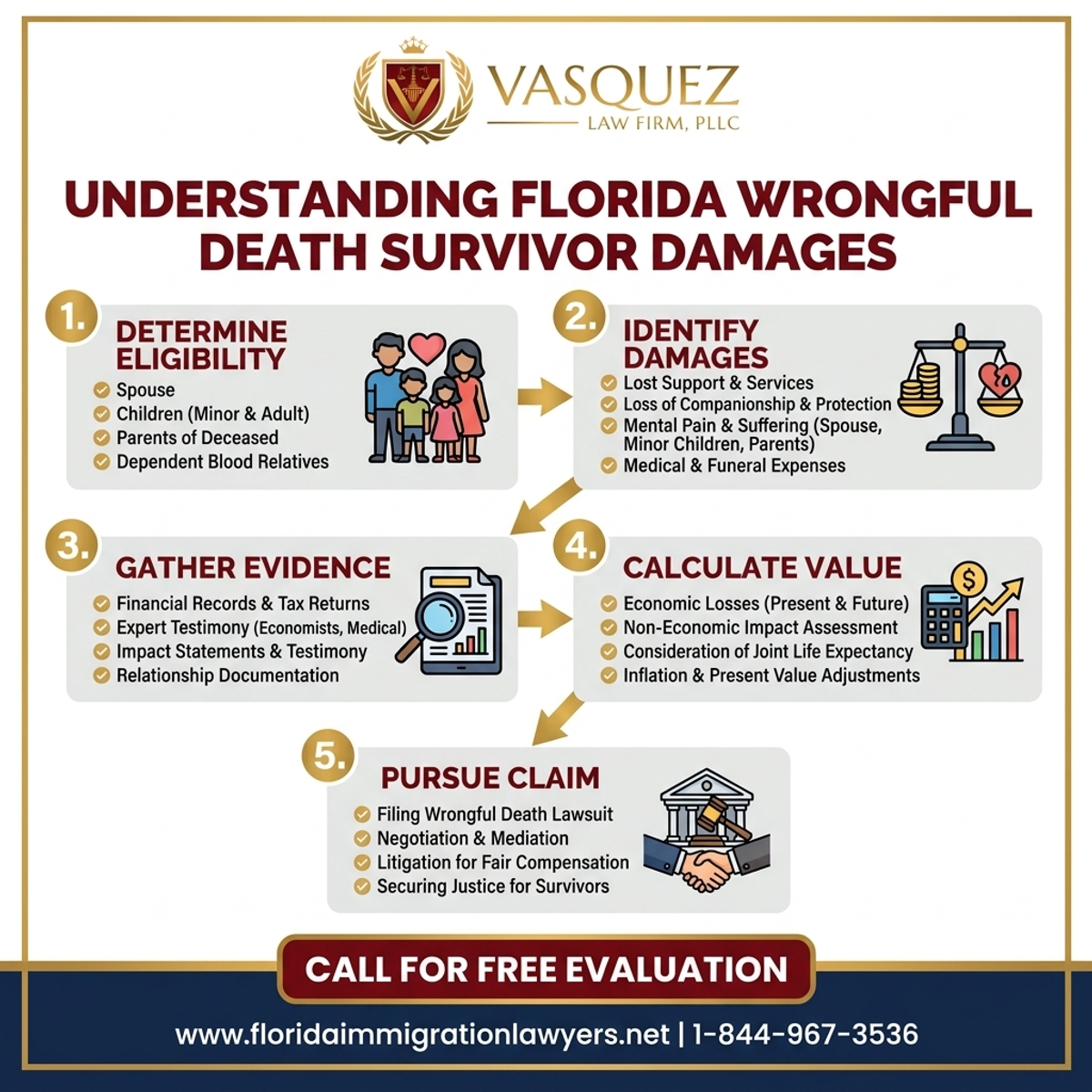
Step-by-Step Process — Understanding Florida Wrongful Death Survivor Damages
Document Checklist
- Death certificate of the deceased
- Evidence of negligence (e.g., police reports, witness statements)
- Proof of survivor eligibility (e.g., birth certificates, marriage licenses)
- Medical records and expenses related to the incident
- Funeral and burial expense receipts
Thorough documentation is the bedrock of a strong wrongful death claim. The items on this checklist are crucial for establishing both liability and the extent of your damages. Organizing these documents early can significantly streamline the legal process and provide a clear picture of your case. Your legal team at Florida Immigration Lawyers will assist you in compiling, organizing, and, if necessary, obtaining any missing records to build a comprehensive and compelling claim.
Timeline and Processing Expectations
The timeline for a wrongful death claim in Florida can vary significantly based on the complexity of the case. Generally, survivors must file a claim within two years from the date of death, as stipulated by Florida's statute of limitations (§95.11(4)(a)). This period can be extended in certain circumstances, such as discovery of new evidence.
From filing to resolution, the process may take several months to a few years, depending on whether the case settles or goes to trial. It's crucial for survivors to work closely with legal counsel to navigate this timeline effectively.
Several factors can influence the duration of a wrongful death claim. These include the complexity of the accident itself, the number of parties involved, the extent of the damages, and the willingness of the defendant and their insurance company to negotiate a fair settlement. Cases involving extensive investigations, multiple expert witnesses, or significant disputes over liability or damages naturally take longer to resolve.
The legal process typically moves through several phases: initial investigation and evidence gathering, filing the lawsuit, the discovery phase (where information is exchanged between parties), mediation or settlement negotiations, and finally, if no settlement is reached, trial. Each phase has its own timeline, and court dockets can also play a role in scheduling. Florida Immigration Lawyers will keep you informed at every stage, managing expectations and working diligently to move your case forward efficiently while ensuring a thorough approach.
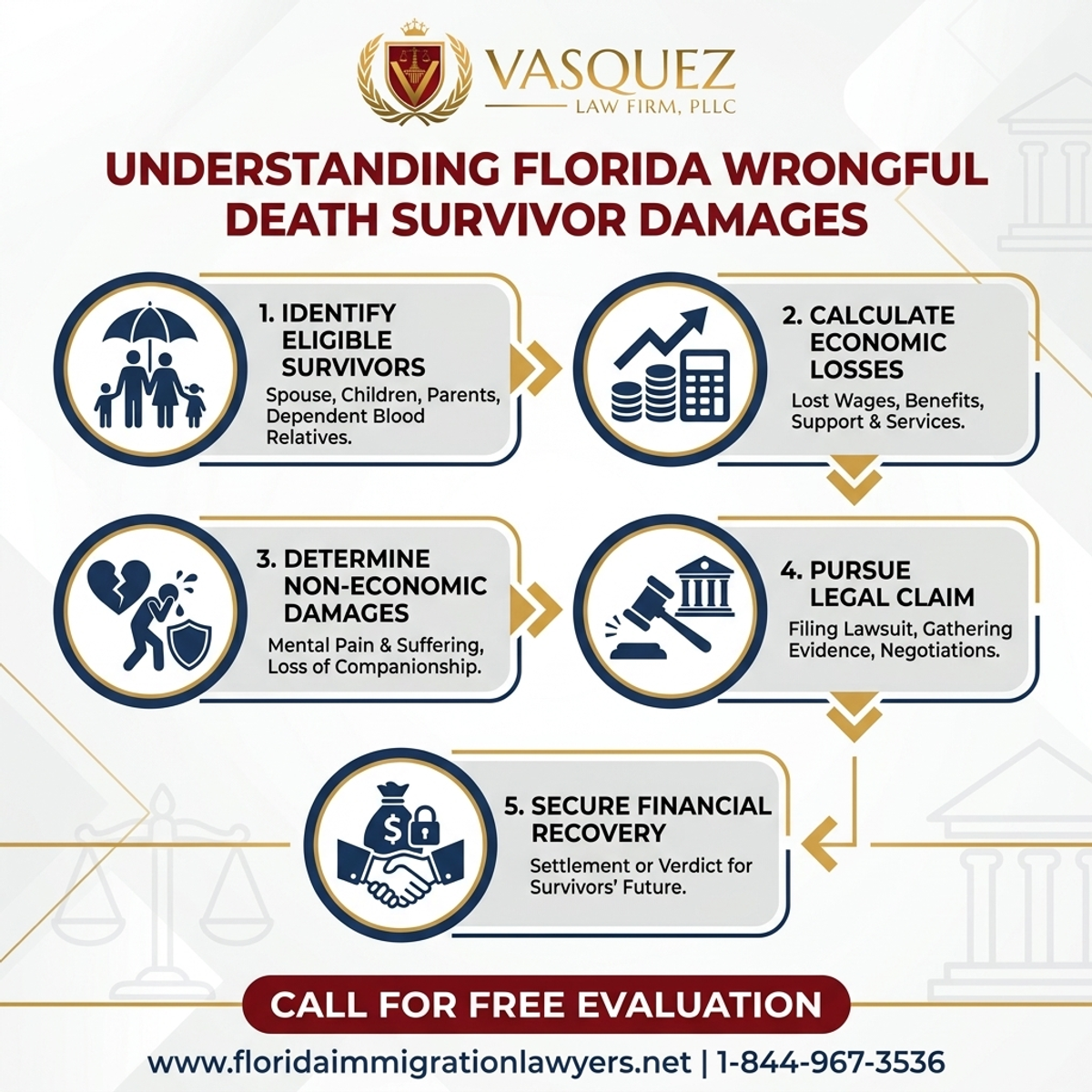
Key Statistics — Understanding Florida Wrongful Death Survivor Damages
Cost Factors and Fee Breakdown
Filing a wrongful death claim involves various costs, including court fees, attorney fees, and potential expert witness fees. Many attorneys, including those at Florida Immigration Lawyers, operate on a contingency fee basis, meaning survivors pay no upfront costs and only pay if the case is successful.
This "no recovery, no fee" arrangement ensures that financial barriers do not impede access to justice for grieving families.
A contingency fee agreement means that our legal fees are contingent upon the successful resolution of your case, whether through a settlement or a favorable verdict at trial. This arrangement covers the attorney's time, legal expertise, and the significant resources dedicated to investigating and prosecuting your claim. It eliminates the financial stress of hourly billing, allowing families to focus on healing without worrying about accumulating legal bills.
It's important to differentiate between attorney fees and litigation costs. While attorney fees are covered by the contingency agreement, case costs—such as court filing fees, deposition expenses, expert witness fees (e.g., accident reconstructionists, medical experts, economists), and obtaining records—are typically reimbursed to the law firm from the settlement or award. Our team at Florida Immigration Lawyers will provide a clear breakdown of all potential costs upfront, ensuring full transparency throughout the process. This model underscores our commitment to making legal assistance accessible to all families in Florida who have suffered an unimaginable loss due due to negligence.
Common Mistakes to Avoid in Wrongful Death Claims
- Missing the Filing Deadline: Not adhering to the two-year statute of limitations can result in losing the right to file a claim.
- Inadequate Evidence Gathering: Failing to collect sufficient evidence can weaken the claim and reduce the chance of a successful outcome.
- Overlooking Eligible Survivors: Not identifying all eligible survivors can limit the potential damages recovered.
- Neglecting to Appoint a Personal Representative: Without a court-appointed representative, the claim cannot proceed.
- Settling Too Early: Accepting a quick settlement offer might not fully compensate for the losses incurred.
- Ignoring Expert Testimonies: Expert witnesses can provide critical insights that bolster a claim.
- Failing to Consult an Attorney: Navigating the legal system without professional guidance can lead to costly errors.
Missing the filing deadline, known as the statute of limitations, is perhaps the most critical error. Florida law generally provides two years from the date of death to file a wrongful death claim. Failing to meet this deadline almost invariably results in the permanent loss of your right to seek compensation, regardless of the merits of your case. Always consult an attorney immediately to confirm your specific deadline.
Inadequate evidence gathering significantly undermines your claim. Without sufficient proof of negligence and the extent of your losses, it becomes challenging to establish liability or justify the compensation sought. Comprehensive documentation, including police reports, medical records, witness statements, and expert analyses, is essential to build a strong case.
Overlooking eligible survivors can lead to an incomplete claim and may prevent certain family members from receiving the compensation they are legally entitled to. Florida statutes define specific categories of survivors, and an experienced attorney can ensure all rightful claimants are identified and included in the lawsuit.
Neglecting to appoint a Personal Representative is a procedural misstep that halts the entire process. The court-appointed PR is the only individual with the legal authority to file and manage the wrongful death claim on behalf of the deceased's estate and all survivors. This appointment is a mandatory first step in the formal legal process.
Settling too early often means accepting an offer that does not fully account for all your present and future losses. Insurance companies may try to resolve cases quickly for the lowest possible amount. An attorney will help you understand the true value of your claim, including long-term financial and emotional damages, ensuring you don't compromise your rightful compensation.
Ignoring expert testimonies can weaken the credibility and strength of your case. Expert witnesses, such as accident reconstructionists, medical professionals, or forensic economists, provide specialized knowledge that can prove negligence, establish causation, or accurately calculate complex damages, significantly bolstering your claim.
Failing to consult an attorney for a wrongful death claim is a common mistake that can have severe consequences. The legal complexities, negotiation tactics of insurance companies, and strict procedural requirements make professional legal guidance indispensable. An experienced wrongful death lawyer from Florida Immigration Lawyers can protect your rights, navigate the system, and maximize your chances of a successful outcome.
When to Call a Lawyer
If you are dealing with the death of a loved one in Coral Springs or elsewhere in Florida, it's essential to consult an attorney as soon as possible. Legal guidance is crucial if:
- You suspect negligence or wrongful act caused the death.
- The insurance company is offering a low settlement.
- There are disputes among survivors about the claim.
Contact Florida Immigration Lawyers to ensure your rights are protected and you receive the compensation you deserve.
Even if you are unsure whether negligence played a role in your loved one's death, an attorney can conduct an independent investigation to determine the viability of a claim. Many deaths initially attributed to accidents may, upon closer inspection, reveal underlying negligence or wrongful acts. Early consultation allows for prompt evidence collection, which is often critical before evidence is lost or altered.
Beyond the immediate aftermath, legal guidance is invaluable when dealing with insurance companies. These entities are primarily concerned with their bottom line and may offer quick, lowball settlements that do not adequately cover your losses. An experienced lawyer from Florida Immigration Lawyers will protect your interests, negotiate on your behalf, and ensure any settlement reflects the true value of your claim.
Furthermore, if your case involves complex circumstances, such as multiple responsible parties, a government entity, or unclear liability, the expertise of a wrongful death attorney becomes indispensable. They can navigate intricate legal frameworks, identify all potential defendants, and build a robust case to secure the maximum compensation possible for your family. Don't hesitate to call 1-844-967-3536 for a free consultation.
Navigating Insurance Companies
Dealing with insurance companies after a wrongful death can be one of the most challenging aspects of the legal process. It's crucial to remember that insurance companies are businesses designed to protect their profits, and their primary goal will often be to minimize the payout on any claim. They may contact you quickly after the incident, offering condolences and requesting statements or information.
It is strongly advised against providing any recorded statements or signing any documents from an insurance company without first consulting with your attorney. Anything you say can potentially be used against your claim later. Insurance adjusters are skilled negotiators trained to elicit information that could harm your case or reduce the value of your potential settlement.
By retaining Florida Immigration Lawyers, you empower your legal team to handle all communications with insurance companies on your behalf. Your attorney will act as a buffer, protecting you from intrusive questioning and ensuring that all information shared is strategically beneficial to your claim. This allows you to focus on grieving and healing, knowing that your legal rights are being vigorously protected by experienced professionals.
About Florida Immigration Lawyers
Florida Immigration Lawyers is dedicated to providing compassionate and thorough legal services to families across Florida. Our team is available 24/7 to assist with wrongful death claims and other personal injury matters. Call us at 1-844-967-3536 or visit our website at https://www.floridaimmigrationlawyers.net for a free consultation. We offer bilingual services to accommodate Spanish-speaking clients.
Sources and References
- U.S. Citizenship and Immigration Services (USCIS)
- Executive Office for Immigration Review (EOIR)
- 8 U.S.C. Chapter 12 - Immigration and Nationality Act
- §95.11(4)(a) - Florida Statutes, Statute of Limitations for Personal Injury
- §768.16-26 - Florida Wrongful Death Act
Related services: fatal car accident claims, fatal truck collisions, fatal pedestrian accident claims.
This article provides general legal information and is not intended as legal advice. Every case is unique, and outcomes depend on specific facts and circumstances. Contact an attorney for advice about your particular situation.
Reviewed By
This article was reviewed for Florida legal accuracy by Harold Estrada-Rodriguez, Florida Bar No. 1041171, the attorney responsible for personal injury matters at Florida Immigration Lawyers. Personal injury representation in Florida only. No recovery, no fee.
Final CTA
For compassionate legal assistance with wrongful death claims, contact Florida Immigration Lawyers at 1-844-967-3536. We offer a free consultation and are here to help you navigate this challenging time. Se Habla Espanol - Estamos aqui para ayudarle.
If you need legal assistance, learn more about Florida personal injury legal team in Orlando, or call us at 1-844-967-3536 for a free consultation.
Do Not Navigate This Process Alone
Our experienced immigration attorneys are ready to fight for you. Get a free, confidential consultation today.
Se Habla Español
Frequently Asked Questions
Florida Immigration Lawyers
Immigration Attorney | Founder, Vasquez Law Firm
U.S. Air Force veteran and immigration attorney with thousands of cases resolved. J.D., NCCU School of Law. AILA member. Admitted to the 4th, 5th, and 11th Circuit Courts.
Available 24/7 - Free Evaluations
Related Legal Services
Our Florida immigration attorneys can help you with slip-and-fall premises liability, Florida wrongful death claims and Florida personal injury attorney Harold Estrada-Rodriguez. Call today at 1-844-967-3536 for a free consultation.
Related Links
Related Topics
Free Legal Consultation
Discuss your case with our experienced attorneys. We're available 24/7.
Se Habla Español - Estamos aquí para ayudarle.
Related Articles
Florida Pedestrian Accident Rights and Damages | VLF Florida
If you're a pedestrian hit by a car in a Florida crosswalk, you may be entitled to damages. Learn about crosswalk laws, driver fault, and potential compensation for your injuries.
Understanding Florida's 50% Bar Rule in Comparative Negligence
Learn about Florida's 50% bar rule in comparative negligence and how it affects your ability to recover damages in personal injury cases. This guide covers the essentials of understanding your rights and responsibilities under Florida law.
Understanding Florida's 2-Year Statute of Limitations in PI
Learn about Florida's 2-year statute of limitations for personal injury claims and how recent changes impact your rights. Contact Florida Immigration Lawyers for a free consultation.
Florida Rear-End Collision Whiplash Claims | VLF Florida
Rear-end collisions in Florida often lead to serious injuries such as whiplash and herniated discs. Learn how to navigate the claims process effectively.