Florida Refugee Immigration Help: 2026 Guide
For those seeking Florida refugee immigration help, understanding the path to safety and resettlement is critical. Refugee status is granted to individuals facing persecution in their home countries, and the process typically begins overseas, involving referrals from UNHCR or U.S. Embassies. This guide clarifies eligibility criteria, the multi-step application process, and the vital role of resettlement agencies in Florida, particularly in the Orlando area. We detail the necessary documentation, provide an estimated timeline for the various stages, and break down potential costs, emphasizing that government application fees for refugees are generally waived. Avoiding common mistakes like inconsistent information or missed deadlines is paramount. Florida Immigration Lawyers offers compassionate, expert legal counsel to navigate these complexities, from preparing for USCIS interviews to addressing family reunification concerns. We are dedicated to advocating for your rights and helping you build a secure future in Florida. Contact us for a free case review.

For individuals seeking Florida refugee immigration help, the process involves a complex series of steps often initiated outside the United States. Refugee status is granted to those persecuted or fearing persecution in their home country, as defined by U.S. and international law. Once granted, refugees may be resettled in Florida through various agencies, receiving initial support for housing, employment, and integration. Navigating this system requires understanding eligibility criteria, application procedures, and available resources. Legal assistance is often crucial for a successful outcome and to ensure all rights are protected during this challenging transition.
- Eligibility: Must meet the international definition of a refugee, fearing persecution based on race, religion, nationality, political opinion, or social group.
- Application Process: Typically starts with a referral from UNHCR or a U.S. Embassy abroad, followed by extensive interviews and security checks.
- Resettlement Support: Upon arrival in Florida, refugees receive assistance from resettlement agencies for housing, cultural orientation, and job placement.
- Legal Guidance: An experienced immigration attorney can provide vital assistance, clarify complex laws, and help prepare documentation for refugee status and resettlement.
Florida, a state known for its diverse communities and welcoming spirit, often serves as a new home for individuals and families fleeing persecution and seeking safety. If you are seeking Florida refugee immigration help, understanding the intricate legal pathways and support systems available is your first crucial step. The journey to secure refugee status and resettle in a new country can be overwhelming, filled with bureaucratic hurdles, emotional challenges, and critical deadlines. This comprehensive guide aims to demystify the process, offering clarity on eligibility, application procedures, and the vital resources awaiting you in the Sunshine State.
From the initial stages of proving your well-founded fear of persecution to integrating into a new community in Central Florida, every step matters. Our goal is to equip you with the knowledge needed to make informed decisions and to highlight the importance of expert legal representation. At Florida Immigration Lawyers, we understand the profound courage it takes to seek refuge and are dedicated to providing compassionate, effective legal counsel. We are here to help you navigate this complex journey with confidence. For a free case review and to discuss your unique situation, call Florida Immigration Lawyers at 1-844-967-3536 today.
Understanding Refugee Status and Resettlement in Florida
Refugee status, as defined under U.S. immigration law and international conventions, is a protective legal classification for individuals who have fled their home country and cannot return due to a well-founded fear of persecution. This fear must be based on one of five specific grounds: race, religion, nationality, membership in a particular social group, or political opinion. The Immigration and Nationality Act (INA) Section 101(a)(42) provides the statutory definition that guides U.S. policy. Unlike asylum seekers, who apply for protection from within the U.S. or at a port of entry, refugees typically apply for this status from outside the United States and are processed overseas.
Florida plays a significant role in the national refugee resettlement program, welcoming thousands of individuals and families each year. The state's robust network of resettlement agencies, supported by federal funding and local communities, assists newly arrived refugees with essential services. These services include immediate housing, cultural orientation, English language training, employment assistance, and access to healthcare and education. Central Florida, particularly the Orlando area, has historically been a key hub for refugee resettlement, offering a diverse and supportive environment for integration. Understanding the distinction between refugee and asylum status is critical, as the application processes and initial pathways to protection differ significantly. Refugees are granted status before arriving in the U.S., while asylum seekers request it upon or after arrival. For more information on the official definitions and procedures, you can visit the U.S. Citizenship and Immigration Services (USCIS) website.
How Do I Apply for Refugee Status and Resettlement in Florida?
Applying for refugee status and subsequent resettlement in Florida typically begins outside the United States. Unlike asylum, which is sought from within U.S. borders, refugee status is generally granted to individuals who are referred for resettlement by the United Nations High Commissioner for Refugees (UNHCR) or by a U.S. Embassy abroad. These referrals are crucial as direct applications from individuals for refugee status are not accepted. Once referred, applicants undergo a rigorous multi-step process that involves extensive vetting and security checks before they are approved for travel and resettlement in the U.S. This process is designed to ensure the safety and security of both the applicants and the host country.
The resettlement journey for approved refugees destined for Florida involves coordination between various U.S. government agencies and non-governmental organizations. The U.S. Department of State's Bureau of Population, Refugees, and Migration (PRM) oversees the U.S. Refugee Admissions Program (USRAP) and works with nine national resettlement agencies, which then partner with local affiliates in Florida. These local agencies, many of which have offices in Central Florida, are responsible for providing initial reception and placement services. This includes meeting refugees at the airport, providing safe housing, assisting with school enrollment, and helping find initial employment. The entire process, from referral to arrival and initial integration, is complex and highly structured, emphasizing the need for legal guidance to understand each stage. For detailed information on the U.S. Refugee Admissions Program, consult the U.S. Department of State website.
- Referral to USRAP: The first step is typically a referral by the UNHCR or a U.S. Embassy/NGO to the U.S. Refugee Admissions Program (USRAP). This is a critical prerequisite; individuals cannot self-petition for refugee status from outside the U.S.
- Resettlement Support Center (RSC) Processing: Once referred, your case is assigned to one of several Resettlement Support Centers (RSCs) located globally. The RSC collects biographical data, conducts initial screenings, and prepares your case for review.
- USCIS Interview: A USCIS officer will conduct an in-person interview to determine if you meet the refugee definition under U.S. law. This is a crucial stage where you must present a credible and consistent account of your persecution fear.
- Security Checks and Medical Exam: Extensive background and security checks are conducted by multiple U.S. government agencies. You will also undergo a mandatory medical examination to ensure you do not have any inadmissible health conditions.
- Adjudication and Approval: If all checks are cleared and the USCIS officer approves your petition, you will be granted refugee status. This decision allows you to be considered for resettlement.
- Cultural Orientation & Travel: Before travel, you may attend cultural orientation sessions. Travel arrangements to the U.S. are then coordinated, typically through the International Organization for Migration (IOM).
- Arrival and Resettlement in Florida: Upon arrival in Florida, you will be met by a local resettlement agency. This agency provides initial support, including housing, food, clothing, and assistance with accessing social services, employment, and education.
What Documents Are Needed for Refugee Resettlement in Florida?
While much of the documentation for refugee status is gathered during the initial referral and interview process by the UNHCR or Resettlement Support Centers, having personal and evidentiary documents readily available is crucial. The primary documents needed are those that establish your identity, family relationships, and, most importantly, provide evidence of the persecution you have suffered or fear. These documents are vital for the USCIS interview and subsequent processing, as they help corroborate your testimony and build a strong case for your refugee claim. Inaccurate or missing documentation can significantly delay the process or even lead to a denial, underscoring the importance of meticulous preparation.
Beyond personal identification, any records that detail the threats, harm, or discrimination you faced in your home country are invaluable. This could include official reports, medical records, or public statements. For individuals being resettled in Florida, these documents will also be essential for integrating into the community, such as enrolling children in school, applying for social security numbers, and securing employment. It is highly recommended to have original documents, along with certified translations into English, if they are not already in English. Consulting with an immigration attorney can help you identify and organize all necessary documentation, ensuring your application is as robust as possible. Remember that legal counsel is particularly helpful when dealing with complex or sensitive documents related to persecution. For information on specific forms and requirements, you can refer to the USCIS Forms page.
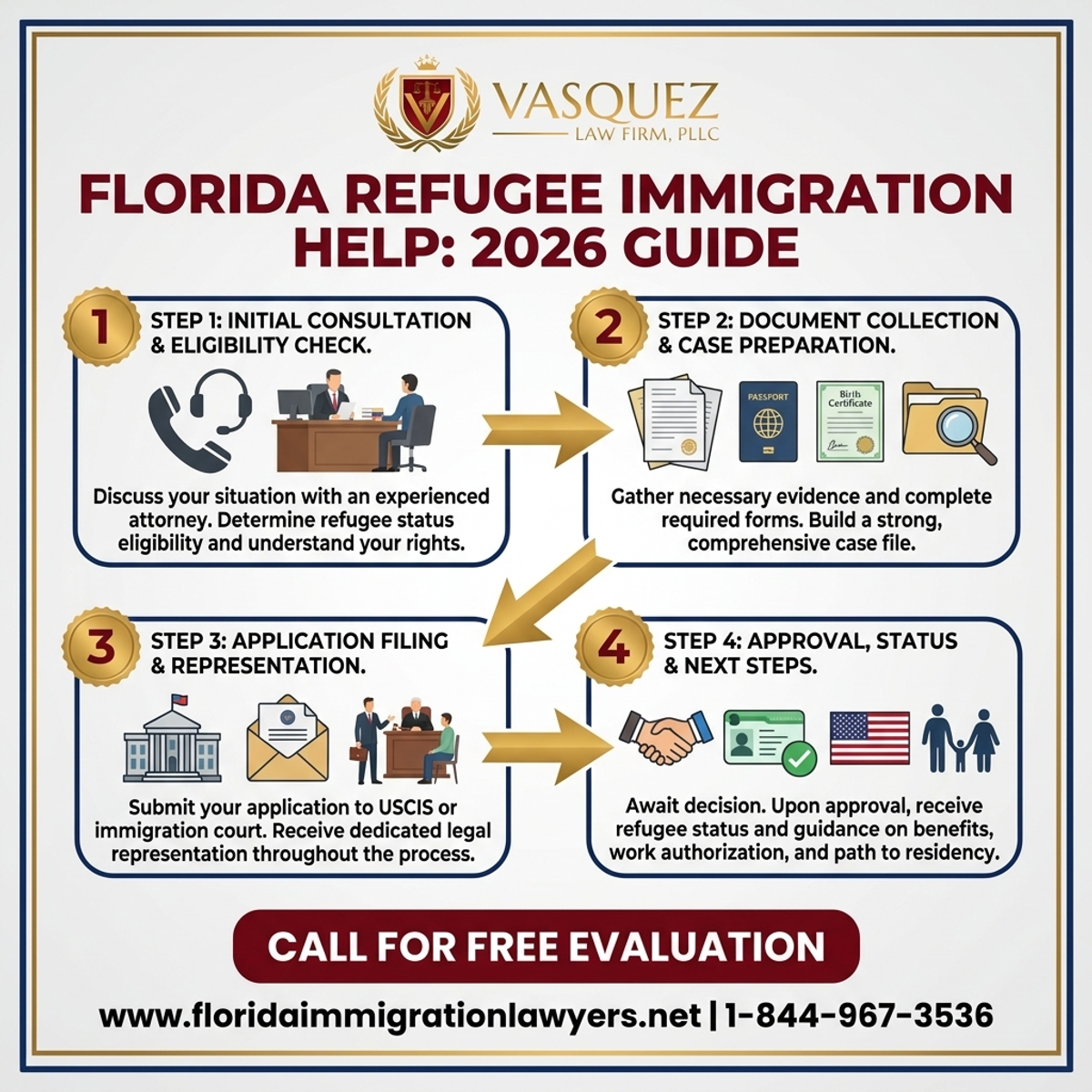
Step-by-Step Process — Florida Refugee Immigration Help: 2026 Guide
- Proof of Identity: Passports, national ID cards, birth certificates, or any official documents establishing your identity. Even if expired or difficult to obtain, these are critical.
- Proof of Family Relationships: Marriage certificates, birth certificates of children, adoption papers, or other documents demonstrating your familial ties, especially if applying with dependents.
- Evidence of Persecution: This is arguably the most important category. It can include police reports, medical records documenting injuries, news articles, court documents, affidavits from witnesses, letters from human rights organizations, or any written proof detailing the threats, arrests, torture, or discrimination you experienced or fear.
- Travel Documents: Any existing travel documents or visas, even if expired.
- Biographical Information: Comprehensive details about your background, education, employment history, and addresses.
- Medical Records: While a new medical exam will be required, any existing medical records, especially those related to persecution, can be supportive.
- Photos: Passport-style photographs for various forms.
- Translations: All documents not in English must be accompanied by a certified English translation.
How Long Does Refugee Resettlement Take in Florida in 2026?
The timeline for refugee resettlement in Florida, as of 2026, is highly variable and often spans several years. There is no fixed duration, as the process is influenced by numerous factors, including the country of origin, the complexity of the individual case, security screening requirements, and the fluctuating capacity of the U.S. Refugee Admissions Program (USRAP). Global events, changes in U.S. policy, and the volume of referrals from UNHCR can also significantly impact processing times. While some cases may move faster, it is common for applicants to wait for a considerable period after their initial referral before final approval and travel to the U.S. Patience and persistent engagement with your legal counsel or resettlement agency are crucial during this extended waiting period.
Once approved, the final stages of travel and initial resettlement in Florida are typically more expedited. Upon arrival, local resettlement agencies, many active in Central Florida, strive to provide immediate support to help refugees quickly integrate. This includes securing initial housing, providing a stipend for basic needs, and connecting individuals with essential services. However, the journey to full self-sufficiency and integration can take much longer, often requiring ongoing support and personal effort. Understanding these timelines helps manage expectations and allows for better planning. Individuals should always consult the latest information from USCIS or their legal representative, as processing times are subject to frequent updates and changes. The Executive Office for Immigration Review (EOIR) also provides resources for those who might transition to asylum claims or other immigration processes, which can be found at justice.gov/eoir.
| Stage | Typical Timeframe (As of 2026) | Notes |
|---|---|---|
| UNHCR/U.S. Embassy Referral | Highly variable (months to years) | Depends on country situation and UNHCR caseload. |
| Resettlement Support Center (RSC) Processing | 3-12 months | Data collection, initial forms, case preparation. |
| USCIS Interview | Scheduled after RSC processing; wait times vary | Crucial step for refugee status determination. |
| Security Checks | 6-24 months (or longer) | Conducted by multiple agencies; a major factor in overall delay. |
| Medical Examination | 1-3 months | Must be current at time of travel; may need to be repeated. |
| Travel & Initial Resettlement | 1-3 months post-approval | Coordinated by IOM and local Florida resettlement agencies. |
What Are the Costs Associated with Refugee Resettlement and Legal Help?
When considering the costs associated with refugee resettlement and securing legal help in Florida, it's important to distinguish between government fees and legal representation fees. As of 2026, individuals applying for refugee status through the U.S. Refugee Admissions Program generally do not pay application fees to the U.S. government. This is a critical distinction designed to ensure that financial barriers do not prevent those fleeing persecution from seeking safety. The costs of travel to the United States are also typically covered by the International Organization for Migration (IOM) through a loan program, which refugees are expected to repay over time, usually interest-free. However, indirect costs and the fees for professional legal assistance can still be significant.
While the government aims to minimize direct financial burdens on refugees, the cost of expert legal assistance is an investment that can significantly improve your chances of a successful outcome. An experienced immigration attorney can help prepare your case, gather evidence, represent you during interviews, and navigate any challenges that arise, such as appealing a denial or addressing complex eligibility issues. Legal fees vary widely depending on the complexity of the case, the attorney's experience, and the services required. Many law firms, including Florida Immigration Lawyers, offer free initial consultations to discuss your case and provide an estimate of legal costs. It is always advisable to understand all potential costs upfront and to seek counsel to protect your rights and ensure a smooth resettlement process in Florida. Additional information regarding fees can be found on the USCIS website, but always verify for any specific form you might encounter.
| Item | Typical Fee (As of 2026) | Notes |
|---|---|---|
| Refugee Application (Form I-590) | $0 | No filing fee required for refugee applications. |
| Biometrics Services Fee | $0 | Generally waived for refugees. |
| Medical Examination | Varies (typically $200-$500) | Paid to authorized panel physician; may be covered by resettlement agencies upon arrival. |
| Travel to U.S. | Covered by IOM loan | Interest-free loan, repaid over time after arrival. |
| Legal Consultation | Varies (often free initial consultation) | Florida Immigration Lawyers offers free case reviews. |
| Legal Representation | Varies (hourly or flat fee) | Costs depend on case complexity and attorney services. |
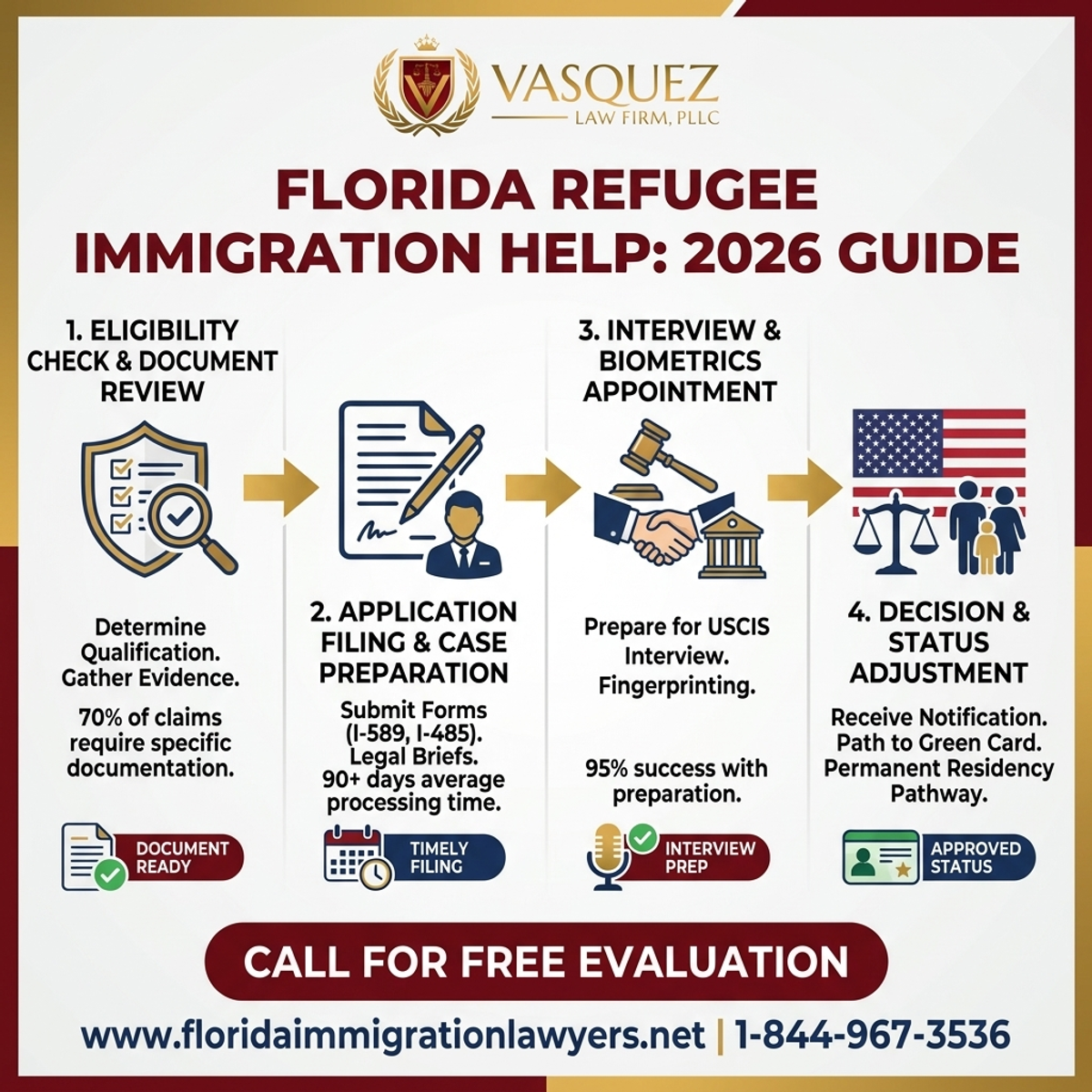
Key Statistics — Florida Refugee Immigration Help: 2026 Guide
Do not navigate this process alone. The complexities of refugee immigration and resettlement require experienced legal guidance. Contact Florida Immigration Lawyers today to schedule your free consultation and receive the support you deserve. We are committed to protecting your rights and helping you build a new life in Florida.
Common Mistakes to Avoid in Refugee Immigration
Navigating the refugee immigration process can be fraught with potential pitfalls. Avoiding common mistakes is crucial to a successful outcome and to prevent unnecessary delays or denials. Being informed and meticulous can make a significant difference in your journey to safety and resettlement in Florida.
- Providing Inconsistent Information: Any discrepancies in your testimony or documentation can raise doubts about your credibility. Always be truthful and consistent in all statements and forms.
- Failing to Disclose All Relevant Information: Withholding information, even if seemingly minor or embarrassing, can be detrimental. Full disclosure is essential for a transparent and trustworthy application.
- Missing Deadlines: The immigration process involves strict deadlines for submitting documents or responding to requests. Missing these can lead to case delays or even closure.
- Insufficient Evidence of Persecution: A successful refugee claim requires strong, credible evidence of persecution or a well-founded fear of it. Lack of supporting documents can weaken your case significantly.
- Not Seeking Legal Counsel: Attempting to navigate the complex U.S. immigration laws without an experienced attorney can lead to critical errors, missed opportunities, and increased stress.
- Traveling Internationally Before Approval: If you are seeking refugee status, traveling back to your home country or other countries could be seen as an indication that you no longer fear persecution, potentially jeopardizing your case.
- Failing to Update Contact Information: Moving without notifying USCIS or your legal counsel of your new address can result in missed notices, interviews, or crucial communications.
- Failing to Understand the Distinction Between Refugee and Asylum: These terms have distinct legal definitions and application processes. Misunderstanding which applies to your situation can lead to incorrect filings and delays.
- Not Preparing for Interviews: Interviews with USCIS or other officials are critical. Failing to prepare your testimony, review your evidence, and anticipate questions can hinder your ability to present a strong case.
When to Call a Lawyer for Florida Refugee Immigration Help
The decision to seek legal counsel for Florida refugee immigration help is often one of the most important steps you can take. While government agencies and resettlement organizations provide valuable support, they cannot offer legal advice or represent you in court. An experienced immigration attorney from Florida Immigration Lawyers can be an invaluable advocate, especially when facing complex legal scenarios or uncertainty.
You should consider contacting an attorney if your case involves any complexities, such as a prior denial, a criminal record, or if you have previously been ordered removed or deported. Legal counsel is also critical if you are unsure whether you meet the eligibility criteria for refugee status or if you need assistance gathering compelling evidence of persecution. Furthermore, if you are concerned about family reunification, navigating the resettlement benefits, or transitioning from another immigration status, our attorneys can provide clarity and strategic guidance. We understand the specific nuances of immigration law relevant to Florida residents and can help you prepare thoroughly for interviews, manage documentation, and represent your interests effectively. Don't wait until problems arise; proactive legal engagement can prevent many common pitfalls and secure a smoother path to a new life in Florida. For assistance with any aspect of your immigration journey, including asylum claims or deportation defense, our team is ready to help.
About Florida Immigration Lawyers
Florida Immigration Lawyers is a leading law firm dedicated to providing comprehensive and compassionate immigration legal services across the entire state of Florida. Our team of highly skilled and experienced attorneys understands the profound impact immigration matters have on individuals and families. We are committed to guiding our clients through the complexities of U.S. immigration law with integrity, professionalism, and a deep commitment to their success. Whether you are seeking refugee status, asylum, family-based visas, employment visas, or facing deportation, we are here to advocate for your rights and help you achieve your immigration goals.
With a focus on personalized service and attention to detail, we pride ourselves on delivering effective legal strategies tailored to each client's unique circumstances. We offer free case reviews, operate 24/7 for your convenience, and are proud to provide bilingual services (English and Spanish) to ensure clear and accessible communication. Our firm is dedicated to serving all of Florida, from our base in Central Florida, and our attorneys are prepared to assist clients no matter where they are located in the state. For dedicated legal representation you can trust, contact Florida Immigration Lawyers at 1-844-967-3536 or schedule a free consultation today. We are here to help you navigate your immigration journey with confidence and peace of mind.
Sources and References
- U.S. Citizenship and Immigration Services (USCIS)
- Executive Office for Immigration Review (EOIR)
- U.S. Department of State
- 8 U.S.C. § 1101(a)(42) - Definition of Refugee (Immigration and Nationality Act)
- 8 U.S.C. § 1157 - Annual Admission of Refugees and Admission of Emergency Situation Refugees
- 8 C.F.R. Part 208 - Procedures for Asylum and Withholding of Removal
- USCIS Policy Manual, Volume 7, Part A - Refugees and Asylees
Related services: asylum application process, humanitarian protection programs.
This article provides general legal information and is not intended as legal advice. Every case is unique, and outcomes depend on specific facts and circumstances. Contact an attorney for advice about your particular situation.
Your journey to a new life in Florida begins with informed decisions and strong legal support. If you or a loved one needs expert guidance on refugee status or resettlement, do not hesitate. Call Florida Immigration Lawyers today at 1-844-967-3536 for your free, confidential case review. Se Habla Espanol - Estamos aqui para ayudarle.
Do Not Navigate This Process Alone
Our experienced immigration attorneys are ready to fight for you. Get a free, confidential case review today.
Se Habla Español
Or leave your details and we’ll call you:
Free Evaluation in 24 Hours
Or talk to us right now
AI voice assistant — available 24/7
FreeFrequently Asked Questions

William J. Vásquez
Founding Attorney · Vasquez Law Firm
U.S. Air Force veteran and immigration attorney with years of hands-on U.S. immigration experience. J.D., NCCU School of Law. AILA member. Admitted to the 4th, 5th, and 11th Circuit Courts.
Available 24/7 - Free Evaluations
Reviewed for legal accuracy by William J. Vásquez
Licensed in North Carolina; U.S. immigration is federal practice.
Related Legal Services
Our Florida immigration attorneys can help you with citizenship and naturalization, immigration practice areas and free immigration consultation. Call today at 1-844-967-3536 for a free case review.
Related Links
Related Topics
Free Legal Case Review
Discuss your case with our experienced attorneys. We're available 24/7.
Se Habla Español - Estamos aquí para ayudarle.
Related Articles
Immigration Lawyer Orlando Free Consultation in Florida
For individuals and families in Orlando, Florida, navigating the complexities of U.S. immigration law requires expert guidance. An immigration lawyer in Orlando offers crucial support for everything from visa applications and green card processes to naturalization and deportation defense. This comprehensive guide details what a free consultation covers, providing a step-by-step overview of immigration pathways, essential document checklists, and expected timelines in 2026. We also highlight common mistakes to avoid, discuss the critical role of legal counsel in deportation and asylum cases, and explain why choosing a local Orlando immigration attorney is beneficial. Florida Immigration Lawyers is dedicated to serving the diverse community of Orlando with compassionate, effective legal solutions, ensuring you receive personalized advice and robust representation for a successful immigration journey.
Deportation Attorney St. Petersburg: Florida Defense in 2026
Facing deportation in St. Petersburg or anywhere in Florida can be a terrifying experience. The U.S. government's initiation of removal proceedings demands immediate and expert legal intervention to protect your right to remain in the country. This comprehensive guide from Florida Immigration Lawyers explains the entire deportation process, from receiving a Notice to Appear (NTA) to navigating complex immigration court hearings. We detail the crucial role an experienced deportation defense lawyer plays, outlining how they can identify potential forms of relief, prepare essential documentation, and represent you effectively before an Immigration Judge. Learn about the step-by-step process, critical documents needed, typical timelines in Florida, and the costs involved. We also highlight common mistakes to avoid that could jeopardize your case and emphasize when it's absolutely vital to seek legal counsel. Florida Immigration Lawyers serves clients across the entire state, offering compassionate, dedicated, and strategic advocacy to fight for your future. Contact us for a free case review and let us help you understand your options and build a strong defense.
Credible Fear Interview Lawyer in Florida 2026
A credible fear interview (CFI) is a crucial step for individuals in Florida facing expedited removal who express a fear of persecution or torture if returned to their home country. This interview, conducted by a USCIS Asylum Officer, determines if there's a "significant possibility" you could establish eligibility for asylum or other protection. A positive finding leads to a hearing before an Immigration Judge, while a negative one can result in swift deportation. The process involves apprehension by immigration authorities, expressing fear, referral to an Asylum Officer, and the interview itself. Documents like identity papers, evidence of persecution, and a personal statement can strengthen your claim. Understanding the questions, maintaining consistency, and avoiding common mistakes are vital. While there are no direct USCIS fees for the CFI, legal representation is highly recommended and comes with associated costs. Florida Immigration Lawyers offers expert guidance, helping you navigate this complex process, prepare effectively, and advocate for your rights. If you or a loved one are preparing for a CFI, contact us immediately for a free case review.
H-4 EAD Spouse Work Permit Rules in Florida 2026
For H-1B visa holders in Florida, the H-4 EAD is a vital work authorization for their spouses, enabling them to pursue careers and contribute to family income. This comprehensive guide for 2026 details eligibility requirements, which include the H-1B spouse having an approved Form I-140 or an H-1B extension under AC21. We cover the step-by-step application process for Form I-765, including necessary documents like marriage certificates and I-94 records. The article also provides insights into typical processing times, which can range from 5 to 12 months, and a breakdown of associated costs, including USCIS fees and potential legal expenses. We highlight common mistakes to avoid, such as incorrect eligibility categories or late renewals, and emphasize the importance of maintaining H-4 status. Understanding these rules ensures H-1B families in Florida can navigate the H-4 EAD process smoothly, fostering financial independence and professional growth for spouses.