H-4 EAD Spouse Work Permit Rules in Florida 2026
For H-1B visa holders in Florida, the H-4 EAD is a vital work authorization for their spouses, enabling them to pursue careers and contribute to family income. This comprehensive guide for 2026 details eligibility requirements, which include the H-1B spouse having an approved Form I-140 or an H-1B extension under AC21. We cover the step-by-step application process for Form I-765, including necessary documents like marriage certificates and I-94 records. The article also provides insights into typical processing times, which can range from 5 to 12 months, and a breakdown of associated costs, including USCIS fees and potential legal expenses. We highlight common mistakes to avoid, such as incorrect eligibility categories or late renewals, and emphasize the importance of maintaining H-4 status. Understanding these rules ensures H-1B families in Florida can navigate the H-4 EAD process smoothly, fostering financial independence and professional growth for spouses.
An H-4 EAD (Employment Authorization Document) allows certain H-4 visa holders, specifically spouses of H-1B nonimmigrants who are seeking lawful permanent resident status, to work legally in the United States. In Florida, the rules for H-4 EAD eligibility and application are consistent with national USCIS guidelines, focusing on the H-1B spouse's approved Form I-140, Immigrant Petition for Alien Worker, or their H-1B status extending beyond the six-year limit. This authorization significantly benefits H-1B families by providing financial independence and career opportunities for spouses.
- H-4 EAD grants work authorization to eligible H-1B spouses.
- Eligibility requires the H-1B spouse to have an approved I-140 or a specific H-1B extension.
- The application process involves filing Form I-765 with USCIS.
- Processing times can vary, but generally take several months as of 2026.
- Maintaining H-4 status is crucial for continuous EAD validity.
Navigating H-4 EAD for H-1B Spouses in Florida: A 2026 Guide
For many H-1B visa holders building their lives and careers in Florida, the ability for their spouses to work legally in the U.S. is a critical factor for family well-being and economic stability. The H-4 EAD, or Employment Authorization Document, provides this crucial opportunity for eligible H-4 dependent spouses. This authorization can transform the lives of H-1B families, allowing spouses to pursue professional goals, contribute to household income, and integrate more fully into their communities, whether in Orlando, Miami, Tampa, or other vibrant Florida cities.
However, the regulations surrounding H-4 EAD can be complex, with specific eligibility criteria, filing procedures, and potential pitfalls. Understanding these nuances is essential for a successful application. This comprehensive guide will walk you through the intricacies of the H-4 EAD program in Florida for 2026, covering eligibility, application steps, processing times, costs, and common mistakes to avoid. Our goal is to empower H-1B families in Florida with the knowledge needed to navigate this process confidently.
Do you have questions about your H-4 EAD eligibility or need assistance with your application? Don't navigate this complex legal landscape alone. Call Florida Immigration Lawyers at 1-844-967-3536 for a free case review and let our experienced team guide you.
What is H-4 EAD and Who is Eligible in Florida?
The H-4 EAD is a specific type of work authorization available to certain H-4 nonimmigrants, who are typically the spouses and unmarried children under 21 of H-1B visa holders. As of 2026, this vital program allows eligible H-4 spouses to obtain a work permit, enabling them to work for any employer in the United States without needing a separate sponsored visa. This provides immense relief and opportunity for H-1B families, particularly those who have established roots in Florida's thriving professional sectors like technology, healthcare, and tourism.
Eligibility for an H-4 EAD is not universal for all H-4 visa holders. It is specifically granted to H-4 spouses who meet one of two key conditions. First, the H-1B principal must be the beneficiary of an approved Form I-140, Immigrant Petition for Alien Worker. This signifies that the H-1B worker is on the path to obtaining lawful permanent residency. Second, the H-1B principal must have been granted H-1B status under sections 106(a) and (b) of the American Competitiveness in the Twenty-First Century Act of 2000 (AC21), which permits H-1B status extensions beyond the standard six-year limit. This typically applies to H-1B workers whose PERM labor certification or I-140 petition has been pending for 365 days or more. These rules are codified under 8 CFR 214.2(h)(9)(iv) and 8 CFR 274a.12(c)(26).
For H-1B families residing in Florida, meeting these criteria is paramount. Whether your H-1B spouse works for a tech giant in Orlando, a healthcare system in Tampa, or a financial institution in Miami, their immigration status directly impacts your eligibility. It is crucial to gather all supporting documentation related to your H-1B spouse's status, especially their approved I-140 or evidence of their H-1B extension under AC21. Understanding these specific requirements ensures that your application for a spouse work permit in Florida starts on solid ground.
How Do I Apply for an H-4 EAD in Florida?
To apply for an H-4 EAD in Florida, you must file Form I-765, Application for Employment Authorization, with U.S. Citizenship and Immigration Services (USCIS). This process typically involves compiling a comprehensive set of documents and submitting them to the appropriate USCIS Lockbox facility. The application can be filed concurrently with an H-4 change or extension of status application (Form I-539) or separately, depending on your current H-4 status.
The application process for an H-4 EAD involves several detailed steps to ensure all necessary information and supporting documents are submitted correctly. Mistakes can lead to delays or even denials, making meticulous preparation essential. For those in Florida, the process is streamlined by following national USCIS guidelines, but local assistance can be invaluable.
Step-by-Step Guide to Filing Your H-4 EAD Application:
-
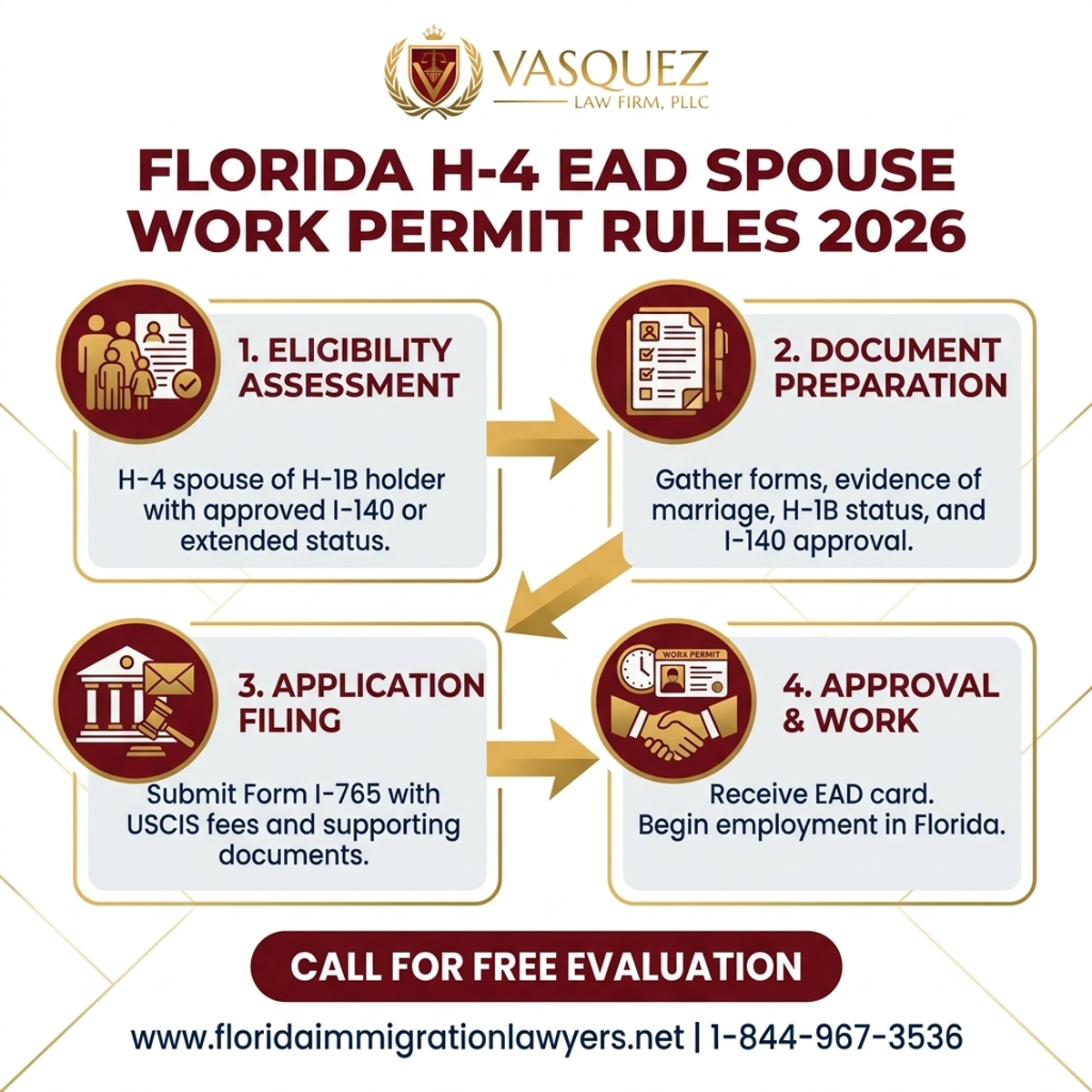
Determine Eligibility: Confirm that your H-1B spouse meets the criteria (approved I-140 or H-1B extension under AC21). Gather proof of their H-1B status and your H-4 status.
-
Complete Form I-765: Fill out Form I-765 accurately and completely. For H-4 EAD, the eligibility category is (c)(26). Ensure all questions are answered, and sign the form in blue ink.
-
Gather Supporting Documents: Collect all required documents, including:
- Copy of your current H-4 visa stamp and I-94 record.
- Copy of your H-4 approval notices (Form I-797) if applicable.
- Copy of your H-1B spouse's current H-1B visa stamp, I-94 record, and H-1B approval notices.
- Copy of your H-1B spouse's approved Form I-140, Immigrant Petition for Alien Worker (if applicable).
- Evidence of your marriage to the H-1B principal (e.g., marriage certificate).
- Two passport-style photos taken within 30 days of filing.
- Copy of a government-issued identity document (e.g., passport biographic page).
- Previous EAD cards (front and back) if you have held one before.
Step-by-Step Process — H-4 EAD Spouse Work Permit Rules in Florida 2026
-
Prepare the Filing Fee: As of 2026, the USCIS filing fee for Form I-765 is subject to change, so always check the latest fee on the USCIS website. Payment should be made via check or money order payable to "U.S. Department of Homeland Security."
-
Assemble and Mail the Application: Organize your application packet with Form I-765 on top, followed by the fee, photos, and supporting documents. Send it to the correct USCIS Lockbox facility based on the filing instructions for Form I-765. For Florida residents, this is typically a designated address for certain states.
-
Attend Biometrics Appointment: After filing, you will likely receive a notice for a biometrics appointment at a local Application Support Center (ASC), such as the one in Orlando. Attending this appointment is mandatory for fingerprinting and photo capture.
-
Receive EAD Card: Upon approval, USCIS will mail your Employment Authorization Document (EAD card) to the address provided in your application.
What is the H-4 EAD Processing Time and What to Expect in 2026?
As of 2026, the processing time for an H-4 EAD application (Form I-765) can vary significantly, typically ranging from 5 to 12 months, and sometimes longer depending on the specific USCIS service center and the volume of applications. While there isn't a specific "Florida" processing time, all applications from Florida residents are processed by national USCIS service centers. The complexity of your case, completeness of documents, and current USCIS backlogs all play a role. It's crucial for H-1B families in Florida to plan ahead, especially if their current work authorization is expiring or if they are filing concurrently with an H-4 extension.
Applicants can check the most up-to-date processing times on the USCIS website's processing times page by selecting Form I-765 and the appropriate service center (usually based on your mailing address). The 2026 i-539 h-4 change of status processing time months can also impact concurrent EAD applications, as USCIS may process them together. Delays often occur if RFE (Request for Evidence) is issued due to missing or unclear documentation. Proactive preparation of a thorough application packet can help mitigate these delays.
H-4 EAD Application Timeline and Processing Expectations (2026)
| Stage | Typical Timeframe | Notes |
|---|---|---|
| Application Submission to Receipt Notice | 1-3 weeks | USCIS sends Form I-797C, Notice of Action, acknowledging receipt. |
| Biometrics Appointment Notice | 3-8 weeks after receipt | Notice sent for appointment at a local Application Support Center (e.g., Orlando ASC). |
| Biometrics Appointment | Scheduled date (usually 2-4 weeks after notice) | Mandatory for fingerprinting and photo. Failure to attend can lead to denial. |
| Case Review and Decision | 5-12+ months after filing | This is the main processing period. Can be longer with RFEs or backlogs. |
| EAD Card Production and Mailing | 1-2 weeks after approval | Once approved, the card is printed and mailed. |
What are the Costs Associated with H-4 EAD Application in Florida?
The primary cost associated with an H-4 EAD application is the USCIS filing fee for Form I-765. As of 2026, this fee is subject to change, and applicants should always verify the most current amount directly on the USCIS website's fee schedule. Beyond the government fee, applicants in Florida may incur additional expenses related to preparing and filing their application, particularly if they seek professional legal assistance.
While the USCIS fee is a fixed cost for all applicants nationwide, other expenses can vary. For example, if you opt to use professional photography services for your passport-style photos, there will be a small cost. Similarly, shipping costs for mailing your application via certified mail or courier service should be factored in. The most significant variable cost, however, is legal representation. Engaging an experienced immigration attorney in Florida can be a valuable investment, ensuring your application is meticulously prepared, correctly filed, and that any potential issues are addressed proactively.
H-4 EAD Application Cost Factors (2026)
| Item | Typical Fee | Notes |
|---|---|---|
| USCIS Form I-765 Filing Fee | Varies (check USCIS website) | Mandatory government fee, subject to periodic changes. |
| Passport-Style Photos | $10-$20 | For two photos, if not taken at home. |
| Postage/Courier Services | $10-$50 | Recommended for secure, trackable delivery to USCIS. |
| Legal Fees (Attorney) | Varies widely | Cost for professional assistance with document preparation, review, and filing. Highly recommended for complex cases. |
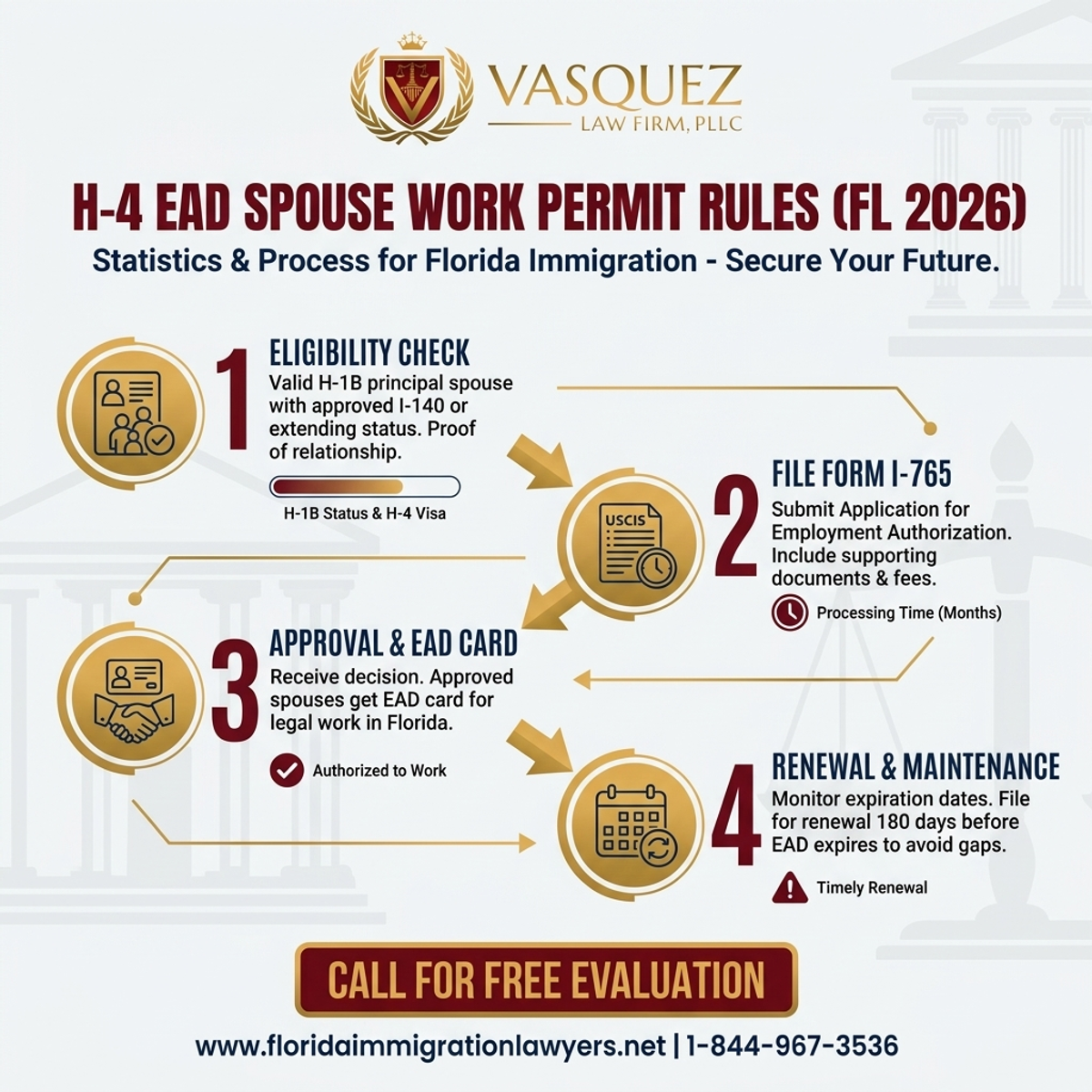
Key Statistics — H-4 EAD Spouse Work Permit Rules in Florida 2026
It's important to budget for these costs and understand that legal fees, while an additional expense, often provide peace of mind and significantly reduce the risk of errors or delays. For many H-1B families in Florida, the ability for a spouse to gain work authorization far outweighs the initial investment in the application process.
Do not navigate this process alone. Contact Florida Immigration Lawyers today at 1-844-967-3536 for a free case review and dedicated support for your H-4 EAD application.
Understanding H-4 EAD Rules and Maintaining Status in Florida
Obtaining an H-4 EAD is a significant step, but understanding the ongoing rules and requirements for maintaining your status and work authorization in Florida is equally important. An H-4 EAD is directly tied to the H-1B principal's status; if the H-1B status is not maintained or if the H-1B visa holder's employment changes in a way that impacts their I-140 or AC21 eligibility, the H-4 EAD holder's authorization may be jeopardized. This interconnectedness means H-1B families must remain vigilant about their immigration compliance.
One critical aspect is the validity period of the H-4 EAD, which typically aligns with the H-4 status validity. It is essential to file for an H-4 extension and EAD renewal well in advance of expiration to avoid any gaps in work authorization. USCIS generally recommends filing renewals 120-180 days before expiration. During the renewal process, if an H-4 EAD application is timely filed, certain applicants may be eligible for an automatic extension of their employment authorization for up to 540 days, as per a recent USCIS policy update. This provides a crucial safety net for H-1B spouses in Florida who are awaiting their new EAD card.
Furthermore, H-4 EAD holders can work in any field, full-time or part-time, for any employer, and can even start their own business, as long as it is a legitimate enterprise. There are no restrictions on the type of employment, which offers immense flexibility compared to other visa categories. However, any change in the H-1B principal's employment that leads to a new H-1B petition or a change in their I-140 status must be carefully managed to ensure the H-4 EAD remains valid. Consulting with an immigration attorney is highly advisable for any significant changes to ensure continuous compliance with U.S. immigration laws, particularly those outlined in 8 U.S.C. § 1184 regarding nonimmigrant classifications.
Benefits of H-4 EAD for H-1B Families in Florida
The H-4 EAD program offers profound benefits that extend far beyond mere work authorization for H-1B families residing in Florida. It represents a pathway to greater financial stability, professional fulfillment, and deeper integration into the vibrant communities across the state. For many H-1B spouses, the H-4 EAD provides the opportunity to restart or continue their careers, utilizing their skills and education in a new country, which can significantly boost household income and savings, especially in a growing economy like Florida's.
Beyond the economic advantages, the H-4 EAD addresses a critical emotional and psychological need. Spouses of H-1B visa holders often experience challenges associated with being unable to work, including feelings of isolation, underutilization of professional skills, and dependency. The ability to work legally alleviates these burdens, fostering greater independence, self-worth, and mental well-being. This empowerment contributes to a more balanced and happier family life, reducing stress on the H-1B principal as well.
Furthermore, the H-4 EAD strengthens Florida's economy by allowing highly skilled individuals to contribute their talents to various industries. Many H-4 spouses possess advanced degrees and professional experience, and their entry into the workforce fills critical skill gaps and boosts innovation. For example, in Central Florida, where the tech and medical sectors are booming, H-4 EAD holders can support these industries, contributing to the state's overall economic growth and diversity. This policy not only benefits individual families but also enhances the broader community by integrating skilled immigrants into the workforce. The U.S. Department of State also plays a role in visa issuance, but the EAD itself is a USCIS-issued document.
Common Mistakes to Avoid in Your H-4 EAD Application
Applying for an H-4 EAD requires precision and attention to detail. Even minor errors can lead to significant delays, requests for evidence (RFEs), or even denial. H-1B families in Florida should be aware of these common pitfalls to ensure a smooth application process.
-
Filing Without H-1B Spouse's Approved I-140: A common mistake is applying for an H-4 EAD before the H-1B principal's Form I-140, Immigrant Petition for Alien Worker, has been approved. This is a primary eligibility requirement, and filing prematurely will result in a denial.
-
Incorrect Eligibility Category: On Form I-765, failing to select the correct eligibility category "(c)(26)" for H-4 spouses can cause immediate issues, leading to rejection or RFE.
-
Expired H-4 Status or I-94: Submitting an H-4 EAD application when your underlying H-4 status or I-94 record has already expired will almost certainly lead to denial. Always ensure your H-4 status is valid at the time of filing.
-
Missing or Incomplete Supporting Documents: Failing to include copies of all required documents, such as marriage certificates, H-1B approval notices, I-94 records, or the H-1B spouse's approved I-140, is a frequent cause of RFEs and delays. Ensure every piece of evidence is present and legible.
-
Outdated Passport Photos: Submitting photos that are older than 30 days or do not meet USCIS specifications (size, background, head position) can result in an RFE. Always provide fresh, compliant photos.
-
Incorrect Filing Fee or Payment Method: USCIS fees change periodically. Submitting an incorrect fee amount or an improper payment method (e.g., a personal check that bounces) will cause the application to be rejected. Always verify the current fee on the USCIS website.
-
Not Attending Biometrics Appointment: Failing to attend your scheduled biometrics appointment at an ASC (like the one in Orlando) without proper rescheduling can lead to your application being considered abandoned and subsequently denied.
-
Late Renewal Application: Waiting until the last minute to file for an H-4 EAD renewal can result in a gap in employment authorization, even with the automatic extension rules, if there are unexpected delays. File at least 5-6 months before your current EAD expires.
When to Call an Immigration Lawyer for Your H-4 EAD in Florida
While the H-4 EAD application process may seem straightforward, certain situations warrant the expertise of an experienced immigration attorney. If you are an H-1B family in Florida, seeking legal counsel can prevent costly mistakes, expedite your application, and provide peace of mind. You should strongly consider contacting Florida Immigration Lawyers if you encounter any of the following scenarios:
- Complex Eligibility Issues: If your H-1B spouse's I-140 is not yet approved, or if there are complexities regarding their H-1B extension under AC21, an attorney can help clarify your eligibility.
- Previous Denials or Immigration History Issues: If you have had previous visa denials, overstays, or any other immigration-related complications, legal counsel is crucial to address potential red flags.
- Concurrent Filings: When filing the H-4 EAD concurrently with an H-4 extension (Form I-539) or change of status, an attorney can ensure proper coordination and documentation.
- Request for Evidence (RFE) Received: If USCIS sends an RFE, it means they need more information. Responding correctly and comprehensively is critical, and an attorney can help craft a strong response.
- Expiring Work Authorization: If your current EAD or H-4 status is nearing expiration and you need to ensure seamless continued work authorization, an attorney can help with timely and strategic filing.
- Uncertainty or Stress: Navigating immigration law can be overwhelming. If you feel uncertain about any part of the process or are experiencing undue stress, professional guidance can make a significant difference.
Florida Immigration Lawyers has extensive experience with H-4 EAD applications and understands the unique needs of H-1B families across Florida. Our team can provide tailored advice, meticulous document preparation, and robust representation to ensure your application has the best chance of success. We are here to help you understand your options and secure your work authorization.
About Florida Immigration Lawyers
Florida Immigration Lawyers is a leading immigration law firm dedicated to serving individuals and families across the entire state of Florida. With our office strategically located in Orlando, we are deeply familiar with the local and national immigration landscape, providing comprehensive legal services to our diverse clientele. Our team of experienced attorneys is committed to upholding the rights of immigrants and helping them achieve their American dreams, whether it's obtaining a work permit like the H-4 EAD, securing a family-based visa, or defending against deportation.
We understand that immigration matters are deeply personal and often life-changing. That's why we offer empathetic, client-focused representation, ensuring that you receive personalized attention and clear communication throughout your legal journey. From family immigration to business immigration, deportation defense, and citizenship applications, our firm handles a wide array of immigration cases. We pride ourselves on our accessibility, offering free case reviews and being available 24/7 to address your urgent concerns. When you choose Florida Immigration Lawyers, you choose a partner who stands by you every step of the way.
Reach out to us today at 1-844-967-3536 to discuss your H-4 EAD application or any other immigration needs. Let our dedicated attorneys provide the expert guidance you deserve.
Sources and References
- U.S. Citizenship and Immigration Services (USCIS)
- Executive Office for Immigration Review (EOIR)
- U.S. Department of State
- 8 U.S.C. § 1184 - Admission of nonimmigrants
- 8 U.S.C. Chapter 12 - Immigration and Nationality Act (INA)
- 8 CFR 214.2(h)(9)(iv) - H Classification; Period of stay for H-1B nonimmigrant.
- 8 CFR 274a.12(c)(26) - Classes of aliens authorized to accept employment; Spouses of H-1B nonimmigrants.
- American Competitiveness in the Twenty-First Century Act of 2000 (AC21)
Related services: family petition process, family-based green cards, fiancé visa (K-1), marriage-based immigration.
This article provides general legal information and is not intended as legal advice. Every case is unique, and outcomes depend on specific facts and circumstances. Contact an attorney for advice about your particular situation.
Secure your future and your right to work in Florida. Don't delay—call Florida Immigration Lawyers for your free case review today at 1-844-967-3536. Se Habla Espanol - Estamos aqui para ayudarle.
Do Not Navigate This Process Alone
Our experienced immigration attorneys are ready to fight for you. Get a free, confidential consultation today.
Se Habla Español
Or leave your details and we’ll call you:
Free Evaluation in 24 Hours
Or talk to us right now

AI voice assistant — available 24/7
FreeFrequently Asked Questions

William J. Vásquez
Founding Attorney · Vasquez Law Firm
U.S. Air Force veteran and immigration attorney with years of hands-on U.S. immigration experience. J.D., NCCU School of Law. AILA member. Admitted to the 4th, 5th, and 11th Circuit Courts.
Available 24/7 - Free Evaluations
Reviewed for legal accuracy by William J. Vásquez
Licensed in North Carolina; U.S. immigration is federal practice.
Related Legal Services
Our Florida immigration attorneys can help you with citizenship and naturalization, immigration practice areas and free immigration consultation. Call today at 1-844-967-3536 for a free consultation.
Related Links
Related Topics
Free Legal Case Review
Discuss your case with our experienced attorneys. We're available 24/7.
Se Habla Español - Estamos aquí para ayudarle.
Related Articles
Immigration Lawyer Orlando Free Consultation in Florida
For individuals and families in Orlando, Florida, navigating the complexities of U.S. immigration law requires expert guidance. An immigration lawyer in Orlando offers crucial support for everything from visa applications and green card processes to naturalization and deportation defense. This comprehensive guide details what a free consultation covers, providing a step-by-step overview of immigration pathways, essential document checklists, and expected timelines in 2026. We also highlight common mistakes to avoid, discuss the critical role of legal counsel in deportation and asylum cases, and explain why choosing a local Orlando immigration attorney is beneficial. Florida Immigration Lawyers is dedicated to serving the diverse community of Orlando with compassionate, effective legal solutions, ensuring you receive personalized advice and robust representation for a successful immigration journey.
Immigration Interview Preparation in Florida 2026 Guide
For individuals and families across Florida, the immigration interview is a critical step towards achieving permanent residency or citizenship. This comprehensive guide details crucial aspects of immigration interview preparation in Florida, including understanding the purpose of USCIS interviews, a step-by-step guide to preparation, a detailed document checklist, and typical processing timelines as of 2026. We also cover cost factors, common questions asked, and vital mistakes to avoid. Whether your interview is for a green card, adjustment of status, or naturalization, meticulous preparation is key. Learn how to organize your documents, practice your answers, and understand when legal representation from Florida Immigration Lawyers can make a significant difference in your case. Our goal is to empower you with the knowledge to approach your interview with confidence and clarity.
221(g) Visa Denial & Consular Return in Florida 2026
A 221(g) visa denial is a temporary refusal, not a final rejection, indicating that your application requires additional documents or administrative processing before a final decision. For individuals in Florida, understanding this specific type of consular processing is crucial. This comprehensive guide explains the reasons behind a 221(g) notice, outlines the step-by-step process for responding, details what to expect during administrative processing, and discusses potential outcomes and associated costs. We cover common mistakes to avoid and highlight when expert legal assistance from Florida Immigration Lawyers can be invaluable. Our firm is dedicated to helping you navigate the complexities of immigration law, providing strategic guidance and advocacy to address your 221(g) denial and pursue a successful resolution. Contact us for a free case review and let our experienced team assist you.
F-1 Reinstatement Process in Florida 2026
For international students in Florida, falling out of F-1 status can be a daunting experience, threatening academic progress and future immigration prospects. The F-1 reinstatement process offers a vital pathway to regain legal standing without leaving the U.S. This comprehensive guide from Florida Immigration Lawyers details everything you need to know, from understanding eligibility requirements and compiling essential documents to navigating processing times and avoiding common pitfalls. We cover the step-by-step application for Form I-539, provide crucial insights into maintaining your status while your application is pending, and outline the associated costs. Whether your status violation was due to an administrative error, an unforeseen emergency, or a minor misunderstanding, prompt action and meticulous preparation are key. Discover why expert legal guidance is indispensable for a successful F-1 reinstatement in Florida, ensuring your academic journey remains on track. Contact Florida Immigration Lawyers for a free case review.