Understanding F-1 Reinstatement in Florida
If you're an international student in Gainesville, Florida, who has fallen out of F-1 visa status, don't worry. F-1 reinstatement could be your solution to continuing your education. Learn about the process, required documents, common pitfalls, and when to consult a lawyer. Call Florida Immigration Lawyers for a free consultation.
The process of F-1 reinstatement is crucial for students who have fallen out of status in Florida. It involves filing Form I-539 with the USCIS, providing evidence of your previous status, and demonstrating that the violation was beyond your control. Key steps include gathering necessary documentation and understanding the timeline for processing.
- File Form I-539 for F-1 reinstatement.
- Demonstrate circumstances beyond your control.
- Consult Florida-specific regulations and resources.
Introduction
If you're an international student in Gainesville, Florida, maintaining your F-1 student visa status is crucial for your academic journey. However, life can be unpredictable, and sometimes students find themselves out of status. The good news is that F-1 reinstatement offers a pathway to regain your status and continue your studies. This article will guide you through the reinstatement process and what you need to know to navigate it successfully. Call Florida Immigration Lawyers at 1-844-YO-PELEO for a free consultation.
Maintaining F-1 status means adhering to strict regulations set forth by U.S. Citizenship and Immigration Services (USCIS), including full-time enrollment, avoiding unauthorized employment, and completing your program within the allotted time. Falling out of status, even unintentionally, can lead to serious consequences, such as the inability to continue your education, loss of eligibility for practical training opportunities (OPT/CPT), and even deportation proceedings.
Understanding the F-1 reinstatement process is not just about filling out forms; it's about presenting a compelling case to USCIS that demonstrates your eligibility and commitment to your academic goals. While challenging, successful reinstatement allows you to resume your education without having to leave the U.S. and reapply for a new visa. It's a critical lifeline for many international students across Florida, from the vibrant campuses of Gainesville to the bustling cities of Miami and Orlando.
Understanding F-1 Reinstatement
F-1 reinstatement is a process that allows students who have fallen out of status to restore their student visa status. This is particularly important for those studying in Florida, where international students contribute significantly to local economies, such as in Gainesville. Reinstatement can help you avoid deportation and continue your education without interruption.
To apply for reinstatement, you must demonstrate that your loss of status was due to circumstances beyond your control, such as a medical emergency or administrative error. The process involves submitting Form I-539 to the USCIS, along with supporting documentation.
The key phrase here is "circumstances beyond your control." This typically refers to unforeseen events like a severe illness or accident that prevented you from maintaining full-time enrollment, a natural disaster impacting your financial support, or an administrative error made by your Designated School Official (DSO). It's crucial to understand that willful violations, such as engaging in unauthorized employment or intentionally failing to enroll in courses, generally do not qualify for reinstatement. USCIS looks for genuine, unavoidable situations that led to the status violation.
There are generally two pathways for an F-1 student who has fallen out of status: applying for reinstatement with USCIS or departing the U.S. and re-entering with a new Form I-20 and F-1 visa. While leaving and re-entering might seem simpler, it can be risky, especially if your visa is expired or if you have an extended period of unlawful presence. Reinstatement allows you to remain in the U.S. while your application is pending, providing continuity in your studies and avoiding potential issues at the border. However, during this period, you cannot travel internationally without abandoning your application.
Step-by-Step Guide to F-1 Reinstatement
- Schedule a consultation with your Designated School Official (DSO) to discuss your situation and obtain a new Form I-20.
- Complete Form I-539, Application to Extend/Change Nonimmigrant Status, available on the USCIS website.
- Gather supporting documents, including a letter explaining your situation, financial documentation, and proof of your previous status.
- Submit your application package to the appropriate USCIS address as listed on the form instructions.
- Await a decision from USCIS. Processing times can vary, so be prepared for a wait.
Your initial meeting with your DSO is perhaps the most critical first step. Before this meeting, gather all relevant documents that explain why you fell out of status. Your DSO will assess your eligibility, provide guidance, and, if appropriate, issue a new Form I-20 endorsed for reinstatement. This new I-20 is essential as it reflects your intention to continue your studies and acknowledges your school's support for your reinstatement application. Without a supportive DSO and a new I-20, your reinstatement application is unlikely to succeed.
When completing Form I-539, accuracy and completeness are paramount. Read all instructions carefully and ensure every section is filled out truthfully and precisely. Any discrepancies or omissions could lead to delays or even a denial. If you have dependents (F-2 visa holders) who also need their status reinstated, they must be included on your Form I-539 or file their own, depending on USCIS guidelines. It's often advisable to consult with an experienced immigration attorney at Florida Immigration Lawyers to ensure this complex form is completed without error, especially if you're unsure about any specific questions.
The supporting documentation is where you build your case. Your letter of explanation should be a detailed, chronological narrative of the events that led to your status violation, clearly demonstrating that these were beyond your control. Attach evidence for every claim made in your letter – medical records for illness, police reports for accidents, official letters from your university for administrative errors, or bank statements showing a sudden loss of funds. Financial documentation must prove you have sufficient funds to cover your tuition and living expenses for the remainder of your program, demonstrating your ability to maintain F-1 status once reinstated.
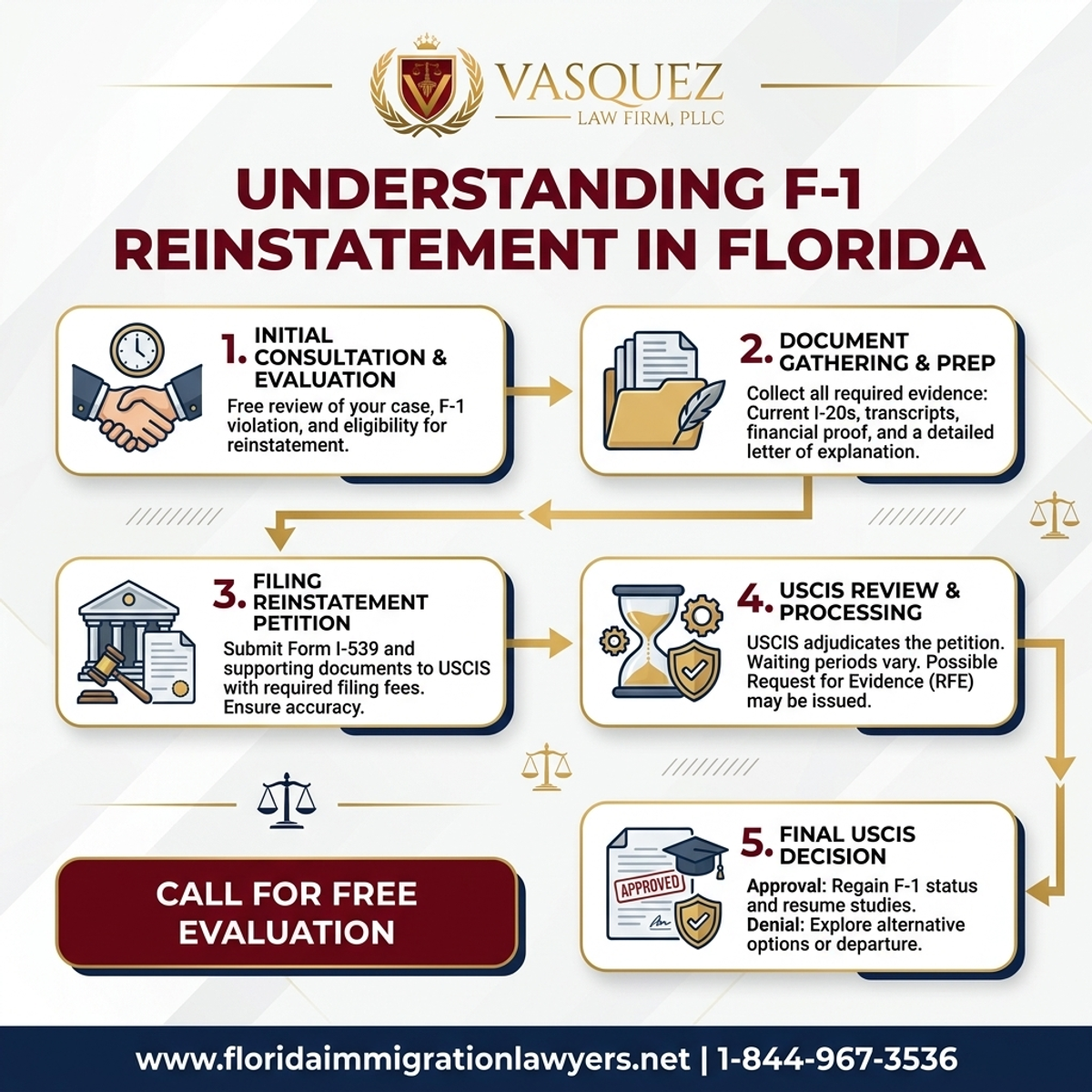
Step-by-Step Process — Understanding F-1 Reinstatement in Florida
Document Checklist
- Form I-539
- New Form I-20 issued by your DSO
- Letter explaining the reason for your status violation
- Financial support documents
- Proof of previous status (e.g., transcripts, attendance records)
Beyond the core documents, it’s beneficial to provide a comprehensive package. For Form I-539, ensure you are using the most current version from the USCIS website, as older versions will be rejected. The new Form I-20 from your DSO should clearly indicate that it is for reinstatement purposes and reflect your current program of study and expected completion date. This document is a testament to your school's continued support and your eligibility for F-1 status.
Your letter of explanation is your opportunity to tell your story clearly and concisely. It should be typed, signed, and dated, detailing the exact dates you fell out of status, the specific circumstances, and how those circumstances were genuinely beyond your control. Include any steps you took to mitigate the situation or to try and regain status prior to applying for reinstatement. For example, if you faced a medical emergency, provide doctor's notes, hospital bills, or a letter from your physician explaining your inability to attend classes.
Financial support documents are critical to demonstrate that you will not become a public charge and can sustain yourself while studying. This typically includes bank statements (personal or sponsor's), scholarship letters, affidavits of support from sponsors, and proof of income. Ensure these documents are current and clearly show sufficient funds to cover tuition, living expenses, and health insurance for at least one academic year. Additionally, proof of previous status should include copies of your passport biographical page, F-1 visa stamp, I-94 arrival/departure record, all previous Forms I-20, and official academic transcripts or enrollment verification letters from your university in Florida.
Timeline and Processing Expectations
The timeline for F-1 reinstatement can vary depending on the USCIS workload and current processing times. Typically, it can take several months to receive a decision. During this period, it is important to maintain communication with your DSO and comply with any additional requests from USCIS.
Several factors can influence how long your F-1 reinstatement application takes. These include the specific USCIS service center handling your case, the volume of applications they are processing, and whether your application triggers a Request for Evidence (RFE). An RFE can significantly extend processing times, often adding several months to the wait, as USCIS requires additional documentation or clarification before making a decision. It is vital to respond to any RFE promptly and thoroughly.
While your application is pending, you are considered to be in a period of authorized stay, meaning you are not accruing unlawful presence. However, you are technically out of F-1 status. During this time, it is crucial to continue maintaining full-time enrollment, if possible, and adhere to all F-1 student regulations. You should generally avoid traveling outside the U.S., as doing so will be considered an abandonment of your reinstatement application. Monitoring your case status online through the USCIS website and keeping your DSO informed are good practices. If you experience unusual delays or need guidance on responding to an RFE, contacting Florida Immigration Lawyers at 1-844-YO-PELEO can provide valuable assistance.
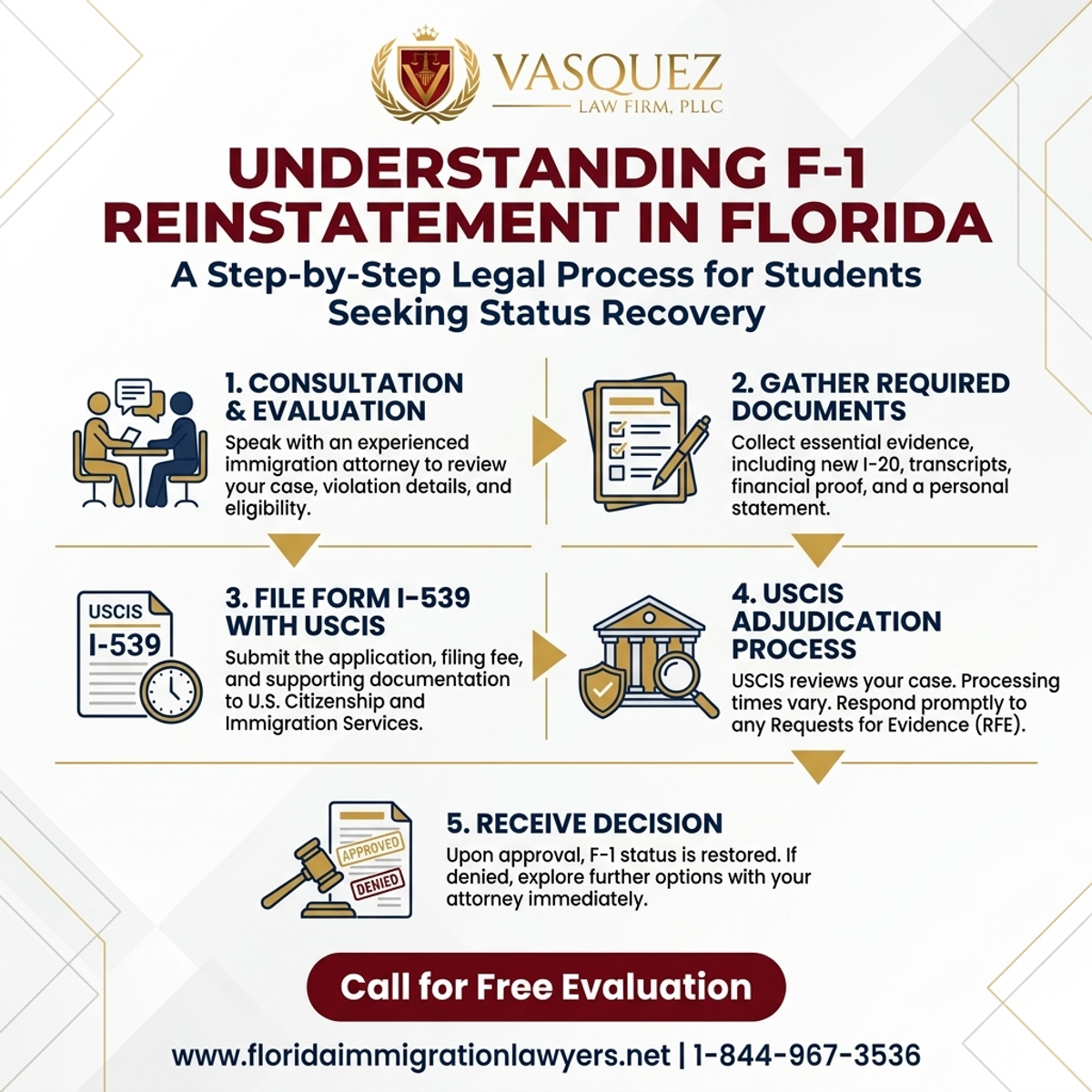
Key Statistics — Understanding F-1 Reinstatement in Florida
Cost Factors and Fee Breakdown
While filing fees for Form I-539 are subject to change, it's essential to verify the current fee on the USCIS website before applying. Additional costs may include fees for obtaining new documents or translations, if necessary. Consulting with an immigration lawyer can also incur costs, but their expertise may be invaluable in ensuring your application is complete and accurate.
The primary cost is the USCIS filing fee for Form I-539, which must be paid by check or money order. In addition to this, USCIS often requires a biometric services fee for identity verification, which is a separate charge. These fees are non-refundable, regardless of the outcome of your application, making it even more critical to submit a strong and error-free petition from the outset.
Beyond the direct USCIS fees, consider other potential expenses. If any of your supporting documents are not in English, they must be accompanied by a certified English translation, which can incur translation service fees. Postage and courier services for submitting your application package, especially if you opt for tracked and insured mail, are also minor but necessary costs. In some cases, you might need to pay for new academic transcripts or other official records from your institution. While these individual costs may seem small, they can add up, so it's wise to budget comprehensively for the entire reinstatement process.
Investing in legal counsel from Florida Immigration Lawyers, while an additional cost, can be a strategic decision. An experienced attorney can help you navigate the complexities of immigration law, ensure all forms are correctly filled, compile a robust supporting document package, and craft a compelling letter of explanation. This expertise can significantly increase your chances of approval and potentially save you from costly delays, RFEs, or even denial, which would necessitate further legal action or a complete reapplication. We offer free consultations to discuss your specific situation and provide a transparent overview of potential legal fees.
Common Mistakes to Avoid
- Failing to consult with your DSO before applying for reinstatement can lead to incomplete applications.
- Not providing a detailed explanation of your circumstances can result in a denial.
- Missing supporting documentation can delay processing.
- Submitting incorrect or outdated forms can invalidate your application.
- Ignoring requests for additional information from USCIS can result in denial.
- Underestimating processing times and planning poorly can affect your studies.
- Neglecting to update your address with USCIS may cause you to miss important correspondence.
- Failing to maintain enrollment while awaiting reinstatement can impact your eligibility.
- Misinterpreting legal requirements without consulting an attorney can lead to errors.
- Assuming reinstatement is guaranteed can result in unexpected outcomes.
Each of these common mistakes can have significant repercussions, ranging from lengthy delays to outright denial of your reinstatement application. For instance, failing to consult with your DSO not only means you won't have the necessary new I-20, but you also miss out on crucial guidance from the person most familiar with your school's policies and USCIS expectations for F-1 students. Their support letter is often a cornerstone of a successful application.
A vague or incomplete explanation of your circumstances is a major red flag for USCIS. They need a clear, compelling narrative backed by solid evidence to be convinced that your status violation was truly beyond your control. Similarly, missing supporting documentation will almost certainly trigger a Request for Evidence (RFE), which adds months to your processing time and increases the stress of the waiting period. Always double-check the USCIS website for the latest form editions and instructions; submitting an outdated form will lead to an automatic rejection.
Ignoring requests for additional information from USCIS is perhaps the most critical error. RFEs come with strict deadlines, and failure to respond within the specified timeframe will result in a denial, often without further recourse. Underestimating processing times can lead to poor academic planning, affecting your ability to register for future semesters or apply for Optional Practical Training (OPT). Furthermore, neglecting to update your address with USCIS means you could miss vital correspondence, including your approval notice or an RFE, leading to further complications. Maintaining enrollment (even if technically out of status) demonstrates your commitment to your studies, which is a positive factor for USCIS. Given the complexities, misinterpreting legal requirements is common, highlighting why legal advice from Florida Immigration Lawyers is invaluable. Remember, reinstatement is a discretionary benefit; it's never guaranteed, so a meticulously prepared application is essential.
When to Call a Lawyer
If you're facing complications with your F-1 status, consulting an immigration lawyer can provide clarity and guidance. Situations like a complex immigration history, previous violations, or needing to expedite your case are instances where legal assistance is beneficial. At Florida Immigration Lawyers, we focus on helping students navigate the reinstatement process. Contact us today to discuss your case.
Beyond the scenarios mentioned, you should strongly consider legal counsel if you have any prior immigration issues, such as a previous overstay, a visa denial, or any minor criminal infractions, even if unrelated to your student status. These complexities can significantly impact your eligibility for reinstatement and require an expert eye to address them appropriately in your application. An attorney can help you present your case in the most favorable light, mitigating any potential negative factors that USCIS might consider.
Furthermore, if you are approaching the five-month mark since falling out of status (the general deadline for filing reinstatement), or if you've already received a Notice to Appear (NTA) in immigration court, immediate legal intervention is critical. An NTA indicates that the Department of Homeland Security intends to initiate deportation proceedings against you, making the reinstatement process much more urgent and complex. In such high-stakes situations, the specialized knowledge of Florida Immigration Lawyers can be the difference between successfully regaining your status and facing removal from the U.S. Don't hesitate to call us at 1-844-YO-PELEO for timely and professional advice.
About Florida Immigration Lawyers
Florida Immigration Lawyers is dedicated to providing legal services to immigrants throughout Florida. Our services include assistance with student visas, deportation defense, and family immigration. With a team of experienced attorneys, we are committed to helping you achieve your immigration goals. Call us at 1-844-YO-PELEO or visit our website at https://www.floridaimmigrationlawyers.net for a free consultation. We are available 24/7 and ready to assist you with your immigration needs.
Our commitment extends beyond just processing paperwork; we understand the profound impact that immigration matters have on individuals and families. For international students, successfully navigating F-1 reinstatement means preserving dreams, academic futures, and career aspirations. We pride ourselves on offering compassionate, client-focused representation, ensuring that you feel supported and informed at every stage of your immigration journey.
Whether you are facing a complex F-1 reinstatement case, seeking assistance with other visa types like H-1B or O-1, or exploring pathways to permanent residency and citizenship, our attorneys bring a wealth of knowledge and experience. We are deeply familiar with the nuances of U.S. immigration law and are adept at crafting persuasive arguments and meticulously preparing applications. Trust Florida Immigration Lawyers to be your dedicated advocate, providing the clarity and strategic guidance needed to overcome immigration challenges. Reach out for your free consultation today at 1-844-YO-PELEO – Se Habla Español.
Frequently Asked Questions About F-1 Reinstatement
Sources and References
- U.S. Citizenship and Immigration Services (USCIS)
- Executive Office for Immigration Review (EOIR)
- 8 U.S.C. Chapter 12 - Immigration and Nationality Act
Related services: immigration practice areas, family immigration services, citizenship and naturalization.
This article provides general legal information and is not intended as legal advice. Every case is unique, and outcomes depend on specific facts and circumstances. Contact an attorney for advice about your particular situation.
Strong closing CTA: Call Florida Immigration Lawyers at 1-844-YO-PELEO for a free consultation. Se Habla Español - Estamos aquí para ayudarle.
If you need legal assistance, learn more about immigration lawyers in Florida, or call us at 1-844-YO-PELEO for a free consultation.
Do Not Navigate This Process Alone
Our experienced immigration attorneys are ready to fight for you. Get a free, confidential case review today.
Se Habla Español
Or leave your details and we’ll call you:
Free Evaluation in 24 Hours
Or talk to us right now

AI voice assistant — available 24/7
FreeFrequently Asked Questions

William J. Vásquez
Founding Attorney · Vasquez Law Firm
U.S. Air Force veteran and immigration attorney with years of hands-on U.S. immigration experience. J.D., NCCU School of Law. AILA member. Admitted to the 4th, 5th, and 11th Circuit Courts.
Available 24/7 - Free Evaluations
Reviewed for legal accuracy by William J. Vásquez
Licensed in North Carolina; U.S. immigration is federal practice.
Related Legal Services
Our Florida immigration attorneys can help you with asylum protection, citizenship and naturalization and immigration practice areas. Call today at 1-844-YO-PELEO for a free case review.
Related Links
Related Topics
Free Legal Case Review
Discuss your case with our experienced attorneys. We're available 24/7.
Se Habla Español - Estamos aquí para ayudarle.
Related Articles
DUI Immigration Consequences in Florida 2026
A DUI conviction in Florida can have severe immigration consequences, potentially leading to inadmissibility, deportation, or denial of immigration benefits. For non-citizens, a DUI is not just a traffic offense but a serious criminal matter that federal immigration law scrutinizes closely. Factors like multiple offenses, injury, or property damage can escalate a simple DUI to a Crime Involving Moral Turpitude (CIMT) or even an aggravated felony, triggering mandatory detention and removal proceedings. Understanding the specific nature of your Florida conviction and its interpretation under the Immigration and Nationality Act (INA) is crucial. This article outlines how DUIs impact immigration status, the grounds for inadmissibility and deportation, a step-by-step guide to navigating the process, essential documentation, and expected timelines for 2026. We also highlight common mistakes to avoid and when to seek legal counsel from an experienced immigration attorney. Florida Immigration Lawyers offers comprehensive support for individuals facing these challenging situations, providing expert guidance through complex legal landscapes.
Dual Citizenship Lawyer in Florida: What You Need to Know
For Florida residents, the concept of dual citizenship, or holding two passports, offers a compelling blend of opportunities and challenges. While the U.S. generally permits dual nationality, the path to achieving this status requires a meticulous understanding of both U.S. immigration laws and the citizenship policies of your country of origin. This guide explores the definition of dual citizenship, the detailed step-by-step process for U.S. naturalization, and the significant benefits and potential pitfalls involved. We cover essential documentation, typical timelines, and cost considerations for 2026, providing crucial insights for anyone in Orlando, Miami, or across Florida considering this important legal step. Learn about common mistakes to avoid and understand when to seek professional legal counsel to navigate this complex process successfully. Florida Immigration Lawyers is here to provide expert, bilingual support for your dual citizenship journey.
Immigration Lawyer Orlando Free Consultation in Florida
For individuals and families in Orlando, Florida, navigating the complexities of U.S. immigration law requires expert guidance. An immigration lawyer in Orlando offers crucial support for everything from visa applications and green card processes to naturalization and deportation defense. This comprehensive guide details what a free consultation covers, providing a step-by-step overview of immigration pathways, essential document checklists, and expected timelines in 2026. We also highlight common mistakes to avoid, discuss the critical role of legal counsel in deportation and asylum cases, and explain why choosing a local Orlando immigration attorney is beneficial. Florida Immigration Lawyers is dedicated to serving the diverse community of Orlando with compassionate, effective legal solutions, ensuring you receive personalized advice and robust representation for a successful immigration journey.
EAD Advance Parole Combo Card in Florida: What You Need
An EAD advance parole combo card allows individuals with pending adjustment applications to both work and travel abroad without jeopardizing their green card application. Learn how to apply in Florida, what documents you need, and common mistakes to avoid.