F-1 Visa Guide for Florida University Students 2026
International students looking to study at Florida universities need to understand the F-1 visa process. This guide covers eligibility, application steps, required documents, and common pitfalls. Learn how Florida Immigration Lawyers can help you navigate your educational journey in the U.S.
What is the F-1 Visa?
The F-1 visa is a non-immigrant visa for students wishing to pursue academic studies in the U.S. It permits enrollment in accredited U.S. institutions, including universities and colleges in Orlando, Florida. As of 2026, the F-1 visa remains the most common type for international students.
As a non-immigrant visa, the F-1 status signifies that you intend to return to your home country after completing your studies. This 'non-immigrant intent' is a critical aspect of your application and something you may need to demonstrate during your visa interview. The F-1 visa is specifically designed for full-time academic or language training programs. It allows you to immerse yourself fully in your studies while experiencing American culture and education.
To qualify, you must be accepted by a Student and Exchange Visitor Program (SEVP) approved school and meet financial and English proficiency requirements. Maintaining full-time student status and following SEVP guidelines are crucial for compliance. It's not just about getting the visa; it's about adhering to its conditions throughout your stay. This includes maintaining good academic standing, understanding limitations on employment, and ensuring your I-20 form remains current. Failing to comply with these rules can lead to severe consequences, including loss of visa status and potential deportation. Always consult with Florida Immigration Lawyers if you have any doubts about maintaining your F-1 status.
How to Apply for an F-1 Visa?
Applying for an F-1 visa involves several steps:
- Obtain Form I-20: After acceptance to an SEVP-approved school, you'll receive Form I-20, which is necessary for the visa application. This document, officially known as the 'Certificate of Eligibility for Nonimmigrant Student Status,' is issued by your chosen university or college. It contains crucial information about your program of study, expected start and end dates, and estimated costs. Ensure all information on your I-20 matches your passport exactly, and sign it where indicated.
- Pay the SEVIS Fee: The Student and Exchange Visitor Information System fee must be paid before your visa interview. This fee supports the SEVIS system, which tracks and monitors F-1 students and exchange visitors. You must pay the I-901 SEVIS fee online and print your receipt. Keep this receipt safe, as you will need it for your visa interview and potentially upon entry to the U.S.
- Complete the DS-160 Form: This online application is used for non-immigrant visas. The DS-160, or 'Online Nonimmigrant Visa Application,' requires detailed personal information, travel history, educational background, and security questions. Be thorough and honest in your responses, as any discrepancies can lead to delays or denial. Once completed, print the confirmation page with the barcode.
- Schedule a Visa Interview: Interviews are conducted at U.S. embassies or consulates. You should schedule your interview as soon as possible after receiving your I-20 and paying the SEVIS fee, as wait times can vary significantly depending on the country and time of year. It's advisable to schedule it well in advance of your program start date to allow for processing time.
- Attend the Interview: Be prepared with necessary documentation and proof of financial support. The interview is a critical step where a consular officer will assess your eligibility, including your non-immigrant intent and ability to fund your studies. Dress professionally, be polite, and answer all questions truthfully and concisely. Practice answering common questions about your academic plans, why you chose your specific school, and how you will finance your education.
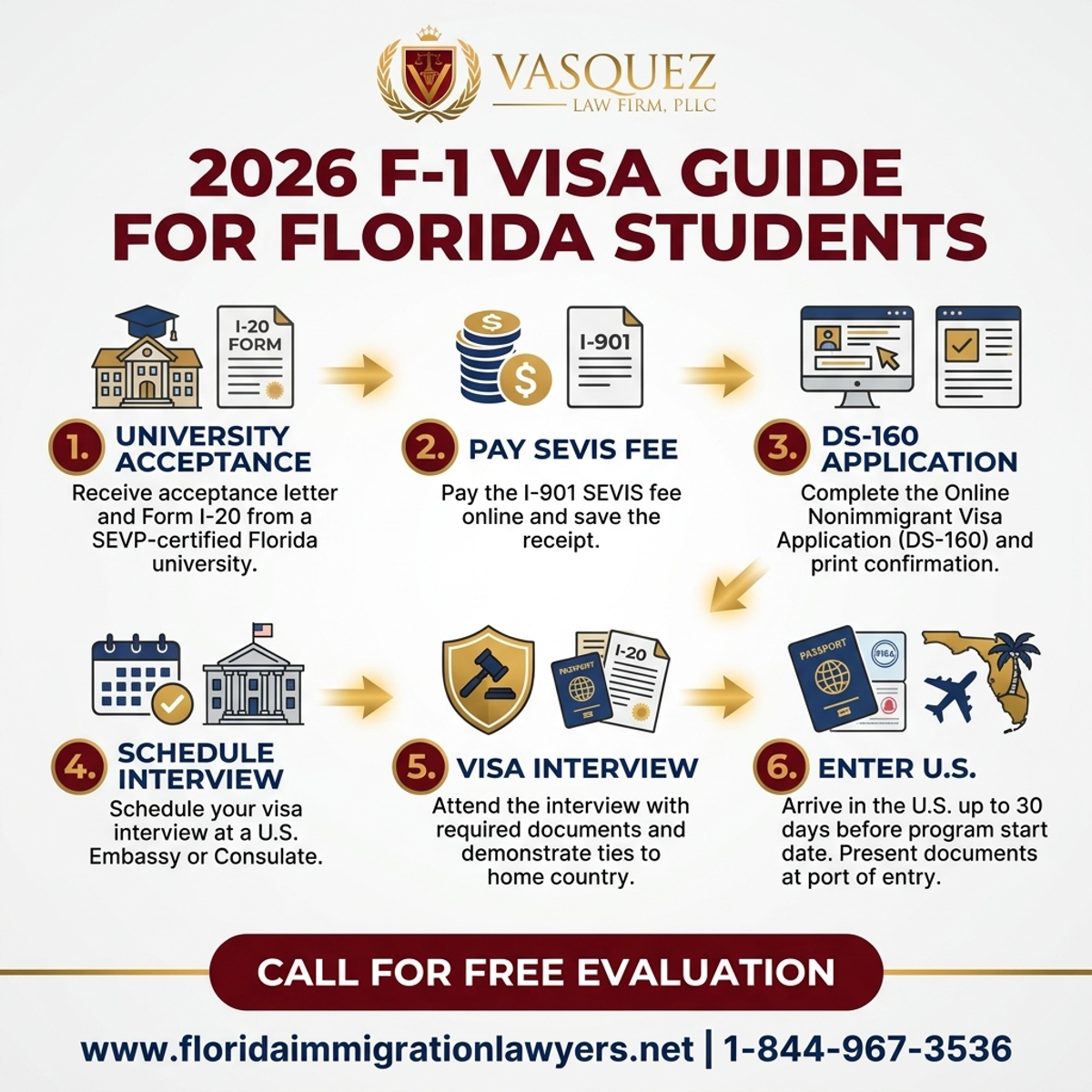
Step-by-Step Process — F-1 Visa Guide for Florida University Students 2026
What Documents Are Required for an F-1 Visa?
Gathering the right documents is crucial. Here’s a checklist:
- Form I-20 from your institution: This is your Certificate of Eligibility. Ensure it's signed by both you and a designated school official (DSO) and that all personal details (name, date of birth) match your passport.
- Valid passport: Your passport must be valid for at least six months beyond your intended period of stay in the U.S. If your passport is nearing expiration, renew it before applying for the visa.
- DS-160 confirmation page: Print this page with the barcode after successfully submitting your online application. It serves as proof of your application.
- SEVIS fee receipt: Proof that you have paid the I-901 SEVIS fee. This receipt is essential and should be kept with your other documents.
- Financial support evidence: This includes bank statements, scholarship letters, or sponsor affidavits demonstrating you have sufficient funds to cover your tuition, living expenses, and other costs for your first year of study, as indicated on your I-20.
- Academic transcripts and diplomas: Official transcripts from all previous educational institutions, along with any diplomas or degrees earned. These documents validate your academic history and qualifications.
- Proof of English proficiency: Scores from standardized tests like TOEFL or IELTS, or a letter from your university confirming your English proficiency if a waiver was granted.
Beyond this core checklist, it's wise to bring any supporting documents that can strengthen your case. This might include a letter of admission from your university, your resume or CV, and any previous visa records. Organize all your documents neatly in a folder, making them easily accessible for the consular officer during your interview. Being prepared and organized can significantly streamline the interview process.
For students with unique financial situations, such as those relying on multiple sponsors or complex scholarship arrangements, preparing comprehensive financial documentation is paramount. For instance, if a family member is sponsoring you, you'll need their bank statements, an affidavit of support, and proof of their relationship to you. Florida Immigration Lawyers can help review your financial documents to ensure they meet all requirements and present a clear picture of your ability to fund your education.
F-1 Visa Processing Timeline
Understanding the timeline is key to ensuring you meet all deadlines. As of 2026, typical processing times are as follows:
| Stage | Typical Timeframe | Notes |
|---|---|---|
| Form I-20 Issuance | 2-4 weeks | After acceptance by the school |
| SEVIS Fee Payment | Immediate | Must be paid before the interview |
| DS-160 Form Submission | 1-2 days | Online submission |
| Visa Interview Scheduling | 1-3 weeks | Varies by consulate |
| Visa Processing | 1-4 weeks | After interview |
It's crucial to understand that these timelines are estimates and can fluctuate significantly based on various factors. Peak seasons, such as summer months before fall semesters, often see longer wait times for interview appointments and visa processing. The specific U.S. embassy or consulate where you apply also plays a role, with some locations experiencing higher demand than others. Always check the specific consulate's website for their current wait times.
To avoid unnecessary stress and potential delays, it is highly recommended to start your F-1 visa application process as early as possible—ideally, several months before your program's start date. This allows for unexpected delays, such as requests for additional documentation or administrative processing. For example, if your program begins in August, aiming to have your visa interview completed by May or June would provide a comfortable buffer.
In some cases, administrative processing (AP) can extend the visa processing time beyond the typical 1-4 weeks. AP is often triggered by specific security checks and can last for several weeks or even months. While there's little you can do to expedite AP, being truthful and complete in your DS-160 application can help minimize the chances of such delays. If you encounter significant delays or your program start date is approaching, Florida Immigration Lawyers can provide guidance on potential next steps or inquiries.
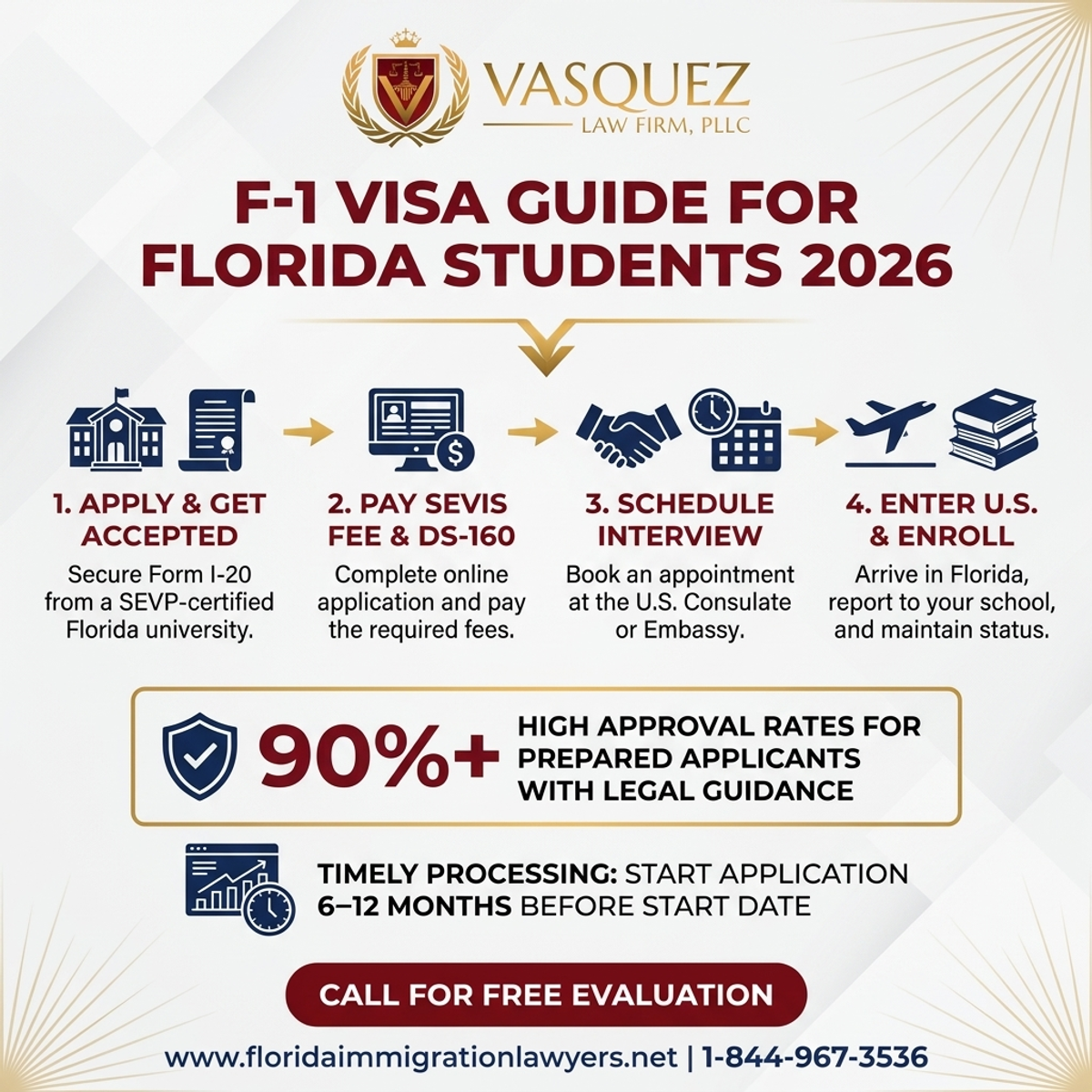
Key Statistics — F-1 Visa Guide for Florida University Students 2026
Costs Associated with F-1 Visa
While exact fees can vary, here are common costs:
| Item | Typical Fee | Notes |
|---|---|---|
| SEVIS Fee | Varies | Paid before the interview |
| Visa Application Fee | Varies | Non-refundable |
| Miscellaneous Costs | Varies | Travel, documentation, etc. |
The SEVIS I-901 fee, which supports the Student and Exchange Visitor Information System, is a mandatory payment that typically ranges around $220 for F-1 students. The non-refundable visa application (MRV) fee, generally about $185, covers the administrative costs of processing your application. These are standard fees set by the U.S. government and are subject to change, so always check the official Department of State website for the most current information.
Beyond these primary government fees, international students should budget for several other 'miscellaneous' costs. These can include expenses for obtaining official academic transcripts and their certified translations, passport application or renewal fees, and costs associated with travel to the U.S. embassy or consulate for your interview. Depending on your location, these travel expenses, including flights, accommodation, and local transport, can add up significantly. It's prudent to factor these into your overall financial planning for your F-1 visa application.
Furthermore, consider potential legal fees if you choose to seek professional assistance. While not mandatory, engaging Florida Immigration Lawyers for a free case review at 1-844-YO-PELEO can be a wise investment, especially if your case is complex or you want to ensure every step is handled correctly. Their expertise can save you from costly mistakes or delays down the line. Remember, securing your F-1 visa is the first financial step in your educational journey, which will also involve significant tuition and living expenses in Florida.
Do not navigate this process alone. Contact Florida Immigration Lawyers today.
Common Mistakes to Avoid
The F-1 visa application process, while seemingly straightforward, is fraught with potential pitfalls that can lead to delays, denials, or even future immigration complications. Understanding and actively avoiding these common mistakes is as crucial as knowing the correct steps. A single oversight can derail your dream of studying in Florida, making careful attention to detail paramount.
- Incomplete Application: Missing documents can delay or deny your visa. Always double-check that you have every required form and supporting document.
- Incorrect Financial Documentation: Providing inadequate proof of funds can lead to a refusal. Ensure your bank statements are current, reflect the required amount for your I-20, and are properly translated if necessary.
- Ignoring SEVIS Fee: Not paying the SEVIS fee can result in denied entry at the border. The fee must be paid and confirmed before your interview.
- Poor Interview Preparation: Failing to prepare for your interview questions may lead to denial. Practice answering questions about your academic goals, ties to your home country, and financial stability.
- Overlooking Visa Expiry: Not renewing your visa on time can result in unlawful status. While your I-20 dictates your legal stay, your visa stamp allows re-entry.
- Failure to Maintain Full-Time Status: Dropping below full-time enrollment can lead to visa status issues. Consult your DSO before making any changes to your course load.
- Not Understanding Post-Graduation Options: Failing to plan for OPT or a change of status can affect your stay. Be aware of the grace period and application deadlines for post-study work.
Many students underestimate the importance of clarity and consistency across all application materials. For instance, sometimes students might list different addresses or phone numbers on their DS-160 than what is on their I-20, which can raise red flags. Furthermore, being vague or inconsistent during the visa interview can signal a lack of genuine intent or preparedness. Seeking guidance from Florida Immigration Lawyers can help you meticulously review your application and prepare for the interview, significantly reducing the risk of these common errors.
When to Call a Lawyer
Visa applications can be complex. You should consider calling a lawyer if:
- You face difficulties in obtaining necessary documentation: This could include complex financial situations where proof of funds is hard to consolidate, or if you have a past criminal record that needs careful explanation and supporting legal documents.
- Your visa application is denied: A denial is not necessarily the end of your journey. An immigration lawyer can help you understand the reasons for denial, identify potential avenues for appeal, or strategize for a stronger reapplication.
- You need to change your status from another visa to F-1: If you are currently in the U.S. on a different non-immigrant visa (e.g., B1/B2 tourist visa, H4 dependent visa) and wish to change to F-1 status, the process involves specific forms and strict deadlines. An attorney ensures compliance and proper submission.
- You have questions about maintaining your visa status: Whether it's concerns about authorized reduced course loads, taking a leave of absence, or understanding the rules around on-campus employment, a lawyer can provide accurate advice to keep you in lawful F-1 status.
- You require assistance with post-study work options: Navigating Optional Practical Training (OPT), STEM OPT extensions, or transitioning to other work visas like the H-1B can be intricate. A lawyer can guide you through the application processes and deadlines to maximize your post-graduation opportunities.
Proactive legal consultation is often the best approach. Rather than waiting for a problem to arise, a quick call to Florida Immigration Lawyers at 1-844-YO-PELEO for a free consultation can help you anticipate challenges and prepare effectively. This foresight can save you significant time, stress, and potential financial loss in the long run, ensuring your path to studying in Florida is as smooth as possible.
Florida Immigration Lawyers can provide the guidance you need. Explore our immigration services.
Frequently Asked Questions About the F-1 Visa
Can I work on an F-1 visa?
Yes, F-1 visa holders have limited work options. During your academic program, you can typically work on-campus for up to 20 hours per week while school is in session, and full-time during breaks. Off-campus employment generally requires authorization through Curricular Practical Training (CPT) or Optional Practical Training (OPT), which are directly related to your field of study. Always obtain proper authorization from your Designated School Official (DSO) and USCIS before starting any off-campus work to maintain your visa status.
What if my F-1 visa expires while I'm in the U.S.?
An F-1 visa stamp in your passport is primarily for entering the U.S. Once you are inside the country, your legal status is determined by your I-20 form and your adherence to its terms, indicated by 'D/S' (Duration of Status) on your I-94 record. If your visa stamp expires while you are in the U.S. but your I-20 is still valid and you maintain your student status, you can continue your studies lawfully. However, if you travel outside the U.S., you will need a valid F-1 visa stamp to re-enter.
Can my family accompany me on an F-1 visa?
Yes, your spouse and unmarried children under the age of 21 can apply for F-2 dependent visas to accompany you to the U.S. F-2 visa holders have certain restrictions; for example, they cannot work in the U.S. and generally cannot pursue full-time academic studies, though minor children can attend primary and secondary school. You will need to demonstrate sufficient financial resources to support your dependents, and they will each need their own I-20 form.
What happens if I change schools?
If you decide to transfer to another SEVP-approved school, you must follow a specific transfer process. This involves notifying your current school's DSO of your intent to transfer, who will then 'release' your SEVIS record to the new institution. Your new school will then issue a new I-20 form. It's crucial to complete this process correctly and within the designated timelines to maintain your F-1 status. Consult with both schools' DSOs and consider legal advice from Florida Immigration Lawyers for a smooth transition.
How long can I stay in the U.S. after graduation?
Upon completing your program of study, F-1 visa holders are granted a 60-day grace period. During this time, you can prepare to depart the U.S., apply for Optional Practical Training (OPT), or apply for a change of status to another visa category. If you apply for OPT, your status allows you to remain in the U.S. while your OPT application is pending, and then for the duration of your approved OPT period. Plan your post-graduation steps well in advance to avoid overstaying your authorized period.
About Florida Immigration Lawyers
At Florida Immigration Lawyers, we are dedicated to assisting international students in understanding and navigating the U.S. immigration system. We offer comprehensive services from visa applications to deportation defense. Our experienced attorneys are here to help you every step of the way. Available 24/7, we provide free case reviews and serve all of Florida. Schedule a free consultation today or browse our immigration practice areas.
Our team at Florida Immigration Lawyers possesses an in-depth understanding of the specific challenges and requirements faced by F-1 visa applicants and current students. We stay abreast of the latest changes in immigration laws and SEVP regulations, ensuring that our advice is always current and accurate. Whether you're applying for your initial F-1 visa, seeking to transfer schools, or exploring post-graduation work options like OPT, our attorneys provide personalized, strategic guidance tailored to your unique situation, helping you confidently pursue your academic and professional aspirations in Florida.
Sources and References
- U.S. Citizenship and Immigration Services (USCIS)
- Executive Office for Immigration Review (EOIR)
- U.S. Department of State
- 8 U.S.C. Chapter 12 - Immigration and Nationality Act
Related services: family immigration services, citizenship and naturalization, asylum protection.
This article provides general legal information and is not intended as legal advice. Every case is unique, and outcomes depend on specific facts and circumstances. Contact an attorney for advice about your particular situation.
Ready to start your journey? Call Florida Immigration Lawyers at 1-844-YO-PELEO for a free consultation. Se Habla Espanol - Estamos aqui para ayudarle.
Do Not Navigate This Process Alone
Our experienced immigration attorneys are ready to fight for you. Get a free, confidential case review today.
Se Habla Español
Or leave your details and we’ll call you:
Free Evaluation in 24 Hours
Or talk to us right now
AI voice assistant — available 24/7
FreeFrequently Asked Questions

William J. Vásquez
Founding Attorney · Vasquez Law Firm
U.S. Air Force veteran and immigration attorney with years of hands-on U.S. immigration experience. J.D., NCCU School of Law. AILA member. Admitted to the 4th, 5th, and 11th Circuit Courts.
Available 24/7 - Free Evaluations
Reviewed for legal accuracy by William J. Vásquez
Licensed in North Carolina; U.S. immigration is federal practice.
Related Legal Services
Our Florida immigration attorneys can help you with deportation defense, family immigration services and immigration lawyer cost in Florida. Call today at 1-844-YO-PELEO for a free case review.
Related Links
Related Topics
Free Legal Case Review
Discuss your case with our experienced attorneys. We're available 24/7.
Se Habla Español - Estamos aquí para ayudarle.
Related Articles
EB-5 Investor Green Card in Florida: A 2026 Guide
Explore how to obtain an EB-5 investor green card in Florida. Learn about the investment requirements, processes, and benefits of participating in this program. Discover how Florida's economic landscape can be an ideal setting for your investment. Contact Florida Immigration Lawyers for a free case review.
Certificate of Eligibility for Expungement in Florida 2026
For non-U.S. citizens in Florida, understanding how a state expungement impacts immigration status is critical. A certificate of eligibility for expungement in Florida allows a criminal record to be sealed or expunged under state law. However, federal immigration agencies often disregard such state-level relief, still considering the original criminal offense as a conviction for immigration purposes. This can have severe implications for visa applications, green card eligibility, naturalization, and even lead to deportation. This guide clarifies the Florida expungement process, its limited effect on federal immigration law, and key steps to protect your status in 2026. Learn about common mistakes, required documents, timelines, and when to seek expert legal counsel from Florida Immigration Lawyers to navigate these complex issues effectively.
Immigration Lawyer Orlando Free Consultation in Florida
For individuals and families in Orlando, Florida, navigating the complexities of U.S. immigration law requires expert guidance. An immigration lawyer in Orlando offers crucial support for everything from visa applications and green card processes to naturalization and deportation defense. This comprehensive guide details what a free consultation covers, providing a step-by-step overview of immigration pathways, essential document checklists, and expected timelines in 2026. We also highlight common mistakes to avoid, discuss the critical role of legal counsel in deportation and asylum cases, and explain why choosing a local Orlando immigration attorney is beneficial. Florida Immigration Lawyers is dedicated to serving the diverse community of Orlando with compassionate, effective legal solutions, ensuring you receive personalized advice and robust representation for a successful immigration journey.
Immigration Lawyer in Central Florida 2026 Guide
Explore the importance of hiring an immigration lawyer in Central Florida. Learn about services, timelines, and tips to avoid common mistakes. Contact Florida Immigration Lawyers for expert advice.