Dual Citizenship Lawyer: Your Florida Naturalization
Embarking on the path to U.S. citizenship involves a crucial naturalization interview, a step that can be daunting for many. This comprehensive guide from Florida Immigration Lawyers provides essential tips and insights for applicants across Florida, including Tampa, to confidently approach their USCIS interview in 2026. We delve into what to expect during the interview, the critical documents you'll need, and a typical timeline for the process. Understanding the role of a dual citizenship lawyer, especially for complex cases or those with specific concerns about maintaining original citizenship, is highlighted as an invaluable resource. Learn how to avoid common mistakes, prepare effectively for the English and civics tests, and recognize when professional legal assistance from Florida Immigration Lawyers can make a significant difference in your journey to becoming a U.S. citizen. Our dedicated team is ready to offer a free consultation and personalized guidance every step of the way.

Navigating the naturalization interview in Florida requires thorough preparation and a clear understanding of USCIS requirements. While the term "dual citizenship lawyer" often refers to attorneys assisting with the complexities of maintaining two citizenships, these legal professionals are also invaluable for U.S. naturalization, ensuring applicants are ready for their interview. This includes preparing for questions about your application, U.S. history and government, and English proficiency. Seeking advice from a qualified dual citizenship lawyer, especially one familiar with Florida immigration procedures, can significantly enhance your chances of success and help you avoid common mistakes, ensuring a smooth path to becoming a U.S. citizen.
- Prepare thoroughly for the civics and English tests.
- Gather all necessary original documents and copies.
- Be honest and consistent in your answers.
- Seek legal guidance from a dual citizenship lawyer for complex cases.
- Understand the importance of good moral character.
Becoming a U.S. citizen is a monumental step, a journey that many immigrants in Florida embark upon with hope and determination. The naturalization interview is a pivotal moment in this process, often viewed with a mix of anticipation and anxiety. For many, the idea of maintaining ties to their home country while embracing U.S. citizenship brings up questions about dual citizenship, and this is where the expertise of a dual citizenship lawyer becomes invaluable. While the U.S. generally permits dual nationality, understanding its implications, especially during the naturalization process, is crucial.
At Florida Immigration Lawyers, we understand the unique challenges and opportunities that arise during the citizenship application process. From the bustling streets of Tampa to the vibrant communities across Florida, we are dedicated to guiding individuals through every stage, including comprehensive preparation for your naturalization interview. This guide is designed to equip you with the knowledge and confidence needed to succeed. Do not navigate this complex process alone; call Florida Immigration Lawyers at 1-844-967-3536 for a free consultation and let our experienced team assist you.
What is the Naturalization Interview Process in Florida?
The naturalization interview is a mandatory step for nearly all applicants seeking U.S. citizenship. Conducted by a USCIS officer, its primary purpose is to verify the information on your Form N-400, Application for Naturalization, assess your eligibility, and evaluate your English language proficiency and knowledge of U.S. history and government (civics). In Florida, interviews are typically held at one of the state's USCIS Field Offices, such as those in Tampa, Orlando, or Miami. The officer will ask questions about your application, your background, your moral character, and your understanding of civic duties. It is a comprehensive review designed to ensure you meet all legal requirements for naturalization as outlined in the Immigration and Nationality Act (INA), specifically INA Section 316.
As of 2026, the process remains largely consistent: you will receive an interview notice after filing your N-400 and completing your biometrics appointment. This notice will specify the date, time, and location of your interview. It is critical to arrive on time with all requested documents. The interview typically lasts between 20 to 45 minutes, though it can be longer depending on the complexity of your case. The officer will administer the English test (reading, writing, and speaking) and the civics test. Passing these tests is essential, unless you qualify for an exemption based on age and length of permanent residency. Understanding what to expect can significantly reduce stress and improve your performance.
How Can a Dual Citizenship Lawyer Help with My Naturalization Interview?
A dual citizenship lawyer, while often specializing in the legalities of holding multiple citizenships, plays a crucial role in the U.S. naturalization process by providing expert guidance for your interview. Their assistance extends beyond merely filling out forms; they offer comprehensive preparation that can be the deciding factor in your application's success. A lawyer can review your entire N-400 application for accuracy and consistency, identify potential red flags or complex issues, and help you gather all necessary supporting documentation. They can also conduct mock interviews, simulating the actual USCIS experience, which builds confidence and ensures you are ready for any question the officer might ask.
For individuals in Florida, especially those with unique circumstances such as past arrests, extensive travel, or questions about good moral character, a dual citizenship lawyer can provide invaluable counsel. They understand the nuances of immigration law, including 8 U.S.C. Chapter 12, and can represent you at the interview if needed, offering a layer of reassurance and advocacy. Their expertise is particularly beneficial if you anticipate challenges with the English or civics test, or if you have concerns about maintaining your original citizenship while becoming a U.S. citizen. Their presence can help clarify complex legal points for the USCIS officer and ensure your rights are protected throughout the process. Don't underestimate the benefit of professional legal support.
What Documents Do I Need for My USCIS Citizenship Interview in 2026?
Preparing for your USCIS citizenship interview in 2026 involves gathering a comprehensive set of original documents and their copies. The USCIS interview notice will list specific documents to bring, but a general checklist is essential for all applicants. Failing to present required documents can cause significant delays or even lead to a denial. It is always better to over-prepare than to arrive without a critical piece of evidence. Organize your documents neatly, perhaps in a binder, to make them easily accessible for the officer. Ensure all foreign language documents are accompanied by certified English translations.
Here is a general checklist of documents you should prepare:
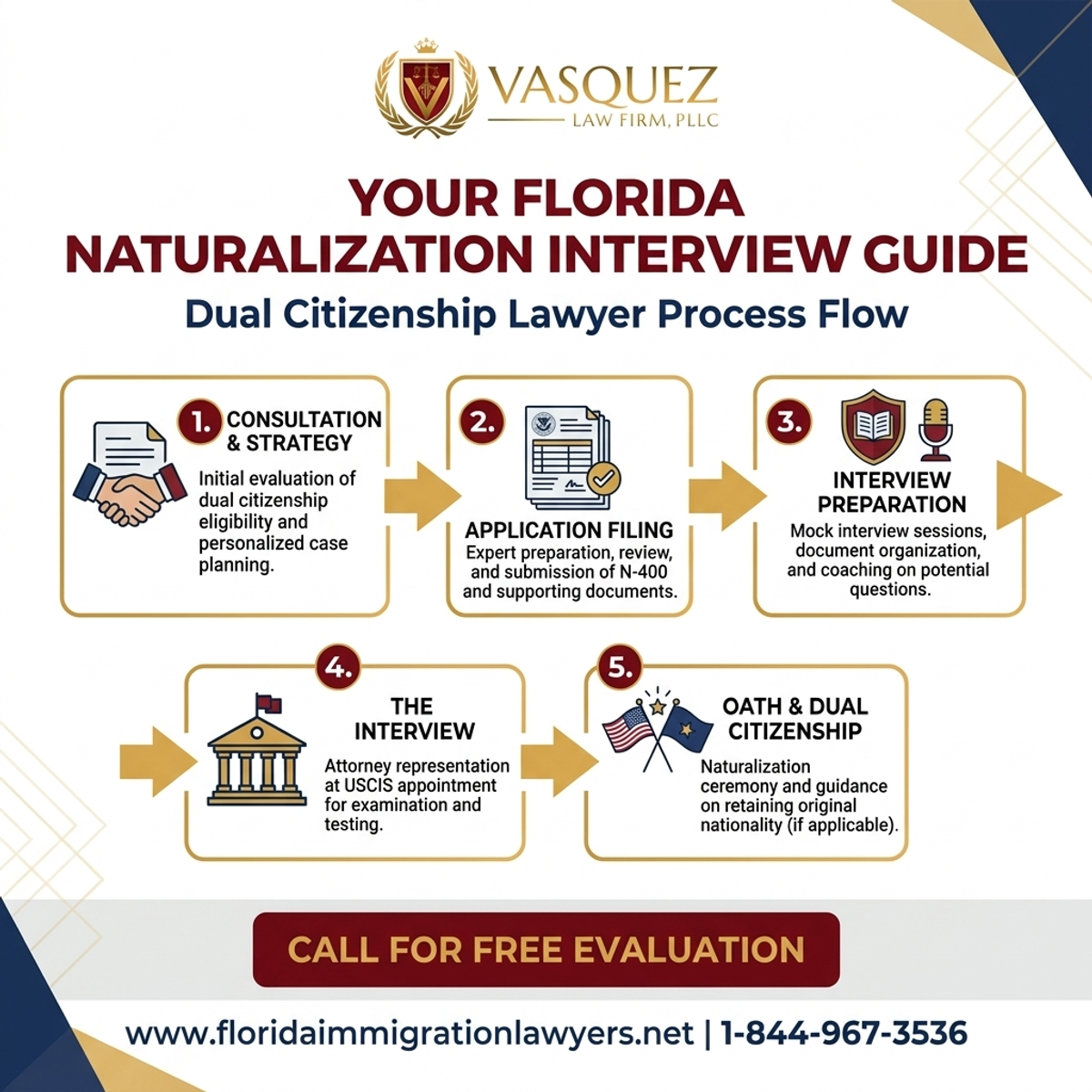
Step-by-Step Process — Dual Citizenship Lawyer: Your Florida Naturalization Interview Guide
- Your interview appointment notice.
- Your Permanent Resident Card (Green Card).
- Your passport and any other travel documents.
- State-issued identification (e.g., driver's license).
- All passports, current and expired, for the last five years (or three years if married to a U.S. citizen).
- Certified copies of marriage certificates, divorce decrees, or death certificates for yourself and your spouse.
- Birth certificates for your children, if applicable.
- Court disposition records for any arrests or citations, even if expunged or dismissed.
- Tax returns, W-2s, or tax transcripts for the last five years (or three years).
- Proof of selective service registration, if applicable.
- Evidence of continuous residency and physical presence in the U.S.
- Any documents you submitted with your N-400 application.
What is the Typical Timeline for the Naturalization Interview and Oath Ceremony?
The timeline for the naturalization interview and subsequent oath ceremony can vary significantly based on the USCIS Field Office workload, the complexity of your case, and current processing times. As of 2026, applicants in Florida, for instance, at the Tampa Field Office, might experience different waiting periods compared to those in Miami or Orlando. Generally, after submitting your Form N-400, you will first receive a receipt notice, followed by an appointment for biometrics. The interview notice typically arrives several months after biometrics. The period between the interview and the oath ceremony is usually shorter, but can still vary. USCIS aims for efficiency, but unforeseen circumstances can always cause delays. Staying informed on current processing times via the USCIS website is always recommended.
Here is a typical timeline for the naturalization process, though individual cases may differ:
| Stage | Typical Timeframe | Notes |
|---|---|---|
| File Form N-400 | Day 1 | Application submission with all required documentation. |
| Receipt Notice | 1-3 weeks | Confirmation of application received by USCIS. |
| Biometrics Appointment | 3-8 weeks after filing | Fingerprints, photograph, and signature collection. |
| Interview Scheduling Notice | 2-8 months after biometrics | Official notification of your interview date and location. |
| Naturalization Interview | 3-12 months after biometrics | Assessment of eligibility, English, and civics knowledge. |
| Decision on N-400 | Same day to several weeks | Officer may approve on the spot or request further evidence. |
| Oath Ceremony Scheduling Notice | 2-8 weeks after approval | Notification of the ceremony date and location. |
| Oath of Allegiance Ceremony | 3-10 weeks after approval | Final step to become a U.S. citizen. |
What Should I Expect During the Citizenship Interview Examination?
The naturalization interview examination is a formal but generally straightforward process designed to confirm your eligibility for U.S. citizenship. Upon arrival at the USCIS Field Office, such as the one in Tampa, you will check in and wait for your name to be called. A USCIS officer will then escort you to a private office. The interview begins with an oath to tell the truth, followed by a review of your N-400 application. The officer will ask questions to verify all the information you provided, ensuring consistency and accuracy. They will inquire about your personal history, family, employment, travel, and any criminal record, no matter how minor. This is your opportunity to clarify any discrepancies or provide additional context.
Following the review of your N-400, the officer will administer the English and civics tests. The English test has three components: speaking, reading, and writing. The speaking portion is assessed throughout the interview as you communicate with the officer. For reading, you will need to read one out of three sentences correctly. For writing, you will need to write one out of three sentences accurately. The civics test consists of up to 10 questions from a predefined list of 100 civics questions. You must answer 6 out of 10 questions correctly to pass. If you fail any part of the tests, you may be scheduled for a second interview. Be prepared, be honest, and answer all questions clearly and concisely. Remember, the officer is looking for honesty and good moral character.
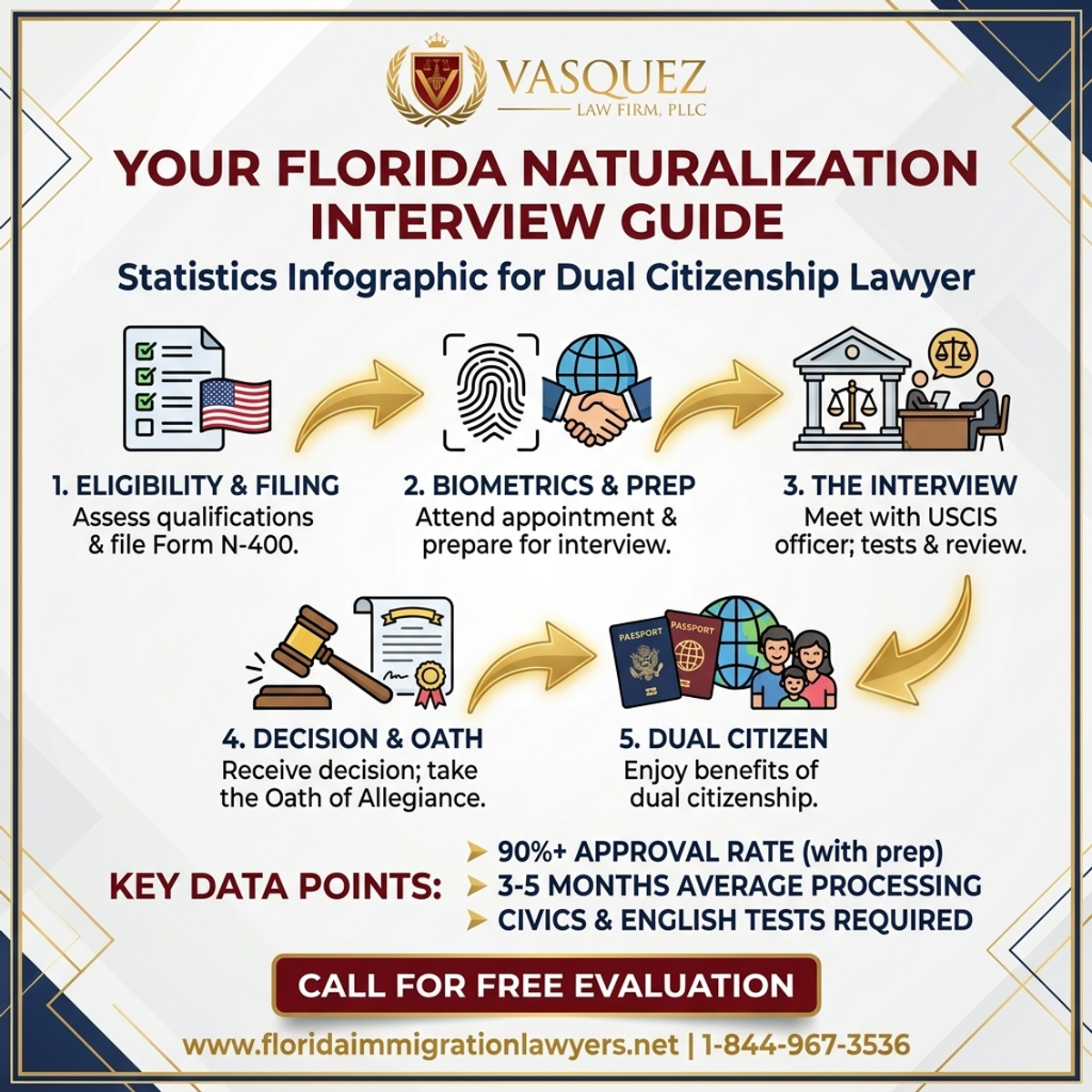
Key Statistics — Dual Citizenship Lawyer: Your Florida Naturalization Interview Guide
Do not navigate this process alone. Contact Florida Immigration Lawyers today at 1-844-967-3536 for a free consultation and let our experienced team help you prepare for your naturalization interview.
Common Mistakes to Avoid During Your Citizenship Interview
The naturalization interview is a critical step, and even minor errors can lead to delays or denials. Being aware of common pitfalls can help you avoid them.
- Failing to Update USCIS on Changes: If your address, marital status, or employment changes after filing your N-400, you must inform USCIS promptly. Failure to do so can raise questions about your honesty and eligibility.
- Providing Inconsistent Information: All answers given during the interview must match the information on your N-400 application and other immigration documents. Any discrepancies, even minor ones, can lead to scrutiny and requests for further evidence.
- Lack of Preparation for English and Civics Tests: Underestimating the importance of these tests is a common mistake. Many applicants fail because they do not adequately study the 100 civics questions or practice their English reading and writing skills.
- Arriving Late or Unprepared: Punctuality is crucial. Arriving late can lead to a reschedule or even a denial. Not bringing all requested original documents and copies will cause significant delays.
- Not Disclosing All Arrests or Citations: Even minor traffic tickets, expunged records, or arrests that did not lead to conviction must be disclosed. USCIS has access to your criminal history, and non-disclosure is considered misrepresentation.
- Misunderstanding Good Moral Character Requirements: Certain actions, such as tax evasion, false claims to U.S. citizenship, or certain criminal offenses, can impact your ability to establish good moral character, which is a core requirement for naturalization.
- Lack of Knowledge About Your Own Application: You should be intimately familiar with every detail of your N-400. The officer will ask questions directly from it, and hesitating or not knowing answers can suggest you didn't prepare it yourself.
- Displaying Disrespect or Dishonesty: Treat the USCIS officer with respect. Any signs of dishonesty, evasiveness, or disrespect can negatively impact your case. Always be truthful, even if the answer is unfavorable.
- Inadequate Proof of Continuous Residence: Applicants often fail to provide sufficient evidence of maintaining continuous residency in the U.S., especially if they have taken long trips outside the country. Ensure you have documentation for all absences.
- Ignoring Legal Advice: Attempting to navigate complex legal issues without the guidance of an immigration attorney can lead to costly mistakes. A dual citizenship lawyer can identify potential problems and provide strategies to address them.
When to Call a Lawyer for Your Naturalization Interview
While many naturalization cases are straightforward, certain situations warrant the immediate assistance of an experienced immigration attorney. If you have any concerns about your eligibility, a past criminal record (even minor offenses), or extended absences from the U.S., consulting a dual citizenship lawyer is highly advisable. Similarly, if you have previously been denied an immigration benefit, have questions about selective service registration, or are unsure about maintaining your original citizenship while becoming a U.S. citizen, legal counsel can provide clarity and strategic advice. Our attorneys at Florida Immigration Lawyers are adept at handling complex naturalization cases and can offer tailored support.
You should also consider contacting a lawyer if you have received a Request for Evidence (RFE) or a Notice of Intent to Deny (NOID) for your N-400 application. These notices indicate specific issues that need to be addressed, and a lawyer can help you formulate a strong response. Furthermore, if you require accommodations for a disability during your interview, or if you feel uncomfortable with English and need an interpreter (though generally not allowed for the English test itself), a lawyer can guide you through the proper procedures. Don't wait until problems arise; proactive legal advice can prevent many issues from escalating. We serve clients throughout Florida, including Tampa, Orlando, and Miami, ensuring you have access to expert legal representation.
At Florida Immigration Lawyers, we are committed to helping individuals and families achieve their American dream. Our firm specializes in a wide range of immigration services, including naturalization, family immigration, business immigration, asylum, and deportation defense. With offices across Florida, we provide personalized, compassionate, and effective legal representation. Our team of dedicated attorneys understands the intricacies of U.S. immigration law and is passionate about protecting your rights and guiding you through every step of your legal journey. We offer free consultations and are available 24/7 to address your concerns. Choose Florida Immigration Lawyers for experienced and reliable legal support.
Sources and References
- U.S. Citizenship and Immigration Services (USCIS)
- Executive Office for Immigration Review (EOIR)
- 8 U.S.C. Chapter 12 - Immigration and Nationality Act (INA)
- 8 CFR Part 316 - General Requirements for Naturalization
- USCIS Policy Manual, Volume 12 - Citizenship and Naturalization
Related services: citizenship test preparation, dual citizenship guidance.
This article provides general legal information and is not intended as legal advice. Every case is unique, and outcomes depend on specific facts and circumstances. Contact an attorney for advice about your particular situation.
Ready to take the next step towards U.S. citizenship? Don't face your naturalization interview unprepared. Contact Florida Immigration Lawyers today for a free, no-obligation consultation. Our experienced team is here to help you navigate the complexities of immigration law. Call us now at 1-844-967-3536. Se Habla Espanol - Estamos aqui para ayudarle.
If you need legal assistance, learn more about how our naturalization attorneys can help, or call us at 1-844-967-3536 for a free consultation.
Do Not Navigate This Process Alone
Our experienced immigration attorneys are ready to fight for you. Get a free, confidential consultation today.
Se Habla Español
Or leave your details and we’ll call you:
Free Evaluation in 24 Hours
Or talk to us right now
AI voice assistant — available 24/7
FreeFrequently Asked Questions

William J. Vásquez
Founding Attorney · Vasquez Law Firm
U.S. Air Force veteran and immigration attorney with years of hands-on U.S. immigration experience. J.D., NCCU School of Law. AILA member. Admitted to the 4th, 5th, and 11th Circuit Courts.
Available 24/7 - Free Evaluations
Reviewed for legal accuracy by William J. Vásquez
Licensed in North Carolina; U.S. immigration is federal practice.
Related Legal Services
Our Florida immigration attorneys can help you with experienced immigration attorneys, business immigration and asylum protection. Call today at 1-844-967-3536 for a free consultation.
Related Links
Related Topics
Free Legal Consultation
Discuss your case with our experienced attorneys. We're available 24/7.
Se Habla Español - Estamos aquí para ayudarle.
Related Articles
K-3 Visa Timeline in Florida: What to Expect
Learn the K-3 visa timeline process in Florida, including steps, costs, and documentation. Understand your options in 2026 with guidance from Florida Immigration Lawyers.
Military Naturalization Expedited in Florida Bases
Explore military naturalization options for families at Florida bases, including parole in place benefits in Miami. Learn how to expedite your application with expert guidance from Florida Immigration Lawyers.
Finding Immigration Legal Help in North Florida
Discover how to find an immigration lawyer in Orlando offering a free consultation. Understand the services available and why choosing Florida Immigration Lawyers can make a difference in your case.
TPS Honduras Latest News 2026 in Florida Pathway
Learn about the TPS to green card pathway for Honduran immigrants in Florida. Discover eligibility requirements, processing timelines, and common mistakes to avoid. Contact Florida Immigration Lawyers for expert guidance.