Dual Citizenship in Florida: What You Need to Know
Explore the benefits and process of obtaining dual citizenship in Florida, particularly for residents of Homestead. Learn about the requirements, potential challenges, and how to navigate the legal landscape with the help of Florida Immigration Lawyers.

Dual Citizenship in Florida: What You Need to Know
The concept of dual citizenship, holding nationality in two different countries simultaneously, is a fascinating and increasingly common reality in our interconnected world. For many, it represents a bridge between cultures, offering unique opportunities and a deeper sense of belonging. While the United States generally permits dual nationality, the specifics can be complex, especially when considering individual circumstances and the laws of other nations. If you're residing in Florida and contemplating or navigating the path to dual citizenship, understanding the nuances is paramount.
This comprehensive guide will demystify dual citizenship, exploring its benefits, potential challenges, and the processes involved. We'll delve into how U.S. law views dual nationality, the role of naturalization, and when expert legal guidance becomes indispensable. Whether you're a long-term resident, a recent immigrant, or someone with ancestral ties abroad, gaining clarity on dual citizenship can empower you to make informed decisions about your future.
Understanding Dual Citizenship: A Global Perspective
Dual citizenship, also known as dual nationality, means that a person is a citizen of two countries at the same time. This status can arise in several ways: by birth, through naturalization, or by marriage. For instance, a child born in the United States to parents who are citizens of another country might automatically acquire both U.S. citizenship (by birthright, jus soli) and the citizenship of their parents' country (by descent, jus sanguinis).
The U.S. Stance on Dual Nationality
It's a common misconception that the United States does not recognize dual citizenship. In reality, while the U.S. government does not actively encourage dual nationality, it generally permits it. U.S. law does not require a person to choose between their U.S. citizenship and the citizenship of another country. However, individuals are expected to uphold their duties and obligations to the United States while within its borders. The key is that a U.S. citizen who also holds another nationality must still be treated as a U.S. citizen by the U.S. government for all purposes.
This permissive stance means that if you become a U.S. citizen through naturalization, you typically do not have to renounce your prior citizenship unless specifically required by the laws of your country of origin. Conversely, if you are a U.S. citizen by birth and acquire citizenship in another country, you generally do not lose your U.S. citizenship unless you formally and intentionally renounce it.
Benefits and Potential Challenges of Holding Two Passports
Embracing dual citizenship can unlock a multitude of advantages, enhancing personal and professional opportunities. However, it also comes with certain responsibilities and potential complexities that require careful consideration.
The Advantages of Dual Citizenship
- Increased Travel Freedom: Holding two passports can simplify international travel, allowing easier entry and exit from both countries without the need for visas in many cases.
- Expanded Economic Opportunities: Dual citizens may have the right to live, work, and own property in both countries, opening up new avenues for business, investment, and employment.
- Enhanced Cultural and Personal Ties: It strengthens connections to ancestral heritage, allowing individuals to maintain deep roots in both cultures, participate in political processes, and enjoy social benefits.
- Educational Benefits: Access to educational institutions and potentially lower tuition fees in both countries can be a significant advantage.
- Security and Flexibility: In times of political instability or economic downturn in one country, having citizenship in another can offer a valuable safety net and greater personal flexibility.
Potential Challenges and Considerations
- Tax Obligations: U.S. citizens, including dual nationals, are generally subject to U.S. taxation on their worldwide income, regardless of where they reside. This can lead to complex tax filing requirements and potential double taxation, although treaties and foreign tax credits can often mitigate this. Understanding FATCA (Foreign Account Tax Compliance Act) is crucial.
- Military Service: Some countries require mandatory military service from their citizens. A dual national might face obligations in both countries, though waivers or exemptions often exist.
- Political Allegiance: While the U.S. permits dual nationality, situations may arise where allegiance to one country could conflict with the interests of the other.
- Renunciation Issues: If you decide to renounce one citizenship, the process can be complex and irreversible, requiring careful thought and legal advice.
- Loss of Citizenship: While rare, certain actions, such as serving in a foreign military at war with the U.S. or taking an oath of allegiance to a foreign state with the intent to relinquish U.S. citizenship, could potentially lead to the loss of U.S. nationality.
The Path to Dual Citizenship: Focusing on U.S. Naturalization
For many individuals in Florida, the journey to dual citizenship involves first becoming a U.S. citizen through the naturalization process. This process allows eligible lawful permanent residents (green card holders) to acquire U.S. citizenship. Once naturalized, you generally retain your original citizenship unless your birth country's laws explicitly forbid dual nationality or require you to renounce it.
Key Steps in U.S. Naturalization:
- Eligibility Requirements: You must generally be at least 18 years old, be a lawful permanent resident for a specific period (usually 5 years, or 3 years if married to a U.S. citizen), demonstrate continuous residence and physical presence in the U.S., possess good moral character, and have a basic understanding of English and U.S. civics.
- Form N-400, Application for Naturalization: This is the primary application form submitted to U.S. Citizenship and Immigration Services (USCIS). It requires detailed personal information, residency history, and background checks.
- Biometrics Appointment: Applicants attend an appointment to provide fingerprints, photographs, and a signature for background and security checks.
- Interview: A USCIS officer will interview you to verify the information on your N-400 application, assess your English language proficiency, and test your knowledge of U.S. history and government.
- Decision and Oath Ceremony: If your application is approved, you will receive a notice for an Oath of Allegiance ceremony, where you officially become a U.S. citizen.
Navigating the naturalization process can be intricate, with strict requirements and potential pitfalls. Seeking professional guidance from an experienced immigration attorney can significantly streamline the process and help avoid common mistakes.
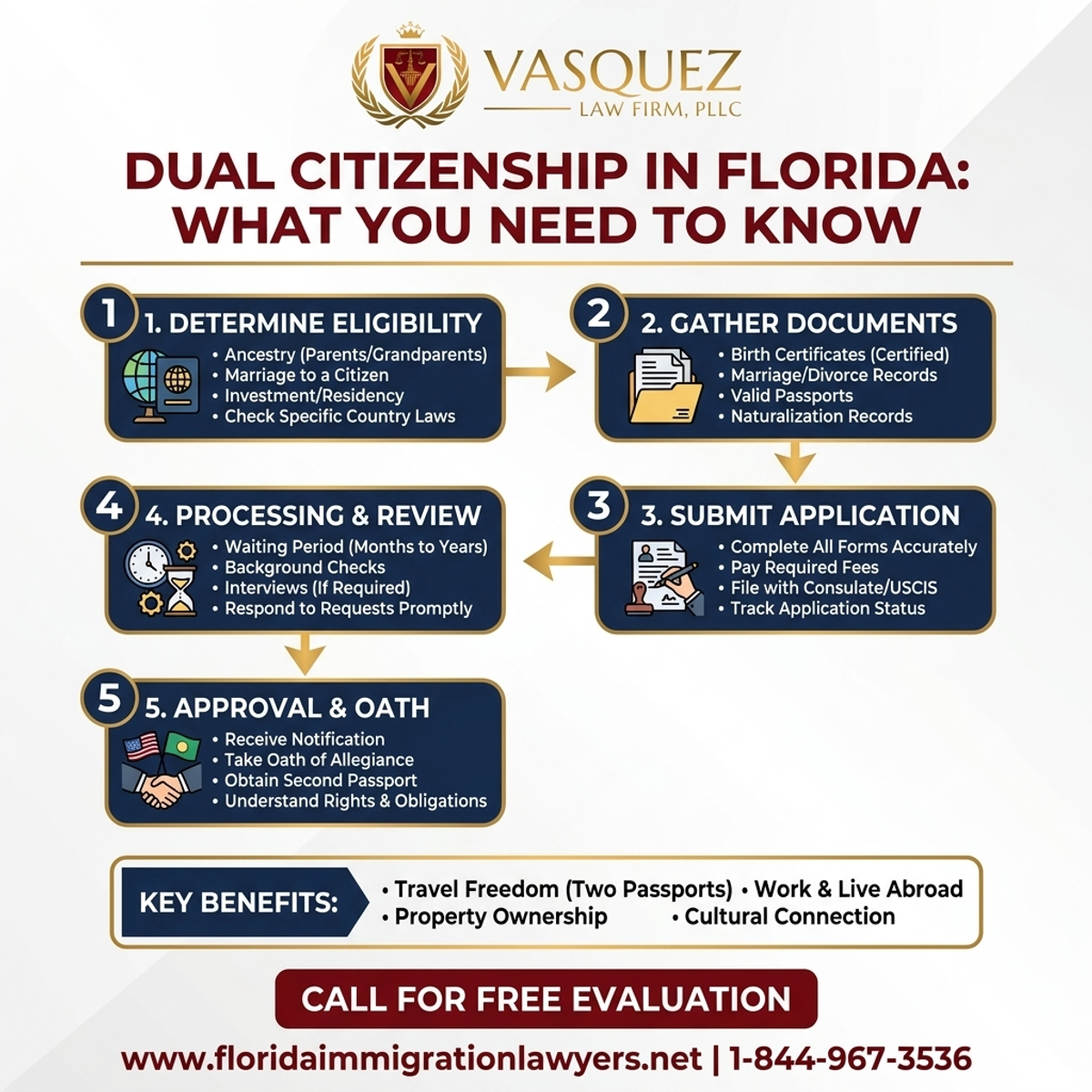
Step-by-Step Process — Dual Citizenship in Florida: What You Need to Know
Dual Citizenship by Birth and Descent
Beyond naturalization, dual citizenship can also be acquired automatically:
- Jus Soli (Right of Soil): A child born in the United States is generally a U.S. citizen, regardless of the parents' nationality. If the parents are citizens of another country that grants citizenship by descent, the child may automatically be a dual national.
- Jus Sanguinis (Right of Blood): Many countries grant citizenship to children born abroad if one or both parents are citizens of that country. If a U.S. citizen parent has a child in a foreign country, that child may be a U.S. citizen by birth abroad, and also a citizen of the foreign country if its laws permit.
Navigating Complexities: When to Seek Expert Legal Guidance
While the general principles of dual citizenship might seem straightforward, individual cases often present unique and intricate challenges. The laws governing nationality can vary significantly between countries, and a misstep in one jurisdiction could have unforeseen consequences in another. This is where the expertise of a seasoned immigration attorney becomes not just beneficial, but often essential.
For instance, if you have a criminal record, even a minor one, it could jeopardize your naturalization application or affect your ability to retain U.S. citizenship. An attorney can assess the impact of such issues and advise on the best course of action. Similarly, individuals who have spent significant time outside the U.S. may face challenges proving continuous residence or physical presence, requiring careful documentation and legal arguments.
Furthermore, if you are seeking dual citizenship due to fears of persecution in your country of origin, or if your current status in the U.S. is precarious, the intersection of asylum law and naturalization can be particularly complex. An attorney specializing in asylum can help you understand how your pursuit of dual nationality might interact with your protection claims in the U.S., ensuring that you do not inadvertently compromise your safety or legal standing. They can guide you through the delicate balance of seeking protection while also exploring options for long-term stability.
Another critical area where legal counsel is invaluable is in situations involving potential deportation defense. If you are a lawful permanent resident considering naturalization, but have received a Notice to Appear (NTA) or are otherwise facing removal proceedings, attempting to naturalize without expert legal advice could exacerbate your situation. An attorney can help you understand the implications of your immigration history on your naturalization eligibility and, more importantly, defend your right to remain in the U.S. while simultaneously exploring pathways to citizenship. They can identify any grounds of inadmissibility or deportability that might arise during the naturalization process and develop strategies to mitigate these risks. This proactive approach is vital to protect your future in the United States.
Moreover, for those with complex family histories, such as citizenship acquired through adoption or parents who naturalized after their birth, determining eligibility for dual citizenship can involve intricate legal interpretations. An attorney can meticulously review your family's immigration history and relevant international laws to establish your claims accurately. They can also assist with the process of obtaining Certificates of Citizenship or Consular Reports of Birth Abroad, which are crucial documents for affirming U.S. nationality.
In essence, any scenario that deviates from the most straightforward path to dual citizenship warrants professional legal review. An attorney provides clarity, protects your rights, and navigates the bureaucratic hurdles on your behalf, ensuring that your journey to dual nationality is as smooth and secure as possible.
Florida's Context for Dual Nationals
While dual citizenship is primarily governed by federal and international law, living in Florida as a dual national can have specific practical implications. Florida, like other states, will recognize your U.S. citizenship for all state-level rights and responsibilities. This means you can vote in state and local elections, obtain a Florida driver's license, own property, and access state services just like any other U.S. citizen.
However, your second nationality might influence certain aspects, such as professional licensing if it requires specific security clearances or declarations of foreign affiliations. It's also important to understand how Florida's inheritance laws might interact with the laws of your other country of citizenship, especially concerning assets held abroad. While these are typically minor considerations compared to federal immigration and tax laws, they underscore the importance of comprehensive legal awareness.
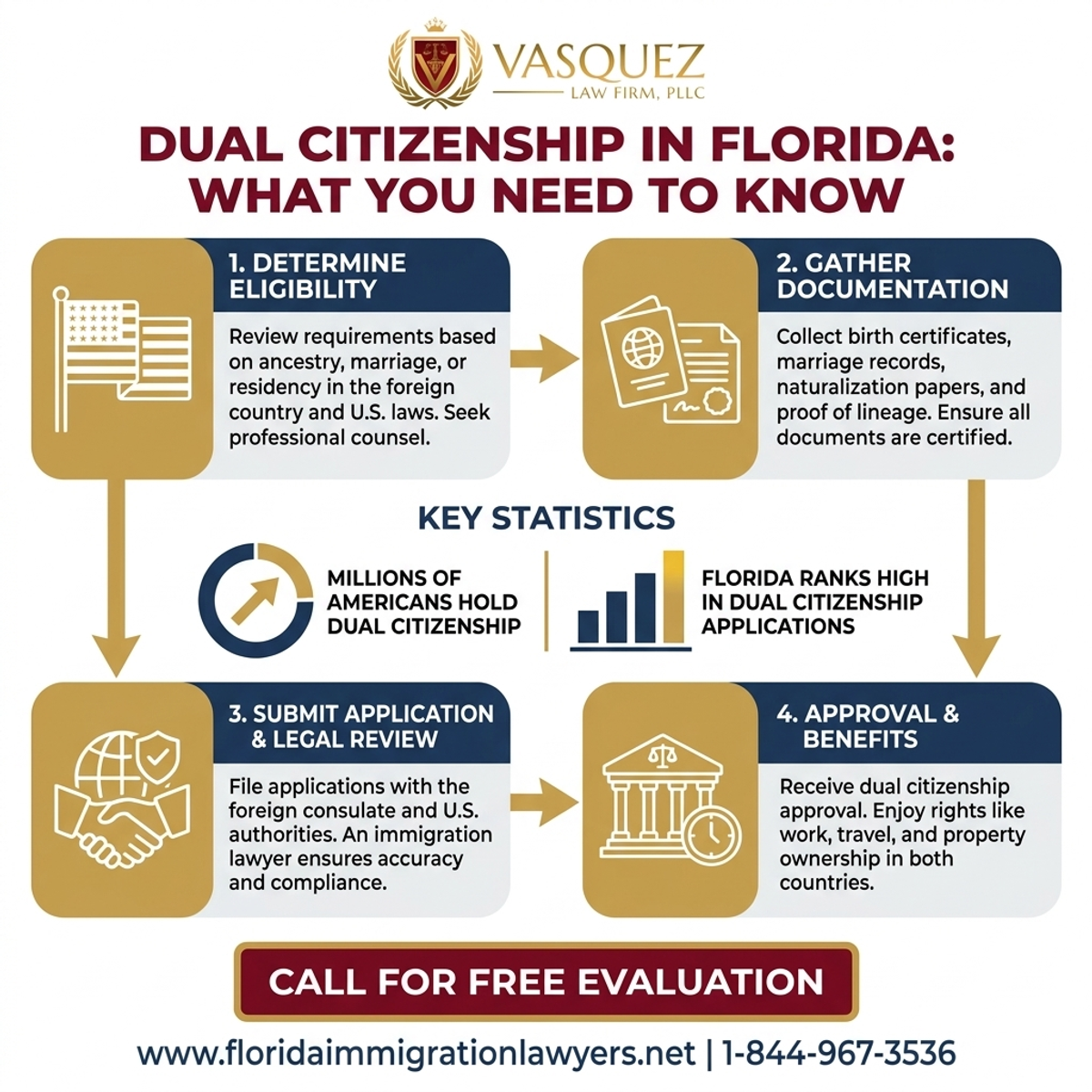
Key Statistics — Dual Citizenship in Florida: What You Need to Know
Finding local legal expertise in Florida means you can consult with attorneys who are not only well-versed in federal immigration law but also understand the local context and resources available to dual nationals in the state. This localized knowledge can be invaluable when dealing with state-specific regulations or seeking local support networks.
Choosing the Right Legal Partner in Florida
Given the complexities involved, partnering with a knowledgeable and experienced immigration law firm is crucial for anyone pursuing or managing dual citizenship. An attorney can provide personalized advice tailored to your specific situation, helping you understand the requirements, avoid potential pitfalls, and navigate the bureaucratic processes efficiently.
When selecting legal representation, look for a firm with a proven track record in immigration and naturalization cases, and one that demonstrates a deep understanding of international law as it pertains to dual nationality. A reputable firm will offer clear communication, transparent fee structures, and a commitment to protecting your best interests.
Our dedicated team of attorneys specializes in a wide range of immigration matters, including naturalization and dual citizenship cases. We are committed to providing comprehensive legal support to individuals and families throughout Florida, ensuring they achieve their immigration goals with confidence and peace of mind.
Conclusion: Empowering Your Dual Citizenship Journey
Dual citizenship offers a wealth of opportunities, from enhanced travel and economic freedom to a richer connection with your heritage. However, it is a status that comes with significant legal and financial responsibilities. Understanding the U.S. government's stance, the naturalization process, and the potential challenges is the first step toward a successful journey.
Whether you are just beginning to explore the possibility of dual nationality or are facing complex issues as a current dual citizen, expert legal guidance is invaluable. Don't navigate these intricate waters alone. For personalized advice and comprehensive support on your naturalization and dual citizenship journey, we invite you to contact us today for a consultation. Let us help you secure your future and embrace the full potential of your dual identity.
Sources and References
- U.S. Citizenship and Immigration Services (USCIS)
- Executive Office for Immigration Review (EOIR)
- U.S. Department of State - Bureau of Consular Affairs
- Immigration and Nationality Act (INA), 8 U.S.C. Chapter 12
Do Not Navigate This Process Alone
Our experienced immigration attorneys are ready to fight for you. Get a free, confidential consultation today.
Se Habla Español
Frequently Asked Questions
Florida Immigration Lawyers
Immigration Attorney | Founder, Vasquez Law Firm
U.S. Air Force veteran and immigration attorney with thousands of cases resolved. J.D., NCCU School of Law. AILA member. Admitted to the 4th, 5th, and 11th Circuit Courts.
Available 24/7 - Free Evaluations
Related Legal Services
Our Florida immigration attorneys can help you with family immigration services, immigration practice areas and free immigration consultation. Call today at 1-844-967-3536 for a free consultation.
Related Links
Related Topics
Free Legal Consultation
Discuss your case with our experienced attorneys. We're available 24/7.
Se Habla Español - Estamos aquí para ayudarle.
Related Articles
F-1 Reinstatement Process for Florida Students | VLF Florida
Learn how to navigate the F-1 reinstatement process in Florida with this comprehensive guide. Whether you're out of status or need assistance, Florida Immigration Lawyers can help you regain your student visa status.
Citizenship Application Delay in Florida: What to Know
Delays in citizenship application processing can be frustrating for Florida residents. Learn how to navigate these delays effectively with expert guidance from Florida Immigration Lawyers.
E-2 Visa: Florida Business Investor Guide | VLF Florida
Explore how the E-2 investor visa facilitates business ventures in Florida, specifically in Hialeah. Learn about eligibility, application steps, and how Florida Immigration Lawyers can assist you.
Immediate Relative Petition in Florida: A Guide | VLF Florida
Learn how to file an immediate relative petition in Florida to reunite your family. Discover the steps, required documents, and common mistakes to avoid. Contact Florida Immigration Lawyers for expert guidance.