Dual Citizenship in Florida: A Comprehensive Guide
Explore the advantages and process of obtaining dual citizenship in Florida. Learn about the naturalization process, common pitfalls to avoid, and when to seek legal assistance. Contact Florida Immigration Lawyers for expert guidance.

- Understanding eligibility and requirements for dual citizenship.
- The naturalization process in Florida.
- Legal implications of holding two passports.
- The importance of consulting with an immigration lawyer.
In the vibrant community of Naples, Florida, many residents are exploring the benefits of dual citizenship. Whether you're an immigrant seeking to maintain ties with your home country or a U.S. citizen looking to expand your global presence, dual citizenship offers numerous advantages. This comprehensive guide will delve into the requirements and processes involved in obtaining dual citizenship, focusing on Florida's unique legal landscape. Call Florida Immigration Lawyers at 1-844-967-3536 for a free consultation to navigate this complex process with ease.
Understanding Dual Citizenship
Dual citizenship means being a citizen of two countries simultaneously. This status allows individuals to enjoy rights and privileges in both nations, such as voting and residency rights. In the United States, dual citizenship is permitted, although not explicitly encouraged. The process typically involves naturalization, where a foreign national becomes a U.S. citizen while retaining citizenship in another country.
For residents of Florida, particularly in areas like Naples, dual citizenship can offer increased mobility and economic opportunities. It is crucial to understand the specific requirements of both the U.S. and the other nation involved. Consulting with an immigration attorney can ensure you meet all legal obligations, including those outlined in the Immigration and Nationality Act (INA).
Beyond the fundamental rights, dual citizenship opens doors to a multitude of benefits. For instance, it can facilitate easier international travel, often eliminating the need for visas when visiting either country. This is particularly advantageous for business professionals, students, or families with strong ties to both nations. Access to social services, healthcare, and educational opportunities in both countries can also be a significant draw, providing a safety net and expanded choices for individuals and their families.
Furthermore, holding dual nationality can offer enhanced economic and investment opportunities. You might be able to own property, establish businesses, or work in either country without complex visa restrictions. This flexibility can be a powerful tool for wealth creation and career advancement. Culturally, dual citizenship allows individuals to maintain a deeper connection to their heritage, participate in political processes, and feel a sense of belonging in two distinct societies. It's a status that truly embodies a global perspective, enriching personal and professional lives.
However, it's essential to recognize that while the U.S. permits dual citizenship, not all countries do. Some nations require you to renounce your previous citizenship upon naturalization, while others have specific treaties or agreements with the U.S. that allow for it. Understanding these intricate bilateral agreements and the laws of your country of origin is paramount. This is where the expertise of Florida Immigration Lawyers becomes invaluable. They can assess your unique situation and provide tailored advice, ensuring you navigate these complexities without jeopardizing your status in either nation. Call us at 1-844-967-3536 for a comprehensive evaluation.
The Naturalization Process in Florida
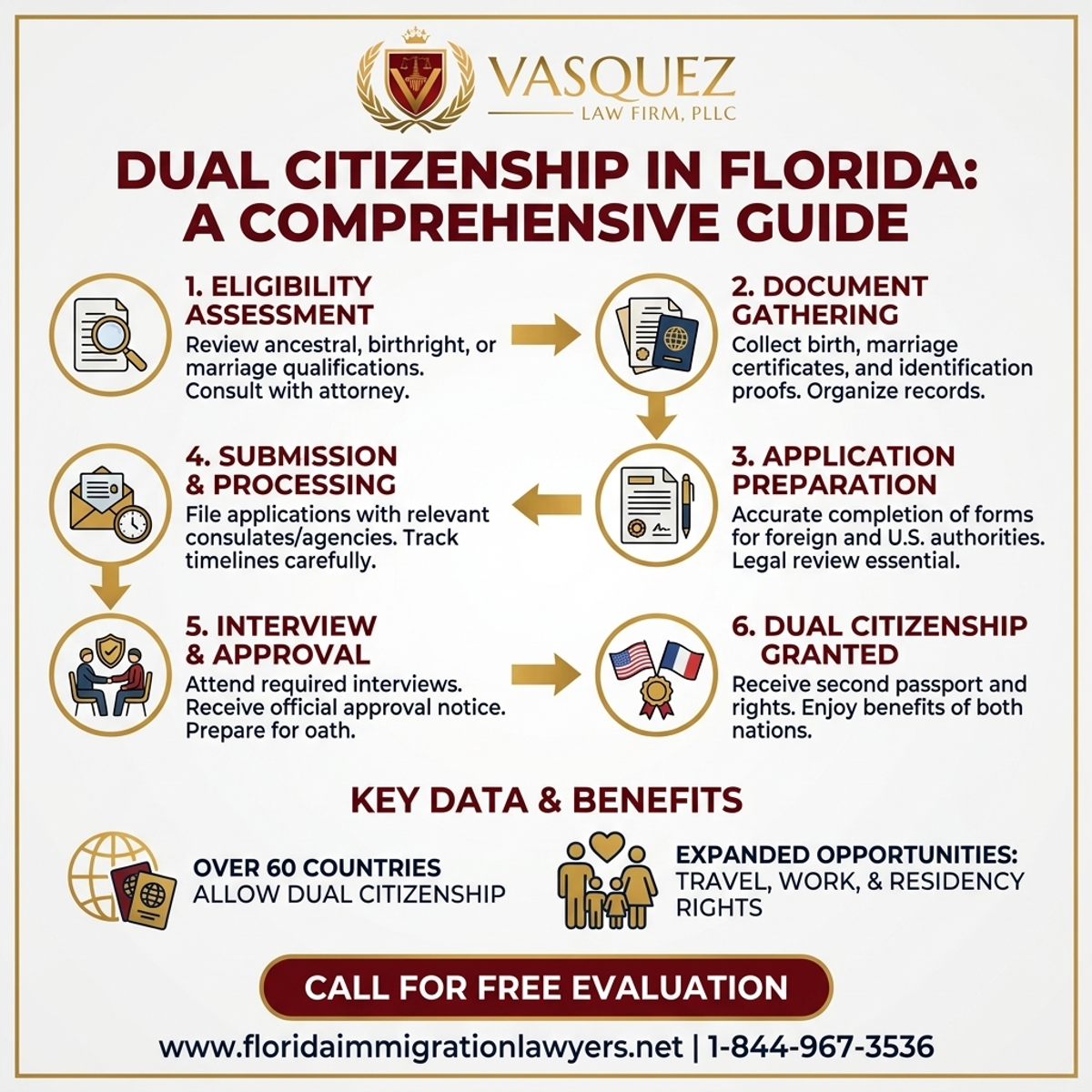
The path to becoming a U.S. citizen, a prerequisite for most dual citizenship scenarios, is known as naturalization. This process is standardized across the United States, but local USCIS field offices in Florida, such as those serving Naples, handle applications, interviews, and ceremonies. Understanding each step thoroughly is vital for a smooth application. Florida Immigration Lawyers can guide you through every phase, ensuring your application meets all federal requirements and is presented optimally.
- Eligibility Assessment: This initial step is critical. You must be at least 18 years old, be a lawful permanent resident (Green Card holder) for at least five years (or three years if married to a U.S. citizen), demonstrate continuous residency and physical presence in the U.S., and show good moral character. You must also be able to read, write, and speak basic English and have a fundamental understanding of U.S. history and government (civics). Our attorneys can help you determine if you meet these complex criteria and address any potential issues early on.
- Application Submission: The core of the process is filing Form N-400, Application for Naturalization, with the U.S. Citizenship and Immigration Services (USCIS). This form requires extensive personal information, residency history, employment details, and a declaration of good moral character. It is paramount that all information is accurate and consistent with your immigration record. Errors or omissions can lead to significant delays or even denial. Accompanying documents, such as copies of your Green Card, marriage certificates, or divorce decrees, must also be meticulously prepared and submitted.
- Biometrics Appointment: After submitting your application, USCIS will send you an appointment notice for biometrics collection. This typically involves fingerprinting, photographs, and a signature. These biometrics are used for background and security checks to ensure you do not pose a risk and to verify your identity. Attending this appointment is mandatory, and failure to do so without proper rescheduling can severely impact your application.
- Interview and Exam: This is a pivotal stage where a USCIS officer will review your application, ask questions about your background, and administer the English and civics tests. The English test assesses your ability to read, write, and speak basic English, while the civics test covers U.S. history and government. Thorough preparation is key to success. Florida Immigration Lawyers offer resources and guidance to help you prepare effectively for this interview, including mock interviews and study materials for the civics test.
- Oath of Allegiance: The final step for approved applicants is the naturalization ceremony, where you take the Oath of Allegiance to the United States. This is a formal and often moving event, signifying your commitment to the U.S. and officially making you a U.S. citizen. Upon taking the oath, you will receive your Certificate of Naturalization, which serves as proof of your U.S. citizenship. With this certificate, you can then apply for a U.S. passport, completing your journey to dual citizenship if your other country permits it.
Document Checklist for Dual Citizenship
A meticulously prepared document package is crucial for a successful naturalization application, which is the gateway to dual citizenship for many. Any missing or incorrect documentation can lead to delays, requests for evidence (RFEs), or even denial. Ensuring every piece of paper is in order is a cornerstone of the process.
- Completed naturalization application (Form N-400): This is the primary form that initiates your naturalization process. It must be filled out accurately, completely, and signed. Any discrepancies between the information on Form N-400 and your other immigration records can raise red flags for USCIS, necessitating careful review before submission.
- Proof of residency in Florida: While not explicitly a separate form, you will need to demonstrate continuous residency in the U.S. for the required period, with at least three months in the state or USCIS district where you apply. This can include utility bills, lease agreements, property deeds, tax returns, and employment records showing your address in Florida.
- Two passport-sized photographs: These photographs must meet specific USCIS requirements, including size, background color, and facial expression. They are used for your Green Card (if applicable) and your Certificate of Naturalization. It's advisable to get professional passport photos taken to ensure compliance.
- Biometrics appointment notice: While this notice is generated by USCIS, you must bring it with you to your biometrics appointment. It serves as your official invitation and contains important barcode information needed for your fingerprinting and background checks. Keep this document safe once received.
- Documents proving continuous residency: This is a broad category that can include various items such as tax transcripts for the past five years (or three years if applicable), employment letters, school transcripts, and records of any extended trips outside the U.S. These documents help USCIS verify that you have met the continuous residency requirements for naturalization.
- Marriage certificate (if applying under the three-year rule): If you are applying for naturalization based on marriage to a U.S. citizen, you will need to provide your marriage certificate, proof of your spouse's U.S. citizenship, and evidence of a bona fide marriage, such as joint bank accounts, property deeds, or birth certificates of children.
- Certified court dispositions for any arrests or convictions: If you have any criminal history, no matter how minor or old, you must disclose it and provide certified court documents for each arrest or conviction. Failure to disclose can lead to severe penalties, including denial of your application and potential deportation. Always consult with Florida Immigration Lawyers if you have any criminal record.
Organizing these documents can be overwhelming, but Florida Immigration Lawyers can help you compile a complete and accurate package. We ensure that every piece of evidence supports your application, minimizing the chances of delays or complications. Call 1-844-967-3536 for expert assistance.
Step-by-Step Process — Dual Citizenship in Florida: A Comprehensive Guide
Timeline and Processing Expectations
Obtaining dual citizenship can take several months to over a year. Factors influencing the timeline include the completeness of your application, USCIS processing times, and the scheduling of your interview and ceremony. In Florida, processing times may be shorter or longer depending on the local USCIS office workload. It is advisable to regularly check for updates on processing times through the USCIS website.
The overall timeline is highly variable and can be influenced by several external factors beyond the applicant's control. These include the volume of applications USCIS is currently handling, the staffing levels at specific field offices (like those serving Naples), and any policy changes that might affect processing priorities. For instance, national emergencies or legislative shifts can sometimes lead to unforeseen backlogs. While the USCIS website provides estimated processing times, these are averages and individual cases can deviate significantly.
To help mitigate potential delays, it's crucial to submit an application that is not only complete but also well-organized and free of errors. Any request for additional evidence (RFE) or notice of intent to deny (NOID) will inevitably prolong the process. Furthermore, responding promptly and comprehensively to any USCIS inquiries is essential. Florida Immigration Lawyers can assist in preparing a robust application package, proactively addressing potential issues, and monitoring your case status to keep you informed of any developments. We understand the anxiety that can accompany long waiting periods and strive to make the process as transparent as possible for our clients.
Cost Factors and Fee Breakdown
The costs associated with applying for dual citizenship can vary. Consider application fees, legal services, and potential travel expenses for appointments. While specific government fees are subject to change, consulting a lawyer can provide clarity on expected costs and payment options. Remember, investing in professional legal assistance can prevent costly mistakes.
The primary government fee is for filing Form N-400, the Application for Naturalization, which also covers the biometrics services fee. These fees are set by USCIS and are subject to periodic changes, so it's vital to check the most current fee schedule on the USCIS website before filing. In certain circumstances, applicants with low income may be eligible for a fee waiver, which can significantly reduce the financial burden. Our team at Florida Immigration Lawyers can help assess your eligibility for such waivers and assist with the necessary documentation.
Beyond government fees, other potential costs include professional legal fees for an immigration attorney, which can vary based on the complexity of your case and the services required. While some applicants choose to navigate the process independently, the value of legal expertise cannot be overstated, especially for complex cases or those with potential complications like a criminal record or extended absences from the U.S. There may also be costs for obtaining supporting documents, such as certified
Sources and References
- U.S. Citizenship and Immigration Services (USCIS)
- Executive Office for Immigration Review (EOIR)
- U.S. Department of State - Bureau of Consular Affairs
- Immigration and Nationality Act (INA), 8 U.S.C. Chapter 12
Do Not Navigate This Process Alone
Our experienced immigration attorneys are ready to fight for you. Get a free, confidential consultation today.
Se Habla Español
Frequently Asked Questions
Florida Immigration Lawyers
Immigration Attorney | Founder, Vasquez Law Firm
U.S. Air Force veteran and immigration attorney with thousands of cases resolved. J.D., NCCU School of Law. AILA member. Admitted to the 4th, 5th, and 11th Circuit Courts.
Available 24/7 - Free Evaluations
Related Legal Services
Our Florida immigration attorneys can help you with business immigration, asylum protection and deportation defense. Call today at 1-844-967-3536 for a free consultation.
Related Links
Related Topics
Free Legal Consultation
Discuss your case with our experienced attorneys. We're available 24/7.
Se Habla Español - Estamos aquí para ayudarle.
Related Articles
Immigration Services in Jacksonville, Florida | VLF Florida
Navigating immigration services in Jacksonville, Florida, requires understanding visa processes and legal guidance. Explore our comprehensive guide for expert insights.
Immigration Attorney in Orlando, Florida: Your Guide
Finding the right immigration attorney in Orlando, Florida, can significantly impact your immigration journey. Learn about the services available and how to choose the best legal help for your needs. Call Florida Immigration Lawyers at 1-844-967-3536 for a free consultation.
Understanding the Asylum One-Year Deadline in Florida
Discover the importance of filing for asylum within the one-year deadline in Florida and learn how changed circumstances can affect your case. Call Florida Immigration Lawyers at 1-844-967-3536 for expert guidance.
L-1 Visa Intracompany Transfers in Florida | VLF Florida
Learn about the L-1 visa process for intracompany transfers in Florida. Our guide covers eligibility, documentation, timeline, and common pitfalls. Contact Florida Immigration Lawyers for a free consultation.