Derived Citizenship in Florida: How Parents Can Pass It On
For families in Florida, understanding derived citizenship is key. This guide covers eligibility for children born abroad or residing in the U.S., the step-by-step N-600 application, document checklists, and common mistakes. Learn how parents can confer citizenship and when to seek legal help from Florida Immigration Lawyers for a smooth process. Secure your child's future with expert guidance.

Derived citizenship allows certain children to automatically become U.S. citizens through their U.S. citizen parents, often without needing to naturalize themselves. This typically applies to children who are lawful permanent residents and under 18 years old when their parent naturalizes or meets specific criteria. It's a crucial pathway for many families in Florida to secure their child's future.
- Children under 18 can often derive citizenship.
- Requires at least one U.S. citizen parent.
- Child must be a lawful permanent resident.
- Form N-600 is used to obtain proof of derived citizenship.
- Legal guidance is highly recommended for this complex process.
Imagine your child, born abroad or residing in Florida, automatically becoming a U.S. citizen because of your own citizenship. This isn't just a dream; it's a legal reality for many families through a process known as derived citizenship. Understanding this pathway is vital for parents in Naples and across Florida who wish to secure their child's future in the United States.
This comprehensive guide from Florida Immigration Lawyers will walk you through the intricacies of derived citizenship. We will cover eligibility requirements, the application process, necessary documentation, and common pitfalls to avoid. Our goal is to provide clarity and empower you with the knowledge to navigate this important journey for your family.
Do you have questions about your child's eligibility for derived citizenship? Do not hesitate to seek expert advice. Call Florida Immigration Lawyers at 1-844-967-3536 for a free consultation today. We are here to help your family.
Understanding Derived Citizenship in Florida: An Overview
Derived citizenship, often confused with acquired citizenship (which occurs automatically at birth abroad to U.S. citizens), refers to a child automatically becoming a U.S. citizen when specific conditions are met after birth. These conditions generally relate to a parent's naturalization or certain events occurring before the child's 18th birthday. This pathway is a cornerstone of family immigration law in the U.S.
For families residing in Florida, particularly in areas like Naples, understanding these rules is critical. The U.S. Citizenship and Immigration Services (USCIS) handles these applications, and their policies apply uniformly across the nation, though local USCIS field offices in Miami or Tampa may conduct interviews when necessary.
The Child Citizenship Act of 2000 (CCA)
The Child Citizenship Act of 2000 (CCA), codified primarily at INA Section 320 (8 U.S.C. § 1431), revolutionized how children of U.S. citizens obtain citizenship. This act streamlined the process, making it automatic for many children who meet specific criteria. It ensures that children do not have to undergo a separate naturalization process if their parents are U.S. citizens.
The CCA applies to children who are under 18 years of age, are lawful permanent residents, and have at least one parent who is a U.S. citizen by birth or naturalization. The child must also be residing in the legal and physical custody of the U.S. citizen parent. This law brought much-needed clarity and simplicity to a previously complex area of immigration law.
Eligibility Criteria for Children Born Abroad
A child born abroad to one U.S. citizen parent and one non-citizen parent, or two U.S. citizen parents, may acquire citizenship at birth if certain residency requirements are met by the U.S. citizen parent(s). This is "acquired citizenship." However, if those requirements aren't met at birth, the child might still gain citizenship through derivation.
For children born abroad to U.S. citizen parents who did not meet the transmission requirements at birth, or to parents who later naturalized, derived citizenship is a key option. The process involves demonstrating that the child meets the criteria of the CCA before their 18th birthday. This often requires careful documentation and attention to detail, especially for families navigating Florida immigration.
Eligibility for Children Residing in the U.S.
For a child residing in the U.S. to obtain parents citizenship through derivation, they must meet several conditions. First, at least one parent must be a U.S. citizen, either by birth or naturalization. Second, the child must be under the age of 18. Third, the child must be a lawful permanent resident (have a green card).
Finally, the child must be residing in the U.S. in the legal and physical custody of the U.S. citizen parent. All these conditions must be met simultaneously for derived citizenship to occur automatically. This applies whether the child was born in Florida or immigrated to Florida from abroad.
The Step-by-Step Process to Claim Derived Citizenship
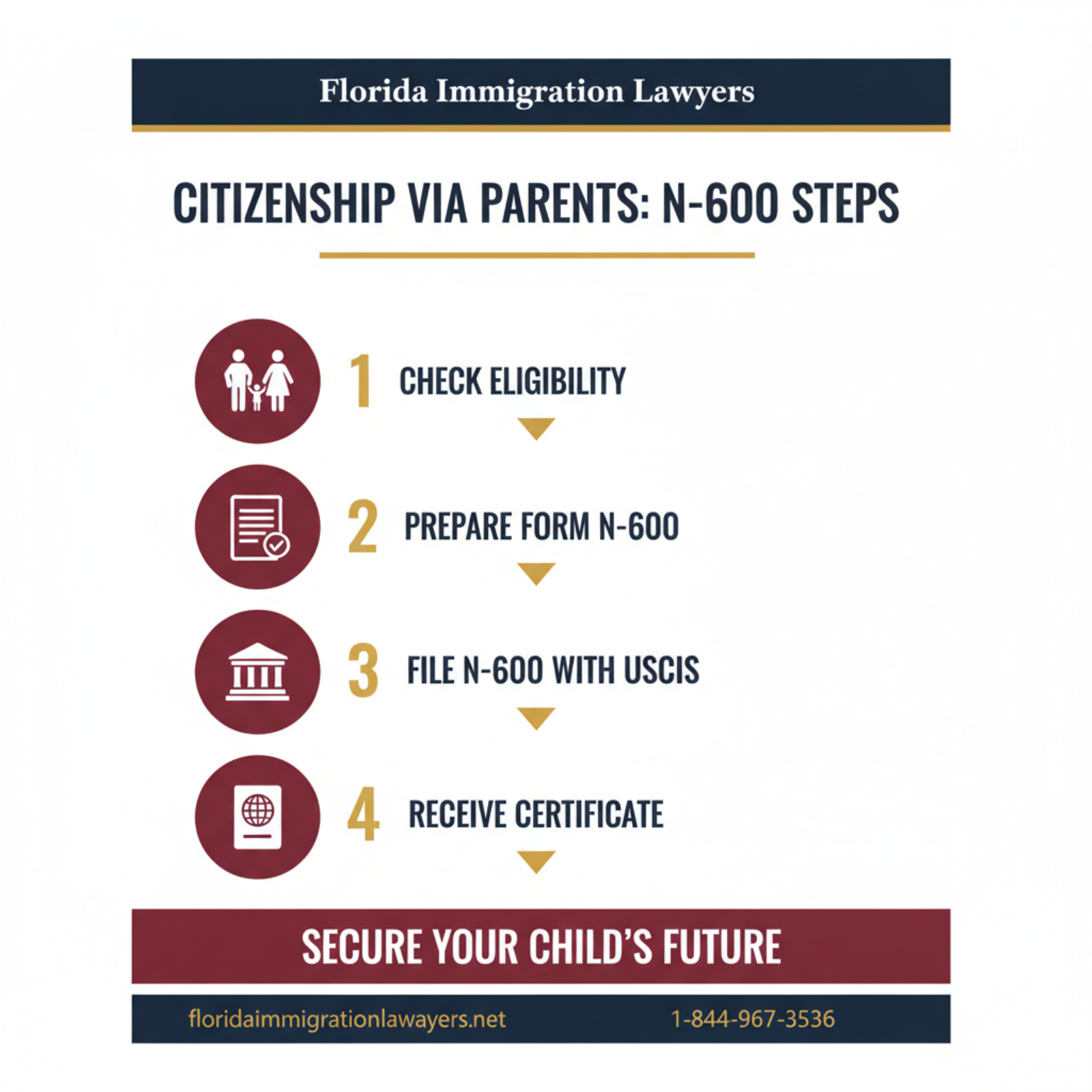
While derived citizenship is often automatic, obtaining official proof, such as a Certificate of Citizenship, requires an application. This certificate serves as definitive proof of U.S. citizenship, useful for passports, voting, and other benefits. Here is a general outline of the process:
-
Determine Eligibility: Confirm that your child meets all the criteria for derived citizenship. This includes having a U.S. citizen parent, being under 18, being a lawful permanent resident, and residing in the legal and physical custody of the U.S. citizen parent. This is the crucial first step before proceeding.
-
Gather Required Documents: Collect all necessary supporting documentation, such as birth certificates, marriage certificates, proof of parent's U.S. citizenship, the child's green card, and custody documents. Accuracy and completeness are paramount to avoid delays.
-
Complete Form N-600, Application for Certificate of Citizenship: Fill out Form N-600 meticulously. This form is used to apply for a Certificate of Citizenship for a child who acquired or derived U.S. citizenship through a U.S. citizen parent. Ensure all sections are answered truthfully and completely.
-
Pay the Filing Fee: Submit the required filing fee with your application. USCIS fees can change, so always check the most current fee schedule on the USCIS website. Fee waivers may be available for eligible applicants, but these are generally for naturalization applications, not typically for N-600.
-
Submit the Application: Mail your completed Form N-600, along with all supporting documents and the fee, to the appropriate USCIS Lockbox facility. The filing instructions for Form N-600 will specify the correct mailing address based on your location in Florida.
-
Attend Biometrics Appointment (If Required): USCIS may require the child to attend a biometrics appointment to collect fingerprints and photographs. This is a standard part of the process for identity verification. You will receive a notice with the date, time, and location.
-
Attend Interview (If Required): While many N-600 applications are approved without an interview, USCIS may request one, especially if there are complexities or missing information. Both the U.S. citizen parent and the child typically attend. Be prepared to answer questions about the child's eligibility.
-
Receive Decision: After USCIS reviews the application and any interviews, they will issue a decision. If approved, your child will receive their Certificate of Citizenship. This document is proof of their U.S. citizenship, similar to a U.S. birth certificate.
Essential Documents for Your Citizenship Application
Preparing a thorough and accurate package of documents is crucial for a successful citizenship application. Missing or incorrect documents can lead to significant delays or even denials. Here is a general checklist of documents typically required when applying for a Certificate of Citizenship:
- Child's birth certificate (with certified English translation if applicable).
- Child's Permanent Resident Card (Green Card).
- Parent's birth certificate (if U.S. citizen by birth).
- Parent's Certificate of Naturalization (if U.S. citizen by naturalization).
- Parents' marriage certificate (if applicable).
- Divorce decrees or death certificates for any prior marriages of parents (if applicable).
- Legal custody documents (if parents are divorced or separated, showing U.S. citizen parent has legal and physical custody).
- Evidence of U.S. citizen parent's physical presence in the U.S. (if applicable, for acquired citizenship cases).
- Child's passport photos (passport-style, as per USCIS specifications).
- Any other documents requested by USCIS to establish eligibility.
Always make copies of all documents submitted for your records. Do not send original documents unless specifically requested by USCIS, as they may not be returned.
Timeline and Processing Expectations for Derived Citizenship
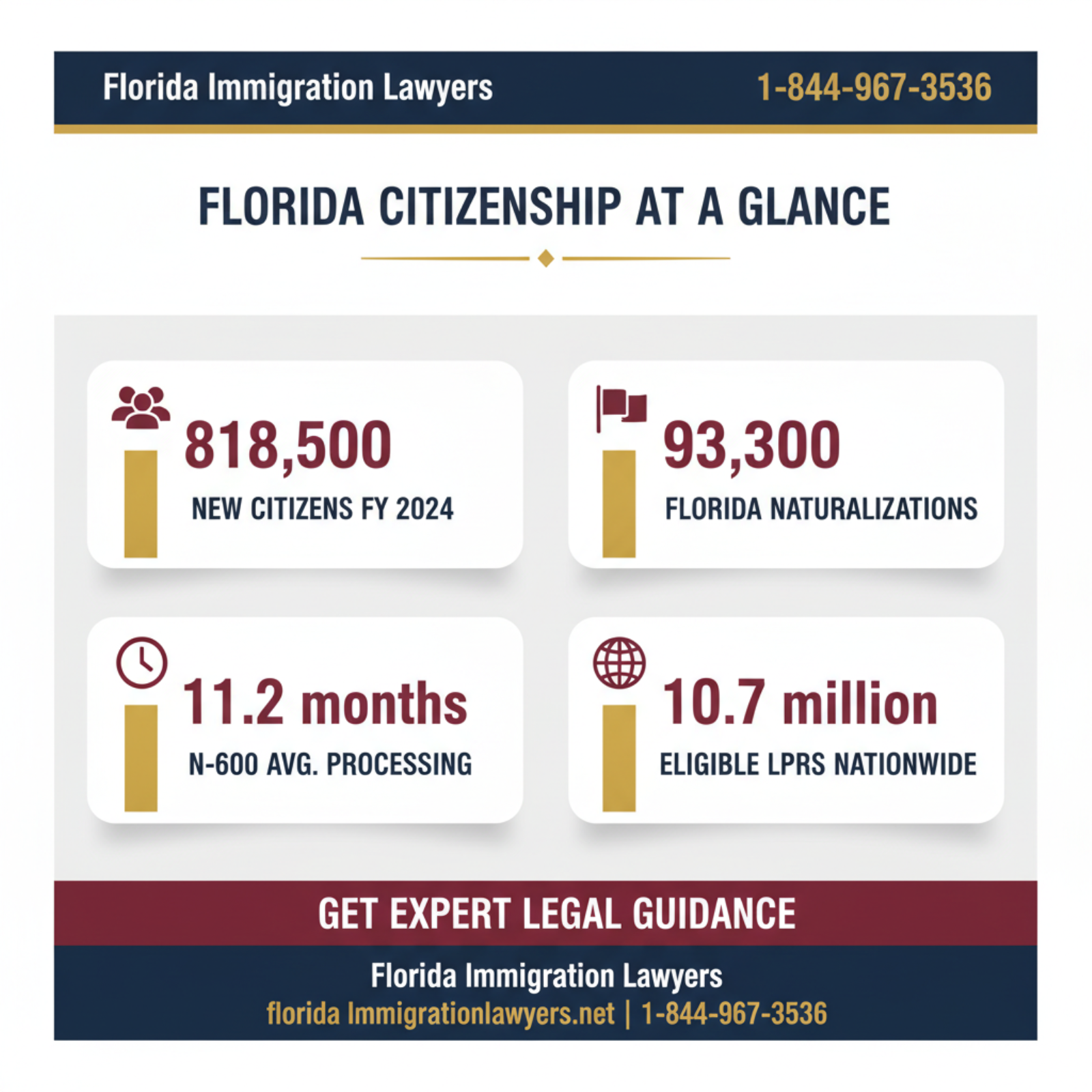
The processing time for Form N-600, Application for Certificate of Citizenship, can vary significantly. Factors influencing the timeline include the specific USCIS service center or field office handling your case, the completeness of your application, and the current USCIS workload. Generally, you can expect processing to take several months to over a year.
It is important to regularly check the USCIS website for current processing times by form type and field office. For families in Florida, cases might be processed through national service centers, but interviews, if required, would typically be scheduled at a local field office like Miami or Tampa. Patience is key, but proactive follow-up with legal counsel can help if delays occur.
While awaiting a decision, your child remains a lawful permanent resident. The Certificate of Citizenship is proof of citizenship, not the act of becoming a citizen itself, as derived citizenship is automatic once conditions are met. This distinction is important for understanding the legal status during the waiting period.
Cost Factors and Fee Breakdown for Form N-600
Applying for a Certificate of Citizenship involves certain costs. The primary cost is the USCIS filing fee for Form N-600. This fee is subject to change, so it is crucial to verify the current amount directly on the USCIS website before submitting your application. The fee is generally non-refundable, even if the application is denied.
Beyond the USCIS fee, other potential costs include: fees for obtaining certified copies of birth certificates, marriage certificates, or other vital records; translation fees for any documents not in English; and postage costs for mailing the application. While fee waivers are generally available for certain low-income applicants for naturalization, they are not typically available for Form N-600 applications.
Engaging an experienced immigration attorney, such as those at Florida Immigration Lawyers, also involves legal fees. While an additional cost, legal representation can be invaluable. An attorney ensures your application is correctly prepared, all documents are in order, and you are properly advised throughout the process, potentially saving time and preventing costly mistakes.
The path to derived citizenship can be complex, with specific legal requirements and detailed documentation. Do not navigate this process alone and risk delays or denials. Contact Florida Immigration Lawyers today to ensure your child's application is handled professionally and efficiently.
Common Mistakes to Avoid in Your Derived Citizenship Application
-
Failing to Confirm Eligibility: Many parents assume their child is automatically a citizen without verifying all the criteria. This can lead to filing an application for an ineligible child, resulting in denial and lost fees. Always confirm your child meets all conditions under INA 320 or INA 322.
-
Submitting Incomplete Documentation: A common pitfall is failing to include all required supporting documents or sending uncertified copies when certified ones are needed. This causes delays, Requests for Evidence (RFEs), and can even lead to denial. Double-check every item on the checklist.
-
Incorrectly Filling Out Form N-600: Errors in filling out the application form, such as typos, omissions, or inconsistent information, can be detrimental. USCIS is very particular about accuracy. Carefully review the form instructions and proofread thoroughly.
-
Not Providing Certified English Translations: Any document not originally in English must be accompanied by a certified English translation. Failing to provide this will result in an RFE and delay the process. Ensure the translator certifies their competence.
-
Missing the Age Requirement: Derived citizenship generally occurs before the child's 18th birthday. If a child turns 18 before all conditions are met, they may lose eligibility for derived citizenship and might need to pursue naturalization on their own. Timing is critical.
-
Assuming Automatic Citizenship Without Proof: While citizenship may be automatic, official proof (the Certificate of Citizenship) is necessary for many benefits. Not obtaining this proof can create difficulties for the child later in life when proving their U.S. citizenship status.
-
Not Maintaining Lawful Permanent Resident Status: For derived citizenship under INA 320, the child must be a lawful permanent resident when the U.S. citizen parent naturalizes and while residing in the U.S. in their custody. Losing this status before conditions are met can jeopardize eligibility.
-
Ignoring Custody Requirements: The child must be in the legal and physical custody of the U.S. citizen parent. If parents are divorced or separated, clear legal documentation of custody is essential. Failure to demonstrate this can be a reason for denial.
-
Not Responding to RFEs or Interview Notices: If USCIS sends a Request for Evidence or an interview notice, it is crucial to respond promptly and completely. Missing deadlines or failing to appear can lead to the denial of the application without further consideration.
-
Sending Original Documents Unnecessarily: Unless specifically requested, always send copies of supporting documents, not originals. USCIS generally does not return original documents, and losing vital records can cause significant problems.
When to Call a Florida Immigration Lawyer
While the concept of derived citizenship seems straightforward, the application process can be fraught with complexities. Many specific scenarios warrant the expertise of an experienced immigration attorney. If your family is in Florida, particularly in Naples or the surrounding areas, seeking legal counsel can make a significant difference.
You should consider calling Florida Immigration Lawyers if:
- You are unsure if your child meets all eligibility requirements, especially concerning custody, residency, or the exact date citizenship was derived.
- Your child was born abroad, and there are questions about the U.S. citizen parent's physical presence requirements.
- You have a complex family situation, such as adoption, children born out of wedlock, or previous divorces and remarriages.
- USCIS has issued a Request for Evidence (RFE) or a Notice of Intent to Deny (NOID) on your child's N-600 application.
- You need assistance gathering and organizing the extensive documentation required, ensuring everything is correctly translated and certified.
- You are concerned about potential issues during an interview with USCIS and want thorough preparation.
- Your child is nearing their 18th birthday, and you need to expedite the process to ensure eligibility is met before they "age out."
Our attorneys at Florida Immigration Lawyers regularly assist families throughout Florida with their citizenship applications and immigration needs. We understand the nuances of the law and are dedicated to protecting your family's future. Let us help you navigate this critical process with confidence.
About Florida Immigration Lawyers
Florida Immigration Lawyers is a leading immigration law firm dedicated to serving individuals and families across the entire state of Florida. Our mission is to provide compassionate, effective, and results-driven legal representation for all immigration matters. We understand the profound impact immigration issues have on lives, and we are committed to guiding our clients through every step of their journey.
Our firm specializes in a wide range of immigration services, including family-based petitions, business immigration, deportation defense, asylum claims, naturalization, and derived citizenship cases. We pride ourselves on our deep knowledge of U.S. immigration law and our unwavering dedication to our clients.
Why choose Florida Immigration Lawyers? Our experienced attorneys offer personalized attention, strategic legal advice, and a commitment to achieving the best possible outcome for your case. We are available 24/7 to answer your questions and offer free consultations to discuss your unique situation. Serving all of Florida, we are your trusted partners in immigration.
Contact us today at 1-844-967-3536 or visit our website at https://www.floridaimmigrationlawyers.net to schedule your free consultation. Let us put our expertise to work for you.
Sources and References
- U.S. Citizenship and Immigration Services (USCIS)
- USCIS Policy Manual, Volume 12, Part H, Chapter 2 - Automatic Acquisition of Citizenship after Birth (INA 320)
- USCIS Policy Manual, Volume 12, Part H, Chapter 4 - Application for Certificate of Citizenship (INA 322)
- Form N-600, Application for Certificate of Citizenship
- 8 U.S.C. § 1431 (Immigration and Nationality Act Section 320) - Children Born Outside the United States and Residing Permanently in the United States; Conditions for Automatic Citizenship
- 8 U.S.C. § 1433 (Immigration and Nationality Act Section 322) - Children Born Outside the United States; Conditions for Application for Certificate of Citizenship
- 8 CFR Part 320 (Code of Federal Regulations) - Children of Citizens of the United States
- 8 CFR Part 322 (Code of Federal Regulations) - Children of United States Citizens Residing Outside the United States
This article provides general legal information and is not intended as legal advice. Every case is unique, and outcomes depend on specific facts and circumstances. Contact an attorney for advice about your particular situation.
Securing your child's U.S. citizenship is a profound step towards their future. Do not leave this critical process to chance. Contact Florida Immigration Lawyers today for a free, no-obligation consultation to discuss your child's derived citizenship case. Our experienced team is ready to provide the guidance and representation you need. Call us now at 1-844-967-3536. Se Habla Español - Estamos aquí para ayudarle.
Do Not Navigate This Process Alone
Our experienced immigration attorneys are ready to fight for you. Get a free, confidential consultation today.
Se Habla Español
Frequently Asked Questions
Florida Immigration Lawyers
Immigration Attorney | Founder, Vasquez Law Firm
U.S. Air Force veteran and immigration attorney with thousands of cases resolved. J.D., NCCU School of Law. AILA member. Admitted to the 4th, 5th, and 11th Circuit Courts.
Available 24/7 - Free Evaluations
Related Legal Services
Our Florida immigration attorneys can help you with family immigration services, immigration practice areas and free immigration consultation. Call today at 1-844-967-3536 for a free consultation.
Related Links
Related Topics
Free Legal Consultation
Discuss your case with our experienced attorneys. We're available 24/7.
Se Habla Español - Estamos aquí para ayudarle.
Related Articles
Stokes Interview: Navigating Marriage Fraud in Florida
A Stokes interview is a specialized, separate interview conducted by USCIS when there are suspicions of marriage fraud in a green card application. This rigorous process involves individual questioning of spouses, focusing on inconsistencies in their testimonies to determine the authenticity of their marital bond. For couples in Florida, navigating this high-stakes interview requires meticulous preparation, extensive documentation, and often the strategic guidance of an experienced immigration lawyer. Understanding the process, preparing for detailed questions, and presenting a strong case are crucial for overcoming marriage fraud allegations and securing your immigration future. Florida Immigration Lawyers stands ready to assist you.
Immigration Attorney Gainesville: North Florida Legal Help
For those in Gainesville, Alachua County, and throughout North Florida, navigating U.S. immigration law requires expert guidance. An experienced immigration attorney can simplify complex processes, from family-based petitions and employment visas to critical asylum claims and deportation defense. This comprehensive guide outlines the essential services provided by an immigration attorney, details necessary documentation, clarifies processing timelines, and discusses associated costs. We also highlight common mistakes to avoid and crucial scenarios where legal counsel is indispensable. Florida Immigration Lawyers serves all of Florida, including Gainesville and St. Petersburg, providing dedicated legal support to help you achieve your immigration goals. Contact us for a free consultation to discuss your specific needs.
Military Naturalization Expedited at Florida Bases
Explore expedited military naturalization processes for service members at Florida bases like MacDill. Learn about eligibility, steps, and common mistakes. Contact Florida Immigration Lawyers for a free consultation.
Protect Yourself from Immigration Scams in Florida
Learn how to protect against immigration scams in Florida, focusing on St. Petersburg. This guide covers identifying scams, verifying credentials, and getting legal help. Call Florida Immigration Lawyers at 1-844-967-3536 for assistance.