Can DACA Recipients Travel Within the U.S. in 2026? Florida
For DACA recipients in Florida, understanding the nuances of domestic and international travel, as well as the work permit renewal process, is crucial. While domestic travel within the U.S. is generally permitted, international travel requires an approved Advance Parole document, which is granted only under very specific and limited circumstances. This comprehensive guide details the step-by-step process for renewing your DACA and Employment Authorization Document (EAD), including essential documentation, fees, and processing times as of 2026. We also highlight common mistakes to avoid, such as late filings or misrepresenting information, which can jeopardize your DACA status. Given the evolving legal landscape surrounding DACA, staying informed and seeking legal counsel is more important than ever. Florida Immigration Lawyers is dedicated to helping DACA recipients navigate these complexities, offering free case reviews and professional support to protect your rights and ensure your stability in Florida.
Yes, DACA recipients can generally travel domestically within the U.S. in 2026 without issues. However, international travel requires an approved Advance Parole document from USCIS, which is rarely granted for DACA beneficiaries except under specific humanitarian, educational, or employment circumstances. Traveling internationally without advance parole will likely result in a denial of re-entry and potential removal proceedings. It is crucial for DACA recipients in Florida to understand these distinctions to protect their status and work authorization.
- Domestic travel within the U.S. is generally permitted for DACA recipients.
- International travel requires an approved Advance Parole document (Form I-131).
- Advance Parole for DACA is limited to specific urgent reasons.
- Applying for DACA renewal and your work permit (EAD) should be done early to maintain status.
- Always consult with an experienced immigration attorney before any international travel.
For many young individuals in Florida, the Deferred Action for Childhood Arrivals (DACA) program represents a pathway to stability, allowing them to work and live without constant fear of deportation. As of 2026, DACA continues to face legal challenges, yet for current recipients, understanding your rights and responsibilities, especially concerning travel and work permits, is paramount. Whether you're considering a trip across state lines, contemplating a visit abroad, or simply need to renew your employment authorization, knowing the precise regulations is crucial for maintaining your status.
This comprehensive guide from Florida Immigration Lawyers will delve into the intricacies of DACA, focusing on travel restrictions, the work permit renewal process, essential documentation, and expected timelines in Florida. We aim to equip you with the knowledge needed to navigate these complex immigration waters successfully. From the bustling streets of Orlando to the vibrant communities across the state, we understand the unique challenges DACA recipients face. Don't navigate this journey alone. Call Florida Immigration Lawyers at 1-844-YO-PELEO for a free case review and guidance tailored to your specific situation.
Can DACA Recipients Travel Within the U.S. in 2026?
As of 2026, DACA recipients can generally travel freely within the continental United States, Hawaii, Alaska, Puerto Rico, and the U.S. Virgin Islands. This domestic travel does not require advance parole or any special permission from USCIS. You should carry a valid government-issued photo identification, such as your DACA Employment Authorization Document (EAD) and a state-issued driver's license (like a Florida driver's license), especially when flying. While domestic travel is largely unrestricted, it is always wise to be prepared and understand your rights, particularly if you are flying through or residing in areas with a significant U.S. Customs and Border Protection (CBP) presence, such as near Florida's international airports or coastal regions.
The key distinction lies between domestic and international travel. Traveling outside the United States, even to neighboring countries like Canada or Mexico, is considered international travel. For DACA recipients, leaving the U.S. without an approved Advance Parole document (Form I-131) will almost certainly result in your inability to re-enter the country. This can lead to severe consequences, including the termination of your DACA status and initiation of removal proceedings. It is vital to consult with an immigration attorney before making any international travel plans, as the rules for DACA advance parole are very strict and subject to change based on ongoing litigation and policy shifts. The current legal landscape, shaped by various court decisions, emphasizes caution for any DACA recipient considering international travel.
Understanding Your DACA Work Permit (EAD) in Florida
Your DACA work permit, formally known as an Employment Authorization Document (EAD) or Form I-766, is a critical component of your DACA status. It grants you legal authorization to work in the United States and is typically valid for two years. For DACA recipients in Florida, this EAD opens doors to employment opportunities across various sectors, allowing you to contribute to the state's economy and pursue professional growth. Holding a valid EAD means you can apply for jobs, obtain a Social Security number, and often qualify for a state-issued driver's license, enabling greater independence and integration into Florida's communities, from Orlando to Miami.
The EAD is not just a work authorization; it also serves as a primary form of identification for many DACA recipients, proving your temporary legal presence in the U.S. It is crucial to keep your EAD valid and renewed promptly to avoid any gaps in employment eligibility or legal status. Any lapse in your EAD validity can lead to job loss and potential complications with other aspects of your life, such as driver's license renewal. Understanding the importance of this document is the first step in responsibly managing your DACA status. The ability to work legally under 8 U.S.C. Section 1324a is a fundamental benefit of DACA, providing stability and security.
How Do I Renew My DACA and Work Permit in Florida? (Step-by-Step Guide)
Renewing your DACA and work permit in Florida involves a precise process that requires careful attention to detail and timely submission. As of 2026, USCIS recommends filing your renewal application 120 to 150 days before your current DACA and EAD expire. This timeframe helps account for potential processing delays and ensures continuity of your work authorization. Missing this window can lead to a lapse in your employment eligibility and could even put your DACA status at risk. Our immigration practice areas can provide tailored assistance.
- Check Your Eligibility: Ensure you continue to meet all DACA eligibility criteria, including continuous residence in the U.S. since June 15, 2007, and no disqualifying criminal offenses.
- Gather Necessary Documents: Collect copies of your previous DACA approval notice (Form I-797) and EAD card, proof of continuous residence if there are significant gaps or changes, and two passport-style photos.
- Complete Forms I-821D, I-765, and I-765WS: Fill out Form I-821D (Consideration of Deferred Action for Childhood Arrivals), Form I-765 (Application for Employment Authorization), and Form I-765 Worksheet (I-765WS) accurately and completely. Ensure all questions are answered, and signatures are provided where required.
- Prepare Filing Fees: As of 2026, the total filing fee includes the Form I-765 fee and the biometrics services fee. Do not send cash. Use a money order or check made payable to the U.S. Department of Homeland Security.
- Mail Your Application: Send your complete application package to the appropriate USCIS Lockbox facility. The correct address depends on where you live and the delivery service you use. Always check the USCIS website for the most current mailing instructions.
- Attend Biometrics Appointment: After filing, you will receive an appointment notice for biometrics (fingerprints, photo, and signature) at an Application Support Center (ASC), such as the one in Orlando. Attending this appointment is mandatory.
- Receive Decision: USCIS will review your application. If approved, you will receive a new DACA approval notice and EAD card in the mail.
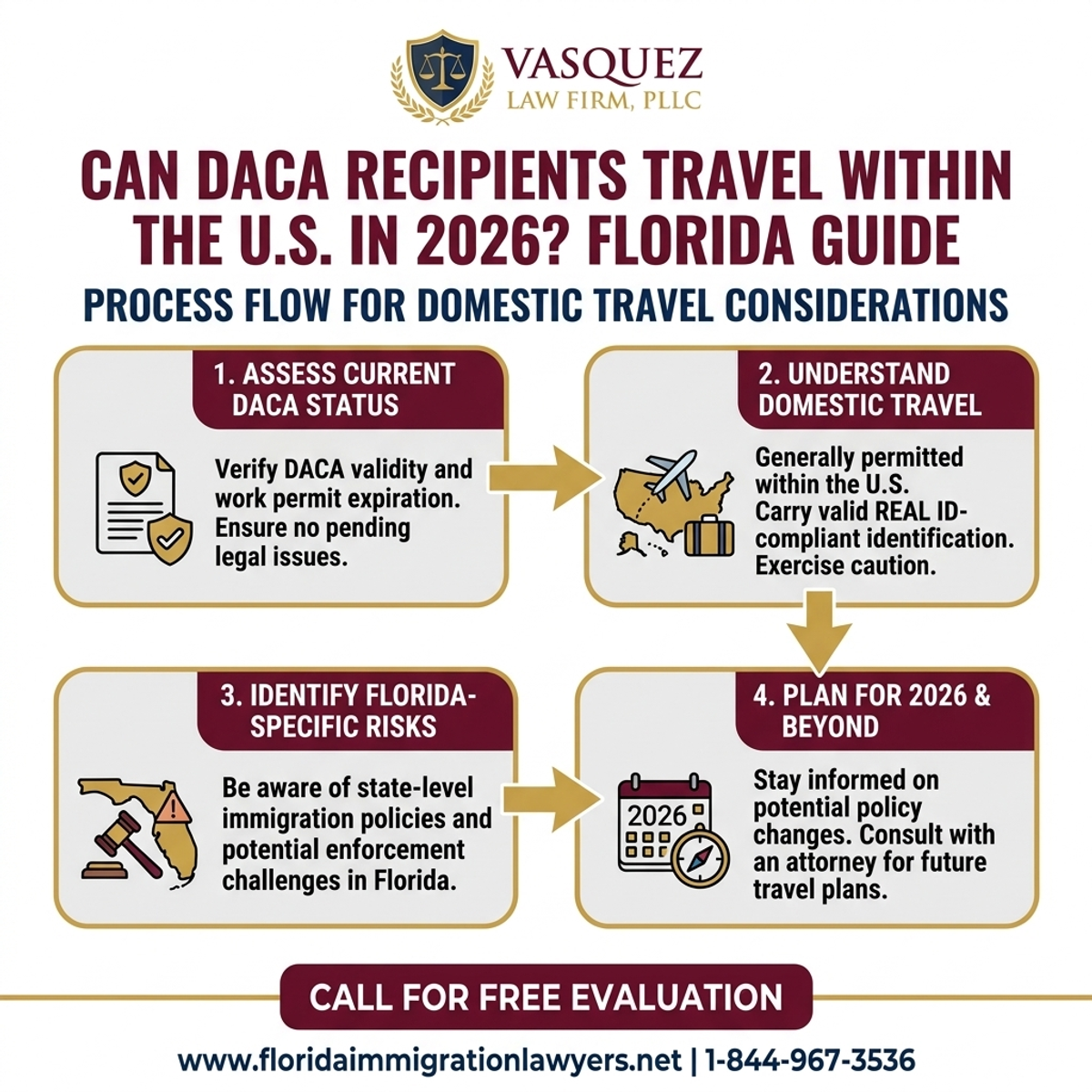
Step-by-Step Process — Can DACA Recipients Travel Within the U.S. in 2026? Florida Guide
Required Documents and Fees for DACA Renewal in 2026
A successful DACA and work permit renewal hinges on submitting a complete and accurate package of documents along with the correct filing fees. Preparing these items thoroughly minimizes the risk of delays or rejections. As of 2026, the specific forms required are Form I-821D, Form I-765, and Form I-765WS. Each form has specific instructions that must be followed precisely. Additionally, supporting documentation is crucial to establish your continued eligibility for DACA.
Document Checklist for DACA Renewal:
- Copy of your most recent DACA approval notice (Form I-797).
- Copy of your most recent Employment Authorization Document (EAD) card (front and back).
- Two identical passport-style photographs taken within 30 days of filing.
- Copy of your birth certificate with a certified English translation (if applicable).
- Copy of your passport identity page or national identity document with photo.
- Proof of continuous residence in the U.S. since your last DACA approval (e.g., utility bills, school records, employment records, bank statements, medical records).
- Any updated biographical information or evidence of name change (if applicable).
- Documentation of any new criminal history, if applicable (even minor offenses should be disclosed and reviewed by an attorney).
- Completed and signed Form I-821D, I-765, and I-765WS.
Cost Factors and Fee Breakdown for DACA Renewal:
It is important to note that USCIS fees are subject to change. Always verify the current fees on the official USCIS website before submitting your application. Fee waivers are generally not available for DACA applications, though limited exemptions may apply in extreme hardship cases.
| Item | Typical Fee (As of 2026) | Notes |
|---|---|---|
| Form I-765 (Application for Employment Authorization) | Check current USCIS website | This fee covers the processing of your work permit. |
| Biometrics Services Fee | Check current USCIS website | Required for fingerprinting and background checks. |
| Total Filing Fee | Sum of above fees | Payment must be made by money order or personal check to "U.S. Department of Homeland Security." |
What Are the Current DACA Processing Times in Florida?
DACA processing times can vary significantly based on the USCIS Service Center handling your application and the volume of submissions. As of 2026, typical processing times for DACA renewal applications can range from 3 to 6 months, but some cases may take longer. USCIS provides an online tool to check current processing times for specific forms and service centers. It's important to monitor these times and plan your renewal application accordingly to prevent any gaps in your employment authorization. Proactive filing, generally 120-150 days before expiration, is the best strategy for DACA recipients in Florida.
While your application is pending, USCIS may issue a Request for Evidence (RFE) if they need more information, which can extend the processing time. Biometrics appointments at Florida Application Support Centers, such as those in Orlando, Tampa, or Miami, are typically scheduled within a few weeks to a couple of months after filing. Delays can also occur due to ongoing litigation affecting the DACA program or administrative backlogs. If your application is pending for an unusually long time, or if your EAD is close to expiring without a decision, contacting an immigration attorney for assistance is advisable. They can help inquire about your case status and explore potential options.
| Stage | Typical Timeframe (As of 2026) | Notes |
|---|---|---|
| Application Filing to Biometrics Appointment | 3-8 weeks | You will receive a notice for your appointment at a local ASC in Florida. |
| Biometrics to Decision | 2-5 months | This is the main review period by USCIS Service Centers. |
| Total Processing Time (from filing to receiving EAD) | 3-6 months (average) | May vary based on caseloads and policy changes. File early! |
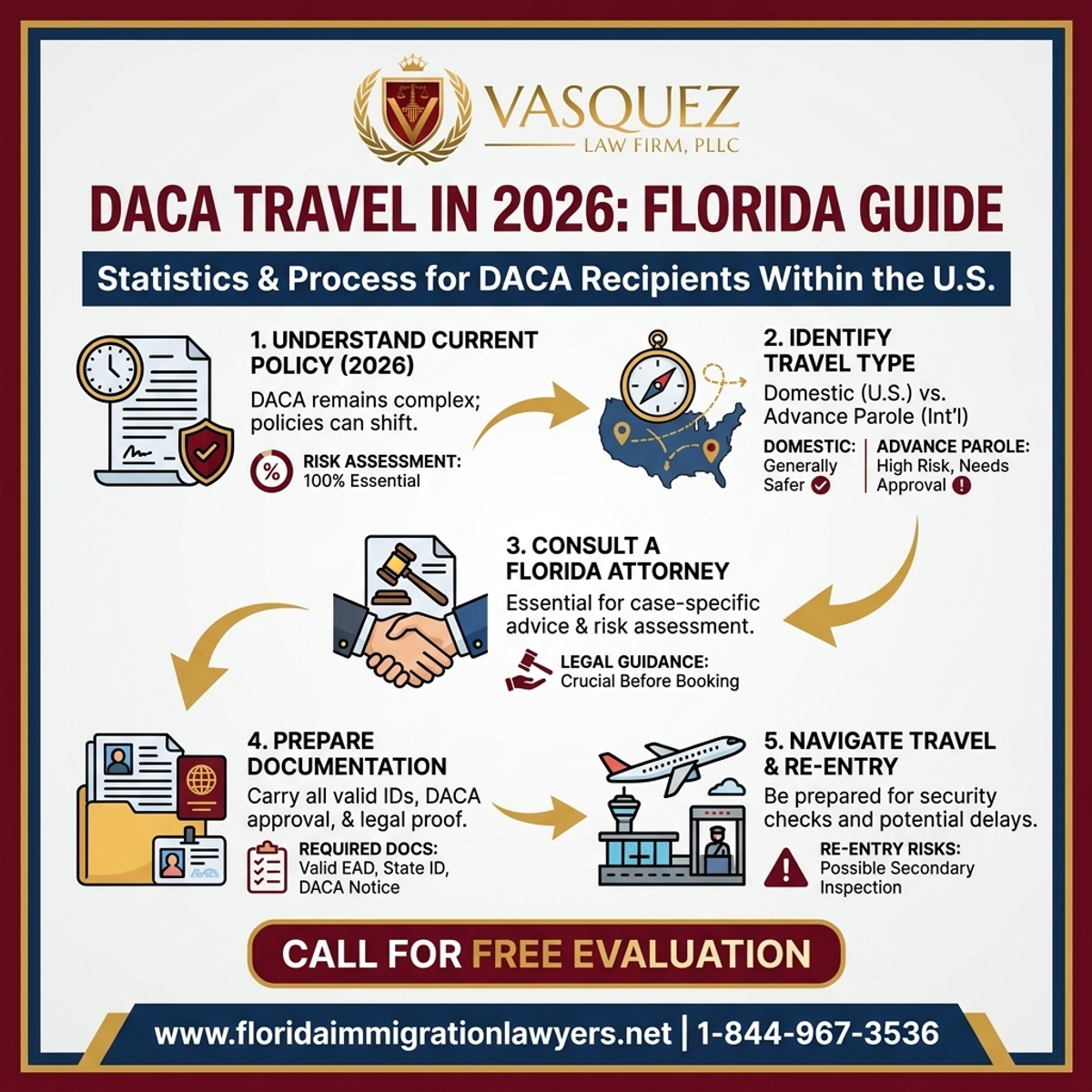
Key Statistics — Can DACA Recipients Travel Within the U.S. in 2026? Florida Guide
Do not navigate this complex process alone. Contact Florida Immigration Lawyers today to ensure your DACA renewal is handled efficiently and accurately. Our team is ready to provide the professional support you need. Schedule a free consultation with us.
Navigating Advance Parole and DACA's Legal Future in Florida
Advance Parole is a document that allows certain non-citizens to travel abroad and return to the United States without abandoning their pending application for adjustment of status or, in the case of DACA, without losing their deferred action. For DACA recipients, obtaining advance parole is exceptionally difficult and strictly limited to humanitarian, educational, or employment purposes. Examples include attending a funeral for a close family member, receiving specialized medical treatment not available in the U.S., or participating in academic programs that are directly related to your major or employment. Routine vacations or visits to family abroad are generally not considered sufficient grounds for DACA advance parole approval under current policy.
The legal future of DACA remains uncertain, with ongoing litigation and appeals continuously shaping the program's scope and availability. Courts, including the Executive Office for Immigration Review (EOIR), are regularly addressing challenges to DACA. While DACA currently allows renewals, new applications have been paused due to court orders. These legal developments mean that policies surrounding DACA, including eligibility and advance parole criteria, could change. It is crucial for DACA recipients in Florida to stay informed about these changes and understand their potential impact. Consulting with our experienced attorneys can help you understand the latest developments and how they might affect your status or travel plans. Even with a valid EAD, your DACA status is not a pathway to permanent residency on its own, and any travel must be undertaken with extreme caution and legal advice.
Common Mistakes DACA Recipients Make to Avoid
Navigating DACA requires diligence and attention to detail. Avoiding common pitfalls is crucial to maintaining your status and eligibility.
- Filing Renewal Applications Late: Failing to submit your DACA renewal application within the recommended 120-150 day window before expiration can lead to a lapse in employment authorization and legal status, potentially jeopardizing your job and ability to drive.
- Providing Inaccurate Information: Any false statements or misrepresentations on your forms can lead to denial of your application, accusations of fraud, and even initiation of removal proceedings. Always be truthful and thorough.
- Not Disclosing Criminal History: Even minor arrests or citations must be disclosed, regardless of the outcome. Failure to disclose can be seen as a misrepresentation and lead to severe consequences, including DACA termination.
- Traveling Internationally Without Advance Parole: Leaving the U.S. without an approved Advance Parole document is one of the most significant risks, almost certainly resulting in denial of re-entry and DACA termination.
- Ignoring Requests for Evidence (RFEs): If USCIS sends an RFE, you must respond completely and within the specified timeframe. Failing to do so will likely result in a denial of your application.
- Not Keeping Copies of All Documents: Always make and retain copies of every document you submit to USCIS, as well as mailing receipts. This is essential for your records and for addressing any future issues.
- Failing to Update Contact Information: Moving without updating your address with USCIS can lead to missed notices, appointments, and critical communications, potentially causing delays or denials.
- Believing DACA is a Path to Green Card: DACA provides temporary relief from deportation and work authorization but does not directly lead to permanent residency or citizenship. Understanding its limitations is vital.
- Not Seeking Legal Advice for Complex Cases: If you have a criminal record, previous denials, or any unusual circumstances, attempting to handle your DACA case without an attorney can be a costly mistake.
- Assuming Laws Won't Change: The DACA program is subject to ongoing legal and political challenges. Assuming current policies will remain indefinitely can lead to being unprepared for changes.
When to Call a Lawyer for Your DACA Case in Florida
While some DACA renewals may seem straightforward, certain situations warrant the immediate attention of an experienced immigration attorney. If you are a DACA recipient in Florida facing any complexities, seeking legal counsel is not just advisable—it's often essential. Our team at Florida Immigration Lawyers is dedicated to protecting your rights and ensuring your DACA status remains secure.
You should contact an attorney if you:
- Have any criminal history, even minor arrests or charges, as this can affect your DACA eligibility.
- Have had a previous DACA application or renewal denied.
- Are considering international travel and need to apply for Advance Parole.
- Are unsure about your continuous residence or physical presence requirements.
- Have questions about your eligibility due to a change in circumstances (e.g., leaving the U.S. without advance parole).
- Are in removal proceedings or have a final order of removal. Our deportation defense services can be critical.
- Received a Request for Evidence (RFE) or a Notice of Intent to Deny (NOID) from USCIS.
- Are a new DACA applicant, as initial applications are currently not being processed, but legal advice is crucial for future readiness.
- Need assistance gathering complex documentation or understanding legal terminology.
An attorney can provide personalized advice, help you prepare a strong application, represent you in communications with USCIS, and navigate any legal challenges that arise, ensuring the strongest possible outcome for your DACA case.
About Florida Immigration Lawyers
Florida Immigration Lawyers is a leading law firm dedicated to providing comprehensive and compassionate immigration legal services across the entire state of Florida. With a deep understanding of U.S. immigration law and a commitment to our clients, we strive to achieve the strongest possible outcomes for individuals and families navigating the complex immigration system. Our experienced attorneys focus on a wide range of immigration matters, including DACA renewals, family immigration, asylum, deportation defense, and naturalization.
We pride ourselves on offering personalized attention, strategic legal advice, and unwavering support to our diverse clientele. Located in Central Florida, we serve clients from Orlando and all surrounding areas, available 24/7 to address your urgent legal needs. We offer free case reviews to help you understand your options without financial commitment. Choose Florida Immigration Lawyers for dedicated advocacy and guidance through every step of your immigration journey. Call us today at 1-844-YO-PELEO to schedule your free consultation.
Sources and References
- U.S. Citizenship and Immigration Services (USCIS)
- Executive Office for Immigration Review (EOIR)
- U.S. Department of State
- 8 U.S.C. Chapter 12 - Immigration and Nationality Act (INA)
- 8 U.S.C. Section 1324a - Unlawful employment of aliens
- 8 CFR 212.5 - Parole of aliens into the United States
- USCIS Policy Manual - Volume 7, Part A, Chapter 3 - Advance Parole
Related services: H-1B specialty occupation visas, L-1 intracompany transfer visas, work visas for professionals, investment and entrepreneur visas.
This article provides general legal information and is not intended as legal advice. Every case is unique, and outcomes depend on specific facts and circumstances. Contact an attorney for advice about your particular situation.
Your DACA status is a valuable asset that requires careful management. Whether you have questions about travel, renewal, or any other aspect of your immigration journey, Florida Immigration Lawyers is here to help. Our compassionate and knowledgeable team is ready to provide the guidance you need. Don't risk your future; secure experienced legal representation. Call us now at 1-844-YO-PELEO for your free case review. Se Habla Espanol - Estamos aqui para ayudarle.
If you need legal assistance, learn more about business immigration consultation, or call us at 1-844-YO-PELEO for a free case review.
Do Not Navigate This Process Alone
Our experienced immigration attorneys are ready to fight for you. Get a free, confidential case review today.
Se Habla Español
Or leave your details and we’ll call you:
Free Evaluation in 24 Hours
Or talk to us right now
AI voice assistant — available 24/7
FreeFrequently Asked Questions

William J. Vásquez
Founding Attorney · Vasquez Law Firm
U.S. Air Force veteran and immigration attorney with years of hands-on U.S. immigration experience. J.D., NCCU School of Law. AILA member. Admitted to the 4th, 5th, and 11th Circuit Courts.
Available 24/7 - Free Evaluations
Reviewed for legal accuracy by William J. Vásquez
Licensed in North Carolina; U.S. immigration is federal practice.
Related Legal Services
Our Florida immigration attorneys can help you with deportation defense, family immigration services and immigration lawyer cost in Florida. Call today at 1-844-YO-PELEO for a free case review.
Related Links
Related Topics
Free Legal Case Review
Discuss your case with our experienced attorneys. We're available 24/7.
Se Habla Español - Estamos aquí para ayudarle.
Related Articles
Immigration Lawyer Orlando Free Consultation in Florida
For individuals and families in Orlando, Florida, navigating the complexities of U.S. immigration law requires expert guidance. An immigration lawyer in Orlando offers crucial support for everything from visa applications and green card processes to naturalization and deportation defense. This comprehensive guide details what a free consultation covers, providing a step-by-step overview of immigration pathways, essential document checklists, and expected timelines in 2026. We also highlight common mistakes to avoid, discuss the critical role of legal counsel in deportation and asylum cases, and explain why choosing a local Orlando immigration attorney is beneficial. Florida Immigration Lawyers is dedicated to serving the diverse community of Orlando with compassionate, effective legal solutions, ensuring you receive personalized advice and robust representation for a successful immigration journey.
Immigration Lawyer Services in Orlando, Florida
Explore immigration consultation services in Orlando, Florida, with a qualified immigration lawyer. Learn what to expect and understand your options for family and business immigration needs.
Fraud Prevention and Detection Fee: What to Know in Florida
Explore the fraud prevention and detection fee essential for immigration processes in Florida. Discover how it impacts applications like the I-601 waiver and learn key steps to navigate this requirement effectively.
2026 Diversity Visa Lottery Errors: Avoid Mistakes
Avoid common errors in the 2026 Diversity Visa Lottery. Learn how to apply effectively for the green card lottery in Florida. This comprehensive guide covers the application process, common mistakes, and essential tips to increase your chances of success.