Consular Processing for Florida Applicants
Consular processing is essential for Florida residents bringing family members to the U.S. This guide covers steps, common mistakes, and when to seek legal help.

Consular processing is a vital pathway for individuals in Florida seeking to obtain an immigrant visa to live permanently in the United States. This process allows applicants to complete their visa interview at a U.S. embassy or consulate in their home country, rather than adjusting their status within the U.S. It's a complex journey, but with the right guidance, it can lead to a successful outcome for you and your family.
Understanding Consular Processing for Florida Applicants
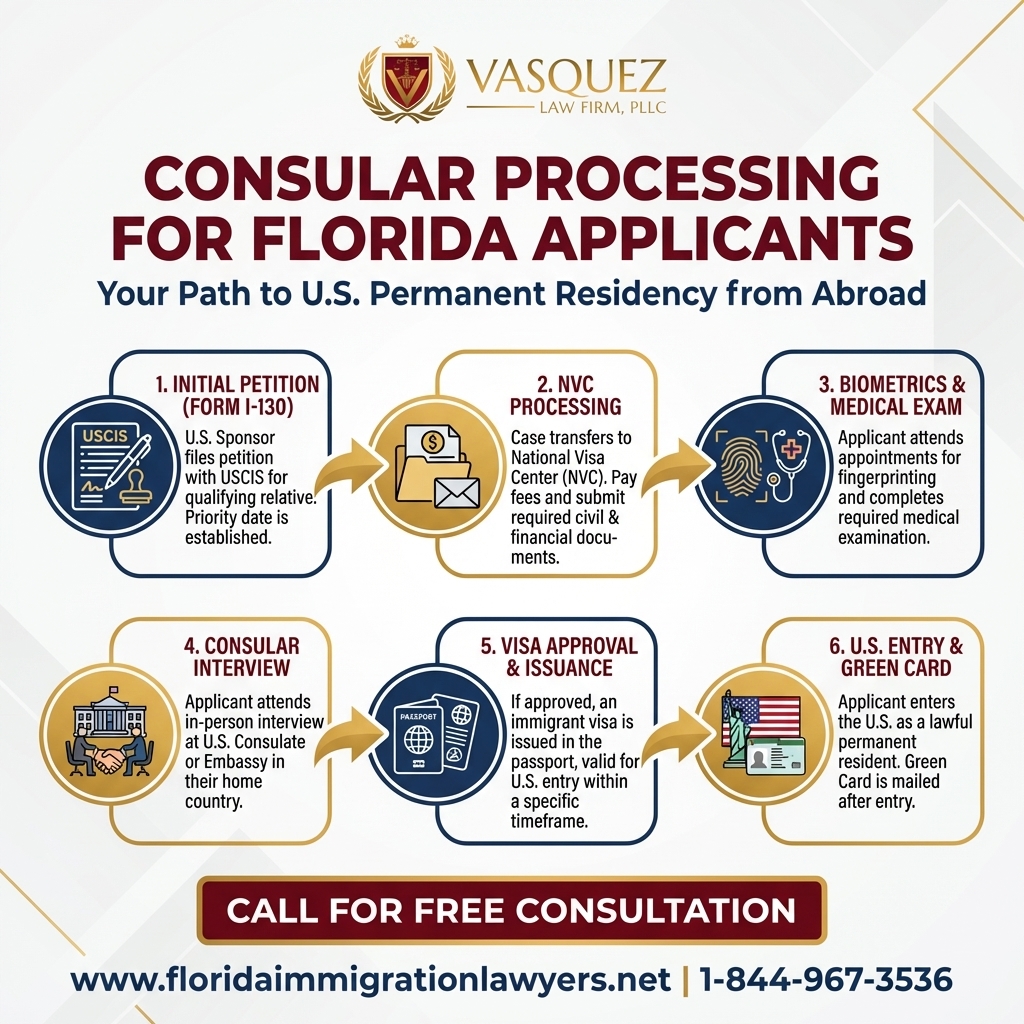
For many Florida residents sponsoring family members or employees, consular processing is the primary method to bring their loved ones or skilled workers to the U.S. It involves several stages, starting with the approval of an immigrant petition by U.S. Citizenship and Immigration Services (USCIS), followed by thorough processing through the National Visa Center (NVC), and culminating in a crucial interview at a U.S. embassy or consulate abroad. This method is typically used when the beneficiary is living outside the United States or is ineligible to adjust status domestically. Understanding each phase is crucial for a smooth application, especially for those navigating the process from Florida.
Eligibility Requirements and Visa Categories
Before embarking on consular processing, it's essential to determine eligibility. Generally, consular processing is available for individuals who are beneficiaries of approved immigrant petitions (Form I-130 for family-based, Form I-140 for employment-based, or Form I-360 for special immigrants). Key eligibility factors include having a qualifying relationship with a U.S. citizen or lawful permanent resident, meeting specific visa category requirements, and being admissible to the United States. Common visa categories include:
- Family-Based Visas: For spouses, children, parents, and siblings of U.S. citizens, and spouses and unmarried children of lawful permanent residents.
- Employment-Based Visas: For individuals sponsored by U.S. employers due to their skills, education, or investment.
- Diversity Visas: For individuals from countries with historically low rates of immigration to the U.S.
- Special Immigrant Visas: For religious workers, certain broadcasters, and others.
Each category has specific requirements and annual limitations, often leading to wait times based on priority dates. Understanding your specific category is the first critical step.
The Consular Processing Journey: A Detailed Overview
The consular processing journey is multi-faceted, requiring meticulous attention to detail at each stage:
-
Petition Filing and Approval (USCIS)
The process begins when a U.S. citizen or lawful permanent resident (LPR) files a petition (e.g., Form I-130 for family members, Form I-140 for employment-based) with USCIS. This petition establishes the qualifying relationship or employment offer. Once approved, USCIS forwards the petition to the National Visa Center (NVC).
-
National Visa Center (NVC) Processing
The NVC acts as a central hub, collecting necessary documents and fees before your case can proceed to an embassy or consulate. This stage involves:
- Paying Fees: Immigrant visa application processing fees and Affidavit of Support fees.
- Submitting Form DS-260: The online Immigrant Visa Application. Accuracy is paramount here, as this form forms the basis of your interview.
- Submitting Civil Documents: Birth certificates, marriage certificates, divorce decrees, police certificates from all countries lived in, military records, and court records.
- Submitting Financial Evidence: The Affidavit of Support (Form I-864) and supporting financial documents from the petitioner to prove they can financially support the immigrant.
Once all documents are accepted and reviewed by the NVC, your case is deemed 'documentarily qualified,' and you will be notified that an interview will be scheduled.
-
Scheduling the Interview
After NVC processing is complete, the NVC will schedule an interview at the appropriate U.S. embassy or consulate in the applicant's country of residence. The NVC will send an appointment letter detailing the date, time, and location of the interview, along with instructions for the medical examination.
-
Medical Examination
Before the interview, applicants must undergo a medical exam by an authorized panel physician. This exam checks for certain communicable diseases, physical or mental disorders, and drug abuse. The results are sealed and given to the applicant to bring to their interview.
-
The Embassy Interview
This is a critical step where a consular officer will review your application and documents, and ask questions to determine your eligibility for an immigrant visa. The officer will verify the information provided in your DS-260 and ensure you meet all legal requirements.
Gathering Essential Documentation
The success of your consular processing application heavily relies on the completeness and accuracy of your documentation. Missing or incorrect documents are a leading cause of delays. You will need to bring original documents, as well as photocopies, to your interview. Key documents typically include:
- Passport valid for at least six months beyond your intended date of entry into the U.S.
- Birth certificates for all applicants.
- Marriage certificate (if applicable).
- Divorce or death certificates of any previous marriages (if applicable).
- Police certificates from all countries where you have lived for more than six months since age 16.
- Court and prison records (if applicable).
- Military records (if applicable).
- Photocopies of the petitioner's U.S. passport, birth certificate, or naturalization certificate.
- Form I-864, Affidavit of Support, and supporting financial documents (tax transcripts, employment letters, pay stubs) from the petitioner and any joint sponsors.
- Two identical color photographs meeting specific U.S. visa photo requirements.
- Your NVC interview appointment letter.
- Sealed medical exam results.
It is crucial to organize these documents meticulously and ensure all foreign language documents are accompanied by certified English translations.
Preparing for Your Embassy Interview
The interview is often the most nerve-wracking part, but thorough preparation can significantly ease the process. Here are some tips:
- Be Organized: Bring all original documents and copies, neatly organized in a folder. Create a checklist to ensure nothing is forgotten.
- Be Honest and Concise: Answer all questions truthfully and directly. Avoid volunteering unnecessary information. If you don't understand a question, ask for clarification.
- Understand Your Application: Be thoroughly familiar with all the information submitted in your DS-260 and the supporting petitions. The consular officer will refer to these documents.
- Dress Appropriately: Present yourself professionally. Business casual attire is generally recommended.
- Practice English (if applicable): While interpreters are available, demonstrating some English proficiency can be helpful and show your commitment to integrating into the U.S.
- Review Your Case: Understand the purpose of your visa, your relationship to the petitioner, and your intentions in the U.S.
- Arrive Early: Allow ample time for security checks and processing at the embassy.
Navigating Common Challenges in Consular Processing
Consular processing, while a clear path, is not without its potential hurdles. Applicants from Florida and elsewhere may encounter various challenges that can delay or complicate their journey. Understanding these common issues can help you prepare and mitigate their impact.
One frequent challenge is Administrative Processing (221(g)). This occurs when a consular officer determines that an application requires further review after the interview. It can involve additional background checks, security clearances, or requests for more information. While often resolved, it can lead to unpredictable delays, sometimes lasting months or even years, causing significant anxiety for applicants and their families. Patience and timely responses to any requests are key during this period.
Another significant hurdle can be Requests for Evidence (RFEs) from USCIS or the NVC. These requests indicate that the reviewing officer needs more information or documentation to make a decision on your petition or application. RFEs often arise from insufficient initial submissions, discrepancies in information, or a need for clearer proof of a relationship or financial support. Responding comprehensively and promptly to an RFE is crucial to avoid further delays or even denial.
Perhaps the most serious challenges involve Inadmissibility Issues. U.S. immigration law outlines various grounds on which an individual can be deemed inadmissible, preventing them from entering the country. These can include health-related grounds (e.g., certain communicable diseases), criminal grounds (e.g., convictions for certain crimes), security-related grounds, public charge concerns, and previous immigration violations (e.g., unlawful presence, misrepresentation). If you have concerns about potential inadmissibility, it is vital to seek legal counsel immediately. In some cases, waivers may be available, but these are complex and require strong legal arguments. Issues of inadmissibility can sometimes intersect with situations that might require deportation defense or even considerations for asylum if an individual fears returning to their home country due to persecution. Addressing these proactively with an experienced attorney is paramount.
Finally, delays and backlogs are an unfortunate reality in immigration processing. Visa bulletin fluctuations, high application volumes, and global events can all contribute to extended wait times. While beyond an applicant's control, staying informed and ensuring your application is always up-to-date can help minimize personal delays.
Post-Interview Procedures and Visa Issuance
If your interview is successful and the consular officer approves your visa, congratulations! The process isn't quite over, but you are very close to achieving your goal. Typically, the consular officer will keep your passport and inform you when and how your visa will be delivered. The visa will be stamped directly into your passport. You will also receive a sealed immigrant visa packet, which you must NOT open. This packet contains important documents that you will present to the Customs and Border Protection (CBP) officer at your U.S. port of entry.
Upon entering the U.S. with your immigrant visa, you will be admitted as a lawful permanent resident. Your Permanent Resident Card (Green Card) will then be mailed to your U.S. address within a few weeks or months. It's crucial to ensure your U.S. mailing address is accurate and up-to-date with USCIS to receive your Green Card promptly.
The Indispensable Role of an Immigration Attorney
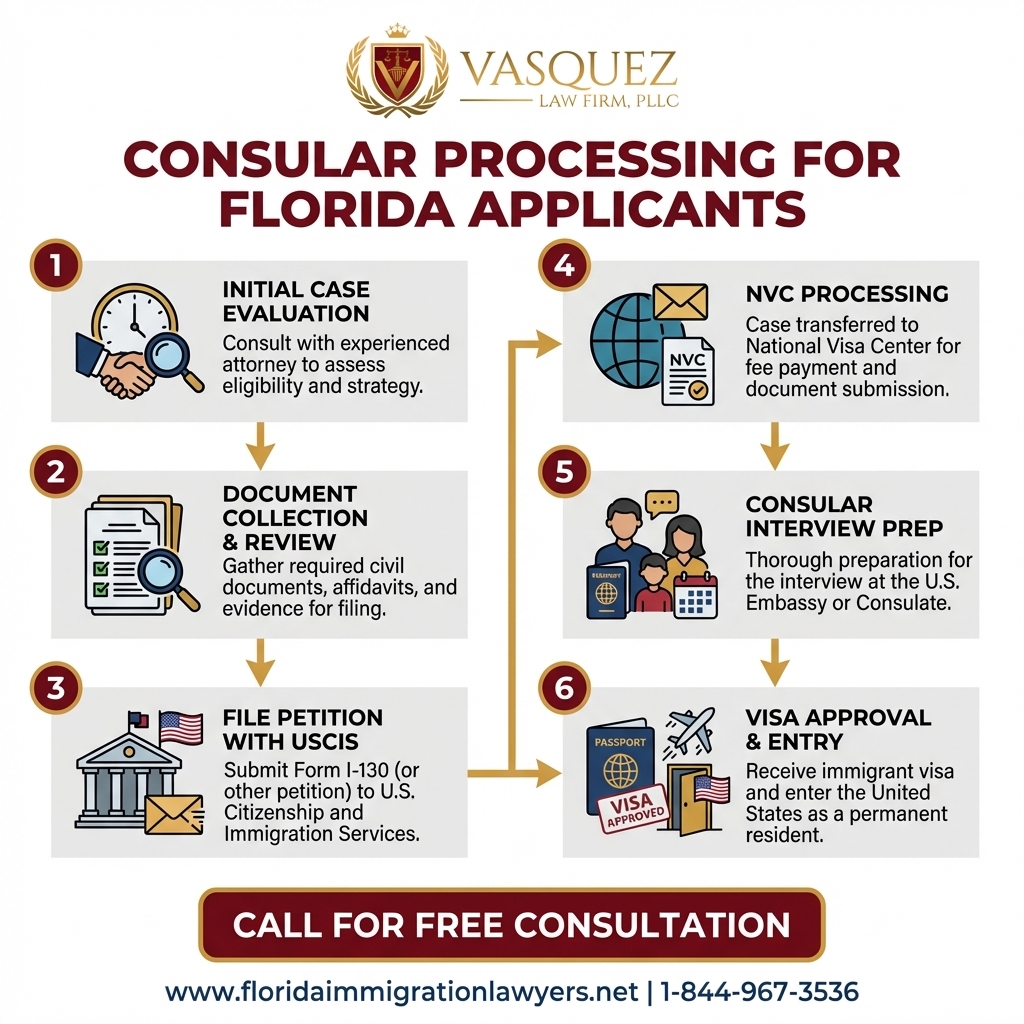
Navigating the intricacies of consular processing, especially for Florida applicants, can be overwhelming. The process involves numerous forms, strict deadlines, complex legal requirements, and potential pitfalls that can lead to significant delays or even denial. This is where the expertise of a seasoned immigration attorney becomes not just beneficial, but often indispensable.
An attorney can provide invaluable assistance from the very beginning, helping you understand your eligibility, identify the correct visa category, and meticulously prepare your initial petitions. They ensure that all forms are accurately completed, all required documents are gathered, and that your application meets the stringent standards set by USCIS and the NVC. This proactive approach significantly reduces the likelihood of RFEs or administrative processing delays.
Furthermore, an experienced lawyer can offer comprehensive interview preparation, coaching you on what to expect, the types of questions you might face, and how to present your case clearly and confidently. For applicants facing potential inadmissibility issues, such as past criminal convictions, previous immigration violations, or health-related concerns, an attorney is crucial. They can assess your situation, advise on the availability of waivers, and prepare compelling arguments to overcome these challenges, potentially preventing a visa denial that could have long-lasting consequences. Our attorneys are well-versed in these complex scenarios.
Should any complications arise during the NVC stage or after the interview, such as administrative processing or a Notice of Intent to Deny, an attorney can intervene on your behalf, communicate with the relevant government agencies, and advocate for your case. Their legal knowledge and experience can often expedite resolutions and protect your rights throughout the process. For Florida residents, having local representation means having someone who understands both federal immigration law and any state-specific considerations that might indirectly impact your case.
Ultimately, investing in legal counsel provides peace of mind, increases the likelihood of a successful outcome, and helps you avoid costly mistakes. Don't navigate this complex journey alone; seek professional guidance to secure your future in the United States. Contact us today for a consultation.
Conclusion
Consular processing is a well-established pathway to permanent residency in the United States for many Florida-based petitioners and their beneficiaries abroad. While it can be a lengthy and detailed process, understanding each step, meticulously preparing all required documentation, and anticipating potential challenges are key to a successful outcome. From the initial petition to the final interview, every detail matters.
For Florida applicants, the dream of uniting with family or bringing skilled workers to the U.S. through consular processing is achievable with diligent effort and expert guidance. Don't underestimate the complexity of immigration law. Seeking professional legal advice can significantly streamline the process, help navigate any hurdles that may arise, and ensure your application is as strong as possible. If you are considering consular processing, we encourage you to contact us for a free consultation today to discuss your specific situation and how our experienced team can assist you.
Do Not Navigate This Process Alone
Our experienced immigration attorneys are ready to fight for you. Get a free, confidential consultation today.
Se Habla Español
Frequently Asked Questions

William J. Vásquez
Founding Attorney · Vasquez Law Firm
U.S. Air Force veteran and immigration attorney with thousands of cases resolved. J.D., NCCU School of Law. AILA member. Admitted to the 4th, 5th, and 11th Circuit Courts.
Available 24/7 - Free Evaluations
Related Legal Services
Our Florida immigration attorneys can help you with free immigration consultation, experienced immigration attorneys and business immigration. Call today at 1-844-967-3536 for a free consultation.
Related Links
Related Topics
Free Legal Consultation
Discuss your case with our experienced attorneys. We're available 24/7.
Se Habla Español - Estamos aquí para ayudarle.
Related Articles
E-2 Visa for Florida Business Investors | VLF Florida
Learn about the E-2 investor visa for Florida business opportunities, tailored for Fort Lauderdale entrepreneurs. Discover the process, requirements, and common pitfalls. Contact Florida Immigration Lawyers for expert assistance.
Immigration Documents Checklist for Florida | VLF Florida
Navigating immigration processes in Florida requires a comprehensive checklist of documents. This guide helps you gather all necessary paperwork to ensure a successful application. Consult Florida Immigration Lawyers for personalized assistance.
Immigration Attorney West Palm Beach Guide | VLF Florida
Navigate the complexities of immigration in West Palm Beach with a trusted attorney. Learn what to expect, common pitfalls, and how to choose the right legal help.
Dual Citizenship in Florida: What You Need to Know
Explore dual citizenship in Florida, understand the process, and learn how to apply. Discover the benefits and complexities involved with having two passports and navigating immigration laws. Call Florida Immigration Lawyers for expert guidance.
