Child Status Protection Act in Florida: Aging Out Concerns
The Child Status Protection Act (CSPA) provides essential protections for immigrant children who might otherwise age out of eligibility due to long processing times. Learn how the CSPA works in Florida, steps to apply, common mistakes to avoid, and when to call a lawyer for guidance. Contact Florida Immigration Lawyers for a free consultation to secure your family's future.
- The CSPA helps prevent children from losing their eligibility as derivative beneficiaries.
- Eligibility depends on specific calculations of age at visa availability.
- Attention to timelines and accurate documentation is crucial.
- Consulting a lawyer can help navigate complex cases.
Introduction
Imagine a scenario: your family has been waiting years for an immigration petition to be processed, only for your child to turn 21 and potentially lose eligibility to immigrate with you. This is a concern many families face, but the Child Status Protection Act (CSPA) offers a lifeline. This article explains how the CSPA can protect your child's immigration status, especially in Florida where processing times vary. Call Florida Immigration Lawyers at 1-844-YO-PELEO for a free consultation to discuss your specific case.
The journey through the U.S. immigration system can be lengthy and fraught with anxiety, particularly when a child's eligibility hinges on their age. The CSPA was specifically designed to alleviate this stress, offering a critical mechanism to 'freeze' a child's age for immigration purposes, thereby preserving their ability to immigrate with their family. Understanding its nuances is vital for any family navigating these complex waters.
For families residing in or seeking to immigrate to Florida, these protections are especially relevant. With diverse communities and varying processing workloads across different USCIS field offices in the state, delays can be unpredictable. This guide will delve into the specifics of CSPA, offering practical insights and emphasizing why timely and informed action, often with the assistance of experienced professionals like Florida Immigration Lawyers, is paramount.
What is the Child Status Protection Act (CSPA)?
The Child Status Protection Act, or CSPA, was enacted to address the problem of "aging out" where children turn 21 before their immigration process is complete, disqualifying them from entering the U.S. as a child. As of 2026, the CSPA allows certain children to retain their "child" status based on their age at the time of visa availability, not the final processing date.
The act primarily helps those classified as derivative beneficiaries of family or employment-based petitions. It freezes their age under certain conditions, which is critical for families navigating complex immigration timelines.
Before the CSPA, many children who were included in their parents' visa petitions found themselves ineligible to immigrate by the time a visa became available simply because they had turned 21 during the long processing delays. This often led to heartbreaking separations, forcing families to file new, separate petitions for their adult children, which could take many more years. The CSPA was a direct legislative response to mitigate these unintended consequences, ensuring that bureaucratic delays do not unfairly penalize immigrant families.
The CSPA applies to several categories of immigrants, including immediate relatives (though their age calculation is simpler), family-sponsored preference categories, employment-based preference categories, and diversity visa applicants. For a child to be considered a "child" under the CSPA, they must generally be unmarried and meet specific age calculation criteria at the time their visa becomes available. This protection is not automatic; it requires careful attention to filing deadlines and a thorough understanding of the applicable rules. Florida Immigration Lawyers can help determine if your child qualifies under these provisions.
Understanding the specific category under which your family's petition falls is crucial, as the CSPA calculation methods can differ slightly. For instance, immediate relatives (unmarried children of U.S. citizens) have their age frozen on the date the Form I-130 petition is filed, provided they remain unmarried. For preference categories, the calculation is more intricate, involving subtracting the petition's pending time from the child's age on the visa availability date. This distinction is vital for accurate planning and application.
How Does the CSPA Work in Florida?
In Florida, the CSPA operates by calculating the child's age based on the date the visa becomes available, subtracting the time the petition was pending. For those in Miami and surrounding areas, understanding local processing times is crucial.
For example, if a family petition was pending for 2 years and a visa becomes available when the child is 21, the CSPA may "freeze" the age at 19, keeping the child eligible to immigrate as part of the family unit. This is crucial for those facing delays at Florida USCIS offices.
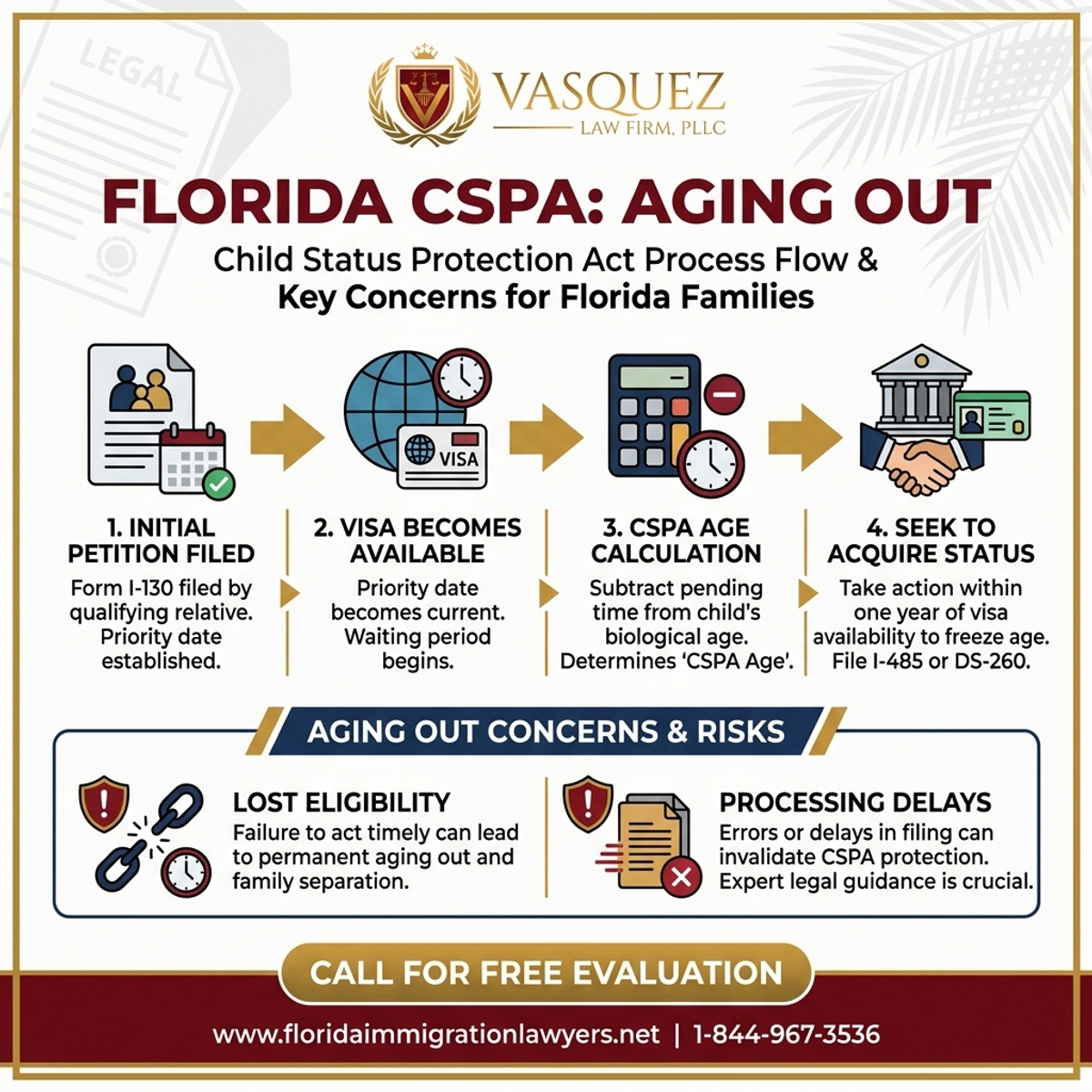
Step-by-Step Process — Child Status Protection Act in Florida: Aging Out Concerns
The core of the CSPA calculation involves three key dates: the date the visa petition (e.g., Form I-130 or I-140) was filed, the date the petition was approved, and the date a visa number becomes available according to the Department of State's monthly Visa Bulletin. The difference between the filing and approval dates represents the "pending time" of the petition. This pending time is then subtracted from the child's actual age on the date the visa becomes available. If the resulting "CSPA age" is under 21, the child remains eligible.
Beyond the age calculation, a critical requirement for CSPA protection is that the child must "seek to acquire" lawful permanent resident status within one year of a visa becoming available. This typically means filing Form I-485 (Application to Register Permanent Residence or Adjust Status) if in the U.S., or applying for an immigrant visa through consular processing if abroad. Missing this one-year window, even if the CSPA age calculation is favorable, can lead to loss of eligibility. This is a common pitfall that Florida Immigration Lawyers help clients avoid by providing timely guidance.
Consider a real-world example in Florida: A U.S. citizen parent files an I-130 petition for their unmarried child (F1 category) on January 1, 2018. The petition is approved on January 1, 2020 (2 years pending time). A visa becomes available on January 1, 2024, when the child is 22 years old. Under CSPA, the child's age is calculated as 22 (age on visa availability) - 2 (petition pending time) = 20 years old. Since 20 is under 21, the child is CSPA-protected. However, the child must then file for adjustment of status or apply for an immigrant visa by January 1, 2025, to meet the "sought to acquire" requirement. Navigating these precise dates and requirements can be challenging, making professional legal assistance invaluable.
Steps to Apply for CSPA Protection
Applying for CSPA protection isn't a separate application but rather a calculation that applies to an existing immigration petition. The following steps outline the general process, emphasizing the critical points for families in Florida.
- Determine Eligibility: Confirm the child is a derivative beneficiary and calculate the CSPA age. It is crucial to accurately determine the child's CSPA age using the specific formula relevant to their visa category. This often involves subtracting the period the underlying petition was pending from the child's age on the visa availability date.
- Check Visa Bulletin: Regularly review the Visa Bulletin for updates on visa availability. The Visa Bulletin, published monthly by the Department of State, provides crucial dates for when immigrant visas become available. Monitoring this bulletin diligently is essential to know when your priority date becomes current and the one-year "sought to acquire" clock begins.
- File Timely Applications: Submit all required documentation promptly when a visa number becomes available. Once a visa number is current, the child (or their parent on their behalf) must take affirmative steps to seek permanent residence, typically by filing Form I-485 (Adjustment of Status) or by initiating consular processing. This action must occur within one year of the visa becoming available to satisfy the "sought to acquire" rule.
- Seek Legal Advice: Consult with an immigration attorney to ensure compliance with all CSPA provisions. Given the complexity of age calculations, different visa categories, and strict deadlines, professional legal advice is highly recommended. Florida Immigration Lawyers can provide tailored guidance, ensuring all requirements are met and potential pitfalls are avoided.
Successfully navigating these steps requires meticulous record-keeping and a proactive approach. Any miscalculation or delay can jeopardize a child's eligibility. Therefore, from the moment a petition is filed, families should be aware of CSPA provisions and plan accordingly, perhaps by scheduling a consultation with Florida Immigration Lawyers to understand their specific timeline.
Document Checklist for CSPA Applications
While CSPA itself doesn't have a standalone application form, the eligibility is determined as part of the overall adjustment of status or immigrant visa application. Having a comprehensive and organized set of documents is vital for a smooth process, especially when dealing with USCIS offices in Florida.
- Birth certificate of the child
- Copy of the approved petition
- Proof of visa availability (Visa Bulletin)
- Application forms (e.g., I-485 for adjustment of status)
- Evidence of continuous residence in the U.S. if applicable
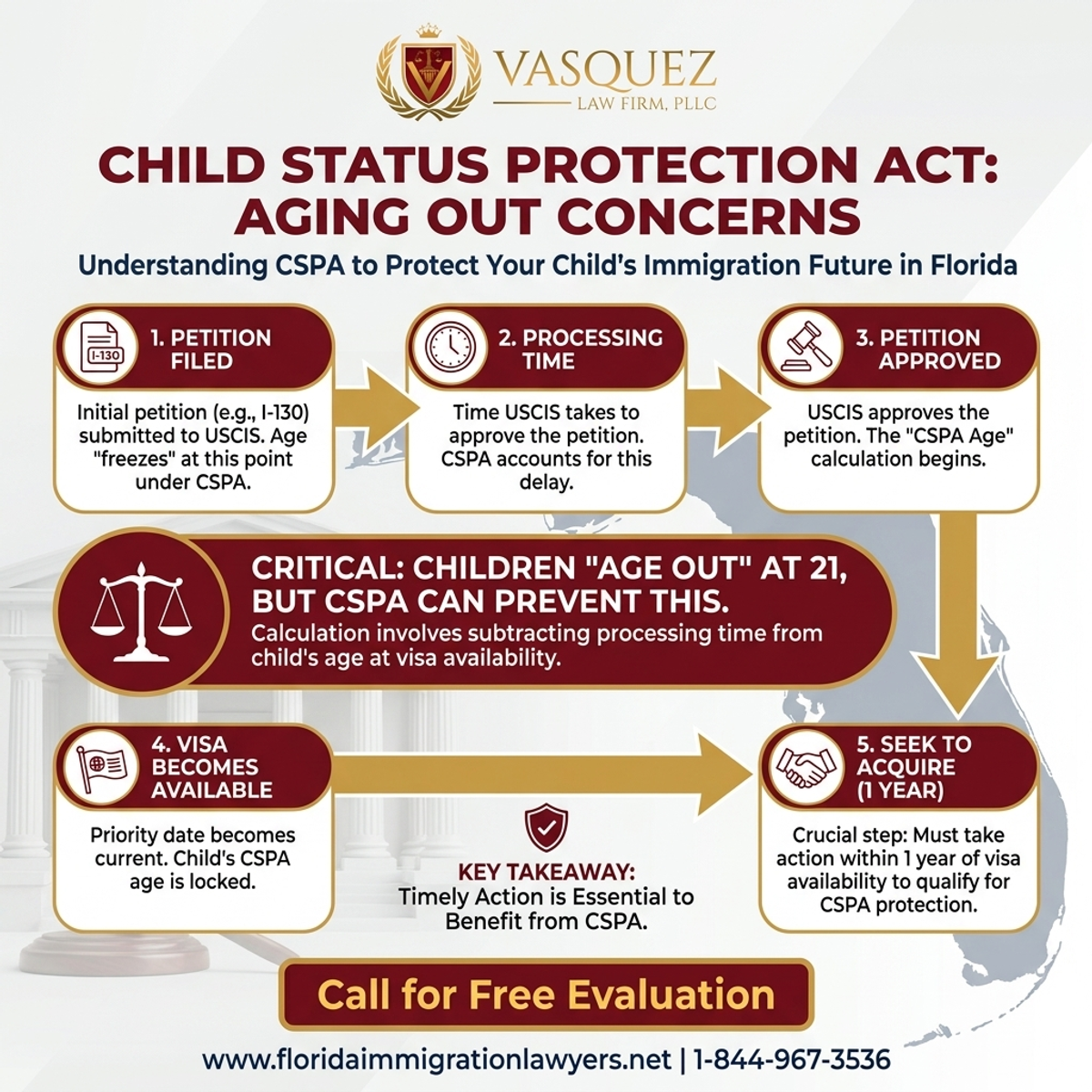
Key Statistics — Child Status Protection Act in Florida: Aging Out Concerns
Beyond the primary documents listed, applicants should also prepare supporting evidence such as marriage certificates (if applicable to the principal applicant), financial documents (e.g., Form I-864 Affidavit of Support), medical examination results, and police clearances. All foreign language documents must be accompanied by certified English translations. Organizing these documents meticulously and ensuring their accuracy can significantly reduce processing delays and requests for evidence from USCIS.
It is highly advisable to make multiple copies of all submitted documents for your records. When working with Florida Immigration Lawyers, they will assist you in compiling a robust application package, ensuring no critical piece of evidence is overlooked. Their expertise can be invaluable in presenting a clear and compelling case to immigration authorities.
Timeline and Processing Expectations
Understanding the timeline for CSPA-related immigration processes is crucial for setting realistic expectations and planning. While the CSPA aims to mitigate the impact of long waits, the overall journey still involves several stages, each with its own variable timeframe.
| Stage | Typical Timeframe | Notes |
|---|---|---|
| Initial Petition | 6-12 months | Varies by petition type and service center |
| Visa Availability | Varies | Check monthly Visa Bulletin |
| Adjustment of Status | 8-14 months | Subject to local USCIS office processing times |
The "Typical Timeframe" estimates provided above are general and can fluctuate significantly based on factors such as the petitioner's country of birth, the specific visa preference category, and the current workload of USCIS service centers and the National Visa Center. Economic and political factors can also influence processing speeds, sometimes leading to unexpected backlogs or advancements in priority dates.
Monitoring the monthly Visa Bulletin is not just a suggestion but a necessity. The Final Action Dates and Dates for Filing charts dictate when a visa number is considered available for your specific category and country. Staying informed allows you to act promptly within the crucial one-year window for CSPA eligibility. For personalized timeline assessments and proactive case management, consulting with Florida Immigration Lawyers is highly recommended, as they can provide up-to-date information and strategize based on current processing trends affecting Florida residents.
Cost Factors and Fee Breakdown
Immigration processes, including those involving CSPA, come with various fees. It's important to budget for these costs to avoid delays in your application. The fees are set by government agencies and can change periodically, so always check the most current rates.
| Item | Typical Fee | Notes |
|---|---|---|
| Filing Fee (I-485) | Variable | Check USCIS for current rates |
| Biometric Services | Variable | Required for applicants 14-78 years old |
| Attorney Fees | Variable | Depends on case complexity |
In addition to the listed items, applicants should also anticipate other potential costs. These can include fees for required medical examinations by USCIS-approved civil surgeons, translation services for foreign documents, and potentially travel expenses for interviews or biometric appointments. While some fees are fixed by the government, attorney fees can vary widely depending on the complexity of your case, the attorney's experience, and the scope of services provided.
Investing in legal representation, though an additional cost, can be invaluable. An experienced immigration attorney can help you avoid costly mistakes, ensure timely filing, and navigate complex legal issues, ultimately saving you time and potential heartache. Florida Immigration Lawyers offers transparent fee structures and can discuss all potential costs during your free consultation, ensuring you have a clear understanding of the financial commitment involved in protecting your child's immigration status.
Common Mistakes to Avoid
Navigating the Child Status Protection Act can be intricate, and even minor errors can have significant consequences, potentially leading to the loss of eligibility for your child. Being aware of common pitfalls is the first step in avoiding them.
- Missing the Visa Bulletin: Failing to monitor the Visa Bulletin can lead to missed opportunities for filing. This is perhaps the most critical error, as the one-year "sought to acquire" clock begins ticking when a visa becomes available. Consistent monitoring is essential.
- Incorrect Age Calculation: Miscalculating the CSPA age can result in ineligibility. The formula can be complex, especially with different rules for various visa categories. A precise calculation is paramount to ensure your child truly qualifies.
- Late Filing: Delays in submitting applications after visa availability can risk aging out. Remember the one-year "sought to acquire" rule; missing this deadline, even by a day, can invalidate CSPA protection.
- Lack of Documentation: Incomplete paperwork can delay processing. Submitting an application without all required supporting documents can lead to Requests for Evidence (RFEs) or even denial, wasting precious time.
- Assuming Eligibility: Not all children qualify under CSPA; verify eligibility requirements. CSPA has specific criteria, and not every child who turns 21 during processing will automatically be protected. Always confirm eligibility first.
- Ignoring Local Differences: Processing times vary; understanding specific Florida timelines is critical. USCIS field offices in Florida can have different workloads and processing speeds, which can impact your specific timeline.
- Not Consulting a Lawyer: Complex cases require legal guidance to navigate successfully. The nuances of CSPA, coupled with constantly evolving immigration laws, make legal counsel almost indispensable for many families.
By being vigilant and proactive, and by seeking guidance from professionals like Florida Immigration Lawyers, families can significantly reduce the risk of these common errors. Their experience in handling CSPA cases in Florida ensures that all details are meticulously managed, from age calculation to timely filing.
When to Call a Lawyer
If you are concerned about your child aging out, it's essential to consult with a lawyer. Legal guidance is crucial when timelines are tight, or eligibility is unclear. Florida Immigration Lawyers can offer advice tailored to your circumstances.
Beyond general concerns, specific situations warrant immediate legal consultation. If your child's age calculation appears borderline, if there have been previous immigration issues or denials, or if there are any complexities such as a child having married (which generally disqualifies them from CSPA), a lawyer's expertise becomes indispensable. Even minor discrepancies in dates or documentation can lead to significant delays or outright denials, making early intervention critical.
An experienced immigration attorney, such as those at Florida Immigration Lawyers, can provide a thorough assessment of your child's eligibility, accurately calculate their CSPA age, and ensure all application forms are correctly filled out and submitted on time. They can also represent you in communications with USCIS or the National Visa Center, addressing any Requests for Evidence or other inquiries efficiently. Don't wait until a problem arises; proactive legal consultation can save your family from immense stress and potential separation. Call 1-844-YO-PELEO today.
About Florida Immigration Lawyers
Florida Immigration Lawyers is dedicated to providing legal services across Florida. Our team focuses on immigration law, offering support in areas like family immigration, asylum, and deportation defense. With bilingual services available, we ensure all of Florida's immigrant communities are served with care and professionalism. Call us at 1-844-YO-PELEO or visit our website for a free consultation.
Our commitment extends beyond just legal representation; we strive to be a compassionate and trustworthy partner for families navigating the often-overwhelming immigration system. We understand the profound impact immigration decisions have on individuals and their loved ones, which is why we approach each case with meticulous attention to detail and a personalized strategy. Whether you are in Miami, Orlando, Tampa, or anywhere else in Florida, our dedicated team is ready to assist.
Choosing Florida Immigration Lawyers means choosing a team that is deeply familiar with both federal immigration laws and the specific operational procedures of USCIS offices throughout Florida. Our attorneys stay abreast of the latest legal developments and policy changes, ensuring that our advice is always current and effective. We pride ourselves on clear communication, ensuring you are informed and confident at every stage of your immigration journey. Contact us today at 1-844-YO-PELEO to experience the difference legal guidance can make.
Frequently Asked Questions About CSPA
Q: Does CSPA apply to all children?
A: No, CSPA does not apply to all children. It primarily benefits derivative beneficiaries of family-sponsored, employment-based, and Diversity Visa petitions, as well as some immediate relatives. Eligibility depends on specific age calculations and whether the child remains unmarried. It’s crucial to verify your child's specific category and circumstances to determine if CSPA protection is applicable to their case. Consulting Florida Immigration Lawyers can help clarify this.
Q: What is the "sought to acquire" requirement?
A: The "sought to acquire" requirement means the child must take an affirmative step to apply for permanent residency within one year of their visa becoming available. This typically involves filing Form I-485 (Adjustment of Status) if they are in the U.S. or applying for an immigrant visa through consular processing if abroad. Failing to meet this one-year deadline will result in the loss of CSPA protection, even if the age calculation was favorable.
Q: Can a child lose CSPA protection after it's granted?
A: Yes, CSPA protection can be lost. The most common way is if the child marries before becoming a lawful permanent resident, as CSPA only protects unmarried children. Additionally, failing to meet the "sought to acquire" requirement within one year of visa availability can also lead to the loss of protection. It is vital to maintain eligibility throughout the entire immigration process.
Q: How do I know when my child's visa is available?
A: You can determine when your child's visa is available by regularly checking the Department of State's monthly Visa Bulletin. This bulletin lists the "priority dates" that are current for various visa categories and countries. Your child's priority date must be earlier than the listed date for their visa category to be considered available. Florida Immigration Lawyers can assist you in interpreting the Visa Bulletin and tracking your priority date.
Q: What if my child's CSPA age is exactly 21?
A: If your child's calculated CSPA age is exactly 21, they are still considered to have "aged out" and will not be eligible for CSPA protection. To qualify, the CSPA age must be *under* 21. This emphasizes the critical importance of precise age calculation and understanding the specific rules. If you find your child's age is borderline, immediate consultation with Florida Immigration Lawyers is highly recommended to explore all possible options.
Sources and References
- U.S. Citizenship and Immigration Services (USCIS)
- Executive Office for Immigration Review (EOIR)
- 8 U.S.C. Chapter 12 - Immigration and Nationality Act
- Visa Bulletin
Related services: immigration practice areas, family immigration services, citizenship and naturalization.
This article provides general legal information and is not intended as legal advice. Every case is unique, and outcomes depend on specific facts and circumstances. Contact an attorney for advice about your particular situation.
For more information, call Florida Immigration Lawyers at 1-844-YO-PELEO. Se Habla Español - Estamos aquí para ayudarle.
If you need legal assistance, learn more about immigration case consultation, or call us at 1-844-YO-PELEO for a free consultation.
Do Not Navigate This Process Alone
Our experienced immigration attorneys are ready to fight for you. Get a free, confidential case review today.
Se Habla Español
Or leave your details and we’ll call you:
Free Evaluation in 24 Hours
Or talk to us right now

AI voice assistant — available 24/7
FreeFrequently Asked Questions

William J. Vásquez
Founding Attorney · Vasquez Law Firm
U.S. Air Force veteran and immigration attorney with years of hands-on U.S. immigration experience. J.D., NCCU School of Law. AILA member. Admitted to the 4th, 5th, and 11th Circuit Courts.
Available 24/7 - Free Evaluations
Reviewed for legal accuracy by William J. Vásquez
Licensed in North Carolina; U.S. immigration is federal practice.
Related Legal Services
Our Florida immigration attorneys can help you with free immigration consultation, business immigration and deportation defense. Call today at 1-844-YO-PELEO for a free case review.
Related Links
Related Topics
Free Legal Case Review
Discuss your case with our experienced attorneys. We're available 24/7.
Se Habla Español - Estamos aquí para ayudarle.
Related Articles
EB-5 Investor Green Card in Florida: A 2026 Guide
Explore how to obtain an EB-5 investor green card in Florida. Learn about the investment requirements, processes, and benefits of participating in this program. Discover how Florida's economic landscape can be an ideal setting for your investment. Contact Florida Immigration Lawyers for a free case review.
Certificate of Eligibility for Expungement in Florida 2026
For non-U.S. citizens in Florida, understanding how a state expungement impacts immigration status is critical. A certificate of eligibility for expungement in Florida allows a criminal record to be sealed or expunged under state law. However, federal immigration agencies often disregard such state-level relief, still considering the original criminal offense as a conviction for immigration purposes. This can have severe implications for visa applications, green card eligibility, naturalization, and even lead to deportation. This guide clarifies the Florida expungement process, its limited effect on federal immigration law, and key steps to protect your status in 2026. Learn about common mistakes, required documents, timelines, and when to seek expert legal counsel from Florida Immigration Lawyers to navigate these complex issues effectively.
Immigration Lawyer Orlando Free Consultation in Florida
For individuals and families in Orlando, Florida, navigating the complexities of U.S. immigration law requires expert guidance. An immigration lawyer in Orlando offers crucial support for everything from visa applications and green card processes to naturalization and deportation defense. This comprehensive guide details what a free consultation covers, providing a step-by-step overview of immigration pathways, essential document checklists, and expected timelines in 2026. We also highlight common mistakes to avoid, discuss the critical role of legal counsel in deportation and asylum cases, and explain why choosing a local Orlando immigration attorney is beneficial. Florida Immigration Lawyers is dedicated to serving the diverse community of Orlando with compassionate, effective legal solutions, ensuring you receive personalized advice and robust representation for a successful immigration journey.
Immigration Lawyer in Central Florida 2026 Guide
Explore the importance of hiring an immigration lawyer in Central Florida. Learn about services, timelines, and tips to avoid common mistakes. Contact Florida Immigration Lawyers for expert advice.