Change of Status B-2 to F-1 in Florida
Navigating the process from B-2 to F-1 status in Florida can be challenging. Learn about the steps, common mistakes, and when to seek legal help. Call Florida Immigration Lawyers for a consultation.
- Understand the eligibility requirements.
- Prepare necessary documentation.
- Consult with an immigration lawyer for guidance.
Introduction
Transitioning from a tourist to a student status in Florida can open doors to educational opportunities and career advancements. However, navigating this change of status from B-2 to F-1 involves various steps and legal complexities. This article provides a comprehensive guide to help you through the process, focusing specifically on West Palm Beach, Florida. Call Florida Immigration Lawyers at 1-844-YO-PELEO for a free consultation to ensure your application is handled correctly.
Florida, with its diverse culture, vibrant economy, and numerous reputable educational institutions, is an attractive destination for international students. Changing your status from a B-2 tourist visa to an F-1 student visa allows you to pursue academic goals legally and immerse yourself in American higher education. This process, while seemingly straightforward, requires meticulous attention to detail and a thorough understanding of U.S. immigration law.
Successfully changing your immigration status is not just about filling out forms; it's about demonstrating a clear intent to study and meet all eligibility criteria set by the U.S. Citizenship and Immigration Services (USCIS). Our goal is to demystify this process, offering practical advice and highlighting the critical junctures where legal guidance from Florida Immigration Lawyers can make all the difference.
Overview of Changing Status from B-2 to F-1
Changing your immigration status from a B-2 tourist visa to an F-1 student visa requires careful planning and attention to detail. The B-2 visa is typically for those visiting the U.S. temporarily for tourism, while the F-1 visa is for students enrolled in academic programs. West Palm Beach, Florida, home to several renowned educational institutions, is a popular destination for international students.
To be eligible, you must first be accepted into a Student and Exchange Visitor Program (SEVP)-certified institution. The application process involves several steps, including submitting Form I-539, "Application to Extend/Change Nonimmigrant Status," to the USCIS. Understanding the requirements and preparing your documents meticulously is crucial to avoid delays and potential denials.
A fundamental distinction lies in the intent associated with each visa. A B-2 visa holder is presumed to have non-immigrant intent, meaning they intend to return to their home country after a temporary stay. An F-1 visa holder, while also a non-immigrant, has the primary intent of pursuing a full course of study. When applying for a change of status, you must clearly demonstrate that your initial intent for entering the U.S. as a tourist was genuine and that your decision to study arose after your arrival, not before.
This "change of intent" is a critical aspect USCIS scrutinizes. You will need to provide a compelling personal statement explaining your motivations for wishing to study in the U.S. and how this decision developed during your visit. For instance, you might have discovered a unique academic program or realized a passion for a particular field while exploring educational opportunities in Florida. Consulting with Florida Immigration Lawyers can help you craft a persuasive narrative that addresses this crucial element effectively.
Step-by-Step Guide to Changing Your Status
- Acceptance to a SEVP-Certified School: Before applying for a change of status, secure admission to an accredited school that participates in SEVP.
- Receive Form I-20: Once accepted, the institution will issue a Form I-20, "Certificate of Eligibility for Nonimmigrant Student Status," which you need for your application.
- Complete Form I-539: Fill out Form I-539 and pay the associated fees. This form is critical for requesting a change from B-2 to F-1 status.
- Prepare Supporting Documents: Include your Form I-20, proof of sufficient financial support, and a personal statement explaining your intention to study in the U.S.
- Submit Application to USCIS: Send your completed application and documents to the appropriate USCIS Lockbox Facility. Ensure all information is accurate and complete to prevent delays.
Let's delve deeper into each of these essential steps. Securing admission to an SEVP-certified school is non-negotiable. These are institutions approved by the Student and Exchange Visitor Program to enroll international students. You can search for SEVP-certified schools on the Study in the States website. Ensure your chosen program is a full-time academic or language program, as F-1 visas are not granted for part-time study.
Upon acceptance, your Designated School Official (DSO) will issue Form I-20. This document is your official certificate of eligibility and contains crucial information, including your SEVIS ID number, program start and end dates, and estimated costs of attendance. It's vital to review your I-20 carefully for any errors and to understand all the details it provides, as it forms the backbone of your F-1 application.
Completing Form I-539 accurately is paramount. This form is your formal request to USCIS to change your nonimmigrant status. Pay close attention to all sections, ensuring consistency with your supporting documents. If you have dependents (spouse or children) also seeking a change of status to F-2, they can be included on the same Form I-539. Any omissions or inaccuracies can lead to Requests for Evidence (RFEs) or even denial. For complex cases, consider contacting Florida Immigration Lawyers at 1-844-YO-PELEO for assistance with form preparation.
The meticulous preparation of supporting documents cannot be overstressed. Beyond the I-20 and financial proof, you'll need copies of your passport biographical page, B-2 visa stamp, I-94 arrival/departure record, and a personal statement. The personal statement is your opportunity to articulate your genuine desire to study and explain why you decided to pursue education after arriving as a tourist. This statement should be clear, concise, and compelling, demonstrating your academic goals and intent to return home after completing your studies.
Finally, submitting your application correctly to the appropriate USCIS Lockbox Facility is the last physical step. Always send your application via certified mail with a return receipt requested, or through a courier service that provides tracking. Keep a complete copy of everything you submit for your records. This includes all forms, supporting documents, and proof of payment. This organized approach can save you considerable stress and time if any issues arise during processing.
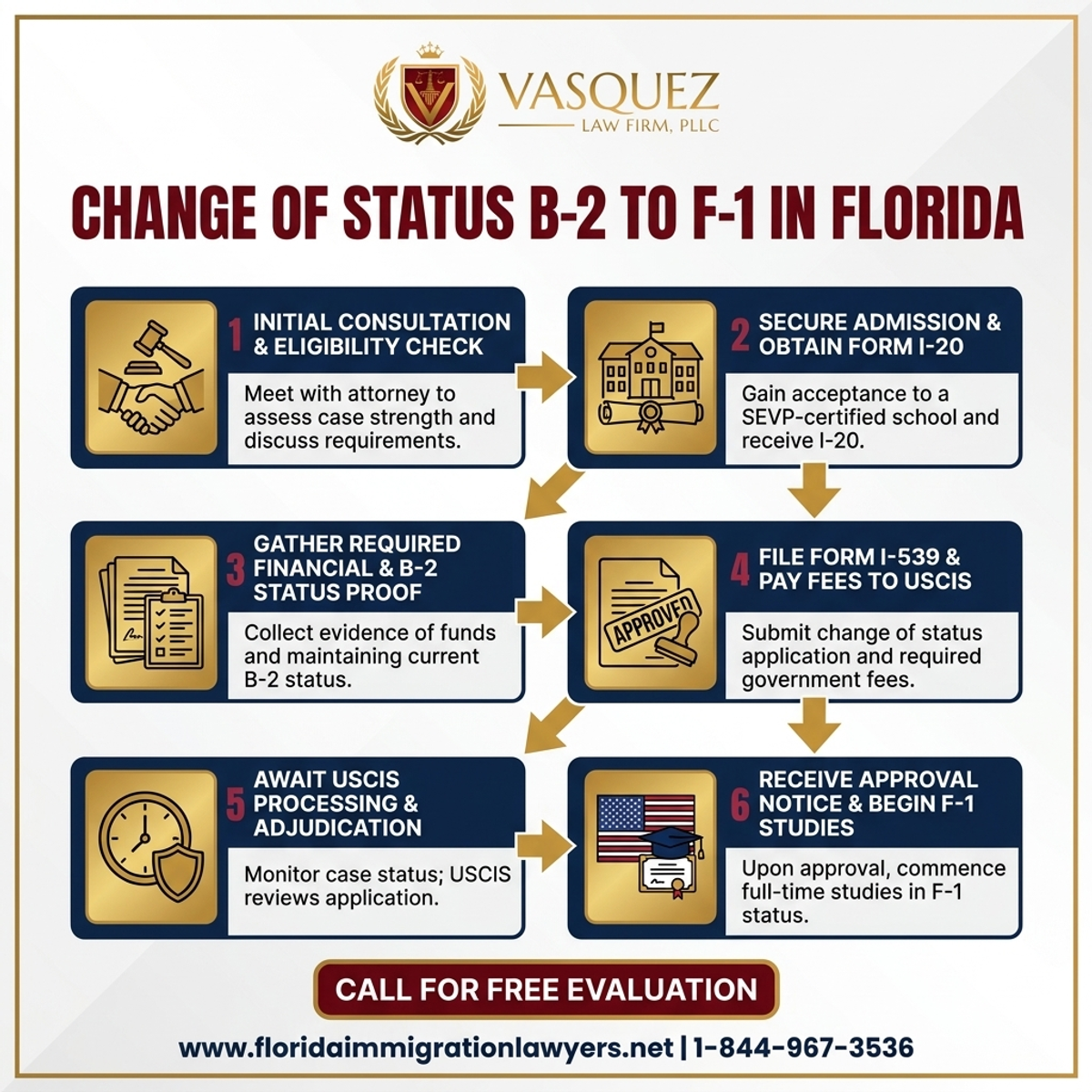
Step-by-Step Process — Change of Status B-2 to F-1 in Florida
Document Checklist for B-2 to F-1 Change of Status
Gathering and organizing all required documents is a critical phase in your change of status application. A single missing or improperly prepared document can lead to significant delays or even denial, requiring you to reapply or potentially leave the U.S.
- Completed Form I-539
- Form I-20 from a SEVP-certified school
- Proof of financial ability to cover tuition and living expenses
- Copy of B-2 visa and passport biographical page
- Personal statement of educational intentions
- Any additional documents requested by USCIS
Let's elaborate on the importance of these documents. Your Form I-539 must be filled out entirely and accurately, including all personal information, travel history, and reasons for the change of status. The Form I-20 is issued by your prospective school and confirms your acceptance into a full-time program. It details the program's length, tuition, and living costs, which directly correlates with the financial evidence you must provide.
Proof of financial ability is perhaps one of the most scrutinized aspects of the application. USCIS needs assurance that you will not become a public charge and can fully fund your education and living expenses without resorting to unauthorized employment. This can include official bank statements, scholarship letters, or affidavits of support from sponsors, along with their financial documentation. The personal statement allows you to clearly articulate your academic goals, why you chose your specific program, and how your decision to study developed after your initial entry as a tourist, addressing the crucial 'intent' issue. Always keep copies of all submitted documents for your records.
Timeline and Processing Expectations
The processing time for changing status from B-2 to F-1 can vary based on the current workload at the USCIS. Typically, it may take several months, so it is advisable to apply well in advance of your intended start date. Staying in communication with your designated school official (DSO) and checking the status of your application regularly at the USCIS case status online is recommended.
Several factors can influence the processing timeline, including the specific USCIS service center handling your case, the volume of applications, and whether you receive a Request for Evidence (RFE). An RFE can add several weeks or even months to your processing time, as you'll need to gather and submit additional documentation, and USCIS will then re-evaluate your case.
It is crucial to file your Form I-539 application before your authorized B-2 stay expires. If you apply in a timely manner, you are generally permitted to remain in the U.S. while your change of status application is pending, even if your B-2 status expires during this period. This is known as a "period of authorized stay." However, you cannot begin your F-1 program of study until your change of status is officially approved. Attempting to study before approval can lead to serious immigration consequences, including denial of your application and potential unlawful presence. For precise guidance on your specific timeline and status, consult with Florida Immigration Lawyers.
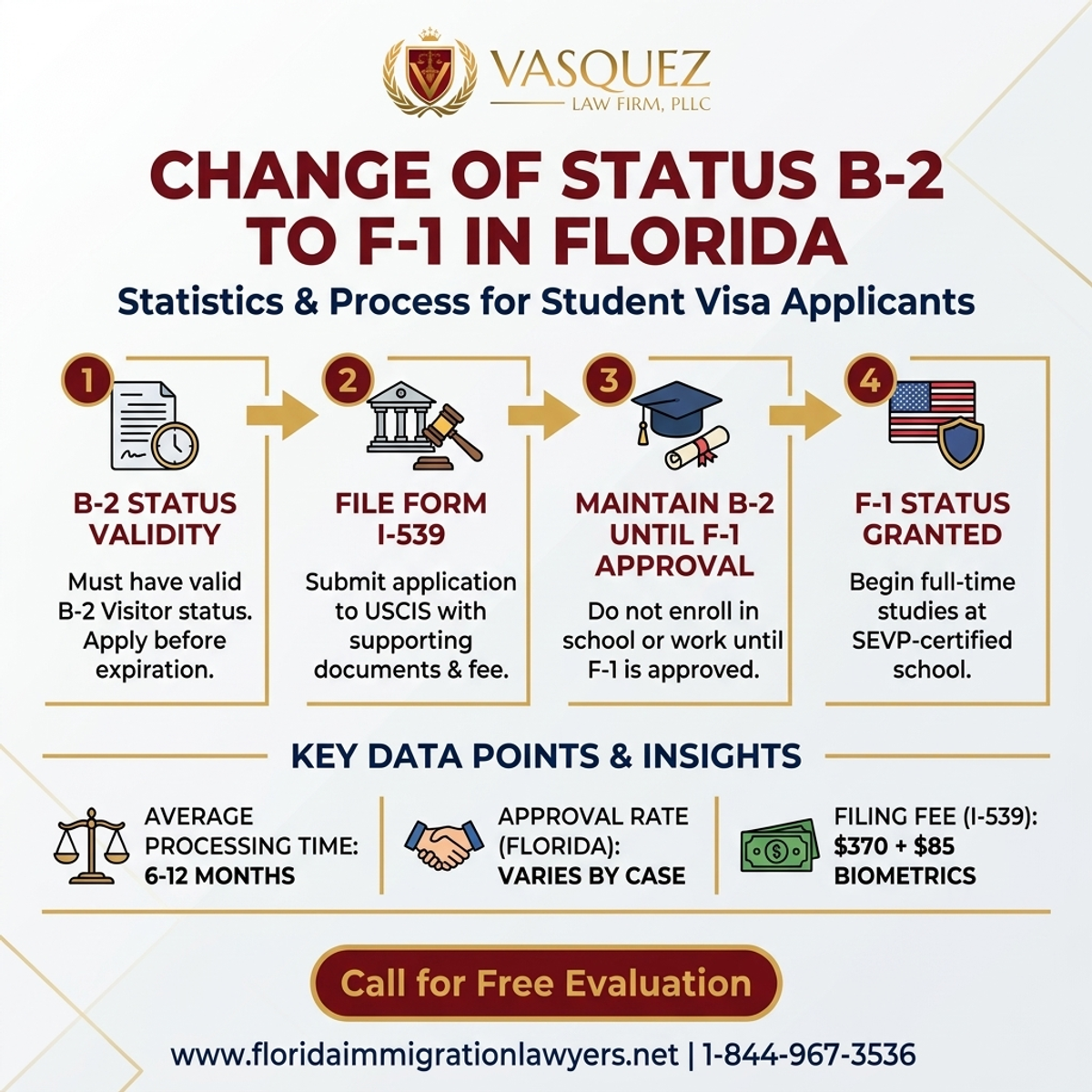
Key Statistics — Change of Status B-2 to F-1 in Florida
Cost Factors and Fee Breakdown
While specific amounts can change, you should anticipate fees for submitting Form I-539 and the SEVIS I-901 fee associated with your Form I-20. Additional costs might include university application fees and expenses for obtaining necessary documentation. Consulting with an immigration attorney can help you understand potential costs and avoid unexpected expenses.
The current filing fee for Form I-539 is typically around $470, but it is essential to always check the USCIS website for the most up-to-date fee schedule, as these amounts can change without much notice. Additionally, you must pay the SEVIS I-901 fee, which is currently $350 for F-1 students. This fee funds the Student and Exchange Visitor Information System (SEVIS), which tracks nonimmigrant students and exchange visitors.
Beyond these mandatory government fees, consider other potential costs. University application fees can range from $50 to $100 or more per institution. You might also incur costs for translating foreign documents into English, obtaining certified copies, or securing express mail services for your application. If you choose to work with an immigration attorney, legal fees will also be part of your overall budget. While this is an additional expense, the expertise and peace of mind provided by Florida Immigration Lawyers can be invaluable in ensuring a smooth and successful application process.
Do not navigate this process alone. Contact Florida Immigration Lawyers today. Our experienced attorneys can provide invaluable assistance.
Common Mistakes to Avoid
- Missing Deadlines: Failing to submit your application before your B-2 visa expires can jeopardize your status.
- Incomplete Documentation: Not providing all required documents can lead to delays or denials.
- Insufficient Financial Evidence: Inadequate proof of financial ability can result in application denial.
- Incorrect Form Filling: Errors on Form I-539 can cause processing delays.
- Ignoring School Requirements: Not following instructions from your SEVP-certified school can complicate your application.
- Applying Without Legal Advice: Not consulting with an immigration attorney can lead to misunderstandings of the process.
- Not Confirming SEVP Certification: Applying to a non-SEVP-certified school can invalidate your application.
Avoiding common pitfalls is critical for a successful change of status application. One of the most severe mistakes is failing to file your Form I-539 before your B-2 status expires. If you overstay your authorized period, you begin to accrue "unlawful presence," which can lead to bars from re-entering the U.S. for several years. Always track your I-94 expiration date and ensure your application is postmarked well in advance.
Another frequent error is submitting an application with insufficient financial evidence. USCIS demands clear, verifiable proof that you have the funds to cover your tuition and living expenses for the entire duration specified on your I-20. This means providing official bank statements, scholarship letters, or notarized affidavits of support with accompanying financial documents from sponsors. Simply stating you have funds without concrete proof will likely result in a denial.
Finally, many applicants underestimate the complexity of the personal statement or fail to address the change of intent adequately. Your statement must clearly explain why you decided to pursue studies after entering as a tourist, rather than having pre-conceived intent to study. It should be sincere, detailed, and consistent with your overall application. An experienced attorney from Florida Immigration Lawyers can help you refine your statement and ensure all aspects of your application are robust.
Frequently Asked Questions (FAQs)
Can I start studying while my B-2 to F-1 change of status is pending?No, you cannot begin your F-1 program of study until USCIS officially approves your change of status application. Starting classes while your application is pending is a violation of your B-2 status and can lead to a denial of your F-1 application and potential immigration consequences. Wait for the approval notice before enrolling in classes.What if my B-2 visa expires while my application is pending?If you filed your Form I-539 application before your B-2 visa expired, you are generally permitted to remain in the U.S. while USCIS processes your change of status. This is known as a "period of authorized stay." However, you cannot travel outside the U.S. during this time without abandoning your application.Can I travel outside the U.S. while my application is pending?It is highly advisable not to travel outside the U.S. while your change of status application is pending. Leaving the country typically means abandoning your I-539 application. If you depart, you would need to apply for an F-1 visa at a U.S. embassy or consulate abroad to re-enter the U.S. as a student.What if my change of status application is denied?If your application is denied, you will typically be given a specific period to depart the U.S. or appeal the decision. Depending on the reasons for denial, you might be able to reapply or seek an F-1 visa at a U.S. embassy abroad. Immediate consultation with Florida Immigration Lawyers is crucial to understand your options and avoid accruing unlawful presence.When to Call a Lawyer
If you face any uncertainties or complications during your change of status process, it is crucial to seek legal advice. Situations like receiving a Request for Evidence (RFE) from USCIS or having a complex immigration history are instances where professional guidance is indispensable. Florida Immigration Lawyers offer support to navigate these challenges effectively.
Beyond RFEs, other scenarios demand immediate legal consultation. If you have any prior immigration violations, such as a previous visa overstay, unauthorized employment, or even minor arrests, your case becomes significantly more complex. These issues can severely impact your eligibility and require a skilled attorney to present your case favorably to USCIS. Similarly, if your B-2 status is nearing expiration and you're racing against the clock, an attorney can help expedite the preparation and submission of your application.
A lawyer from Florida Immigration Lawyers can also provide invaluable assistance in preparing your personal statement, ensuring it effectively communicates your intent and academic goals. They can review all your documentation for completeness and accuracy, anticipate potential issues, and represent you in communications with USCIS. Don't hesitate to call us at 1-844-YO-PELEO for a free consultation if you have any doubts about your change of status application.
About Florida Immigration Lawyers
Florida Immigration Lawyers is dedicated to assisting individuals with their immigration needs across Florida. Our team provides comprehensive services, from visa applications to deportation defense. We prioritize personalized service and are available 24/7 to offer free consultations. Call us at 1-844-YO-PELEO or visit our website for more information.
Our firm understands the profound impact that immigration decisions have on individuals and families. We are committed to providing compassionate, effective, and strategic legal representation. For those seeking to change their status from a B-2 tourist visa to an F-1 student visa, our experience ensures that every detail is meticulously handled, increasing your chances of a successful outcome. We guide you through the complexities, helping you avoid common pitfalls and present the strongest possible case to USCIS.
Sources and References
- U.S. Citizenship and Immigration Services (USCIS)
- Executive Office for Immigration Review (EOIR)
- 8 U.S.C. Chapter 12 - Immigration and Nationality Act
Related services: immigration practice areas, family immigration services, citizenship and naturalization.
This article provides general legal information and is not intended as legal advice. Every case is unique, and outcomes depend on specific facts and circumstances. Contact an attorney for advice about your particular situation.
Call us at 1-844-YO-PELEO for a free consultation. Se Habla Español - Estamos aquí para ayudarle.
If you need legal assistance, learn more about how our immigration attorneys can help, or call us at 1-844-YO-PELEO for a free consultation.
Do Not Navigate This Process Alone
Our experienced immigration attorneys are ready to fight for you. Get a free, confidential case review today.
Se Habla Español
Or leave your details and we’ll call you:
Free Evaluation in 24 Hours
Or talk to us right now
AI voice assistant — available 24/7
FreeFrequently Asked Questions

William J. Vásquez
Founding Attorney · Vasquez Law Firm
U.S. Air Force veteran and immigration attorney with years of hands-on U.S. immigration experience. J.D., NCCU School of Law. AILA member. Admitted to the 4th, 5th, and 11th Circuit Courts.
Available 24/7 - Free Evaluations
Reviewed for legal accuracy by William J. Vásquez
Licensed in North Carolina; U.S. immigration is federal practice.
Related Legal Services
Our Florida immigration attorneys can help you with citizenship and naturalization, immigration practice areas and free immigration consultation. Call today at 1-844-YO-PELEO for a free case review.
Related Links
Related Topics
Free Legal Case Review
Discuss your case with our experienced attorneys. We're available 24/7.
Se Habla Español - Estamos aquí para ayudarle.
Related Articles
DUI Immigration Consequences in Florida 2026
A DUI conviction in Florida can have severe immigration consequences, potentially leading to inadmissibility, deportation, or denial of immigration benefits. For non-citizens, a DUI is not just a traffic offense but a serious criminal matter that federal immigration law scrutinizes closely. Factors like multiple offenses, injury, or property damage can escalate a simple DUI to a Crime Involving Moral Turpitude (CIMT) or even an aggravated felony, triggering mandatory detention and removal proceedings. Understanding the specific nature of your Florida conviction and its interpretation under the Immigration and Nationality Act (INA) is crucial. This article outlines how DUIs impact immigration status, the grounds for inadmissibility and deportation, a step-by-step guide to navigating the process, essential documentation, and expected timelines for 2026. We also highlight common mistakes to avoid and when to seek legal counsel from an experienced immigration attorney. Florida Immigration Lawyers offers comprehensive support for individuals facing these challenging situations, providing expert guidance through complex legal landscapes.
Dual Citizenship Lawyer in Florida: What You Need to Know
For Florida residents, the concept of dual citizenship, or holding two passports, offers a compelling blend of opportunities and challenges. While the U.S. generally permits dual nationality, the path to achieving this status requires a meticulous understanding of both U.S. immigration laws and the citizenship policies of your country of origin. This guide explores the definition of dual citizenship, the detailed step-by-step process for U.S. naturalization, and the significant benefits and potential pitfalls involved. We cover essential documentation, typical timelines, and cost considerations for 2026, providing crucial insights for anyone in Orlando, Miami, or across Florida considering this important legal step. Learn about common mistakes to avoid and understand when to seek professional legal counsel to navigate this complex process successfully. Florida Immigration Lawyers is here to provide expert, bilingual support for your dual citizenship journey.
Immigration Lawyer Orlando Free Consultation in Florida
For individuals and families in Orlando, Florida, navigating the complexities of U.S. immigration law requires expert guidance. An immigration lawyer in Orlando offers crucial support for everything from visa applications and green card processes to naturalization and deportation defense. This comprehensive guide details what a free consultation covers, providing a step-by-step overview of immigration pathways, essential document checklists, and expected timelines in 2026. We also highlight common mistakes to avoid, discuss the critical role of legal counsel in deportation and asylum cases, and explain why choosing a local Orlando immigration attorney is beneficial. Florida Immigration Lawyers is dedicated to serving the diverse community of Orlando with compassionate, effective legal solutions, ensuring you receive personalized advice and robust representation for a successful immigration journey.
EAD Advance Parole Combo Card in Florida: What You Need
An EAD advance parole combo card allows individuals with pending adjustment applications to both work and travel abroad without jeopardizing their green card application. Learn how to apply in Florida, what documents you need, and common mistakes to avoid.