Asylum Interview Preparation in Florida: Your 2026 Guide
For individuals and families in Florida, the asylum interview is a critical step towards protection. This comprehensive 2026 guide from Florida Immigration Lawyers provides essential insights into preparing for your USCIS asylum interview. Learn about key documents, what to expect during the process, and common mistakes to avoid. We cover everything from filing your I-589 application to understanding timelines and legal costs. Our aim is to empower you with the knowledge needed for a successful outcome. Contact us for a free consultation and expert legal support.

Preparing for your asylum interview in Florida is critical for a successful outcome. This process, overseen by USCIS, requires thorough documentation, clear articulation of your fear, and understanding of U.S. asylum law. Seeking legal guidance from experienced Florida Immigration Lawyers can significantly enhance your I-589 application and interview readiness.
- Gather all supporting documents, including identification and evidence of persecution.
- Practice answering common asylum interview questions clearly and consistently.
- Understand the legal definition of asylum and how your case fits.
- Dress professionally and arrive early for your USCIS interview.
- Consider a mock interview to build confidence and refine your narrative.
Imagine living in fear, seeking safety, and finally having the chance to tell your story. For many individuals and families in Florida, the asylum interview represents a pivotal moment on their journey to protection in the United States. This crucial step with U.S. Citizenship and Immigration Services (USCIS) can determine your future. We understand the immense pressure and anxiety that come with preparing for such an important meeting, especially when your safety and future depend on it.
This comprehensive guide from Florida Immigration Lawyers is designed to demystify the asylum interview process in Florida for 2026. We will walk you through essential preparation steps, required documents, what to expect, and common pitfalls to avoid. Our goal is to empower you with the knowledge and confidence needed to present your case effectively. Do not face this complex process alone. Call Florida Immigration Lawyers at 1-844-967-3536 for a free consultation and let us help you prepare.
Understanding the Asylum Process in Florida: A 2026 Overview
The journey to obtaining asylum in the United States begins with demonstrating a well-founded fear of persecution in your home country. This fear must be based on one of five protected grounds: race, religion, nationality, membership in a particular social group, or political opinion. The I-589 application, officially known as the Application for Asylum and for Withholding of Removal, is the cornerstone of this process.
Once your I-589 application is filed with USCIS, you generally enter what is known as the affirmative asylum process. Unlike defensive asylum, which occurs in immigration court, affirmative asylum interviews are conducted by an Asylum Officer. For applicants in Florida, this typically means an interview at the USCIS Asylum Office in Miami, which serves a wide geographical area. Understanding the nuances of Florida asylum law and local procedures is essential for your asylum interview preparation.
Affirmative vs. Defensive Asylum
It is crucial to distinguish between affirmative and defensive asylum. Affirmative asylum is sought proactively by individuals not currently in removal proceedings. You file your I-589 application directly with USCIS. If your affirmative asylum claim is not granted, your case may then be referred to an immigration judge for defensive asylum proceedings.
Defensive asylum, conversely, is sought by individuals who are already in removal proceedings before an immigration court. This often happens if you are apprehended by immigration authorities or if your affirmative asylum claim is referred. The stakes are particularly high in defensive asylum cases, making experienced legal representation vital for your deportation defense Florida.
The Role of USCIS in Your Asylum Journey
USCIS plays a central role in evaluating affirmative asylum claims. Asylum Officers are trained to conduct non-adversarial interviews, gathering testimony and evidence to assess the credibility and merits of your case. Their decision is based on U.S. immigration law, specifically the Immigration and Nationality Act (INA). Your USCIS interview preparation should focus on presenting a clear, consistent, and compelling narrative that aligns with legal requirements.
Your Step-by-Step Asylum Interview Guide in Florida
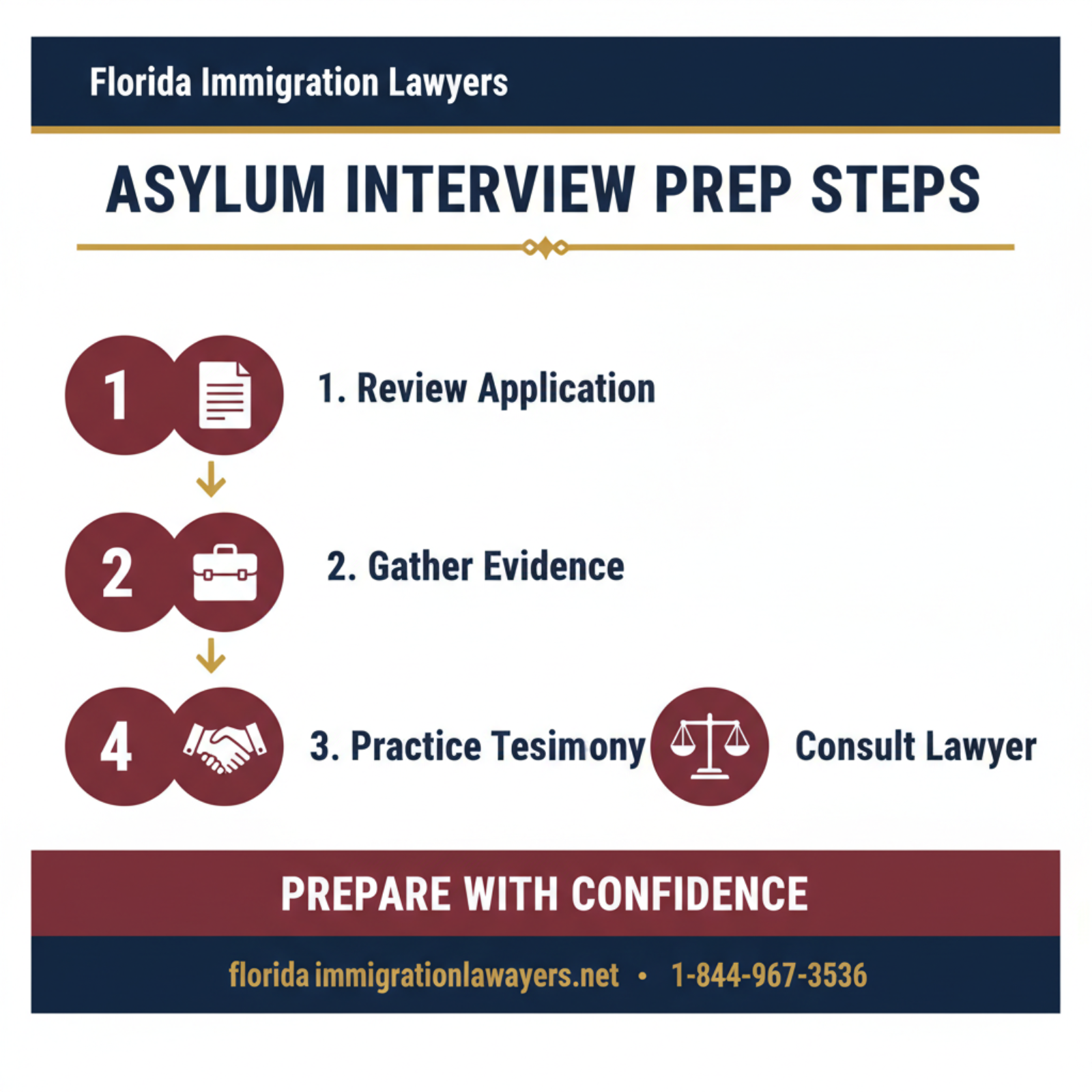
Successful asylum interview preparation involves a methodical approach. From the moment you receive your interview notice until the day of your USCIS interview, every step contributes to a stronger case. This guide outlines the key stages you should follow.
- Receive Your Interview Notice: After filing your I-589 application, USCIS will send you an interview notice. This document specifies the date, time, and location of your asylum interview, typically at the Miami Asylum Office. Pay close attention to any instructions regarding documents or dependents.
- Consult with an Attorney: This is arguably the most critical step. An experienced immigration attorney from Florida Immigration Lawyers can help you review your I-589 application, identify potential weaknesses, gather strong evidence, and conduct mock interviews. They can also accompany you to the USCIS interview.
- Gather and Organize Documents: Begin collecting all original documents and supporting evidence. This includes identification, birth certificates, marriage certificates, and any proof of persecution or corroborating evidence. Organize these meticulously for easy access during the interview.
- Prepare Your Testimony: Your personal story is central to your asylum claim. Practice recounting your experiences clearly, chronologically, and consistently. Be prepared to elaborate on your fear of persecution and why you cannot return to your home country. Focus on specific events and details.
- Attend a Mock Interview: Participating in a mock asylum interview with your attorney is invaluable. This simulates the actual interview environment, allowing you to practice answering difficult questions, manage your emotions, and refine your narrative. It helps reduce anxiety and builds confidence.
- Understand the Interview Process: Know what to expect on the day. The interview will be conducted by an Asylum Officer, often with an interpreter if you are not fluent in English. Your attorney can clarify their role and your rights during the process.
- Attend Your Interview: Arrive early, dressed professionally, with all your organized documents. Listen carefully to all questions, answer truthfully, and ask for clarification if needed. Remember, your attorney is there to assist and protect your rights.
Essential Documents for Your Asylum Interview in Florida
Having a comprehensive and well-organized set of documents is paramount for your asylum interview. These documents corroborate your testimony and provide crucial evidence for your claim. Failing to present necessary documentation can significantly weaken your case.
- Identification: Your passport, national identity card, or any other government-issued identification from your home country. Bring the originals and copies for yourself and any dependents included in your I-589 application.
- Birth Certificates: Original birth certificates for yourself and all dependents listed on your application.
- Marriage Certificate: If applicable, your original marriage certificate.
- Photographs: Recent passport-style photographs for yourself and all dependents. Check USCIS guidelines for specific requirements.
- Travel Documents: Any travel documents used to enter the U.S., such as visas or entry stamps.
- I-589 Application and Supporting Documents: A complete copy of your filed I-589 application and all previously submitted supporting documents.
- Evidence of Persecution: This is critical. It can include police reports, medical records documenting injuries, news articles, affidavits from witnesses, letters from human rights organizations, or country condition reports. Ensure these directly relate to your claim and are properly translated.
- Witness Affidavits: Sworn statements from individuals who witnessed your persecution or can attest to your fear. These should be detailed and notarized.
- Country Condition Reports: Official reports from reputable organizations (e.g., U.S. State Department, Amnesty International, Human Rights Watch) that describe the human rights situation in your home country, supporting your claim of persecution.
- Proof of Relationship: If including family members, evidence of your relationship (e.g., birth certificates, marriage certificates).
- Proof of Residence: Utility bills, leases, or other documents showing your current address in Florida.
Ensure all documents not in English are accompanied by certified English translations. Your attorney at Florida Immigration Lawyers can help you determine what specific evidence is most relevant to your case and ensure it meets USCIS standards.
Asylum Interview Timelines and Expectations in 2026
The waiting period for an asylum interview can vary significantly, often causing anxiety for applicants. While USCIS aims to schedule interviews quickly, backlogs can lead to delays. Understanding the typical timeline and what to expect post-interview is crucial for managing your expectations in 2026.
Current Processing Times in Florida
Historically, USCIS has faced challenges with asylum interview backlogs. While the "affirmative asylum interview schedule" (AAIS) aims to prioritize recently filed applications, older cases may still be pending for extended periods. For those in Florida, the Miami Asylum Office processes a high volume of cases, which can impact individual wait times. It is not uncommon for an interview to be scheduled several months or even years after filing your I-589 application. However, newly filed cases are often prioritized for interview scheduling within 21 days of filing, depending on current policies. You can check current processing times on the USCIS website.
What Happens During the Interview?
An asylum interview typically lasts between one to three hours, though it can be shorter or longer depending on the complexity of your case. The Asylum Officer will ask detailed questions about your background, your reasons for seeking asylum, and the persecution you fear. They will also review your documents. If you bring an interpreter, they will translate questions and your answers. Your attorney can be present to observe, clarify, and ensure your rights are protected, but generally does not speak on your behalf during the testimony.
Post-Interview Procedures
After your USCIS interview, the Asylum Officer will either issue a decision, refer your case to an immigration judge, or continue your case for further review. In many cases, a decision is not made on the same day. You will typically receive a decision in the mail within a few weeks or months. If asylum is granted, you will be able to apply for a Green Card one year later. If your case is referred to an Immigration Judge, you will begin defensive asylum proceedings in immigration court, where a different set of legal procedures applies. This is where strong deportation defense Florida becomes absolutely critical.
Understanding Asylum Application Costs and Legal Fees
Navigating the asylum process involves various considerations, including potential financial costs. It is important to understand what fees, if any, you might encounter and the value of investing in legal representation.
USCIS Filing Fees
Fortunately, there is no fee to file the I-589 application for asylum and for withholding of removal. This means you do not pay USCIS directly to submit your initial asylum claim. However, there may be fees associated with other related processes, such as applying for an Employment Authorization Document (EAD) while your asylum application is pending. Always refer to the official USCIS website for the most current fee information, as these can change.
Costs for Supporting Documents and Translations
While the I-589 application itself is free, you may incur costs related to gathering supporting evidence. These can include fees for obtaining official documents from your home country, medical records, police reports, or expert opinions. Additionally, any document not in English must be accompanied by a certified English translation, which typically involves a fee. Budgeting for these incidental costs is an important part of your asylum interview preparation.
The Value of Legal Representation
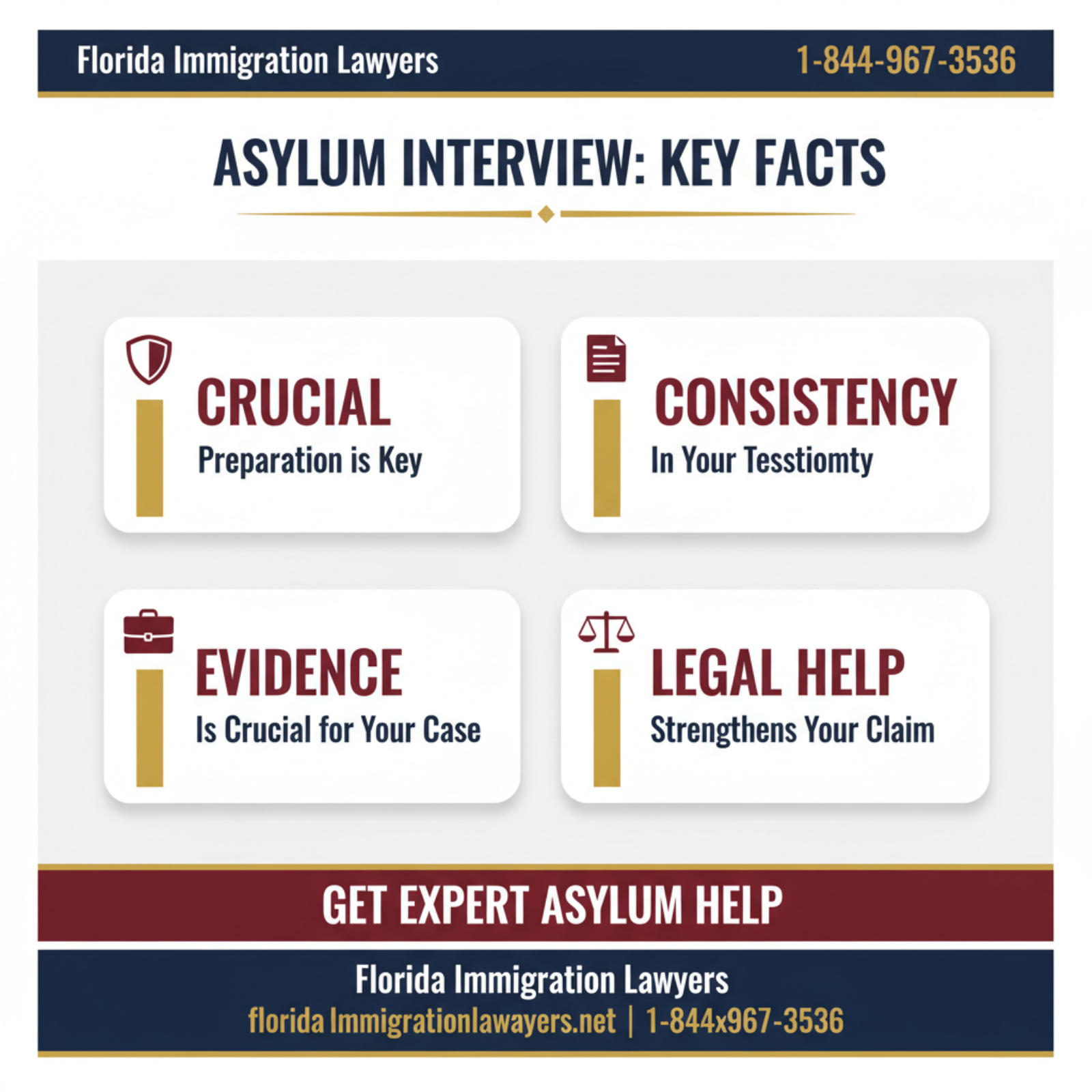
The most significant cost factor for many asylum seekers is legal representation. While not legally required, hiring an experienced immigration attorney greatly increases your chances of success. Attorneys charge for their time and expertise, which can vary based on the complexity of your case and the firm's fee structure. Florida Immigration Lawyers offers transparent fee structures and provides initial free consultations to discuss your case without obligation. The investment in legal counsel helps ensure your I-589 application is properly prepared, your evidence is strong, and you are thoroughly ready for your USCIS interview. This investment can prevent costly delays or even denial, making it invaluable for your future.
Do not navigate this complex and high-stakes process alone. The success of your asylum interview can profoundly impact your future and that of your family. For dedicated and experienced legal support, contact Florida Immigration Lawyers today at 1-844-967-3536. We are here to help you every step of the way.
Common Mistakes to Avoid During Your Asylum Interview
Making even a minor error during your asylum interview can have significant consequences. Being aware of these common pitfalls and actively working to avoid them is a crucial part of your asylum interview preparation.
- Inconsistency in Testimony: Providing different details or timelines than what is in your I-589 application or previous statements. Asylum Officers are trained to detect inconsistencies, which can undermine your credibility. Always be truthful and consistent.
- Lack of Specificity: General statements about fear or persecution without specific dates, locations, names, or events. Your story needs to be detailed and concrete to be convincing.
- Failure to Disclose All Information: Withholding information, even seemingly minor details, can be perceived as dishonesty. Disclose all relevant facts, even if they are difficult to discuss.
- Poor Document Organization: Arriving with disorganized or incomplete documents. This can create a chaotic impression and make it difficult for the Asylum Officer to review your evidence efficiently.
- Lack of Preparation for Questions: Not practicing how to articulate your story or answer challenging questions. You must be able to clearly explain why you fear persecution and why you cannot return home.
- Emotional Outbursts or Aggression: While understandable to be emotional, losing control or becoming aggressive can negatively impact the interview. Strive to remain composed and respectful.
- Not Using an Interpreter (If Needed): If you are not fluent in English, insist on using a certified interpreter provided by USCIS or a reliable one you bring. Attempting to struggle through the interview in English can lead to misunderstandings.
- Failing to Understand Legal Definitions: Not knowing the legal definition of persecution or the five protected grounds. Your claim must fit within these legal frameworks.
- Bringing Unnecessary People: Only bring essential individuals (attorney, interpreter, dependents). Bringing friends or extended family can be distracting and is generally not allowed.
- Lying or Misrepresenting Facts: This is a severe offense. Any deliberate misrepresentation of facts can lead to a denial of asylum and potentially other immigration consequences.
When to Call a Florida Immigration Lawyer for Asylum Help
While the law does not mandate legal representation for an asylum interview, the complexities of immigration law and the high stakes involved make it highly advisable. Knowing when to seek legal counsel can be the difference between approval and denial. Florida Immigration Lawyers are here to provide expert guidance.
You should contact Florida Immigration Lawyers if:
- You are preparing your I-589 application: An attorney can help you complete the application accurately, gather necessary documents, and draft a compelling declaration.
- You have received an asylum interview notice: This is the ideal time for intensive USCIS interview preparation, including mock interviews and legal strategy development.
- Your case involves complex legal issues: If your situation is not straightforward, involves past immigration issues, or falls under complex interpretations of Florida asylum law, an attorney is essential.
- You have faced previous denials or referrals: If your affirmative asylum claim was denied and referred to an immigration judge, you absolutely need an attorney for deportation defense Florida.
- You fear deportation: If you are in removal proceedings, an attorney can represent you in immigration court and fight for your right to asylum.
- You need help gathering evidence: Lawyers have resources and experience to help you secure difficult-to-obtain evidence or expert opinions.
- You are unsure about any aspect of the process: Any uncertainty can be addressed by a knowledgeable attorney, ensuring you are fully informed and confident.
Our dedicated team at Florida Immigration Lawyers serves clients across Florida, including Miami, Orlando, Tampa, and throughout the state. We are committed to protecting your rights and helping you achieve safety and security.
About Florida Immigration Lawyers
Florida Immigration Lawyers is a leading law firm dedicated to providing comprehensive and compassionate immigration legal services across the entire state of Florida. With years of experience and a deep understanding of U.S. immigration law, our attorneys are committed to helping individuals, families, and businesses navigate the complexities of the immigration system. We pride ourselves on offering personalized attention and strategic advocacy for every client.
Our firm specializes in a wide range of immigration matters, including:
- General Immigration Law
- Asylum and Refugee Claims
- Deportation Defense
- Family-Based Immigration
- Business Immigration
- Citizenship and Naturalization
Why choose Florida Immigration Lawyers? We offer free consultations, are available 24/7, and provide bilingual services (English and Spanish) to ensure clear communication and understanding. Our attorneys are passionate advocates who will tirelessly work to achieve the best possible outcome for your case. Your future is our priority. Contact us today at 1-844-967-3536 or visit our website at https://www.floridaimmigrationlawyers.net to learn how we can assist you.
Sources and References
- U.S. Citizenship and Immigration Services (USCIS) - Asylum
- U.S. Citizenship and Immigration Services (USCIS) - Form I-589
- Executive Office for Immigration Review (EOIR) - Immigration Courts
- 8 U.S.C. Chapter 12 - Immigration and Nationality Act (INA)
- 8 CFR Part 208 - Asylum and Withholding of Removal
This article provides general legal information and is not intended as legal advice. Every case is unique, and outcomes depend on specific facts and circumstances. Contact an attorney for advice about your particular situation.
Your journey to safety and security in Florida is too important to face alone. Let the experienced attorneys at Florida Immigration Lawyers guide you through every step of your asylum interview preparation. We are dedicated to providing the skilled legal representation you deserve. Call us now for a free consultation at 1-844-967-3536. Se Habla Español - Estamos aquí para ayudarle.
Do Not Navigate This Process Alone
Our experienced immigration attorneys are ready to fight for you. Get a free, confidential consultation today.
Se Habla Español
Frequently Asked Questions
Florida Immigration Lawyers
Immigration Attorney | Founder, Vasquez Law Firm
U.S. Air Force veteran and immigration attorney with thousands of cases resolved. J.D., NCCU School of Law. AILA member. Admitted to the 4th, 5th, and 11th Circuit Courts.
Available 24/7 - Free Evaluations
Related Legal Services
Our Florida immigration attorneys can help you with immigration practice areas, free immigration consultation and experienced immigration attorneys. Call today at 1-844-967-3536 for a free consultation.
Related Links
Related Topics
Free Legal Consultation
Discuss your case with our experienced attorneys. We're available 24/7.
Se Habla Español - Estamos aquí para ayudarle.
Related Articles
Stokes Interview: Navigating Marriage Fraud in Florida
A Stokes interview is a specialized, separate interview conducted by USCIS when there are suspicions of marriage fraud in a green card application. This rigorous process involves individual questioning of spouses, focusing on inconsistencies in their testimonies to determine the authenticity of their marital bond. For couples in Florida, navigating this high-stakes interview requires meticulous preparation, extensive documentation, and often the strategic guidance of an experienced immigration lawyer. Understanding the process, preparing for detailed questions, and presenting a strong case are crucial for overcoming marriage fraud allegations and securing your immigration future. Florida Immigration Lawyers stands ready to assist you.
Immigration Attorney Gainesville: North Florida Legal Help
For those in Gainesville, Alachua County, and throughout North Florida, navigating U.S. immigration law requires expert guidance. An experienced immigration attorney can simplify complex processes, from family-based petitions and employment visas to critical asylum claims and deportation defense. This comprehensive guide outlines the essential services provided by an immigration attorney, details necessary documentation, clarifies processing timelines, and discusses associated costs. We also highlight common mistakes to avoid and crucial scenarios where legal counsel is indispensable. Florida Immigration Lawyers serves all of Florida, including Gainesville and St. Petersburg, providing dedicated legal support to help you achieve your immigration goals. Contact us for a free consultation to discuss your specific needs.
Military Naturalization Expedited at Florida Bases
Explore expedited military naturalization processes for service members at Florida bases like MacDill. Learn about eligibility, steps, and common mistakes. Contact Florida Immigration Lawyers for a free consultation.
Protect Yourself from Immigration Scams in Florida
Learn how to protect against immigration scams in Florida, focusing on St. Petersburg. This guide covers identifying scams, verifying credentials, and getting legal help. Call Florida Immigration Lawyers at 1-844-967-3536 for assistance.
