Visa Bulletin October 2025: Florida Immigration Updates &
The Visa Bulletin October 2025 is crucial for anyone seeking a green card in Florida, including residents of Pembroke Pines. This monthly publication from the U.S. Department of State outlines immigrant visa availability for family-sponsored and employment-based categories, marking the start of a new fiscal year. It details Final Action Dates and Dates for Filing, which dictate when you can submit your adjustment of status application or expect final approval. Understanding your priority date and how it compares to the dates listed is paramount for timely processing. This guide explains how to read the bulletin, what documents you'll need, potential timelines, and common pitfalls to avoid. For personalized advice and to ensure your application is handled correctly, contact Florida Immigration Lawyers for a free consultation.

The Visa Bulletin October 2025 provides critical updates on the availability of immigrant visas for family-sponsored and employment-based categories, marking the start of the new fiscal year. It outlines Final Action Dates and Dates for Filing, guiding applicants in Florida on when they can submit their green card applications or have their cases finalized. Understanding these dates is crucial for timely immigration processing.
- The Visa Bulletin dictates green card availability monthly.
- It distinguishes between Final Action Dates and Dates for Filing.
- Family-sponsored and employment-based categories are affected.
- Priority dates must be current for application submission or approval.
- Consulting an immigration lawyer is vital for navigating complex dates.
Visa Bulletin October 2025: Your Guide to Florida Immigration Updates
Are you an immigrant in Florida, perhaps in Pembroke Pines or a surrounding area, eagerly awaiting your turn for a green card? Do you find yourself constantly checking the U.S. State Department’s monthly Visa Bulletin, hoping your priority date will become current? The Visa Bulletin October 2025 is a critical publication that can significantly impact your immigration journey, especially as it kicks off a new fiscal year.
Navigating the complexities of the Visa Bulletin can be daunting. It is filled with dates, categories, and country-specific limitations that often leave applicants confused. This comprehensive guide from Florida Immigration Lawyers aims to demystify the October 2025 Visa Bulletin, explaining what it means for you and your family in Florida.
We will break down the essential components, discuss how to interpret the dates, and highlight the implications for various visa categories. Our goal is to provide clear, actionable information to help you understand your next steps. Do not hesitate to call Florida Immigration Lawyers at 1-844-967-3536 for a free consultation if you need personalized guidance on your immigration case.
Understanding the Visa Bulletin October 2025: An Overview
The Visa Bulletin is a monthly publication by the U.S. Department of State that summarizes the availability of immigrant visas. These visas are subject to numerical limitations as set by Congress under the Immigration and Nationality Act (INA). The October bulletin is particularly significant as it marks the beginning of a new fiscal year (FY2026), often bringing shifts in visa availability.
The INA establishes worldwide limits on the number of immigrant visas issued each year, as well as per-country limits. When demand for visas in a particular category or from a specific country exceeds the supply, that category or country becomes “oversubscribed.” This leads to a waiting list, and a “priority date” is assigned to each applicant.
What Are Priority Dates, Final Action Dates, and Dates for Filing?
Your priority date is the date your immigrant petition was properly filed with USCIS or, for labor certification cases, the date the Department of Labor received your application. This date essentially marks your place in line for a green card.
The Visa Bulletin presents two key charts for most preference categories: Final Action Dates and Dates for Filing Applications. The Final Action Dates chart indicates when immigrant visas may finally be issued. This means that if your priority date is earlier than the Final Action Date listed for your category and country, your visa is current, and your case can move forward to final adjudication, either through adjustment of status with USCIS or consular processing abroad.
The Dates for Filing Applications chart, on the other hand, allows certain applicants to file their adjustment of status applications with USCIS earlier than their Final Action Date. This can be a significant advantage, as it allows individuals to obtain work authorization and travel permits (advance parole) sooner. USCIS determines monthly whether applicants can use the Dates for Filing chart or must use the Final Action Dates chart for adjustment of status purposes. Always check the USCIS website for their announcement each month.
Family-Sponsored and Employment-Based Preference Categories
The Visa Bulletin categorizes immigrant visas into family-sponsored and employment-based preferences, each with subcategories and specific annual limits. For family-sponsored visas, these include:
- F1: Unmarried Sons and Daughters of U.S. Citizens.
- F2A: Spouses and Children of Permanent Residents.
- F2B: Unmarried Sons and Daughters (21 years of age or older) of Permanent Residents.
- F3: Married Sons and Daughters of U.S. Citizens.
- F4: Brothers and Sisters of U.S. Citizens.
Employment-based visas are divided into:
- EB-1: Priority Workers (e.g., extraordinary ability, outstanding professors/researchers, multinational executives).
- EB-2: Professionals Holding Advanced Degrees or Persons of Exceptional Ability (e.g., National Interest Waiver).
- EB-3: Skilled Workers, Professionals, and Other Workers.
- EB-4: Certain Special Immigrants (e.g., religious workers, broadcasters).
- EB-5: Immigrant Investors.
Each category has specific requirements and varying backlogs, particularly for nationals of certain countries like China, India, Mexico, and the Philippines, which frequently face longer waits. When considering which employment-based green card is fastest, EB-1 is often the quickest for eligible individuals due to its high priority and relatively lower demand compared to EB-2 or EB-3 for most countries.
Reading the Visa Bulletin October 2025: A Step-by-Step Guide
Understanding the Visa Bulletin is crucial for anyone pursuing a green card in Florida. Here is a step-by-step guide on how to interpret the October 2025 Visa Bulletin:
-
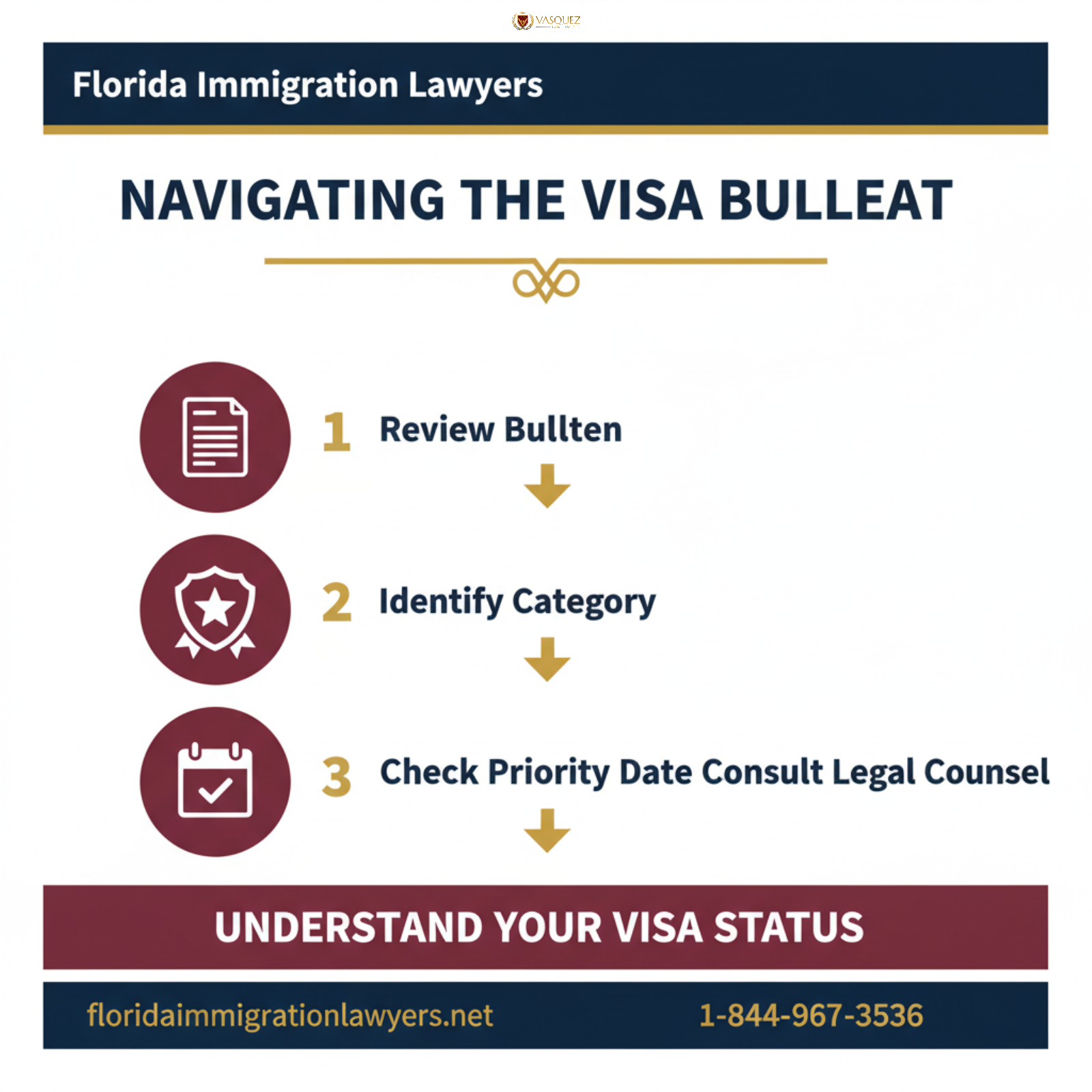
Locate the Current Month's Bulletin: Always ensure you are looking at the official Visa Bulletin for the correct month and year. You can find this on the U.S. Department of State's website.
-
Identify Your Visa Preference Category: Determine whether your petition falls under a family-sponsored (F1, F2A, F2B, F3, F4) or employment-based (EB-1, EB-2, EB-3, EB-4, EB-5) category. Your I-797 approval notice will typically state your category.
-
Find Your Country of Chargeability: This is generally your country of birth, not your current nationality or residence. Locate the column corresponding to your country.
-
Check the "Final Action Dates" Chart (Chart A): This chart shows the dates when immigrant visas are available for final processing. Compare your priority date to the date listed for your category and country. If your priority date is earlier than the date shown, your visa is current, and your case can move forward to final adjudication. For instance, if the chart shows January 1, 2020, and your priority date is December 15, 2019, you are current.
-
Review the "Dates for Filing Applications" Chart (Chart B): This chart indicates when applicants may file their Form I-485, Application to Register Permanent Residence or Adjust Status, with USCIS. Check the USCIS website at the beginning of each month to see if they are accepting filings based on Chart B. If your priority date is earlier than the date listed in Chart B and USCIS allows its use, you may be able to file your I-485 sooner.
-
Understand "C" and "U": If you see a "C" in the chart, it means "Current," indicating that visas are immediately available for all applicants in that category and country. A "U" means "Unauthorized," signifying that visas are not authorized for issuance.
-
Monitor Monthly Updates: The Visa Bulletin changes every month. What is current in October 2025 might retrogress in November 2025, or advance further. Consistent monitoring is essential for all Florida immigrants.
Essential Document Checklist for Adjustment of Status
If your priority date becomes current according to the Visa Bulletin October 2025, and you are eligible to file for adjustment of status in Florida, you will need to prepare a comprehensive set of documents. This list is general; your specific case may require additional items.
- Form I-485, Application to Register Permanent Residence or Adjust Status.
- Form I-130 (if family-based, already approved) or I-140 (if employment-based, already approved).
- Form I-864, Affidavit of Support (for family-based petitions).
- Form I-693, Report of Medical Examination and Vaccination Record.
- Form I-765, Application for Employment Authorization (optional, but highly recommended).
- Form I-131, Application for Travel Document (optional, for advance parole).
- Copies of your birth certificate, marriage certificate (if applicable), and any previous divorce decrees.
- Copies of your passport, visa pages, and I-94 arrival/departure record.
- Two passport-style photographs.
- Copies of all previous I-20s (for F-1 students), DS-2019s (for J-1 exchange visitors), or other relevant immigration documents.
- Evidence of your legal entry into the U.S.
- Police clearances and court records (if any).
- Proof of continuous legal presence in the U.S. (if applicable).
Gathering these documents can be time-consuming. Starting early and organizing everything meticulously will streamline your application process. An experienced immigration lawyer can help you ensure all necessary documents are included.
Timeline and Processing Expectations for Florida Applicants
The processing timeline for green card applications after your priority date becomes current can vary significantly. Factors influencing this include the specific USCIS field office (e.g., Miami, Orlando, Jacksonville), the complexity of your case, and current USCIS workloads. While some employment-based green cards can be faster, USCIS processing times can be unpredictable.
For those filing an I-485 in Florida, after your application is received, you will typically receive a receipt notice, followed by an appointment for biometrics (fingerprints and photos). An interview at a local USCIS field office may be scheduled. The entire process, from filing I-485 to final approval, can take anywhere from several months to several years, depending on the category and caseload.
Many applicants wonder, "Is USCIS moving faster in 2025?" While USCIS has made efforts to reduce backlogs and improve efficiency, processing times remain subject to resource allocation, policy changes, and the volume of applications. It is not possible to guarantee faster processing for everyone in 2025. You can check current processing times on the USCIS website.
The Visa Bulletin itself can also experience periods of rapid advancement, slow movement, or even retrogression. "Why is the Visa Bulletin not moving?" is a common question. This typically occurs when demand for visas significantly outpaces the annual supply for a particular category or country, leading to long backlogs. Retrogression happens when more visas are issued than available in a fiscal year, requiring the State Department to pull back the dates to stay within legal limits. This can be particularly frustrating for Florida residents who have been waiting for years.
Do not navigate this process alone. Contact Florida Immigration Lawyers today to ensure your application is timely and complete, maximizing your chances of success.
Cost Factors and Fee Breakdown for Green Card Applications
Pursuing a green card involves various fees, including government filing fees and potential legal fees. It is important to budget for these costs as part of your immigration journey in Florida.
Government Filing Fees
USCIS charges fees for various forms, such as the I-485, I-765, and I-131. These fees are subject to change and should always be verified on the official USCIS website. For family-sponsored cases, there may also be a fee for the I-130 petition. For employment-based cases, the I-140 petition also incurs a fee, typically paid by the employer. It is crucial to remember that these fees are non-refundable, even if your application is denied.
Legal Fees
Hiring an experienced immigration attorney, like those at Florida Immigration Lawyers, is an investment that can save you time, stress, and potential costly mistakes. Legal fees vary depending on the complexity of your case and the services required. A lawyer can assist with:
- Evaluating your eligibility for adjustment of status or consular processing.
- Preparing and reviewing all necessary forms and supporting documents.
- Responding to Requests for Evidence (RFEs) from USCIS.
- Representing you at interviews, if required.
- Providing ongoing guidance and updates on your case.
While legal fees are an additional cost, the peace of mind and expertise provided by a qualified attorney are invaluable, especially when dealing with the intricacies of the Visa Bulletin October 2025 and complex immigration laws. We offer free consultations to discuss your specific needs and our fee structure.
Common Mistakes to Avoid in Your Immigration Journey
Immigration processes are detail-oriented, and even minor errors can lead to significant delays or denials. Here are common mistakes Florida immigrants should avoid, especially when dealing with a dynamic publication like the Visa Bulletin October 2025:
-
Misinterpreting the Visa Bulletin: Failing to correctly read Final Action Dates versus Dates for Filing, or misidentifying your priority date or category, can lead to filing too early or too late. This can result in rejection of your application or missing a crucial window.
-
Ignoring USCIS Filing Chart Updates: USCIS often specifies which chart (Final Action Dates or Dates for Filing) to use for adjustment of status applications each month. Not checking the USCIS website for this monthly update can lead to your I-485 being rejected.
-
Filing an Incomplete Application: Submitting an I-485 package without all required forms, supporting documents, or correct fees will almost certainly result in a Request for Evidence (RFE) or outright denial, causing significant delays.
-
Failing to Disclose All Information: Omitting information about arrests, previous immigration violations, or other relevant history can be considered misrepresentation and lead to severe consequences, including permanent bars from the U.S.
-
Missing Deadlines: Failing to respond to RFEs, interview notices, or other USCIS communications by the specified deadline can lead to abandonment or denial of your application.
-
Traveling Without Advance Parole: If you have a pending I-485 and travel outside the U.S. without an approved advance parole document (Form I-131), your adjustment of status application may be considered abandoned, potentially barring your re-entry.
-
Changing Employers Without Proper Guidance (for EB cases): For employment-based petitions, changing employers before your green card is approved can jeopardize your application, especially if the new job is not similar or USCIS is not properly notified via Form I-485 Supplement J.
-
Not Updating Address with USCIS: Moving without informing USCIS of your new address can result in missed notices, RFEs, or interview appointments, leading to significant problems for your case.
-
Providing Inconsistent Information: Submitting forms or documents with conflicting information can raise red flags for USCIS and lead to further scrutiny, delays, or even accusations of fraud.
-
Attempting to Self-Represent Complex Cases: While some straightforward cases might be manageable, complex immigration matters, especially those involving waivers or prior issues, are best handled by an experienced attorney. Mistakes can be costly and difficult to rectify.
When to Call a Florida Immigration Lawyer
While this guide provides general information, immigration law is incredibly nuanced. The Visa Bulletin October 2025 is just one piece of a much larger puzzle. You should consider calling Florida Immigration Lawyers if you encounter any of the following scenarios:
- You are unsure how to interpret your priority date or visa category.
- Your priority date is current, and you need assistance preparing your adjustment of status application.
- You have received a Request for Evidence (RFE) or Notice of Intent to Deny (NOID) from USCIS.
- You have a complex immigration history, such as previous denials, overstays, or criminal issues.
- You are concerned about potential retrogression and want to understand your options.
- You are contemplating changing employers while your employment-based green card is pending.
- You need to understand the implications of the Visa Bulletin for family members or dependents.
- You are facing deportation or removal proceedings and need deportation defense.
- You are seeking asylum or have other complex immigration needs beyond typical green card processing.
Our attorneys specialize in a wide range of immigration services, including family-based immigration, business immigration, and citizenship applications. We are well-versed in the latest updates from USCIS and the Department of State, including the intricacies of the Visa Bulletin. Our firm proudly serves clients throughout Florida, including Pembroke Pines and surrounding communities.
About Florida Immigration Lawyers
Florida Immigration Lawyers is a leading immigration law firm dedicated to serving individuals and families across the entire state of Florida. With years of experience and a deep understanding of U.S. immigration laws, our compassionate and skilled attorneys are committed to providing exceptional legal representation and personalized service.
We understand the profound impact immigration matters have on your life. Our firm offers a full spectrum of immigration services, from family-sponsored petitions and employment visas to asylum claims, deportation defense, and naturalization. We pride ourselves on our client-focused approach, ensuring you feel supported and informed at every stage of your journey.
Why choose Florida Immigration Lawyers? We offer free consultations, are available 24/7, and provide bilingual services (English and Spanish) to better serve our diverse community. Our commitment is to help you achieve your immigration goals with integrity and expertise. Visit our website at https://www.floridaimmigrationlawyers.net or call us at 1-844-967-3536 to learn how we can assist you.
Sources and References
- U.S. Citizenship and Immigration Services (USCIS)
- U.S. Department of State - Visa Bulletin
- Executive Office for Immigration Review (EOIR)
- 8 U.S.C. § 1151 (Immigration and Nationality Act Section 201 - Worldwide Level of Immigration)
- 8 U.S.C. § 1153 (Immigration and Nationality Act Section 203 - Allocation of immigrant visas)
- 8 CFR § 245.1 (Adjustment of Status eligibility requirements)
- USCIS Policy Manual, Volume 7, Part B, Chapter 3 (Visa Availability and Priority Dates)
This article provides general legal information and is not intended as legal advice. Every case is unique, and outcomes depend on specific facts and circumstances. Contact an attorney for advice about your particular situation.
Understanding the Visa Bulletin October 2025 is a critical step for your immigration journey in Florida. Do not let confusion or uncertainty delay your dreams. Florida Immigration Lawyers is here to provide the expert guidance you need. Call us today for a free consultation at 1-844-967-3536. Se Habla Español - Estamos aquí para ayudarle.
Do Not Navigate This Process Alone
Our experienced immigration attorneys are ready to fight for you. Get a free, confidential consultation today.
Se Habla Español
Frequently Asked Questions
Florida Immigration Lawyers
Immigration Attorney | Founder, Vasquez Law Firm
U.S. Air Force veteran and immigration attorney with thousands of cases resolved. J.D., NCCU School of Law. AILA member. Admitted to the 4th, 5th, and 11th Circuit Courts.
Available 24/7 - Free Evaluations
Related Legal Services
Our Florida immigration attorneys can help you with asylum protection, deportation defense and citizenship and naturalization. Call today at 1-844-967-3536 for a free consultation.
Related Links
Related Topics
Free Legal Consultation
Discuss your case with our experienced attorneys. We're available 24/7.
Se Habla Español - Estamos aquí para ayudarle.
Related Articles
Understanding Citizenship Application Delays in Florida
Facing delays in your citizenship application in Florida? Learn about the causes, how to manage them, and when to seek legal help. Our guide provides insights into the N-400 process and offers practical advice for applicants in Tallahassee. Contact us for a free consultation.
VAWA Self-Petition for Abused Spouse in Florida | VLF Florida
Learn how to file a VAWA self-petition in Florida as an abused spouse. Discover eligibility requirements, process steps, and when to seek legal help. Call Florida Immigration Lawyers for a free consultation.
Navigating the Unlawful Presence Waiver in Florida
Learn about the I-601A provisional waiver for unlawful presence in Florida. This guide covers eligibility, application steps, common mistakes, and why consulting an attorney is crucial. Contact Florida Immigration Lawyers for a free consultation.
Protecting Against Immigration Scams in Florida | VLF Florida
Learn how to protect yourself from immigration scams in Florida, including notario fraud. Discover actionable steps and legal resources. Call Florida Immigration Lawyers at 1-844-967-3536.