Adjustment of Status Florida Guide: Get Your Green Card
Applying for a green card from within the U.S. through adjustment of status (Form I-485) can be a life-changing step for immigrants in Florida. This comprehensive guide details the eligibility requirements, a step-by-step application process, essential documents, expected timelines, and associated costs. We highlight Florida-specific considerations, including local USCIS offices and the importance of avoiding common mistakes that could jeopardize your application. Learn how to navigate this complex journey successfully and when to seek expert legal counsel from Florida Immigration Lawyers to secure your permanent residency in the Sunshine State. Get a free consultation today.

Adjustment of Status (AOS) allows eligible individuals already present in the U.S. to apply for lawful permanent residency (a green card) without leaving the country. This involves filing Form I-485, Application to Register Permanent Residence or Adjust Status, with USCIS. Eligibility typically hinges on having an approved immigrant petition, such as a family-based I-130 or an employment-based I-140, and maintaining lawful entry or meeting specific exceptions. For applicants in Florida, understanding state-specific resources and the nuances of local USCIS field offices, like those in Orlando or Miami, is crucial for a smooth process.
- Eligibility: Generally requires an approved immigrant petition and lawful entry into the U.S.
- Application: File Form I-485 with all required supporting documents.
- Interview: Most applicants attend an interview at a USCIS field office.
- Green Card: Upon approval, you become a lawful permanent resident.
For many immigrants, the dream of calling Florida home permanently is a powerful motivator. Whether you've built a life in Kissimmee, Orlando, or anywhere across the Sunshine State, securing your legal residency is a critical step. If you are currently in the United States and qualify for a green card, the process of adjustment of status offers a pathway to achieving that dream without having to return to your home country. This comprehensive guide will walk you through the intricacies of the I-485 application, its requirements, potential challenges, and how to navigate the system effectively, especially for those residing in Florida. Don't embark on this journey alone. Call Florida Immigration Lawyers at 1-844-967-3536 for a free consultation and let our experienced team help you understand your options.
Understanding Adjustment of Status (I-485) in Florida
Adjustment of Status (AOS) is the process by which an eligible non-citizen can apply for lawful permanent resident (LPR) status, or a green card, while remaining in the United States. This is a significant advantage over consular processing, which requires applicants to travel to a U.S. embassy or consulate abroad for their immigrant visa interview. For individuals and families in Florida, AOS offers stability and allows them to continue their lives, work, and education without interruption during the application period. The core of this process is Form I-485, Application to Register Permanent Residence or Adjust Status.
To be eligible for adjustment of status under Immigration and Nationality Act (INA) Section 245(a), codified at 8 U.S.C. § 1255(a), you must generally meet several key requirements. These often include having an approved immigrant petition (such as an I-130 for family-based or I-140 for employment-based immigration), being inspected and admitted or paroled into the U.S., and having an immigrant visa immediately available. Certain individuals, like immediate relatives of U.S. citizens, may be able to adjust status even if they have overstayed a visa or worked without authorization. However, other categories, such as those with certain criminal histories or prior immigration violations, may face significant hurdles or require waivers.
Florida is a vibrant state with a large and diverse immigrant population, making the demand for adjustment of status applications consistently high. USCIS field offices in Florida, including those in Orlando, Tampa, and Miami, handle interviews for local applicants. Understanding the specific procedures and potential backlogs at these offices is vital. Florida Immigration Lawyers has extensive experience assisting clients throughout the state, from Kissimmee to the Florida Keys, ensuring their applications are meticulously prepared and properly submitted. Our deep knowledge of local procedures and federal immigration law, as outlined in 8 CFR Part 245, empowers our clients to navigate this complex journey with confidence.
Step-by-Step Guide to the Adjustment of Status Process
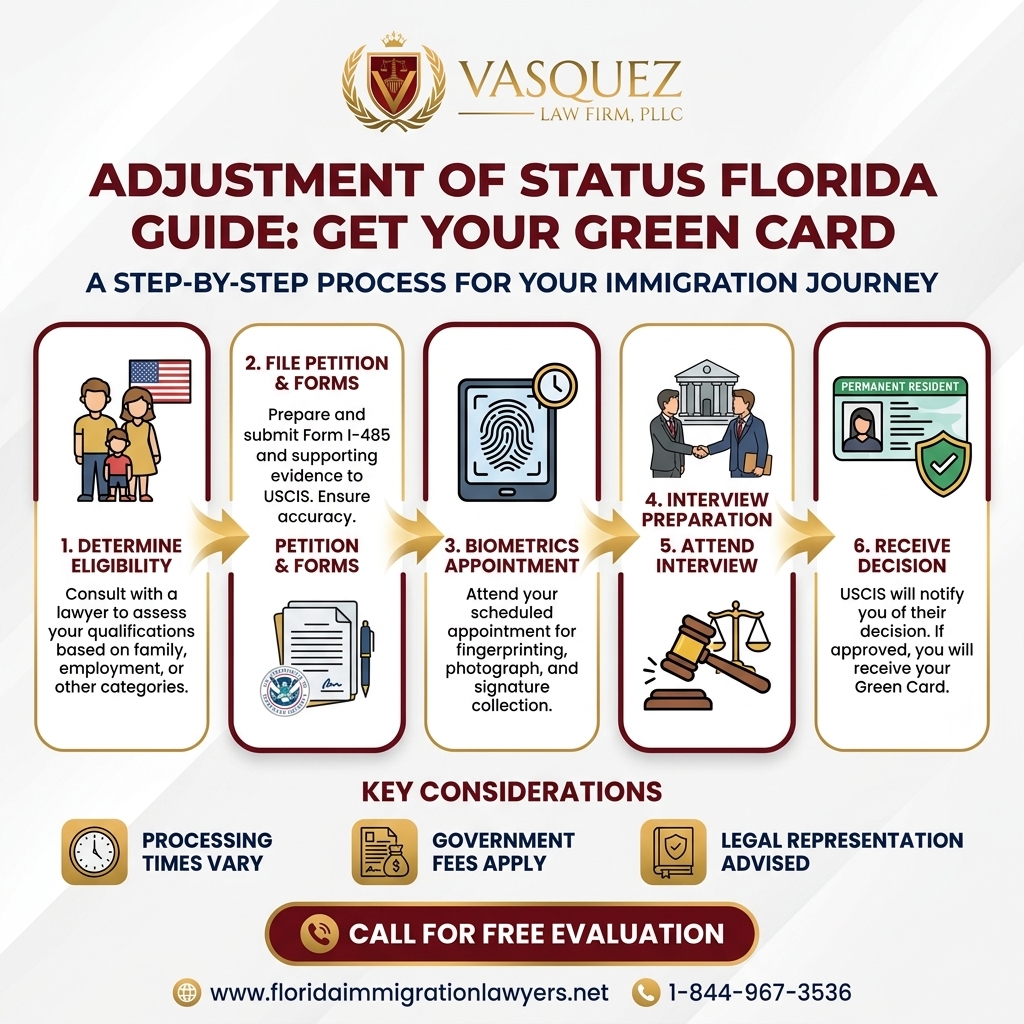
Navigating the adjustment of status process can seem daunting, but breaking it down into manageable steps makes it clearer. Follow this comprehensive guide to understand what to expect as you pursue your green card in Florida.
-
Step 1: Establish Eligibility and Underlying Petition
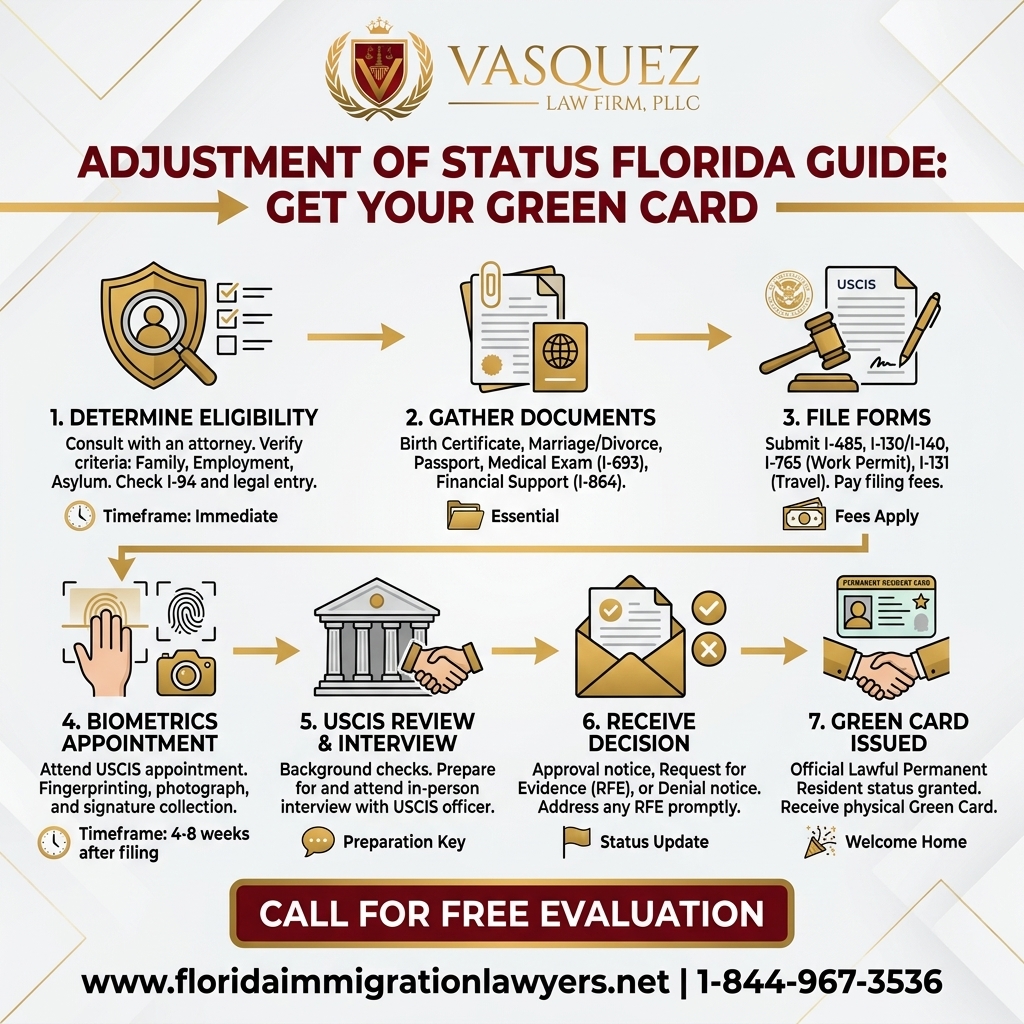
Before you can apply for adjustment of status, you must typically have an approved immigrant petition that establishes your eligibility for a green card. This is often Form I-130, Petition for Alien Relative, filed by a U.S. citizen or lawful permanent resident family member, or Form I-140, Immigrant Petition for Alien Worker, filed by an employer. In some cases, such as for asylum seekers, a different underlying basis like an approved I-589 application may serve. Ensure your petition is approved and, if applicable, that your priority date is current according to the Visa Bulletin published by the Department of State.
-
Step 2: File Form I-485 and Supporting Documents
Once your eligibility is established and an immigrant visa is available, you will file Form I-485, Application to Register Permanent Residence or Adjust Status. This form is the cornerstone of your application. You will submit it along with a substantial packet of supporting documents, including birth certificates, marriage certificates (if applicable), passport photos, and medical exam results. Many applicants concurrently file for employment authorization (Form I-765) and advance parole (Form I-131) to allow them to work and travel while their I-485 is pending. This concurrent filing is a common strategy to maintain legal status and flexibility during the lengthy processing period.
-
Step 3: Attend Biometrics Appointment
After USCIS accepts your I-485 application, you will receive an appointment notice for biometrics. This appointment, typically at a local Application Support Center (ASC) in Florida, involves capturing your fingerprints, photograph, and signature. These biometrics are used for background checks and identity verification. It is a mandatory step, and failing to attend can lead to delays or even denial of your application. Make sure to bring the appointment notice and a valid photo ID.
-
Step 4: Prepare for the Interview
Most adjustment of status applicants are required to attend an interview with a USCIS officer at a field office. For Florida residents, this could be in Orlando, Tampa, or Miami. During the interview, the officer will review your application, ask questions about your eligibility, the underlying petition, your relationship (for family-based cases), and your immigration history. It is crucial to be honest and well-prepared. Bring all original documents, including those previously submitted, as well as any updated evidence. An attorney from Florida Immigration Lawyers can help you prepare thoroughly, ensuring you understand the types of questions you may face and how to present your case effectively.
-
Step 5: Receive a Decision
Following your interview, the USCIS officer will make a decision. If approved, you will typically receive your green card in the mail within a few weeks. If additional information is needed, USCIS may issue a Request for Evidence (RFE), which requires a timely and comprehensive response. In some cases, a Notice of Intent to Deny (NOID) may be issued, giving you a final opportunity to present arguments against denial. A denial can have serious consequences, potentially leading to deportation proceedings, highlighting the importance of professional legal assistance throughout the process.
Essential Documents for Your I-485 Application
A complete and accurate application package is paramount for a successful adjustment of status. Missing or incorrect documents are among the most common reasons for delays, Requests for Evidence (RFEs), or even denials. As you prepare your Form I-485 in Florida, gather the following essential documents:
- Form I-485, Application to Register Permanent Residence or Adjust Status: The primary application form itself, completed accurately and signed.
- Form I-130 (or other underlying petition) Approval Notice: Evidence that your immigrant petition has been approved. If filing concurrently, include the I-130 form.
- Copy of Birth Certificate: A certified copy of your birth certificate. If it's not in English, it must be accompanied by a certified English translation.
- Copies of Passport & Visa Pages: All pages of your passport, including the biographical page and any pages with visas or entry stamps.
- Form I-94, Arrival/Departure Record: Proof of your lawful entry into the United States. You can often retrieve this online from the CBP website.
- Two Passport-Style Photos: Taken within 30 days of filing the application, meeting USCIS specifications.
- Form I-693, Report of Medical Examination and Vaccination Record: Completed by a USCIS-approved civil surgeon in a sealed envelope. This is a critical component for health-related admissibility.
- Form I-864, Affidavit of Support (Family-Based): For most family-based petitions, a sponsor must demonstrate the financial means to support the applicant.
- Proof of Relationship (Family-Based): Marriage certificates, birth certificates of children, joint bank accounts, photos, and other evidence proving a bona fide relationship.
- Police Clearances and Court Records: If you have any arrests or convictions, even minor ones, you must disclose them and provide certified court disposition documents. This is especially important for Florida residents, where local county clerk offices provide such records.
- Previous Immigration Filings: Copies of any prior applications, petitions, or notices from USCIS or immigration courts.
- Employment Authorization Document (EAD) and Advance Parole (AP) Forms: If applying concurrently, include Forms I-765 and I-131 and their supporting documents.
Organizing these documents correctly is crucial. Florida Immigration Lawyers can help you compile a robust application package, ensuring no detail is overlooked, which can significantly expedite your process.
Timelines and Processing Expectations for Florida Applicants
One of the most common questions our clients ask about adjustment of status is, "How long will it take?" The answer, unfortunately, is that processing times can vary significantly based on several factors, including the specific USCIS service center, the field office handling your interview, the complexity of your case, and current USCIS caseloads. While there's no single definitive timeline, we can provide general expectations for applicants in Florida.
Typically, the entire adjustment of status process, from filing the I-485 to receiving the green card, can take anywhere from 10 months to over 2 years. This estimate does not include the time it takes for your underlying immigrant petition (like an I-130) to be approved, which can add several months or even years, especially for preference categories with long backlogs. For Florida residents, interviews are scheduled at USCIS field offices in Orlando, Tampa, or Miami, depending on your residency. These offices have varying backlogs, which can impact your interview scheduling. You can check current processing times on the USCIS website, but remember these are estimates and can change frequently.
What to Expect in the Process Timeline:
- Initial Receipt Notice: Within 2-4 weeks after filing.
- Biometrics Appointment: 3-8 weeks after filing.
- Employment Authorization Document (EAD) / Advance Parole (AP): If concurrently filed, these work permits and travel documents often arrive within 6-12 months. This is crucial for maintaining legal employment and the ability to travel while your green card application is pending.
- Interview Scheduling: This is the most variable part, often taking 6-18 months after biometrics, depending on the field office and case type. For instance, immediate relative cases often move faster than some preference categories.
- Decision: Typically within a few weeks to a few months after the interview. Some decisions are made on the spot, while others require further review.
It's important to remain patient and responsive throughout this period. Any Requests for Evidence (RFEs) or interview rescheduling can extend your timeline. Our team at Florida Immigration Lawyers monitors your case status diligently and proactively responds to any USCIS inquiries, helping to keep your process on track. We understand the anticipation and stress involved, particularly for those building their lives in Florida communities like Kissimmee, and we are committed to providing clear communication and support every step of the way.
Cost Factors and Fee Breakdown for Adjustment of Status
Understanding the financial commitment involved in the adjustment of status process is essential for planning. The total cost is not just about the USCIS filing fees; it also includes other mandatory expenses and, optionally, legal fees for professional assistance. While USCIS fees can change, and we cannot provide exact current figures, we can outline the typical components of the cost.
Key Cost Components:
- USCIS Filing Fees:
- Form I-485, Application to Register Permanent Residence or Adjust Status: This is the primary fee for your green card application.
- Form I-130, Petition for Alien Relative (if filed concurrently or as the underlying petition): A separate fee applies to the family-based petition.
- Biometrics Services Fee: A mandatory fee for fingerprinting and background checks.
- Form I-765, Application for Employment Authorization (EAD): Often filed concurrently with I-485, but the fee may be waived if filed with I-485.
- Form I-131, Application for Travel Document (Advance Parole): Also often filed concurrently, and the fee may be waived if filed with I-485.
It's important to note that USCIS fees are subject to change. Always check the official USCIS website or consult with an attorney for the most current fee schedule. In some limited circumstances, applicants may be eligible for a fee waiver by filing Form I-912, Request for Fee Waiver, if they meet specific poverty guidelines.
- Medical Examination Fee (Form I-693): This fee is paid directly to the USCIS-approved civil surgeon who conducts your medical exam. The cost varies by doctor and location in Florida but typically ranges from a few hundred dollars. This is a crucial and mandatory part of the application process, ensuring you meet public health admissibility standards.
- Attorney Fees: While not mandatory, hiring an experienced immigration attorney from Florida Immigration Lawyers can be an invaluable investment. Our fees cover comprehensive legal guidance, meticulous preparation of all forms and documents, strategic advice, communication with USCIS, and representation at interviews. We offer transparent fee structures and free consultations to discuss your specific case and associated costs, providing peace of mind as you navigate the complexities of immigration law.
- Miscellaneous Costs: These can include fees for obtaining certified copies of documents (birth certificates, marriage licenses from Florida county clerks), translation services for non-English documents, postage, and travel expenses for biometrics appointments or interviews in cities like Orlando or Miami.
Budgeting for these expenses is a crucial part of your adjustment of status planning. An attorney can help you understand the full financial scope and potential for fee waivers, ensuring you are prepared for every step.
Do not navigate this complex process alone. The stakes are too high, and even minor errors can lead to significant delays or denials. Contact Florida Immigration Lawyers today for expert guidance and dedicated representation. Our team is ready to provide the support you need.
Common Mistakes to Avoid During Adjustment of Status
The adjustment of status process is highly detailed, and even seemingly small errors can lead to significant setbacks, including delays, Requests for Evidence (RFEs), or outright denial. Avoiding these common pitfalls is crucial for a smooth application process. Here are 7-12 common mistakes that applicants often make:
-
Filing Incomplete or Incorrect Forms: Submitting forms with missing information, unsigned sections, or outdated versions is a frequent error. USCIS will reject such applications, causing immediate delays. Always use the latest forms from the USCIS website and fill out every applicable section accurately.
-
Missing Supporting Documentation: Failing to include all required evidence, such as birth certificates, marriage licenses, or financial documents, will inevitably lead to an RFE. This prolongs the process and adds stress. Create a checklist and meticulously verify every item before submission.
-
Failing to Disclose Criminal History: Any past arrests, charges, or convictions, even if expunged or minor, must be disclosed. Hiding this information can be considered misrepresentation and lead to a permanent bar from the U.S. Always provide certified court dispositions and discuss with an attorney.
-
Traveling Without Advance Parole: Leaving the U.S. while your I-485 is pending without an approved Advance Parole document (Form I-131) can be considered abandonment of your adjustment of status application. This is a critical mistake that can prevent you from re-entering the country and lead to denial.
-
Not Attending Biometrics or Interview: Missing scheduled appointments for biometrics or your green card interview without proper rescheduling can result in the denial of your application. Always keep track of notices and respond promptly.
-
Ignoring Requests for Evidence (RFEs): If USCIS sends an RFE, it means they need more information. Failing to respond by the deadline, or providing an inadequate response, will almost certainly lead to a denial. Address all points in the RFE comprehensively and on time.
-
Not Updating Address Changes: If you move, you must notify USCIS within 10 days by filing Form AR-11. Failing to do so can result in missed notices, appointments, and potentially the denial of your application due to lack of communication.
-
Submitting an Expired Medical Exam: Form I-693 (medical exam) has a validity period. If your application takes too long, or if you wait too long to submit it, your medical exam might expire before your interview or decision, necessitating a new one and causing delays.
-
Misrepresenting Facts or Providing False Information: Any false statement or fraudulent document submitted to USCIS can lead to severe consequences, including permanent ineligibility for immigration benefits and potential criminal charges. Honesty and accuracy are paramount.
-
Overstaying Visa or Working Without Authorization (for non-immediate relatives): While immediate relatives of U.S. citizens may be excused from certain violations, most other applicants for adjustment of status must have maintained lawful status and not worked without authorization. Understanding your specific eligibility is crucial to avoid this pitfall.
-
Filing Without an Underlying Immigrant Petition: Adjustment of status is not a standalone process; it must be based on an approved or concurrently filed immigrant petition (e.g., I-130, I-140). Filing I-485 without this foundation will lead to rejection.
-
Attempting to Adjust Status from an Ineligible Category: Not all visa categories or forms of entry allow for adjustment of status. For example, individuals who entered without inspection (EWI) are generally ineligible unless they qualify for specific exceptions like Section 245(i). Consulting an attorney can confirm your eligibility.
These mistakes can be costly and emotionally draining. Working with knowledgeable Florida immigration attorneys ensures that your application is prepared correctly, minimizing risks and maximizing your chances of approval.
When to Call a Florida Immigration Lawyer
While some immigration processes appear straightforward, adjustment of status can involve complex legal nuances that are best handled by an experienced attorney. Knowing when to seek legal counsel is crucial for protecting your rights and ensuring a successful outcome. You should strongly consider contacting Florida Immigration Lawyers if you encounter any of the following scenarios:
- Complex Eligibility Issues: If you have a history of overstays, unauthorized employment, prior deportations, or entered the U.S. without inspection, your case will likely require expert analysis to determine eligibility and potential waivers.
- Criminal History: Any arrests, charges, or convictions, no matter how minor, can significantly complicate your application and potentially lead to inadmissibility. An attorney can assess the impact and advise on necessary waivers or defenses.
- Previous Immigration Denials or Problems: If you've had previous visa denials, petitions rejected, or have been in deportation proceedings, your case carries additional scrutiny.
- Marriage-Based Adjustment with Red Flags: If your marriage is relatively new, there's a significant age difference, or you have a history of previous marriages, USCIS may scrutinize your relationship more closely. An attorney helps prove the bona fide nature of your marriage.
- Language Barriers or Difficulty Understanding Legal Terminology: Immigration law is filled with complex jargon. If English is not your first language or you find it challenging to comprehend legal documents, an attorney can ensure you fully understand the process and your rights.
- Receiving a Request for Evidence (RFE) or Notice of Intent to Deny (NOID): These notices indicate a problem with your application that requires a detailed and timely legal response. An attorney can formulate the strongest possible reply.
- Unfamiliarity with USCIS Procedures: The specific requirements and procedures of USCIS, particularly at Florida field offices, can be confusing. An attorney provides clarity and ensures compliance.
- Stress and Uncertainty: The immigration process is inherently stressful. Having a knowledgeable advocate by your side provides peace of mind and allows you to focus on your life in Florida.
Florida Immigration Lawyers serves clients across the state, including in communities like Kissimmee, Orlando, and Miami. We specialize in family-based immigration and adjustment of status cases, offering personalized, compassionate, and effective legal representation. Don't risk your future; let our team of dedicated attorneys guide you.
About Florida Immigration Lawyers
Florida Immigration Lawyers is a leading immigration law firm dedicated to serving individuals and families throughout the entire state of Florida. With years of experience and a deep commitment to our clients, we understand the profound impact immigration matters have on people's lives. Our firm is built on a foundation of legal excellence, compassionate service, and unwavering advocacy. We pride ourselves on providing personalized attention to each case, recognizing that every client's situation is unique.
We offer a comprehensive range of immigration legal services, including but not limited to, adjustment of status, asylum applications, deportation defense, family-based petitions, employment visas, and naturalization and citizenship. Our attorneys are highly skilled in navigating the complexities of U.S. immigration law, staying current with the latest policies and procedures to provide the most effective representation possible. Whether you are in Kissimmee, Tampa, Jacksonville, or Miami, our firm is equipped to assist you.
Choosing Florida Immigration Lawyers means choosing a partner who will stand by you every step of the way. We offer free consultations to discuss your case, are available 24/7 to address urgent concerns, and proudly offer bilingual services (Se Habla Español) to ensure clear communication. Our goal is to make your immigration journey as smooth and successful as possible, helping you achieve your dreams of living and thriving in Florida. Contact us today at 1-844-967-3536 or visit our website at https://www.floridaimmigrationlawyers.net to learn more about how we can help you.
Sources and References
- U.S. Citizenship and Immigration Services (USCIS) - Adjustment of Status
- U.S. Citizenship and Immigration Services (USCIS) - Filing Fees
- Executive Office for Immigration Review (EOIR)
- U.S. Customs and Border Protection (CBP) - I-94 Retrieval
- Immigration and Nationality Act (INA) Section 245(a) (8 U.S.C. § 1255(a))
- 8 Code of Federal Regulations (CFR) Part 245 - Adjustment of Status
- USCIS Policy Manual - Volume 7, Adjustment of Status
Related services: immigration practice areas, business immigration, free immigration consultation.
This article provides general legal information and is not intended as legal advice. Every case is unique, and outcomes depend on specific facts and circumstances. Contact an attorney for advice about your particular situation.
Don't let the complexities of immigration law deter you from pursuing your dreams. Florida Immigration Lawyers is here to provide the expert legal assistance you need for your adjustment of status application. With a free consultation, you can discuss your case with an experienced attorney and understand your best path forward. Call us today at 1-844-967-3536. Se Habla Espanol - Estamos aqui para ayudarle.
If you need legal assistance, learn more about get immigration legal help today, or call us at 1-844-967-3536 for a free consultation.
Do Not Navigate This Process Alone
Our experienced immigration attorneys are ready to fight for you. Get a free, confidential consultation today.
Se Habla Español
Or leave your details and we’ll call you:
Free Evaluation in 24 Hours
Or talk to us right now
AI voice assistant — available 24/7
FreeFrequently Asked Questions

William J. Vásquez
Founding Attorney · Vasquez Law Firm
U.S. Air Force veteran and immigration attorney with years of hands-on U.S. immigration experience. J.D., NCCU School of Law. AILA member. Admitted to the 4th, 5th, and 11th Circuit Courts.
Available 24/7 - Free Evaluations
Reviewed for legal accuracy by William J. Vásquez
Licensed in North Carolina; U.S. immigration is federal practice.
Related Legal Services
Our Florida immigration attorneys can help you with deportation defense, citizenship and naturalization and family immigration services. Call today at 1-844-967-3536 for a free consultation.
Related Links
Related Topics
Free Legal Consultation
Discuss your case with our experienced attorneys. We're available 24/7.
Se Habla Español - Estamos aquí para ayudarle.
Related Articles
Stem OPT Immigration Lawyer: 2026 Florida Guide
For F-1 students in Florida, the STEM OPT extension offers a vital 24-month work authorization after their initial OPT. This guide, updated for 2026, covers eligibility, the step-by-step application process, required documents, and critical timelines. Graduates from Florida universities in STEM fields must navigate strict USCIS regulations, including the E-Verify employer requirement. Learn how to avoid common mistakes and when to seek professional legal assistance from a dedicated stem OPT immigration lawyer to ensure a successful application and continued career growth in the U.S. Florida Immigration Lawyers offers expert guidance for students across the state.
Dual Citizenship Lawyer: Navigating Delays in Florida
Facing citizenship delays in Florida can be challenging, but understanding the process and knowing your options is key. Learn how a dual citizenship lawyer can assist you in navigating N-400 processing and USCIS backlogs in Hialeah.
"ina § 208(a)(2)" One-Year Filing Deadline: Florida Asylum
Discover the importance of the "ina § 208(a)(2)" one-year filing deadline for asylum seekers in Florida. Learn about the steps, documents needed, and common mistakes to avoid in your asylum application process.
DV-2027 Registration Period: Your Green Card Lottery Guide
The DV-2027 Diversity Visa (DV) lottery offers a unique pathway to permanent residency for individuals from countries with historically low immigration rates to the U.S. Expected to open in Fall 2025, the registration period requires strict adherence to eligibility criteria, including country of birth and specific education or work experience. This guide from Florida Immigration Lawyers covers the step-by-step application process, essential documents, critical timelines, and associated costs. We highlight common mistakes to avoid and explain when legal counsel is indispensable, especially for residents in Florida. Understanding the nuances of the green card lottery is vital for a successful application. Contact us for expert guidance on your DV-2027 journey.