BIA Remand: Florida Immigration Appeal Guide
A BIA remand can be a pivotal moment in an immigration case, offering a second chance after an unfavorable decision from an Immigration Judge. This complex process involves the Board of Immigration Appeals (BIA) sending a case back to the Immigration Judge for further review, often due to legal errors or the need for more evidence. For individuals in Florida, understanding the intricacies of the BIA remand process, from administrative appeals to potential federal circuit court review, is essential. This guide provides an overview of the process, key documentation, timelines, and common mistakes to avoid. Florida Immigration Lawyers are here to offer expert legal assistance, ensuring your rights are protected and your case is presented effectively.

A BIA remand occurs when the Board of Immigration Appeals (BIA) sends an immigration case back to the Immigration Judge (IJ) for further proceedings. This usually happens because the BIA finds an error in the IJ's original decision, requires more evidence, or needs a different application of law. For individuals in Florida, understanding this process is crucial as it offers a second chance to present your case, potentially preventing deportation or allowing for a path to legal status. It is a complex legal stage, and expert guidance is essential to navigate the detailed requirements and deadlines.
- A BIA remand means your case returns to the Immigration Judge.
- It often signifies an error in the initial decision or a need for more evidence.
- Strict deadlines and legal procedures govern the remand process.
- Expert legal representation is critical for a successful outcome.
- A remand offers a renewed opportunity to present your immigration case.
Facing an immigration challenge can be one of the most stressful experiences of your life, especially when your future in the United States hangs in the balance. Perhaps you've received an unfavorable decision from an Immigration Judge, and now your case is headed to the Board of Immigration Appeals (BIA). Even more complex is when the BIA decides to send your case back to the Immigration Judge, a process known as a BIA remand.
This situation can feel like a rollercoaster of emotions, leaving you wondering what comes next and how to best protect your rights. For immigrants in Florida, from Tampa to Miami, understanding the nuances of a BIA remand is absolutely critical. It represents a vital opportunity, but also a period fraught with strict deadlines and intricate legal requirements.
At Florida Immigration Lawyers, we understand the stakes involved. We are dedicated to guiding individuals and families through every stage of the immigration process, including complex appeals and remands. Our goal is to provide clarity, strategic advocacy, and unwavering support. Do not face this intricate legal challenge alone; call Florida Immigration Lawyers at 1-844-967-3536 for a free consultation today.
Understanding the BIA Remand Process in Florida
The immigration appeals process in the United States is multi-layered, designed to ensure fairness and adherence to legal standards. At its heart is the Board of Immigration Appeals (BIA), the highest administrative body for interpreting and applying immigration laws. When an Immigration Judge (IJ) in Florida, perhaps from the courts in Miami, Orlando, or Bradenton, issues a decision, either side—the immigrant or the government—can appeal that decision to the BIA.
A BIA remand is a specific outcome of such an appeal. It means the BIA has reviewed the IJ's decision and found reasons to send the case back for further action. This is not a final decision on the merits of your case, but rather an instruction for the IJ to revisit certain aspects. It could be due to a procedural error, a misapplication of law, or the need for additional evidence to be considered. For many, a remand offers a crucial second chance.
The Executive Office for Immigration Review (EOIR), which oversees both Immigration Judges and the BIA, plays a central role in this administrative process. When a case is remanded, it returns to the jurisdiction of the EOIR's Immigration Courts. The specific court in Florida where your case originated will typically be the one to which it is remanded. Navigating this administrative back-and-forth requires a deep understanding of immigration law and procedure, especially given the strict deadlines and evidentiary rules that apply.
The Board of Immigration Appeals (BIA)
The BIA is part of the Department of Justice and has nationwide jurisdiction to review decisions made by Immigration Judges. It operates as an appellate body, reviewing records from the lower courts and issuing decisions based on legal arguments and the existing evidence. The BIA does not typically hold new hearings or hear live testimony; instead, it reviews the written record, including transcripts, exhibits, and legal briefs. Its decisions are binding on all Immigration Judges unless reversed by the Attorney General or a federal court.
Grounds for a Remand
A BIA remand can be issued for several reasons. Often, it's because the BIA determines the IJ made a legal error, such as misinterpreting a statute or regulation. For instance, if an IJ in a Florida immigration court denied an asylum claim based on an outdated legal standard, the BIA might remand the case. Another common reason is if the BIA believes the IJ did not fully consider all the evidence presented, or if new material evidence has become available that could impact the outcome. Procedural errors, like failing to adequately explain a decision or denying due process, can also lead to a remand. Understanding these grounds is key to preparing for the next stage of your case.
Navigating Your Immigration Appeal: From EOIR to the BIA
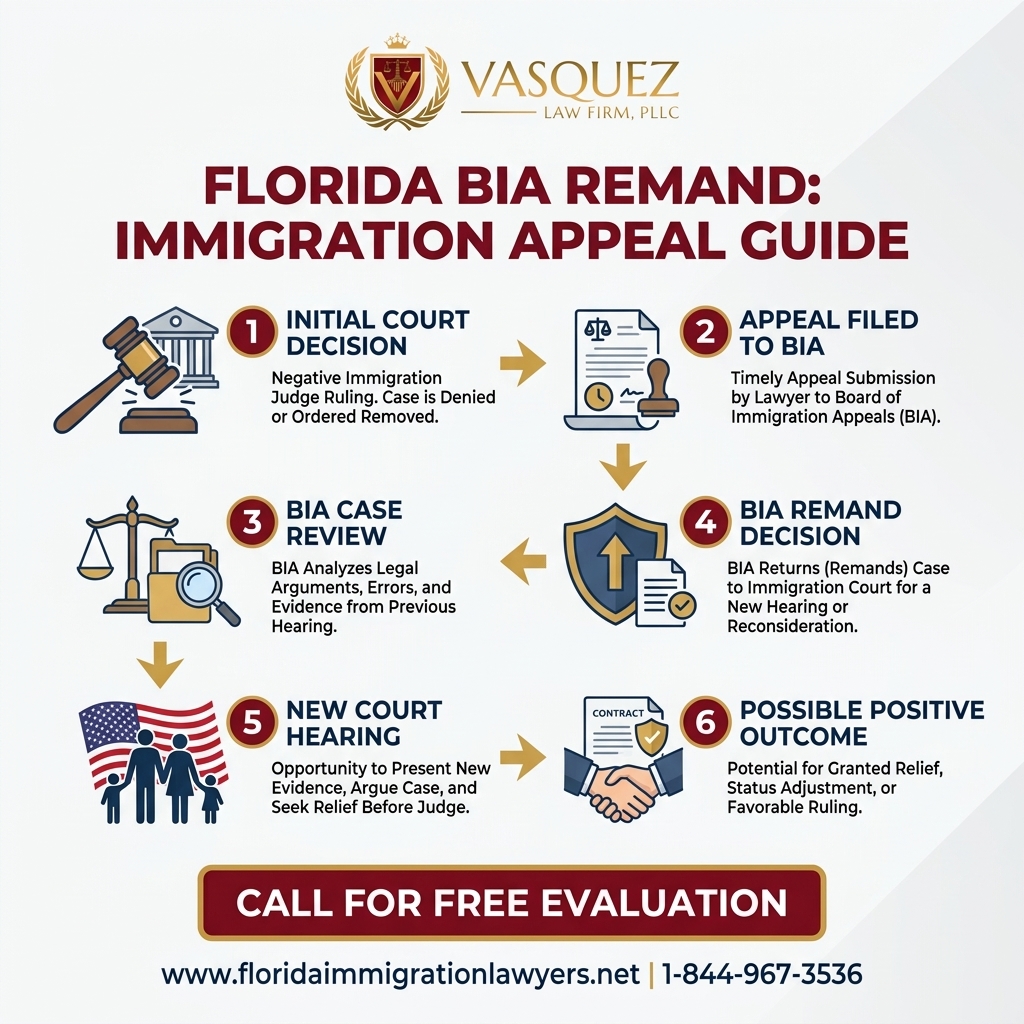
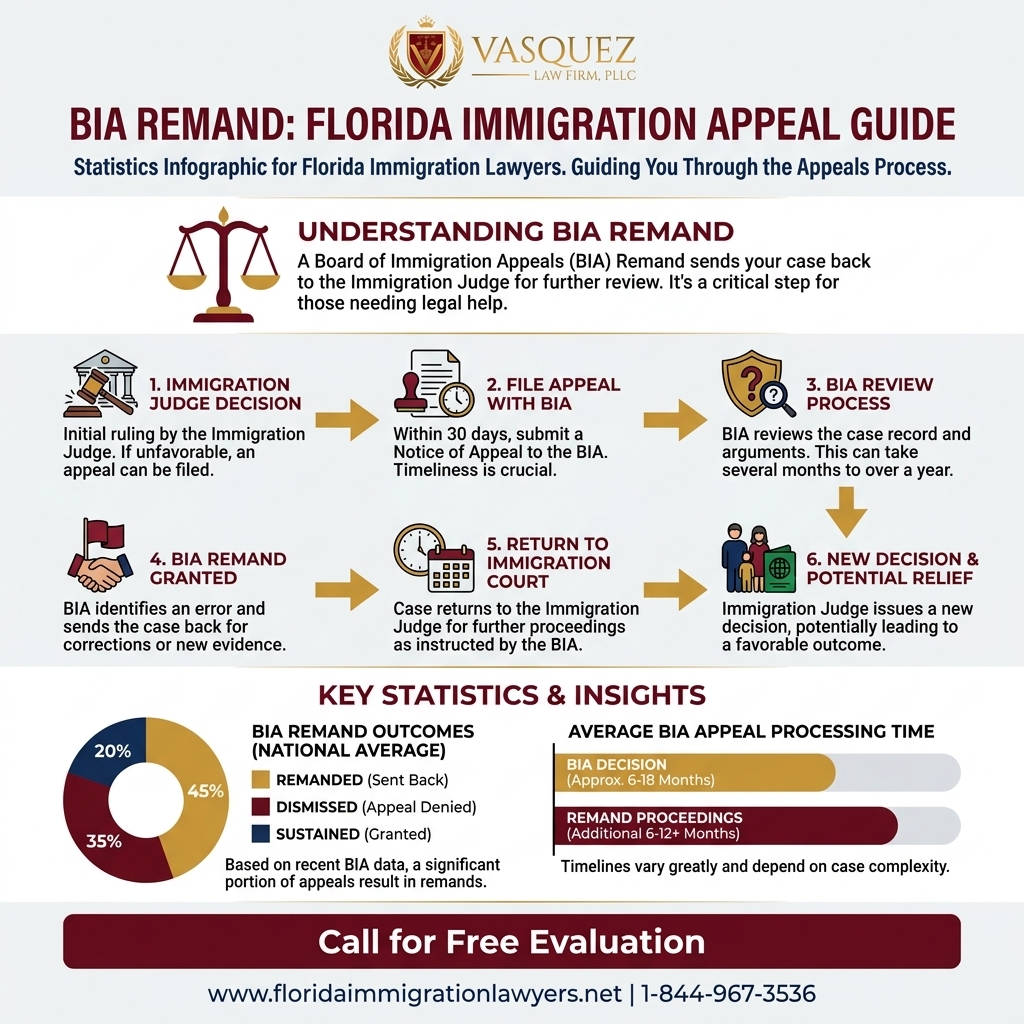
When an Immigration Judge in Florida issues an unfavorable decision, the first step in seeking a review is to file an appeal with the Board of Immigration Appeals (BIA). This is a critical stage that must be handled with precision and within strict timeframes. You typically have 30 calendar days from the date of the IJ's oral decision or the mailing of a written decision to file a Notice of Appeal (Form EOIR-26). Missing this deadline is almost always fatal to your appeal, highlighting the urgency of immediate legal action.
The Form EOIR-26 requires you to specify the errors of fact or law made by the Immigration Judge. It is not enough to simply state disagreement with the decision; you must articulate specific legal grounds for the appeal. For example, you might argue that the IJ erred in finding you lacked credibility, misapplied a particular section of the Immigration and Nationality Act (INA), or failed to consider crucial evidence. This initial filing sets the stage for the entire appeal process and is a complex legal document.
After filing the Notice of Appeal, both parties are typically given time to submit written briefs. These briefs are comprehensive legal arguments supported by references to the administrative record, relevant case law, statutes, and regulations. A well-crafted brief is paramount, as it is your primary opportunity to persuade the BIA. The BIA will review these submissions along with the entire record of proceedings from the Immigration Court. If the BIA identifies an issue that warrants further consideration by the Immigration Judge, it will issue a BIA remand order, sending the case back to the original court.
Initial Appeal to the BIA
The process of appealing to the BIA begins with the Notice of Appeal. This form must be filed with the BIA directly. It is vital to include a clear statement of the errors in the Immigration Judge's decision. For instance, if you were in removal proceedings in the Tampa Immigration Court and the IJ denied your application for adjustment of status, your appeal might argue the IJ incorrectly determined you were inadmissible or failed to properly weigh hardship factors. This foundational document requires careful legal drafting.
The BIA's Review Process
Once the Notice of Appeal and briefs are submitted, the BIA reviews the administrative record. This includes all documents, transcripts of hearings, and evidence presented before the Immigration Judge. The BIA's review is generally limited to the record created below, meaning new evidence is typically not considered unless it meets specific, narrow criteria. The BIA can then affirm the IJ's decision, reverse it, or issue a BIA remand. A remand is often a positive development, indicating that the BIA sees potential merit in your arguments or finds a flaw that needs correction, giving your case a renewed chance before the Immigration Judge.
Key Documents for a Successful BIA Remand
Successfully navigating a BIA remand requires meticulous organization and a thorough understanding of the documentation involved. The administrative record from your initial proceedings before the Immigration Judge is the cornerstone of your case. This record includes all applications, petitions, exhibits, motions, orders, and transcripts of hearings. It is imperative to review this record carefully to identify any errors or omissions that may have led to the BIA's decision to remand your case. Your attorney will analyze this record to pinpoint areas for improvement or correction.
When a case is remanded, it often means the BIA requires the Immigration Judge to consider additional evidence or re-evaluate existing evidence under a different legal framework. Therefore, preparing new or supplemental documentation becomes critical. This could include updated affidavits from witnesses or family members, new country condition reports for asylum claims, additional financial records for adjustment of status cases, or expert witness reports. Each piece of evidence must be relevant, credible, and properly presented to the Immigration Court, often with English translations if in another language.
Furthermore, legal briefs and motions play a significant role during the remand. Your attorney will likely file new legal arguments, motions to reopen, or motions to reconsider, addressing the specific reasons for the BIA remand. These documents must cite relevant legal authority, including sections of the Immigration and Nationality Act (INA), federal regulations (Code of Federal Regulations, e.g., 8 CFR Part 1003), and precedent decisions from the BIA or federal courts. The strength of your documentation and legal arguments directly impacts the likelihood of a favorable outcome in a Florida immigration court.
- Complete Administrative Record: All documents from previous proceedings, including applications, exhibits, and hearing transcripts.
- New or Supplemental Evidence: Affidavits, expert reports, country condition reports, medical records, financial statements, or character references.
- Legal Briefs and Motions: Arguments addressing the BIA's remand order, citing relevant statutes (e.g., 8 U.S.C. Chapter 12), regulations, and case law.
- Proof of Identity and Nationality: Passports, birth certificates, or other identification documents.
- Proof of Relationship (if applicable): Marriage certificates, birth certificates for family-based cases.
- Financial Documents: Tax returns, employment letters, or affidavits of support (Form I-864) for adjustment of status.
- Police Clearances/Criminal Records: If criminal history is a factor, ensure all relevant disposition documents are included.
- Translations: All foreign language documents must be accompanied by certified English translations.
Timeline and What to Expect During a BIA Remand in Florida
The timeline for a BIA remand can be unpredictable and often lengthy, adding to the stress for individuals and families in Florida. Once the BIA issues a remand order, the case is sent back to the Immigration Court where it originated. This could be one of the busy courts in Miami, Orlando, or Bradenton, Florida. The administrative process of physically transferring the file and re-calendaring the case can take several weeks or even months. Patience is crucial, but vigilance is equally important to ensure your case does not fall through the cracks.
Upon its return, your case will be placed back on the Immigration Judge's docket. The IJ will then schedule a new hearing, which might be a master calendar hearing or an individual hearing, depending on the specific instructions from the BIA and the issues that need to be addressed. The purpose of this hearing is to take the action mandated by the BIA. For example, if the BIA remanded for the IJ to consider new evidence, the hearing will focus on the presentation and evaluation of that evidence. If the remand was due to a legal error, the IJ will apply the correct legal standard.
The duration of proceedings post-remand varies significantly. Factors such as the complexity of the issues, the availability of the Immigration Judge, and the volume of cases in Florida's immigration courts can all influence the timeline. Some cases may be resolved in a few months, while others can take over a year. Throughout this period, your attorney will monitor the case status, prepare any necessary filings, and continue to develop your legal strategy. Staying informed and responsive to requests from the court or your legal team is vital to keep the process moving efficiently.
Typical Remand Process Timeline:
- BIA Remand Order Issued: 1-3 months after BIA appeal brief submission.
- Case Transferred to Immigration Court: 1-3 months following remand order.
- New Hearing Scheduled: 3-6 months after case transfer, depending on court docket.
- Hearing and Decision by IJ: Varies greatly, from a single hearing to several over many months.
- Potential for Further Appeal: If the IJ's decision post-remand is still unfavorable, another appeal to the BIA or a federal circuit court may be possible, adding more time.
When a BIA Remand Leads to Federal Circuit Court Review
While a BIA remand offers a renewed chance at the administrative level, not all cases conclude favorably after returning to the Immigration Judge. If, after the remand and subsequent proceedings, the Immigration Judge issues another unfavorable decision that is then affirmed by the BIA, your recourse may shift to the federal judicial system. For individuals in Florida, this means filing a Petition for Review with the United States Court of Appeals for the Eleventh Circuit. This is a significant escalation, moving from administrative law to federal constitutional and statutory review.
A Petition for Review is a formal request for a federal court to review the final order of removal issued by the BIA. It is not an opportunity to present new evidence or re-litigate facts. Instead, the Eleventh Circuit Court of Appeals will primarily assess whether the BIA's decision was legally sound, whether proper procedures were followed, and if the BIA's factual findings were supported by substantial evidence. This level of review is highly technical and demands exceptional legal expertise, often focusing on complex questions of law and constitutional due process.
The Eleventh Circuit, based in Atlanta, Georgia, handles all federal appeals originating from Florida, Georgia, and Alabama. Its decisions are binding on all immigration courts and BIA panels within its jurisdiction. Successfully navigating a Petition for Review requires a deep understanding of federal appellate procedure, highly specialized legal research, and persuasive written advocacy. This final stage of appeal is extremely challenging, and the stakes are incredibly high, as an adverse decision from the Circuit Court typically exhausts all judicial remedies, leading to a final order of removal. The Executive Office for Immigration Review (EOIR) provides oversight for the administrative process, but federal courts have the ultimate say on legal challenges.
The Role of the 11th Circuit
The U.S. Court of Appeals for the Eleventh Circuit serves as the primary federal appellate court for immigration cases arising from Florida. When the BIA issues a final order of removal, and all administrative appeals are exhausted, the 11th Circuit is where petitioners can seek judicial review. The court's role is not to retry the case but to review the BIA's legal conclusions and ensure they comply with the Immigration and Nationality Act (INA) and constitutional principles. This often involves scrutinizing legal interpretations and the BIA's application of precedent. For instance, recent decisions from the 11th Circuit, like those regarding detention policies or state immigration laws, underscore the court's significant impact on Florida immigration law.
Grounds for Federal Court Intervention
Seeking review from the 11th Circuit typically involves arguing that the BIA made an error of law, abused its discretion, or violated constitutional due process rights. Common grounds include challenges to the BIA's interpretation of a statute (e.g., 8 U.S.C. § 1252), its factual findings not being supported by substantial evidence, or claims that the BIA acted arbitrarily or capriciously. The court generally lacks jurisdiction to review discretionary decisions, such as a denial of a waiver, unless a legal or constitutional error is involved. For example, if the BIA denied a motion to reopen based on an incorrect legal standard, this could be a valid ground for a Petition for Review.
Do not navigate this complex and critical process alone. The journey through a BIA remand and potential federal court review demands an experienced legal team. Contact Florida Immigration Lawyers today at 1-844-967-3536 for a free consultation. We are here to provide the dedicated representation you need.
Common Mistakes to Avoid in BIA Remand Cases
The complexities of a BIA remand mean that even small errors can have significant, often irreversible, consequences. Avoiding these common pitfalls is crucial for anyone in Florida facing this stage of their immigration case.
- Missing Deadlines: The most critical mistake. Missing the 30-day deadline to appeal to the BIA, or any subsequent deadlines set by the Immigration Court, can lead to your case being dismissed or a final order of removal becoming enforceable.
- Failing to Understand the Remand Order: Not fully grasping why the BIA remanded your case means you won't address the specific issues. This can lead to the same errors being repeated.
- Not Providing Sufficient New Evidence: If the remand was for further evidentiary development, failing to gather and present compelling new evidence will likely result in a reiteration of the original unfavorable decision.
- Ignoring the Administrative Record: The BIA reviews the existing record. Not thoroughly reviewing it for errors, missing documents, or inconsistencies can weaken your case.
- Submitting Inadmissible Evidence: Presenting evidence that doesn't meet legal standards (e.g., hearsay without exception, unauthenticated documents) can lead to its exclusion and harm your case.
- Lack of Proper Legal Argumentation: Simply presenting facts without connecting them to relevant immigration law and precedent (e.g., 8 CFR Part 1003) is insufficient. Strong legal briefs are essential.
- Assuming Automatic Stay of Removal: An appeal to the BIA generally stays removal, but this is not always the case, especially if a motion to reopen is filed. Always confirm the status of your stay.
- Failing to Update Contact Information: Moving without notifying the Immigration Court and BIA of your new address can lead to missed hearing notices and orders, resulting in an in absentia removal order.
- Not Consulting an Experienced Attorney: Attempting to navigate the BIA remand process without legal counsel significantly increases the risk of errors and an unfavorable outcome.
- Underestimating the Government's Case: The government's attorney will also be preparing for the remand. Failing to anticipate and counter their arguments can be detrimental.
When to Call a Florida Immigration Lawyer
The immigration system is notoriously complex, and a BIA remand elevates that complexity significantly. While it offers a second chance, it also presents a new set of challenges that are best handled by experienced legal professionals. You should immediately contact a Florida immigration lawyer if your case has been remanded by the BIA, or if you are considering appealing an Immigration Judge's decision.
Here are specific scenarios where calling an attorney from Florida Immigration Lawyers is not just advisable, but often essential:
- Your case has been remanded by the BIA: This is a clear signal that the BIA found issues requiring further attention. An attorney can interpret the remand order, identify the specific issues, and develop a winning strategy for the proceedings back before the Immigration Judge.
- You received an unfavorable decision from an Immigration Judge: If you're considering appealing to the BIA, you have a strict 30-day deadline. An attorney can quickly assess the grounds for appeal, prepare the Notice of Appeal (Form EOIR-26), and draft a compelling legal brief.
- Your case involves complex legal issues: If your case touches upon intricate areas of law, such as asylum eligibility, waivers of inadmissibility, or criminal grounds of deportability, the expertise of a lawyer is indispensable.
- You need to present new evidence: If the remand requires the submission of new evidence, an attorney knows how to properly gather, authenticate, and present it in a manner that adheres to court rules and maximizes its impact.
- You are facing potential federal court review: If your case progresses beyond the BIA to the U.S. Court of Appeals for the Eleventh Circuit, you are entering the realm of federal appellate law, which demands a highly specialized legal skill set.
- You have experienced procedural errors or due process violations: An attorney can identify and argue these critical issues, which can be grounds for relief or a successful appeal.
At Florida Immigration Lawyers, we specialize in deportation defense and complex appeals. We serve clients across Florida, including Tampa, Orlando, and Miami, providing strategic and compassionate representation. Don't risk your future by navigating these challenging waters alone. Let our team provide the experienced guidance you need for your deportation defense or immigration appeal.
About Florida Immigration Lawyers
Florida Immigration Lawyers is a leading law firm dedicated to providing comprehensive and compassionate immigration legal services across the entire state of Florida. We understand that immigration matters are deeply personal and often life-changing. Our team of skilled and experienced attorneys is committed to advocating fiercely for our clients, guiding them through the intricate pathways of U.S. immigration law.
We offer a wide range of services, including family-based immigration, business immigration, deportation defense, asylum claims, citizenship applications, and complex appeals, including those involving a BIA remand. With offices strategically located to serve communities throughout Florida, we pride ourselves on our accessibility, our commitment to client success, and our ability to offer bilingual services (English and Spanish) to ensure clear communication and understanding.
Choosing Florida Immigration Lawyers means partnering with a team that prioritizes your future. We are available 24/7 to address your urgent concerns and offer free, confidential consultations to discuss your specific situation. Let us be your trusted advocates in your immigration journey. Visit our website at floridaimmigrationlawyers.net or call us directly at 1-844-967-3536.
Sources and References
- U.S. Citizenship and Immigration Services (USCIS)
- Executive Office for Immigration Review (EOIR)
- U.S. Department of State (Travel.State.Gov)
- 8 U.S.C. Chapter 12 - Immigration and Nationality Act (INA)
- 8 U.S.C. § 1229a - Removal proceedings; cancellation of removal and adjustment of status
- 8 U.S.C. § 1252 - Judicial review of orders of removal
- 8 CFR Part 1003 - Executive Office for Immigration Review (Rules of Procedure for Immigration Appeals)
Related services: asylum and refugee protection, immigration waivers, humanitarian protection programs, DACA renewal and applications.
This article provides general legal information and is not intended as legal advice. Every case is unique, and outcomes depend on specific facts and circumstances. Contact an attorney for advice about your particular situation. Immigration laws are subject to frequent change and interpretation.
Navigating a BIA remand or any other complex immigration appeal requires a strategic and experienced legal approach. Your future in Florida and the United States depends on it. Don't leave your case to chance.
Contact Florida Immigration Lawyers today for a free consultation. Our dedicated team is ready to provide the expert guidance and representation you deserve. Call us now at 1-844-967-3536. Se Habla Espanol - Estamos aqui para ayudarle.
Do Not Navigate This Process Alone
Our experienced immigration attorneys are ready to fight for you. Get a free, confidential consultation today.
Se Habla Español
Or leave your details and we’ll call you:
Free Evaluation in 24 Hours
Or talk to us right now

AI voice assistant — available 24/7
FreeFrequently Asked Questions

William J. Vásquez
Founding Attorney · Vasquez Law Firm
U.S. Air Force veteran and immigration attorney with years of hands-on U.S. immigration experience. J.D., NCCU School of Law. AILA member. Admitted to the 4th, 5th, and 11th Circuit Courts.
Available 24/7 - Free Evaluations
Reviewed for legal accuracy by William J. Vásquez
Licensed in North Carolina; U.S. immigration is federal practice.
Related Legal Services
Our Florida immigration attorneys can help you with experienced immigration attorneys, business immigration and asylum protection. Call today at 1-844-967-3536 for a free consultation.
Related Links
Related Topics
Free Legal Consultation
Discuss your case with our experienced attorneys. We're available 24/7.
Se Habla Español - Estamos aquí para ayudarle.
Related Articles
Stem OPT Immigration Lawyer: 2026 Florida Guide
For F-1 students in Florida, the STEM OPT extension offers a vital 24-month work authorization after their initial OPT. This guide, updated for 2026, covers eligibility, the step-by-step application process, required documents, and critical timelines. Graduates from Florida universities in STEM fields must navigate strict USCIS regulations, including the E-Verify employer requirement. Learn how to avoid common mistakes and when to seek professional legal assistance from a dedicated stem OPT immigration lawyer to ensure a successful application and continued career growth in the U.S. Florida Immigration Lawyers offers expert guidance for students across the state.
Dual Citizenship Lawyer: Navigating Delays in Florida
Facing citizenship delays in Florida can be challenging, but understanding the process and knowing your options is key. Learn how a dual citizenship lawyer can assist you in navigating N-400 processing and USCIS backlogs in Hialeah.
"ina § 208(a)(2)" One-Year Filing Deadline: Florida Asylum
Discover the importance of the "ina § 208(a)(2)" one-year filing deadline for asylum seekers in Florida. Learn about the steps, documents needed, and common mistakes to avoid in your asylum application process.
DV-2027 Registration Period: Your Green Card Lottery Guide
The DV-2027 Diversity Visa (DV) lottery offers a unique pathway to permanent residency for individuals from countries with historically low immigration rates to the U.S. Expected to open in Fall 2025, the registration period requires strict adherence to eligibility criteria, including country of birth and specific education or work experience. This guide from Florida Immigration Lawyers covers the step-by-step application process, essential documents, critical timelines, and associated costs. We highlight common mistakes to avoid and explain when legal counsel is indispensable, especially for residents in Florida. Understanding the nuances of the green card lottery is vital for a successful application. Contact us for expert guidance on your DV-2027 journey.