CSPA Florida: Protecting Children from Aging Out Immigration
The Child Status Protection Act (CSPA) is a crucial law designed to prevent children from "aging out" of eligibility for immigration benefits due to processing delays. For families in Florida, understanding CSPA means ensuring that a child who turns 21 while their green card application is pending can still qualify as a derivative beneficiary. This guide explains the complex CSPA age calculation, eligibility requirements, and the critical deadlines like the "sought to acquire" provision. We cover essential documents and what to expect regarding timelines and costs. Avoiding common mistakes is paramount, and seeking legal guidance from Florida Immigration Lawyers is highly recommended to protect your family's future and navigate the intricacies of immigration law in Tampa and across the state.
The Child Status Protection Act (CSPA) is a critical U.S. immigration law designed to prevent certain children from "aging out" of eligibility for immigration benefits due to processing delays. In Florida, this means that if your child turns 21 while their green card application is pending, CSPA may allow them to retain their classification as a "child" for immigration purposes. This protection is vital for derivative beneficiaries of family-sponsored, employment-based, or diversity visa petitions. Understanding the complex age calculation formula and strict deadlines is paramount for families in Tampa and across Florida seeking to keep their loved ones together. Consulting with an experienced immigration lawyer is highly recommended to ensure proper application of CSPA.
- CSPA protects children from losing immigration eligibility if they turn 21 during processing.
- The law applies to certain family-sponsored, employment-based, and diversity visa categories.
- A specific CSPA age calculation considers petition pending time and visa availability.
- Strict deadlines, like the "sought to acquire" requirement, must be met.
- Legal guidance is crucial for families in Florida navigating CSPA complexities.
CSPA Florida: Protecting Children from Aging Out Immigration
Imagine your family has waited years for an immigration petition to be approved, only to discover that your child, who was eligible when the petition was filed, has now turned 21 during the lengthy processing period. This heartbreaking situation, known as "aging out," can shatter dreams of reunification and permanent residency. For countless families across Florida, including those in vibrant communities like Tampa, Orlando, and Miami, the fear of a child losing their immigration eligibility is a significant concern.
Fortunately, the U.S. Congress enacted the Child Status Protection Act (CSPA) in 2002 to address this very issue. CSPA offers a vital safeguard, allowing many children to retain their "child" status even if they legally turn 21 before their visa or green card is finalized. This law is a beacon of hope for derivative beneficiaries, ensuring that administrative delays do not unfairly penalize families seeking to establish a new life in the United States.
Navigating the intricacies of CSPA, however, can be incredibly complex. It involves precise age calculations, understanding different visa categories, and adhering to strict deadlines. Given the evolving landscape of immigration law, staying informed and seeking guidance is more important than ever. This comprehensive guide will demystify CSPA for Florida residents, explaining who qualifies, how the age is calculated, common pitfalls, and why legal representation is indispensable.
Do not let processing delays jeopardize your family's future. If you are concerned about a child aging out, call Florida Immigration Lawyers at 1-844-YO-PELEO for a free consultation. Our dedicated team is here to help you understand your options and protect your loved ones.
Understanding the Child Status Protection Act (CSPA) in Florida
The Child Status Protection Act (CSPA) was signed into law to provide relief to immigrant children who, through no fault of their own, would "age out" of eligibility for certain immigration benefits. Before CSPA, if a child turned 21 while their parent's visa petition was pending or processing, they would automatically lose their status as a "child" and often face significantly longer waits, or even complete ineligibility, to immigrate. This created immense stress and uncertainty for families, particularly in states like Florida with large immigrant populations and often lengthy processing times at local USCIS field offices.
CSPA essentially freezes a child's age for immigration purposes at a specific point in time, allowing them to remain eligible as a derivative beneficiary. This protection applies to several categories of visas, including family-sponsored preference petitions, employment-based preference petitions, and diversity visa petitions. Without CSPA, many children whose parents were applying for green cards would find themselves separated from their families or forced to pursue entirely new, often more arduous, immigration pathways. The law recognizes the inherent unfairness of administrative backlogs impacting a child's eligibility.
For Florida residents, understanding CSPA is particularly important. Our state is a melting pot of cultures, and many families are navigating the complexities of U.S. immigration. Whether you are in Tampa, Jacksonville, Miami, or any other part of Florida, the principles of CSPA apply to your case. The law ensures that the U.S. immigration system accounts for the reality of processing delays, offering a crucial safety net for young immigrants. It is not an automatic application, however; specific steps must be taken to ensure its benefits are realized, making informed action essential.
Who is a Derivative Beneficiary?
A derivative beneficiary is a spouse or unmarried child (under 21) of a principal visa applicant. For example, if a parent is sponsored for a green card, their children are typically included in the same petition as derivative beneficiaries. CSPA's primary function is to protect these children from aging out during the often-long period between the initial petition filing and the final visa availability date.
How CSPA Works: Calculating Your Age for Immigration in Florida
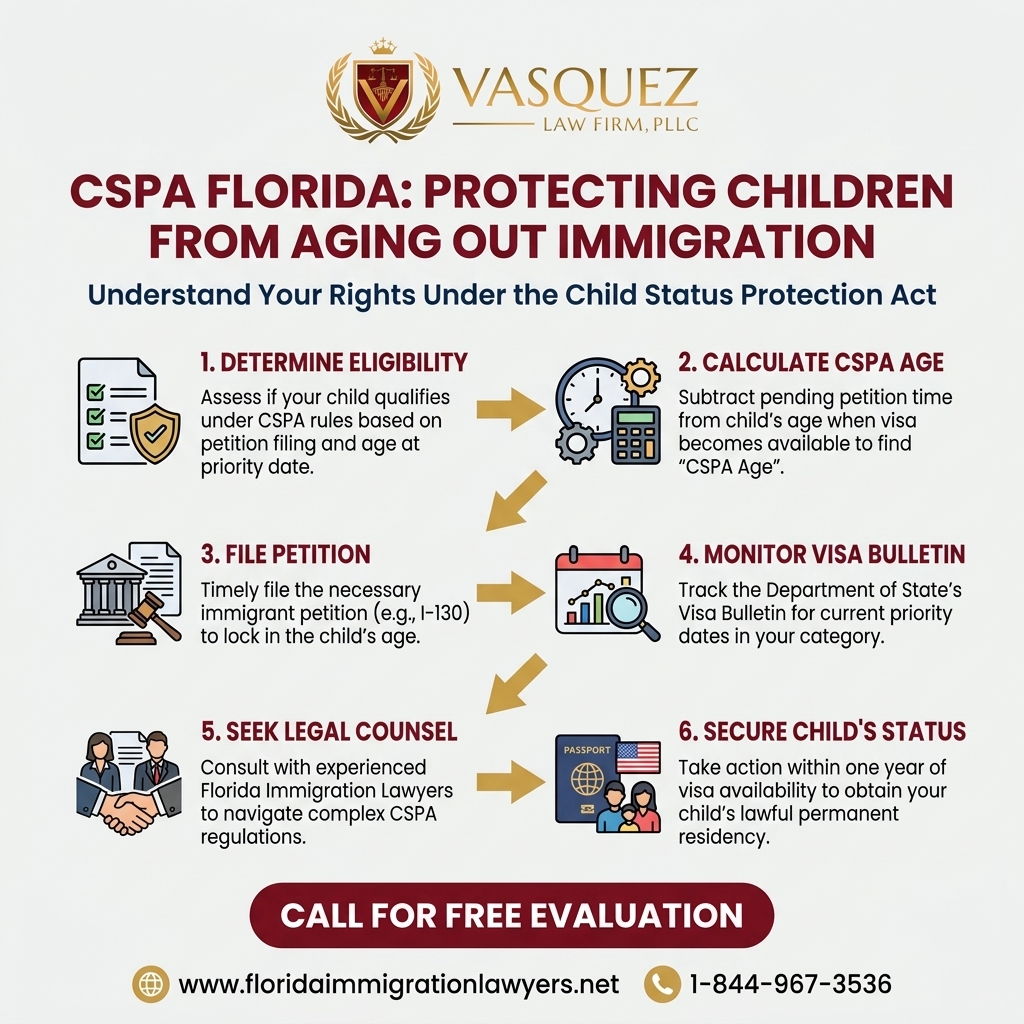
The core of the Child Status Protection Act (CSPA) lies in its unique age calculation formula. This formula determines a child's CSPA age, which may be different from their biological age. The goal is to subtract the time a visa petition was pending from the child's biological age on the date a visa becomes available. This calculation is critical for families in Florida, as it dictates whether a child can still qualify as a derivative beneficiary for a green card.
Here’s the general CSPA age calculation formula: CSPA Age = Biological Age on Visa Availability Date - Petition Pending Time. The "petition pending time" is the period from the date the immigrant visa petition (e.g., Form I-130, I-140) was filed until the date it was approved. The "visa availability date" is usually the first day of the month that the U.S. Department of State's Visa Bulletin shows a visa is available for the applicant's preference category and country of chargeability.
It is important to note that this calculation applies differently based on the type of visa petition. For Immediate Relatives (parents of U.S. citizens, spouses of U.S. citizens, unmarried children under 21 of U.S. citizens), CSPA operates differently, generally protecting them if they are under 21 at the time the petition is filed. For family-sponsored preference categories (e.g., F1, F2A, F2B, F3, F4), employment-based preference categories, and diversity visas, the calculation is more intricate and relies heavily on the visa bulletin. Miscalculating this age can have severe consequences, potentially leading to the denial of a green card application for a child in Florida.
The Importance of the Visa Bulletin
The Visa Bulletin, published monthly by the U.S. Department of State, is a crucial tool for CSPA calculations. It lists the cutoff dates for different visa categories and countries. Your visa is considered "available" when your priority date becomes current according to the Visa Bulletin. For family preference categories, the "Dates for Filing" chart or the "Final Action Dates" chart may be relevant, depending on whether USCIS or the State Department allows filing based on the earlier date. Understanding which date to use is key for an accurate CSPA calculation.
Key Eligibility Requirements and What to Do in Florida
While the Child Status Protection Act (CSPA) provides a critical lifeline, not all children automatically qualify for its protections. There are specific eligibility requirements that must be met, and families in Florida need to be particularly diligent in understanding and fulfilling these criteria. The type of visa category, the timing of actions, and the child's marital status all play a significant role in determining CSPA applicability. A thorough review of your specific circumstances is essential.
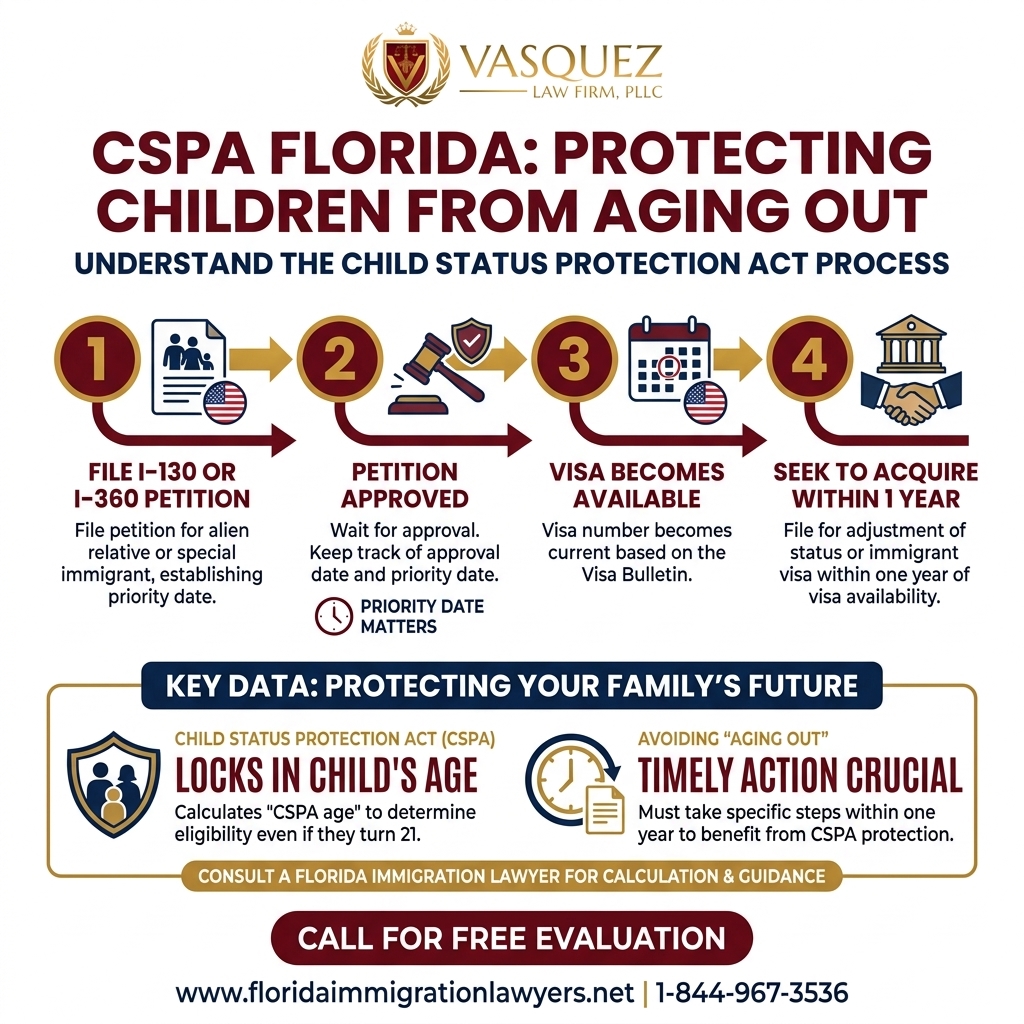
One of the most crucial requirements is the "sought to acquire" provision. For most preference categories, the child must have "sought to acquire" lawful permanent resident status within one year of a visa becoming available. This generally means filing Form I-485 (Application to Register Permanent Residence or Adjust Status) with USCIS if adjusting status in the U.S., or submitting Form DS-260 (Immigrant Visa Application) and attending an interview at a U.S. embassy or consulate abroad if undergoing consular processing. Failing to meet this one-year deadline, even by a single day, can result in the loss of CSPA benefits, causing immense hardship for families throughout Florida.
Different visa categories also have unique considerations. For Immediate Relatives (children of U.S. citizens), the CSPA age is simply the child's age on the date the Form I-130 petition was filed. For Family First Preference (F1), Family Second Preference (F2A/F2B), Family Third Preference (F3), and Family Fourth Preference (F4) categories, the complex age calculation, factoring in petition pending time and visa availability, is used. Furthermore, the child must remain unmarried to benefit from CSPA in most cases. If a child marries before obtaining permanent residency, they generally lose eligibility as a derivative beneficiary, regardless of CSPA.
Florida-Specific Considerations
For those living in Florida, your application will typically be processed through the USCIS Tampa Field Office, Orlando Field Office, or Miami Field Office if you are adjusting status. If you are applying from abroad, your case would be handled by a U.S. embassy or consulate in your home country. Understanding which office or consulate has jurisdiction and their specific procedures can be an added layer of complexity. Our firm, Florida Immigration Lawyers, regularly assists clients across the state, from the Panhandle to the Keys, in navigating these local and international processes effectively.
Step-by-Step Guide to Applying CSPA Protections
Applying for Child Status Protection Act (CSPA) benefits is not a separate application; rather, it is a legal argument made within the context of your existing immigration process. Whether you are pursuing adjustment of status within the U.S. or consular processing abroad, understanding these steps is crucial for families in Florida. Following the correct procedures and submitting accurate documentation is paramount to successfully invoke CSPA and protect your child from aging out.
-
Determine Your CSPA Age: The first and most critical step is to accurately calculate your child's CSPA age. This involves identifying the date the Form I-130 or I-140 petition was filed, the date it was approved, and the date your priority date became current on the Visa Bulletin. Subtract the petition's pending time (approval date minus filing date) from your child's biological age on the visa availability date. This calculation determines if your child is still considered under 21 for immigration purposes. Be precise, as even minor errors can lead to denial. Many families in Florida find this step challenging and seek legal assistance for accurate calculations.
-
Ensure "Sought to Acquire" Requirement is Met: For most preference categories, you must demonstrate that your child "sought to acquire" permanent residence within one year of the visa becoming available. This means filing Form I-485 (for adjustment of status) or submitting Form DS-260 and attending an interview (for consular processing) within that 365-day window. This is a strict deadline, and missing it can invalidate CSPA protection.
-
File the Appropriate Application:
- For Adjustment of Status (within U.S.): If the child is in the U.S. and eligible, file Form I-485, Application to Register Permanent Residence or Adjust Status, with USCIS. Clearly indicate in the cover letter or during the interview that CSPA protection is being invoked.
- For Consular Processing (outside U.S.): If the child is abroad, the National Visa Center (NVC) will process the case. Ensure that the DS-260 Immigrant Visa Application is submitted promptly and that the child attends the visa interview at the U.S. embassy or consulate. CSPA is typically addressed during this stage.
-
Provide Supporting Documentation: Submit all required documents, including birth certificates, petition approval notices, and any other evidence that supports your CSPA age calculation. This may include copies of the visa bulletin for the relevant month. Clear, organized documentation can significantly streamline the process.
-
Attend Interviews and Respond to RFEs: Be prepared for interviews with USCIS or consular officers. If a Request for Evidence (RFE) is issued, respond promptly and thoroughly with the requested information. This is often where CSPA eligibility is closely scrutinized. For families in Florida, attending interviews at local USCIS offices requires careful preparation.
-
Monitor Your Case Status: Regularly check the status of your application through the USCIS online tools or the Department of State's CEAC website. Stay informed about any updates or requests for additional information. Timely monitoring can prevent delays and missed deadlines.
Essential Documents for CSPA Cases in Florida
Successfully invoking the Child Status Protection Act (CSPA) requires meticulous preparation and the submission of accurate, comprehensive documentation. For families in Florida, gathering these essential documents is a critical step in proving a child's eligibility and ensuring their immigration journey proceeds smoothly. A well-organized submission can prevent requests for evidence (RFEs) and unnecessary delays in a process that is already time-sensitive.
Here is a checklist of typical documents and information required for CSPA cases:
- Birth Certificates: Original or certified copies of the child's birth certificate, clearly showing their date of birth. This is fundamental for establishing their biological age.
- Marriage Certificates: If applicable, the marriage certificate of the principal applicant (parent) to establish the family relationship.
- Divorce Decrees/Death Certificates: Any relevant divorce decrees or death certificates if a previous marriage ended, impacting the family structure.
- Form I-130 or I-140 Petition Approval Notice: A copy of the approval notice (Form I-797) for the underlying visa petition. This document is crucial for determining the petition filing and approval dates, which are essential for the CSPA age calculation.
- Visa Bulletin Printouts: Copies of the relevant U.S. Department of State Visa Bulletin for the month your priority date became current. This proves the visa availability date used in the CSPA age calculation.
- Proof of "Sought to Acquire": Evidence that the child "sought to acquire" lawful permanent resident status within one year of visa availability. This could include:
- Filed Form I-485 receipt or approval notice (for adjustment of status).
- Confirmation of submitted Form DS-260 and/or interview appointment letter (for consular processing).
- Passport Copies: Copies of the child's passport, showing biographical data and entry stamps, if relevant to their immigration history.
- Proof of Relationship: Additional evidence such as school records, medical records, photos, and affidavits to further establish the parent-child relationship, especially in complex cases.
- Affidavits: Sworn statements from individuals with personal knowledge of the family relationship, if needed.
All foreign language documents must be accompanied by a certified English translation. Ensuring every document is accurate, complete, and properly translated is a cornerstone of a successful CSPA claim. Our Florida Immigration Lawyers team can assist you in meticulously preparing and organizing this documentation for submission to USCIS or the National Visa Center.
CSPA Timelines, Processing Expectations, and Cost Factors
Navigating the immigration system with the added complexity of the Child Status Protection Act (CSPA) requires a realistic understanding of timelines, processing expectations, and associated costs. For families in Florida, these factors can significantly influence planning and decision-making. While CSPA aims to mitigate delays, it does not necessarily speed up the overall immigration process, which can still take many years depending on the visa category and country of origin.
Processing Timelines: The total time from filing an initial petition to receiving a green card can range from a few years to over a decade. This depends heavily on the visa preference category (e.g., F2A is generally faster than F4), the country of chargeability, and fluctuations in the Visa Bulletin. USCIS processing times for Form I-485 (adjustment of status) can vary significantly by service center and field office (e.g., Tampa, Miami, Orlando). Similarly, consular processing times at U.S. embassies abroad are subject to local backlogs and operational efficiency. It is crucial to monitor the USCIS Processing Times website and the Visa Bulletin regularly.
What to Expect:
- Initial Petition (I-130/I-140) Approval: This can take several months to several years.
- Visa Availability: Once the petition is approved, you must wait for your priority date to become current on the Visa Bulletin. This is where CSPA calculation becomes critical.
- Adjustment of Status (I-485): After filing I-485, expect biometrics appointments, potential requests for evidence (RFEs), and an interview at a local USCIS field office in Florida. This stage can take 1-3 years.
- Consular Processing (DS-260/Interview): After NVC processing, an interview is scheduled at a U.S. embassy or consulate abroad. This stage typically takes 6-12 months after visa availability.
Cost Factors and Fee Breakdown: Immigration processes involve various fees that can accumulate. While CSPA itself doesn't have a separate fee, it impacts the larger application process. Here's a general breakdown:
- USCIS Filing Fees: Fees for petitions (e.g., Form I-130, I-140) and applications (e.g., Form I-485, I-765, I-131, I-693 medical exam). These fees are subject to change, so always check the official USCIS website for current amounts.
- Department of State Fees: Immigrant visa application processing fees (DS-260) for consular processing.
- Medical Examination Fees: Required for both adjustment of status and consular processing, paid directly to USCIS-approved civil surgeons or panel physicians. Costs vary.
- Attorney Fees: Legal representation is an investment in ensuring your case is handled correctly. Fees vary based on the complexity of the case and the services provided. Many Florida immigration law firms, including ours, offer free initial consultations to discuss these costs.
- Translation Fees: Costs for certified translations of any foreign language documents.
These costs can add up, and it is important for Florida families to budget accordingly. While some fees are non-negotiable government charges, legal fees for guidance can save significant time, stress, and potential denial costs in the long run.
Do not navigate this process alone. Contact Florida Immigration Lawyers today to ensure your family's immigration journey is handled with precision and care. Call us at 1-844-YO-PELEO for a free consultation.
Common Mistakes to Avoid in CSPA Cases
The Child Status Protection Act (CSPA) is a complex area of immigration law, and even minor errors can lead to the denial of crucial benefits. For families in Florida, being aware of common mistakes can help prevent heartbreaking setbacks and ensure a smoother path to permanent residency. Avoiding these pitfalls often requires meticulous attention to detail and a clear understanding of immigration regulations.
-
Incorrect CSPA Age Calculation: This is perhaps the most frequent and impactful mistake. Miscalculating the petition pending time or the visa availability date can lead to an incorrect CSPA age, causing USCIS or a consular officer to determine the child has aged out. The formula is precise, and any error can be detrimental.
-
Missing the "Sought to Acquire" Deadline: Failing to file the I-485 application or submit the DS-260/attend the interview within one year of the visa becoming available is a common and fatal error for many CSPA cases. This deadline is strictly enforced, and there are very few exceptions. Many families in Florida are unaware of this critical timeframe.
-
Assuming Automatic CSPA Application: CSPA is not automatically applied. It must be actively invoked and proven. If you do not explicitly state your eligibility and provide supporting documentation, immigration authorities may not apply the CSPA calculation to your case.
-
Misunderstanding Visa Bulletin Charts: Confusing the "Dates for Filing" chart with the "Final Action Dates" chart on the Visa Bulletin can lead to an incorrect CSPA age calculation and missed deadlines. Knowing which chart applies to your specific case is crucial, especially when USCIS allows for earlier filing dates.
-
Changes in Marital Status: For most CSPA cases, the child must remain unmarried. If a derivative child marries before their green card is approved, they generally lose their eligibility, regardless of CSPA protection. This is a critical factor for young adults.
-
Incomplete or Incorrect Documentation: Submitting a petition or application with missing documents (like birth certificates, approval notices, or proof of "sought to acquire") or providing inaccurate information can lead to RFEs, delays, or outright denials. All foreign language documents must have certified English translations.
-
Not Disclosing All Relevant Information: Withholding information or providing inconsistent details about the child's age, family history, or previous immigration attempts can raise red flags and complicate the CSPA claim.
-
Failing to Seek Legal Advice: Given the complexities of CSPA, attempting to navigate the process without experienced legal counsel is a significant risk. An immigration attorney can ensure accurate calculations, timely filings, and proper documentation.
When to Call a Florida Immigration Lawyer for CSPA Cases
The intricacies of the Child Status Protection Act (CSPA) mean that knowing when to seek professional legal assistance is paramount. While some cases may appear straightforward, even slight missteps can have severe, lasting consequences. For families in Florida, consulting with an experienced immigration lawyer, especially one familiar with local USCIS field offices and common issues, can make all the difference in a successful outcome.
You should strongly consider contacting Florida Immigration Lawyers if any of the following scenarios apply to your situation:
- Complex Age Calculations: If the CSPA age calculation seems confusing, or if there are multiple petition filings or changes in circumstances, an attorney can ensure accurate calculation and application of the law. This is particularly true for derivative beneficiaries in family preference categories where the Visa Bulletin plays a critical role.
- Approaching Age 21: If your child is nearing their 21st birthday and their visa is not yet available, immediate legal review is essential to determine if CSPA can protect them. Proactive planning is key.
- Denied CSPA Claim or Petition: If USCIS or a consular officer has denied your child's CSPA eligibility or the underlying petition, an attorney can help analyze the denial reasons, assess options for appeal or motion to reconsider, and rectify any issues.
- Changes in Family Circumstances: Events like a parent's naturalization, divorce, or changes in the child's marital status can impact CSPA eligibility. An attorney can advise on how these changes affect your case and potential new strategies.
- "Sought to Acquire" Deadline Issues: If you are unsure whether you met the one-year "sought to acquire" deadline, or if you believe you have a valid reason for missing it, legal counsel can evaluate your options and argue for equitable tolling if applicable.
- Deportation Concerns: If a child is aging out and is in removal proceedings, an attorney specializing in deportation defense can help explore CSPA as a defense strategy to prevent their removal from the U.S.
- Unusual Case Scenarios: Cases involving adoption, stepchildren, or complex family structures often require specialized legal interpretation of CSPA provisions.
- General Uncertainty and Stress: The immigration process is inherently stressful. Having a knowledgeable attorney guide you through the CSPA process provides peace of mind and increases the likelihood of a positive outcome.
Florida Immigration Lawyers has extensive experience assisting families throughout Florida, from Tampa to the Florida Keys, with CSPA and other family-based immigration matters. We understand the nuances of the law and are dedicated to protecting your family's future. Our attorneys are ready to provide the guidance you need.
About Florida Immigration Lawyers
Florida Immigration Lawyers is an immigration law firm dedicated to serving individuals and families across the entire state of Florida. With a deep understanding of U.S. immigration law and its unique impact on Florida's diverse communities, we are committed to providing compassionate, effective, and results-driven legal representation. Our team of experienced attorneys focuses on a wide range of immigration services, including family-based visas, asylum claims, deportation defense, citizenship applications, and business immigration solutions. We pride ourselves on offering personalized attention, clear communication, and strategic advocacy for every client.
We understand the challenges and anxieties that come with navigating the complex immigration system. That's why we offer free, confidential consultations to help you understand your options and develop a tailored legal strategy. Our firm is available 24/7, ensuring that you can reach us when you need us most. We are proud to offer bilingual services, with a team ready to assist clients in both English and Spanish, making legal support accessible to a broader range of individuals and families. At Florida Immigration Lawyers, your family's future is our priority. Visit floridaimmigrationlawyers.net or call 1-844-YO-PELEO today to schedule your free consultation.
Sources and References
- U.S. Citizenship and Immigration Services (USCIS) Policy Manual: Volume 7, Part A, Chapter 7 - Child Status Protection Act (CSPA)
- U.S. Department of State: Visa Bulletin
- Executive Office for Immigration Review (EOIR): Florida Immigration Courts
- Immigration and Nationality Act (INA) Section 203(h) - Age determination for children
- 8 U.S.C. § 1153(h) - Corresponding U.S. Code section for CSPA
- 8 CFR Part 204 - Petitions, particularly regarding eligibility criteria.
Related services: immigration practice areas.
This article provides general legal information and is not intended as legal advice. Every case is unique, and outcomes depend on specific facts and circumstances. Contact an attorney for advice about your particular situation.
Don't let the complexities of immigration law prevent your family from being together. If you have questions about the Child Status Protection Act or any other immigration matter in Florida, our experienced attorneys are here to help. Contact Florida Immigration Lawyers for a free consultation today. Call us at 1-844-YO-PELEO. Se Habla Español - Estamos aquí para ayudarle.
If you need legal assistance, learn more about how our immigration attorneys can help, or call us at 1-844-YO-PELEO for a free consultation.
Do Not Navigate This Process Alone
Our experienced immigration attorneys are ready to fight for you. Get a free, confidential case review today.
Se Habla Español
Or leave your details and we’ll call you:
Free Evaluation in 24 Hours
Or talk to us right now

AI voice assistant — available 24/7
FreeFrequently Asked Questions

William J. Vásquez
Founding Attorney · Vasquez Law Firm
U.S. Air Force veteran and immigration attorney with years of hands-on U.S. immigration experience. J.D., NCCU School of Law. AILA member. Admitted to the 4th, 5th, and 11th Circuit Courts.
Available 24/7 - Free Evaluations
Reviewed for legal accuracy by William J. Vásquez
Licensed in North Carolina; U.S. immigration is federal practice.
Related Legal Services
Our Florida immigration attorneys can help you with citizenship and naturalization, immigration practice areas and free immigration consultation. Call today at 1-844-YO-PELEO for a free case review.
Related Links
Related Topics
Free Legal Case Review
Discuss your case with our experienced attorneys. We're available 24/7.
Se Habla Español - Estamos aquí para ayudarle.
Related Articles
DUI Immigration Consequences in Florida 2026
A DUI conviction in Florida can have severe immigration consequences, potentially leading to inadmissibility, deportation, or denial of immigration benefits. For non-citizens, a DUI is not just a traffic offense but a serious criminal matter that federal immigration law scrutinizes closely. Factors like multiple offenses, injury, or property damage can escalate a simple DUI to a Crime Involving Moral Turpitude (CIMT) or even an aggravated felony, triggering mandatory detention and removal proceedings. Understanding the specific nature of your Florida conviction and its interpretation under the Immigration and Nationality Act (INA) is crucial. This article outlines how DUIs impact immigration status, the grounds for inadmissibility and deportation, a step-by-step guide to navigating the process, essential documentation, and expected timelines for 2026. We also highlight common mistakes to avoid and when to seek legal counsel from an experienced immigration attorney. Florida Immigration Lawyers offers comprehensive support for individuals facing these challenging situations, providing expert guidance through complex legal landscapes.
Dual Citizenship Lawyer in Florida: What You Need to Know
For Florida residents, the concept of dual citizenship, or holding two passports, offers a compelling blend of opportunities and challenges. While the U.S. generally permits dual nationality, the path to achieving this status requires a meticulous understanding of both U.S. immigration laws and the citizenship policies of your country of origin. This guide explores the definition of dual citizenship, the detailed step-by-step process for U.S. naturalization, and the significant benefits and potential pitfalls involved. We cover essential documentation, typical timelines, and cost considerations for 2026, providing crucial insights for anyone in Orlando, Miami, or across Florida considering this important legal step. Learn about common mistakes to avoid and understand when to seek professional legal counsel to navigate this complex process successfully. Florida Immigration Lawyers is here to provide expert, bilingual support for your dual citizenship journey.
Immigration Lawyer Orlando Free Consultation in Florida
For individuals and families in Orlando, Florida, navigating the complexities of U.S. immigration law requires expert guidance. An immigration lawyer in Orlando offers crucial support for everything from visa applications and green card processes to naturalization and deportation defense. This comprehensive guide details what a free consultation covers, providing a step-by-step overview of immigration pathways, essential document checklists, and expected timelines in 2026. We also highlight common mistakes to avoid, discuss the critical role of legal counsel in deportation and asylum cases, and explain why choosing a local Orlando immigration attorney is beneficial. Florida Immigration Lawyers is dedicated to serving the diverse community of Orlando with compassionate, effective legal solutions, ensuring you receive personalized advice and robust representation for a successful immigration journey.
EAD Advance Parole Combo Card in Florida: What You Need
An EAD advance parole combo card allows individuals with pending adjustment applications to both work and travel abroad without jeopardizing their green card application. Learn how to apply in Florida, what documents you need, and common mistakes to avoid.