Immigration Lawyer Cape Coral: Your Florida Guide
Navigating immigration law in Cape Coral, Lee County, and Southwest Florida can be incredibly complex. This comprehensive guide from Florida Immigration Lawyers provides essential information on the services an immigration lawyer offers, step-by-step processes, crucial documentation, and common mistakes to avoid. Whether you're seeking family reunification, employment visas, or deportation defense, understanding the intricacies of U.S. immigration law is vital. Learn about timelines, cost factors, and when to seek legal counsel to ensure a successful outcome for your case. Our dedicated team is here to provide personalized guidance and strong advocacy for all your immigration needs in Florida. Contact us for a free consultation.
Quick Answer: Immigration Lawyer Cape Coral
Navigating immigration law in Cape Coral and Southwest Florida requires specialized legal guidance due to the complex federal regulations and local nuances. An experienced immigration lawyer in Cape Coral can provide crucial support for various cases, including family-based petitions, employment visas, naturalization, and deportation defense. They help ensure all documentation is accurate, deadlines are met, and your rights are protected throughout the process. Seeking professional assistance from a dedicated Florida immigration law firm is essential to achieving a favorable outcome and understanding your options.
- Guidance on U.S. immigration laws and procedures.
- Assistance with visa applications, green cards, and citizenship.
- Representation in immigration court for deportation defense.
- Ensuring compliance with all federal and state requirements.
- Protecting your rights and interests throughout the legal journey.
Immigrating to the United States or navigating its complex legal system from within can be an overwhelming journey. For residents of Cape Coral, Lee County, and the broader Southwest Florida region, finding a knowledgeable and compassionate immigration lawyer is not just a preference, it's a necessity. The legal landscape is constantly shifting, with new policies and court decisions impacting individuals and families daily. Whether you are seeking to reunite with loved ones, secure employment authorization, or defend against deportation, having legal representation is paramount.
This comprehensive guide will walk you through the critical aspects of immigration law relevant to Southwest Florida residents. We will explore the types of services an immigration lawyer offers, the typical processes involved, and common pitfalls to avoid. Our goal is to empower you with the information needed to make informed decisions about your immigration future.
Do not attempt to navigate these intricate legal waters alone. For personalized guidance and a clear path forward, call Florida Immigration Lawyers at 1-844-YO-PELEO for a free consultation. Our team is ready to assist you.
Understanding Immigration Challenges in Southwest Florida
Southwest Florida, encompassing vibrant communities like Cape Coral, Fort Myers, Naples, and Port Charlotte, is a diverse region with a significant immigrant population. This diversity brings unique immigration challenges and opportunities. Residents in Lee County, Collier County, and Charlotte County often face specific issues related to family petitions, employment opportunities, and sometimes, unforeseen legal hurdles like deportation proceedings. The proximity to major ports and international airports also means a higher volume of individuals interacting with federal immigration authorities.
The local economy in Southwest Florida, driven by tourism, agriculture, and service industries, attracts individuals from various backgrounds seeking work and new beginnings. This creates a demand for employment-based visas and legal guidance for businesses seeking to hire foreign talent. Moreover, families from Latin America, the Caribbean, and other global regions have established roots here, making family reunification a common and vital aspect of local immigration law practice. Understanding the specific needs and demographics of this region is crucial for providing effective legal support.
Dealing with federal agencies like USCIS (U.S. Citizenship and Immigration Services) and EOIR (Executive Office for Immigration Review) can be daunting. While there isn't a dedicated immigration court in Cape Coral itself, cases for Southwest Florida residents are typically heard in the Miami or Orlando Immigration Courts. This geographical distance adds another layer of complexity for individuals who may need to travel for hearings. A local immigration lawyer in Cape Coral understands these logistical challenges and can help prepare clients for these proceedings, ensuring they are well-represented.
Recent policy shifts, such as those impacting asylum seekers or requiring stricter vetting, further complicate the immigration landscape. For instance, the USCIS website provides updates on policy changes that directly affect applications. An attorney stays abreast of these changes, offering timely and accurate advice. They can help you understand how broader national policies, like the 11th Circuit's rulings on detention policies, might indirectly influence local enforcement or processing times. This localized expertise combined with national legal awareness is invaluable.
Services an Immigration Lawyer in Cape Coral Offers
An experienced immigration lawyer serving Cape Coral and Lee County provides a comprehensive range of legal services designed to address the diverse needs of the immigrant community. These services span from initial consultations to complex litigation, ensuring that clients receive tailored advice and robust representation. Understanding the full scope of these services can help you identify when and how legal assistance can benefit your specific situation.
Family-Based Immigration and Petitions
One of the most common areas of immigration law involves family reunification. Lawyers assist U.S. citizens and lawful permanent residents in petitioning for their relatives to come to or remain in the United States. This includes preparing and filing Form I-130, Petition for Alien Relative, and guiding clients through the subsequent steps, whether it's adjustment of status in the U.S. or consular processing abroad. We handle cases involving spouses, children, parents, and siblings, navigating preference categories and visa bulletin fluctuations. This process, governed by sections like INA § 201 (8 U.S.C. § 1151), can be lengthy and requires meticulous documentation.
Employment-Based Visas and Business Immigration
For individuals seeking to work in the U.S. or businesses looking to sponsor foreign employees, an immigration lawyer facilitates the process of obtaining various employment-based visas. This includes H-1B visas for specialty occupations, L-1 visas for intra-company transferees, O-1 visas for individuals with extraordinary ability, and various investor visas. We guide both employers and employees through the complex labor certification process (PERM) and petition filings, ensuring compliance with Department of Labor regulations and USCIS requirements. This area is critical for Southwest Florida's growing economy.
Deportation Defense and Removal Proceedings
Facing deportation can be one of the most frightening experiences for an immigrant. An attorney provides vigorous defense for individuals in removal proceedings before the Executive Office for Immigration Review (EOIR). This involves identifying potential relief options, such as asylum, cancellation of removal, adjustment of status, or waivers. They represent clients in immigration court hearings, file necessary motions and appeals, and work to protect their right to remain in the U.S. The stakes are incredibly high, and legal counsel is indispensable in these situations. More information on immigration court can be found at justice.gov/eoir.
Citizenship and Naturalization
Becoming a U.S. citizen is the ultimate goal for many immigrants. Lawyers assist eligible permanent residents with the naturalization process, including preparing Form N-400, Application for Naturalization, and preparing them for the civics test and interview. We also help address any potential issues that might arise during the application, such as criminal history or prolonged absences from the U.S. This critical step solidifies one's place in American society, granting full rights and responsibilities.
Asylum and Refugee Status
Individuals fleeing persecution in their home countries can seek asylum or refugee status in the U.S. An immigration lawyer helps prepare asylum applications (Form I-589), gather crucial evidence, and represent clients in asylum interviews with USCIS or in defensive asylum proceedings before an immigration judge. This area of law is deeply humanitarian and requires a sensitive yet strategic approach to demonstrate a well-founded fear of persecution. Our firm is dedicated to protecting those seeking safety and refuge.
The Step-by-Step Process for Common Immigration Cases
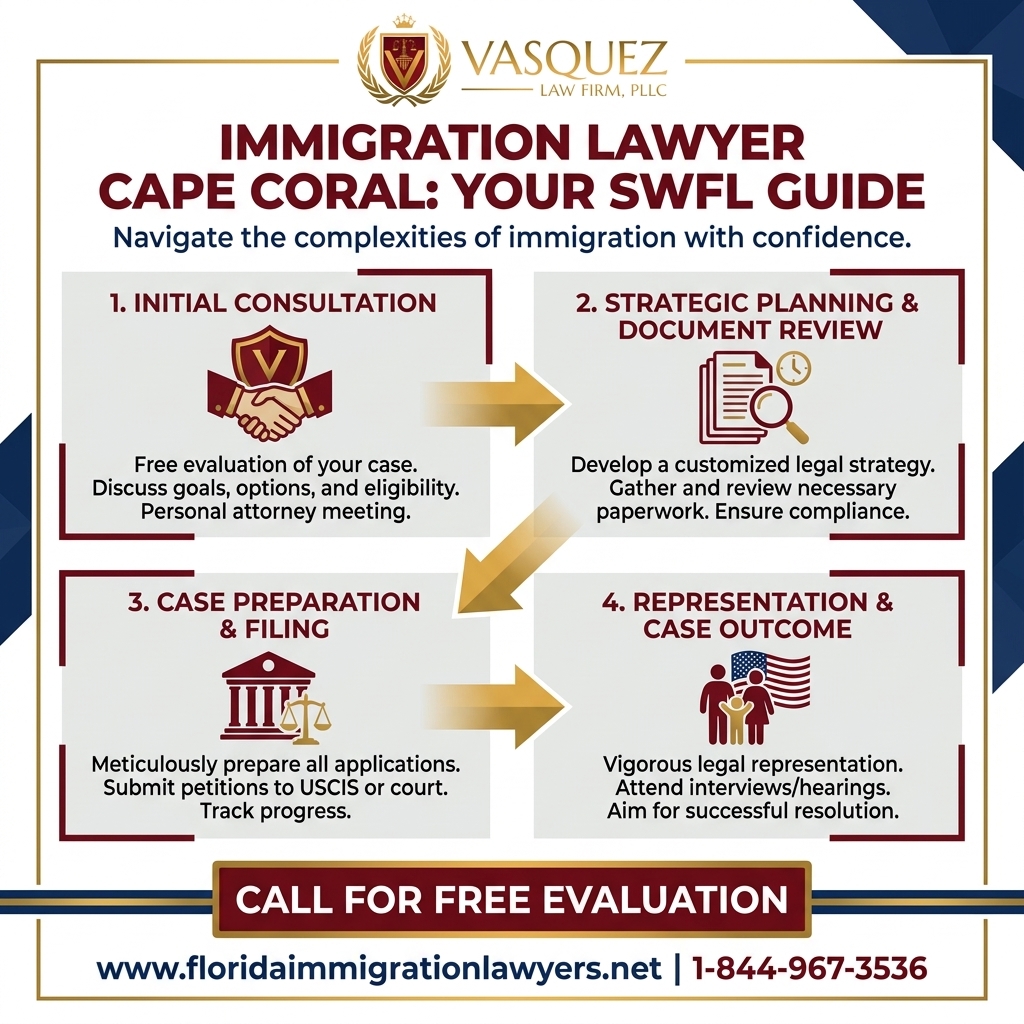
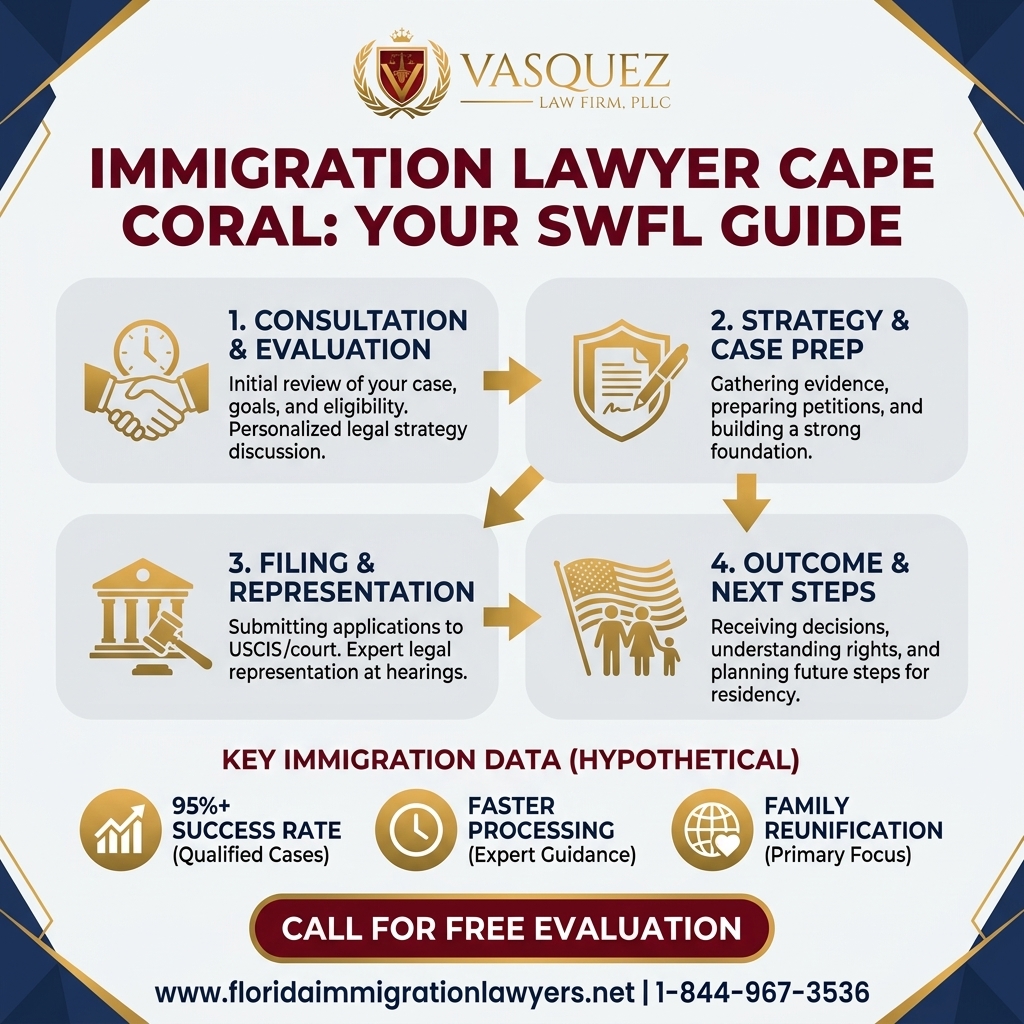
While every immigration case is unique, many follow a general framework of steps. Understanding this typical progression can help set expectations and highlight the importance of legal guidance at each stage. Here, we outline the common steps for two frequent scenarios: family-based green card applications and naturalization.
- Initial Consultation and Case Evaluation: The first step is always to meet with an immigration lawyer in Cape Coral. During this consultation, your attorney will assess your eligibility, discuss your goals, explain the legal options available, and outline the potential challenges. They will gather preliminary information and advise on the best strategy for your case. This is crucial for setting a strong foundation.
- Petition Filing (e.g., Form I-130 for Family): For family-based cases, a U.S. citizen or lawful permanent resident sponsor files a petition with USCIS. This form establishes the qualifying relationship between the petitioner and the beneficiary. For employment cases, the employer typically files an I-140 petition. Accurate and complete filing is essential to avoid delays or rejections. The processing times for these initial petitions can vary significantly, sometimes taking several months to over a year, depending on the visa category and USCIS workload.
- Waiting for Visa Availability (if applicable): For certain family categories (e.g., siblings of U.S. citizens, adult children of LPRs) and most employment-based categories, there is an annual limit on the number of visas issued. Applicants must wait for their priority date to become current according to the Visa Bulletin published by the U.S. Department of State. This waiting period can range from a few years to over a decade, depending on the country of origin and preference category. Your attorney will monitor the Visa Bulletin closely.
- Application for Adjustment of Status or Consular Processing: Once a visa becomes available or if the beneficiary is an immediate relative of a U.S. citizen and is physically present in the U.S. with a lawful entry, they can either apply for adjustment of status (Form I-485) or proceed with consular processing abroad. Adjustment of status allows the individual to obtain a green card without leaving the U.S., while consular processing involves an interview at a U.S. embassy or consulate in their home country. Both paths require extensive documentation and interviews.
- Biometrics Appointment: For most applications, including adjustment of status and naturalization, applicants must attend a biometrics appointment at a local Application Support Center (ASC). Here, fingerprints, photographs, and signatures are collected for background checks. This is a standard security measure and typically occurs a few weeks after filing the primary application.
- Interview with USCIS or Consular Officer: A crucial step for many applications is an interview. For adjustment of status, this takes place at a USCIS field office (e.g., Fort Myers or Orlando). For consular processing, it's at an embassy or consulate. During the interview, an officer reviews the application, asks questions to verify information, and assesses eligibility. Your attorney can prepare you thoroughly for this interview, and in some cases, attend with you.
- Decision and Card Issuance: Following a successful interview and background checks, USCIS or the consular officer will make a decision. If approved, a green card or naturalization certificate will be issued. If denied, your attorney can help you understand the reasons and explore options for appeal or refiling. This final step marks the culmination of a long and often challenging process.
Essential Documents for Your Immigration Application
Preparing a complete and accurate set of documents is paramount for any immigration application. Missing or incorrect documents can lead to delays, requests for evidence (RFEs), or even denial. While specific requirements vary by case type, the following list outlines general categories of documents typically needed. Your immigration lawyer will provide a precise checklist tailored to your situation.
- Proof of Identity and Nationality: Valid passports, birth certificates, national identity cards.
- Proof of Lawful Entry and Immigration Status: I-94 arrival/departure records, visas, previous immigration documents (e.g., EAD cards, previous green cards).
- Proof of Relationship (for family petitions): Marriage certificates, birth certificates, adoption decrees, divorce decrees, extensive photographic evidence, joint bank accounts, utility bills, and other evidence of a bona fide relationship.
- Financial Documentation: Affidavits of support (Form I-864) from sponsors, tax returns, W-2s, employment verification letters, bank statements.
- Medical Examination Results: Required for adjustment of status and consular processing, completed by a USCIS-approved civil surgeon.
- Police Clearances/Criminal Records: From all countries of residence since age 16, if applicable.
- Educational and Work History: Diplomas, transcripts, professional licenses, letters of employment, resumes (especially for employment-based visas).
- Photographs: Passport-style photographs meeting specific USCIS requirements.
- Court and Prison Records: If an applicant has any criminal history, certified copies of all court dispositions, arrest records, and prison records are essential.
- Military Records: If applicable, for both U.S. and foreign military service.
Navigating Timelines and Costs for Immigration Cases in Florida
Immigration processes are notoriously time-consuming, and their costs can be substantial. Understanding the variables that influence both timelines and fees is essential for planning your immigration journey, especially for residents in Fort Myers, Cape Coral, and the broader Southwest Florida area. While an immigration lawyer in Cape Coral cannot guarantee specific outcomes or processing times, they can provide realistic expectations and help manage the financial aspects.
Processing Expectations and Timelines
Processing times for immigration applications are highly variable and depend on several factors:
- Case Type: Family-based petitions, employment visas, asylum applications, and naturalization each have distinct processing pipelines. For instance, immediate relative petitions (spouses, minor children, parents of U.S. citizens) generally process faster than preference categories, which are subject to annual quotas and long waiting lists.
- USCIS Service Center/Field Office: The workload at the specific USCIS service center or field office handling your case can impact processing speed. For Southwest Florida residents, cases might be processed by various centers, and interviews typically take place at the Fort Myers or Orlando field offices. You can check current processing times on the USCIS Processing Times page.
- Completeness of Application: Incomplete applications or those with errors will inevitably lead to delays, including Requests for Evidence (RFEs) or Notices of Intent to Deny (NOIDs). A thoroughly prepared application by an experienced attorney significantly reduces these risks.
- Background Checks: All applicants undergo extensive background and security checks, which can sometimes be unpredictable in their duration.
- Immigration Court Dockets: For deportation defense cases, the backlog in immigration courts, particularly in Miami and Orlando, can mean a lengthy process spanning months or even years.
Cost Factors and Fee Breakdown
The total cost of an immigration case typically involves two main components: government filing fees and legal fees.
- Government Filing Fees: USCIS, Department of State, and other agencies charge fees for processing petitions and applications. These fees vary widely depending on the form (e.g., I-130, I-485, N-400), the number of applicants, and whether biometrics or other services are required. These fees are subject to change and are non-refundable. Your attorney will inform you of the exact fees applicable to your case at the time of filing.
- Medical Examination Fees: If required, a medical examination by a USCIS-approved civil surgeon involves separate fees paid directly to the doctor's office.
- Legal Fees: Attorney fees compensate your immigration lawyer for their expertise, time, and services. These fees can be structured in various ways: a flat fee for specific services (e.g., naturalization application), hourly rates for complex cases (e.g., deportation defense), or a combination. Legal fees reflect the complexity of the case, the attorney's experience, and the amount of work involved. A reputable firm like Florida Immigration Lawyers will provide a transparent fee agreement, outlining all costs upfront.
It is crucial to budget for both government and legal fees from the outset. While the costs can seem substantial, investing in experienced legal representation often saves time, reduces stress, and significantly increases the likelihood of a successful outcome, preventing costly mistakes down the line.
Common Mistakes to Avoid in Immigration Cases
Immigration law is highly technical, and even minor errors can lead to significant delays, denials, or even long-term negative consequences. Being aware of common mistakes can help you avoid pitfalls and protect your immigration journey, especially when dealing with federal agencies from Cape Coral or Lee County.
- Filing Incomplete or Inaccurate Applications: Submitting forms with missing information, incorrect dates, or insufficient evidence is a leading cause of delays and Requests for Evidence (RFEs). USCIS will often return incomplete applications or deny them outright. This wastes time and money, and in some cases, can jeopardize your eligibility if deadlines are missed.
- Misrepresenting Facts or Lying: Providing false information or making misrepresentations on any immigration form or during an interview can lead to severe penalties, including a permanent bar from entering the U.S. or denial of all future immigration benefits. Honesty and transparency, guided by legal advice, are always the best policy.
- Missing Deadlines: Immigration processes are replete with strict deadlines for filing responses to RFEs, appeals, or attending court hearings. Missing a deadline can result in the automatic denial of an application or even an order of removal. Tracking these dates precisely is critical.
- Failing to Disclose Criminal History: Even minor arrests or convictions, including those expunged, must be disclosed to immigration authorities. Failure to do so can be considered a misrepresentation and lead to denial. An immigration lawyer can advise on the immigration consequences of criminal records and how to properly disclose them.
- Leaving the U.S. Without Proper Authorization (e.g., Advance Parole): Individuals with pending adjustment of status applications who leave the U.S. without obtaining advance parole may have their application automatically abandoned upon departure. This can be a devastating mistake, preventing their return.
- Not Responding to USCIS/EOIR Notices: Ignoring notices, RFEs, or hearing notices from immigration authorities is a grave error. These documents contain critical information and deadlines. Failure to respond can lead to negative decisions without further consideration of your case.
- Entering into a Fraudulent Marriage: Marrying solely for immigration benefits is considered marriage fraud and carries severe penalties, including fines, imprisonment, and a permanent bar from obtaining immigration benefits. USCIS actively investigates such cases.
- Not Updating Address with USCIS: Immigrants are legally required to notify USCIS of any change of address within 10 days of moving. Failure to do so can result in missed notices, potentially leading to adverse decisions in your case or even removal proceedings. This is governed by 8 CFR § 265.1.
- Overstaying a Visa: Remaining in the U.S. beyond the authorized period of stay can trigger bars to re-entry (3-year or 10-year bars) and make it difficult to adjust status later. Understanding your authorized stay and adhering to it is crucial.
- Attempting to Navigate Complex Cases Alone: While some simple applications might seem straightforward, complex cases involving waivers, criminal issues, or deportation defense almost always require professional legal help. Self-representation in these scenarios significantly increases the risk of an unfavorable outcome.
- Not Preparing for Interviews: Going into a USCIS or consular interview without adequate preparation can lead to misstatements or a failure to present your case effectively. An attorney can provide crucial preparation and mock interviews.
When to Call an Immigration Lawyer in Cape Coral
The decision to hire an immigration lawyer is a pivotal one that can significantly impact the outcome of your case. While some straightforward applications might be manageable for individuals, many situations warrant immediate legal intervention. For residents of Cape Coral, Fort Myers, and throughout Southwest Florida, knowing when to seek professional help can save time, money, and prevent irreversible mistakes.
You should strongly consider contacting Florida Immigration Lawyers if you encounter any of the following scenarios:
- Facing Deportation or Removal Proceedings: If you receive a Notice to Appear (NTA) in immigration court, immediate legal counsel is essential. This is a serious situation where your right to remain in the U.S. is at stake. An attorney can explore all available defenses and forms of relief.
- Prior Denials or Complex Case History: If you've had a previous application denied, or if your immigration history involves complications like overstays, criminal issues, or previous entries without inspection, legal expertise is critical to address these challenges effectively.
- Applying for Asylum or Refugee Status: These cases are highly sensitive and require compelling evidence of persecution. A lawyer can help gather documentation, prepare your testimony, and represent you in interviews or court hearings.
- Navigating Waivers of Inadmissibility: If you have issues that make you inadmissible to the U.S. (e.g., certain criminal offenses, prior immigration violations), you may need to apply for a waiver. These are complex and require strong legal arguments and evidence.
- Marriage-Based Green Card Applications with Red Flags: If your marriage is new, has a significant age difference, or involves a large cultural gap, USCIS may scrutinize it for fraud. A lawyer can help you prepare robust evidence of a bona fide marriage.
- Employer-Sponsored Visas: Businesses sponsoring foreign workers or individuals seeking employment visas often encounter complex labor certifications and detailed petition requirements. Legal guidance ensures compliance for both parties.
- Any Doubts or Confusion: If you are unsure about which forms to file, what documents are needed, or how to respond to a USCIS request, it's always best to consult an attorney. Proactive legal advice can prevent future problems.
Our firm, Florida Immigration Lawyers, is well-versed in the specific challenges faced by immigrants in Lee County and the surrounding areas. We offer comprehensive services, from initial consultations to court representation, ensuring you have a dedicated advocate by your side.
About Florida Immigration Lawyers
Florida Immigration Lawyers is a leading law firm dedicated to providing comprehensive and compassionate immigration legal services across the entire state of Florida, including Cape Coral, Fort Myers, and Southwest Florida. With a deep understanding of U.S. immigration law and a commitment to our clients, we strive to achieve the strongest possible outcomes for individuals, families, and businesses navigating the complex immigration system. Our attorneys bring extensive experience in various immigration matters, from family petitions and employment visas to complex deportation defense and asylum cases.
We pride ourselves on offering personalized attention, strategic advice, and vigorous advocacy. Our team is available 24/7 to address your urgent concerns and provide peace of mind. We offer free, no-obligation consultations to discuss your case and outline your options. We understand that immigration challenges can be stressful, which is why we are dedicated to making the legal process as smooth and understandable as possible. Se Habla Español – our bilingual team ensures that language is never a barrier to quality legal representation. Choose Florida Immigration Lawyers for experienced, empathetic, and effective legal support.
Sources and References
- U.S. Citizenship and Immigration Services (USCIS)
- Executive Office for Immigration Review (EOIR)
- U.S. Department of State - Visa Bulletin
- 8 U.S.C. Chapter 12 - Immigration and Nationality Act (INA)
- 8 CFR § 265.1 - Notices of address changes
- USCIS Policy Manual
Related services: immigration practice areas.
This article provides general legal information and is not intended as legal advice. Every case is unique, and outcomes depend on specific facts and circumstances. Contact an attorney for advice about your particular situation.
If you are in Cape Coral, Fort Myers, or anywhere in Southwest Florida and need an experienced immigration lawyer, do not delay. Your future and the future of your family depend on informed decisions. Contact Florida Immigration Lawyers today for a free, confidential consultation. Call us at 1-844-YO-PELEO – Se Habla Español – Estamos aqui para ayudarle.
If you need legal assistance, learn more about immigration lawyers in Florida, or call us at 1-844-YO-PELEO for a free consultation.
Do Not Navigate This Process Alone
Our experienced immigration attorneys are ready to fight for you. Get a free, confidential case review today.
Se Habla Español
Or leave your details and we’ll call you:
Free Evaluation in 24 Hours
Or talk to us right now

AI voice assistant — available 24/7
FreeFrequently Asked Questions

William J. Vásquez
Founding Attorney · Vasquez Law Firm
U.S. Air Force veteran and immigration attorney with years of hands-on U.S. immigration experience. J.D., NCCU School of Law. AILA member. Admitted to the 4th, 5th, and 11th Circuit Courts.
Available 24/7 - Free Evaluations
Reviewed for legal accuracy by William J. Vásquez
Licensed in North Carolina; U.S. immigration is federal practice.
Related Legal Services
Our Florida immigration attorneys can help you with immigration lawyer cost in Florida, experienced immigration attorneys and asylum protection. Call today at 1-844-YO-PELEO for a free case review.
Related Links
Related Topics
Free Legal Case Review
Discuss your case with our experienced attorneys. We're available 24/7.
Se Habla Español - Estamos aquí para ayudarle.
Related Articles
EAD Advance Parole Combo Card in Florida: What You Need
An EAD advance parole combo card allows individuals with pending adjustment applications to both work and travel abroad without jeopardizing their green card application. Learn how to apply in Florida, what documents you need, and common mistakes to avoid.
PERM Labor Certification in Florida: A 2026 Guide
Learn all about the PERM labor certification process in Florida, essential for employers sponsoring green card applicants. Understand the steps, document requirements, and common mistakes to avoid in this 2026 guide.
Dual Citizenship Lawyer in Florida: What You Need to Know
For Florida residents, the concept of dual citizenship, or holding two passports, offers a compelling blend of opportunities and challenges. While the U.S. generally permits dual nationality, the path to achieving this status requires a meticulous understanding of both U.S. immigration laws and the citizenship policies of your country of origin. This guide explores the definition of dual citizenship, the detailed step-by-step process for U.S. naturalization, and the significant benefits and potential pitfalls involved. We cover essential documentation, typical timelines, and cost considerations for 2026, providing crucial insights for anyone in Orlando, Miami, or across Florida considering this important legal step. Learn about common mistakes to avoid and understand when to seek professional legal counsel to navigate this complex process successfully. Florida Immigration Lawyers is here to provide expert, bilingual support for your dual citizenship journey.
Immigration Lawyer Orlando Free Consultation in Florida
For individuals and families in Orlando, Florida, navigating the complexities of U.S. immigration law requires expert guidance. An immigration lawyer in Orlando offers crucial support for everything from visa applications and green card processes to naturalization and deportation defense. This comprehensive guide details what a free consultation covers, providing a step-by-step overview of immigration pathways, essential document checklists, and expected timelines in 2026. We also highlight common mistakes to avoid, discuss the critical role of legal counsel in deportation and asylum cases, and explain why choosing a local Orlando immigration attorney is beneficial. Florida Immigration Lawyers is dedicated to serving the diverse community of Orlando with compassionate, effective legal solutions, ensuring you receive personalized advice and robust representation for a successful immigration journey.