Immigration Bond Hearing Florida: Your Guide to Freedom
Navigating an immigration bond hearing in Florida can be daunting. If you or a loved one is detained by ICE, understanding the process for release on bond is crucial. This comprehensive guide from Florida Immigration Lawyers covers eligibility, the step-by-step hearing process, required documentation, and what to expect regarding timelines and costs. We also highlight common mistakes and explain why expert legal representation is vital for a successful outcome. With immigration courts in Orlando and Miami serving individuals detained across the state, including Gainesville, having local legal expertise is invaluable. Our firm is dedicated to helping individuals secure their freedom and fight their immigration cases effectively.

An immigration bond hearing in Florida is a crucial court proceeding where an Immigration Judge determines if a detained individual can be released from U.S. Immigration and Customs Enforcement (ICE) custody by posting a bond. The judge assesses factors like flight risk, danger to the community, and ties to the community (such as family and employment in Florida). Securing an immigration bond allows individuals to fight their deportation case from outside detention, significantly improving their ability to gather evidence and prepare a strong defense. Understanding this process is vital for anyone facing detention in Florida.
- Immigration bond hearings determine if a detained individual can be released on bond.
- Judges consider flight risk, danger to the community, and community ties.
- A bond allows individuals to pursue their immigration case outside of detention.
- Legal representation is critical for a successful bond outcome.
- The process involves specific steps, from detention to the bond hearing itself.
Finding yourself or a loved one in immigration detention in Florida can be an incredibly frightening and disorienting experience. The sudden loss of freedom, coupled with the complexities of immigration law, often leaves individuals feeling hopeless. Perhaps your family member was picked up by ICE in Gainesville, or maybe you are concerned about a friend detained in a facility like Baker County. The immediate concern for many becomes: How can I get out? The answer, in many cases, lies in understanding and successfully navigating the immigration bond hearing process.
At Florida Immigration Lawyers, we understand the immense stress and uncertainty that detention brings. Our mission is to provide clear, compassionate, and effective legal guidance to help you or your loved one secure release. This comprehensive guide will walk you through everything you need to know about an immigration bond hearing in Florida, from eligibility criteria to the step-by-step process and what to expect. We will also highlight common pitfalls and explain why having experienced legal counsel is not just helpful, but often essential. Do not face this challenging time alone. Call Florida Immigration Lawyers at 1-844-967-3536 for a free consultation and let us help you pursue freedom.
Understanding the Immigration Bond Hearing Process in Florida
An immigration bond hearing is a proceeding before an Immigration Judge where the judge decides whether an individual detained by ICE can be released from custody upon payment of a bond. This bond acts as a guarantee that the individual will appear for all future immigration court hearings. The authority for these hearings comes primarily from the Immigration and Nationality Act (INA), specifically INA Section 236(a) (8 U.S.C. § 1226(a)), which grants the Attorney General the power to detain and release individuals on bond pending a decision on their removability. In Florida, these hearings typically take place at one of the state's immigration courts, such as those in Orlando or Miami, which serve individuals detained across the state, including from areas like Gainesville.
The primary goal of an immigration bond hearing is to convince the Immigration Judge that the detained individual is neither a flight risk nor a danger to the community. Unlike criminal bond hearings, where the focus is often on the severity of the alleged crime, immigration bond hearings delve deeply into an individual's background, community ties, and potential risk factors. The burden of proof generally lies with the detained individual to demonstrate that they warrant release on bond. This requires presenting compelling evidence and often testimony, which can be daunting without legal assistance. Our firm has extensive experience presenting these cases effectively to judges throughout Florida.
Eligibility for an Immigration Bond in Florida
Not everyone detained by ICE is eligible for an immigration bond. Eligibility depends on several factors, including the individual's immigration history, criminal record, and the specific charges they face. Generally, individuals who are subject to mandatory detention under INA Section 236(c) are not eligible for a bond hearing. This typically includes individuals with certain criminal convictions, particularly aggravated felonies or specific drug offenses, as well as those who have re-entered the U.S. after a prior deportation. Determining eligibility is the first critical step and requires a thorough review of the individual's immigration and criminal records.
For those who are eligible, the Immigration Judge considers several discretionary factors to determine if a bond should be granted and, if so, the appropriate amount. These factors include: ties to the community (e.g., family in Florida, employment, property ownership), length of residence in the U.S., employment history, criminal history (even minor offenses can impact the decision), prior immigration violations, and any humanitarian factors. The judge will weigh these factors to assess the individual's likelihood of appearing for future court dates and whether they pose a danger to public safety. Presenting a comprehensive case that highlights strong positive equities is crucial for a favorable bond decision in Florida. Our attorneys are adept at building such compelling arguments.
Step-by-Step Guide to the Immigration Bond Hearing Process
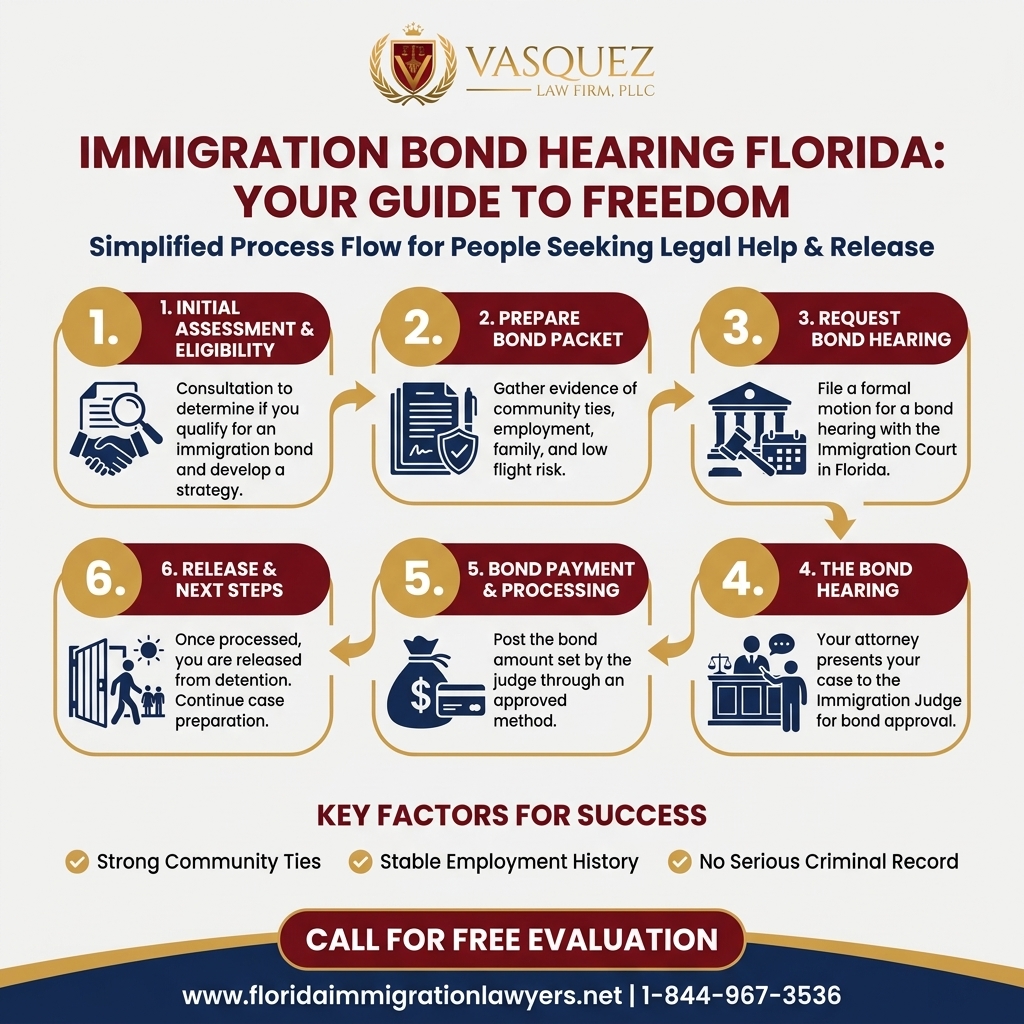
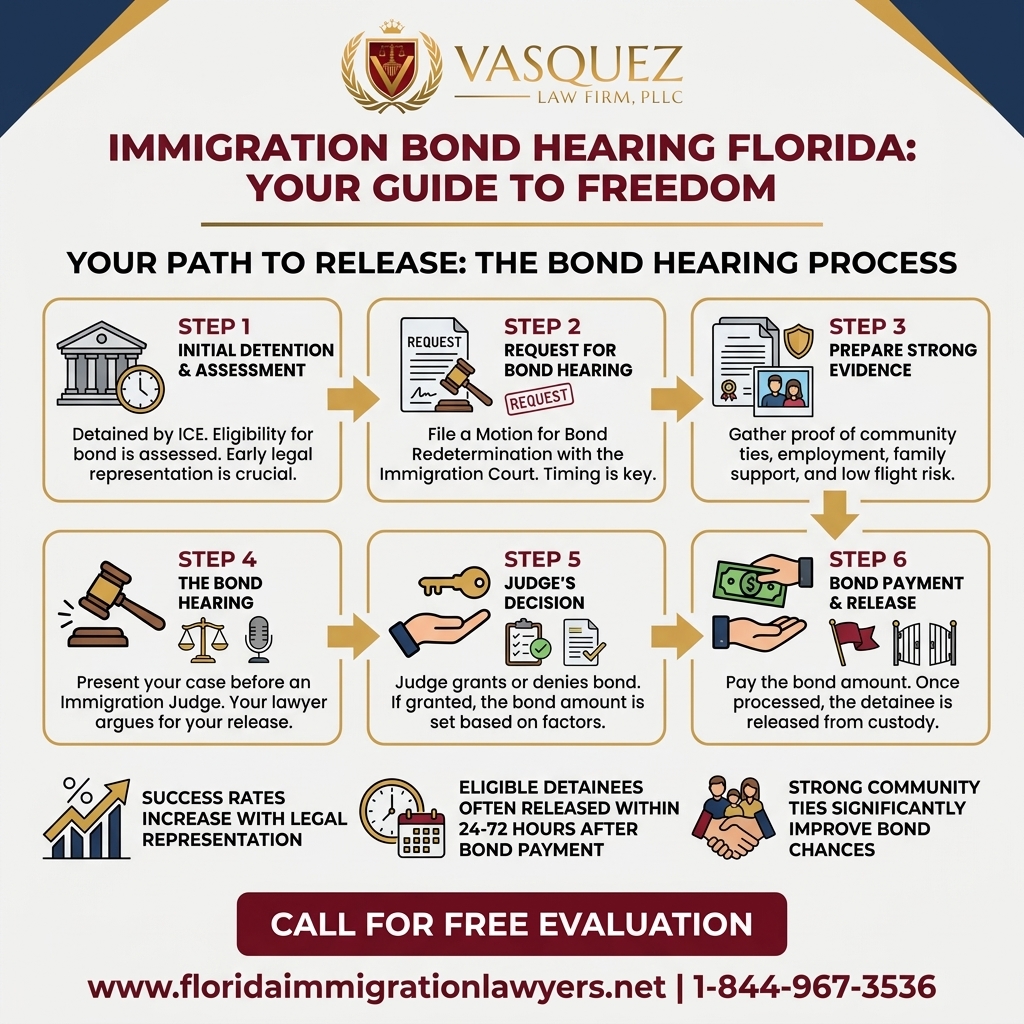
Navigating the immigration bond hearing process can be complex, but understanding each step can help reduce anxiety and improve preparedness. Here is a typical overview of the process:
-
Detention by ICE: The process begins when an individual is taken into custody by U.S. Immigration and Customs Enforcement (ICE). This can happen during a targeted enforcement action, a traffic stop, or even after release from criminal custody. In Florida, individuals may be held at facilities such as the Baker County Detention Center, Glades County Detention Center, or Krome Service Processing Center, among others. Families in Gainesville, for example, might find their loved ones detained far from home.
-
Issuance of Notice to Appear (NTA): After detention, ICE typically issues a Form I-862, Notice to Appear (NTA), which formally initiates removal proceedings. The NTA outlines the charges against the individual and specifies why the government believes they are removable from the U.S. This document is critical as it forms the basis of all subsequent court proceedings.
-
Custody Review and Bond Redetermination Request: In some cases, ICE may set an administrative bond amount. If no bond is set, or if the family believes the amount is too high, a request for a bond hearing must be filed with the Immigration Court. This is done by filing Form EOIR-33B, Request for a Custody Redetermination. This form formally asks an Immigration Judge to review the custody decision and determine if a bond is appropriate.
-
Scheduling the Bond Hearing: Once the bond request is filed, the Immigration Court will schedule a hearing. The speed of scheduling can vary depending on the court's caseload and jurisdiction. For individuals detained in Florida, hearings typically occur at the Orlando Immigration Court or the Miami Immigration Court. It is important to know the specific court and docket number to track the case.
-
The Bond Hearing Itself: During the hearing, the Immigration Judge will hear arguments from the detained individual (or their attorney) and the ICE attorney. The individual must present evidence and testimony demonstrating that they are not a flight risk or a danger to the community. This is where strong documentation and compelling arguments are critical. The judge will make a decision on whether to grant a bond and, if so, the amount.
-
Posting the Bond: If a bond is granted, the individual or their sponsor must pay the bond amount to ICE. This is typically done at an ICE field office that handles bond payments, such as those in Orlando, Tampa, or Miami. It is crucial to follow all instructions carefully to ensure the bond is processed correctly and without delay. The bond must be paid in full, usually by money order or cashier's check.
-
Release from Detention: Once the bond is paid and processed, ICE will arrange for the individual's release from the detention facility. This process can take several hours or even a day, depending on the facility's administrative procedures. Upon release, the individual will be given documentation regarding their upcoming court dates and conditions of release. Our firm guides families through every step, ensuring a smooth transition.
Essential Documents and Evidence for a Florida Immigration Bond Hearing
To maximize the chances of a favorable outcome at an immigration bond hearing in Florida, presenting a strong case supported by comprehensive documentation is paramount. The goal is to demonstrate strong ties to the community, good moral character, and a lack of flight risk or danger to public safety. Gathering these documents promptly after detention is crucial, as delays can prolong the detention period. Our Florida Immigration Lawyers team helps clients compile a robust evidence packet tailored to their specific circumstances.
Here is a checklist of common documents and evidence that can be highly beneficial:
- Proof of Identity and Nationality: Passport, birth certificate, national ID card.
- Proof of Residence in Florida: Lease agreements, utility bills, mortgage statements, property deeds.
- Employment History: Letters from employers, pay stubs, tax returns (IRS Form W-2 or 1099), employment verification letters.
- Family Ties in the U.S.: Birth certificates of U.S. citizen children, marriage certificates to U.S. citizens or lawful permanent residents, affidavits from family members attesting to relationships and support.
- Financial Stability: Bank statements, property ownership documents, evidence of assets.
- Medical Records: If the detainee has significant health issues requiring ongoing care not easily managed in detention.
- Educational Records: Diplomas, transcripts, enrollment verification.
- Community Involvement: Letters from community leaders, religious figures, or volunteer organizations attesting to good moral character and community contributions.
- Criminal History Documentation: Certified court dispositions for any past arrests or convictions. It is better to present these openly and with context rather than have them discovered by the judge.
- Affidavits of Support: Letters from family or friends willing to act as bond sponsors, detailing their financial ability and commitment to ensure the detainee attends court.
Do not navigate this process alone. The stakes are incredibly high when a loved one's freedom is on the line. Contact Florida Immigration Lawyers today at 1-844-967-3536 for a free consultation. Our experienced attorneys are ready to provide the dedicated legal support you need to fight for release.
Navigating ICE Detention Centers and Florida Immigration Courts
Florida hosts several key ICE detention facilities and immigration courts that play a central role in the immigration bond hearing process. Understanding the geography and operational procedures of these facilities is crucial for family members and legal representatives. Individuals apprehended anywhere in Florida, including rural areas near Gainesville or the bustling cities, may be transported to one of these centers. The primary detention facilities include the Baker County Detention Center in Macclenny, the Glades County Detention Center in Moore Haven, and the Krome Service Processing Center in Miami. These facilities vary in their visitation policies, communication protocols, and access for attorneys, which can add layers of complexity to an already stressful situation. Our firm has experience working with all these facilities, streamlining communication and legal visits.
Immigration Courts in Florida are primarily located in Orlando and Miami. These courts handle a vast caseload of deportation proceedings, including bond hearings, for individuals detained across the state. The specific court where a bond hearing takes place depends on the detention facility where the individual is held. For instance, individuals detained in North Florida, such as those near Gainesville, might have their hearings scheduled at the Orlando Immigration Court. Each court has its own procedural nuances and calendaring practices. Our attorneys are intimately familiar with the judges and procedures in both the Orlando and Miami Immigration Courts, allowing us to provide effective representation. Knowing which court has jurisdiction and how to communicate with it effectively is a critical part of a successful defense strategy.
Timeline and Processing Expectations for Immigration Bonds
The timeline for an immigration bond hearing in Florida can vary significantly based on several factors, including the specific detention facility, the caseload of the Immigration Court, and whether an administrative bond was initially set by ICE. Generally, once a Request for Custody Redetermination (Form EOIR-33B) is filed, a bond hearing may be scheduled within a few weeks to a couple of months. However, in busy jurisdictions like Florida, delays can occur. It is important to file the request as soon as possible to expedite the process.
After a bond is granted by the Immigration Judge, the process of posting the bond and securing release typically involves several steps. The bond payment must be made at an authorized ICE field office, which can be found in major Florida cities like Orlando, Tampa, or Miami. This payment must be in the form of a money order or cashier's check, paid by a U.S. citizen or lawful permanent resident. Once the payment is processed, ICE will issue a release order to the detention facility. The actual physical release from detention can take anywhere from a few hours to 24-48 hours, depending on the detention center's internal procedures and staffing. While this waiting period can be agonizing for families, our team at Florida Immigration Lawyers works diligently to keep you informed at every stage, providing realistic expectations and minimizing delays where possible.
Cost Factors and Fee Breakdown for Immigration Bonds
Understanding the financial implications of an immigration bond hearing in Florida is crucial for families seeking to secure a loved one's release. There are primarily two categories of costs: the bond amount itself and legal fees. The bond amount, set by the Immigration Judge, can vary widely. It typically ranges from $1,500 to $25,000 or even higher in more complex cases. The judge determines this amount based on the individual's flight risk and danger to the community, aiming to set an amount that encourages appearance at future court dates. This money is held by ICE and is returned (minus any administrative fees) if the individual attends all their court hearings. However, if they fail to appear, the bond is forfeited.
In addition to the bond amount, legal fees for representation at an immigration bond hearing are a significant consideration. These fees cover the attorney's time for preparing the case, gathering evidence, communicating with ICE and the court, and representing the client at the hearing. While the cost of legal representation is an investment, it dramatically increases the likelihood of a favorable bond decision and a lower bond amount. Many families opt to work with a bond agency that can post the bond for a non-refundable fee (typically 10-15% of the total bond amount), which can be a viable option if the full bond amount is not immediately available. Our firm provides transparent fee structures and works with clients to explore all financial options, ensuring that access to justice is not hindered by cost concerns. We believe that securing legal counsel is an investment in your loved one's future and their ability to fight their immigration case from a position of freedom.
Common Mistakes to Avoid in an Immigration Bond Hearing
Navigating an immigration bond hearing without experienced legal counsel can lead to critical errors that jeopardize a loved one's chance for release. Avoiding these common mistakes is paramount:
-
Not Requesting a Bond Hearing: Some individuals or families assume ICE will automatically set a bond or that a hearing isn't an option. Failing to file Form EOIR-33B, Request for Custody Redetermination, means missing the opportunity for a judge to review the case. This can lead to prolonged, unnecessary detention.
-
Lack of Sufficient Evidence: A bond hearing requires solid proof of community ties, good moral character, and lack of flight risk. Presenting minimal or unconvincing evidence, such as vague affidavits or incomplete financial records, significantly weakens the case. The judge needs concrete, verifiable documentation.
-
Misrepresenting Facts or Immigration History: Attempting to hide past arrests, immigration violations, or previous deportations will severely undermine credibility with the Immigration Judge. ICE and the court have access to extensive databases; honesty, even about negative aspects, is always the best policy, presented with proper context by an attorney.
-
Missing Court Dates After Release: If a bond is granted and the individual is released, failing to appear for any subsequent immigration court hearings will result in bond forfeiture and likely a new order of removal in absentia. This mistake can have permanent, devastating consequences for their immigration future.
-
Communicating with ICE Without Counsel: Detained individuals should generally avoid discussing their case or signing any documents with ICE agents without first consulting an attorney. Statements made can be used against them in court, and signing certain documents could waive critical rights or even lead to voluntary departure without fully understanding the implications.
-
Not Having a Suitable Bond Sponsor: The person posting the bond must be a U.S. citizen or lawful permanent resident and often needs to demonstrate financial stability. If the sponsor does not meet these criteria, or if their funds are questionable, the bond may not be accepted, delaying release.
-
Ignoring Criminal Record Impact: Even minor criminal offenses, especially those involving moral turpitude or violence, can negatively impact bond eligibility or result in a higher bond amount. Failing to address these issues or provide certified dispositions can be detrimental. An attorney can help explain the context and rehabilitation efforts.
-
Not Understanding Mandatory Detention: Some individuals are mandatorily detained and are not eligible for a bond hearing. Attempting to pursue a bond hearing when statutory bars exist wastes time and resources. An attorney can quickly assess eligibility and explore alternative relief.
-
Failing to Appeal a Bond Decision: If a bond is denied or set too high, there is typically a right to appeal the decision to the Board of Immigration Appeals (BIA). Failing to file a timely appeal means accepting the judge's decision, potentially prolonging detention unnecessarily.
-
Underestimating the Importance of Community Ties: While criminal history and flight risk are paramount, demonstrating strong ties to the U.S. community, especially in Florida, is a key discretionary factor. Not highlighting these sufficiently through employment, family, and community involvement can weaken a case.
When to Call a Florida Immigration Lawyer for a Bond Hearing
The decision to seek legal representation for an immigration bond hearing in Florida is one of the most critical choices you will make. While it is technically possible to represent yourself, the complexities of immigration law, the strict evidentiary standards, and the high stakes involved make professional legal counsel almost indispensable. You should consider calling Florida Immigration Lawyers immediately if you or a loved one is detained by ICE and facing removal proceedings, especially if:
- The individual has a prior criminal record, even if it seems minor. Criminal history significantly impacts bond eligibility and requires expert legal analysis.
- There are previous immigration violations, such as prior deportations, unlawful entries, or overstays. These issues complicate the case and often require nuanced legal arguments.
- ICE has indicated that the individual is subject to mandatory detention, as an attorney can review this determination and explore any potential exceptions.
- The individual has limited English proficiency and struggles to understand the legal process or communicate effectively with court officials.
- The bond amount set by ICE (if any) seems unreasonably high, or no bond has been set at all.
- There are complex legal issues involved, such as potential eligibility for asylum or other forms of relief from removal, which can influence bond eligibility.
- You need assistance gathering the extensive documentation required to prove community ties and good moral character in Florida.
- You are unsure about the specific immigration court or detention center procedures in Florida.
Our experienced attorneys at Florida Immigration Lawyers are available to provide immediate assistance. We can quickly assess the situation, determine bond eligibility, and develop a robust strategy to advocate for release. From preparing the necessary forms to representing you in court and guiding you through the bond payment process, we are here to support you every step of the way. Do not delay in seeking help; early intervention can make a significant difference in the outcome.
About Florida Immigration Lawyers
Florida Immigration Lawyers is a leading immigration law firm dedicated to serving individuals and families across the entire state of Florida. With a deep understanding of the intricacies of U.S. immigration law and a compassionate approach, we provide comprehensive legal services to those navigating the complex immigration system. Our firm specializes in a wide range of practice areas, including deportation defense, family-based immigration, business immigration, citizenship, and asylum. We are committed to protecting the rights and futures of our clients, offering personalized strategies and relentless advocacy.
Our team of dedicated attorneys understands the unique challenges faced by immigrants and their families in Florida, from Gainesville to Miami. We pride ourselves on our accessibility and responsiveness, offering free consultations and being available 24/7 to address urgent legal needs. When you choose Florida Immigration Lawyers, you choose a partner who will stand by your side, fight for your rights, and guide you toward a brighter future. Contact us today at 1-844-967-3536 or visit our website at https://www.floridaimmigrationlawyers.net to learn how we can help you.
Sources and References
- U.S. Citizenship and Immigration Services (USCIS)
- Executive Office for Immigration Review (EOIR)
- U.S. Department of State (travel.state.gov)
- 8 U.S.C. § 1226(a) - Detention and release of aliens pending removal proceedings (Immigration and Nationality Act Section 236(a))
- 8 CFR § 1003.19 - Custody and bond.
- Form I-862, Notice to Appear (NTA)
- Form EOIR-33B, Request for a Custody Redetermination
Related services: immigration waivers, humanitarian protection programs, DACA renewal and applications, temporary protected status (TPS).
This article provides general legal information and is not intended as legal advice. Every case is unique, and outcomes depend on specific facts and circumstances. Contact an attorney for advice about your particular situation.
If you or a loved one is facing detention and needs an immigration bond hearing in Florida, do not wait. Time is of the essence. Contact Florida Immigration Lawyers today for a free, confidential consultation. Our dedicated team is ready to provide the expert legal guidance and representation you need. Call us now at 1-844-967-3536. Se Habla Espanol - Estamos aqui para ayudarle.
If you need legal assistance, learn more about get deportation defense help today, or call us at 1-844-967-3536 for a free consultation.
Do Not Navigate This Process Alone
Our experienced immigration attorneys are ready to fight for you. Get a free, confidential consultation today.
Se Habla Español
Or leave your details and we’ll call you:
Free Evaluation in 24 Hours
Or talk to us right now

AI voice assistant — available 24/7
FreeFrequently Asked Questions

William J. Vásquez
Founding Attorney · Vasquez Law Firm
U.S. Air Force veteran and immigration attorney with years of hands-on U.S. immigration experience. J.D., NCCU School of Law. AILA member. Admitted to the 4th, 5th, and 11th Circuit Courts.
Available 24/7 - Free Evaluations
Reviewed for legal accuracy by William J. Vásquez
Licensed in North Carolina; U.S. immigration is federal practice.
Related Legal Services
Our Florida immigration attorneys can help you with immigration practice areas, free immigration consultation and experienced immigration attorneys. Call today at 1-844-967-3536 for a free consultation.
Related Links
Related Topics
Free Legal Consultation
Discuss your case with our experienced attorneys. We're available 24/7.
Se Habla Español - Estamos aquí para ayudarle.
Related Articles
Stem OPT Immigration Lawyer: 2026 Florida Guide
For F-1 students in Florida, the STEM OPT extension offers a vital 24-month work authorization after their initial OPT. This guide, updated for 2026, covers eligibility, the step-by-step application process, required documents, and critical timelines. Graduates from Florida universities in STEM fields must navigate strict USCIS regulations, including the E-Verify employer requirement. Learn how to avoid common mistakes and when to seek professional legal assistance from a dedicated stem OPT immigration lawyer to ensure a successful application and continued career growth in the U.S. Florida Immigration Lawyers offers expert guidance for students across the state.
Dual Citizenship Lawyer: Navigating Delays in Florida
Facing citizenship delays in Florida can be challenging, but understanding the process and knowing your options is key. Learn how a dual citizenship lawyer can assist you in navigating N-400 processing and USCIS backlogs in Hialeah.
"ina § 208(a)(2)" One-Year Filing Deadline: Florida Asylum
Discover the importance of the "ina § 208(a)(2)" one-year filing deadline for asylum seekers in Florida. Learn about the steps, documents needed, and common mistakes to avoid in your asylum application process.
DV-2027 Registration Period: Your Green Card Lottery Guide
The DV-2027 Diversity Visa (DV) lottery offers a unique pathway to permanent residency for individuals from countries with historically low immigration rates to the U.S. Expected to open in Fall 2025, the registration period requires strict adherence to eligibility criteria, including country of birth and specific education or work experience. This guide from Florida Immigration Lawyers covers the step-by-step application process, essential documents, critical timelines, and associated costs. We highlight common mistakes to avoid and explain when legal counsel is indispensable, especially for residents in Florida. Understanding the nuances of the green card lottery is vital for a successful application. Contact us for expert guidance on your DV-2027 journey.