I-360 Widow Petition Florida: Self-Petitioning After Loss
For non-citizen widows and widowers of U.S. citizens in Florida, the I-360 self-petition offers a crucial pathway to lawful permanent residency. This guide from Florida Immigration Lawyers details the eligibility requirements, including filing within two years of your spouse's death and proving a bona fide marriage. We cover the step-by-step process, essential documents, expected timelines for 2026, and associated costs. Learn to avoid common mistakes like missing deadlines or insufficient evidence. If you're in Hollywood, Miami, or anywhere in Florida and facing this challenging situation, our experienced attorneys can provide the compassionate legal support you need. Contact us for a free consultation.

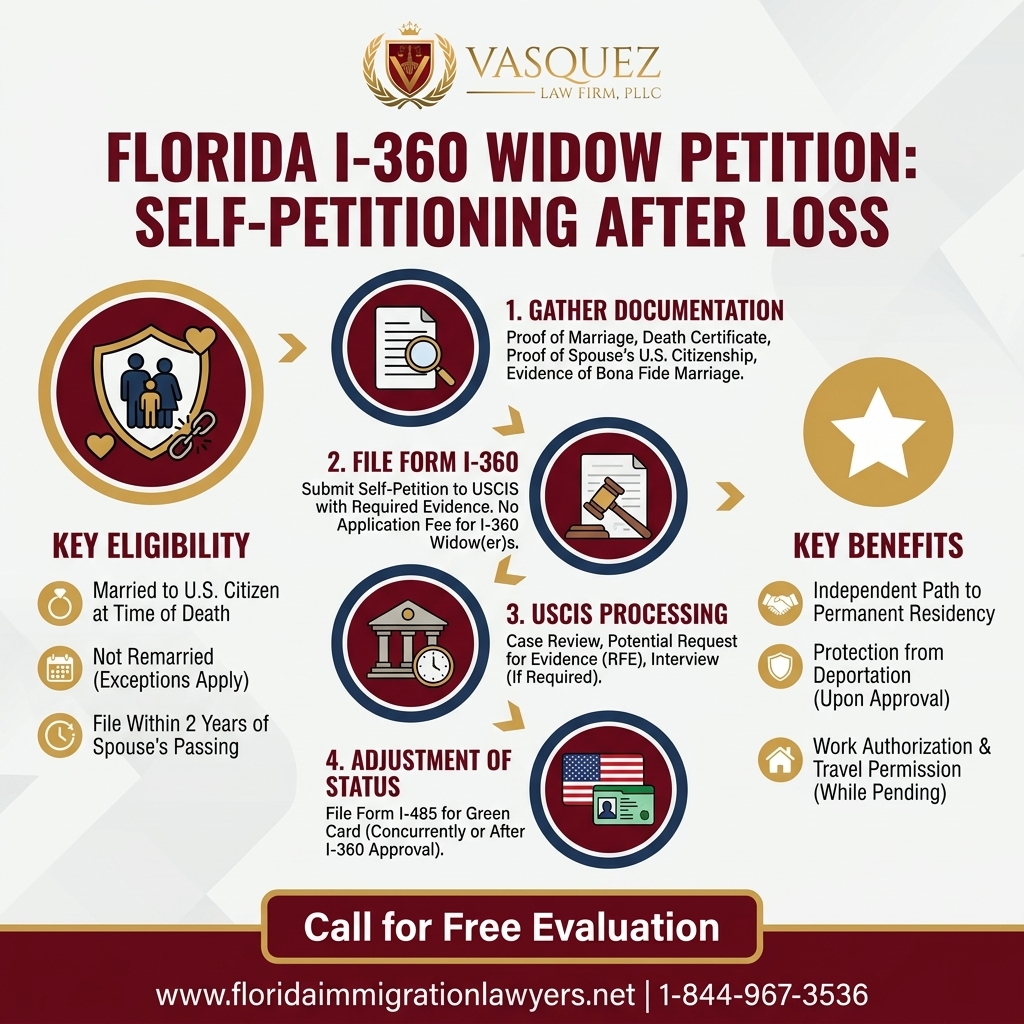
If you are a widow or widower of a U.S. citizen living in Florida, you may be eligible to self-petition for a Green Card using Form I-360, Petition for Amerasian, Widow(er), or Special Immigrant. This process allows you to apply for lawful permanent residency without a relative petition from your deceased spouse, provided you meet specific criteria. Key requirements include proving a bona fide marriage, remaining unmarried, and generally filing within two years of your spouse's death. Navigating this emotional and complex process often requires expert legal guidance to ensure all documents are correctly submitted and deadlines are met.
- File Form I-360 within two years of your U.S. citizen spouse's death.
- You must not have remarried.
- Provide robust evidence of a bona fide marriage.
- The deceased spouse must have been a U.S. citizen at the time of death.
- Consult an experienced immigration attorney for personalized support.
Losing a loved one is an incredibly difficult experience, often leaving individuals grappling with grief and uncertainty. For non-citizen spouses of U.S. citizens in Florida, this profound loss can be compounded by anxieties about their immigration status. You may be wondering how your future in the United States will be affected, especially if your U.S. citizen spouse was the primary petitioner for your Green Card. Fortunately, U.S. immigration law provides a pathway for widows and widowers to continue their journey toward lawful permanent residency through the I-360 widow self-petition.
At Florida Immigration Lawyers, we understand the emotional challenges and legal complexities involved in such cases. This comprehensive guide is designed to help you understand the eligibility requirements, the filing process, potential timelines, and common pitfalls to avoid when pursuing an I-360 self-petition in Florida. Our goal is to empower you with the knowledge you need to make informed decisions during this sensitive time. We are here to provide compassionate and expert legal assistance every step of the way. Call Florida Immigration Lawyers at 1-844-967-3536 for a free consultation today.
Understanding the I-360 Widow(er) Self-Petition in Florida
The I-360 widow(er) self-petition is a critical provision under U.S. immigration law, specifically outlined in Section 204(a)(1)(A)(ii) of the Immigration and Nationality Act (INA), found at 8 U.S.C. § 1154. This pathway allows certain non-citizen widows or widowers of U.S. citizens to petition for themselves to become lawful permanent residents. This means you do not need another U.S. citizen relative to sponsor you, providing a vital lifeline when your primary petitioner, your spouse, is no longer living. For many individuals in diverse communities across Florida, from Hollywood to Miami and Orlando, understanding this option is essential for securing their future.
To be eligible for an I-360 widow self-petition, you must meet several strict criteria. First, you must have been legally married to a U.S. citizen at the time of their death. The marriage must have been bona fide, meaning it was entered into in good faith and not solely for immigration purposes. Secondly, your deceased spouse must have been a U.S. citizen, not just a lawful permanent resident. Thirdly, you must file Form I-360 within two years of your spouse's death. This two-year deadline is critical and strictly enforced by USCIS. Lastly, you must not have remarried. If you remarry before the I-360 petition is approved, you will lose your eligibility. These requirements ensure the integrity of the immigration system while providing a humanitarian path for those who have suffered such a significant loss.
The I-360 petition recognizes the unique vulnerability of individuals who lose their sponsoring spouse, preventing them from being left in an uncertain immigration status. This provision is particularly relevant in Florida, a state with a large and diverse immigrant population. Many foreign nationals marry U.S. citizens and establish deep roots within the community, often raising families and contributing to the local economy. When tragedy strikes, the ability to self-petition offers a sense of stability and continuity. Our family immigration lawyers at Florida Immigration Lawyers are well-versed in these specific regulations and can help you navigate the nuances of your case, ensuring all eligibility requirements are met and properly documented.
Step-by-Step Guide to Filing Your I-360 Petition in Florida
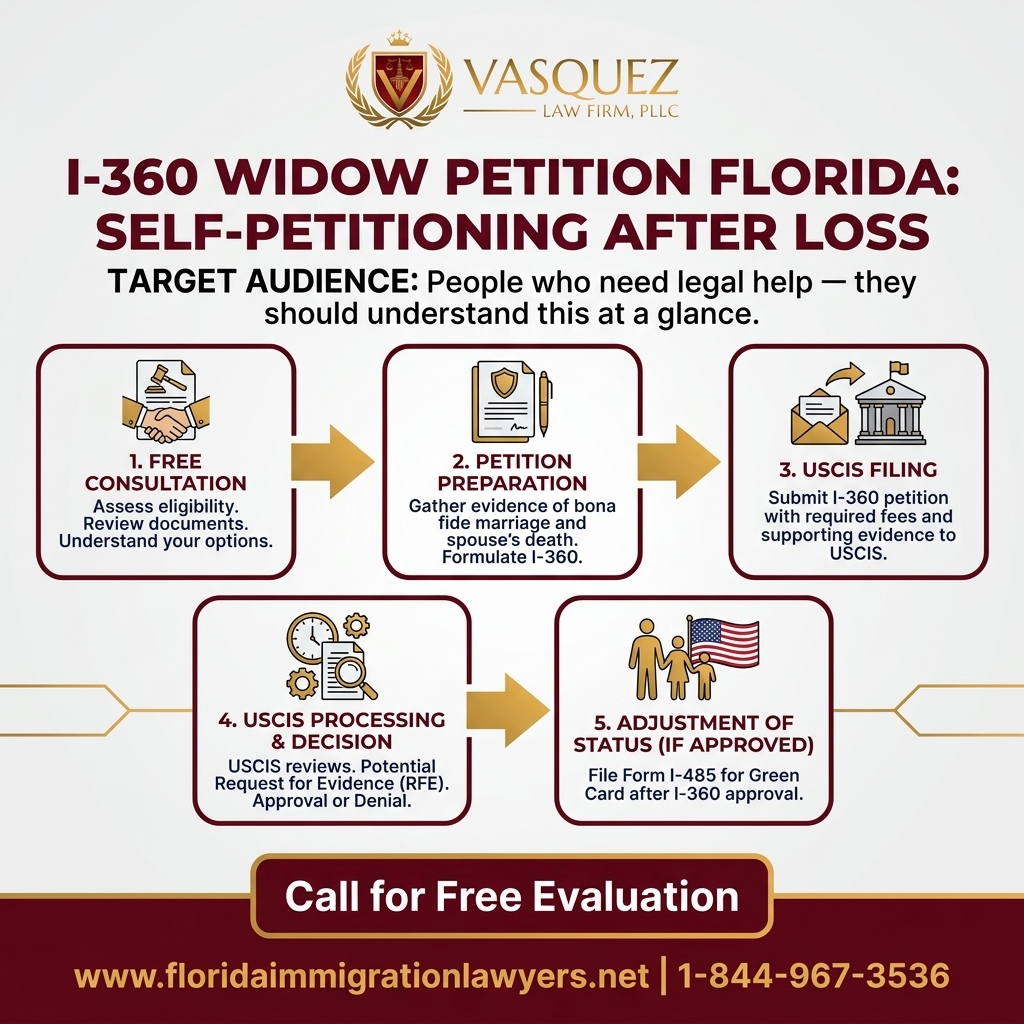
Filing an I-360 self-petition can be a complex process, but breaking it down into manageable steps can help. Understanding each phase is crucial for a successful outcome, especially when dealing with the emotional weight of your circumstances. Our firm assists clients throughout Florida, including those interacting with the USCIS field offices in Miami, Orlando, and Tampa.
- Gather Essential Documents: Begin by collecting all necessary documents. This includes your U.S. citizen spouse's death certificate, your marriage certificate, and proof of your spouse's U.S. citizenship (e.g., birth certificate, U.S. passport). You will also need substantial evidence to prove your marriage was bona fide. This evidence is key to demonstrating your relationship was genuine and not just for immigration benefits.
- Complete Form I-360: Accurately fill out Form I-360, Petition for Amerasian, Widow(er), or Special Immigrant. Pay close attention to every detail, as even minor errors can lead to delays or rejections. The form requires comprehensive personal information about you and your deceased spouse, along with details about your marriage.
- Prepare Supporting Evidence for a Bona Fide Marriage: This is one of the most critical steps. USCIS scrutinizes these petitions closely. You should provide a wide range of evidence such as joint bank account statements, joint tax returns, property deeds, mortgage agreements, utility bills in both names, insurance policies showing each other as beneficiaries, photographs together, and affidavits from friends and family who can attest to the legitimacy of your marriage. The more evidence you provide, the stronger your case.
- File Your Petition with USCIS: Once all forms are completed and evidence is compiled, submit your I-360 petition package to the correct USCIS Service Center. The specific filing address depends on where you reside and the form instructions. Always send your application via certified mail with a return receipt requested to track delivery.
- Attend Biometrics Appointment: After filing, you will receive a receipt notice and typically a separate appointment notice for biometrics (fingerprints, photographs, and signature). This appointment usually takes place at a local Application Support Center (ASC) in Florida, such as those near Hollywood or Fort Lauderdale.
- Respond to Requests for Evidence (RFEs): USCIS may issue an RFE if they require additional information or clarification. It is crucial to respond promptly and thoroughly within the given deadline. Failing to do so can result in denial of your petition.
- Interview (if required): While not always required for I-360 widow(er) petitions, USCIS may schedule an interview at a local field office, such as the one in Miami. An attorney can prepare you for this interview and even attend with you to provide support.
- Decision and Adjustment of Status/Consular Processing: If your I-360 is approved, you may then proceed with adjusting your status to a lawful permanent resident (if you are already in the U.S. and eligible to adjust) by filing Form I-485, Application to Register Permanent Residence or Adjust Status. Alternatively, if you are outside the U.S. or ineligible for adjustment, you will undergo consular processing through a U.S. embassy or consulate abroad. Our immigration attorneys can guide you through either pathway.
Essential Document Checklist for I-360 Self-Petitioners
A meticulous compilation of documents is paramount for a successful I-360 widow self-petition. Missing or incomplete documentation is a primary cause for delays and Requests for Evidence (RFEs). This checklist outlines the critical documents you will need to prepare, ensuring your application is as robust as possible. Remember to provide copies of all documents, never originals, unless specifically requested by USCIS.
- Form I-360, Petition for Amerasian, Widow(er), or Special Immigrant: The primary application form, filled out accurately and completely.
- Proof of Deceased Spouse's U.S. Citizenship: A copy of their U.S. birth certificate, naturalization certificate, or U.S. passport.
- Deceased Spouse's Death Certificate: An official, certified copy of the death certificate.
- Marriage Certificate: An official, certified copy of your marriage certificate with the U.S. citizen spouse.
- Evidence of Bona Fide Marriage: Comprehensive documentation proving your marriage was legitimate. This can include:
- Joint bank account statements, credit card statements, and investment accounts.
- Joint lease agreements, mortgage documents, or property deeds.
- Utility bills, phone bills, or other household expenses in both names.
- Life insurance policies, wills, or trusts showing each other as beneficiaries.
- Joint tax returns for all years married.
- Birth certificates of any children born to the marriage.
- Photographs of the couple together from various stages of the relationship.
- Affidavits from friends, family, and employers attesting to the legitimacy of the marriage.
- Correspondence addressed to both spouses, or records of shared memberships.
- Your Birth Certificate: A copy of your official birth certificate.
- Proof of Termination of Previous Marriages: If you or your deceased spouse had prior marriages, provide divorce decrees or death certificates for each.
- Passport-Style Photographs: Two identical color photographs of yourself, meeting USCIS specifications.
- Form I-797, Approval Notice for Form I-130 (if applicable): If your deceased spouse filed an I-130 petition for you before their death, include a copy of the approval notice.
- Translations: Any documents not in English must be accompanied by a certified English translation.
I-360 Processing Timelines and Expectations in 2026
Understanding the potential processing timelines for an I-360 widow self-petition is crucial for managing expectations. As of 2026, USCIS processing times can vary significantly based on the service center handling your case, the volume of applications, and the complexity of your specific petition. While USCIS provides estimated processing times on its website, these are subject to change and should be viewed as general guidance rather than guarantees. For applicants in Florida, petitions are typically processed at the Vermont Service Center or the Nebraska Service Center, depending on the specific filing instructions.
Generally, after you file your Form I-360, you can expect to receive a receipt notice within a few weeks. This notice, Form I-797C, confirms that USCIS has received your application. A few weeks after that, you will likely receive an appointment notice for biometrics. The biometrics appointment itself is usually quick, taking place at a local Application Support Center (ASC) in Florida, such as those in Miami, Orlando, or Jacksonville. These appointments are essential for background checks and security clearances. Following biometrics, the waiting period for an initial decision or a Request for Evidence (RFE) can range from several months to over a year. The most common reason for delays is an RFE, which requires you to provide additional information or evidence. Prompt and thorough responses are vital to keep your case moving forward.
If your I-360 petition is approved, the next step depends on whether you are adjusting status within the U.S. or pursuing consular processing abroad. If you file Form I-485 concurrently or subsequently, the adjustment of status process involves its own set of timelines, including potential interviews at a USCIS field office in Florida. The entire journey from filing I-360 to receiving a Green Card can take anywhere from 1.5 to 3 years, sometimes longer in complex cases. It is important to remember that these are estimates, and each case is unique. Working with an experienced immigration attorney from Florida Immigration Lawyers can help you prepare for these timelines and respond effectively to any challenges, ensuring your case progresses as smoothly as possible.
Cost Factors and Fee Breakdown for Your I-360 Petition
When preparing to file an I-360 widow self-petition, understanding the associated costs is an important part of the planning process. While the primary USCIS filing fee for Form I-360 is a significant component, other potential expenses can add up. It is important to note that USCIS fees can change, so always refer to the official USCIS website or consult with an attorney for the most current fee schedule. Our firm does not provide specific fee amounts here as they are subject to change without notice, but we can guide you on the types of fees involved.
The main costs you can anticipate include the USCIS filing fee for Form I-360 itself. If you are also filing for adjustment of status concurrently or subsequently, you will incur additional fees for Form I-485, Application to Register Permanent Residence or Adjust Status, and potentially a biometrics fee. These fees are non-refundable, regardless of the outcome of your petition. Beyond government fees, other significant costs may arise. For instance, if any of your supporting documents are not in English, you will need to pay for certified translations. Obtaining official copies of vital records, such as death certificates or marriage certificates, may also incur small fees from the issuing authorities in Florida or elsewhere.
Perhaps the most valuable investment you can make is in legal representation. While not mandatory, hiring an experienced immigration attorney from Florida Immigration Lawyers can significantly increase your chances of success. Our legal fees cover a wide range of services, including thoroughly preparing your petition, compiling evidence, responding to RFEs, and representing you at interviews. These fees vary depending on the complexity of your case and the services required. We believe that professional legal guidance is an investment in your future, helping to avoid costly mistakes and delays. We offer free consultations to discuss your specific situation and provide a clear understanding of potential costs involved. Do not let financial concerns prevent you from seeking the expert assistance you deserve.
Do not navigate this process alone. The complexities of immigration law, combined with the emotional burden of your loss, can be overwhelming. Contact Florida Immigration Lawyers today at 1-844-967-3536 for dedicated support and a free consultation. Our team is ready to assist you.
Common Mistakes to Avoid in Your I-360 Widow Self-Petition
Navigating the I-360 widow self-petition process requires meticulous attention to detail. Even minor errors can lead to significant delays, Requests for Evidence (RFEs), or even denial. Avoiding these common mistakes can save you time, stress, and potential heartbreak.
- Failing to File Within the Two-Year Deadline: This is perhaps the most critical mistake. You generally must file Form I-360 within two years of your U.S. citizen spouse's death. Missing this deadline, except in very limited circumstances, will result in ineligibility.
- Insufficient Evidence of a Bona Fide Marriage: USCIS requires substantial proof that your marriage was legitimate and not entered into solely for immigration purposes. Simply having a marriage certificate is not enough. Lack of joint documents, shared finances, and a cohesive narrative can lead to skepticism and denial.
- Remarrying Before I-360 Approval: If you remarry before your I-360 petition is approved, you automatically lose eligibility for the widow(er) petition. This is a strict rule that must be adhered to.
- Errors or Inconsistencies on Forms: Incorrect dates, misspelled names, or inconsistent information across different forms can raise red flags for USCIS, leading to RFEs or even accusations of misrepresentation.
- Not Disclosing All Children (Including Step-Children): You must list all your children, including step-children, on the petition, even if they are not immigrating with you. Failure to do so can be seen as misrepresentation.
- Ignoring Requests for Evidence (RFEs): If USCIS sends an RFE, it means they need more information. Failing to respond fully and on time will almost certainly lead to a denial.
- Not Keeping Copies of Everything: Always make and keep copies of every document you submit to USCIS, including the application form, supporting evidence, and correspondence. This is vital for your records and if anything is lost.
- Lack of Professional Legal Guidance: Attempting to navigate the complex immigration system without an experienced attorney often leads to avoidable errors and missed opportunities, especially in sensitive cases like the I-360 widow petition.
- Submitting Original Documents (Unless Requested): Unless USCIS specifically asks for an original, always submit copies. Originals can be lost and are difficult to replace.
- Not Addressing Previous Immigration Issues: Any prior immigration violations, overstays, or criminal history must be disclosed and properly addressed. Hiding such issues can lead to permanent bars from the U.S.
- Failure to Update USCIS on Address Changes: If you move, you must notify USCIS within 10 days using Form AR-11. Failing to do so can result in missed notices and critical deadlines.
When to Call a Florida Immigration Lawyer for Your I-360 Petition
While the information provided here offers a solid foundation, the I-360 widow self-petition process is rarely straightforward. The emotional toll of losing a spouse combined with the intricate demands of immigration law can be overwhelming. Knowing when to seek professional legal assistance is crucial for protecting your future in the United States. Florida Immigration Lawyers are here to provide the support and expertise you need, serving clients across Hollywood, Miami, Fort Lauderdale, and all of Florida.
You should consider contacting an immigration attorney immediately if your situation involves any complexities. For example, if your marriage was relatively short, if there are questions about the bona fides of your marriage, or if you have a complicated marital history (e.g., previous divorces or annulments), legal counsel is invaluable. Similarly, if you have any past immigration violations, criminal records, or have ever been in removal or deportation proceedings, an attorney can assess the potential impact on your I-360 petition and advise on the best course of action. Even if you believe your case is simple, a lawyer can provide peace of mind by ensuring all requirements are met and the application is submitted correctly and comprehensively.
Furthermore, if you receive a Request for Evidence (RFE) from USCIS, it is a strong indicator that you need legal help. RFEs often require specific legal arguments and additional documentation that can be challenging to navigate without expertise. An attorney can help you understand exactly what USCIS is asking for and craft a compelling response. If you are struggling to gather sufficient evidence of your bona fide marriage, or if the two-year filing deadline is approaching rapidly, do not hesitate to reach out. Our attorneys are experienced in all aspects of immigration law and are dedicated to guiding you through this sensitive process with compassion and skill. We can help you identify potential issues before they arise, prepare for interviews, and advocate on your behalf, allowing you to focus on healing and rebuilding your life.
About Florida Immigration Lawyers
Florida Immigration Lawyers is a leading law firm dedicated to providing exceptional legal representation to immigrants across the entire state of Florida. With a deep understanding of U.S. immigration laws and a compassionate approach, we stand by our clients through every step of their immigration journey. We believe that everyone deserves fair and effective legal counsel, especially during challenging times such as navigating an I-360 widow self-petition.
Our experienced team offers a wide range of immigration services, including family-based petitions, deportation defense, asylum claims, citizenship applications, and business immigration. We are committed to achieving the best possible outcomes for our clients, leveraging our extensive knowledge and personalized strategies. Our firm is known for its unwavering dedication, attention to detail, and commitment to client success. We pride ourselves on clear communication and keeping our clients informed throughout their case.
Choosing Florida Immigration Lawyers means choosing a partner who genuinely cares about your future. We offer free consultations to discuss your unique situation and provide clear, honest advice. Our team is available 24/7, ensuring you have access to legal support when you need it most. We serve all of Florida, including Hollywood, Miami, Orlando, Tampa, and Jacksonville. Visit our website at floridaimmigrationlawyers.net or call us at 1-844-967-3536 to schedule your consultation and take the first step towards securing your immigration status.
Sources and References
- U.S. Citizenship and Immigration Services (USCIS) - Form I-360, Petition for Amerasian, Widow(er), or Special Immigrant
- Executive Office for Immigration Review (EOIR)
- U.S. Department of State - Consular Processing Information
- 8 U.S.C. § 1154 (INA 204) - Petition for immigrant status
- 8 CFR § 204.2(b) - Petitions for a widow or widower
- USCIS Policy Manual - Volume 7, Part A, Chapter 5 - Widows and Widowers
Related services: family petition process, family-based green cards, fiancé visa (K-1), marriage-based immigration.
This article provides general legal information and is not intended as legal advice. Every case is unique, and outcomes depend on specific facts and circumstances. Contact an attorney for advice about your particular situation.
Securing your immigration future after the loss of a U.S. citizen spouse is a journey you don't have to embark on alone. The compassionate and skilled attorneys at Florida Immigration Lawyers are ready to stand by your side, offering expert legal guidance tailored to your unique circumstances in Florida. We are dedicated to helping you navigate the complexities of the I-360 widow self-petition with dignity and professionalism. Do not let uncertainty dictate your future.
Contact Florida Immigration Lawyers today for a free, confidential consultation. Call us at 1-844-967-3536. Se Habla Español - Estamos aquí para ayudarle.
Do Not Navigate This Process Alone
Our experienced immigration attorneys are ready to fight for you. Get a free, confidential consultation today.
Se Habla Español
Frequently Asked Questions
Florida Immigration Lawyers
Immigration Attorney | Founder, Vasquez Law Firm
U.S. Air Force veteran and immigration attorney with thousands of cases resolved. J.D., NCCU School of Law. AILA member. Admitted to the 4th, 5th, and 11th Circuit Courts.
Available 24/7 - Free Evaluations
Related Legal Services
Our Florida immigration attorneys can help you with immigration practice areas, free immigration consultation and experienced immigration attorneys. Call today at 1-844-967-3536 for a free consultation.
Related Links
Related Topics
Free Legal Consultation
Discuss your case with our experienced attorneys. We're available 24/7.
Se Habla Español - Estamos aquí para ayudarle.
Related Articles
I-360 Widow Self-Petition in Florida: A Guide | VLF Florida
If you're a widow or widower of a U.S. citizen in Florida, you may be eligible to self-petition for a green card using Form I-360. Learn about the process, requirements, and how Florida Immigration Lawyers can assist you.
U Visa for Crime Victims in Coral Springs, Florida
Discover how the U visa can provide immigration relief for crime victims in Coral Springs, Florida. This blog covers eligibility, application processes, and common pitfalls to avoid. Contact Florida Immigration Lawyers for expert guidance.
DACA Renewal Florida 2026 Guide for Dreamers | VLF Florida
For thousands of young individuals, Deferred Action for Childhood Arrivals (DACA) provides a vital pathway to live and work legally in the United States. If you are a DACA recipient in Florida, preparing for your 2026 renewal is a critical step to maintain your protected status. This comprehensive guide from Florida Immigration Lawyers details the step-by-step process, essential documents, timelines, and cost factors. We also highlight common mistakes to avoid and specific scenarios when legal counsel is indispensable. Our aim is to provide clarity and empower you with the necessary information for a successful DACA renewal. Do not navigate this complex process alone; our experienced team is ready to assist you every step of the way.
DACA Renewal Guide for Dreamers in Florida 2026 | VLF Florida
Renew your DACA in Florida for 2026 with our comprehensive guide. From gathering documents to understanding costs, we cover it all. Contact Florida Immigration Lawyers for a free consultation and support through this process.