Refugee Resettlement Florida: Your Guide to a New Life
Refugee resettlement in Florida offers a pathway to safety and a new beginning for individuals fleeing persecution. This guide details the complex process, from initial referral and overseas vetting to arrival in cities like Orlando and the eventual application for a Green Card. We cover essential documentation, expected timelines, and cost factors, emphasizing the critical role of legal assistance. Learn how to navigate the challenges, avoid common mistakes, and secure a stable future in Florida with the expert guidance of Florida Immigration Lawyers. Our firm provides dedicated support for every step of your journey.

Quick Answer: Refugee Resettlement in Florida
Refugee resettlement in Florida involves a structured process managed by the U.S. government and various non-profit agencies to help individuals fleeing persecution establish a new life. This complex journey begins with a referral, often from the U.S. Department of State or UNHCR, followed by extensive vetting, medical exams, and cultural orientation before arrival. Upon entering the U.S., refugees receive initial support to integrate into communities like Orlando. After one year, they are generally eligible to apply for lawful permanent residency. Navigating this path requires careful attention to detail and adherence to strict immigration laws, making legal guidance invaluable.
- Refugee status is granted to individuals fleeing persecution outside their home country.
- The process involves referral, extensive vetting, and medical examinations.
- Resettlement agencies in Florida provide crucial support upon arrival.
- Refugees typically apply for a Green Card one year after entering the U.S.
- Legal assistance is vital for understanding eligibility and avoiding common pitfalls.
Fleeing persecution and seeking a safe haven is an incredibly challenging journey. For those granted refugee status, the path to rebuilding a life often leads to the United States, and for many, specifically to Florida. The Sunshine State, with its diverse communities and established support networks, has become a significant destination for individuals and families seeking immigration relief and a fresh start. Understanding the intricacies of refugee resettlement Florida is crucial for a successful transition, from initial arrival to eventual citizenship.
This comprehensive guide will walk you through the entire process, from defining refugee status to navigating the resettlement journey in Florida. We will cover eligibility requirements, the step-by-step application process, essential documentation, expected timelines, and the financial considerations involved. Our goal is to demystify this often overwhelming process and empower you with the knowledge needed to secure your future. You do not have to face this journey alone. Call Florida Immigration Lawyers at 1-844-967-3536 for a free consultation and let our experienced team assist you every step of the way.
Understanding Refugee Status and Resettlement in Florida
To begin, it is important to clarify what refugee status entails. Under U.S. immigration law, a refugee is defined in Section 101(a)(42) of the Immigration and Nationality Act (INA), codified at 8 U.S.C. § 1101(a)(42), as someone who is outside their country of nationality and unable or unwilling to return to, and unable or unwilling to avail themselves of the protection of, that country because of persecution or a well-founded fear of persecution on account of race, religion, nationality, membership in a particular social group, or political opinion. This status is generally determined while an individual is still outside the United States, often with the involvement of the United Nations High Commissioner for Refugees (UNHCR) or a U.S. embassy or consulate.
The U.S. Refugee Admissions Program (USRAP) is a formal process for identifying, vetting, and admitting refugees. Unlike asylum seekers who apply for protection once they are already in the U.S. or at a port of entry, refugees are processed overseas. Florida plays a vital role in this program, serving as a primary resettlement state. Cities like Orlando, Miami, and Jacksonville have robust networks of non-profit organizations and community services dedicated to assisting refugees. These organizations work closely with the federal government to provide initial housing, food, medical care, and cultural orientation, helping newcomers adapt to their new environment. The journey from initial fear to finding safety in a new community is profound, and Florida strives to offer a welcoming environment, despite the current complexities and backlogs within the broader immigration system.
Florida’s diverse population and strong community support systems make it an attractive destination for refugees. However, the sheer volume of individuals seeking refuge means that resources can be stretched, and the process can be lengthy. Understanding the distinction between refugee and asylum in Florida is critical. While both offer protection from persecution, the procedural paths are distinct. Our firm specializes in clarifying these differences and guiding individuals through the appropriate legal channels, ensuring their rights are protected throughout their journey to a new life in Florida.
The Refugee Resettlement Process: A Step-by-Step Guide
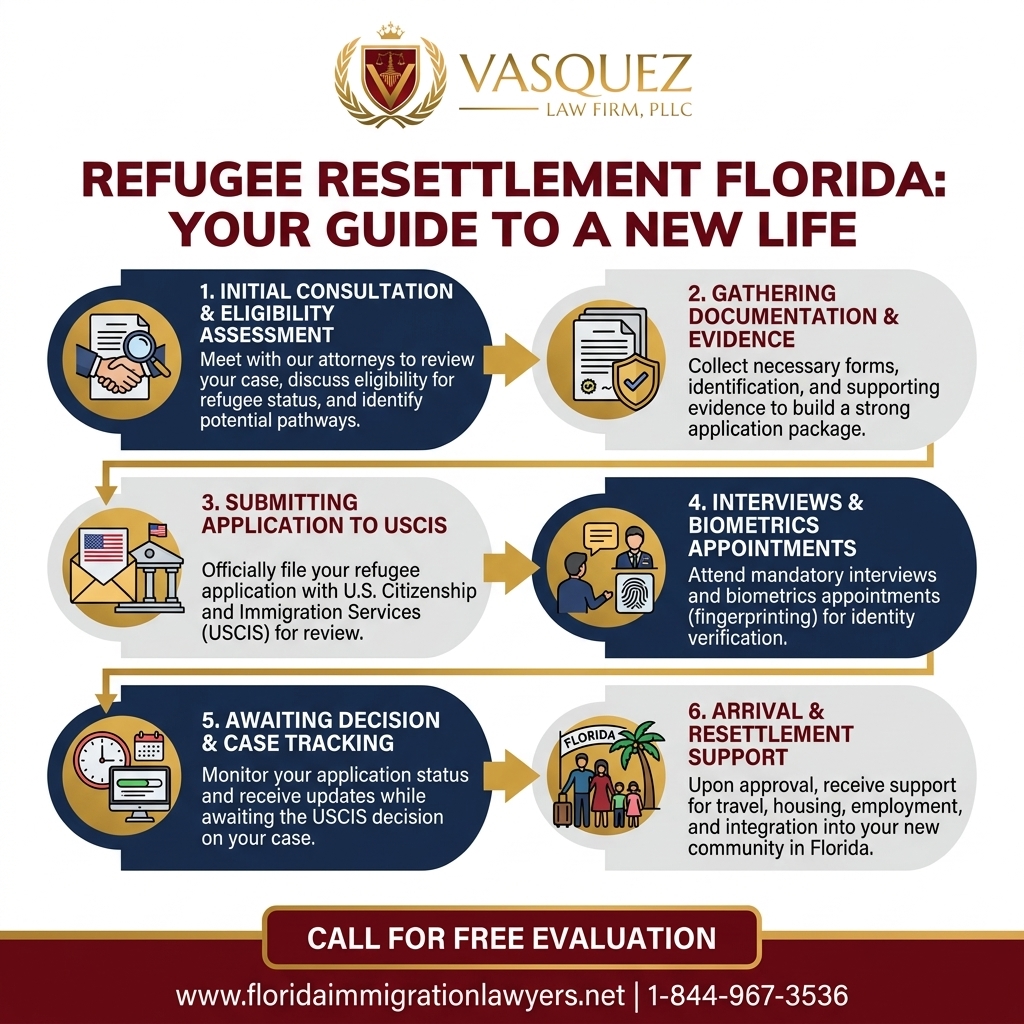
The journey to refugee resettlement Florida is a multi-stage process that requires patience and meticulous attention to detail. Here is a general overview of the steps involved, from initial referral to long-term integration:
- Referral to the U.S. Refugee Admissions Program (USRAP): Most refugees are referred to the USRAP by the UNHCR, a U.S. embassy, or a specially designated non-governmental organization. There is no direct application for refugee status from abroad to the U.S. government. This initial step is critical and often takes place in a third country where the individual has sought temporary refuge.
- Extensive Interview and Vetting Process: Once referred, applicants undergo a rigorous interview process with officers from U.S. Citizenship and Immigration Services (USCIS). This involves detailed questioning about their claims of persecution, personal history, and family background. This stage also includes comprehensive security checks conducted by multiple U.S. government agencies, which can take a significant amount of time due to their thorough nature.
- Medical Examination: All refugee applicants must undergo a medical examination to screen for communicable diseases and ensure they meet U.S. health admissibility requirements. This examination is performed by approved panel physicians and is a mandatory step for all individuals seeking to enter the United States as refugees.
- Cultural Orientation: Before departure, refugees often participate in cultural orientation programs. These sessions provide vital information about life in the United States, including American laws, cultural norms, employment expectations, and the services they will receive upon arrival. This preparation helps to ease the transition into a new society.
- Assignment to a Resettlement Agency: Once approved, refugees are assigned to a resettlement agency in the U.S., which could be located in Florida. This assignment is based on factors such as family ties, specific medical needs, and the capacity of local agencies in cities like Orlando to provide support. The agency then prepares for the refugee's arrival, coordinating housing and initial services.
- Travel to the U.S.: The International Organization for Migration (IOM) typically arranges and funds the travel for approved refugees. Upon arrival at a U.S. port of entry, refugees are inspected by Customs and Border Protection (CBP) officers. They are then met by representatives from their assigned resettlement agency.
- Initial Resettlement Services: In Florida, resettlement agencies provide crucial support for the first 30-90 days. This includes temporary housing, food assistance, help enrolling children in school, accessing medical care, applying for Social Security cards, and connecting with employment services. The goal is to help refugees achieve self-sufficiency as quickly as possible.
- Adjustment of Status to Lawful Permanent Resident: One year after entering the U.S. as a refugee, individuals are generally required to apply for adjustment of status to become a lawful permanent resident (Green Card holder). This involves filing Form I-485 with USCIS. Our attorneys can help ensure this critical application is filed correctly and on time.
Essential Documents for Refugee Resettlement and Adjustment of Status
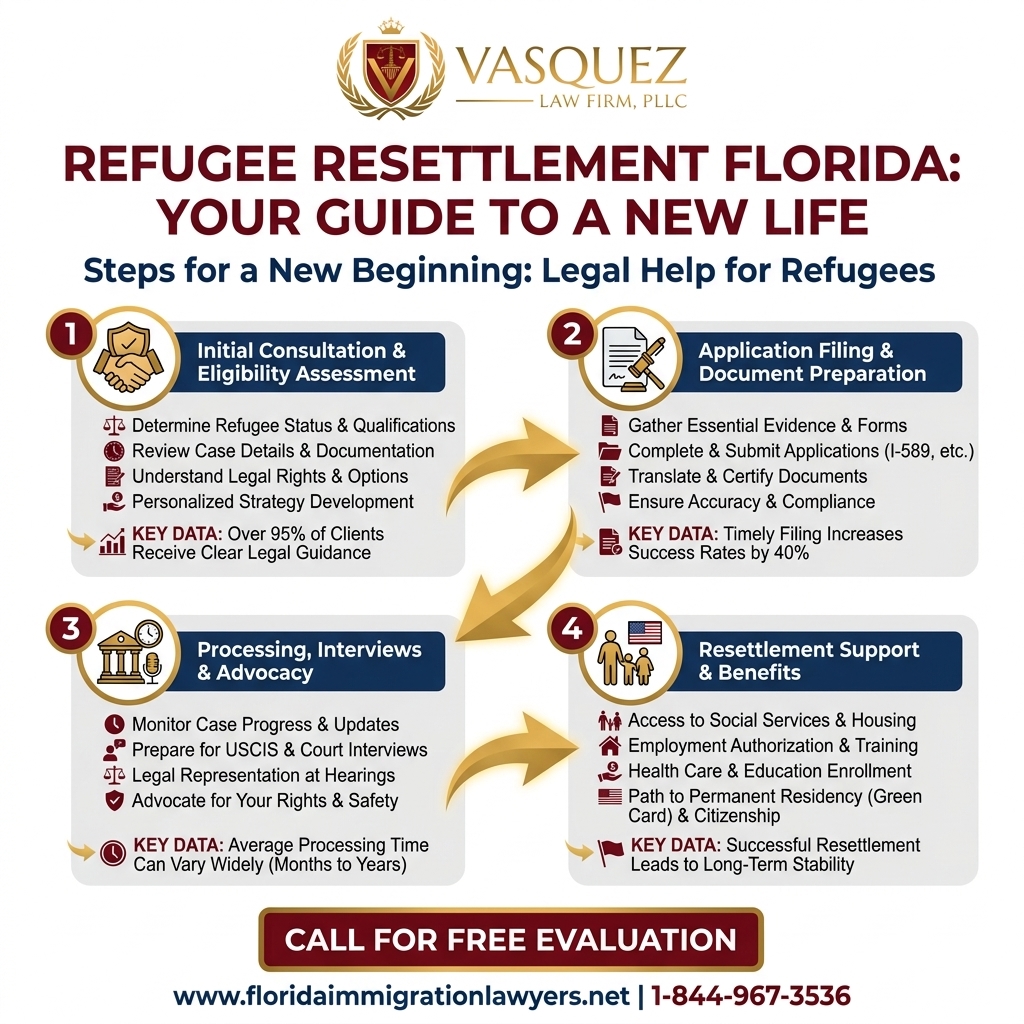
Successfully navigating the refugee resettlement process and eventually applying for a Green Card requires meticulous organization of various documents. Missing or incorrect documentation can lead to significant delays or even denial. Here is a comprehensive checklist of documents you will typically need:
- Proof of Refugee Status: This includes your Form I-94 (Arrival/Departure Record) endorsed with your refugee status, and any approval notices for your refugee classification (e.g., Form I-590, Registration for Classification as Refugee). For those who entered under a derivative refugee petition, the Form I-730 approval notice is also crucial.
- Identity and Civil Documents: Original birth certificates for yourself and all family members included in your application, marriage certificates (if applicable), divorce decrees (if applicable), and any national identity documents or passports you may possess. Even if these documents were left behind or lost during your flight, it is important to disclose this and explore alternatives with legal counsel.
- Medical Examination Results: The sealed envelope containing the results of your mandatory medical examination, conducted by a USCIS-approved civil surgeon. Do not open this envelope yourself; USCIS requires it to be submitted sealed.
- Photographs: Recent passport-style photographs that meet USCIS specifications for all applicants. These are typically required for various forms, including the Green Card application.
- Proof of Relationship: If applying with family members, or if family members are joining you later, you will need documents proving your relationship, such as birth certificates, marriage certificates, and adoption decrees.
- Financial Records: While initial refugee processing has no fees, for the Green Card application, you may need to demonstrate financial self-sufficiency or eligibility for a fee waiver (Form I-912). Documents could include bank statements, employment letters, or affidavits of support from family members.
- Police Clearances: Depending on your age and countries of residence, you may need to provide police certificates from countries where you have lived for six months or more since the age of 16. The specific requirements can vary, and legal guidance is beneficial here.
- USCIS Forms: For adjustment of status, you will primarily need Form I-485, Application to Register Permanent Residence or Adjust Status. You may also need Form I-765 for Employment Authorization and Form I-131 for a Refugee Travel Document, depending on your needs.
Our experienced attorneys at Florida Immigration Lawyers can help you compile, review, and submit all necessary documentation accurately, minimizing potential delays. We understand the unique challenges faced by refugees in obtaining these documents and can assist in strategizing solutions.
Timelines and Expectations for Refugee Resettlement in Florida
The timeline for refugee resettlement Florida can vary significantly, often spanning several years from the initial referral to gaining permanent residency and beyond. It is crucial to set realistic expectations and understand that many factors, including global events, policy changes, and administrative backlogs, can influence processing speeds. While the U.S. government and resettlement agencies work diligently, patience is a key component of this journey.
Initial Processing and Arrival (Overseas):
The overseas processing, from referral to arrival in the U.S., can take anywhere from 18 months to several years. This extensive period includes multiple interviews, thorough security checks, and medical screenings. Factors such as the applicant's country of origin, the complexity of their case, and the current capacity of the USRAP directly impact these timelines. For instance, individuals from certain regions may face more stringent or prolonged security vetting processes. The U.S. government's annual refugee admissions ceiling also plays a significant role, affecting how many individuals can be processed and admitted each fiscal year. You can monitor general processing times on the USCIS website, though specific refugee processing times are often harder to pinpoint.
Resettlement and Integration (First Year in Florida):
Upon arrival in Florida, the initial resettlement phase typically lasts for 30 to 90 days, during which time resettlement agencies provide intensive support. However, the process of full integration into society, including securing stable employment, learning English, and establishing community ties, can extend for several years. Refugees in Orlando and other Florida cities often receive assistance with housing, initial food supplies, and access to medical care and public benefits. The goal is self-sufficiency, which is a gradual process.
Adjustment of Status to Green Card (After One Year):
A critical milestone occurs one year after a refugee's admission to the U.S.: eligibility to apply for a Green Card (lawful permanent residency). This application, Form I-485, typically takes 8-24 months to process, depending on the specific USCIS field office (e.g., the Orlando Field Office) and current backlogs. It involves submitting required documentation, attending a biometrics appointment, and potentially an interview. Once a Green Card is granted, refugees become lawful permanent residents, gaining more stability and fewer travel restrictions. Our team at Florida Immigration Lawyers can help prepare and submit this vital application, mitigating potential delays.
Path to U.S. Citizenship:
Five years after obtaining lawful permanent residency, refugees may be eligible to apply for U.S. citizenship through naturalization. This requires meeting residency requirements, demonstrating good moral character, passing English and civics tests, and taking an Oath of Allegiance. This is the final step in the immigration journey, offering full participation in American society.
Cost Factors and Fee Breakdown for Refugees
Understanding the financial aspects of refugee resettlement Florida is essential, though it is important to note that the initial refugee processing itself typically involves no direct filing fees for the applicant. The U.S. government and international organizations cover many of the initial costs associated with identification, vetting, and travel. However, certain fees do arise later in the process, particularly when applying for adjustment of status to a Green Card.
Initial Refugee Processing (No Fees):
Individuals applying for refugee status from overseas do not pay application fees to USCIS or the Department of State. The costs associated with interviews, security checks, and medical examinations are generally covered by the U.S. government or partner organizations. Similarly, the travel costs to the United States are typically covered by the International Organization for Migration (IOM), though refugees may be required to sign a promissory note to repay these travel loans over time once they are employed.
Adjustment of Status (Green Card) Fees:
The primary cost refugees will encounter is when they apply for adjustment of status to become a lawful permanent resident (Green Card holder) one year after their arrival. This involves filing Form I-485, Application to Register Permanent Residence or Adjust Status. As of 2026, the filing fee for Form I-485 can be substantial, along with a separate fee for biometrics services (fingerprints and photos). These fees are subject to change, and it is always advisable to check the most current fee schedule on the USCIS website before filing.
Fee Waiver Eligibility:
Many refugees and their families may be eligible for a fee waiver if they meet certain income guidelines or are receiving means-tested public benefits. Filing Form I-912, Request for Fee Waiver, can exempt applicants from paying the I-485 and biometrics fees. It is crucial to correctly document your eligibility for a fee waiver, as an improperly filed waiver request can lead to delays or rejection of your application. Our legal team can help assess your eligibility and prepare a robust fee waiver request.
Other Potential Costs:
- Attorney Fees: While not mandatory, hiring an immigration attorney is a valuable investment. Legal fees cover professional guidance, preparation of complex forms, representation during interviews, and strategic advice, significantly increasing the likelihood of a successful outcome.
- Translations: Any documents not in English must be accompanied by certified English translations, which incur costs.
- Photographs: Fees for passport-style photographs.
- Travel Documents: If you need a Refugee Travel Document (Form I-131) to travel internationally, there is a separate filing fee for that application.
Initial resettlement agencies in Florida provide limited financial assistance for the first few months, covering basic needs. However, refugees are expected to become self-sufficient. Understanding these costs and planning for them is a crucial step in the resettlement process. Our firm offers transparent fee structures and can discuss payment options during your free consultation.
Do not navigate this complex process alone. Contact Florida Immigration Lawyers today for dedicated support in Orlando and across Florida. Our team is ready to provide the guidance you need to achieve your immigration goals.
Common Mistakes to Avoid in Refugee Resettlement
The refugee resettlement process is fraught with potential pitfalls that can lead to significant delays, complications, or even denial of status. Avoiding these common mistakes is paramount for a successful outcome. Here are 7-12 crucial errors to steer clear of:
- Providing Inconsistent Information: Any discrepancies in your story or biographical details across different applications or interviews can raise red flags with USCIS and lead to intense scrutiny, delays, or a finding of lack of credibility. Always be truthful and consistent.
- Missing Deadlines: The most critical deadline for refugees is applying for adjustment of status (Green Card) one year after arrival in the U.S. Failing to file Form I-485 within this window can jeopardize your path to permanent residency and potentially lead to deportation defense issues.
- Failing to Disclose Criminal History: Even minor arrests or convictions, regardless of how long ago they occurred or if charges were dropped, must be disclosed. Concealing information can be seen as misrepresentation and lead to severe immigration consequences.
- Not Updating Contact Information: Moving without notifying USCIS or the resettlement agency of your new address can result in missed appointments, lost notices, and critical delays. Always file Form AR-11 within 10 days of moving.
- Traveling Internationally Without Proper Authorization: As a refugee, you cannot simply use your national passport to travel abroad. You need a Refugee Travel Document (Form I-131) to re-enter the U.S. Traveling without it can lead to inadmissibility upon return.
- Ignoring Requests for Additional Evidence (RFE): USCIS often sends Requests for Evidence (RFEs) or Notices of Intent to Deny (NOIDs). Failing to respond adequately or on time can result in the denial of your application. These requests must be taken seriously.
- Attempting to File Complex Forms Without Legal Review: Immigration forms are complex and unforgiving. Even small errors can cause rejections or processing delays. Relying solely on self-help guides for applications like Form I-485 is a common mistake.
- Misunderstanding the Difference Between Refugee and Asylum Processes: Confusing the two distinct legal pathways can lead to filing the wrong applications or making incorrect statements that harm your case. Seek clarification from a qualified attorney.
- Not Seeking Mental Health or Trauma Support: The trauma experienced by refugees can be profound. Neglecting mental health can impact your ability to integrate and communicate effectively during interviews. Resettlement agencies and community organizations in Florida offer vital support.
- Falling Victim to Immigration Fraud: Be wary of individuals who promise guaranteed results, charge exorbitant fees, or claim to have special connections. Only work with licensed attorneys or accredited representatives.
- Failing to Maintain Good Moral Character: Throughout the process, and especially when applying for a Green Card and citizenship, maintaining good moral character is essential. Any criminal activity can derail your immigration journey.
- Not Understanding Work Authorization Limitations: While refugees receive work authorization, understanding its scope and limitations is crucial. Working without proper authorization can have serious negative consequences.
When to Call a Florida Immigration Lawyer
While the refugee resettlement process is designed to be supportive, it is inherently complex and can present numerous challenges. Knowing when to seek legal counsel from an experienced Florida immigration lawyer can make a critical difference in the success and smoothness of your journey. You should consider contacting Florida Immigration Lawyers in several specific scenarios.
If your case involves any complexities such as a previous denial of refugee status or asylum, a criminal history (even minor offenses), or concerns about inadmissibility grounds, legal representation is not just advisable but often essential. Our attorneys are adept at handling such intricate cases, providing robust deportation defense and strategizing the best path forward.
Furthermore, if you are struggling with the application for adjustment of status (Green Card) after your first year in the U.S., or if you have received a Request for Evidence (RFE) or Notice of Intent to Deny (NOID) from USCIS, immediate legal intervention is critical. We can help you gather the necessary documentation, craft compelling responses, and represent you in interviews, such as those conducted at the Orlando USCIS Field Office. Navigating family reunification for relatives still abroad, especially through Form I-730, is another area where our expertise can prevent costly mistakes and delays.
Any time you feel uncertain about your rights, obligations, or the next steps in your immigration journey, particularly concerning citizenship or any form of humanitarian parole, a free consultation with Florida Immigration Lawyers can provide clarity and peace of mind. We serve all of Florida, including Orlando, ensuring that you have access to expert legal support tailored to your unique situation.
About Florida Immigration Lawyers
Florida Immigration Lawyers is a premier law firm dedicated to serving individuals and families throughout the state of Florida with comprehensive immigration legal services. Our team of compassionate and knowledgeable attorneys understands the profound impact immigration matters have on our clients' lives. We are committed to providing personalized, effective legal representation, ensuring that every client receives the attention and advocacy they deserve.
We specialize in a wide range of immigration practice areas, including refugee and asylum claims, Green Card applications, family-based petitions, deportation defense, and naturalization. Our firm prides itself on its deep understanding of U.S. immigration law and its commitment to staying abreast of the latest legal developments and policy changes. Whether you are seeking protection, reuniting with family, or pursuing U.S. citizenship, we are here to guide you through every step of the process.
Choosing Florida Immigration Lawyers means choosing a partner who will fight tirelessly for your rights and your future. We offer free consultations, are available 24/7, and proudly offer bilingual services (Se Habla Español) to ensure effective communication. Our main office is accessible to clients across Florida, including those in Orlando, Miami, and Tampa. Visit us at https://www.floridaimmigrationlawyers.net or call 1-844-967-3536 today to schedule your free consultation and take the first step towards a secure future.
Sources and References
- U.S. Citizenship and Immigration Services (USCIS)
- Executive Office for Immigration Review (EOIR)
- U.S. Department of State (Bureau of Population, Refugees, and Migration)
- Immigration and Nationality Act (INA) Section 101(a)(42) (8 U.S.C. § 1101(a)(42)) - Definition of Refugee
- 8 Code of Federal Regulations (CFR) Part 207 - Refugee Status
- 8 Code of Federal Regulations (CFR) Part 209 - Adjustment of Status of Refugees and Asylees
- USCIS Policy Manual - Volume 7, Part M - Refugees and Asylees
Related services: asylum application process, withholding of removal, humanitarian protection programs.
This article provides general legal information and is not intended as legal advice. Every case is unique, and outcomes depend on specific facts and circumstances. Contact an attorney for advice about your particular situation.
Your journey to a new life in Florida as a refugee is significant, and navigating its legal complexities requires expert guidance. Do not let uncertainty or fear prevent you from securing your future. Contact Florida Immigration Lawyers today for a free, confidential consultation at 1-844-967-3536. Se Habla Español - Estamos aqui para ayudarle.
Do Not Navigate This Process Alone
Our experienced immigration attorneys are ready to fight for you. Get a free, confidential consultation today.
Se Habla Español
Frequently Asked Questions
Florida Immigration Lawyers
Immigration Attorney | Founder, Vasquez Law Firm
U.S. Air Force veteran and immigration attorney with thousands of cases resolved. J.D., NCCU School of Law. AILA member. Admitted to the 4th, 5th, and 11th Circuit Courts.
Available 24/7 - Free Evaluations
Related Legal Services
Our Florida immigration attorneys can help you with experienced immigration attorneys, business immigration and asylum protection. Call today at 1-844-967-3536 for a free consultation.
Related Links
Related Topics
Free Legal Consultation
Discuss your case with our experienced attorneys. We're available 24/7.
Se Habla Español - Estamos aquí para ayudarle.
Related Articles
Immigration Bond Hearing Florida: Secure Release from Detention
Facing an immigration bond hearing in Florida can be one of the most stressful experiences for individuals and their families. When a loved one is detained by ICE, understanding the path to their release is paramount. This detailed guide from Florida Immigration Lawyers explains the entire process, from initial detention and bond eligibility to preparing for your hearing and securing release. We cover essential documents, timelines, cost factors, and common mistakes to avoid. With offices serving all of Florida, including Hialeah, our expert attorneys are ready to provide the compassionate and effective legal representation you need to navigate these complex challenges. Learn how strong legal advocacy can make a difference in securing freedom from detention.
Immigration Rights in Florida: Know Your Legal Protections
Navigating immigration law in Florida can be complex, especially when facing potential encounters with Immigration and Customs Enforcement (ICE). This comprehensive guide empowers you with essential immigration rights, detailing your legal protections and what to do if you or a loved one are stopped or detained. Learn how to protect yourself, avoid critical mistakes, and understand the crucial role of legal counsel in safeguarding your future in Florida. From Homestead to Miami, knowing your rights is your first line of defense against deportation and legal challenges. Contact Florida Immigration Lawyers for a free consultation.
Unlawful Presence Waiver in Florida: A Guide | VLF Florida
Discover how the unlawful presence waiver can help immigrants in Florida. Learn about eligibility, application steps, and common mistakes to avoid. Contact Florida Immigration Lawyers for a free consultation.
Citizenship Test Preparation Florida: Your Guide to
Preparing for the U.S. citizenship test in Florida is a critical step towards naturalization. This comprehensive guide from Florida Immigration Lawyers covers understanding the English and civics tests, a step-by-step application process, essential documents, and effective preparation strategies. Learn about common mistakes to avoid and when to seek legal counsel for complex cases. Our experienced attorneys serve clients across Florida, including Gainesville, providing personalized support to help you achieve your dream of becoming a U.S. citizen. Contact us for a free consultation and navigate your naturalization journey with confidence and expert guidance.