SIJS Florida: Special Immigrant Juvenile Status Guide 2026
Special Immigrant Juvenile Status (SIJS) in Florida provides a critical pathway to legal residency for vulnerable children who have experienced abuse, neglect, or abandonment. This comprehensive guide from Florida Immigration Lawyers details the eligibility requirements, the two-phase application process involving Florida state courts and USCIS, essential documentation, and expected timelines for 2026. We also highlight common mistakes to avoid and explain when professional legal assistance is indispensable. For minors in Hollywood, Miami, or anywhere in Florida, understanding SIJS is the first step towards a secure future. Contact our experienced attorneys for a free consultation to navigate this complex legal journey.

Special Immigrant Juvenile Status (SIJS) in Florida offers a critical pathway to lawful permanent residency for undocumented children who have been abused, neglected, or abandoned by one or both parents. This status allows eligible minors, typically under 21 and unmarried, to seek protection and a green card without requiring parental sponsorship. The process involves obtaining a specific order from a Florida state court and then petitioning U.S. Citizenship and Immigration Services (USCIS). Navigating the complex legal requirements, especially those involving state dependency or family courts in Florida, makes experienced legal counsel essential for a successful outcome.
- SIJS protects vulnerable children in Florida from abuse, neglect, or abandonment.
- Requires a specific order from a Florida state court before filing with USCIS.
- Applicants must generally be under 21 and unmarried.
- Leads to eligibility for lawful permanent residency (a green card).
- Legal assistance is highly recommended due to the dual court system involvement.
For many young individuals in Florida, the journey to a stable and secure future in the United States is fraught with challenges. They arrive seeking refuge from unimaginable circumstances, often having experienced severe neglect, abuse, or abandonment in their home countries or within the U.S. borders. Without proper legal status, these vulnerable children face immense uncertainty, fear of deportation, and limited access to education and support systems. This is where Special Immigrant Juvenile Status (SIJS) in Florida becomes a beacon of hope.
SIJS is a vital immigration benefit designed to protect these children, offering them a pathway to lawful permanent residency, commonly known as a green card. It recognizes their unique vulnerability and provides a legal avenue to remain in the U.S. safely. However, the process is intricate, involving both Florida state courts and federal immigration agencies. Understanding each step, from obtaining the necessary state court order in places like Hollywood to filing the federal petition, is crucial for success.
This comprehensive guide from Florida Immigration Lawyers will walk you through the complexities of SIJS, focusing on the specific requirements and procedures within Florida. We will explain eligibility, outline the application steps, detail required documentation, discuss timelines, and highlight potential costs. Our goal is to empower you with the knowledge needed to pursue this critical protection for a child in need. Do not let the complexities deter you from seeking justice and security for a vulnerable minor. Call Florida Immigration Lawyers at 1-844-967-3536 for a free consultation to discuss your specific situation and learn how we can help.
Understanding Special Immigrant Juvenile Status (SIJS) in Florida
Special Immigrant Juvenile Status (SIJS) is a unique immigration classification that provides a pathway to lawful permanent residency for certain undocumented children who have been abused, neglected, or abandoned. Established under Section 101(a)(27)(J) of the Immigration and Nationality Act (INA), 8 U.S.C. 1101(a)(27)(J), this provision acknowledges that some children cannot be safely returned to their home countries or reunified with their parents due to severe mistreatment. For these children, SIJS offers a chance at a new beginning and protection within the United States.
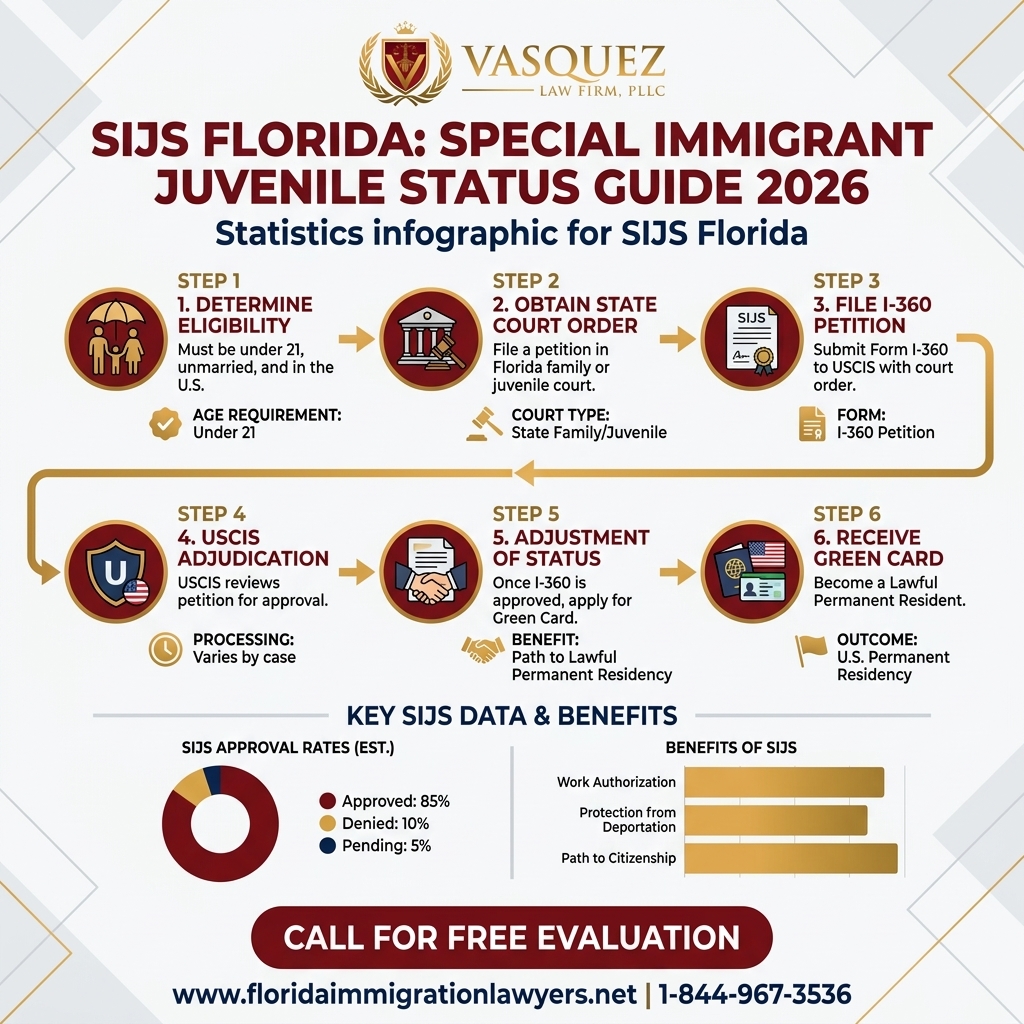
To be eligible for SIJS in Florida, a child must meet several key criteria. First, they must be under 21 years old and unmarried at the time of filing the Form I-360 petition. Second, a Florida state court, such as a dependency court or family court, must have issued an order finding that the child is dependent on the court or has been committed to the custody of a state agency or an individual appointed by the court. This crucial court order must also determine that reunification with one or both parents is not viable due to abuse, neglect, abandonment, or a similar basis under Florida law. Furthermore, the court must find that it is not in the child's best interest to return to their or their parent's country of nationality or last habitual residence.
In Florida, these state court orders are typically obtained through dependency court proceedings, often initiated by the Department of Children and Families (DCF) or through family court proceedings for guardianship or custody. For instance, in Broward County, which includes Hollywood, or in Miami-Dade County, these courts frequently handle cases involving children who have suffered severe harm. The specific findings required by USCIS must be explicitly stated in the state court order, making the guidance of an attorney familiar with both Florida family law and immigration law absolutely essential. Our firm specializes in helping clients navigate these complex legal intersections to secure vital protections. Learn more about our comprehensive immigration law services.
Step-by-Step Guide to Applying for SIJS in Florida
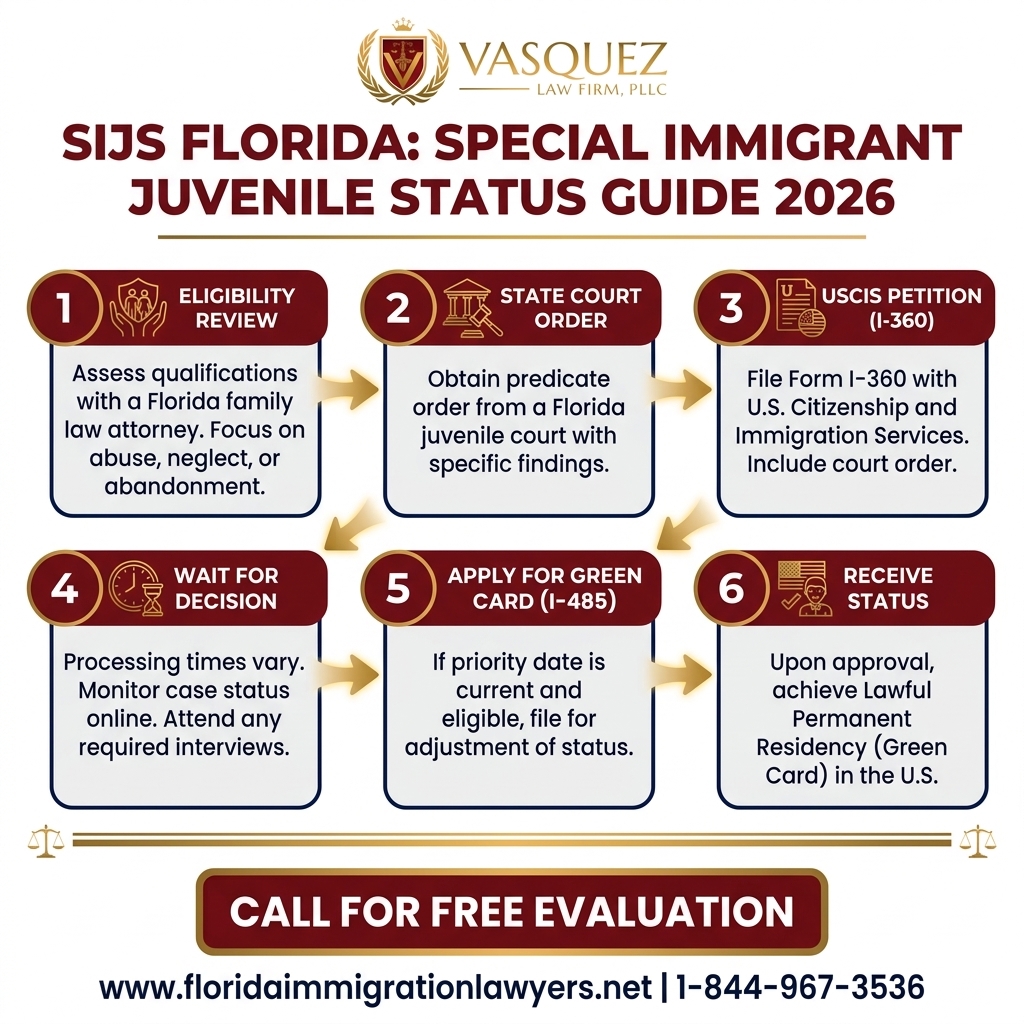
Applying for SIJS in Florida involves a two-part process: first, securing a specific order from a Florida state court, and second, petitioning U.S. Citizenship and Immigration Services (USCIS). Each step has distinct requirements and timelines, making careful preparation and legal guidance paramount.
-
Obtain a State Court Order: This is the foundational step for any SIJS petition. You must secure an order from a Florida state court, such as a dependency court or family court, that makes specific findings required by immigration law. This order must declare the child dependent on the court, or committed to the custody of a state agency or an individual appointed by the court. Crucially, it must also state that reunification with one or both parents is not possible due to abuse, neglect, abandonment, or a similar basis, and that it is not in the child's best interest to return to their country of origin. This step often requires extensive litigation within the Florida state court system, presenting a significant hurdle for many applicants. For example, a dependency court in Palm Beach County might issue such an order after a finding of severe neglect against a child's parents.
-
File Form I-360, Petition for Amerasian, Widow(er), or Special Immigrant: Once you have the certified state court order, the next step is to file Form I-360 with USCIS. This petition formally requests Special Immigrant Juvenile Status. You must include the state court order, the child's birth certificate, and any other supporting documentation proving eligibility. USCIS will review this petition to ensure all immigration requirements are met, including the findings from the Florida state court. This federal petition is the core of the immigration application. For detailed instructions and forms, visit the official USCIS website.
-
Apply for Adjustment of Status (Form I-485) or Consular Processing: After the Form I-360 is approved, the child becomes eligible to apply for lawful permanent residency (a green card). Most SIJS recipients in Florida will file Form I-485, Application to Register Permanent Residence or Adjust Status, concurrently with or after the I-360 approval, if they are physically present in the U.S. and an immigrant visa is immediately available. This involves a medical examination, biometric appointments, and potentially an interview at a local USCIS field office, such as those in Miami or Tampa. If the child is outside the U.S. or cannot adjust status, they would pursue consular processing through a U.S. embassy or consulate abroad.
Essential Documents for Your SIJS Application
A successful SIJS in Florida application hinges on presenting a complete and accurate set of documents to both the Florida state court and USCIS. Missing or incorrect documentation can lead to delays or even denial. Gathering these documents can be challenging, especially for vulnerable children, which is why legal assistance is invaluable.
Here is a general checklist of essential documents:
- Certified State Court Order: This is the most critical document. It must be issued by a Florida state court (e.g., dependency, family, or probate court) and contain all specific findings required by INA Section 101(a)(27)(J). This includes findings of dependency or custody, non-viability of parental reunification due to abuse, neglect, or abandonment, and that it is not in the child's best interest to return to their home country.
- Birth Certificate: A certified copy of the child's birth certificate is needed to prove age and identity. If unavailable, secondary evidence of birth may be accepted.
- Identification Documents: Copies of the child's passport, national identity card, or any other government-issued identification.
- Evidence of Parentage: Documents proving the relationship between the child and their parents, even if reunification is not sought.
- Form I-360, Petition for Amerasian, Widow(er), or Special Immigrant: The completed and signed form, along with all required supporting documentation.
- Form I-485, Application to Register Permanent Residence or Adjust Status (if applicable): Completed and signed, filed concurrently or after I-360 approval.
- Form I-765, Application for Employment Authorization (optional): Allows the child to work while their I-485 is pending.
- Form I-864, Affidavit of Support (if applicable): Required for adjustment of status if the child has a sponsor.
- Medical Examination Report (Form I-693): Completed by a USCIS-approved civil surgeon.
- Photographs: Passport-style photos for all relevant forms.
- Affidavits/Declarations: Statements from individuals with personal knowledge of the child's abuse, neglect, or abandonment, or their dependency on the court.
- Proof of Guardianship/Custody: If the child is in the custody of an individual or state agency, documentation of that arrangement.
- Police Clearance Certificates: If applicable, from any country where the child has resided for six months or more since age 16.
Ensuring every document is accurate, translated if necessary, and properly submitted is a complex task. Our attorneys at Florida Immigration Lawyers are adept at helping clients in Hollywood and across Florida compile these critical applications.
Timelines and Processing Expectations for SIJS Cases in Florida
The timeline for obtaining SIJS in Florida and ultimately a green card can vary significantly, often spanning several months to over a year, depending on various factors. Understanding these processing expectations is crucial for managing the child's journey and preparing for each stage.
Florida State Court Proceedings
The initial phase involves obtaining the necessary state court order. This process can take anywhere from a few weeks to several months, depending on the specific Florida court (dependency or family), the complexity of the case, the court's calendar, and the cooperation of all parties involved. In some cases, especially where parental rights must be terminated or extensive investigations by the Department of Children and Families are required, this stage can be lengthy. For instance, a complex guardianship case in a busy court in Miami-Dade County might take longer than a straightforward dependency case in a less populated area. It is important to remember that this state court order is non-negotiable for the SIJS petition.
USCIS Form I-360 Processing
Once the state court order is secured, the Form I-360 petition is filed with USCIS. Processing times for I-360 petitions can fluctuate significantly. Historically, these petitions have taken anywhere from 6 months to over 18 months, depending on the specific USCIS service center handling the case and its current workload. You can check the approximate processing times on the USCIS website. During this period, USCIS may issue a Request for Evidence (RFE) if they need additional information or clarification, which will extend the overall timeline. Careful preparation of the initial filing can help mitigate potential delays.
Adjustment of Status (Form I-485) and Green Card Issuance
After the I-360 is approved, the child can apply for adjustment of status to become a lawful permanent resident by filing Form I-485. For many SIJS recipients, an immigrant visa number is immediately available, meaning they can file the I-485 concurrently with or shortly after the I-360. However, for some nationalities, particularly those from Mexico, El Salvador, Guatemala, and Honduras, there might be a waiting period due to visa bulletin backlogs, as per INA Section 245(a). This waiting period can add several months or even years to the process. Once the I-485 is filed, it involves biometric appointments, potential RFEs, and an interview at a local USCIS office (e.g., Orlando, Jacksonville, or Kendall). The entire I-485 process, from filing to green card issuance, can take another 8-24 months. Total time from start to finish for a typical SIJS case in Florida could range from 18 months to 3 years or more, emphasizing the need for patience and persistent legal advocacy. Our deportation defense attorneys are also equipped to handle SIJS cases that arise in removal proceedings.
Cost Factors and Fee Breakdown for SIJS Petitions
Understanding the financial aspects of pursuing SIJS in Florida is an important part of the planning process. While the primary goal is to secure legal protection for a vulnerable child, there are several fees and costs associated with both the state court proceedings and the federal immigration application. These costs can vary, and it is crucial to budget accordingly or explore options for fee waivers.
USCIS Filing Fees
The U.S. Citizenship and Immigration Services (USCIS) charges fees for various forms. For SIJS applicants, the Form I-360, Petition for Amerasian, Widow(er), or Special Immigrant, typically does not require a filing fee. However, if the child is simultaneously applying for adjustment of status, there will be fees for Form I-485, Application to Register Permanent Residence or Adjust Status, and the associated biometric services fee. USCIS fees are subject to change, so always check the latest fee schedule on the official USCIS website. It is important to note that eligible applicants may apply for a fee waiver using Form I-912, Request for Fee Waiver, if they meet certain income or public benefits criteria. This can significantly reduce the financial burden.
Medical Examination Fees
All applicants for adjustment of status must undergo a medical examination conducted by a USCIS-approved civil surgeon. The cost of this examination is paid directly to the civil surgeon's office and can vary by provider and location in Florida, often ranging from a few hundred dollars. This fee is separate from USCIS filing fees and is not typically covered by a fee waiver.
Attorney Fees
Perhaps the most significant cost factor, and often the most valuable investment, is legal representation. Navigating the dual legal systems of Florida state courts and federal immigration law is incredibly complex. An experienced immigration attorney will assist with:
- Preparing and filing the state court petition to obtain the required SIJS findings.
- Representing the child in Florida state court proceedings, which can be contentious.
- Preparing and filing Form I-360 and all supporting documentation with USCIS.
- Responding to Requests for Evidence (RFEs) from USCIS.
- Preparing and filing Form I-485 and accompanying documents.
- Preparing the child for and attending the USCIS interview, if required.
 Attorney fees for SIJS cases can vary based on the complexity of the case, the attorney's experience, and the geographic location within Florida. While it represents an upfront investment, professional legal guidance dramatically increases the likelihood of a successful outcome and can prevent costly mistakes. Many firms, including Florida Immigration Lawyers, offer payment plans to help manage this expense. For more information, please visit our contact page.
Do not navigate this process alone. Contact Florida Immigration Lawyers today.
Common Mistakes to Avoid in SIJS Applications
Navigating the complex SIJS process requires meticulous attention to detail. Even minor errors can lead to significant delays or outright denial. Avoiding these common pitfalls is crucial for a successful outcome in Florida.
-
Failing to Obtain a Proper State Court Order: The Florida state court order is the cornerstone of an SIJS petition. A common mistake is receiving an order that does not contain all the specific findings required by immigration law (e.g., findings of dependency/custody, non-viability of parental reunification due to abuse/neglect/abandonment, and that it's not in the child's best interest to return to their country). Without these precise findings, USCIS will deny the I-360 petition.
-
Missing the Age-Out Deadline: While the federal SIJS law allows applicants to be under 21, Florida state courts generally have jurisdiction over minors only until age 18. If a state court order is not secured before the child turns 18, it becomes significantly more difficult, if not impossible, to obtain the necessary findings. This is a critical deadline that often catches families off guard.
-
Incomplete or Inaccurate Form I-360 Filings: Submitting an I-360 petition with missing information, unsigned forms, or insufficient supporting documentation is a frequent error. This will inevitably lead to a Request for Evidence (RFE) or a denial, prolonging the process and adding stress.
-
Lack of Evidence for Abuse/Neglect/Abandonment: While the state court order establishes the findings, USCIS still reviews the underlying basis. Failing to provide additional supporting evidence (e.g., affidavits, police reports, DCF records) can weaken the petition, especially if the state court order's findings are challenged.
-
Not Disclosing All Immigration History: Any prior encounters with immigration authorities, regardless of how minor, must be fully disclosed. Hiding or misrepresenting information can lead to severe consequences, including findings of fraud and permanent bars to immigration benefits.
-
Failing to Respond to RFEs in a Timely Manner: If USCIS issues an RFE, it provides a specific deadline for response. Ignoring or failing to provide all requested documents by the deadline will almost certainly result in a denial of the petition.
-
Leaving the U.S. Without Advance Parole: After filing an I-485 application, leaving the United States without first obtaining advance parole can be considered an abandonment of the application, leading to its denial and potential inadmissibility upon return. This is a particularly dangerous mistake.
-
Not Preparing for the USCIS Interview: If an interview is required for the I-485, being unprepared or providing inconsistent answers can jeopardize the entire application. Understanding the types of questions asked and practicing responses is vital.
-
Ignoring Visa Bulletin Availability: For certain nationalities, particularly from Central American countries, there can be a backlog for SIJS visas. Filing an I-485 when a visa number is not available can lead to delays or rejection. Understanding the Visa Bulletin is crucial.
-
Attempting to Navigate the Process Without Legal Counsel: The most significant mistake is often trying to handle an SIJS case alone. The interplay between state and federal law, the specific legal findings required, and the detailed documentation make it incredibly difficult for non-attorneys to succeed, especially for a minor's future.
When to Call a Lawyer for Special Immigrant Juvenile Status
While this guide provides valuable information, the complexities of Special Immigrant Juvenile Status in Florida almost always necessitate the expertise of a qualified immigration attorney. The dual nature of the process, involving both state and federal legal systems, presents unique challenges that are best navigated with professional legal guidance. Knowing when to seek legal help can make all the difference in a child's future.
You should call Florida Immigration Lawyers immediately if any of the following scenarios apply:
- You are considering applying for SIJS: The initial assessment of eligibility is critical. An attorney can determine if a child meets the complex criteria and advise on the most effective strategy, especially concerning the Florida state court order.
- A child is approaching their 18th birthday: The age-out deadline for state court jurisdiction is a major concern. An attorney can help expedite the state court process to ensure the necessary order is obtained before it's too late.
- There are complications with obtaining a state court order: If family members are uncooperative, or if the Florida state court process is proving difficult, legal counsel is essential to advocate for the child's best interests and secure the required findings.
- You have received a Request for Evidence (RFE) or Notice of Intent to Deny (NOID) from USCIS: These notices indicate that USCIS requires more information or intends to deny the petition. A lawyer can help formulate a comprehensive and timely response to address the issues raised.
- The child has a complex immigration history: Prior deportations, criminal convictions, or other immigration violations can complicate an SIJS case. An attorney can assess these issues and determine if waivers or other forms of relief are available. Learn how our asylum attorneys can also assist in complex cases.
- You need assistance with the Adjustment of Status interview: The interview with a USCIS officer can be intimidating. A lawyer can prepare the child and accompany them to the interview, providing reassurance and legal support.
- The child is in removal (deportation) proceedings: SIJS can be a defense against deportation. An attorney can help present the SIJS application in immigration court and work to terminate removal proceedings.
Florida Immigration Lawyers has extensive experience with SIJS cases throughout Florida, including Hollywood, Miami, Orlando, and Tampa. Our team understands the nuances of both Florida state family law and federal immigration law, providing comprehensive representation to protect vulnerable children. We are committed to securing a safe and stable future for these young individuals.
At Florida Immigration Lawyers, we are dedicated to providing compassionate and effective legal representation to immigrants across the entire state of Florida. With offices strategically located to serve diverse communities, our firm has established itself as a leading authority in immigration law. We understand that navigating the U.S. immigration system can be overwhelming, especially for vulnerable populations such as children seeking Special Immigrant Juvenile Status.
Our team of highly skilled and experienced attorneys specializes in a broad range of immigration matters, including SIJS petitions, family-based immigration, asylum claims, deportation defense, and citizenship applications. We pride ourselves on offering personalized attention, clear communication, and a steadfast commitment to achieving the best possible outcomes for our clients. We believe that every individual deserves a fair chance at a secure future in the United States, and we work tirelessly to make that a reality.
What sets Florida Immigration Lawyers apart is our deep understanding of Florida-specific legal nuances combined with extensive federal immigration law expertise. We offer free consultations to assess your case, explain your options, and develop a tailored legal strategy. Our bilingual staff ensures that language is never a barrier to quality legal assistance. We are available 24/7 to address urgent concerns and provide peace of mind. When you choose Florida Immigration Lawyers, you choose a partner who will stand by you every step of the way, fighting for your rights and your future. Call us today at 1-844-967-3536 or visit our website at www.floridaimmigrationlawyers.net.
Sources and References
- U.S. Citizenship and Immigration Services (USCIS)
- Executive Office for Immigration Review (EOIR)
- U.S. Department of State - Visa Bulletin
- 8 U.S.C. Chapter 12 - Immigration and Nationality Act (INA)
- INA Section 101(a)(27)(J) - Definition of Special Immigrant Juvenile
- INA Section 245(a) - Adjustment of Status of Nonimmigrant to That of Person Admitted for Permanent Residence
- 8 CFR 204.11 - Special immigrant juveniles
- USCIS Policy Manual, Volume 6, Part J - Special Immigrant Juveniles
Related services: immigration practice areas, family immigration services, citizenship and naturalization, business immigration.
This article provides general legal information and is not intended as legal advice. Every case is unique, and outcomes depend on specific facts and circumstances. Contact an attorney for advice about your particular situation. Immigration laws are subject to change.
Securing Special Immigrant Juvenile Status can be a life-changing opportunity for vulnerable children in Florida, offering them safety, stability, and a path to a brighter future. Do not let the complexity of the legal process deter you from seeking this vital protection. The experienced team at Florida Immigration Lawyers is here to guide you through every step, ensuring your application is meticulously prepared and strongly presented. We are committed to advocating for children's rights and helping them achieve lawful permanent residency.
Take the first crucial step towards securing a child's future. Contact Florida Immigration Lawyers today for a free, confidential consultation. Call us at 1-844-967-3536. Se Habla Español - Estamos aquí para ayudarle.
Do Not Navigate This Process Alone
Our experienced immigration attorneys are ready to fight for you. Get a free, confidential consultation today.
Se Habla Español
Frequently Asked Questions
Florida Immigration Lawyers
Immigration Attorney | Founder, Vasquez Law Firm
U.S. Air Force veteran and immigration attorney with thousands of cases resolved. J.D., NCCU School of Law. AILA member. Admitted to the 4th, 5th, and 11th Circuit Courts.
Available 24/7 - Free Evaluations
Related Legal Services
Our Florida immigration attorneys can help you with asylum protection, deportation defense and citizenship and naturalization. Call today at 1-844-967-3536 for a free consultation.
Related Links
Related Topics
Free Legal Consultation
Discuss your case with our experienced attorneys. We're available 24/7.
Se Habla Español - Estamos aquí para ayudarle.
Related Articles
Dual Citizenship: Navigating Immigration in Florida
Explore the complexities of dual citizenship in Florida, focusing on the naturalization process, eligibility, and common pitfalls. Learn how to navigate the journey of obtaining two passports while maintaining ties to both countries. Contact Florida Immigration Lawyers at 1-844-967-3536 for a free consultation.
I-360 Widow Self-Petition in Florida: A Guide | VLF Florida
If you're a widow or widower of a U.S. citizen in Florida, you may be eligible to self-petition for a green card using Form I-360. Learn about the process, requirements, and how Florida Immigration Lawyers can assist you.
U Visa for Crime Victims in Coral Springs, Florida
Discover how the U visa can provide immigration relief for crime victims in Coral Springs, Florida. This blog covers eligibility, application processes, and common pitfalls to avoid. Contact Florida Immigration Lawyers for expert guidance.
DACA Renewal Florida 2026 Guide for Dreamers | VLF Florida
For thousands of young individuals, Deferred Action for Childhood Arrivals (DACA) provides a vital pathway to live and work legally in the United States. If you are a DACA recipient in Florida, preparing for your 2026 renewal is a critical step to maintain your protected status. This comprehensive guide from Florida Immigration Lawyers details the step-by-step process, essential documents, timelines, and cost factors. We also highlight common mistakes to avoid and specific scenarios when legal counsel is indispensable. Our aim is to provide clarity and empower you with the necessary information for a successful DACA renewal. Do not navigate this complex process alone; our experienced team is ready to assist you every step of the way.
