TPS to Green Card Florida: Pathway to Permanent Residency
For TPS beneficiaries in Florida, securing a green card is a crucial step towards permanent residency. This comprehensive guide from Florida Immigration Lawyers explains how to transition from Temporary Protected Status to a green card, focusing on eligibility requirements, the adjustment of status process, essential documentation, and common pitfalls. Learn about the 'lawful entry' requirement, the role of family-based or employment-based petitions, and what to expect regarding timelines and costs. With a significant TPS population in Miami and across Florida, understanding these pathways is vital. Our expert team provides dedicated legal support, ensuring you navigate the complex immigration system effectively. Contact us for a free consultation to discuss your specific case.

For Temporary Protected Status (TPS) beneficiaries in Florida, the journey to a green card is possible but requires meeting specific eligibility criteria beyond just holding TPS. You generally need an independent basis for permanent residency, such as a family-based petition from a U.S. citizen or lawful permanent resident, or an employment-based petition. Crucially, proving lawful entry into the U.S. is often a key factor for adjustment of status. The process involves filing Form I-485, Application to Register Permanent Residence or Adjust Status, along with supporting documentation and attending an interview at a USCIS office in Florida, like Miami or Orlando. Seeking legal guidance from experienced immigration attorneys is highly recommended to navigate these complex requirements effectively.
- TPS alone does not lead to a green card; an independent basis is required.
- Lawful entry is a critical factor for adjustment of status for TPS holders.
- Family-based and employment-based petitions are common pathways.
- The process involves filing Form I-485 and attending a USCIS interview.
- Consulting a Florida immigration lawyer is essential for successful navigation.
TPS to Green Card Florida: Your Pathway to Permanent Residency
For many individuals living under Temporary Protected Status (TPS) in Florida, the dream of obtaining a green card and securing permanent residency in the United States is a significant goal. Florida is home to a large and diverse population of TPS beneficiaries, particularly from countries like Venezuela, Haiti, Nicaragua, Honduras, and El Salvador. Understanding the complex legal framework and specific requirements for transitioning from TPS to green card Florida is crucial for those seeking a more stable future.
While TPS provides temporary relief from deportation and work authorization, it does not automatically offer a direct path to permanent residency. Instead, TPS holders must typically qualify for a green card through an entirely separate immigration category, such as a family-based petition or an employment-based visa. This process, known as adjustment of status, can be intricate and filled with potential pitfalls, especially concerning the crucial requirement of "lawful entry."
Navigating these regulations requires precise legal knowledge and strategic planning. This comprehensive guide from Florida Immigration Lawyers will walk you through the eligibility criteria, the step-by-step process, necessary documentation, and common challenges faced by TPS holders in Florida. Our aim is to empower you with the information needed to pursue your goal of permanent residency effectively. Call Florida Immigration Lawyers at 1-844-967-3536 for a free consultation and let our experienced team help you understand your options.
Understanding Temporary Protected Status (TPS) in Florida
Temporary Protected Status (TPS) is a humanitarian immigration benefit provided by the U.S. government to eligible foreign nationals from designated countries. These designations are made when conditions in a country temporarily prevent its nationals from returning safely, or when the country is unable to handle the return of its nationals adequately. Such conditions can include ongoing armed conflict, environmental disaster, or other extraordinary and temporary circumstances. In Florida, a state known for its diverse immigrant communities, TPS has been a lifeline for many, offering temporary protection and the ability to work legally.
The Immigration and Nationality Act (INA) Section 244 outlines the legal framework for TPS. While TPS offers significant benefits, it is important to remember its temporary nature. It does not confer permanent resident status or any other nonimmigrant status. Beneficiaries must re-register periodically to maintain their status, and the designation for a country can be extended, terminated, or redesignated by the Secretary of Homeland Security. Florida's vibrant immigrant communities, particularly in cities like Miami, Orlando, and Tampa, include many TPS holders from various nations, making the pathway from TPS to a green card a critical issue for thousands of residents. Understanding the nuances of TPS is the first step in exploring further immigration avenues. You can learn more about general immigration processes on our immigration practice area page.
Eligibility Requirements for TPS Holders to Adjust Status
Transitioning from TPS to green card Florida is not automatic; it requires meeting specific eligibility criteria for adjustment of status (AOS). The most crucial aspect is having an independent basis for obtaining lawful permanent residency. This means that simply having TPS does not qualify you for a green card. Instead, you must be eligible for a green card through a separate category, such as a family-based petition, an employment-based petition, or other special immigrant categories. For instance, being the spouse, child, or parent of a U.S. citizen, or having a qualifying employment offer, are common pathways.
A critical factor for TPS holders seeking adjustment of status is the requirement of "lawful admission" or "lawful entry." Historically, many TPS beneficiaries who entered the U.S. without inspection faced challenges in adjusting status. However, a significant development occurred with the *Matter of Z-R-Z-C-*, 26 I&N Dec. 704 (BIA 2016) decision, which affirmed that a grant of TPS constitutes a lawful nonimmigrant status and, for purposes of adjustment of status under INA Section 245(a), may be considered a "lawful admission" for those who subsequently travel with advance parole. This ruling has been pivotal for many TPS holders. If you have an immediate relative (spouse, unmarried child under 21, or parent) who is a U.S. citizen, this often provides a strong foundation for a family-based petition. Our family immigration services can provide detailed assistance.
It is essential to consult with an immigration attorney to determine if your specific circumstances, including your method of entry and any travel history, meet the complex requirements for adjustment of status. Any prior immigration violations or criminal history can significantly impact eligibility and may require waivers.
The Adjustment of Status Process for TPS Beneficiaries in Florida
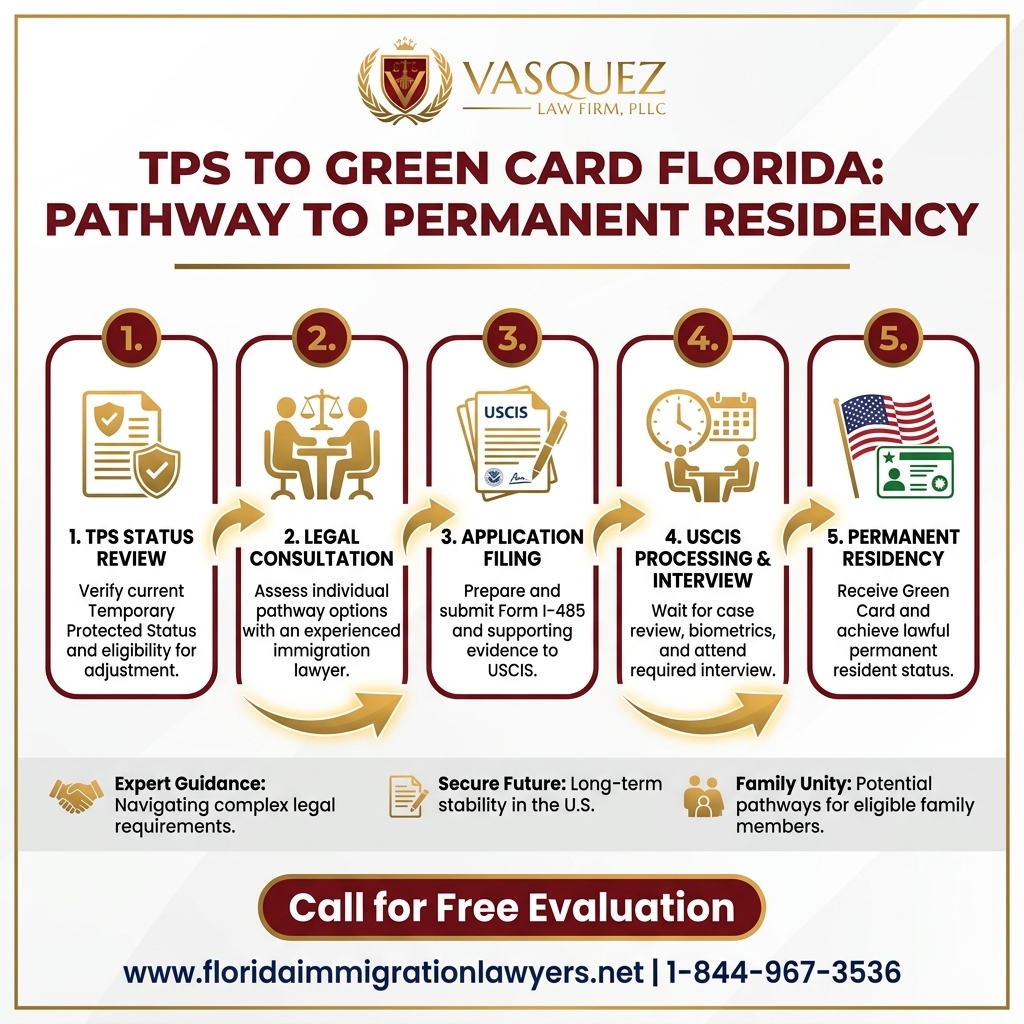
The pathway from TPS to green card Florida involves a multi-step adjustment of status process, primarily handled by U.S. Citizenship and Immigration Services (USCIS). This process typically begins once you have established an underlying eligibility for a green card, separate from your TPS. Here is a general overview of the steps involved:
-
Establish an Independent Basis for a Green Card: Before you can adjust status, you must have an approved or concurrently filed immigrant petition. For family-based green cards, this usually means a U.S. citizen or lawful permanent resident relative files Form I-130, Petition for Alien Relative, on your behalf. For employment-based green cards, an employer typically files Form I-140, Immigrant Petition for Alien Workers, or you may be able to self-petition in certain categories. The priority date must be current for your category.
-
File Form I-485, Application to Register Permanent Residence or Adjust Status: Once your underlying immigrant petition is approved and your priority date is current (if applicable), you can file Form I-485. This form is the core application for adjustment of status. Along with Form I-485, you will typically file Form I-765 for employment authorization (work permit) and Form I-131 for advance parole (travel document), allowing you to work and travel while your green card application is pending.
-
Attend Biometrics Appointment: After filing, USCIS will send you a notice to attend a biometrics appointment at an Application Support Center (ASC) in Florida, such as the one in Miami or Orlando. Here, your fingerprints, photograph, and signature will be collected for background checks.
-
Respond to Requests for Evidence (RFEs) or Notices of Intent to Deny (NOIDs): USCIS may send an RFE if they need more information or documentation to process your case. A NOID indicates that USCIS intends to deny your application and gives you an opportunity to respond. Timely and comprehensive responses are critical.
-
Attend the USCIS Interview: Most adjustment of status applicants are required to attend an interview at a USCIS field office. In Florida, this could be the Miami Field Office, Orlando Field Office, or Tampa Field Office. During the interview, an immigration officer will review your application, ask questions about your eligibility, and verify the information provided. For family-based cases, the interview will also assess the legitimacy of your relationship.
-
Receive a Decision: Following the interview, USCIS will make a decision on your application. If approved, you will receive your green card in the mail. If denied, you will receive a written explanation of the reasons for denial, and you may have options to appeal or refile, depending on the circumstances.
Throughout this process, ensuring all forms are accurately completed and all required documents are submitted is paramount. The legal provisions governing adjustment of status for TPS holders are found in 8 CFR Part 245 and 8 U.S.C. § 1255. For the most current information and forms, always refer to the official USCIS website.
Essential Documents for Your TPS to Green Card Application
A critical component of successfully navigating the TPS to green card Florida pathway is meticulously gathering and submitting all necessary documentation. An incomplete application can lead to delays, Requests for Evidence (RFEs), or even denial. Here is a comprehensive checklist of documents typically required for adjustment of status for TPS beneficiaries:
- Forms:
- Form I-485, Application to Register Permanent Residence or Adjust Status
- Form I-130, Petition for Alien Relative (if family-based)
- Form I-140, Immigrant Petition for Alien Worker (if employment-based)
- Form I-864, Affidavit of Support (for family-based petitions)
- Form I-693, Report of Medical Examination and Vaccination Record (completed by a USCIS-approved civil surgeon)
- Form I-765, Application for Employment Authorization (optional, but highly recommended)
- Form I-131, Application for Travel Document (for Advance Parole, optional)
- Personal Identification and Status Documents:
- Copy of your birth certificate (with certified translation if not in English)
- Copy of your passport biographic page
- Copies of all Form I-797, Approval Notices for TPS (I-821 and I-765)
- Copy of your Form I-94, Arrival/Departure Record (if available, especially if you entered lawfully)
- Copies of any previous visas or entry stamps
- Two passport-style photos
- Proof of Relationship (for family-based petitions):
- Marriage certificate (if applicable)
- Birth certificates of children (if applicable)
- Divorce decrees or death certificates for any prior marriages (for both petitioner and beneficiary)
- Evidence of bona fide marriage (e.g., joint bank accounts, leases, utility bills, photos, affidavits from friends/family)
- Financial Documents:
- Petitioner's federal income tax returns and W-2s/1099s for the past three years (for Form I-864)
- Proof of assets (if relying on assets to meet poverty guidelines)
- Employment verification letters
- Police and Court Records:
- Certified copies of any arrest records, court dispositions, or police reports, even if charges were dismissed or expunged.
Ensure all copies are clear and legible. If any document is not in English, it must be accompanied by a certified English translation. Organizing your documents thoroughly will significantly streamline the application process and reduce potential delays.
Navigating Timelines and Processing Expectations in 2026
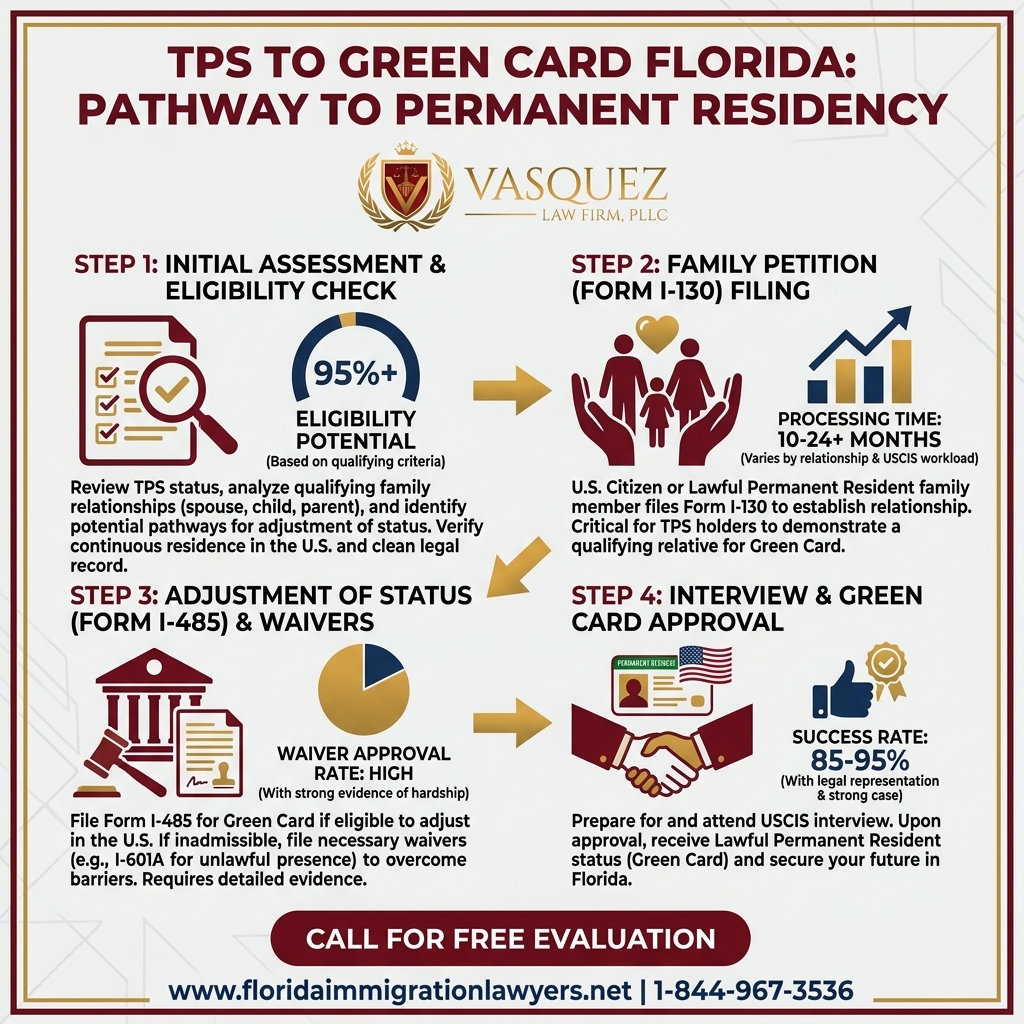
The journey from TPS to green card Florida can involve varying timelines, primarily influenced by the type of underlying immigrant petition and the caseloads at specific USCIS field offices. As of 2026, applicants should be prepared for a process that can take anywhere from one to several years, depending on individual circumstances and the efficiency of immigration agencies. It is crucial to manage expectations and understand the factors that affect processing times.
For family-based petitions (Form I-130), processing times can vary significantly based on the relationship to the petitioner and the petitioner's status (U.S. citizen vs. lawful permanent resident). Immediate relative petitions (spouses, unmarried children under 21, and parents of U.S. citizens) generally have shorter wait times for visa availability. Other family preference categories are subject to the Visa Bulletin, which can involve waiting several years for a priority date to become current. Employment-based petitions also have varying priority dates and processing times. You can always check current USCIS processing times online by form type and field office.
Once the underlying petition is approved and a visa is available, the Form I-485, Application to Adjust Status, enters its own processing timeline. For Florida residents, applications are typically handled by USCIS field offices in Miami, Orlando, or Tampa. These offices often have high volumes of cases, which can contribute to longer processing times. After filing I-485, applicants can expect to receive an Employment Authorization Document (EAD) and Advance Parole (travel document) within several months, allowing them to work and travel while awaiting a decision on their green card. However, the final interview and decision can take an additional 12-24 months, or even longer in some complex cases. Being prepared for potential Requests for Evidence (RFEs) and responding promptly is key to avoiding further delays. The overall timeline is an estimate and can change based on policy shifts or individual case complexities.
Do not navigate this process alone. Contact Florida Immigration Lawyers today. Our team is ready to provide the guidance and support you need.
Cost Factors and Fee Breakdown for Adjustment of Status
Understanding the financial aspects is an important part of planning your transition from TPS to green card Florida. The total cost for adjustment of status can vary significantly, encompassing government filing fees, medical examination fees, and potential legal fees. It's important to note that government fees are subject to change, so always refer to the official USCIS website for the most current fee schedule. We do not list specific amounts here to avoid providing outdated information.
The primary costs typically include:
- USCIS Filing Fees:
- Form I-130, Petition for Alien Relative (if applicable)
- Form I-485, Application to Register Permanent Residence or Adjust Status (includes biometrics fee)
- Form I-765, Application for Employment Authorization (often waived if filed concurrently with I-485)
- Form I-131, Application for Travel Document (often waived if filed concurrently with I-485)
- Medical Examination Fee: You must undergo a medical examination by a USCIS-approved civil surgeon. The cost for this exam varies by provider and is paid directly to the civil surgeon's office. This fee is separate from USCIS filing fees.
- Attorney Fees: Retaining an experienced immigration attorney, such as those at Florida Immigration Lawyers, is a wise investment. Legal fees cover the preparation and filing of all necessary forms, document review, legal advice, representation at interviews, and communication with USCIS. While this is an additional cost, it significantly increases the likelihood of a successful outcome and helps avoid costly mistakes.
For individuals facing financial hardship, USCIS offers the possibility of fee waivers for certain forms, such as Form I-912, Request for Fee Waiver. Eligibility for a fee waiver is based on specific income guidelines or receipt of means-tested benefits. Discussing your financial situation with your attorney can help determine if you qualify for any fee waivers, potentially reducing some of the government costs associated with your application.
Common Mistakes to Avoid When Going from TPS to Green Card
Navigating the complex path from TPS to green card Florida requires careful attention to detail. Many applicants make common mistakes that can lead to significant delays or even denial. Avoiding these pitfalls is crucial for a successful outcome:
-
Not Establishing an Independent Basis for a Green Card: A common misconception is that TPS automatically leads to a green card. This is incorrect. You must qualify for permanent residency through another category, such as a family or employment petition. Failing to secure this underlying eligibility is a fundamental error.
-
Misunderstanding "Lawful Entry" for Adjustment of Status: While TPS can be considered a lawful status, the requirement for "lawful admission" for adjustment of status is complex. If you entered without inspection and did not travel with advance parole after receiving TPS, you might not meet this requirement without specific legal action or waivers. This is a critical point that often trips up applicants.
-
Filing Incomplete or Inaccurate Applications: Submitting forms with missing information, incorrect answers, or insufficient supporting documents is a primary cause of delays and RFEs. Every question must be answered truthfully and thoroughly.
-
Failing to Disclose All Immigration History: Attempting to conceal any part of your immigration history, including prior entries, departures, or interactions with immigration officials, can lead to charges of misrepresentation and potentially a permanent bar from the U.S.
-
Missing Deadlines for TPS Re-registration: While pursuing a green card, it is vital to maintain your TPS status by re-registering during every designated period. Allowing your TPS to lapse can complicate your adjustment of status application.
-
Traveling Internationally Without Advance Parole: If you are applying for adjustment of status and need to travel outside the U.S., you must obtain Advance Parole (Form I-131) first. Leaving the country without it can be considered abandonment of your I-485 application.
-
Providing Inconsistent Information: Any discrepancies between your current application and previous immigration filings (e.g., asylum applications, visa applications) can raise red flags with USCIS and lead to intense scrutiny or accusations of fraud.
-
Not Updating USCIS with Address Changes: Failing to inform USCIS of a change of address (Form AR-11) can result in missed notices, interview appointments, or RFEs, leading to delays or denial of your case.
-
Failing the Medical Examination: Not completing the medical exam with a USCIS-approved civil surgeon, or having a medical condition that makes you inadmissible, can halt your application. Ensure all required vaccinations are up-to-date.
-
Ignoring Criminal History: Any past arrests, charges, or convictions, even minor ones, must be fully disclosed and properly addressed. Certain criminal offenses can make you inadmissible to the U.S. and require a waiver.
-
Not Seeking Legal Counsel: Attempting to navigate the complex immigration system without the guidance of an experienced attorney is perhaps the biggest mistake. An attorney can identify potential issues, ensure proper documentation, and represent your best interests.
When to Call a Florida Immigration Lawyer
The journey from TPS to green card Florida is rarely straightforward, and there are many specific scenarios where the expertise of a seasoned immigration lawyer becomes invaluable. While some cases might seem simple on the surface, even minor complexities can derail an application if not handled correctly. Florida Immigration Lawyers are here to help you navigate these challenges with confidence.
You should strongly consider contacting our firm if any of the following situations apply to you:
- Complex Immigration History: If you have had previous denials, entered the U.S. without inspection, overstayed a visa, or have any other prior immigration violations.
- Criminal Record: Even minor arrests or convictions can have significant immigration consequences. An attorney can assess your criminal history and determine if waivers are available or necessary.
- Uncertainty About "Lawful Entry": If you are unsure whether your entry into the U.S. qualifies as "lawful admission" for adjustment of status purposes, especially if you did not travel with advance parole.
- Questions About Underlying Eligibility: If you are not certain which green card category you qualify for, or if your family relationship or employment situation presents unique challenges.
- Requests for Evidence (RFEs) or Notices of Intent to Deny (NOIDs): Receiving these notices indicates a problem with your application that requires a precise and timely legal response.
- Previous Deportation Orders or Removal Proceedings: These are extremely serious and require immediate legal intervention to explore any available relief, such as an asylum claim or deportation defense.
- Need for Waivers: If you have grounds of inadmissibility (e.g., health issues, criminal history, misrepresentation), you may need to apply for a waiver, which is a complex legal process.
- Language Barriers or Difficulty Understanding Legal Terminology: Our bilingual team can ensure you fully understand every step of the process.
Do not risk your future by attempting to navigate these intricate legal waters alone. Our Florida Immigration Lawyers team is experienced in helping TPS beneficiaries in Miami and across Florida secure their permanent residency. We can assess your unique situation, prepare a strong application, and represent you throughout the process. Contact us today for expert legal assistance.
About Florida Immigration Lawyers
Florida Immigration Lawyers is a leading immigration law firm dedicated to serving individuals and families throughout Florida. We understand the profound impact that immigration matters have on people's lives and are committed to providing compassionate, effective, and results-driven legal representation. Our team of highly skilled attorneys specializes in a wide range of immigration services, including family-based immigration, employment visas, deportation defense, asylum, and citizenship applications. We are particularly adept at assisting TPS beneficiaries in navigating complex pathways like transitioning from TPS to a green card Florida.
We pride ourselves on our client-focused approach, ensuring that every individual receives personalized attention and strategic advice tailored to their unique circumstances. With offices strategically located to serve all of Florida, including major hubs like Miami, we are accessible and responsive to our clients' needs. Our commitment extends to offering free consultations and being available 24/7 to address urgent concerns. We believe in empowering our clients with knowledge and support every step of the way. When you choose Florida Immigration Lawyers, you choose a partner dedicated to protecting your rights and achieving your immigration goals. Visit our attorneys page to learn more about our dedicated legal team.
Sources and References
- U.S. Citizenship and Immigration Services (USCIS)
- Executive Office for Immigration Review (EOIR)
- U.S. Department of State
- 8 U.S.C. § 1254a - Temporary Protected Status
- 8 U.S.C. § 1255 - Adjustment of Status of Nonimmigrant to That of Person Admitted for Permanent Residence
- 8 CFR Part 244 - Temporary Protected Status for Nationals of Designated Foreign States
- 8 CFR Part 245 - Adjustment of Status to That of Person Admitted for Permanent Residence
- Matter of Z-R-Z-C-, 26 I&N Dec. 704 (BIA 2016)
Related services: immigration practice areas, citizenship and naturalization, asylum protection, business immigration.
This article provides general legal information and is not intended as legal advice. Every case is unique, and outcomes depend on specific facts and circumstances. Contact an attorney for advice about your particular situation. Immigration laws are subject to change.
Ready to take the next step towards permanent residency? Don't let the complexities of the immigration system overwhelm you. The experienced team at Florida Immigration Lawyers is here to guide you through every stage of transitioning from TPS to a green card. We offer comprehensive legal services and a commitment to your success. Contact us today for a free consultation at 1-844-967-3536. Se Habla Espanol - Estamos aqui para ayudarle.
Do Not Navigate This Process Alone
Our experienced immigration attorneys are ready to fight for you. Get a free, confidential consultation today.
Se Habla Español
Frequently Asked Questions
Florida Immigration Lawyers
Immigration Attorney | Founder, Vasquez Law Firm
U.S. Air Force veteran and immigration attorney with thousands of cases resolved. J.D., NCCU School of Law. AILA member. Admitted to the 4th, 5th, and 11th Circuit Courts.
Available 24/7 - Free Evaluations
Related Legal Services
Our Florida immigration attorneys can help you with asylum protection, deportation defense and citizenship and naturalization. Call today at 1-844-967-3536 for a free consultation.
Related Links
Related Topics
Free Legal Consultation
Discuss your case with our experienced attorneys. We're available 24/7.
Se Habla Español - Estamos aquí para ayudarle.
Related Articles
Find a Spanish-Speaking Immigration Lawyer in Hialeah
Navigating immigration matters in Hialeah, Florida, requires expert legal guidance. A local, Spanish-speaking immigration lawyer understands the unique challenges faced by residents in Miami-Dade County. Learn why hiring a qualified attorney is crucial for your immigration needs.
Immigration Lawyer Hialeah Florida: Your Guide to Legal Help
For residents of Hialeah, Florida, navigating U.S. immigration law can be complex. Whether you seek a visa, green card, or need deportation defense, a skilled immigration lawyer in Hialeah, Florida, is crucial. This guide from Florida Immigration Lawyers covers essential steps, document requirements, timelines, and cost factors. We emphasize avoiding common mistakes and knowing when to seek legal counsel for intricate cases like asylum or family petitions. Our firm provides comprehensive, bilingual support for Miami-Dade County and all Florida residents, ensuring empathetic and effective representation. Contact us for a free consultation to protect your rights and future.
DACA Renewal Guide for Florida Dreamers 2026 | VLF Florida
Renew your DACA status in Florida for 2026 with our comprehensive guide. Learn key steps, document requirements, and common mistakes to avoid. Call Florida Immigration Lawyers at 1-844-967-3536 for a free consultation today.
Special Immigrant Juvenile Status in Florida | VLF Florida
SIJS offers a pathway to legal residency for minors in Florida who have faced abuse, abandonment, or neglect. Learn how SIJS can provide legal protection and a brighter future. Call us for a free consultation.