Asylum Application Florida Process: Guide for 2026
Navigating the complex asylum application Florida process requires a clear understanding of legal requirements, deadlines, and potential challenges. This comprehensive guide from Florida Immigration Lawyers outlines the step-by-step process for seeking asylum in Florida, covering eligibility, essential documentation, timelines, and cost factors. Learn about the crucial one-year filing deadline, the difference between affirmative and defensive asylum, and the importance of strong corroborating evidence. We also highlight common mistakes to avoid and provide clear guidance on when to seek professional legal assistance. Our firm is dedicated to helping individuals in Kissimmee, Orlando, Miami, and across Florida secure their future. Contact us for a free consultation.
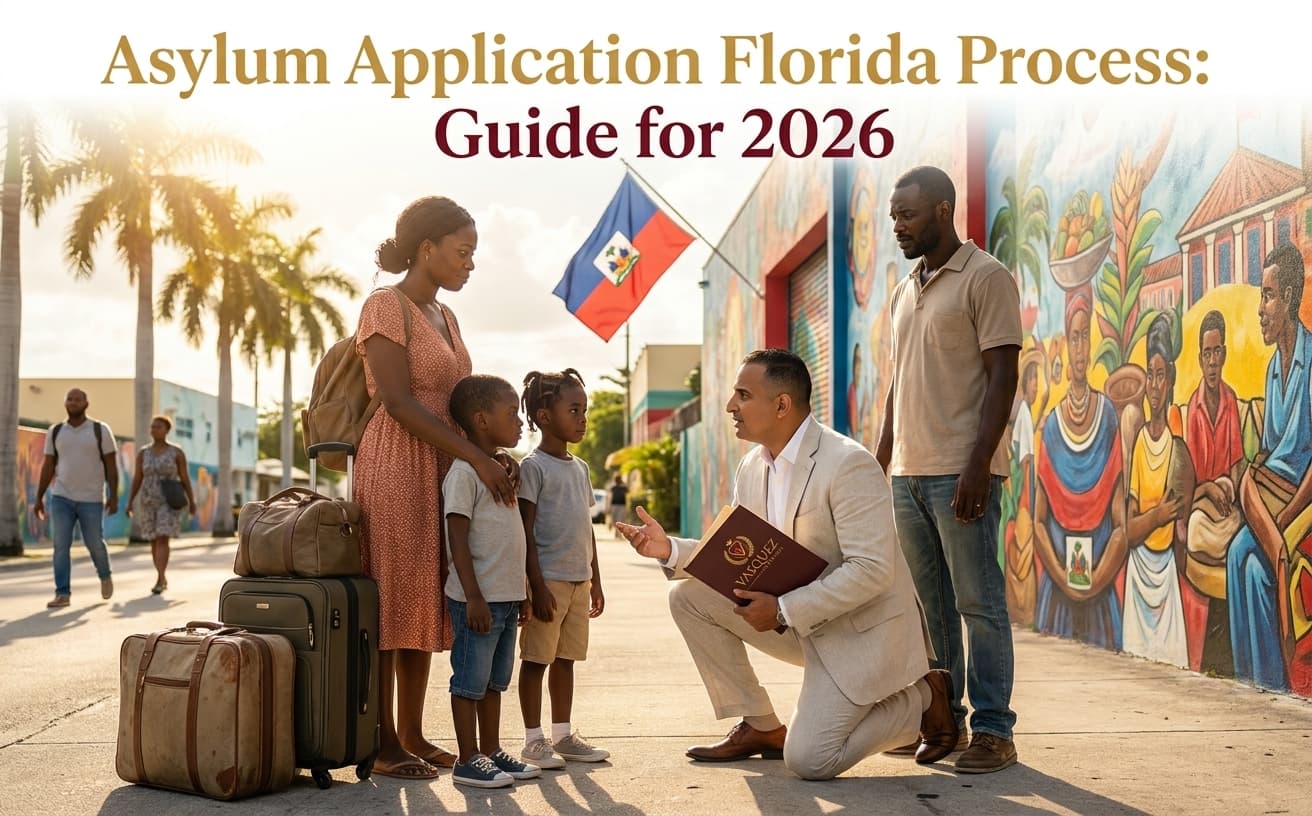
The asylum application Florida process allows individuals fleeing persecution in their home country to seek protection in the United States. This complex process involves filing Form I-589, Application for Asylum and for Withholding of Removal, within one year of arrival, unless an exception applies. Applicants must demonstrate a well-founded fear of persecution based on race, religion, nationality, membership in a particular social group, or political opinion. The journey can involve interviews with USCIS asylum officers or hearings before an immigration judge, particularly in Florida, which hosts significant immigration court activity. Seeking legal counsel from experienced immigration lawyers is crucial to navigate these intricate legal requirements and improve the likelihood of a successful outcome.
- Asylum seekers must file Form I-589 within one year of U.S. entry.
- Eligibility requires a well-founded fear of persecution on specific grounds.
- The process can be affirmative (USCIS) or defensive (Immigration Court).
- Florida has active immigration courts, making local legal expertise vital.
- Legal representation significantly enhances an applicant's chances.
Imagine leaving everything you know behind, driven by an overwhelming fear for your safety or even your life. This is the reality for many individuals who seek asylum application Florida process, a critical pathway to protection within the United States. Whether you are in Kissimmee, Orlando, Miami, or anywhere else in the Sunshine State, understanding the asylum process is the first step toward building a new, secure future. The legal landscape surrounding asylum is constantly evolving, with recent developments, such as decisions impacting detention policies, underscoring the need for up-to-date information and guidance.
This comprehensive guide from Florida Immigration Lawyers will walk you through the intricacies of the asylum application process in Florida. We cover everything from eligibility requirements and the necessary documentation to potential timelines and the common pitfalls to avoid. Our goal is to empower you with the knowledge needed to pursue your asylum claim effectively, providing clarity in what can often feel like an overwhelming journey. We believe that everyone deserves a fair chance to present their case and seek safety.
Do not navigate this complex legal path alone. The stakes are incredibly high, and the nuances of immigration law can be difficult to understand without professional assistance. For personalized guidance and to discuss your unique situation, call Florida Immigration Lawyers at 1-844-YO-PELEO for a free consultation. Our dedicated team is ready to help you every step of the way.
Understanding Asylum in Florida: An Overview for 2026
Asylum offers protection to individuals already in the United States who meet the definition of a refugee. This definition is outlined in Section 101(a)(42) of the Immigration and Nationality Act (INA), found at 8 U.S.C. § 1101(a)(42). To qualify, you must show that you have suffered persecution in your home country, or have a well-founded fear of future persecution, based on one of five protected grounds: race, religion, nationality, membership in a particular social group, or political opinion. The persecution must be at the hands of your government or a group that your government is unable or unwilling to control.
Florida, with its diverse population and geographical proximity to many regions experiencing instability, is a significant hub for asylum seekers. The state is home to several USCIS Field Offices and Immigration Courts, including the Orlando Immigration Court and the Miami Immigration Court, which handle a substantial volume of asylum cases. For individuals residing in areas like Kissimmee, navigating the process often involves interactions with these specific federal agencies. Understanding the legal framework, particularly 8 CFR Part 208, which details asylum procedures, is fundamental to building a strong case. This initial overview sets the stage for understanding why the asylum application Florida process is both critical and challenging.
There are two main avenues for seeking asylum: affirmative asylum and defensive asylum. Affirmative asylum is sought by individuals who are not currently in removal proceedings. They file their application directly with USCIS. If their application is denied by USCIS, they are typically referred to an Immigration Court for defensive asylum proceedings. Defensive asylum, on the other hand, is sought by individuals who are already in removal (deportation) proceedings before an Immigration Judge. The choice of pathway depends on your current immigration status and how you entered the United States. Our attorneys focus on both types of cases, providing robust deportation defense for those facing removal.
It is important to note that the one-year filing deadline is a critical aspect of asylum law. Generally, you must file your Form I-589 within one year of your last arrival in the United States. Failure to meet this deadline can severely impact your eligibility, although certain exceptions exist for extraordinary circumstances or changed country conditions. The burden of proof rests squarely on the applicant to demonstrate eligibility for asylum, which requires compelling evidence and a coherent narrative. This is where the expertise of an immigration lawyer becomes invaluable, helping you gather and present your case effectively to the authorities in Florida.
The Step-by-Step Asylum Application Florida Process
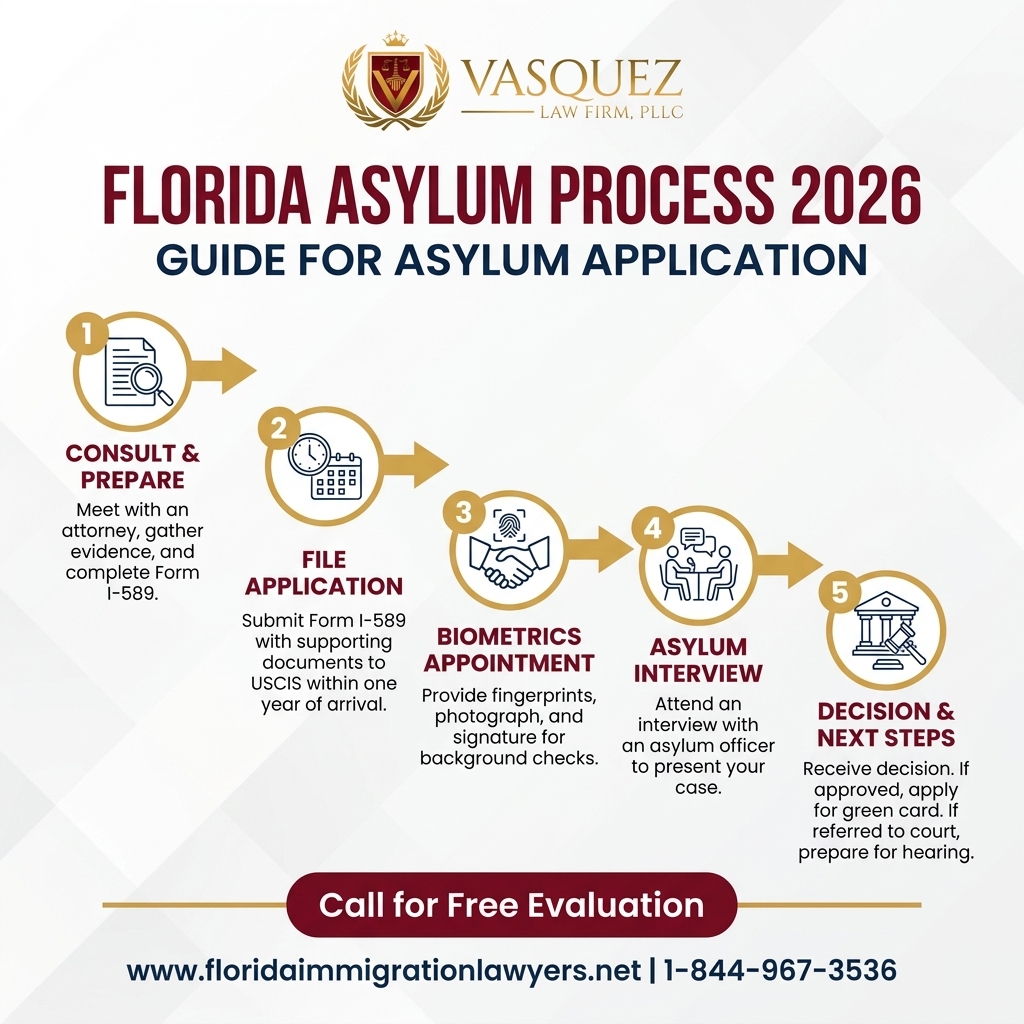
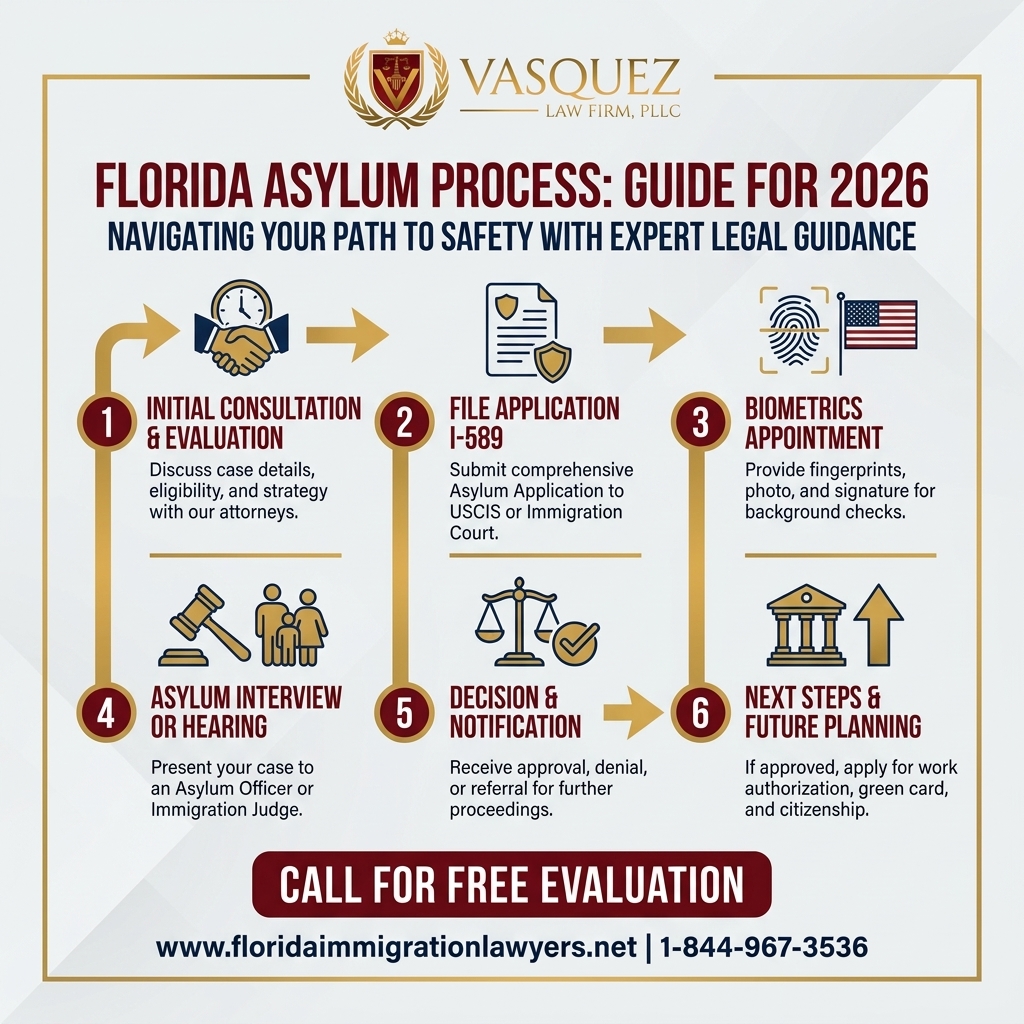
The asylum application Florida process is a detailed journey that requires careful attention to legal requirements and deadlines. Whether you are applying affirmatively or defensively, understanding each step is crucial. This guide outlines the typical progression of an asylum claim, providing a roadmap for individuals seeking protection in Florida. Each phase demands precision and often benefits from the guidance of an experienced attorney who can anticipate challenges and prepare you thoroughly.
Step 1: File Form I-589, Application for Asylum and for Withholding of Removal
This is the foundational document for your asylum claim. You must complete Form I-589 accurately and thoroughly, providing detailed information about yourself, your family, and the persecution you have faced or fear. Crucially, you must file this form within one year of your last arrival in the U.S., unless you qualify for an exception. You will mail the application packet to the appropriate USCIS Service Center. It is vital to keep a copy of everything you submit. This initial filing marks the official start of your asylum process.
Step 2: Biometrics Appointment
After filing Form I-589, USCIS will send you a notice to attend a biometrics appointment at an Application Support Center (ASC). At this appointment, your fingerprints, photograph, and signature will be collected. These biometrics are used for background checks and security clearances. Failure to attend this appointment without proper rescheduling can lead to delays or even denial of your application. This step is a standard part of most immigration applications and helps confirm your identity for the government.
Step 3: Asylum Interview (Affirmative Asylum) or Master Calendar Hearing (Defensive Asylum)
If you filed affirmatively, USCIS will schedule an asylum interview with an asylum officer. This interview, typically held at a USCIS Asylum Office (e.g., Miami Asylum Office for Florida residents), is your opportunity to explain your claim in detail. You can bring an attorney and a translator if needed. The officer will ask questions about your persecution, your fear, and the information in your I-589. If you are in removal proceedings, your first appearance before an Immigration Judge will be a Master Calendar Hearing, where the judge will address preliminary matters, take your pleadings, and set future hearing dates. This marks a critical juncture in the asylum application Florida process.
Step 4: Decision or Referral to Immigration Court
For affirmative asylum applicants, after the interview, the asylum officer will make a decision. If approved, you will be granted asylum. If the officer determines you are not eligible, or if your case is complex, they will typically refer your case to an Immigration Court for defensive asylum proceedings. If referred, you will receive a Notice to Appear (NTA) before an Immigration Judge. For defensive applicants, the Master Calendar Hearing leads to individual hearings where your case is argued before the judge. This is where legal representation truly shines, as an attorney can present your case strategically.
Step 5: Immigration Court Hearings (Defensive Asylum)
If your case proceeds to Immigration Court, you will have a series of hearings. These include additional Master Calendar Hearings and ultimately an Individual Hearing (or Merits Hearing). During the Individual Hearing, you and your attorney will present evidence, call witnesses, and provide testimony to support your asylum claim. The government attorney (DHS counsel) will also present their case and cross-examine you and your witnesses. The Immigration Judge will then issue a decision. This judicial phase of the asylum application Florida process is highly adversarial and requires extensive legal preparation.
Step 6: Appeals Process (If Necessary)
If an Immigration Judge denies your asylum claim, you generally have the right to appeal the decision to the Board of Immigration Appeals (BIA). If the BIA denies your appeal, you may have the option to appeal to a U.S. Circuit Court of Appeals, such as the 11th Circuit Court of Appeals, which covers Florida. The appeals process is complex and has strict deadlines. Consulting with an attorney is essential to determine the viability of an appeal and to ensure all procedural requirements are met. Each stage of this process is designed to ensure due process, but it can be lengthy and challenging.
Essential Document Checklist for Your I-589 Application
A well-prepared asylum application Florida process hinges on thorough documentation. Providing comprehensive and credible evidence is paramount to establishing your eligibility for asylum. The following checklist outlines the key documents you should gather and submit with your Form I-589. Remember, all documents not in English must be accompanied by a certified English translation. Organizing these documents meticulously will strengthen your case and demonstrate the validity of your claim.
- Form I-589, Application for Asylum and for Withholding of Removal: Completed, signed, and dated. Include all required attachments.
- Copies of Identity Documents: Passport, birth certificate, national identity card, visa, I-94 arrival/departure record, or any other proof of identity.
- Evidence of Persecution: This is the most crucial part. It can include police reports, medical records documenting injuries from persecution, witness affidavits, newspaper articles, human rights reports, expert opinions, photos, videos, or letters from organizations.
- Declarations/Affidavits: A detailed personal statement from you explaining your fear of persecution and why you meet the asylum criteria. Also include affidavits from witnesses who can corroborate your story.
- Country Condition Reports: Reports from reputable human rights organizations (e.g., Amnesty International, Human Rights Watch), the U.S. Department of State, or academic sources that describe the human rights situation in your home country and support your claim of persecution.
- Marriage Certificate and Birth Certificates of Dependents: If you are including your spouse or children in your application.
- Proof of Relationship: For any dependents included in your application (e.g., marriage certificates, birth certificates).
- Two Passport-Style Photos: For yourself and each family member included in your application.
- Copy of your I-94 Arrival/Departure Record: Or any other entry document.
- Any Previous Immigration Applications: Copies of any prior applications or petitions filed with USCIS.
- Proof of One-Year Filing Deadline Exception (if applicable): Documentation supporting why you filed after the one-year deadline, such as medical emergencies, legal disability, or changed country conditions.
Gathering these documents can be a daunting task, especially when dealing with traumatic experiences. Our attorneys at Florida Immigration Lawyers can help you organize your evidence, identify gaps, and ensure that your documentation effectively supports your asylum claim. We understand the specific requirements for the asylum application Florida process and how to best present your evidence to USCIS or the Immigration Court. This meticulous approach is vital for any successful petition.
Navigating Timelines and Processing Expectations in Florida
The asylum application Florida process is known for its varying and often lengthy processing times. While USCIS aims to process asylum cases efficiently, backlogs and the complexity of individual cases can lead to significant delays. Understanding these timelines can help manage expectations, but it is important to remember that these are estimates and can change based on current policies, court dockets, and the volume of applications. The current climate, influenced by evolving immigration policies, means that processing times can be particularly unpredictable.
Affirmative Asylum Timelines (USCIS)
- Filing to Biometrics: Typically 3-8 weeks after filing Form I-589.
- Biometrics to Interview: This can vary widely, from a few months to several years, depending on the USCIS Asylum Office's backlog and the priority system. USCIS prioritizes recently filed applications to deter fraudulent claims and reduce the incentive for individuals to use asylum as a means to remain in the U.S. indefinitely.
- Interview to Decision: Often a few weeks to several months after the interview. If the case is referred to Immigration Court, the timeline shifts to defensive asylum.
- Employment Authorization Document (EAD): You can apply for an EAD (work permit) 150 days after your asylum application is filed and remains pending, and it can be issued after 180 days.
Defensive Asylum Timelines (Immigration Court)
- Referral to Master Calendar Hearing: Can range from several weeks to a few months, depending on the court's docket and location (e.g., Orlando Immigration Court vs. Miami Immigration Court).
- Master Calendar to Individual Hearing: This is often the longest wait, ranging from one to several years. Immigration Courts are heavily backlogged, and judges manage numerous cases simultaneously.
- Individual Hearing to Decision: The judge may issue an oral decision immediately or a written decision within a few weeks to months.
- Appeals: If an appeal is filed with the BIA, it can take anywhere from 6 months to 2 years for a decision. Further appeals to the Circuit Court add more time.
These timelines are subject to change and can be influenced by factors such as the complexity of your case, the volume of applications, and any changes in immigration policy. For instance, the recent news about the 11th Circuit rejecting certain mass detention policies could indirectly affect court dockets. It is crucial to stay informed and to have an attorney who can provide up-to-date information specific to your situation in Florida. Patience is key in the asylum application Florida process, but proactive legal guidance can help mitigate delays where possible.
Understanding Cost Factors and Fee Breakdown
The financial aspect of the asylum application Florida process is a common concern for many applicants. While USCIS does not charge a fee to file Form I-589 itself, there are several associated costs that applicants should anticipate. These costs can vary significantly depending on the complexity of your case, whether you hire an attorney, and the need for additional services like translations or expert testimonies. It is important to budget for these expenses to ensure your application proceeds smoothly.
Key Cost Factors:
- USCIS Filing Fees: There is no fee to file Form I-589, the Application for Asylum and for Withholding of Removal. However, if you apply for an Employment Authorization Document (EAD) using Form I-765, there is a separate filing fee, unless you qualify for a fee waiver.
- Legal Fees: This is often the most significant cost. Attorney fees for asylum cases vary widely based on the attorney's experience, the complexity of your case, and the services provided (e.g., preparing the application, representing you at the interview or in court, handling appeals). While there is no standard fee, investing in legal representation is highly recommended due to the intricate nature of asylum law and the high stakes involved.
- Translation Services: Any document not in English must be translated by a certified translator. The cost of these services depends on the volume and language of the documents.
- Document Gathering Costs: Obtaining official documents from your home country, such as birth certificates, marriage certificates, or police records, may incur fees.
- Medical Examinations: While not always required for asylum applicants at the initial stage, medical examinations may be needed later for adjustment of status or if there are specific health-related claims in your persecution narrative.
- Expert Witness Fees: In some complex cases, an expert witness (e.g., a country conditions expert or a psychologist) may be needed to provide testimony or reports, which can be costly.
- Travel Costs: Attending biometrics appointments, USCIS interviews, or Immigration Court hearings in Florida (e.g., traveling to Orlando or Miami) will incur transportation and potentially accommodation costs.
Florida Immigration Lawyers understands that financial constraints can be a concern for asylum seekers. We offer free consultations to discuss your case and provide an estimate of legal fees. We believe that everyone deserves access to quality legal representation, and we strive to provide transparent and fair pricing. While the direct filing fee for asylum is waived, the indirect costs associated with building a strong case can be substantial. Planning for these expenses is an important part of successfully navigating the asylum application Florida process and maximizing your chances of a favorable outcome.
Do not navigate this process alone. The complexities of the asylum application Florida process can be overwhelming, and a single misstep can have profound consequences for your future. Whether you are preparing your initial Form I-589, facing an interview with USCIS, or defending your case in Immigration Court, legal guidance is invaluable. Contact Florida Immigration Lawyers today at 1-844-YO-PELEO for a confidential discussion about your case and to learn how our experienced team can advocate for you.
Common Mistakes to Avoid in the Asylum Application Florida Process
The asylum application Florida process is fraught with potential pitfalls that can jeopardize an otherwise strong case. Avoiding these common mistakes is crucial for maximizing your chances of success. Many of these errors stem from a lack of understanding of complex immigration laws or attempting to navigate the process without legal counsel. Being aware of these traps can save you significant time, stress, and potentially your eligibility for asylum.
- Missing the One-Year Filing Deadline: Failing to file Form I-589 within one year of your last arrival in the U.S. is one of the most common reasons for denial. While exceptions exist, they are difficult to prove. This is a strict statutory requirement under INA 208(a)(2)(B).
- Inconsistent or Inaccurate Information: Providing conflicting details in your application, during interviews, or in court testimony can severely undermine your credibility. USCIS and Immigration Judges scrutinize every detail.
- Lack of Sufficient Corroborating Evidence: While your testimony is important, a strong asylum claim requires corroborating evidence such as police reports, medical records, news articles, or country condition reports.
- Not Explaining the Nexus to a Protected Ground: Applicants must clearly connect their persecution or fear of persecution to one of the five protected grounds (race, religion, nationality, particular social group, political opinion). Simply fearing for your safety is not enough.
- Failing to Disclose All Relevant Information: Hiding past arrests, previous immigration applications, or other pertinent facts can be seen as an attempt to deceive and can lead to a denial, even if the information seems minor.
- Not Preparing for the Interview/Hearing: Underestimating the importance of thorough preparation for your USCIS asylum interview or Immigration Court hearing can lead to a weak presentation of your case.
- Using a Bad Translator: Relying on an unqualified or uncertified translator can lead to miscommunications, misinterpretations of your testimony, and ultimately, damage your case.
- Traveling Internationally While Your Application is Pending: Leaving the U.S. without proper authorization (advance parole) while your asylum application is pending can be seen as abandoning your claim and may lead to its termination.
- Not Updating Your Address with USCIS/EOIR: Failure to inform USCIS and the Executive Office for Immigration Review (EOIR) of an address change can result in missed notices, interview schedules, or court dates, potentially leading to a denial or an order of removal in absentia.
- Failing to Seek Legal Counsel: Navigating the complexities of asylum law, the burden of proof, and the procedural requirements without an experienced immigration attorney significantly reduces your chances of success.
- Not Understanding the Difference Between Asylum, Withholding, and CAT: While often filed together, asylum, withholding of removal, and protection under the Convention Against Torture (CAT) have different eligibility criteria and benefits. A lawyer can explain which forms of relief you qualify for.
- Believing Misinformation from Non-Attorneys: Relying on advice from friends, family, or 'notarios' who are not licensed attorneys can lead to critical errors and irreparable harm to your case.
When to Call a Lawyer for Your Asylum Case in Florida
The decision to seek asylum is momentous, and the legal process that follows is incredibly complex. While it is technically possible to file an asylum application on your own, the statistics show that individuals represented by an attorney have a significantly higher success rate. The asylum application Florida process involves intricate legal arguments, strict deadlines, and a high burden of proof. Knowing when to call a lawyer is not just beneficial, it is often critical for the success of your case.
You should consider contacting Florida Immigration Lawyers if any of the following scenarios apply to you:
- You are considering applying for asylum: The sooner you involve an attorney, the better. We can help you determine eligibility, gather evidence, and prepare your Form I-589 correctly from the outset.
- You are approaching the one-year filing deadline: If you are nearing the one-year anniversary of your entry into the U.S., immediate legal assistance is imperative to discuss exceptions or expedite your filing.
- You are in removal (deportation) proceedings: If you have received a Notice to Appear (NTA) before an Immigration Judge, you are in defensive asylum proceedings. An attorney specializing in deportation defense is crucial to represent you in court.
- You have a complex case: This includes cases involving past criminal history, previous immigration violations, multiple protected grounds, or particularly sensitive persecution narratives.
- You need help gathering evidence: Obtaining documents from your home country or securing expert testimonies can be challenging. An attorney has the resources and experience to assist.
- You are preparing for an asylum interview or court hearing: Our lawyers can thoroughly prepare you for questioning, help you practice your testimony, and represent you effectively before USCIS or an Immigration Judge in Florida, including those at the Orlando or Miami Immigration Courts.
- Your previous asylum application was denied: If you received a denial, an attorney can review your case, identify potential grounds for appeal, and guide you through the complex appeals process to the BIA or Circuit Court.
- You are unsure about any aspect of the process: Any doubt or confusion about eligibility, deadlines, forms, or legal strategies warrants a consultation with an expert.
The experienced attorneys at Florida Immigration Lawyers are dedicated to guiding individuals through every stage of the asylum application Florida process. We understand the unique challenges faced by asylum seekers in areas like Kissimmee and throughout Florida. Our compassionate and knowledgeable legal team is here to provide the robust representation you deserve to protect your future and help you achieve safety. Learn more about our specialized asylum legal services.
About Florida Immigration Lawyers
Florida Immigration Lawyers is a leading law firm dedicated to providing exceptional legal representation to immigrants across the entire state of Florida. With a deep understanding of the complexities of U.S. immigration law, our experienced attorneys are committed to advocating tirelessly for our clients' rights and helping them achieve their immigration goals. We serve individuals and families in Orlando and all communities throughout Florida, offering personalized and compassionate legal services.
Our practice areas include a wide range of immigration matters, such as family immigration, business immigration, naturalization, deportation defense, and, crucially, asylum and refugee claims. We pride ourselves on our client-focused approach, ensuring that each individual receives the attention and strategic counsel their case deserves. Our team of dedicated attorneys is proficient in both English and Spanish, ensuring clear communication and culturally sensitive support for our diverse clientele.
Choosing Florida Immigration Lawyers means partnering with a firm that genuinely cares about your future. We are available 24/7 to address your urgent concerns and offer free consultations to help you understand your legal options without financial commitment. Our unwavering commitment to excellence and our experience make us the trusted choice for immigration legal services in Florida. Call us today at 1-844-YO-PELEO to take the first step toward securing your future.
Sources and References
- U.S. Citizenship and Immigration Services (USCIS) - Form I-589, Application for Asylum and for Withholding of Removal
- Executive Office for Immigration Review (EOIR)
- U.S. Department of State - Refugee and Asylum Information
- 8 U.S.C. § 1101(a)(42) - Definition of Refugee (Immigration and Nationality Act Section 101(a)(42))
- 8 U.S.C. § 1158 - Asylum (Immigration and Nationality Act Section 208)
- 8 CFR Part 208 - Procedures for Asylum and Withholding of Removal
- USCIS Policy Manual, Volume 7 - Asylum and Refugee
Related services: refugee status and resettlement, humanitarian protection programs.
This article provides general legal information and is not intended as legal advice. Every case is unique, and outcomes depend on specific facts and circumstances. Contact an attorney for advice about your particular situation.
Embarking on the asylum application Florida process is a journey that requires courage and legal guidance. Do not face this challenge alone. Florida Immigration Lawyers is here to provide the support, knowledge, and advocacy you need to pursue your claim effectively. Our team is ready to listen to your story and help you navigate every legal hurdle. For a free, confidential consultation, call us today at 1-844-YO-PELEO. Se Habla Español - Estamos aquí para ayudarle.
Do Not Navigate This Process Alone
Our experienced immigration attorneys are ready to fight for you. Get a free, confidential case review today.
Se Habla Español
Or leave your details and we’ll call you:
Free Evaluation in 24 Hours
Or talk to us right now

AI voice assistant — available 24/7
FreeFrequently Asked Questions

William J. Vásquez
Founding Attorney · Vasquez Law Firm
U.S. Air Force veteran and immigration attorney with years of hands-on U.S. immigration experience. J.D., NCCU School of Law. AILA member. Admitted to the 4th, 5th, and 11th Circuit Courts.
Available 24/7 - Free Evaluations
Reviewed for legal accuracy by William J. Vásquez
Licensed in North Carolina; U.S. immigration is federal practice.
Related Legal Services
Our Florida immigration attorneys can help you with family immigration services, immigration lawyer cost in Florida and experienced immigration attorneys. Call today at 1-844-YO-PELEO for a free case review.
Related Links
Related Topics
Free Legal Case Review
Discuss your case with our experienced attorneys. We're available 24/7.
Se Habla Español - Estamos aquí para ayudarle.
Related Articles
DUI Immigration Consequences in Florida 2026
A DUI conviction in Florida can have severe immigration consequences, potentially leading to inadmissibility, deportation, or denial of immigration benefits. For non-citizens, a DUI is not just a traffic offense but a serious criminal matter that federal immigration law scrutinizes closely. Factors like multiple offenses, injury, or property damage can escalate a simple DUI to a Crime Involving Moral Turpitude (CIMT) or even an aggravated felony, triggering mandatory detention and removal proceedings. Understanding the specific nature of your Florida conviction and its interpretation under the Immigration and Nationality Act (INA) is crucial. This article outlines how DUIs impact immigration status, the grounds for inadmissibility and deportation, a step-by-step guide to navigating the process, essential documentation, and expected timelines for 2026. We also highlight common mistakes to avoid and when to seek legal counsel from an experienced immigration attorney. Florida Immigration Lawyers offers comprehensive support for individuals facing these challenging situations, providing expert guidance through complex legal landscapes.
Dual Citizenship Lawyer in Florida: What You Need to Know
For Florida residents, the concept of dual citizenship, or holding two passports, offers a compelling blend of opportunities and challenges. While the U.S. generally permits dual nationality, the path to achieving this status requires a meticulous understanding of both U.S. immigration laws and the citizenship policies of your country of origin. This guide explores the definition of dual citizenship, the detailed step-by-step process for U.S. naturalization, and the significant benefits and potential pitfalls involved. We cover essential documentation, typical timelines, and cost considerations for 2026, providing crucial insights for anyone in Orlando, Miami, or across Florida considering this important legal step. Learn about common mistakes to avoid and understand when to seek professional legal counsel to navigate this complex process successfully. Florida Immigration Lawyers is here to provide expert, bilingual support for your dual citizenship journey.
Immigration Lawyer Orlando Free Consultation in Florida
For individuals and families in Orlando, Florida, navigating the complexities of U.S. immigration law requires expert guidance. An immigration lawyer in Orlando offers crucial support for everything from visa applications and green card processes to naturalization and deportation defense. This comprehensive guide details what a free consultation covers, providing a step-by-step overview of immigration pathways, essential document checklists, and expected timelines in 2026. We also highlight common mistakes to avoid, discuss the critical role of legal counsel in deportation and asylum cases, and explain why choosing a local Orlando immigration attorney is beneficial. Florida Immigration Lawyers is dedicated to serving the diverse community of Orlando with compassionate, effective legal solutions, ensuring you receive personalized advice and robust representation for a successful immigration journey.
EAD Advance Parole Combo Card in Florida: What You Need
An EAD advance parole combo card allows individuals with pending adjustment applications to both work and travel abroad without jeopardizing their green card application. Learn how to apply in Florida, what documents you need, and common mistakes to avoid.