Visa Bulletin January 2026: Florida Immigration Updates...
The Visa Bulletin January 2026 offers critical updates for Florida immigrants awaiting green cards, detailing visa availability through Final Action Dates and Dates for Filing. This guide from Florida Immigration Lawyers explains how these dates impact family-sponsored and employment-based categories, providing a step-by-step process, document checklists, and insights into processing times. We highlight common mistakes to avoid and emphasize when legal counsel is indispensable for navigating complex immigration laws. Whether you're in Coral Springs or elsewhere in Florida, understanding these updates is vital for your immigration journey. Contact our expert team for a free consultation.

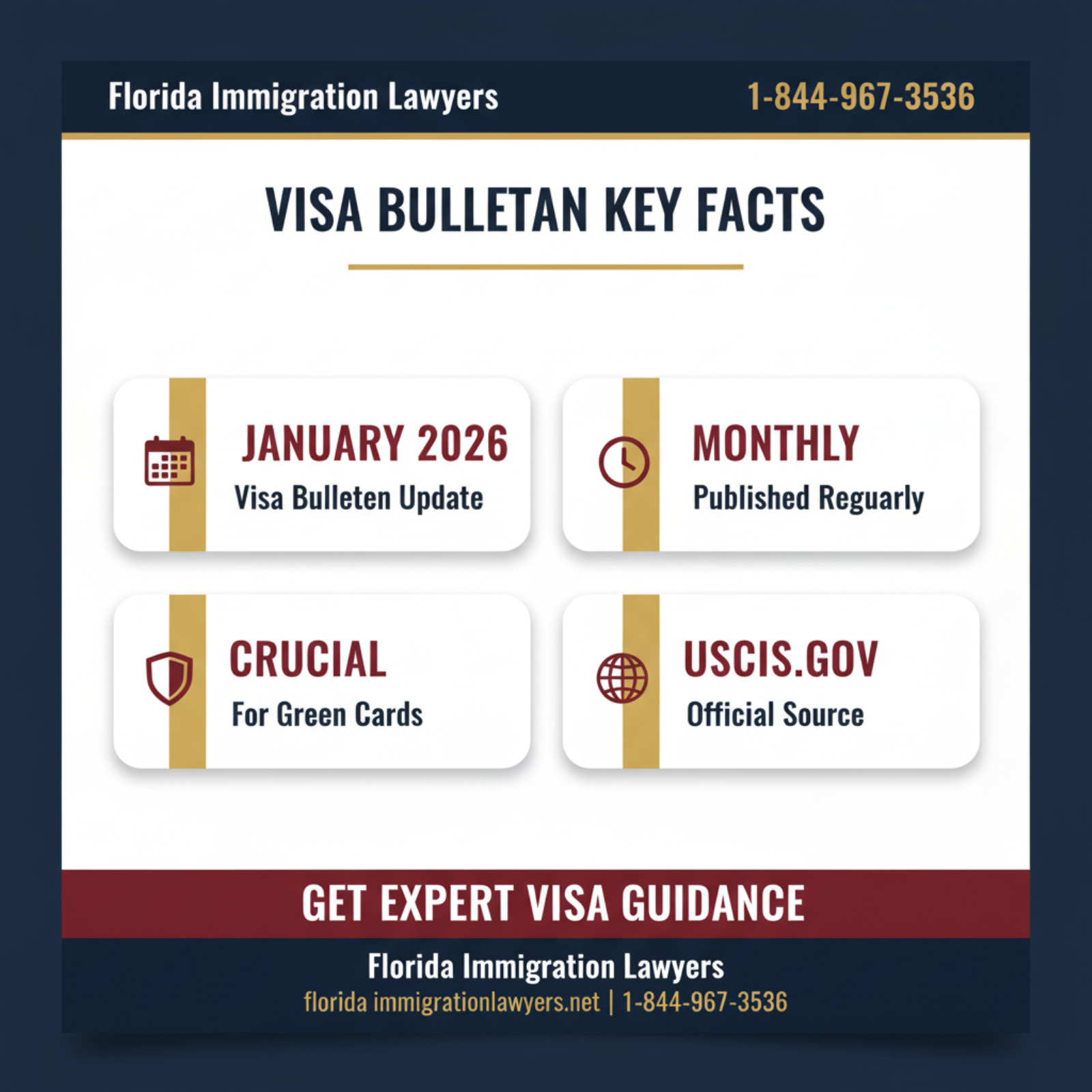
The Visa Bulletin January 2026 outlines immigrant visa availability for family-sponsored and employment-based categories, crucial for those seeking green cards in Florida. It details Final Action Dates and Dates for Filing, guiding when applicants can proceed. Understanding its movements is vital for planning your immigration journey, as priority dates determine eligibility for filing or visa issuance. Consulting an experienced immigration lawyer is highly recommended.
- The Visa Bulletin determines when immigrant visas are available.
- It features both Final Action Dates and Dates for Filing.
- Priority dates are key to understanding your place in the queue.
- Movement can impact family-sponsored and employment-based cases.
- Professional legal guidance is essential for navigating its complexities.
Visa Bulletin January 2026: Essential Updates for Florida Immigrants
Navigating the complex landscape of U.S. immigration can feel like a daunting journey, especially when waiting for your turn in line. For many aspiring immigrants in Florida, the monthly Visa Bulletin is a document of immense significance, dictating the pace and possibility of their American dream. When the Visa Bulletin January 2026 is released, it brings critical updates that can profoundly impact your path to a green card.
At Florida Immigration Lawyers, we understand the anticipation and anxiety that comes with each new bulletin. Our mission is to demystify these updates, providing clear, actionable insights for individuals and families across Coral Springs, Miami, Orlando, and all of Florida. We are here to help you understand how the latest bulletin affects your specific case.
This comprehensive guide will break down the Visa Bulletin January 2026, explain its components, and discuss what these dates mean for your immigration journey in Florida. We will cover everything from priority dates and processing expectations to common mistakes and when to seek legal counsel. Do not navigate this complex process alone. Call Florida Immigration Lawyers at 1-844-967-3536 for a free consultation and let our experienced team guide you.
Understanding the Visa Bulletin January 2026: Your Path to a Green Card
The U.S. Department of State publishes the Visa Bulletin each month, providing a critical roadmap for immigrant visa applicants. It serves as the official announcement of visa availability for various preference categories, both family-sponsored and employment-based. The bulletin's dates determine when immigrants can file their applications or have their visas issued.
For immigrants in Florida, understanding the nuances of the Visa Bulletin January 2026 is paramount. It directly influences the timeline for submitting an Adjustment of Status application (Form I-485) to USCIS, or for proceeding with consular processing abroad. The bulletin reflects the demand for visas versus the annual statutory limits set by Congress.
Key Components: Final Action Dates vs. Dates for Filing
The Visa Bulletin presents two main charts for most preference categories: the Final Action Dates chart and the Dates for Filing Applications chart. Each chart serves a distinct purpose in the immigration process. It is vital to know which chart USCIS is allowing you to use in any given month.
The Final Action Dates chart indicates when an immigrant visa can actually be issued, or when a green card can be approved. This means your priority date must be on or before the date listed in your category and country of chargeability for your case to be finalized. This is the ultimate goal for many applicants.
The Dates for Filing Applications chart, on the other hand, allows certain applicants to file their Adjustment of Status applications earlier. If USCIS determines that there are more immigrant visas available than there are applicants for the current month, they may allow applicants to use the Dates for Filing chart. This can significantly speed up the initial stages of your application process, even if your visa isn't immediately available.
Priority Dates and Preference Categories Explained
Your priority date is essentially your place in line. For family-sponsored petitions, it's the date the Form I-130, Petition for Alien Relative, was properly filed with USCIS. For employment-based petitions, it's usually the date the PERM Labor Certification application was accepted for processing by the Department of Labor, or the date the Form I-140, Immigrant Petition for Alien Worker, was filed.
The Visa Bulletin categorizes immigrant visas into different preference levels. Family-sponsored preferences (F1, F2A, F2B, F3, F4) are based on the relationship to the sponsoring U.S. citizen or lawful permanent resident. Employment-based preferences (EB-1, EB-2, EB-3, EB-4, EB-5) are based on an individual's occupation, skills, or investment. Each category has its own annual quota, and some countries, like China, India, Mexico, and the Philippines, often face longer backlogs due to high demand, impacting Florida residents from these nations.
Navigating the Green Card Process in Florida: A Step-by-Step Guide
Understanding the Visa Bulletin January 2026 is just one part of a multi-stage immigration process. Whether you are in Coral Springs, Tampa, or anywhere else in Florida, the journey to a green card typically involves several key steps. Our firm, Florida Immigration Lawyers, can guide you through each phase, ensuring compliance and efficiency.
-
Step 1: Petition Filing and Priority Date Establishment
The first step usually involves a U.S. citizen or lawful permanent resident (for family cases) or an employer (for employment cases) filing a petition on your behalf. For family-sponsored visas, this is Form I-130, Petition for Alien Relative. For employment-based visas, it's often Form I-140, Immigrant Petition for Alien Worker, which may follow a PERM Labor Certification. The date USCIS receives this petition establishes your crucial priority date.
This date is then used to track your place in the visa queue, as indicated by the monthly Visa Bulletin. It is critical that this initial petition is filed accurately and completely to avoid delays.
-
Step 2: Monitoring the Visa Bulletin January 2026 (and subsequent months)
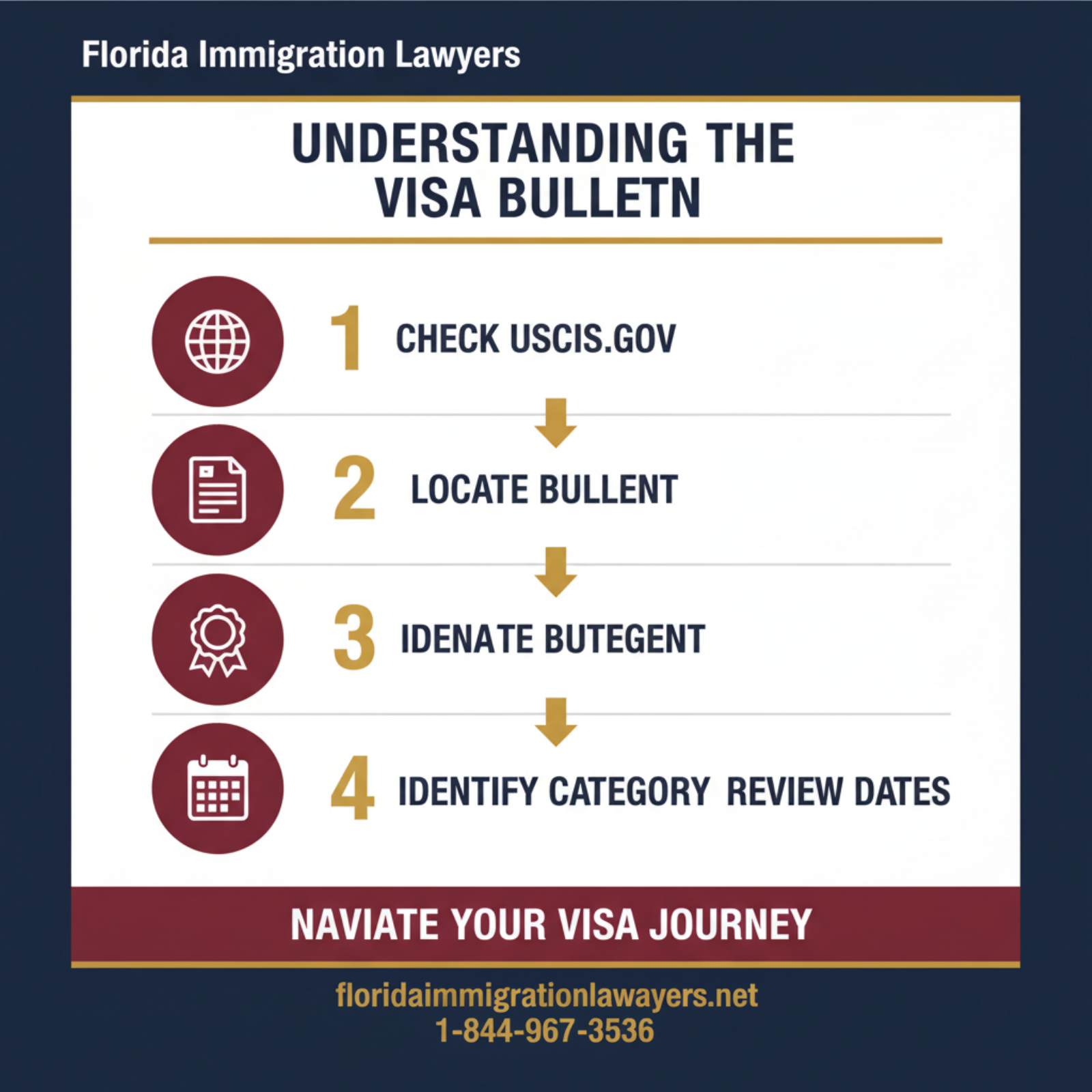
Once your priority date is established, you must diligently monitor the monthly Visa Bulletin. The Visa Bulletin January 2026 will be a key publication for those whose priority dates are approaching current. You will look for your specific preference category and country of chargeability.
If your priority date becomes current according to the Dates for Filing chart, you may be eligible to proceed to the next step of filing your Adjustment of Status application. If it becomes current according to the Final Action Dates chart, your visa is immediately available for issuance or green card approval.
-
Step 3: Filing the Green Card Application (I-485 or Consular Processing)
When your priority date becomes current, you can proceed with the actual green card application. If you are already in the U.S. and meet eligibility requirements, you will typically file Form I-485, Application to Register Permanent Residence or Adjust Status, with USCIS. This application is submitted to a USCIS Lockbox or service center, depending on the filing instructions.
If you are outside the U.S., you will undergo consular processing through the National Visa Center (NVC) and a U.S. embassy or consulate in your home country. This involves submitting required documents to the NVC and attending an interview abroad. Both pathways lead to lawful permanent residency.
-
Step 4: Biometrics, Interview, and Adjudication
After filing Form I-485, you will typically receive an appointment notice for biometrics (fingerprints, photos, signature) at a local Application Support Center (ASC) in Florida, such as those near Miami or Orlando. Following biometrics, an interview may be scheduled at a USCIS field office, for example, in Miami, Orlando, or Tampa, depending on your residence.
During the interview, an immigration officer will review your application and supporting documents. For consular processing, the interview takes place at the U.S. embassy or consulate. The final step is adjudication, where USCIS or the consular officer makes a decision on your application. If approved, your green card will be mailed to you.
Essential Documents for Your Immigration Application in Florida
A successful immigration application, whether for an adjustment of status or consular processing, hinges on submitting a complete and accurate set of documents. Missing or incorrect documentation is a leading cause of delays and denials. This checklist provides a general overview of what you will typically need for your green card application, especially as your Visa Bulletin January 2026 date approaches.
- Birth Certificate: A certified copy of your birth certificate.
- Passport: Valid passport with at least six months validity beyond your intended period of stay.
- Visa Photos: U.S. passport-style photographs.
- Medical Examination: Form I-693, Report of Medical Examination and Vaccination Record, completed by a USCIS-approved civil surgeon.
- Affidavit of Support: Form I-864, Affidavit of Support, from your petitioner, along with their tax returns and proof of income.
- Proof of Relationship: Marriage certificates, birth certificates of children, or other evidence establishing the relationship between the petitioner and beneficiary.
- Employment-Based Documentation: For EB cases, this includes evidence of qualifications (degrees, transcripts), work experience letters, and the approved Form I-140 or PERM Labor Certification.
- Police Certificates: From all countries where you have lived for six months or more since age 16 (for consular processing).
- Previous Immigration Documents: Copies of all prior immigration forms, visas, I-94 records, and any notices from USCIS or immigration courts.
- Marriage Termination Documents: If applicable, divorce decrees or death certificates for any prior marriages of the petitioner or beneficiary.
Gathering these documents can be time-consuming and complex. Our team at Florida Immigration Lawyers can help you compile a robust application package, ensuring all requirements are met for your specific case as guided by the Visa Bulletin January 2026 and subsequent updates.
Anticipating Visa Processing Times and Dates: What to Expect in 2026
The Visa Bulletin January 2026 provides a snapshot, but understanding overall processing times requires a broader perspective. USCIS processing times can fluctuate significantly due to various factors, including caseloads, policy changes, and national security checks. While the bulletin indicates visa availability, it doesn't always predict how long your specific case will take once filed.
Generally, family-sponsored preference categories (F1, F2B, F3, F4) tend to have longer wait times than immediate relatives (spouses, minor children, and parents of U.S. citizens), who are not subject to numerical limits and thus do not appear on the Visa Bulletin. Employment-based categories (EB-1, EB-2, EB-3) can also experience significant backlogs, especially for individuals from high-demand countries. USCIS has indicated that they aim to improve processing efficiency, but backlogs remain a challenge.
Factors Influencing Your Timeline
Several factors can influence how quickly your green card application is processed after your priority date becomes current. The specific USCIS service center or field office handling your case can impact the timeline. For instance, processing times at the Miami Field Office might differ from those in Orlando or Tampa due to local caseloads. Completeness of your application and prompt responses to Requests for Evidence (RFEs) are also crucial. Furthermore, the volume of applications and the annual allocation of visas for your specific category and country of chargeability play a significant role.
Will USCIS Speed Up in 2026?
Many applicants in Florida ask, "Will USCIS speed up in 2026?" While USCIS continuously works to reduce backlogs and improve efficiency, significant changes often depend on congressional appropriations and policy directives. The agency has implemented initiatives aimed at streamlining processes, but predicting drastic improvements is challenging. Applicants should always prepare for potential delays and maintain realistic expectations. Monitoring official USCIS announcements and consulting with an attorney for the latest updates is advisable.
Immigration Application Costs and Fees: Planning Your Budget
Pursuing a green card involves various fees that can add up. It's important to budget for these costs as you prepare your application, especially as your eligibility date approaches with the Visa Bulletin January 2026. These fees are subject to change by USCIS, so it is always best to check the most current fee schedule on the official USCIS website before filing.
Typical Fee Breakdown
- Petition Filing Fees: For forms like I-130 or I-140, paid by the petitioner.
- Form I-485 Application Fee: The primary fee for the Adjustment of Status application. This often includes biometrics services.
- Medical Examination Fee: Paid directly to the civil surgeon. This cost varies depending on the provider and location in Florida.
- Attorney Fees: For legal representation and guidance through the entire process. While an additional cost, it often proves invaluable in avoiding costly mistakes and delays.
- Other Potential Fees: These may include fees for requesting certified copies of documents, translation services, or travel expenses for interviews.
It's important to remember that these fees are generally non-refundable, regardless of the outcome of your application. Therefore, ensuring your application is meticulously prepared is crucial. Florida Immigration Lawyers offers transparent fee structures and can help you understand all the financial aspects involved in your case.
Common Mistakes to Avoid in Your Green Card Application
Even a small error can lead to significant delays or even denial of your green card application. As you prepare to act on the information from the Visa Bulletin January 2026, be mindful of these common pitfalls:
-
Filing Too Early or Too Late
Consequence: Filing an I-485 when your priority date is not current (or not using the correct chart designated by USCIS) will result in rejection. Filing too late after your date becomes current may mean missing out on available visa numbers, especially if dates retrogress.
-
Incomplete or Inaccurate Forms
Consequence: USCIS is strict about complete applications. Missing signatures, unanswered questions, or incorrect information will likely lead to a Request for Evidence (RFE) or outright denial, significantly delaying your process.
-
Insufficient Supporting Documentation
Consequence: Failing to provide all required supporting documents, such as birth certificates, marriage licenses, or financial evidence, will trigger an RFE or denial. This adds stress and extends the waiting period.
-
Failure to Disclose All Immigration History
Consequence: Attempting to conceal past immigration violations, arrests, or previous visa denials can be considered misrepresentation. This can lead to a finding of inadmissibility and a permanent bar from the U.S.
-
Not Updating USCIS with Address Changes
Consequence: If you move within Florida, or anywhere else, and do not update your address with USCIS within 10 days, you might miss critical notices, interview appointments, or RFEs. This can result in your application being denied for abandonment.
-
Lack of Timely Response to RFEs or NOIDs
Consequence: USCIS may send a Request for Evidence (RFE) or a Notice of Intent to Deny (NOID). Failing to respond adequately and on time will almost certainly lead to a denial of your application, requiring you to start over.
-
Traveling Abroad Without Advance Parole
Consequence: If you have a pending I-485 application and travel outside the U.S. without obtaining Advance Parole (Form I-131) first, your I-485 application will be considered abandoned upon your departure. This can be a devastating mistake.
When to Call a Lawyer: Expert Guidance for Your Florida Immigration Journey
While this article provides general information, the complexities of immigration law and the specific details of your case often require personalized legal advice. The Visa Bulletin January 2026 may seem straightforward, but its application to your unique situation is rarely simple. Here are specific scenarios where contacting Florida Immigration Lawyers is not just recommended, but often essential:
- Complex Priority Date Issues: If your priority date is close but not moving as expected, or if you have questions about retrogressions or cross-chargeability.
- Previous Denials or Immigration Violations: If you have a history of visa denials, overstays, or other immigration issues, you need expert advice on potential waivers or solutions.
- Unusual Family or Employment Circumstances: Cases involving adopted children, step-relations, previous marriages, or specific employment categories (like Schedule A occupations) often require nuanced legal interpretation.
- Requests for Evidence (RFEs) or Notices of Intent to Deny (NOIDs): Receiving these notices indicates a problem with your application. A lawyer can help you formulate a strong, timely response.
- Concerns about Admissibility: If you have a criminal record, health issues, or other factors that might make you inadmissible to the U.S., an attorney can assess your situation and advise on waivers.
- Navigating Consular Processing: If you are applying from outside the U.S., the consular process has its own set of rules and challenges that an attorney can help you overcome.
Don't leave your future to chance. Our attorneys at Florida Immigration Lawyers are deeply familiar with USCIS procedures and the intricacies of the Visa Bulletin. We serve clients throughout Florida, including Coral Springs, Miami, Orlando, and Tampa, offering dedicated and compassionate representation. We are committed to helping you achieve your immigration goals.
About Florida Immigration Lawyers
Florida Immigration Lawyers is a leading immigration law firm dedicated to serving individuals, families, and businesses across the entire state of Florida. With offices strategically located to assist clients from Coral Springs to Miami, Orlando, and beyond, our experienced attorneys provide comprehensive legal services in all areas of immigration law.
Our firm specializes in a wide range of immigration matters, including family-based visas, employment-based visas, adjustment of status, naturalization, deportation defense, and asylum. We pride ourselves on our client-focused approach, offering personalized strategies and diligent representation to navigate the often-challenging U.S. immigration system.
Why choose Florida Immigration Lawyers? We are available 24/7 to address your urgent needs, provide free, confidential consultations, and offer bilingual services (English and Spanish) to ensure clear communication. Our commitment is to achieve the best possible outcome for your case with professionalism and empathy. Visit our website at https://www.floridaimmigrationlawyers.net or call us directly at 1-844-967-3536 to learn how we can assist you.
Sources and References
- U.S. Citizenship and Immigration Services (USCIS)
- U.S. Department of State - Visa Bulletin
- 8 U.S.C. Chapter 12 - Immigration and Nationality Act (INA)
- INA § 203 - Preference Immigrant Visas
- 8 CFR § 245 - Adjustment of Status
This article provides general legal information and is not intended as legal advice. Every case is unique, and outcomes depend on specific facts and circumstances. Contact an attorney for advice about your particular situation. Immigration laws are subject to change.
The Visa Bulletin January 2026 is a key piece of your immigration puzzle. Understanding its implications is crucial, but applying it to your unique case requires specialized knowledge. Do not risk your future on incomplete information or procedural errors. Our dedicated team at Florida Immigration Lawyers is ready to provide the guidance you need.
Take the first step towards securing your future in the U.S. Call Florida Immigration Lawyers today at 1-844-967-3536 for a free consultation. Se Habla Español - Estamos aquí para ayudarle.
Do Not Navigate This Process Alone
Our experienced immigration attorneys are ready to fight for you. Get a free, confidential consultation today.
Se Habla Español
Frequently Asked Questions
Florida Immigration Lawyers
Immigration Attorney | Founder, Vasquez Law Firm
U.S. Air Force veteran and immigration attorney with thousands of cases resolved. J.D., NCCU School of Law. AILA member. Admitted to the 4th, 5th, and 11th Circuit Courts.
Available 24/7 - Free Evaluations
Related Legal Services
Our Florida immigration attorneys can help you with deportation defense, citizenship and naturalization and family immigration services. Call today at 1-844-967-3536 for a free consultation.
Related Links
Related Topics
Free Legal Consultation
Discuss your case with our experienced attorneys. We're available 24/7.
Se Habla Español - Estamos aquí para ayudarle.
Related Articles
USCIS Office Locations in Florida | FL Immigration Lawyers
Discover the various USCIS office locations in Florida, including Hollywood. Learn how to schedule appointments and what to expect during your visit. Contact Florida Immigration Lawyers for a free consultation.
Change of Status for Student Visas in Florida | VLF Florida
Changing your student visa status in Florida can be a challenging process. Learn the steps and avoid common pitfalls with guidance from Florida Immigration Lawyers. Call 1-844-967-3536 for a free consultation.
U Visa Certification Process in Florida | VLF Florida
Explore the U visa certification process in Florida. Learn how victims of certain crimes can gain protection and legal status by assisting law enforcement. Understand the steps and resources available in Homestead, Florida.
Expungement Effects on Immigration in Florida | VLF Florida
Explore the effects of expungement on immigration status in Florida. Learn how sealed records can impact your immigration proceedings and what steps to take. Contact Florida Immigration Lawyers for expert guidance.