PERM Labor Certification Process in Florida
Explore the PERM labor certification process in Florida, crucial for employer-sponsored green cards. Learn the steps, timelines, and common mistakes. Contact Florida Immigration Lawyers for expert guidance.

- Employer must show recruitment efforts.
- Certification is needed before filing I-140 petition.
- Approval by the Department of Labor is mandatory.
Introduction
In the bustling city of Hialeah, Florida, employers often face challenges when hiring skilled labor from abroad. The PERM labor certification process is pivotal for those seeking to sponsor foreign employees for permanent residency.
Florida's dynamic economy, spanning from the vibrant tourism sector in Orlando to the burgeoning tech hubs in Miami and the agricultural heartlands, frequently encounters specialized labor demands that cannot always be met by the domestic workforce alone. The PERM process serves as a vital bridge, enabling businesses to access global talent and maintain their competitive edge.
This article provides a comprehensive guide to navigating the PERM process in Florida, including essential steps, common pitfalls, and when to seek legal assistance. Understanding these intricacies is crucial for a successful application, preventing costly delays and potential denials. Call Florida Immigration Lawyers at 1-844-967-3536 for a free consultation to ensure a smooth application process.
Understanding the PERM Labor Certification
The PERM (Program Electronic Review Management) labor certification is a prerequisite for employers who wish to sponsor foreign nationals for a U.S. green card under the employment-based category. It requires employers to demonstrate that there are no American workers available, willing, and qualified for the job offered to the foreign worker.
In Florida, particularly in areas like Hialeah, the demand for specialized skills often necessitates the recruitment of international talent. The process is governed by the Department of Labor (DOL) and involves stringent advertising and recruitment requirements.
At its core, PERM is designed to protect the U.S. labor market by ensuring that foreign workers are not taking jobs away from qualified U.S. citizens or permanent residents. Employers must conduct a good faith recruitment effort to test the labor market before certifying that no qualified U.S. workers were found. This 'U.S. worker test' is the foundation of the entire PERM process and demands meticulous adherence to DOL regulations.
This certification is typically required for Employment-Based Second Preference (EB-2) and Employment-Based Third Preference (EB-3) green card petitions. It is a critical initial step, without which, the subsequent I-140 Immigrant Petition for Alien Worker cannot be filed. Given the detailed nature of federal immigration law and its impact on Florida businesses, securing expert guidance from Florida Immigration Lawyers is highly recommended.
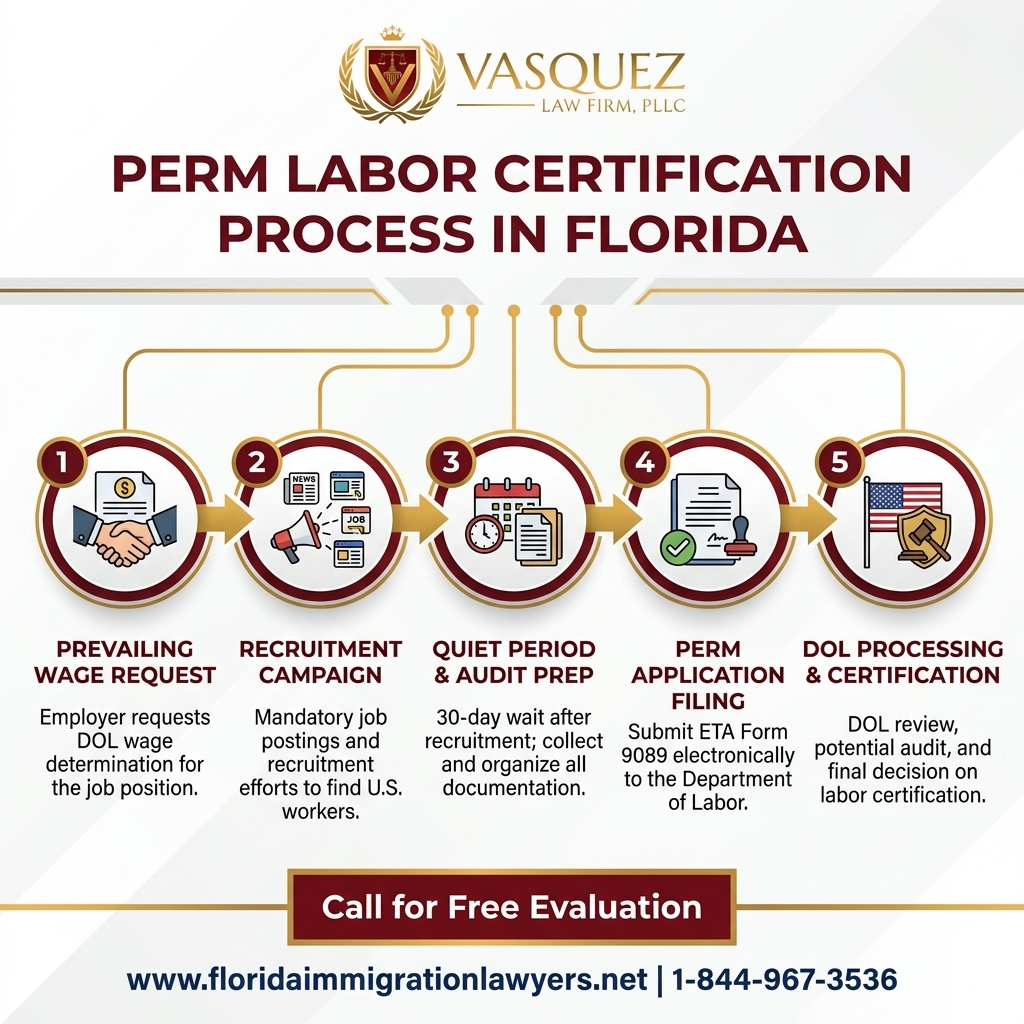
Step-by-Step Guide to the PERM Process
Navigating the PERM labor certification process requires careful attention to detail and strict adherence to Department of Labor (DOL) regulations. Each step is critical and interconnected, with errors at any stage potentially leading to significant delays or outright denial. Employers in Florida must approach this process systematically, ensuring all requirements are met before proceeding.
1. Defining the Job and Crafting the Description
The first crucial step is to accurately outline the job requirements and responsibilities. This involves creating a detailed job description that specifies the duties, minimum education, experience, and any special requirements necessary for the position. It's imperative that these requirements are truly job-related and do not unduly restrict the pool of U.S. applicants. The DOL scrutinizes job descriptions to ensure they are consistent with industry standards and are not tailored specifically for the foreign worker.
Employers must focus on the actual minimum requirements for the job, rather than the foreign worker's specific qualifications. For instance, if a position typically requires a Bachelor's degree and two years of experience, adding a Master's degree requirement solely because the foreign worker possesses one could be deemed unduly restrictive. Any requirement beyond what is normally expected for the position must be justified by a 'business necessity,' which is a high legal standard.
Working with an experienced immigration attorney from Florida Immigration Lawyers can help employers draft compliant job descriptions that accurately reflect the role's needs while adhering to DOL guidelines, thus minimizing the risk of an audit or denial later in the process.
2. Obtaining a Prevailing Wage Determination (PWD)
Before initiating recruitment, employers must request a prevailing wage determination (PWD) from the Department of Labor. This ensures that the wage offered to the foreign worker meets or exceeds the average wage paid to similarly employed workers in the geographic area of intended employment. The PWD is requested by filing Form ETA-9141, Application for Prevailing Wage Determination.
The DOL determines the prevailing wage based on factors such as the job title, duties, minimum requirements, industry, and geographic location. The Occupational Employment Statistics (OES) survey is the most common source for this data, categorizing wages into four levels based on experience and responsibility. Offering a wage below the determined prevailing wage is a common reason for PERM denial, as it signifies that the employer is not offering competitive compensation to U.S. workers.
It is critical to initiate the PWD request early, as processing times can range from several weeks to several months. An accurate PWD is foundational to the entire PERM application, as the recruitment efforts and the final ETA Form 9089 must reflect this determined wage. Florida Immigration Lawyers can assist in accurately completing the ETA-9141 and understanding the PWD results.
3. Conducting the Mandatory Recruitment Efforts
This is arguably the most critical and complex phase of the PERM process. Employers must conduct a series of mandatory recruitment steps to demonstrate that there are no qualified, willing, and available U.S. workers for the position. All recruitment must occur within a specific 30-to-180-day window before filing the ETA Form 9089.
For professional occupations, the employer must conduct three mandatory recruitment steps: a job order placed with the State Workforce Agency (SWA) for 30 days, two Sunday newspaper advertisements in a newspaper of general circulation, and a notice of filing posted at the work site for 10 consecutive business days. In addition to these, employers must choose three additional recruitment steps from a list of ten options, such as posting on the company website, using job search websites, participating in job fairs, or conducting on-campus recruiting.
Meticulous documentation of all recruitment activities is paramount. This includes copies of newspaper ads, printouts of online postings with dates, records of resumes received, interview notes, and detailed justifications for why any U.S. applicants were not qualified. For example, a common pitfall occurs when an employer fails to document why a seemingly qualified U.S. applicant was rejected, leading to an audit and potential denial. Florida Immigration Lawyers emphasizes the importance of maintaining a comprehensive audit file throughout this stage.
4. Filing the ETA Form 9089
Once all recruitment efforts have been completed and no qualified U.S. workers have been found, the employer can proceed to file the ETA Form 9089, Application for Permanent Employment Certification, electronically through the DOL's FLAG system. This form summarizes all aspects of the job offer, the prevailing wage determination, and the recruitment efforts undertaken.
The ETA Form 9089 requires the employer to attest under penalty of perjury that all statements are true and that the recruitment process was conducted in good faith. Accuracy and consistency across all submitted information are crucial. Any discrepancies between the job description, prevailing wage request, recruitment advertisements, and the final ETA Form 9089 can trigger an audit or denial. The form must be filed within 180 days of the start of the first recruitment activity and no sooner than 30 days after the last recruitment activity.
Given the detailed nature of this form and the legal attestations involved, having Florida Immigration Lawyers review and submit the ETA Form 9089 significantly reduces the risk of errors. Their expertise ensures that all information is correctly entered and consistent with the supporting documentation.
5. Awaiting DOL Processing and Responding to Audits
After submission, the ETA Form 9089 enters the DOL's processing queue. The DOL reviews applications in the order they are received. During this stage, the DOL may either certify the application, deny it, or issue an audit notification. An audit is a request for the employer to submit all supporting documentation related to the PERM application, including proof of recruitment, prevailing wage determination, and qualifications of U.S. applicants.
Responding to an audit is a critical phase that requires a thorough and timely submission of all requested evidence. Failure to provide complete documentation or adequate justifications for applicant rejections will lead to a denial. For example, if an employer in Tampa rejected a U.S. applicant for lacking a specific skill, but the job description didn't clearly list that skill as a minimum requirement, the DOL might question the rejection.
If the application is denied, the employer may have options to appeal the decision to the Board of Alien Labor Certification Appeals (BALCA). This process can be lengthy and complex. Engaging Florida Immigration Lawyers is highly advisable during an audit or appeal, as their experience can be instrumental in preparing a robust response and advocating effectively on the employer's behalf.
Document Checklist for PERM Application
A meticulously organized document checklist is essential for a successful PERM application. Gathering all necessary paperwork in advance not only streamlines the filing process but also prepares the employer for a potential DOL audit. Missing or incomplete documentation is a primary cause of delays and denials.
- Detailed job description
- Prevailing wage determination
- Proof of recruitment efforts
- ETA Form 9089
- Company financial documentation
Beyond the listed items, employers should also maintain records of all resumes received, interview notes for U.S. applicants, and detailed reasons for their non-selection. Proof of the foreign worker's qualifications (transcripts, experience letters) should also be readily available, although not submitted with the initial PERM application. These documents collectively demonstrate the employer's good faith efforts and compliance with all regulatory requirements.
Timeline and Processing Expectations
The PERM process can be lengthy, often taking anywhere from six months to over a year. Factors such as audit reviews by the DOL can extend processing times. Employers should plan accordingly and stay informed about any changes in processing times.
A typical PERM timeline can be broken down into several stages: The Prevailing Wage Determination (PWD) itself can take 2-6 months. Following the PWD, the mandatory recruitment period typically lasts 30-180 days. After recruitment, the DOL's processing of the ETA Form 9089 can take an additional 6-12 months for non-audited cases. If an audit is issued, responding to it and awaiting a decision can add another 6-12 months or more to the overall timeline.
Employers in Florida, especially those with foreign workers on expiring non-immigrant visas (like H-1B), must initiate the PERM process well in advance to avoid potential gaps in employment authorization. Monitoring the DOL's official website for current processing times is advisable, but these are merely estimates. Proactive planning and expert legal guidance from Florida Immigration Lawyers can help manage expectations and mitigate potential issues arising from prolonged processing times.
Cost Factors and Fee Breakdown
While there is no filing fee for the PERM application itself, costs are incurred through recruitment advertising and potential legal fees. Employers should budget for these expenses and consider them part of the hiring process.
The primary costs associated with PERM include mandatory newspaper advertisements, which can range from $500 to over $2,000 depending on the publication and its circulation. Additional recruitment steps, such as online job board postings, may also incur fees. The Department of Labor explicitly states that all costs associated with the PERM labor certification process, including advertising and attorney fees, must be borne by the employer and cannot be passed on to the foreign worker.
Legal fees for PERM cases typically range from $3,000 to $7,000 or more, depending on the complexity of the case and the attorney's experience. These fees cover the attorney's expertise in drafting job descriptions, requesting the PWD, overseeing recruitment, preparing and filing the ETA Form 9089, and responding to any audits. Investing in experienced legal counsel from Florida Immigration Lawyers can prevent costly mistakes and ultimately save employers time and money in the long run.
Common Mistakes to Avoid
The PERM labor certification process is fraught with potential pitfalls, and even minor errors can lead to significant delays or outright denials. Understanding and actively avoiding these common mistakes is crucial for any Florida employer undertaking this complex process.
- Inaccurate job descriptions can lead to application denials.
- Failure to meet recruitment requirements results in rejections.
- Incorrect prevailing wage can delay the process.
- Incomplete documentation during audits can cause setbacks.
- Ignoring DOL correspondence can lead to missed deadlines.
- Failing to maintain detailed recruitment records.
- Submitting outdated forms increases risk of rejection.
Beyond these, other mistakes include not providing clear justifications for rejecting U.S. applicants or failing to consider all applicants who meet the minimum requirements. For instance, a small business in Miami once faced a PERM denial because they could not produce records of all resumes received during the recruitment period, making it impossible to prove they had genuinely tested the labor market. Such oversights can force employers to restart the entire lengthy and costly process.
Proactive engagement with an experienced immigration attorney is the best defense against these common errors. Florida Immigration Lawyers can help employers establish robust internal processes for record-keeping, ensure compliance with all recruitment mandates, and meticulously review all documentation before submission, significantly increasing the chances of a successful PERM certification.
When to Call a Lawyer
Engaging an immigration lawyer is crucial if your application faces an audit, if there are discrepancies in job requirements, or if you need assistance with the intricacies of the recruitment process. Florida Immigration Lawyers can provide expert guidance to help you navigate these challenges.
The complexities of interpreting DOL regulations, especially regarding job requirements and recruitment advertising, often necessitate expert legal counsel. For example, determining if a specific skill requirement is unduly restrictive or if a business necessity argument will hold up under scrutiny requires deep knowledge of immigration law. An attorney can help draft compliant job descriptions, advise on appropriate recruitment methods, and ensure all regulatory deadlines are met.
Furthermore, if your application is selected for an audit, the stakes become incredibly high. An audit response requires a meticulously prepared package of evidence and a clear, persuasive legal argument. Attempting to navigate an audit without legal representation significantly increases the risk of denial. Florida Immigration Lawyers possess the experience and strategic insight to effectively respond to audits, appeal adverse decisions, and guide employers through every intricate phase of the PERM process, safeguarding your investment and your foreign worker's future.
About Florida Immigration Lawyers
Florida Immigration Lawyers is dedicated to assisting clients with their immigration needs. We offer comprehensive services in employment-based immigration, family immigration, and more. Our team is available 24/7 to provide support and free consultations. Call us at 1-844-967-3536 or visit our website at floridaimmigrationlawyers.net to learn how we can help you.
With a deep understanding of both federal immigration law and the unique needs of Florida's diverse business landscape, our firm stands ready to assist employers across the state. We pride ourselves on a client-centric approach, offering personalized strategies and unwavering support throughout the often-challenging PERM process. Our track record of success in employment-based immigration speaks to our commitment to helping Florida businesses thrive by securing the talent they need.
We understand the critical role foreign talent plays in driving innovation and economic growth in Florida. Our experienced attorneys are adept at handling complex PERM cases, from initial job description drafting to navigating audits and appeals. When you partner with Florida Immigration Lawyers, you gain a dedicated advocate committed to achieving the best possible outcome for your business and your employees.
Sources and References
- U.S. Citizenship and Immigration Services (USCIS)
- Executive Office for Immigration Review (EOIR)
- U.S. Department of State
- 8 U.S.C. Chapter 12 - Immigration and Nationality Act
Related services: H-1B specialty occupation visas, L-1 intracompany transfer visas, work visas for professionals, investment and entrepreneur visas.
Frequently Asked Questions (FAQs)
This article provides general legal information and is not intended as legal advice. Every case is unique, and outcomes depend on specific facts and circumstances. Contact an attorney for advice about your particular situation.
For personalized assistance with your PERM labor certification application, contact Florida Immigration Lawyers at 1-844-967-3536. Se Habla Español - Estamos aquí para ayudarle.
If you need legal assistance, learn more about speak with a business immigration lawyer, or call us at 1-844-967-3536 for a free consultation.
Do Not Navigate This Process Alone
Our experienced immigration attorneys are ready to fight for you. Get a free, confidential consultation today.
Se Habla Español
Frequently Asked Questions
Florida Immigration Lawyers
Immigration Attorney | Founder, Vasquez Law Firm
U.S. Air Force veteran and immigration attorney with thousands of cases resolved. J.D., NCCU School of Law. AILA member. Admitted to the 4th, 5th, and 11th Circuit Courts.
Available 24/7 - Free Evaluations
Related Legal Services
Our Florida immigration attorneys can help you with immigration practice areas, free immigration consultation and experienced immigration attorneys. Call today at 1-844-967-3536 for a free consultation.
Related Links
Related Topics
Free Legal Consultation
Discuss your case with our experienced attorneys. We're available 24/7.
Se Habla Español - Estamos aquí para ayudarle.
Related Articles
Immigration Services in Jacksonville, Florida | VLF Florida
Navigating immigration services in Jacksonville, Florida, can be challenging. Learn about the essential steps and how Florida Immigration Lawyers can assist you.
Immigration Services in Jacksonville, Florida | VLF Florida
Discover essential immigration services in Jacksonville, Florida. From visa applications to citizenship, learn how Florida Immigration Lawyers can assist you. Call 1-844-967-3536 for a free consultation.
DACA Renewal Florida 2026 Guide: Key Steps | VLF Florida
Navigating the DACA renewal process in Florida can be complex. This guide provides essential tips and steps for Dreamers in Naples and beyond. Call us for a free consultation to ensure your application is completed accurately and on time.
USCIS Processing Times in Florida 2026 | VLF Florida
Discover the USCIS processing times in Florida for 2026 and how they might impact your immigration journey. Stay informed to navigate potential delays effectively.