F-1 Student Visa Florida: Your Guide to University Study
Planning to study in Florida? This comprehensive guide explains the F-1 student visa process, from eligibility and application steps to required documents and financial planning. Learn how to secure your F-1 visa for Florida universities, including specific details for institutions in Gainesville and other areas. We cover common pitfalls to avoid and when to seek legal assistance. Florida Immigration Lawyers offers expert guidance to international students, ensuring a smooth and successful application journey. Contact us for a free consultation to start your academic adventure in the Sunshine State.

Quick Answer: F-1 Student Visa Florida Universities
An F-1 student visa Florida allows international students to pursue academic studies at approved institutions across the Sunshine State. To qualify, you must be accepted by a U.S. government-approved school, such as the University of Florida in Gainesville, demonstrate sufficient financial resources, and prove your intent to return home after your studies. The application involves obtaining a Form I-20, paying the SEVIS fee, completing the DS-160, and attending a visa interview at a U.S. embassy or consulate.
Key takeaways:
- Requires acceptance from a SEVP-approved school and an I-20 form.
- Proof of financial solvency is crucial for the application.
- The process includes online forms, fee payments, and an interview.
- Florida offers diverse educational opportunities for international students.
- Consulting an immigration lawyer can streamline the complex process.
F-1 Student Visa Florida: Your Comprehensive Guide to University Study
Dreaming of pursuing higher education in the vibrant state of Florida? Florida boasts world-class universities, diverse culture, and a welcoming environment for international students. Obtaining an F-1 student visa Florida is your essential first step to turning that dream into a reality. This visa permits you to study full-time at a U.S. government-approved academic institution, from bustling urban campuses to tranquil coastal colleges.
Navigating the U.S. immigration system can be complex and daunting, especially for those unfamiliar with its specific requirements and procedures. From securing your acceptance to a Student and Exchange Visitor Program (SEVP) certified school like the University of Florida in Gainesville, to successfully completing your visa interview, every step demands meticulous attention. Understanding the nuances of the F-1 student visa Florida application is critical for a smooth journey.
This comprehensive guide from Florida Immigration Lawyers will walk you through everything you need to know about securing your F-1 student visa for Florida universities. We will cover eligibility, the step-by-step application process, required documentation, expected timelines, and crucial tips to avoid common pitfalls. Our goal is to empower you with the knowledge needed to confidently pursue your educational aspirations in Florida. Don't navigate this journey alone. Call Florida Immigration Lawyers at 1-844-967-3536 for a free consultation today.
Understanding the F-1 Student Visa for Florida Universities
The F-1 student visa is a non-immigrant visa specifically designed for international students who wish to pursue academic studies in the United States. This includes programs at colleges, universities, seminaries, conservatories, academic high schools, elementary schools, or other academic institutions, as well as language training programs. For students aspiring to study in Florida, this visa is your gateway to institutions like the University of Florida, Florida State University, and the University of Miami, among many others.
Eligibility for an F-1 student visa Florida is stringent and requires you to meet several key criteria. First, you must be accepted by a U.S. institution approved by the Student and Exchange Visitor Program (SEVP). This acceptance will result in the issuance of a Form I-20, Certificate of Eligibility for Nonimmigrant Student Status, which is a foundational document for your visa application. You must also demonstrate sufficient funds to cover your tuition, living expenses, and transportation for the entire duration of your stay in the U.S. without resorting to unauthorized employment.
Furthermore, you must prove your intent to return to your home country after completing your studies. This is often referred to as demonstrating "non-immigrant intent" and is a critical aspect of your visa interview. You cannot use an F-1 visa as a pathway to permanent residency. Florida, with its diverse student population and strong academic programs, is a popular choice for international students. Universities in cities like Gainesville offer excellent research opportunities and a vibrant campus life. The legal framework governing F-1 visas is primarily found in the Immigration and Nationality Act (INA) Section 101(a)(15)(F), codified at 8 U.S.C. § 1101(a)(15)(F), and further detailed in 8 CFR 214.2(f).
Step-by-Step Guide to Obtaining Your F-1 Visa for Florida
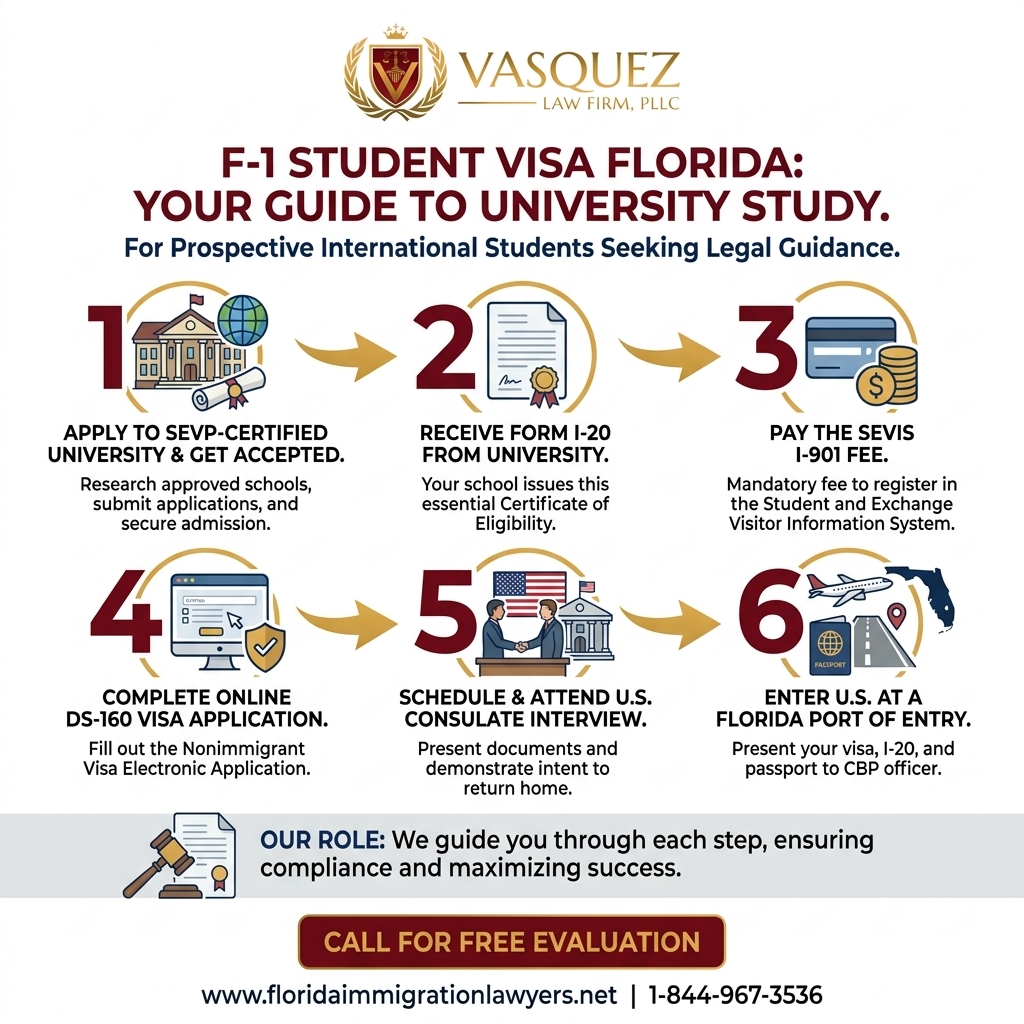
Securing your F-1 student visa Florida involves a series of carefully executed steps. Each stage is crucial, and errors can lead to delays or even denial. Following this detailed guide will help you navigate the process effectively:
-
Gain Acceptance to a SEVP-Approved School in Florida: Your journey begins with applying to and being accepted by a U.S. academic institution certified by the Student and Exchange Visitor Program (SEVP). Many Florida universities, including the University of Florida, Florida International University, and the University of Central Florida, are SEVP-approved. Once accepted, the school will issue you a Form I-20, "Certificate of Eligibility for Nonimmigrant Student Status." This document confirms your enrollment, program of study, and estimated costs.
-
Pay the SEVIS I-901 Fee: After receiving your Form I-20, you must pay the SEVIS I-901 fee. This fee supports the Student and Exchange Visitor Information System (SEVIS), which tracks F-1 students. It's crucial to pay this fee and keep the receipt, as you will need it for your visa interview. The fee must be paid at least three business days before your interview.
-
Complete the DS-160, Online Nonimmigrant Visa Application: The DS-160 is a comprehensive online application form that collects all necessary personal and background information. Be thorough and accurate, as any discrepancies can cause significant issues. After completing and submitting the form, print the confirmation page, which contains a barcode. This page is essential for your interview.
-
Pay the F-1 Visa Application Fee (MRV Fee): In addition to the SEVIS fee, you must pay a non-refundable Machine Readable Visa (MRV) fee. The payment methods vary by country and embassy/consulate, so check the specific instructions on the U.S. embassy or consulate website where you will apply. Keep your receipt as proof of payment.
-
Schedule Your F-1 Visa Interview: Once you have paid both fees and completed the DS-160, you can schedule your visa interview at the nearest U.S. embassy or consulate in your home country. It is advisable to schedule this as early as possible, as wait times can vary significantly. Check the State Department website for current wait times.
-
Attend Your F-1 Visa Interview: This is a critical step where a consular officer will assess your eligibility. Be prepared to discuss your academic plans, financial resources, and your intent to return to your home country after completing your studies. Answer truthfully and concisely. Bring all required documents in an organized manner.
-
Prepare for Departure to Florida: If your visa is approved, you will receive your passport with the F-1 visa stamp. You may enter the U.S. up to 30 days before the start date listed on your Form I-20. Plan your travel, housing, and orientation at your Florida university. Remember to carry your I-20, passport, and visa with you, not in checked luggage.
Essential Documents for Your F-1 Student Visa Application
A successful F-1 student visa Florida application hinges on presenting a complete and accurate set of documents. Missing or incorrect paperwork is a common reason for delays or denials. Organize these documents meticulously before your interview:
- Valid Passport: Your passport must be valid for at least six months beyond your period of stay in the United States.
- Form I-20, Certificate of Eligibility for Nonimmigrant Student Status: This crucial document is issued by your SEVP-approved Florida university. Ensure all information is accurate and matches your passport.
- DS-160 Confirmation Page: The printed confirmation page with the barcode from your submitted online nonimmigrant visa application.
- SEVIS I-901 Fee Payment Receipt: Proof that you have paid the Student and Exchange Visitor Information System fee.
- Visa Application Fee (MRV Fee) Payment Receipt: Confirmation of payment for the non-refundable visa application fee.
- Academic Transcripts and Diplomas: Original or certified copies of your academic records from previous institutions, demonstrating your qualifications for the program.
- Financial Evidence: Official bank statements, scholarship letters, or sponsor affidavits proving you have sufficient funds to cover your tuition and living expenses. This is often the most critical document for demonstrating financial solvency.
- Passport-style Photographs: Recent photographs meeting U.S. visa requirements (usually 2x2 inches, white background, no glasses).
- Proof of Ties to Home Country: Documents like property deeds, family certificates, job offers, or bank accounts in your home country to demonstrate your intent to return after your studies. This helps overcome the presumption of immigrant intent.
- Letter of Acceptance: The official letter from your Florida university confirming your admission.
Navigating F-1 Visa Timelines and Processing Expectations in Florida
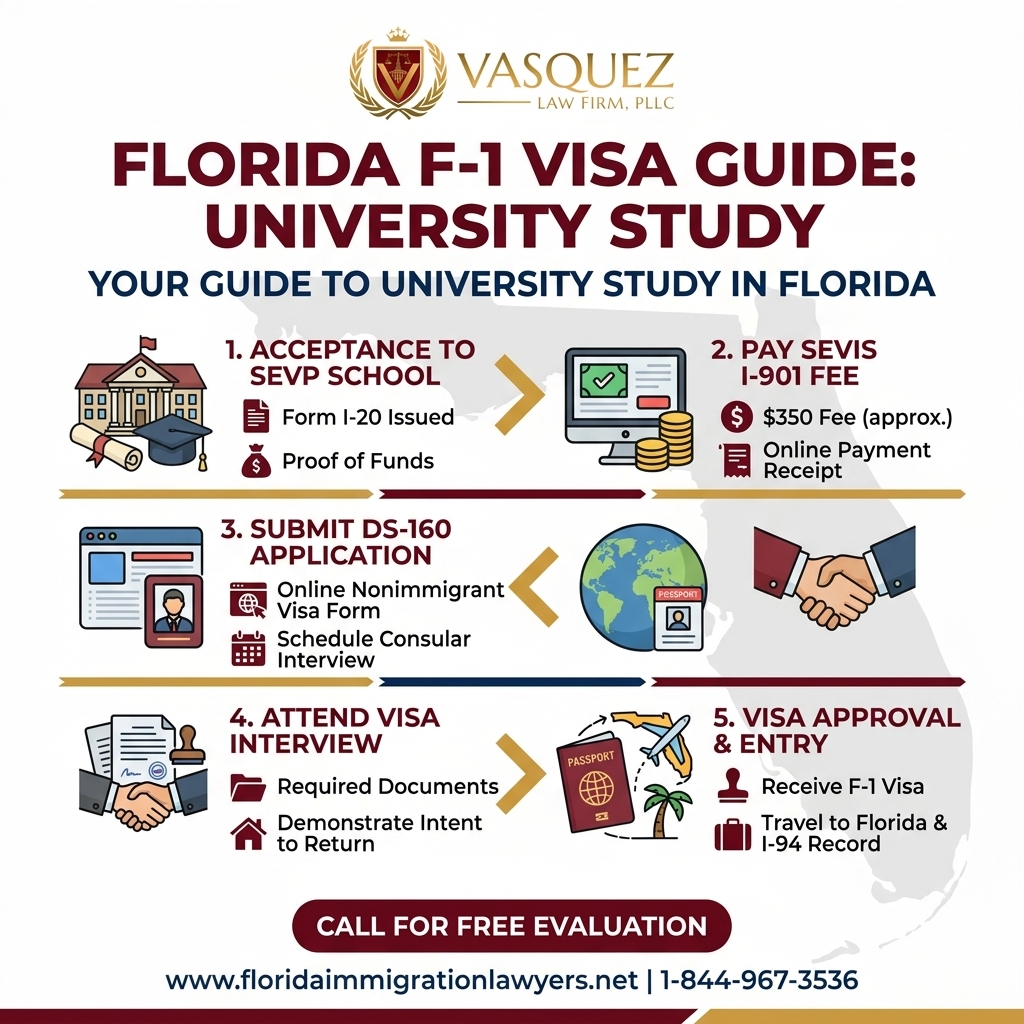
Understanding the timelines for your F-1 student visa Florida application is vital for effective planning. The entire process, from receiving your I-20 to arriving in Florida, can take several weeks to several months. It is always best to start your application as early as possible, ideally at least 3-5 months before your program start date, especially if you are aiming for popular universities like those near Gainesville.
Key stages and their typical timelines include:
- I-20 Issuance: Once accepted by a SEVP-approved school, your Form I-20 typically takes 1-2 weeks to be issued and mailed to you.
- SEVIS Fee Payment: This payment registers almost instantly, but it is advisable to allow a few business days for the system to update before scheduling your interview.
- DS-160 Completion: This online form can take several hours to complete accurately.
- Visa Interview Wait Times: These are highly variable and depend on the U.S. embassy or consulate in your home country. Some locations may have wait times of a few days, while others could be several weeks or even months. Always check the State Department's visa wait times page for the most current information.
- Visa Processing After Interview: If approved, your passport with the F-1 visa stamp is usually returned within 1-2 weeks. However, administrative processing or requests for additional documents (RFEs) can extend this period significantly, sometimes for several months.
Recent global events and policy changes, while not directly impacting the F-1 visa's core requirements, can influence processing times. For instance, increased scrutiny or evolving biometric data policies could add layers to the background check process. Proactive preparation and meticulous documentation can help mitigate potential delays. If you encounter unexpected delays or receive a Request for Evidence (RFE) from USCIS, consulting an experienced immigration lawyer from Florida Immigration Lawyers can be invaluable.
Financial Planning: Costs and Funding Your F-1 Student Visa in Florida
Financial stability is a cornerstone of the F-1 student visa Florida application. You must demonstrate that you have sufficient funds to cover all your expenses without relying on unauthorized employment. This typically includes tuition, fees, living expenses (housing, food, transportation, personal costs), and health insurance for your entire period of study. Florida universities, while offering excellent value, still require significant financial commitment.
The estimated costs will be detailed on your Form I-20. These figures can vary widely depending on the institution (public vs. private), program length, and lifestyle choices. For example, living expenses in a city like Miami or Orlando might be higher than in Gainesville. You will need to provide concrete evidence of these funds, such as bank statements, scholarship letters, or an affidavit of support from a sponsor, accompanied by their financial documentation. These documents must show readily available funds, not just potential income.
Beyond tuition and living costs, there are several mandatory government fees associated with the F-1 visa application:
- SEVIS I-901 Fee: This fee is typically a one-time payment required to maintain your record in the SEVIS system.
- Visa Application Fee (MRV Fee): A non-refundable fee paid for processing your visa application.
- Travel Expenses: Costs associated with your flight to Florida and initial settlement.
While F-1 visa holders are generally prohibited from working off-campus without authorization, there are limited opportunities for on-campus employment and practical training. Curricular Practical Training (CPT) and Optional Practical Training (OPT) allow students to gain work experience directly related to their field of study. CPT is usually part-time during studies, while OPT can be completed pre-completion or post-completion of your degree. Eligibility and regulations for CPT and OPT are outlined in 8 CFR 214.2(f)(10). Understanding these options and their strict limitations is crucial for maintaining your F-1 status. Any unauthorized employment can lead to severe immigration consequences, including deportation and future inadmissibility.
Do not navigate this complex process alone. The requirements for an F-1 student visa are precise, and a single mistake can jeopardize your educational future. Contact Florida Immigration Lawyers today for expert guidance and support. Our team is ready to assist you.
Common Mistakes to Avoid in Your F-1 Student Visa Application
Applying for an F-1 student visa Florida can be a challenging process, and even minor errors can lead to significant setbacks. Being aware of common mistakes can help you avoid them and increase your chances of a successful application:
-
Incomplete or Inaccurate Application Forms: Failing to fill out the DS-160 completely or providing inconsistent information can trigger red flags and lead to denial. Double-check every field for accuracy.
-
Insufficient Proof of Funds: Not demonstrating enough financial resources to cover your entire period of study, or providing outdated/unverifiable bank statements, is a primary reason for F-1 visa denials. Ensure your financial documents are current and clearly show available funds.
-
Lack of "Non-Immigrant Intent": Failing to convince the consular officer that you intend to return to your home country after your studies. Avoid implying any desire to stay permanently in the U.S. or using an F-1 visa as a backdoor to immigration.
-
Missing Deadlines: Applying too late can result in not getting your visa in time for your program start date, forcing you to defer admission. Start the process well in advance.
-
Poor Interview Preparation: Not being able to clearly articulate your academic plans, why you chose your specific Florida university, or how you will fund your education can lead to suspicion and denial. Practice your answers.
-
Providing False Information: Any misrepresentation or fraudulent documents will lead to an immediate and permanent visa denial, and potentially a ban from future U.S. travel. Honesty is paramount.
-
Not Paying SEVIS Fee: Forgetting or delaying payment of the SEVIS I-901 fee means your SEVIS record will not be active, preventing your visa from being issued.
-
Incorrectly Assuming Automatic Approval: Even with an I-20, visa approval is not guaranteed. The consular officer has discretion, and you must meet all criteria. Many applicants for an F-1 student visa Florida make this mistake.
-
Violating F-1 Status Post-Entry: Once in Florida, common violations include unauthorized employment, dropping below full-time enrollment without authorization, or failing to extend your I-20. These can lead to loss of status and potential deportation.
-
Not Informing DSO of Changes: Failing to notify your Designated School Official (DSO) of changes like address, major, or financial situation can lead to issues with your SEVIS record.
When to Call a Florida Immigration Lawyer for Your F-1 Visa
While many F-1 student visa applications are straightforward, certain situations warrant the expertise of an experienced immigration attorney. Florida Immigration Lawyers are here to provide crucial support and guidance, ensuring your application for an F-1 student visa Florida is handled with precision and care.
You should consider calling a lawyer if:
- You Have a Previous Visa Denial: If your F-1 visa or any other U.S. visa has been denied in the past, an attorney can help you understand the reasons for denial and strategize a stronger reapplication.
- Your Financial Situation is Complex: If your funding comes from multiple sources, international sponsors, or unconventional investments, a lawyer can help organize and present your financial evidence effectively.
- You Have a Criminal Record or Immigration Violation: Any past legal issues, even minor ones, can make you inadmissible. An attorney can assess your situation and advise on potential waivers or strategies.
- You Received a Request for Evidence (RFE): If USCIS or the consulate requests additional documentation or clarification, an attorney can help you respond appropriately and thoroughly.
- You Need to Change Your Status: If you are currently in the U.S. on a different visa and wish to change to F-1 status, this process can be intricate and requires legal expertise to avoid violating your current status.
- You Have Concerns About Non-Immigrant Intent: If your background or personal circumstances might make it difficult to prove your intent to return home, an attorney can help you gather compelling evidence and prepare for the interview.
- You Are Confused About OPT/CPT Regulations: Understanding the strict rules for work authorization as an F-1 student is critical. An attorney can clarify your options and ensure compliance.
- You Face Deportation Defense Concerns: If you have violated your F-1 status or face any immigration enforcement action, immediate legal representation is essential.
Our attorneys at Florida Immigration Lawyers understand the specific challenges international students face. We serve clients across Florida, including those planning to study in Gainesville, Miami, Orlando, and Tampa. We can help you prepare for your interview, review your documents, and represent you in complex cases. For assistance with your F-1 student visa Florida, or any other immigration matter like family immigration or general immigration, contact us today.
About Florida Immigration Lawyers
Florida Immigration Lawyers is a leading law firm dedicated to providing comprehensive and compassionate immigration legal services throughout the state of Florida. Our team of experienced attorneys understands the profound impact immigration matters have on individuals and families. We are committed to offering personalized, strategic legal advice to help our clients achieve their immigration goals, whether it's securing an F-1 student visa Florida, pursuing citizenship, or defending against deportation.
With offices strategically located to serve all of Florida, we pride ourselves on our deep understanding of U.S. immigration law and our unwavering dedication to client success. We handle a wide range of cases, including family-based petitions, employment visas, asylum claims, and naturalization. Our firm is known for its meticulous preparation, proactive communication, and ethical representation. We believe in empowering our clients with knowledge and guiding them through every step of their immigration journey.
At Florida Immigration Lawyers, we offer free initial consultations to assess your unique situation and provide clear, actionable advice. We are available 24/7 to address your urgent concerns. Our bilingual team is ready to assist you in both English and Spanish, ensuring that language is never a barrier to accessing quality legal representation. When your future in Florida is at stake, choose the trusted advocates at Florida Immigration Lawyers. Call us now at 1-844-967-3536 or visit our website at floridaimmigrationlawyers.net to learn more about how we can help you.
Sources and References
- U.S. Citizenship and Immigration Services (USCIS)
- U.S. Department of State - Visa Wait Times
- Executive Office for Immigration Review (EOIR)
- Immigration and Nationality Act, Section 101(a)(15)(F) (8 U.S.C. § 1101(a)(15)(F))
- 8 Code of Federal Regulations (CFR) 214.2(f) - Students
- 8 CFR 214.2(f)(10) - Curricular Practical Training (CPT) and Optional Practical Training (OPT)
- Student and Exchange Visitor Program (SEVP)
Related services: immigration practice areas, asylum protection, business immigration, experienced immigration attorneys.
This article provides general legal information and is not intended as legal advice. Every case is unique, and outcomes depend on specific facts and circumstances. Contact an attorney for advice about your particular situation.
Your dream of studying in Florida is within reach. With careful planning and expert legal guidance, you can successfully navigate the F-1 student visa process. Don't let the complexities of immigration law deter you from your educational goals. Contact Florida Immigration Lawyers today for a free consultation and let us help you build a strong case for your F-1 student visa Florida. Call us at 1-844-967-3536. Se Habla Espanol - Estamos aqui para ayudarle.
Do Not Navigate This Process Alone
Our experienced immigration attorneys are ready to fight for you. Get a free, confidential consultation today.
Se Habla Español
Frequently Asked Questions
Florida Immigration Lawyers
Immigration Attorney | Founder, Vasquez Law Firm
U.S. Air Force veteran and immigration attorney with thousands of cases resolved. J.D., NCCU School of Law. AILA member. Admitted to the 4th, 5th, and 11th Circuit Courts.
Available 24/7 - Free Evaluations
Related Legal Services
Our Florida immigration attorneys can help you with experienced immigration attorneys, business immigration and asylum protection. Call today at 1-844-967-3536 for a free consultation.
Related Links
Related Topics
Free Legal Consultation
Discuss your case with our experienced attorneys. We're available 24/7.
Se Habla Español - Estamos aquí para ayudarle.
Related Articles
Withholding of Removal Florida Defense: Your Guide
If you are facing deportation in Florida and fear persecution or torture upon return to your home country, you may be eligible for withholding of removal or protection under the Convention Against Torture (CAT). These forms of relief are crucial for individuals who cannot return safely. Understanding the strict eligibility requirements, the complex legal process, and the high burden of proof is vital for a successful defense. Florida Immigration Lawyers specializes in deportation defense, offering expert guidance to navigate these challenging cases in courts across Florida. We are here to help you protect your future and explore every possible defense.
Voluntary Departure vs Deportation in Florida | VLF Florida
Explore the differences between voluntary departure and deportation in Florida. Understand the implications for immigrants and learn when to seek legal help. Call Florida Immigration Lawyers at 1-844-967-3536.
Consular Return After Visa Denial in Florida | VLF Florida
Facing a visa denial in Florida can be daunting. Learn about the consular return process after a 221(g) notice and get professional help.
Immigration Lawyer Fort Lauderdale: Your Florida Guide 2026
Navigating immigration law in Fort Lauderdale, Florida, requires expert guidance. Our comprehensive guide for 2026 delves into why securing a skilled immigration lawyer Fort Lauderdale is essential. We cover key immigration pathways such as family-based visas, employment-based petitions, asylum claims, and crucial deportation defense strategies specific to Broward County. Learn about the step-by-step process of working with our firm, understanding the costs involved, and setting realistic expectations for timelines. We also highlight common mistakes to avoid and critical scenarios when legal counsel from Florida Immigration Lawyers becomes indispensable. Our firm offers dedicated support for individuals and families across Florida, including Hialeah, ensuring your rights are protected throughout the complex immigration system. Contact us for a free consultation to start your journey with confidence.