RFE Florida Response: Guide to USCIS Requests for Evidence
Received a Request for Evidence (RFE) from USCIS in Florida? This comprehensive guide details how to understand, prepare, and submit a strong RFE response. Learn about common reasons for RFEs, essential document checklists, crucial timelines, and potential costs. Florida Immigration Lawyers provides expert assistance for individuals in Coral Springs, Miami, Orlando, and across the state, ensuring your immigration application has the best chance of success. Avoid common mistakes and understand when professional legal help is indispensable for navigating complex USCIS requests. Contact us for a free consultation and personalized guidance.
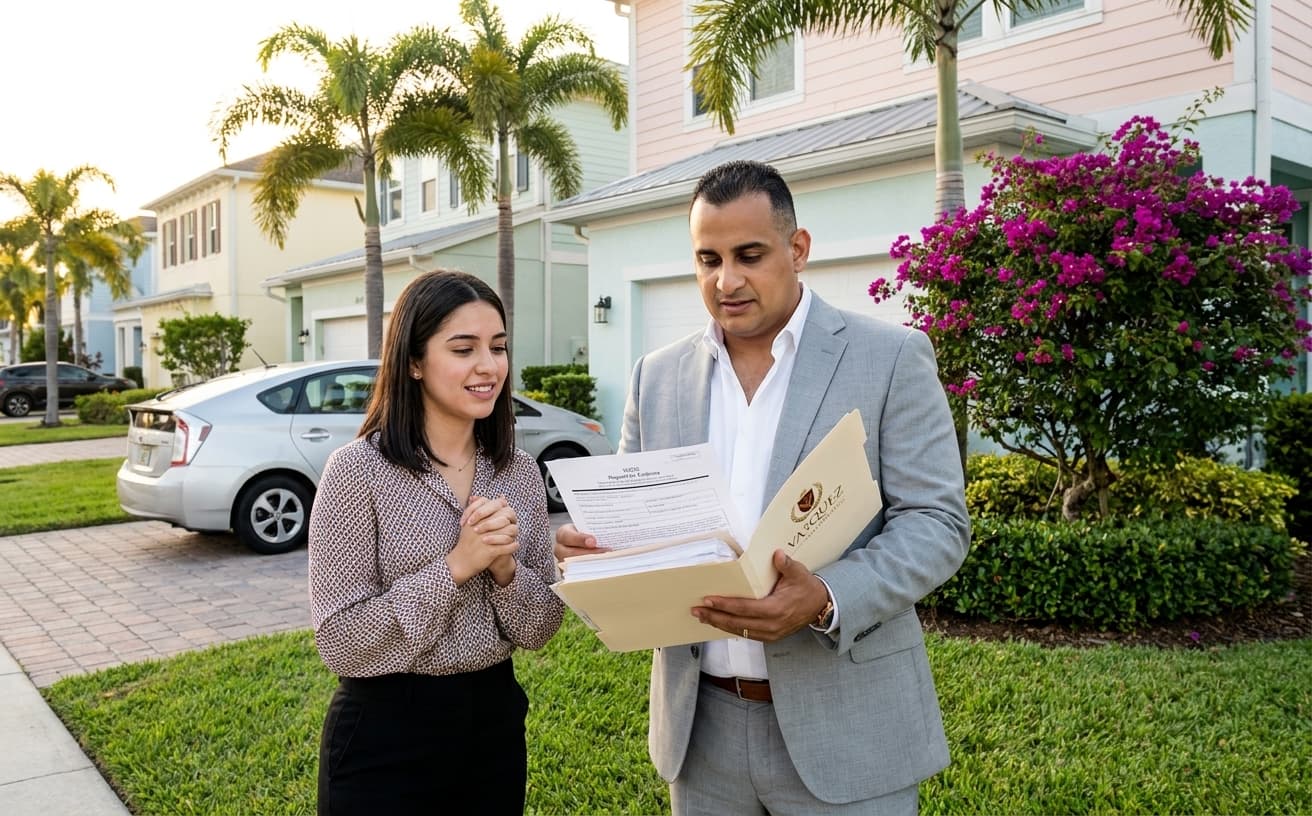
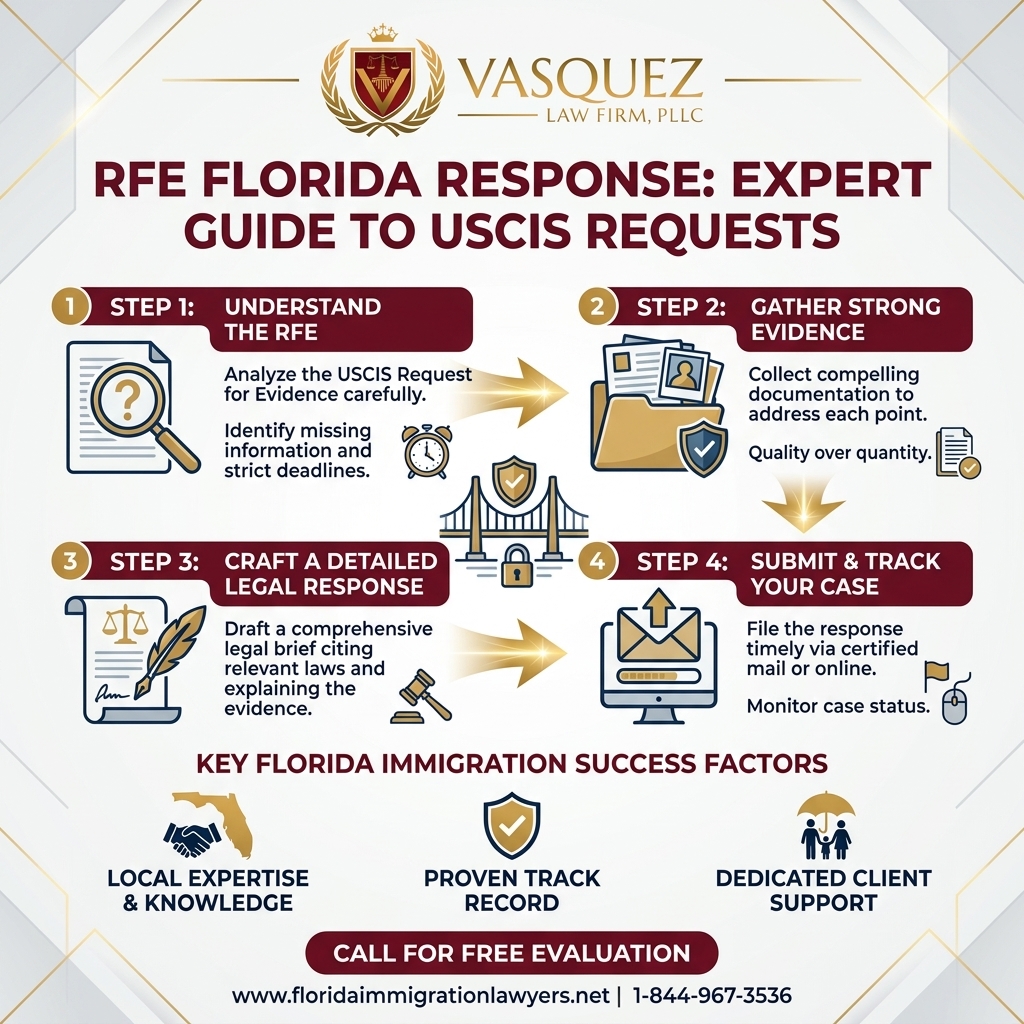
A Request for Evidence (RFE) from USCIS in Florida is a formal notice indicating that your immigration application lacks sufficient supporting documentation or information. Responding to an RFE Florida notice requires a meticulous and timely approach. You must provide the requested evidence by the specified deadline, typically 87 days, to avoid denial of your petition. Failing to submit a comprehensive and accurate response can lead to delays, further RFEs, or even outright denial, impacting your immigration journey significantly. Consulting an experienced Florida immigration lawyer is crucial to ensure a successful outcome.
- An RFE means USCIS needs more information to approve your case.
- Strict deadlines, usually 87 days, apply to RFE responses.
- A comprehensive and accurate response is vital to prevent denial.
- Seek legal guidance from Florida Immigration Lawyers for expert assistance.
- Properly addressing an RFE can prevent delays and improve approval chances.
Receiving a notice from U.S. Citizenship and Immigration Services (USCIS) can often be a source of anxiety, especially when it's a Request for Evidence (RFE). If you're navigating the complexities of immigration in Florida, understanding and effectively responding to an RFE is paramount to the success of your application. An RFE is not an automatic denial; rather, it's an opportunity to provide additional information that USCIS deems necessary to make a decision on your case. This detailed guide will walk you through everything you need to know about preparing a robust RFE Florida response, ensuring your immigration journey continues smoothly.
Whether you're in Coral Springs, Miami, Orlando, or anywhere else in the Sunshine State, a properly handled RFE can make all the difference. We understand the stakes involved in every immigration application. Our goal is to equip you with the knowledge to approach this challenge confidently. Do not navigate this complex process alone. Call Florida Immigration Lawyers at 1-844-YO-PELEO for a free consultation and personalized guidance on your RFE today.
Understanding Your USCIS Request for Evidence (RFE) in Florida
A Request for Evidence (RFE) is a written notice from USCIS asking for more information or documents to support your immigration petition or application. USCIS issues an RFE when the initial submission lacks sufficient evidence to establish eligibility, or when there are inconsistencies or discrepancies in the provided information. This can happen for various reasons, from missing documents to unclear evidence that requires further clarification. For individuals in Florida, receiving an RFE from USCIS field offices in locations like Kendall, Orlando, or Tampa, or from service centers, means your case is under scrutiny, but not necessarily in jeopardy.
The implications of an RFE are significant. It directly impacts the processing timeline of your case, often causing delays while you gather and submit the requested materials. More critically, a poorly prepared or incomplete response to a request for evidence can lead to a denial of your application. USCIS relies on the evidence you provide to determine if you meet the eligibility requirements under the Immigration and Nationality Act (INA), specifically sections like INA § 204 for petition approvals or INA § 245 for adjustment of status. Understanding the specific nature of the RFE is the first critical step. It is essential to read the RFE letter thoroughly to identify exactly what USCIS is asking for and why, as outlined in 8 CFR § 103.2(b)(8).
Common Reasons for an RFE
RFEs are issued for a variety of reasons, and understanding the common triggers can help applicants be proactive. One frequent reason is insufficient initial evidence, such as missing birth certificates, marriage licenses, or financial documents. USCIS might also question the authenticity or credibility of submitted documents. For employment-based petitions, issues related to a petitioner's ability to pay the proffered wage or the beneficiary's qualifications for the position are common. In family-based cases, proof of a bona fide marriage or relationship can often be requested. Furthermore, if there have been changes in your circumstances since filing your application, or if new policies have been implemented, USCIS may issue an RFE to ensure all information is up-to-date and compliant with current regulations. For example, recent policy shifts, such as those impacting biometric data collection, might lead to RFEs seeking updated information or clarification, as highlighted by recent news regarding biometric data policies.
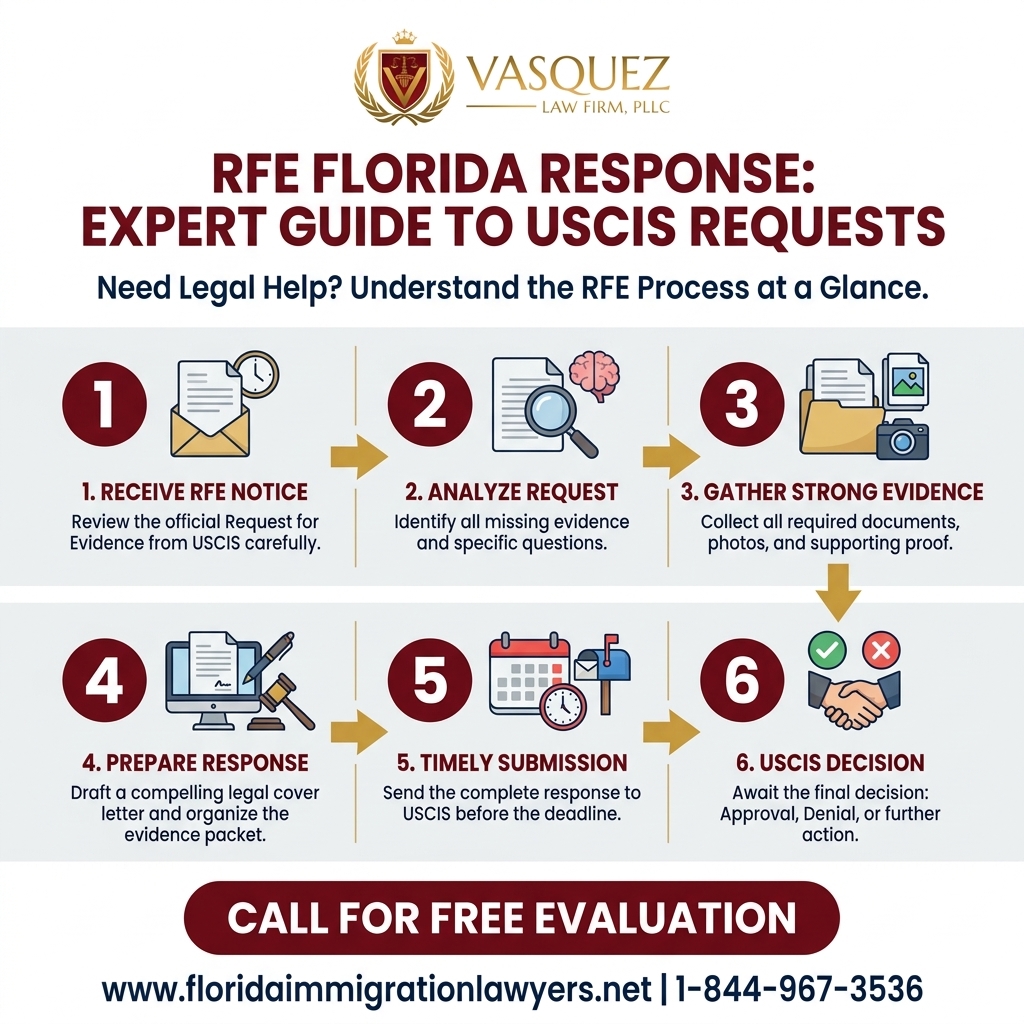
Step-by-Step Guide to Responding to a Florida RFE
Responding to an RFE Florida notice requires a structured and careful approach to ensure all requirements are met. This step-by-step guide will help you navigate the process effectively, whether your RFE originated from a USCIS office in Coral Springs, Miami, or any other Florida location. Each step is crucial to building a strong and successful response.
-
Thoroughly Review the RFE Letter: The very first step is to read the RFE letter multiple times. Understand precisely what information or documents USCIS is requesting. Pay close attention to any specific instructions, deadlines, and the legal basis cited for the request. Often, an RFE will quote specific sections of the INA or 8 CFR that your application must satisfy. Highlight key phrases and required evidence. Do not assume you know what they are asking for; verify it explicitly. This initial review is critical for developing a strategic response.
-
Consult with an Immigration Attorney: Immediately after receiving an RFE, especially if you are in Florida, contact an experienced immigration attorney. An attorney can help you interpret the RFE, identify potential issues, and develop a comprehensive response strategy. They can advise you on the best types of evidence to submit and help you avoid common pitfalls. This is particularly important for complex cases or those with tight deadlines. Florida Immigration Lawyers offers free consultations to discuss your specific RFE.
-
Gather All Requested Documents and Evidence: Begin collecting all the documents and information specified in the RFE. Do not send original documents unless specifically requested. Provide clear, legible copies. If a document is in a foreign language, it must be accompanied by a certified English translation. Go beyond the bare minimum; if the RFE asks for proof of relationship, provide a variety of evidence demonstrating the bona fide nature of the relationship, such as joint bank accounts, photos, affidavits from friends and family, and shared utility bills. Organize everything meticulously.
-
Write a Detailed Cover Letter: Prepare a professional cover letter that clearly lists all the documents you are submitting in response to the RFE. Reference your USCIS case number and the date of the RFE letter. The cover letter should explain how each piece of evidence addresses the specific points raised in the RFE. This helps the USCIS officer easily find and understand your submission. Clearly label each piece of evidence according to your cover letter.
-
Assemble and Submit Your Response Package: Organize your response package neatly. Place the RFE letter on top, followed by your cover letter, and then the supporting evidence in the order listed in your cover letter. Make a complete copy of the entire package for your records. Send your response to the address specified in the RFE letter, usually a USCIS Lockbox facility or service center. Use a reliable shipping method that provides tracking and delivery confirmation, such as USPS Certified Mail or a private courier service. Ensure it arrives before the deadline.
Essential Document Checklist for Your RFE Response
Preparing a thorough RFE Florida response requires careful attention to the requested documents. While the exact list will vary based on your specific RFE, this checklist provides general categories and examples of what USCIS commonly requests. Always refer to your RFE letter for the precise requirements. Remember, the goal is to provide overwhelming evidence that leaves no doubt about your eligibility.
General Documentation
- A copy of the original USCIS RFE letter.
- A detailed cover letter outlining the submitted documents and how they address each point in the RFE.
- Proof of identity, such as copies of passports, driver's licenses, or state IDs.
- Birth certificates (for all relevant parties).
- Marriage certificates (if applicable).
- Divorce decrees or death certificates of previous spouses (if applicable).
- Affidavits from individuals with personal knowledge of facts related to your case, notarized and clearly stating the affiant's relationship to you.
- Official translations for any document not in English, certified by the translator.
Case-Specific Evidence
Depending on the type of application, USCIS may request more specialized documents. For family immigration petitions, you might need:
- Proof of Bona Fide Relationship: Joint bank account statements, joint leases or mortgages, utility bills in both names, shared health insurance policies, photographs together over time, letters/emails/call logs, travel itineraries, and children's birth certificates.
- Financial Documentation: Recent tax returns (IRS Form 1040, W-2s, 1099s), pay stubs, employment verification letters, bank statements, and USCIS Form I-864, Affidavit of Support, with all required attachments.
For employment-based petitions:
- Employer's Ability to Pay: Audited financial statements, annual reports, federal tax returns, or profit and loss statements.
- Beneficiary's Qualifications: Official academic transcripts, diplomas, professional licenses, letters from previous employers, and detailed job descriptions.
For asylum or deportation defense cases:
- Proof of Persecution: Police reports, medical records, news articles, affidavits from witnesses, and country condition reports from sources like the U.S. Department of State.
Always ensure that the evidence directly addresses the points raised in the RFE. Providing extraneous documents can sometimes confuse the officer, so focus on relevancy and clarity.
RFE Response Timelines and Processing Expectations in 2026
When you receive a Request for Evidence (RFE) from USCIS, understanding the strict timelines and what to expect regarding processing is crucial. The RFE letter will clearly state the deadline for your response. This deadline is typically 87 days from the date the RFE was issued, which includes 60 additional days added to the standard 30-day response period for most RFEs and NOIDs (Notices of Intent to Deny) to account for potential mail delays, as per USCIS policy. It is imperative to submit your complete RFE Florida response before this deadline. Missing the deadline will almost certainly lead to the denial of your application, requiring you to start the entire process over and incur new fees.
Understanding Deadlines
The clock starts ticking from the date USCIS issues the RFE, not the date you receive it. Therefore, prompt action upon receipt is essential. If you live in a bustling area like Coral Springs or Miami, mail delivery might be quick, but don't take chances. An attorney can help you organize and prioritize the gathering of documents to meet this critical timeframe. It's often advisable to aim to submit your response at least a week before the actual deadline to account for any unforeseen shipping delays or administrative hiccups. USCIS does not generally grant extensions for RFE responses, so planning is vital.
Post-RFE Processing
Once USCIS receives your RFE response, the processing clock restarts. The time it takes for USCIS to make a decision after receiving your response can vary significantly. It depends on several factors, including the type of application, the complexity of the evidence submitted, and the current workload of the specific USCIS service center or field office handling your case (e.g., the Hialeah, Miami, or Orlando field offices). You can generally check the average processing times on the USCIS website by inputting your form type and the service center. After reviewing your response, USCIS will either approve your application, issue another RFE, or deny the case. While an RFE will naturally extend your overall processing time, a well-prepared and timely response significantly increases the likelihood of a positive outcome without further delays.
Cost Factors and Fee Breakdown for RFE Responses
Responding to a USCIS RFE Florida involves several potential cost factors that applicants should be aware of. While USCIS does not charge a separate fee for submitting an RFE response itself, various expenses can accumulate during the process of gathering and preparing the necessary documentation. Understanding these potential costs is important for financial planning and ensuring you can submit a complete and compelling response.
Legal Fees
One of the primary cost factors is legal representation. Engaging immigration law attorneys, such as Florida Immigration Lawyers, to assist with your RFE response can be a significant investment, but often a worthwhile one. Attorneys charge fees based on their experience and the complexity of your case. These fees typically cover interpreting the RFE, advising on the required evidence, reviewing and organizing documents, drafting comprehensive cover letters, and preparing the entire response package. While it's an added expense, expert legal guidance can save you time, reduce stress, and dramatically increase your chances of a successful outcome, potentially avoiding costly denials and re-filings.
Ancillary Costs
Beyond legal fees, several other ancillary costs may arise. These include:
- Document Translation Fees: If any of your supporting documents are in a foreign language, you will need to pay for certified translations. These fees can vary depending on the length and complexity of the documents.
- Document Retrieval Fees: You might incur costs to obtain official copies of documents like birth certificates, marriage licenses, police records, or academic transcripts from various institutions.
- Medical Exam Fees: In some cases, especially if your initial medical exam expired or USCIS has concerns, you might need to undergo another medical examination, which incurs additional fees.
- Postage and Shipping Fees: Sending your RFE response package via certified mail or a courier service with tracking can add to the cost. Given the importance of the deadline, expedited shipping may be necessary.
- Expert Opinion Fees: For highly complex cases, such as those involving specialized employment or medical conditions, you might need to obtain an expert opinion or evaluation, which can be costly.
- Biometrics Fees: While less common for RFEs, if USCIS requests updated biometrics, there might be a fee associated with rescheduling or providing new fingerprints.
These costs can add up, so it's wise to discuss all potential expenses with your attorney during your initial consultation. A clear understanding of the financial commitment allows you to prepare adequately for your RFE immigration Florida response.
Do not navigate this process alone. Contact Florida Immigration Lawyers today by calling 1-844-YO-PELEO to ensure your RFE response is complete, accurate, and submitted on time. Our team is ready to provide the dedicated support you need.
Common Mistakes to Avoid When Responding to an RFE
Responding to a Request for Evidence (RFE) is a critical juncture in your immigration process. Even minor errors can have significant consequences, leading to delays or even denial. Be mindful of these common mistakes:
-
Failing to Respond by the Deadline: This is arguably the most critical mistake. Missing the RFE deadline, typically 87 days, will result in an automatic denial of your application without further consideration. Always mark your calendar and aim to submit well in advance.
-
Not Understanding the RFE: Submitting documents without fully grasping what USCIS is asking for is a common pitfall. A vague or incomplete RFE response that doesn't directly address each point raised will likely lead to another RFE or a denial. Read the RFE carefully, perhaps multiple times.
-
Submitting Insufficient or Irrelevant Evidence: Providing too little evidence or submitting documents that do not directly pertain to the RFE's requests can be detrimental. Every piece of evidence should serve a clear purpose in demonstrating your eligibility or clarifying a point.
-
Sending Original Documents: Unless specifically instructed, never send original documents. USCIS advises submitting clear, legible copies. Sending originals risks losing them, and they may not be returned.
-
Ignoring Translation Requirements: Any document not in English must be accompanied by a complete, certified English translation. Failing to provide this will render the document unusable and incomplete in USCIS's eyes.
-
Inconsistent Information: Submitting new evidence that contradicts previously provided information without proper explanation can raise red flags and lead to further scrutiny or suspicion of misrepresentation.
-
Poor Organization: A disorganized response package makes it difficult for the USCIS officer to review. This can lead to delays as they try to piece together your submission, or even misinterpretation of your evidence. Use a cover letter and clearly label all documents.
-
Assuming USCIS Knows Your Case: Do not assume the officer reviewing your RFE has full context from your initial application. Your RFE response should be self-contained and clearly explain how the new evidence supports your case.
-
Not Keeping Copies: Always make a complete copy of your entire RFE response package before sending it to USCIS. This copy serves as your record and can be crucial if there are any disputes or future requests.
-
Waiting Until the Last Minute: Delaying the preparation of your RFE response reduces the time available to gather documents, seek legal advice, and address any unexpected issues. This increases the risk of errors or missing the deadline.
-
Failing to Address All Points: Even if an RFE asks for multiple items, you must address every single one. Overlooking even one requested piece of evidence can lead to denial, as USCIS needs a complete picture.
When to Call a Florida Immigration Lawyer for Your RFE
While some RFEs might seem straightforward, many situations warrant the immediate assistance of an immigration lawyer, especially when dealing with a Request for Evidence (RFE) in Florida. The immigration process is highly complex, and even minor missteps can have profound consequences. If you find yourself in any of the following scenarios, it is highly advisable to contact Florida Immigration Lawyers:
- Complex or Vague RFE: If the RFE is difficult to understand, asks for highly technical information, or seems to question fundamental aspects of your eligibility, legal counsel is essential. An attorney can interpret the RFE's true intent and help formulate a strategic response.
- Tight Deadlines: If you have limited time to gather extensive documentation, an attorney can help prioritize, expedite the process, and ensure everything is submitted correctly and on time.
- Prior Denials or Immigration History Issues: If you have a history of immigration issues, previous denials, or any criminal record, an RFE can be particularly sensitive. An attorney can help address these complexities and present your case in the best possible light.
- Lack of Required Documents: If you genuinely cannot obtain a specific document requested by USCIS, an attorney can advise on alternative evidence or strategies to overcome this challenge.
- Marriage-Based or Family-Based RFEs: These often involve proving the bona fide nature of a relationship, which can be subjective and require a strong evidentiary showing. An attorney can help compile compelling evidence and prepare you for potential interviews.
- Employment-Based RFEs: Questions about an employer's ability to pay, the job offer, or the beneficiary's qualifications can be intricate. An attorney can work with both the employer and employee to gather the necessary business and professional documentation.
- Uncertainty About Consequences: If you are unsure about the potential consequences of a specific piece of evidence or how to explain a discrepancy, an attorney can provide clarity and mitigate risks.
Florida Immigration Lawyers has extensive experience helping individuals across Florida, from Coral Springs to Fort Lauderdale, respond to RFEs. Our team understands the nuances of USCIS requirements and is dedicated to protecting your interests. Don't risk your immigration future; seek professional guidance.
About Florida Immigration Lawyers
Florida Immigration Lawyers is a leading immigration law firm dedicated to serving individuals and families across the entire state of Florida. With a deep understanding of U.S. immigration laws and policies, our experienced immigration attorneys provide compassionate yet aggressive legal representation. We specialize in a wide range of immigration matters, including family-based petitions, employment visas, naturalization, asylum, and deportation defense. Our firm is committed to guiding clients through every step of their immigration journey, offering clarity and peace of mind.
We pride ourselves on our client-focused approach, ensuring personalized attention and tailored strategies for each unique case. Our team is fluent in multiple languages, including Spanish, making our services accessible to Florida's diverse immigrant communities. We understand the challenges and anxieties that come with immigration processes, and we are here to provide steadfast support. For a free consultation, contact Florida Immigration Lawyers at 1-844-YO-PELEO. We are available 24/7 to assist you, serving all of Florida with dedication and expertise. Visit our website at https://www.floridaimmigrationlawyers.net to learn more.
Sources and References
- U.S. Citizenship and Immigration Services (USCIS)
- USCIS Processing Times
- Executive Office for Immigration Review (EOIR)
- U.S. Department of State
- 8 U.S.C. Chapter 12 - Immigration and Nationality Act (INA)
- INA § 204 - Petition for Alien Relative
- INA § 245 - Adjustment of Status of Nonimmigrant to That of Person Admitted for Permanent Residence
- 8 CFR § 103.2(b)(8) - Evidence, Requests for Evidence, and Other Information
Related services: immigration practice areas, citizenship and naturalization, asylum protection, business immigration.
This article provides general legal information and is not intended as legal advice. Every case is unique, and outcomes depend on specific facts and circumstances. Contact an attorney for advice about your particular situation.
Your immigration future is too important to leave to chance. If you have received a Request for Evidence (RFE) in Florida, let the dedicated team at Florida Immigration Lawyers provide the expert guidance you need. We offer free consultations to discuss your case and outline a clear path forward. Call us today at 1-844-YO-PELEO. Se Habla Espanol - Estamos aqui para ayudarle.
Do Not Navigate This Process Alone
Our experienced immigration attorneys are ready to fight for you. Get a free, confidential case review today.
Se Habla Español
Or leave your details and we’ll call you:
Free Evaluation in 24 Hours
Or talk to us right now
AI voice assistant — available 24/7
FreeFrequently Asked Questions

William J. Vásquez
Founding Attorney · Vasquez Law Firm
U.S. Air Force veteran and immigration attorney with years of hands-on U.S. immigration experience. J.D., NCCU School of Law. AILA member. Admitted to the 4th, 5th, and 11th Circuit Courts.
Available 24/7 - Free Evaluations
Reviewed for legal accuracy by William J. Vásquez
Licensed in North Carolina; U.S. immigration is federal practice.
Related Legal Services
Our Florida immigration attorneys can help you with asylum protection, citizenship and naturalization and immigration practice areas. Call today at 1-844-YO-PELEO for a free case review.
Related Links
Related Topics
Free Legal Case Review
Discuss your case with our experienced attorneys. We're available 24/7.
Se Habla Español - Estamos aquí para ayudarle.
Related Articles
Immigration Lawyer Orlando Free Consultation in Florida
For individuals and families in Orlando, Florida, navigating the complexities of U.S. immigration law requires expert guidance. An immigration lawyer in Orlando offers crucial support for everything from visa applications and green card processes to naturalization and deportation defense. This comprehensive guide details what a free consultation covers, providing a step-by-step overview of immigration pathways, essential document checklists, and expected timelines in 2026. We also highlight common mistakes to avoid, discuss the critical role of legal counsel in deportation and asylum cases, and explain why choosing a local Orlando immigration attorney is beneficial. Florida Immigration Lawyers is dedicated to serving the diverse community of Orlando with compassionate, effective legal solutions, ensuring you receive personalized advice and robust representation for a successful immigration journey.
EAD Advance Parole Combo Card in Florida 2026
For individuals with a pending Form I-485, Application to Register Permanent Residence or Adjust Status, the EAD Advance Parole Combo Card is an essential document. This single card combines the authorization to work legally in the U.S. (Employment Authorization Document - EAD) with permission to travel internationally and re-enter without abandoning your green card application (Advance Parole). This guide from Florida Immigration Lawyers provides a comprehensive overview for applicants in Florida in 2026, covering eligibility, the step-by-step application process, required documents, expected processing times, and associated costs. We also highlight common mistakes to avoid and when to seek legal counsel to ensure a smooth and successful immigration journey. Understanding this vital card is key to maintaining stability while awaiting your permanent residency approval.
I-601 Waiver Lawyer Florida: Your Guide
Facing inadmissibility issues in Florida? Learn how an I-601 waiver can help you overcome these challenges with the guidance of an experienced lawyer. This guide provides a detailed overview of the process, eligibility requirements, and common pitfalls to avoid. Call Florida Immigration Lawyers at 1-844-YO-PELEO for expert assistance today.
O-1 Visa Extraordinary Ability in Florida: What You Need
Explore the O-1 visa for extraordinary ability in Florida. Learn about eligibility, application process, and common mistakes to avoid. Contact Florida Immigration Lawyers for expert assistance.