Re-Entry Permit Florida: Avoid Green Card Abandonment
Planning an extended trip outside the U.S. from Florida as a Lawful Permanent Resident? Learn how a re-entry permit (Form I-131) is essential to prevent green card abandonment. This guide covers eligibility, the application process, required documents, processing times, and cost factors. Understand the risks of prolonged absences and how to maintain your LPR status. Florida Immigration Lawyers provides expert assistance to protect your residency. Contact us for a free consultation to ensure your international travel plans don't jeopardize your future in the U.S. Don't risk losing your green card; take proactive steps.

A re-entry permit is a crucial document for U.S. Lawful Permanent Residents (LPRs) in Florida who plan to stay outside the United States for an extended period, typically more than one year but less than two. It prevents the presumption of green card abandonment by demonstrating your intent to return. Without this permit, prolonged absences can lead to issues at the port of entry, including potential loss of your permanent resident status. Applying for a Form I-131 re-entry permit while in Florida is a proactive step to protect your residency.
- A re-entry permit protects LPR status during long trips abroad.
- It prevents the presumption of green card abandonment.
- Apply using Form I-131 before leaving the U.S.
- Essential for stays outside the U.S. longer than one year.
- Consult an attorney to understand your specific needs.
Re-Entry Permit Florida: Protecting Your Green Card from Abandonment
Are you a Lawful Permanent Resident (LPR) in Florida considering an extended trip outside the United States? Perhaps you need to care for a sick family member, pursue an educational opportunity, or manage international business. While such travel is a part of life, staying abroad for too long can put your precious green card status at risk. Many LPRs, especially those with family ties or business interests in other countries, find themselves in a challenging position, balancing personal commitments with the requirements of maintaining U.S. residency.
This comprehensive guide will explain the importance of a re-entry permit, specifically Form I-131, and how it serves as a vital safeguard against the dreaded presumption of green card abandonment. We will delve into the application process, required documentation, potential costs, and crucial timelines. Understanding these factors is essential for any Florida LPR planning international travel.
At Florida Immigration Lawyers, we understand the complexities and anxieties that come with navigating immigration laws. Our dedicated team is here to help you protect your permanent resident status. If you are planning an extended absence from the U.S. and concerned about your green card, do not hesitate to seek expert legal guidance. Call Florida Immigration Lawyers at 1-844-967-3536 for a free consultation to discuss your specific situation and ensure your future in Florida is secure.
Understanding the Re-Entry Permit and Green Card Abandonment
A re-entry permit is an official travel document issued by U.S. Citizenship and Immigration Services (USCIS) to lawful permanent residents. Its primary purpose is to allow LPRs to remain outside the United States for up to two years without being considered to have abandoned their permanent resident status. Without a re-entry permit, an absence of six months to one year can raise questions at the port of entry, and an absence of one year or more automatically triggers a presumption of abandonment, making re-entry challenging.
The concept of green card abandonment arises when an LPR is deemed to have relinquished their intent to reside permanently in the United States. Factors that can lead to this presumption include lengthy absences, filing U.S. non-resident tax returns, severing community ties, and failing to maintain a U.S. domicile. For Florida residents, this might involve maintaining a home, employment, and family in the state. The re-entry permit explicitly states your intent to return, rebutting this presumption. USCIS reviews each Form I-131 application carefully, considering the applicant's reasons for extended travel and their ties to the U.S.
It is important to note that a re-entry permit does not guarantee re-admission, but it significantly strengthens your case upon return. Customs and Border Protection (CBP) officers still have the authority to question your intent. However, presenting a valid re-entry permit shifts the burden of proof, requiring CBP to demonstrate that you have abandoned your residency, rather than you having to prove you haven't. This protection is invaluable for LPRs, especially those from diverse communities in Miami, Orlando, or Tampa, who may have strong family or business connections abroad.
Applying for an I-131 Re-Entry Permit in Florida
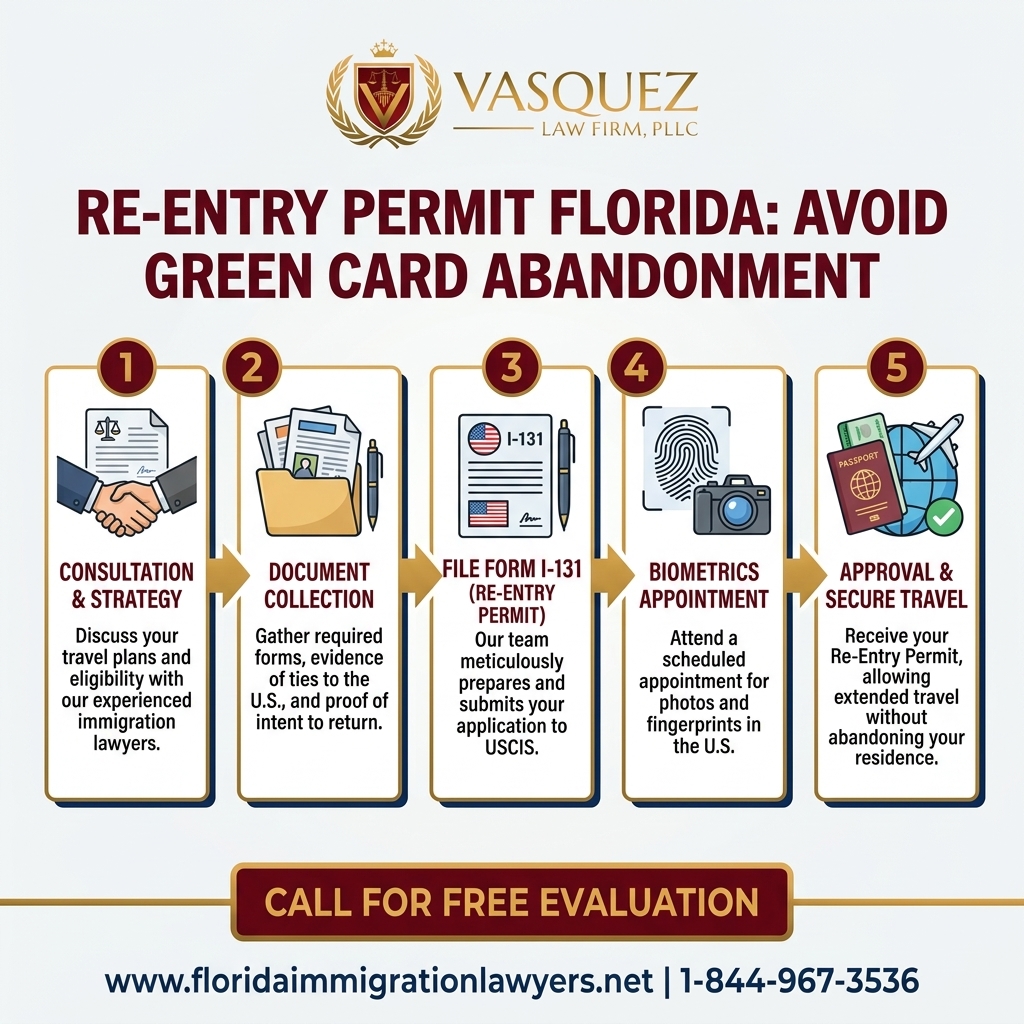
The process of applying for a re-entry permit involves filing Form I-131, Application for Travel Document, with USCIS. This application must be filed while you are physically present in the United States. It is a critical step that should be undertaken well in advance of your planned departure from Florida. Missing this crucial detail can lead to significant complications and potential delays in your travel plans, or worse, put your permanent resident status at risk.
-
Determine Eligibility: You must be a Lawful Permanent Resident (LPR) or a conditional permanent resident. You cannot apply if you are already outside the U.S. and your previous re-entry permit has expired or will expire soon. Ensure your green card is valid and you meet all general eligibility criteria for LPR status.
-
Complete Form I-131: Accurately fill out Form I-131, Application for Travel Document. Provide truthful and complete information regarding your travel plans, reasons for extended absence, and ties to the U.S. This form requires biographical information, details about your permanent residency, and specific information about your intended travel. Pay close attention to all sections to avoid errors.
-
Gather Required Documents: Collect all necessary supporting documents, including copies of your green card, passport identity page, and any previous re-entry permits. You will also need two passport-style photographs. A detailed checklist is provided in the next section, but always refer to the official USCIS instructions for Form I-131 for the most up-to-date requirements.
-
Pay the Filing Fee: Submit the correct filing fee for Form I-131. Be aware that filing fees can change, so always check the current fee on the USCIS website. Do not send cash. Payments are typically made by money order, personal check, cashier's check, or by credit card using Form G-1450, Authorization for Credit Card Transactions.
-
Mail the Application: Send your completed Form I-131, supporting documents, and fee to the appropriate USCIS Lockbox facility. The mailing address depends on whether you are using the U.S. Postal Service or a courier service. Always verify the correct address on the USCIS website to prevent misdelivery and delays.
-
Attend Biometrics Appointment: After filing, USCIS will send you an appointment notice for biometrics (fingerprints and photos) at an Application Support Center (ASC). For Florida residents, this typically means visiting an ASC in cities like Miami, Orlando, or Jacksonville. You MUST attend this appointment, as it is a mandatory part of the process. If you are already planning to depart, you may need to adjust your travel to attend this appointment while still in the U.S.
-
Receive Decision: USCIS will process your application and mail a decision. If approved, your re-entry permit will be sent to the address you provided. It is possible to request the permit be sent to a U.S. Embassy or Consulate abroad if you have a compelling reason and prior arrangement with USCIS.
Understanding Green Card Abandonment Risks for Florida LPRs
For Lawful Permanent Residents living in Florida, understanding the specific risks of green card abandonment is paramount. While a re-entry permit is a powerful tool, it does not absolve you from demonstrating an intent to maintain your U.S. residency. Long absences, even with a permit, can still lead to scrutiny from immigration officials upon your return, particularly at Florida's busy international airports like Miami International (MIA) or Orlando International (MCO).
Immigration officers look for several indicators of abandonment. These include establishing a permanent home abroad, working outside the U.S. for extended periods, filing taxes as a non-resident, or disposing of your U.S. property. For Floridians, maintaining strong ties means keeping a U.S. address, a driver's license, bank accounts, and employment or business interests within the state. If you spend more than a year outside the U.S. without a re-entry permit, the presumption of abandonment is automatic, and you may be denied entry. Even with a permit, if your absence exceeds two years, you would need to apply for a returning resident visa (SB-1) at a U.S. consulate abroad, which is a difficult and complex process.
It is critical for LPRs to understand that having a re-entry permit is just one piece of the puzzle. You must genuinely intend to return and maintain your permanent residence in the U.S. The permit serves as evidence of this intent, but it cannot override actual abandonment if your actions demonstrate otherwise. Consulting with an immigration attorney at Florida Immigration Lawyers can help you navigate these nuances and develop a strategy to protect your status, especially if your travel plans are complex or involve significant time abroad.
Required Documents for Your Re-Entry Permit Application
A complete and accurate application package for Form I-131 is crucial for a smooth process. Missing documents or submitting incorrect information can lead to delays, Requests for Evidence (RFEs), or even denial. Ensuring you have everything in order before filing can save you significant stress and time, especially if you have a tight travel deadline from Florida.
- Form I-131, Application for Travel Document: The original, properly completed, and signed form.
- Two Identical Passport-Style Photographs: Must be recent (taken within 30 days of filing), unmounted, full-face, passport-style photos.
- Copy of Your Permanent Resident Card (Green Card): Both front and back.
- Copy of a Government-Issued Photo Identification: Such as a driver's license or state ID from Florida.
- Copy of Your Passport's Biographic Page: The page with your photo and personal data.
- Proof of Identity: If your green card is not available, provide other evidence of identity and LPR status.
- Proof of Previous Re-Entry Permits (if any): Copies of previously issued re-entry permits.
- Evidence of Your Reasons for Extended Stay Abroad: While not strictly required for initial filing, having documentation supporting your need for a lengthy absence can be beneficial in case of an RFE or interview. This might include letters from employers, educational institutions, or medical professionals.
- Evidence of Ties to the U.S.: Documents demonstrating your continued intent to reside in the U.S., such as property deeds in Florida, U.S. tax returns, bank statements, and family ties.
- Filing Fee: Check or money order for the correct amount, payable to "U.S. Department of Homeland Security," or Form G-1450.
Always review the official USCIS website for the most current instructions and a detailed checklist. Filing a robust application from the outset helps prevent unnecessary complications and ensures that your request for a re-entry permit is processed efficiently, allowing you to travel from Florida with peace of mind.
Processing Times and What to Expect in Florida
Understanding the typical processing times for Form I-131 is crucial for planning your international travel from Florida. USCIS processing times can vary significantly based on workload, policy changes, and the specific service center handling your application. As of 2026, these times can range from several months to over a year. It is highly recommended to file your application as early as possible, ideally at least 4-6 months before your planned departure.
Once you file your Form I-131 application, you will receive a receipt notice (Form I-797C) from USCIS confirming that your application has been received. This notice will typically arrive within a few weeks. The next significant step is the biometrics appointment, which usually occurs 3-8 weeks after filing. As a Florida resident, you will be scheduled at a local Application Support Center (ASC) in cities like Miami, Tampa, or Jacksonville. It is essential to attend this appointment, as failing to do so can lead to a denial of your application. You must be in the U.S. for the biometrics appointment.
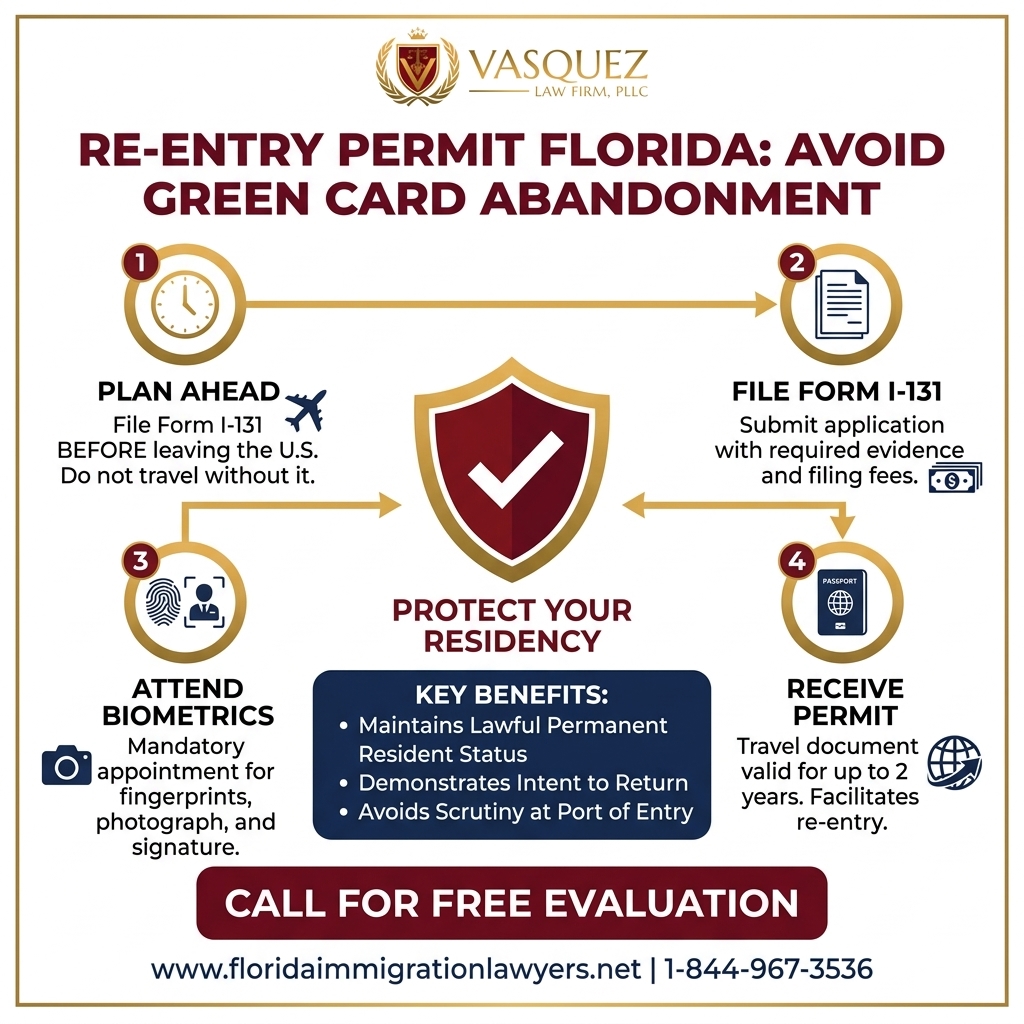
After biometrics, the wait for a decision can be the longest part of the process. You can check the status of your case online using the receipt number provided on your I-797C notice on the USCIS Case Status website. While most applicants receive their re-entry permit by mail, it is sometimes possible to request it be sent to a U.S. embassy or consulate abroad. This option is typically reserved for urgent and compelling circumstances and requires prior approval from USCIS. Planning ahead and seeking legal advice from Florida Immigration Lawyers can help you navigate these timelines and manage expectations effectively.
Cost Factors and Legal Fees for Your I-131 Application
When applying for a re-entry permit, LPRs in Florida need to consider both the government filing fees and potential legal fees if they choose to hire an attorney. Government filing fees are set by USCIS and are subject to change. It is crucial to always verify the current fee directly on the USCIS website before submitting your application. These fees are non-refundable, regardless of the outcome of your application, emphasizing the importance of a correctly prepared submission.
Beyond the USCIS filing fee, there are other potential costs. These may include fees for obtaining passport-style photographs, copying documents, and postage for mailing your application. While these individual costs are relatively small, they add up. The most significant additional cost for many applicants will be legal fees if they decide to retain an immigration attorney. Hiring an attorney from Florida Immigration Lawyers can be a valuable investment, especially given the potential consequences of a denied application or a presumption of green card abandonment.
Legal fees for I-131 applications can vary depending on the complexity of your case, the attorney's experience, and the scope of services provided. An attorney can help ensure your application is accurate, complete, and submitted with all necessary supporting documentation. They can also advise you on how to maintain your LPR status while abroad, prepare you for potential questions at the port of entry, and represent you if issues arise. Investing in legal counsel can provide peace of mind and significantly increase the likelihood of a successful outcome, safeguarding your future as a permanent resident in Florida. We offer free initial consultations to discuss these cost factors.
Common Mistakes to Avoid When Seeking a Re-Entry Permit
Navigating the re-entry permit process can be complex. Avoiding these common errors is crucial for LPRs in Florida:
-
Filing While Abroad: You MUST be physically present in the U.S. when you file Form I-131. Filing from outside the country will result in an automatic denial.
-
Missing Biometrics Appointment: Failing to attend your scheduled biometrics appointment in Florida (e.g., Miami, Orlando) will lead to your application being denied. Ensure you are in the U.S. for this mandatory step.
-
Applying Too Late: Processing times can be lengthy. Filing too close to your departure date may mean you leave the U.S. without your permit, risking abandonment. Apply at least 4-6 months in advance.
-
Incorrect or Incomplete Form I-131: Errors, omissions, or unsigned forms are common reasons for RFEs or denials. Double-check every section carefully.
-
Forgetting Supporting Documents: Failing to include copies of your green card, passport, or photos will delay processing. Always follow the official USCIS checklist.
-
Incorrect Filing Fee: Sending the wrong amount or an expired payment method will cause your application to be rejected. Verify current fees on the USCIS website.
-
Assuming the Permit Guarantees Re-Entry: A re-entry permit helps, but it does not guarantee admission. CBP officers can still question your intent to reside permanently if other evidence suggests abandonment.
-
Exceeding Two Years Abroad: A re-entry permit is generally valid for two years. Staying longer than this typically requires an SB-1 returning resident visa, a much harder process.
-
Not Maintaining U.S. Ties: Even with a permit, severing all U.S. ties (selling property, closing bank accounts, no U.S. address) can still indicate abandonment to immigration officials.
-
Not Seeking Legal Advice: Complex travel plans or previous immigration issues warrant expert legal counsel to ensure compliance and avoid missteps.
When to Call Florida Immigration Lawyers for Re-Entry Permit Assistance
Navigating the intricacies of U.S. immigration law, particularly regarding international travel and maintaining permanent residency, can be daunting. While the process for obtaining a re-entry permit might seem straightforward, certain situations warrant immediate legal consultation with experienced professionals like Florida Immigration Lawyers. Our firm is dedicated to serving LPRs across Florida, including those in Miami, Fort Lauderdale, and Orlando, ensuring their rights and status are protected.
You should contact an attorney if:
- You have a criminal record or any past immigration violations.
- Your previous re-entry permit application was denied.
- You have already spent significant time outside the U.S. and are concerned about potential abandonment issues.
- Your travel plans are complex, involve multiple countries, or extend beyond two years.
- You are a conditional permanent resident, as your status has specific requirements.
- You have lost your green card or it has expired.
- You have been denied entry to the U.S. in the past.
- You have received a Request for Evidence (RFE) from USCIS regarding your I-131 application.
- You are unsure about the required documentation or the best strategy for your specific circumstances.
Our team at Florida Immigration Lawyers can provide personalized advice, help prepare a robust application, and represent you in communications with USCIS. We understand the specific challenges faced by LPRs in Florida and are committed to offering comprehensive support.
About Florida Immigration Lawyers
Florida Immigration Lawyers is a leading immigration law firm dedicated to serving individuals and families across the entire state of Florida. With years of experience and a deep understanding of U.S. immigration law, we provide compassionate and effective legal representation for a wide range of immigration matters. From obtaining a re-entry permit to complex deportation defense cases, our attorneys are committed to achieving the best possible outcomes for our clients.
We pride ourselves on offering personalized attention and strategic advice tailored to each client's unique situation. Our services include family-based immigration, business immigration, asylum claims, naturalization and citizenship applications, and defense against deportation. We understand that immigration challenges can be stressful and life-altering, which is why we offer accessible and responsive support. Call us at 1-844-967-3536 or visit https://www.floridaimmigrationlawyers.net to learn more. We are available 24/7 for free consultations, and Se Habla Espanol - Estamos aqui para ayudarle.
Sources and References
- U.S. Citizenship and Immigration Services (USCIS) - Form I-131, Application for Travel Document
- U.S. Citizenship and Immigration Services (USCIS)
- U.S. Department of State - Returning Resident Visas (SB-1)
- 8 U.S.C. § 1101(a)(20) - Definition of "permanent resident"
- 8 U.S.C. § 1181 - Admission of immigrants into the United States
- 8 CFR § 211.1 - Returning residents
Related services: immigration practice areas, family immigration services.
This article provides general legal information and is not intended as legal advice. Every case is unique, and outcomes depend on specific facts and circumstances. Contact an attorney for advice about your particular situation. Immigration laws are subject to change.
Protecting your permanent resident status is paramount, especially when planning extended international travel. A re-entry permit is a vital tool to demonstrate your intent to return to the U.S. and prevent the presumption of green card abandonment. Don't leave your future to chance. For personalized advice and comprehensive legal support, contact Florida Immigration Lawyers today. Our experienced team is ready to guide you through every step of the process, ensuring your peace of mind.
Call us now for a free consultation at 1-844-967-3536. Se Habla Espanol - Estamos aqui para ayudarle.
If you need legal assistance, learn more about immigration case consultation, or call us at 1-844-967-3536 for a free consultation.
Do Not Navigate This Process Alone
Our experienced immigration attorneys are ready to fight for you. Get a free, confidential consultation today.
Se Habla Español
Frequently Asked Questions
Florida Immigration Lawyers
Immigration Attorney | Founder, Vasquez Law Firm
U.S. Air Force veteran and immigration attorney with thousands of cases resolved. J.D., NCCU School of Law. AILA member. Admitted to the 4th, 5th, and 11th Circuit Courts.
Available 24/7 - Free Evaluations
Related Legal Services
Our Florida immigration attorneys can help you with experienced immigration attorneys, business immigration and asylum protection. Call today at 1-844-967-3536 for a free consultation.
Related Links
Related Topics
Free Legal Consultation
Discuss your case with our experienced attorneys. We're available 24/7.
Se Habla Español - Estamos aquí para ayudarle.
Related Articles
Withholding of Removal Florida Defense: Your Guide
If you are facing deportation in Florida and fear persecution or torture upon return to your home country, you may be eligible for withholding of removal or protection under the Convention Against Torture (CAT). These forms of relief are crucial for individuals who cannot return safely. Understanding the strict eligibility requirements, the complex legal process, and the high burden of proof is vital for a successful defense. Florida Immigration Lawyers specializes in deportation defense, offering expert guidance to navigate these challenging cases in courts across Florida. We are here to help you protect your future and explore every possible defense.
Voluntary Departure vs Deportation in Florida | VLF Florida
Explore the differences between voluntary departure and deportation in Florida. Understand the implications for immigrants and learn when to seek legal help. Call Florida Immigration Lawyers at 1-844-967-3536.
Consular Return After Visa Denial in Florida | VLF Florida
Facing a visa denial in Florida can be daunting. Learn about the consular return process after a 221(g) notice and get professional help.
Immigration Lawyer Fort Lauderdale: Your Florida Guide 2026
Navigating immigration law in Fort Lauderdale, Florida, requires expert guidance. Our comprehensive guide for 2026 delves into why securing a skilled immigration lawyer Fort Lauderdale is essential. We cover key immigration pathways such as family-based visas, employment-based petitions, asylum claims, and crucial deportation defense strategies specific to Broward County. Learn about the step-by-step process of working with our firm, understanding the costs involved, and setting realistic expectations for timelines. We also highlight common mistakes to avoid and critical scenarios when legal counsel from Florida Immigration Lawyers becomes indispensable. Our firm offers dedicated support for individuals and families across Florida, including Hialeah, ensuring your rights are protected throughout the complex immigration system. Contact us for a free consultation to start your journey with confidence.