VAWA Self-Petition in Florida: Abused Spouse Guide 2026
For abused non-citizen spouses in Florida, the VAWA self-petition (Form I-360) offers a confidential path to legal status without the abuser's involvement. This guide from Florida Immigration Lawyers details eligibility, the step-by-step application process, essential documents, and what to expect regarding timelines and costs in 2026. We cover how VAWA provides crucial protections against deportation and outlines the journey from I-360 approval to obtaining a Green Card and eventually U.S. citizenship. Learn about common mistakes to avoid and when to seek legal counsel to navigate this complex yet vital immigration relief.
A VAWA self-petition (Form I-360) in Florida allows certain abused non-citizen spouses, children, or parents of U.S. citizens or Lawful Permanent Residents (LPRs) to apply for immigration benefits independently, without the abuser's involvement. This crucial provision offers a pathway to safety and legal status for individuals who have experienced battery or extreme cruelty, particularly common in areas like Homestead and across Florida. It provides a confidential process, protecting survivors from further abuse and enabling them to pursue a Green Card, often leading to adjustment of status within the United States. Eligibility hinges on proving the abuse, a qualifying relationship, and good moral character.
- VAWA allows abused non-citizens to self-petition for immigration benefits.
- It applies to spouses, children, and parents of U.S. citizens or LPRs.
- The process is confidential and does not require the abuser's cooperation.
- Proof of battery or extreme cruelty is central to the petition.
- Successful VAWA petitioners can pursue a Green Card and adjust their status.
Are you living in fear, trapped in an abusive relationship with a U.S. citizen or permanent resident, worried that seeking help could jeopardize your immigration status in Florida? Many individuals across Homestead and the wider Sunshine State face this agonizing dilemma daily. The U.S. government recognizes this vulnerability and has established critical protections through the Violence Against Women Act (VAWA).
A VAWA self-petition offers a confidential and independent pathway for abused non-citizen spouses, children, and parents to seek legal status without the abuser's knowledge or consent. This comprehensive guide from Florida Immigration Lawyers will walk you through the complexities of the VAWA I-360 process, from eligibility to obtaining your Green Card, providing clarity and hope for a safer future.
We understand the unique challenges faced by immigrants in Florida and are dedicated to helping you navigate this journey. Do not suffer in silence; your safety and legal status are paramount. Call Florida Immigration Lawyers at 1-844-967-3536 for a free consultation to discuss your specific situation confidentially.
Understanding the VAWA Self-Petition in Florida
The Violence Against Women Act (VAWA), enacted in 1994, provides vital immigration relief for non-citizens who have been subjected to battery or extreme cruelty by a U.S. citizen or Lawful Permanent Resident (LPR) spouse, parent, or adult child. Unlike traditional family-based petitions, a VAWA self-petition, filed using Form I-360, allows survivors to petition for themselves without the abuser's participation or even knowledge.
This independence is crucial for individuals in Florida, particularly in communities like Homestead, where fear of retaliation or deportation often prevents victims from reporting abuse. The law recognizes that abusers often leverage their spouse's immigration status as a tool for control, threatening to withdraw a petition or report them to immigration authorities. VAWA seeks to remove this power dynamic, offering a direct route to safety and legal residency.
This self-petition mechanism is a testament to the U.S. government's commitment to protecting vulnerable populations, ensuring that victims of domestic violence are not forced to choose between their safety and their legal status. For many in Florida, understanding VAWA is the first step toward reclaiming control over their lives. It's a pathway to an immigrant visa and eventually a Green Card, offering stability and the opportunity to rebuild without fear. Our firm, Florida Immigration Lawyers, has extensive experience assisting individuals throughout Florida, from Miami to Jacksonville, in successfully navigating these sensitive and complex cases. We ensure your privacy and provide compassionate legal support through every stage of the process.
Eligibility Requirements for a VAWA I-360 Petition
Qualifying for a VAWA self-petition requires meeting specific criteria designed to ensure the protections are extended to those genuinely in need. As an abused spouse in Florida, you must demonstrate several key elements to USCIS. First, you must prove that you are or were married to a U.S. citizen or Lawful Permanent Resident (LPR) abuser. This can include individuals who were married at the time of filing, those whose marriage was terminated within two years prior to filing due to the abuse, or even those who believed they were legally married but the marriage was not valid solely due to the abuser's bigamy.
Furthermore, you must establish that you resided with the abuser at some point during the marriage, even if you no longer live together at the time of filing. The location of abuse, whether in Homestead, Tampa, or any other Florida city, does not alter this requirement. A critical component of eligibility is proving that you suffered "battery" or "extreme cruelty" during the marriage. This can encompass physical abuse, but also psychological, emotional, financial, and sexual abuse. USCIS defines extreme cruelty broadly, recognizing that abuse takes many forms, as outlined in 8 CFR § 204.2(c).
You must also demonstrate that you entered the marriage in good faith, not solely for immigration purposes. Finally, you must show that you are a person of "good moral character." This typically involves a review of your criminal history, if any, and other aspects of your personal conduct. It is important to gather comprehensive evidence for each of these requirements, which can be challenging, but our Florida immigration lawyers are here to guide you through every step. Understanding these intricate requirements is paramount for a successful VAWA self-petition.
The VAWA Self-Petition Application Process: A Step-by-Step Guide
The VAWA self-petition process, while offering immense relief, involves several detailed steps that must be followed meticulously. Understanding this journey is crucial for abused spouses in Florida.
- Gather Evidence and Documentation: This initial and most critical step involves collecting all possible evidence of the abusive relationship, your good faith marriage, cohabitation, and good moral character. This includes personal affidavits, police reports, medical records, court documents, letters from therapists or social workers, and sworn statements from witnesses. For those in Homestead, local domestic violence shelters and support groups can be valuable resources for documentation and support.
- Complete Form I-360, Petition for Amerasian, Widow(er), or Special Immigrant: This is the core application form for a VAWA self-petition. It requires detailed information about yourself, your abuser, and the nature of the abuse. Accuracy and completeness are vital.
- Prepare a Comprehensive Cover Letter: An attorney-prepared cover letter provides a roadmap for USCIS, clearly outlining how your evidence meets each eligibility requirement. This is especially important for complex cases in Florida.
- File Your Petition with USCIS: Once all forms and supporting documents are prepared, your package is mailed to the USCIS Vermont Service Center, which processes all VAWA I-360 petitions. This is a confidential filing, meaning the abuser will not be notified. You can find more information on the official USCIS website.
- Receive Prima Facie Determination: Within a few months of filing, USCIS may issue a "Prima Facie" determination, indicating that your petition appears to be approvable based on the initial evidence. This can provide certain benefits, such as eligibility for public assistance, while your case is pending.
- Attend Biometrics Appointment: You will receive a notice to attend a biometrics appointment at a local USCIS Application Support Center (ASC) in Florida (e.g., Miami, Orlando, or Tampa). Here, your fingerprints, photograph, and signature will be collected for background checks.
- Respond to Requests for Evidence (RFE) or Notice of Intent to Deny (NOID): USCIS may send an RFE if they need more information or a NOID if they intend to deny your petition. Prompt and thorough responses are critical.
- Interview (Rare but Possible): While most VAWA self-petitioners are not interviewed, USCIS reserves the right to request one. If an interview is scheduled, it would typically be at a local USCIS field office in Florida.
- Receive Decision: If approved, USCIS will send an I-360 approval notice. This approval grants you "deferred action" and makes you eligible to apply for adjustment of status (Green Card) if you are physically present in the U.S., as per INA 204(a)(1)(A)(iii).
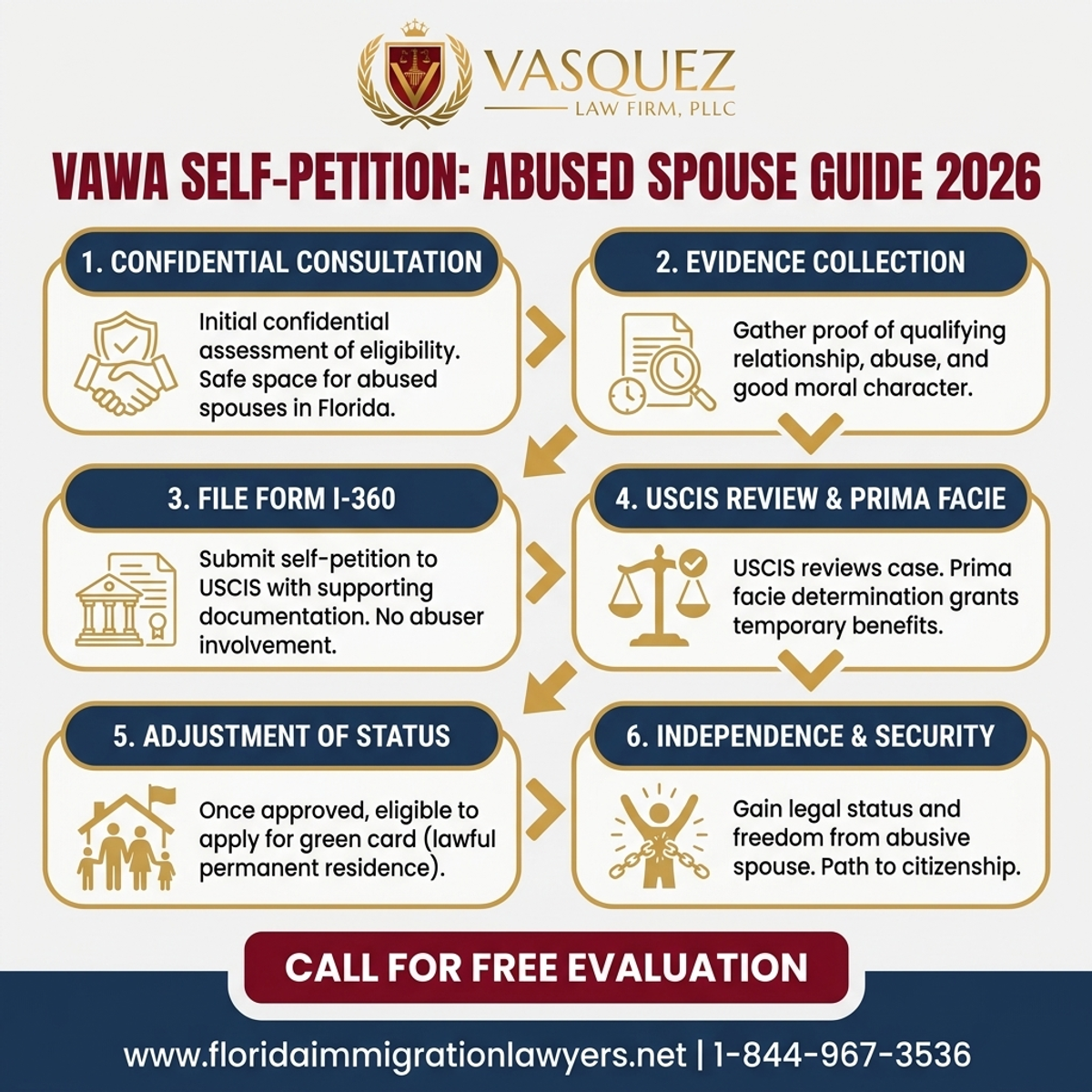
Step-by-Step Process — VAWA Self-Petition in Florida: Abused Spouse Guide 2026
Essential Documents for Your VAWA I-360 Application
A strong VAWA self-petition hinges on compelling evidence. Gathering the right documents is paramount for abused spouses in Florida seeking protection. This checklist outlines the types of evidence generally required to support your I-360 petition:
- Proof of Relationship: Marriage certificate (if applicable), birth certificates of children born of the marriage, joint tax returns, joint bank statements, joint utility bills, joint leases or mortgages.
- Proof of Abuser's Status: Copy of abuser's U.S. birth certificate, naturalization certificate, U.S. passport, or Green Card (Form I-551).
- Proof of Cohabitation: Joint leases, utility bills, mail addressed to both parties at the same address, affidavits from neighbors or landlords.
- Evidence of Battery or Extreme Cruelty:
- Your detailed personal declaration (affidavit) describing the abuse. This is often the most critical piece of evidence.
- Police reports, arrest records, court orders (e.g., restraining orders, protection orders) related to domestic violence.
- Medical records, hospital reports, or photographs documenting injuries.
- Letters or reports from doctors, therapists, counselors, social workers, or domestic violence shelter staff.
- Affidavits from witnesses who observed the abuse or its effects (friends, family, clergy, teachers).
- Evidence of controlling behavior, financial abuse, threats, or isolation (e.g., emails, text messages, voicemails).
- School records or psychological evaluations for children affected by the abuse.
- Proof of Good Faith Marriage: Photographs together, wedding invitations, joint travel itineraries, shared holiday cards, affidavits from people who knew you as a couple. This is to demonstrate the marriage was not solely for immigration purposes.
- Proof of Good Moral Character:
- Your personal declaration affirming good moral character.
- Criminal background checks (FBI identity history summary, local police clearances).
- Affidavits from employers, community leaders, or religious figures attesting to your character.
- Evidence of community involvement or volunteer work.
- Other Supporting Documents: Your birth certificate, passport copies, previous immigration documents (I-94, visa stamps), and any relevant court documents (divorce decrees, custody orders).
Organizing these documents thoroughly is crucial. Missing or incomplete evidence is a common reason for delays or denials. Our Florida immigration lawyers can help you meticulously compile and present your evidence in a compelling manner to USCIS, understanding the specific requirements for applicants in areas like Homestead and surrounding Florida communities.
Navigating the VAWA Processing Timeline and Costs in 2026
The journey through a VAWA self-petition in Florida involves understanding both the timeframes and financial commitments. Processing times for Form I-360 can vary significantly based on USCIS caseloads and the complexity of individual cases. In 2026, petitioners can generally expect the initial I-360 processing to take anywhere from 18 to 30 months from the date of filing. This estimate does not include potential delays caused by Requests for Evidence (RFEs) or the subsequent adjustment of status application. It is important to remember that these are national averages, and while your case is processed at the Vermont Service Center, the impact of national policies and resource allocation can affect all applicants, including those in Florida. For the most current processing times, always check the USCIS website's processing times page.
Upon approval of the I-360, the next step for many is to apply for adjustment of status (Form I-485) to obtain a Green Card. This can be filed concurrently with the I-360 if an immigrant visa number is immediately available (which is typically the case for VAWA petitioners as they are considered "immediate relatives" or are exempt from quotas). Adjustment of status adds another layer of processing, usually taking 6-12 months. During this period, you may be eligible to apply for an Employment Authorization Document (EAD) and advance parole, allowing you to work and travel while your Green Card application is pending.
Regarding costs, the good news for VAWA petitioners is that there is generally no filing fee for Form I-360. This waiver of fees is a critical protection for survivors who may have limited financial resources due to the abuse. However, there are fees associated with the subsequent adjustment of status application (Form I-485), the biometrics service fee, and potentially fees for an Employment Authorization Document (EAD) and Advance Parole. These fees are subject to change, so it is crucial to consult the official USCIS fee schedule at the time of filing. Beyond government fees, petitioners should also consider legal fees for an experienced immigration attorney. While not mandatory, legal representation significantly increases the likelihood of success, especially in complex cases involving detailed evidence and legal arguments. Florida Immigration Lawyers offers free consultations to help you understand the potential costs and navigate the entire process efficiently. We are committed to providing transparent and compassionate service to individuals in Homestead and across Florida.
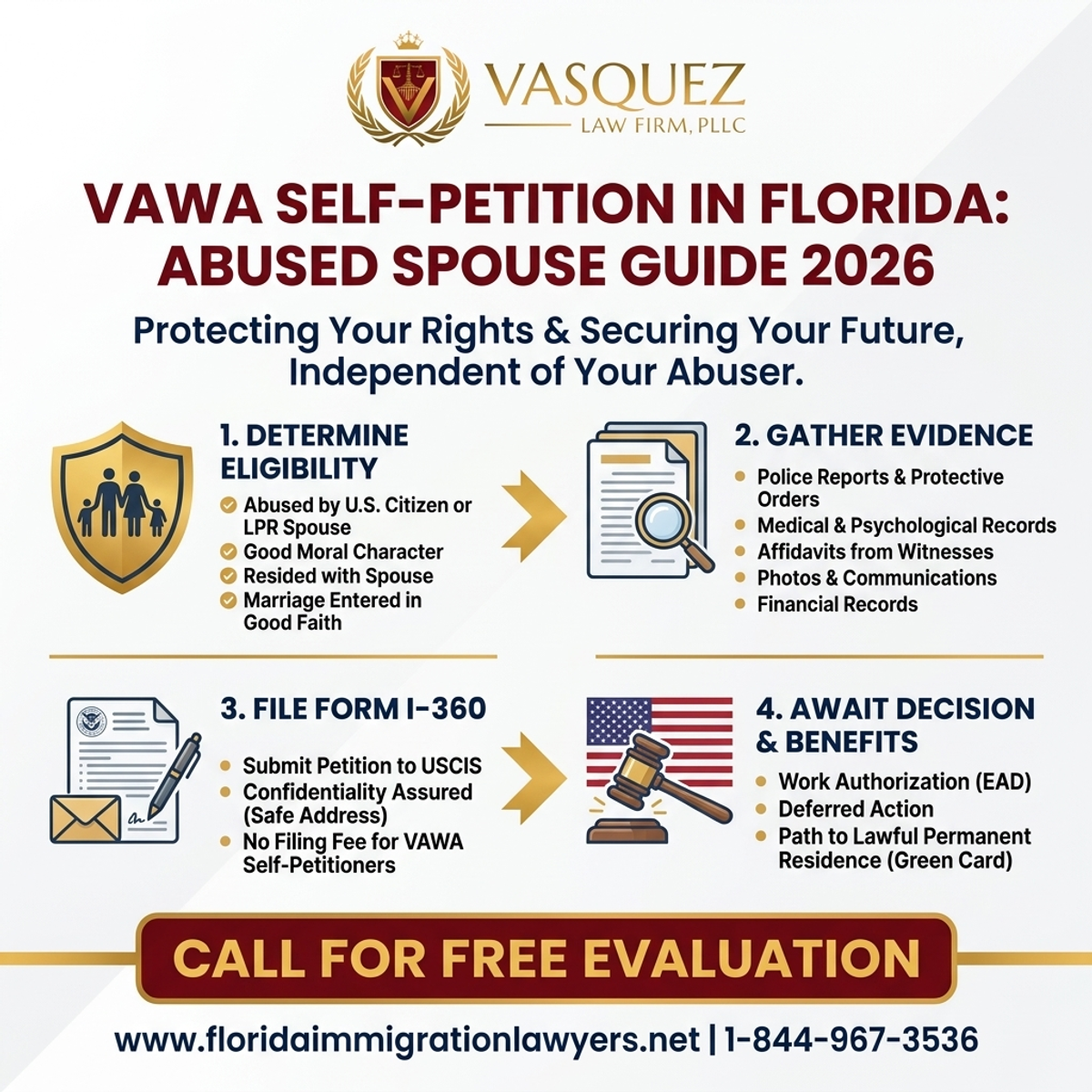
Key Statistics — VAWA Self-Petition in Florida: Abused Spouse Guide 2026
Do not navigate this complex and sensitive process alone. The stakes are too high, and your future depends on presenting a strong, well-documented case. Contact Florida Immigration Lawyers today at 1-844-967-3536 for a confidential, free consultation. Our experienced team is ready to help abused spouses in Florida secure their safety and legal status.
Protecting Your Rights: VAWA and Deportation Defense in Florida
For many abused non-citizens in Florida, the threat of deportation is a constant fear, often wielded by abusers to maintain control. The VAWA self-petition offers significant protections against removal, particularly for those who are already in deportation proceedings. If you are an abused spouse facing removal in an immigration court in Florida, such as the Miami Immigration Court or Orlando Immigration Court, filing an I-360 VAWA petition can be a critical defense strategy. Once a VAWA petition is filed, USCIS notifies the Executive Office for Immigration Review (EOIR), and the immigration judge may administratively close or continue your removal proceedings while your I-360 is pending. This allows you to pursue your humanitarian relief without the immediate pressure of deportation. More information can be found on the EOIR website.
VAWA relief is designed to protect survivors, ensuring they are not penalized for the actions of their abuser. Even if you have a prior order of deportation or removal, or if you entered the U.S. without inspection, VAWA may still provide a pathway to status. Certain grounds of inadmissibility, such as those related to entry without inspection or public charge, can be waived for VAWA self-petitioners under INA 204(a)(1)(B)(v). This is a powerful aspect of the law, recognizing the unique circumstances of domestic violence survivors. Our Florida Immigration Lawyers specialize in both VAWA petitions and deportation defense, offering a comprehensive approach to protect your rights. We understand the interplay between these legal areas and can effectively represent you before both USCIS and the immigration courts throughout Florida, including for those in Homestead. Do not let fear of deportation keep you from seeking the help you deserve.
Life After VAWA: Adjusting Status and Path to Green Card
An approved VAWA I-360 self-petition is a monumental step, but it is typically not the final one in obtaining permanent legal status. For most abused spouses in Florida, the next phase involves adjusting status to become a Lawful Permanent Resident (Green Card holder). As a VAWA approved self-petitioner, you are generally eligible to apply for adjustment of status within the United States using Form I-485, Application to Register Permanent Residence or Adjust Status, provided you meet all other eligibility requirements. This includes being physically present in the U.S. at the time of filing the I-485.
One of the significant advantages for VAWA beneficiaries is that they are considered "immediate relatives" for visa availability purposes, meaning there is no visa quota backlog. This allows for concurrent filing of Form I-360 and Form I-485 in many cases, or filing the I-485 immediately after I-360 approval. During the I-485 processing, you will likely attend a Green Card interview at a local USCIS field office in Florida, such as the Miami Field Office or Orlando Field Office. Here, an officer will review your application, verify your identity, and ask questions to ensure you remain eligible for a Green Card. Our attorneys at Florida Immigration Lawyers will meticulously prepare you for this interview, ensuring you understand what to expect and can confidently answer questions.
Upon approval of your I-485, you will receive your Green Card, officially granting you Lawful Permanent Resident status. This card is usually valid for 10 years and can be renewed. After a period of typically three years as a Green Card holder (for VAWA spouses), you may then become eligible to apply for U.S. citizenship through naturalization, further solidifying your future in Florida. This entire process, from the initial VAWA filing to naturalization, represents a complete journey to safety, independence, and full integration into American society. Our firm is dedicated to supporting you through every stage, ensuring you achieve the stability and peace of mind you deserve.
Navigating the VAWA self-petition process can be complex. Avoiding common pitfalls is crucial for a successful outcome for abused spouses in Florida:
- Failing to Gather Sufficient Evidence: Many petitioners underestimate the volume and type of evidence required. Without comprehensive proof of abuse, good faith marriage, and cohabitation, USCIS may deny the petition. This often includes not providing a detailed personal declaration or corroborating affidavits.
- Delaying the Application: Waiting too long can complicate your case, especially if your abuser's status changes, or if you divorce more than two years prior to filing. Memories fade, and evidence can become harder to obtain over time.
- Not Disclosing All Relevant Information: Hiding criminal history (even minor offenses) or previous immigration violations, even if seemingly insignificant, can lead to a denial for lack of good moral character or misrepresentation. Transparency is key.
- Inaccurate or Inconsistent Information: Discrepancies between your application forms, personal declaration, and supporting documents can raise red flags with USCIS, leading to RFEs or denials. Ensure all dates, names, and facts are consistent.
- Not Understanding "Extreme Cruelty" Broadly: Focusing only on physical abuse and neglecting to document psychological, emotional, financial, or sexual abuse can weaken your case. USCIS recognizes a wide spectrum of abusive behaviors.
- Filing Without Legal Counsel: While not legally required, attempting to self-file a VAWA petition without an experienced attorney often results in errors, omissions, and ultimately, denial. An attorney ensures proper documentation and legal arguments.
- Failing to Respond to RFEs Promptly and Thoroughly: If USCIS requests additional evidence, a late or incomplete response is a common reason for denial. Understanding exactly what is needed and providing it within the deadline is critical.
- Not Maintaining Confidentiality: Discussing your VAWA petition with your abuser or anyone who might inform them could jeopardize your safety and potentially the petition itself. VAWA is designed to be confidential.
When to Call a Lawyer
You should contact an experienced immigration lawyer from Florida Immigration Lawyers immediately if you are an abused spouse considering a VAWA self-petition in Florida. The process is highly complex and emotionally challenging, and navigating it alone can be overwhelming. You absolutely need legal assistance if you are currently in removal proceedings or have a prior deportation order, as VAWA can be a powerful defense. If you have any criminal history, even minor offenses, legal counsel is essential to determine its impact on your good moral character. Furthermore, if your abuser is denying your status, threatening you with deportation, or you lack significant documentation, an attorney can help strategize and gather alternative forms of evidence. Our firm provides compassionate and confidential support, ensuring your rights are protected throughout the entire process, from filing the I-360 to securing your Green Card. Do not risk your future; call us for a free consultation.
About Florida Immigration Lawyers
Florida Immigration Lawyers is a leading law firm dedicated to providing comprehensive and compassionate immigration legal services across the entire state of Florida. With offices serving diverse communities from Homestead to Jacksonville, our experienced attorneys understand the unique challenges faced by immigrants, especially those in vulnerable situations. We specialize in a wide range of immigration matters, including VAWA self-petitions, asylum, deportation defense, family-based immigration, citizenship, and business immigration. Our mission is to protect your rights, provide clear guidance, and achieve the best possible outcomes for your case. We pride ourselves on our client-centered approach, offering personalized attention and strategic legal solutions. We are available 24/7 and offer free, confidential consultations to help you understand your options and take the first step towards a more secure future. Contact us today at 1-844-967-3536 or visit our website at floridaimmigrationlawyers.net.
Sources and References
- U.S. Citizenship and Immigration Services (USCIS) - Violence Against Women Act (VAWA)
- U.S. Citizenship and Immigration Services (USCIS) - Check Processing Times
- Executive Office for Immigration Review (EOIR)
- 8 U.S.C. § 1154 (INA 204) - Procedure for granting immigrant status
- 8 CFR § 204.2(c) - Petitions for spouses, children, or parents of U.S. citizens or lawful permanent residents
- Violence Against Women Act (VAWA) of 1994, Public Law 103-322
Related services: family petition process, family-based green cards, fiancé visa (K-1), marriage-based immigration.
This article provides general legal information and is not intended as legal advice. Every case is unique, and outcomes depend on specific facts and circumstances. Contact an attorney for advice about your particular situation. Immigration laws are subject to change.
If you are an abused spouse in Florida seeking protection and a pathway to legal status through a VAWA self-petition, do not hesitate to reach out. Your safety and future matter. Call Florida Immigration Lawyers now for a free, confidential consultation at 1-844-967-3536. Se Habla Español - Estamos aquí para ayudarle.
Do Not Navigate This Process Alone
Our experienced immigration attorneys are ready to fight for you. Get a free, confidential consultation today.
Se Habla Español
Or leave your details and we’ll call you:
Free Evaluation in 24 Hours
Or talk to us right now

AI voice assistant — available 24/7
FreeFrequently Asked Questions

William J. Vásquez
Founding Attorney · Vasquez Law Firm
U.S. Air Force veteran and immigration attorney with years of hands-on U.S. immigration experience. J.D., NCCU School of Law. AILA member. Admitted to the 4th, 5th, and 11th Circuit Courts.
Available 24/7 - Free Evaluations
Reviewed for legal accuracy by William J. Vásquez
Licensed in North Carolina; U.S. immigration is federal practice.
Related Legal Services
Our Florida immigration attorneys can help you with experienced immigration attorneys, business immigration and asylum protection. Call today at 1-844-967-3536 for a free consultation.
Related Links
Related Topics
Free Legal Consultation
Discuss your case with our experienced attorneys. We're available 24/7.
Se Habla Español - Estamos aquí para ayudarle.
Related Articles
Military Naturalization Expedited in Florida Bases
Explore military naturalization options for families at Florida bases, including parole in place benefits in Miami. Learn how to expedite your application with expert guidance from Florida Immigration Lawyers.
Immigration Lawyer Orlando Free Consultation 2026
Discover how to find an immigration lawyer in Orlando offering a free consultation. Understand the services available and why choosing Florida Immigration Lawyers can make a difference in your case.
We Just Received an RFE: Alternatives for Gainesville,
Receiving a Request for Evidence (RFE) can be overwhelming, especially if your current legal firm isn't responsive. Learn how to navigate this process in Gainesville, Florida, and discover alternatives to ensure your immigration journey stays on track. Contact Florida Immigration Lawyers for expert guidance.
Dual Citizenship Lawyer: Florida Naturalization Interview
Achieving U.S. citizenship is a life-changing goal for many Florida residents, with the naturalization interview standing as a crucial hurdle. This comprehensive guide, crafted with insights from experienced dual citizenship lawyers, provides essential tips to prepare for your USCIS interview in 2026. Learn how to meticulously review your N-400 application, master the civics and English tests, and organize all necessary documentation. We delve into typical processing timelines, common mistakes to avoid, and the specific scenarios where a skilled immigration attorney can be indispensable, particularly for those navigating the complexities of dual nationality. Florida Immigration Lawyers offers dedicated support, ensuring you are fully prepared for every aspect of your interview and can confidently pursue your American dream.