Dual Citizenship Lawyer: Florida Naturalization Interview
Achieving U.S. citizenship is a life-changing goal for many Florida residents, with the naturalization interview standing as a crucial hurdle. This comprehensive guide, crafted with insights from experienced dual citizenship lawyers, provides essential tips to prepare for your USCIS interview in 2026. Learn how to meticulously review your N-400 application, master the civics and English tests, and organize all necessary documentation. We delve into typical processing timelines, common mistakes to avoid, and the specific scenarios where a skilled immigration attorney can be indispensable, particularly for those navigating the complexities of dual nationality. Florida Immigration Lawyers offers dedicated support, ensuring you are fully prepared for every aspect of your interview and can confidently pursue your American dream.

Navigating the naturalization interview is a critical step towards U.S. citizenship, and a dual citizenship lawyer can provide invaluable assistance. These legal professionals offer expert guidance, from meticulously preparing your N-400 application to conducting mock interviews and ensuring all documentation is in order. They also provide crucial advice on the implications of becoming a U.S. citizen for your existing nationality, helping you understand how naturalization might affect your dual citizenship status. Their expertise ensures you are well-prepared to confidently answer questions about your eligibility, English proficiency, and civic knowledge at your Florida USCIS interview.
- Comprehensive N-400 application review and preparation.
- Detailed coaching and mock interviews for confidence.
- Expert advice on required documents and evidence.
- Guidance on potential dual nationality implications post-naturalization.
- Representation and advocacy for complex cases or challenges.
For many residents across Florida, the dream of becoming a U.S. citizen represents the culmination of years of hard work, dedication, and integration into American society. The naturalization process, while rewarding, involves several intricate steps, with the citizenship interview being one of the most pivotal. This interview, conducted by a U.S. Citizenship and Immigration Services (USCIS) officer, determines your eligibility, English language proficiency, and knowledge of U.S. history and government.
Understanding the nuances of the interview, knowing what to expect, and preparing diligently are essential for a successful outcome. This comprehensive guide will walk you through critical tips for your naturalization interview in Florida, drawing on insights often provided by experienced immigration attorneys, including those who specialize in complex citizenship matters like dual nationality. We will cover everything from document preparation to common pitfalls, ensuring you are well-equipped for this significant milestone. Do not navigate this complex journey alone. For personalized guidance and expert support, call Florida Immigration Lawyers at 1-844-967-3536 for a free consultation today.
What is the Naturalization Interview and Why is it Crucial in Florida?
The naturalization interview is a mandatory step in becoming a U.S. citizen, assessing eligibility, English proficiency, and civic knowledge. In Florida, it's conducted by USCIS officers at local field offices, such as those serving St. Petersburg, Tampa, Orlando, and Miami, where your application is reviewed in detail. This interview is your opportunity to demonstrate your commitment to the United States and your understanding of its principles.
The interview serves multiple purposes. First, the USCIS officer will verify the information provided in your Form N-400, Application for Naturalization, ensuring accuracy and completeness. They will ask questions about your personal history, family, employment, travel, and any interactions with law enforcement, all based on the answers you submitted. Second, you will undergo an English language test, which includes reading, writing, and speaking components. Lastly, you will take a civics test, answering questions about U.S. history, government, and geography. Successfully passing these components is vital for your naturalization approval, making thorough preparation absolutely essential.
For individuals in Florida, where diverse communities thrive, understanding the local USCIS office procedures and expectations can be particularly helpful. USCIS field offices in cities like Tampa and Miami handle a significant volume of naturalization applications, each with their own scheduling and interview tendencies. An immigration attorney familiar with these local nuances can provide tailored advice, helping you anticipate potential questions or areas of scrutiny specific to your application and the interviewing officer's approach. Furthermore, for those considering U.S. citizenship while retaining their original nationality, a dual citizenship lawyer can advise on how this process interacts with the laws of both countries, ensuring no unforeseen complications arise.
How Do I Prepare for My USCIS Citizenship Interview in 2026?
Effective preparation for your USCIS citizenship interview in 2026 involves reviewing your N-400 application, studying U.S. history and government, practicing English, and organizing all required documents for your Florida interview appointment. This multi-faceted approach ensures you are ready for every aspect of the examination.
Preparing for your naturalization interview requires a strategic and diligent approach. As of 2026, USCIS emphasizes thoroughness and accuracy in all applications and interviews. Here’s a step-by-step guide to help you prepare effectively:
- Review Your Form N-400 Application Thoroughly: Go over every single question and answer on your N-400. The interviewing officer will primarily use this document to ask you questions. Ensure you remember all the details, dates, and responses you provided. If anything has changed since you filed your application, gather documentation to support these changes and be prepared to explain them clearly.
- Study for the Civics Test: USCIS provides 100 civics questions and answers. You will be asked up to 10 questions, and you must answer at least 6 correctly to pass. Dedicate time to memorize these facts about U.S. history, government, and geography. Many online resources and study guides are available, including those specific to Florida residents, to help you prepare.
- Practice Your English Language Skills: The English test has three parts: speaking, reading, and writing. The speaking test is assessed during your interview as the officer asks you questions. For the reading test, you must read one out of three sentences correctly. For the writing test, you must write one out of three sentences correctly. Practice reading and writing simple English sentences, and engage in conversations to improve your speaking fluency.
- Gather All Required Documents: Create a checklist of all original documents and copies you need to bring. This includes your Green Card, passports, state ID, and any supporting documents related to your N-400 answers. Having everything organized will demonstrate your preparedness and can expedite the interview process.
- Understand the Oath of Allegiance: Familiarize yourself with the Oath of Allegiance, as you will be required to take it if your application is approved. Understand its meaning and significance, as it is the final step in becoming a U.S. citizen.
- Consider a Mock Interview with a Lawyer: An immigration attorney, particularly one experienced with immigration law in Florida, can conduct a mock interview. This practice session can significantly boost your confidence, identify areas needing improvement, and help you anticipate difficult questions. They can also ensure you clearly articulate your answers and present your case effectively.
What Documents Should I Bring to My Naturalization Interview?
You should bring your appointment notice, Green Card, passport, state ID, all original documents submitted with your N-400, and any updated information or documents related to your application to your naturalization interview. Having these items organized and readily accessible is crucial for a smooth interview process, especially at busy Florida USCIS offices.
Proper documentation is paramount for your naturalization interview. The USCIS officer needs to verify your identity and the information in your N-400 application. Failing to bring necessary documents can lead to delays, Requests for Evidence (RFEs), or even a denial. Here is a comprehensive checklist of documents you should prepare:
- Interview Appointment Notice (Form N-400, Interview Notice): This is your official invitation to the interview and contains crucial details like the date, time, and location of your appointment.
- Permanent Resident Card (Green Card): Your original Green Card is essential for identity verification and proof of your lawful permanent resident status.
- State-Issued Identification: Bring your valid driver's license or state ID card issued in Florida.
- Passports and Travel Documents: All valid and expired passports, including your current foreign passport and any travel documents like re-entry permits. The officer will review your travel history, especially any trips outside the U.S. that were 6 months or longer.
- N-400 Application Copy: A copy of your filed N-400 application and any supporting documents you submitted. This will help you follow along with the officer's questions.
- Marriage Certificate(s): If you are applying based on marriage to a U.S. citizen, or if your marital status has changed, bring original marriage certificates and any divorce decrees or death certificates for previous spouses.
- Birth Certificates of Children: If you have children, bring their original birth certificates, whether they are U.S. citizens or not.
- Tax Returns: Provide copies of your federal income tax returns for the past five years (or three years if applying based on marriage to a U.S. citizen). This helps demonstrate good moral character and financial stability.
- Selective Service Registration (for males aged 18-26): If you are a male who resided in the U.S. between the ages of 18 and 26, you must provide proof of Selective Service registration.
- Court Dispositions and Police Records: If you have ever been arrested, charged, or convicted of any crime, bring certified court dispositions, police reports, and any other relevant legal documents, even if the case was dismissed or expunged. This is critical for demonstrating good moral character, as required by 8 U.S.C. § 1427.
- Proof of Residence in Florida: Utility bills, lease agreements, or property deeds showing your continuous residence in Florida, especially if you have moved within the state or from another state.
- Child Support/Alimony Orders: If applicable, bring evidence of payment of child support or alimony.
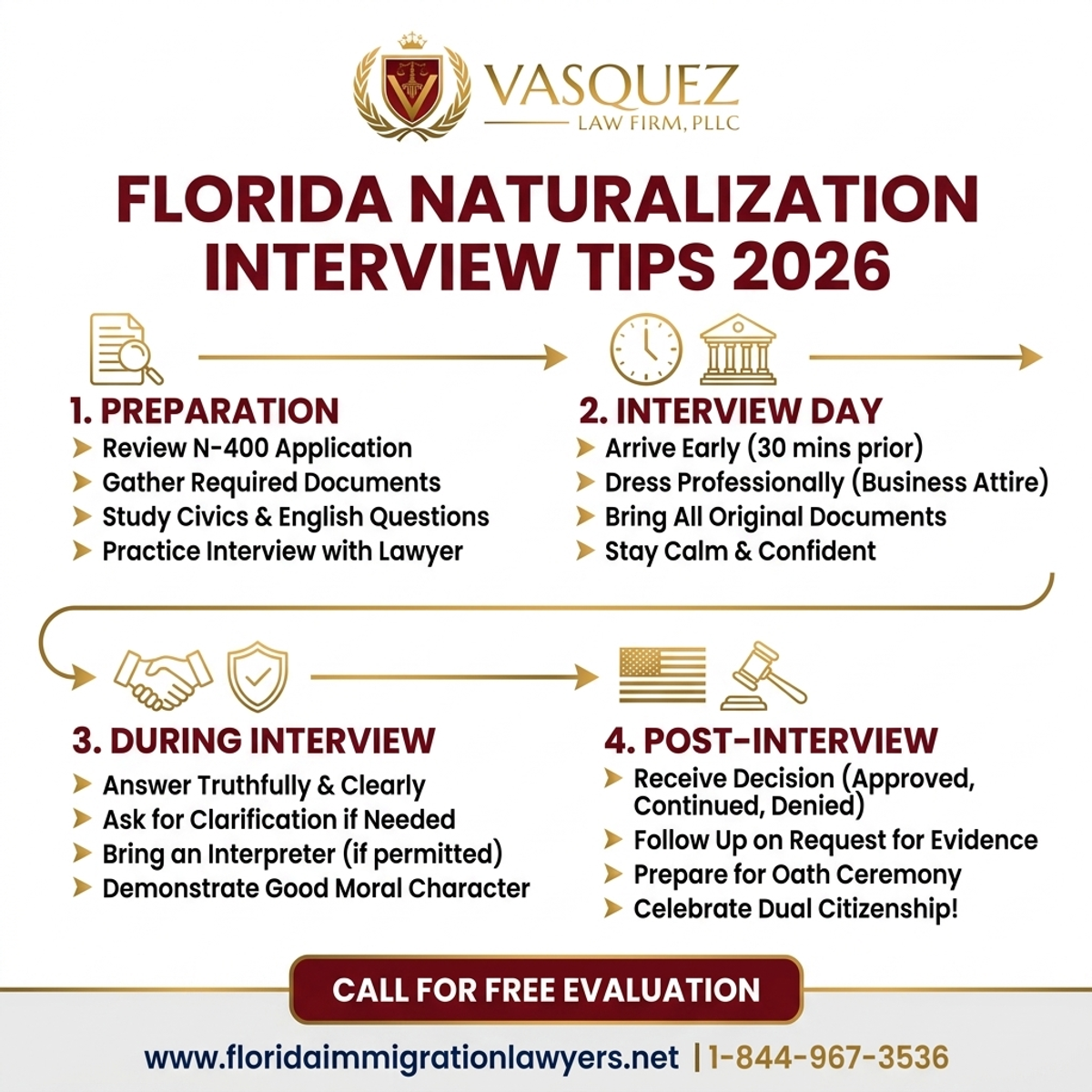
Step-by-Step Process — Dual Citizenship Lawyer: Florida Naturalization Interview Tips 2026
Always bring the originals of all documents, even if you submitted copies with your N-400. It is also wise to bring a complete set of photocopies, just in case the officer needs them. An immigration attorney can help you compile this crucial documentation and ensure nothing is overlooked, preventing potential delays in your naturalization application process.
What is the Typical Timeline for Naturalization in Florida as of 2026?
As of 2026, the typical naturalization process in Florida can take anywhere from 8 to 18 months, varying based on the USCIS field office workload, application complexity, and individual circumstances, following the submission of Form N-400. This timeframe includes all stages from filing to the Oath of Allegiance ceremony.
Understanding the processing timeline for naturalization is important for managing expectations. While USCIS strives for efficiency, various factors can influence how long your application takes, including the specific USCIS field office handling your case (e.g., Tampa, Orlando, Miami, Jacksonville), the volume of applications, and any complexities in your personal history that might require additional review. Here is a general breakdown of the stages and typical timeframes as of 2026:
| Stage | Typical Timeframe (As of 2026) | Notes |
|---|---|---|
| N-400 Filing and Receipt | 1-2 weeks | USCIS sends Form I-797C, Notice of Action, confirming receipt. |
| Biometrics Appointment | 3-5 weeks after filing | Fingerprints, photos, and signature are taken for background checks. |
| Interview Scheduling | 2-10 months after biometrics | Varies significantly by USCIS field office and caseload. Check USCIS processing times for specific Florida offices. |
| Naturalization Interview | N/A (single day event) | The crucial step where eligibility, English, and civics are assessed. |
| Decision on Application | Same day to 120 days after interview | Can be immediate (approved/denied) or delayed for further review (N-14 notice or RFE). |
| Oath of Allegiance Ceremony | 1-6 weeks after approval | The final step to becoming a U.S. citizen; can be administrative or judicial. |
It's important to note that these are averages. Some cases may be processed faster, while others, particularly those with complex issues such as criminal history, extended absences from the U.S., or previous immigration violations, may take longer. Delays can also occur if USCIS issues a Request for Evidence (RFE) or a Notice of Intent to Deny (NOID). Staying informed about your case status through the USCIS online tool is advisable. A seasoned immigration lawyer can help you track your application, respond to any requests from USCIS promptly, and advocate on your behalf to minimize delays.
How Can a Dual Citizenship Lawyer Help with My Naturalization Process?
A dual citizenship lawyer provides comprehensive legal guidance for your naturalization, from N-400 preparation and interview coaching to addressing complex eligibility issues or potential dual nationality implications, ensuring a smoother path to U.S. citizenship. Their expertise is particularly valuable for applicants in Florida who may have intricate international ties.
While the naturalization process can seem straightforward for some, many applicants encounter complexities that require expert legal intervention. This is where a dedicated immigration attorney, often referred to as a dual citizenship lawyer due to their expertise in navigating multi-national legal frameworks, becomes an invaluable asset. Here’s how they can assist you:
- Thorough N-400 Application Preparation: An attorney will meticulously review your N-400 application, ensuring all questions are answered accurately and completely, minimizing the risk of RFEs or denials. They will help you gather all necessary supporting documents and organize them according to USCIS requirements.
- Expert Interview Preparation and Mock Sessions: One of the most significant benefits is personalized interview coaching. Your lawyer will conduct mock interviews, simulating the actual USCIS experience. This helps you practice answering questions confidently, understand the civics and English tests, and learn how to present your case clearly. They can also advise on appropriate demeanor and communication strategies.
- Addressing Complex Eligibility Issues: If you have a criminal record, a history of long absences from the U.S., issues with Selective Service registration, or other factors that could raise questions about your good moral character or continuous residence, a lawyer can assess the situation, prepare necessary waivers or explanations, and present your case effectively to USCIS.
- Guidance on Dual Nationality Implications: For many, becoming a U.S. citizen does not mean renouncing their original citizenship. A dual citizenship lawyer can provide crucial advice on the laws of both the U.S. and your home country regarding dual nationality. They help you understand how U.S. naturalization might affect your existing citizenship status and any potential responsibilities or benefits, ensuring you make informed decisions. This is particularly relevant given the complexities often seen at the State Department's guidance on dual nationality.
- Responding to RFEs and NOIDs: If USCIS requests additional evidence or issues a notice of intent to deny, your lawyer can help you formulate a comprehensive and timely response, preventing adverse decisions.
- Representation at the Interview: While typically not permitted inside the interview room unless specifically requested by USCIS or in certain circumstances, your attorney can accompany you to the USCIS field office in Florida (e.g., St. Petersburg, Tampa) and be available immediately outside to provide support and advice if any issues arise.
- Post-Interview Follow-up: If there are delays in your decision or other post-interview issues, your lawyer can follow up with USCIS on your behalf, advocating for a timely resolution.
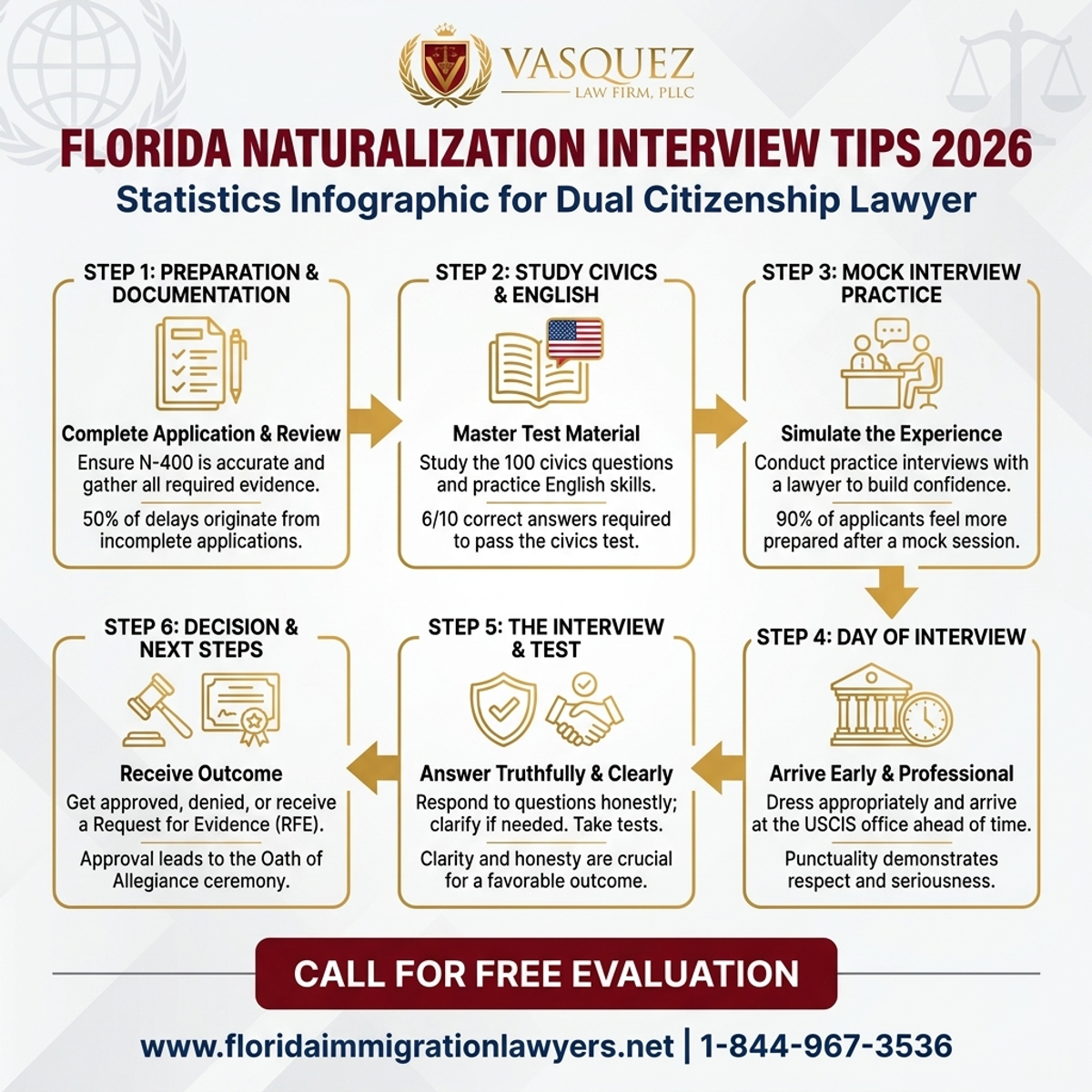
Key Statistics — Dual Citizenship Lawyer: Florida Naturalization Interview Tips 2026
By securing the services of Florida Immigration Lawyers, you gain a dedicated advocate who understands the intricacies of naturalization and dual citizenship law. We are committed to protecting your rights and guiding you through every step of this important process, helping you achieve your American dream.
Do not navigate this process alone. Contact Florida Immigration Lawyers today at 1-844-967-3536 for a free consultation and ensure your naturalization journey is successful.
Common Mistakes to Avoid During Your Naturalization Interview
The naturalization interview is a high-stakes event, and even minor errors can lead to delays or denial. Being aware of common mistakes can help you avoid them and increase your chances of success.
- Lying or Providing Inconsistent Information: Any false statements or inconsistencies with your N-400 application, immigration records, or answers during the interview can lead to a denial, and in severe cases, even allegations of misrepresentation or fraud. Honesty is always the best policy, even if it means disclosing potentially problematic information that your attorney can help you explain.
- Failing to Disclose Arrests or Criminal History: Many applicants mistakenly believe that minor offenses, expunged records, or incidents that occurred long ago do not need to be disclosed. USCIS has access to extensive databases, including FBI records. Failing to disclose any arrest, citation, or conviction, no matter how minor or old, is a serious misrepresentation and can result in denial under INA Section 316.
- Poor English Proficiency: While the English test is basic, some applicants underestimate it. Inability to understand the officer's questions, read a simple sentence, or write a basic sentence can lead to failure of the English portion and a rescheduled interview.
- Not Studying for the Civics Test: Relying on general knowledge is risky. You must study the 100 civics questions provided by USCIS. Failing to answer 6 out of 10 questions correctly will result in a failed civics test and a rescheduled interview.
- Not Bringing All Required Documents: Forgetting your Green Card, passports, tax returns, or other crucial documents can cause significant delays, requiring you to mail in additional evidence or reschedule your interview. Always bring originals and copies of everything.
- Missing Your Appointment: Failing to appear for your scheduled interview without proper notification to USCIS can lead to your application being considered abandoned and subsequently denied. Always check your appointment notice and plan to arrive early.
- Failing to Update Your Address: If you move after filing your N-400, you must update your address with USCIS immediately using Form AR-11. Failure to do so can result in missed notices, including your interview appointment, leading to application abandonment.
- Not Demonstrating Good Moral Character: Good moral character is a fundamental requirement (8 CFR Part 316.10). Certain actions, like failure to pay taxes, child support, or engaging in certain criminal acts, can be grounds for denial. Your attorney can help you address these issues proactively.
- Lack of Continuous Residence: Extended trips outside the U.S. (typically six months or more) can break your continuous residence requirement. Be prepared to explain all absences and provide supporting documentation.
When to Call a Dual Citizenship Lawyer for Your Naturalization Interview
While some naturalization cases are straightforward, many situations warrant the expertise of a seasoned dual citizenship lawyer. Consulting with Florida Immigration Lawyers can make a significant difference in the outcome of your application, especially when facing complexities or uncertainties.
You should strongly consider calling an attorney if:
- You have any criminal history: Even minor arrests, charges, or convictions, regardless of the outcome, can impact your good moral character determination. An attorney can advise on disclosure requirements, potential waivers, and how to present your case.
- You have previous immigration violations or denials: Past issues with visas, green card applications, or prior naturalization attempts can complicate your current application.
- You have concerns about dual nationality: If you wish to retain your original citizenship or are unsure how naturalization will affect it, a dual citizenship lawyer can provide crucial legal advice based on U.S. and foreign laws.
- You have taken long trips outside the U.S.: Extended absences can affect your continuous residence or physical presence requirements. An attorney can help you document your intent and eligibility.
- You received a Request for Evidence (RFE) or Notice of Intent to Deny (NOID): These notices indicate that USCIS has concerns about your application. An attorney can help you craft a comprehensive and persuasive response.
- You have significant language barriers: While the English test is part of the interview, an attorney can ensure you understand all legal questions and processes, and in specific medical circumstances, might help secure an interpreter.
- You feel overwhelmed or unsure about the process: The naturalization process can be stressful. Having a legal expert guide you provides peace of mind and increases your chances of success.
Florida Immigration Lawyers has extensive experience with naturalization cases throughout Florida, including those with complex legal challenges. We are here to provide the strategic advice and representation you need.
About Florida Immigration Lawyers
Florida Immigration Lawyers is a leading immigration law firm dedicated to serving individuals and families across the entire state of Florida. With a deep understanding of U.S. immigration laws and a compassionate approach, we provide comprehensive legal services designed to help you achieve your immigration goals, including U.S. citizenship. Our team of experienced attorneys is committed to offering personalized, effective, and ethical representation.
We specialize in a wide range of immigration matters, from family-based petitions and business immigration to asylum claims and deportation defense. Our firm prides itself on its accessibility, offering free consultations and being available 24/7 to address your urgent legal needs. We understand that every case is unique, and we tailor our strategies to the specific circumstances of each client. Choose Florida Immigration Lawyers for unparalleled dedication and expertise in navigating the complexities of immigration law. Call us at 1-844-967-3536 or visit our website at https://www.floridaimmigrationlawyers.net to learn more about how we can assist you.
Sources and References
- U.S. Citizenship and Immigration Services (USCIS)
- Executive Office for Immigration Review (EOIR)
- U.S. Department of State - Dual Nationality
- 8 U.S.C. Chapter 12 - Immigration and Nationality Act (INA)
- 8 U.S.C. § 1427 - Requirements for Naturalization
- 8 CFR Part 316 - General Requirements for Naturalization
- USCIS Policy Manual, Volume 12, Part D - English and Civics Testing
Related services: citizenship test preparation, dual citizenship guidance, family-based immigration.
This article provides general legal information and is not intended as legal advice. Every case is unique, and outcomes depend on specific facts and circumstances. Contact an attorney for advice about your particular situation.
Preparing for your naturalization interview is a critical step toward achieving U.S. citizenship. With the right preparation and legal guidance, you can approach this milestone with confidence. Do not leave your future to chance. Contact Florida Immigration Lawyers for a free consultation today at 1-844-967-3536. Se Habla Espanol - Estamos aqui para ayudarle.
Do Not Navigate This Process Alone
Our experienced immigration attorneys are ready to fight for you. Get a free, confidential consultation today.
Se Habla Español
Or leave your details and we’ll call you:
Free Evaluation in 24 Hours
Or talk to us right now
AI voice assistant — available 24/7
FreeFrequently Asked Questions

William J. Vásquez
Founding Attorney · Vasquez Law Firm
U.S. Air Force veteran and immigration attorney with years of hands-on U.S. immigration experience. J.D., NCCU School of Law. AILA member. Admitted to the 4th, 5th, and 11th Circuit Courts.
Available 24/7 - Free Evaluations
Reviewed for legal accuracy by William J. Vásquez
Licensed in North Carolina; U.S. immigration is federal practice.
Related Legal Services
Our Florida immigration attorneys can help you with business immigration, asylum protection and deportation defense. Call today at 1-844-967-3536 for a free consultation.
Related Links
Related Topics
Free Legal Consultation
Discuss your case with our experienced attorneys. We're available 24/7.
Se Habla Español - Estamos aquí para ayudarle.
Related Articles
Military Naturalization Expedited in Florida Bases
Explore military naturalization options for families at Florida bases, including parole in place benefits in Miami. Learn how to expedite your application with expert guidance from Florida Immigration Lawyers.
Immigration Lawyer Orlando Free Consultation 2026
Discover how to find an immigration lawyer in Orlando offering a free consultation. Understand the services available and why choosing Florida Immigration Lawyers can make a difference in your case.
Immigration Lawyer Orlando Free Consultation: 2026 Policy
As Florida anticipates significant immigration policy changes by 2026, understanding their potential impact is crucial for residents and businesses across the state, from Naples to Orlando. These reforms may include enhanced enforcement, adjustments to visa programs, and shifts in asylum processing. Navigating these new rules requires expert legal guidance to ensure compliance and protect your rights. Florida Immigration Lawyers offers free consultations to help you understand how these changes affect your specific case, whether you're applying for a visa, seeking adjustment of status, or facing a complex legal challenge. Our comprehensive guide covers anticipated timelines, document requirements, and common mistakes to avoid, emphasizing the importance of informed preparation. Don't let uncertainty jeopardize your future; learn how our experienced attorneys can advocate for you.
DUI Immigration Consequences in Florida: What to Know
A DUI conviction in Florida can have significant immigration consequences, including potential inadmissibility and deportation. Learn how to navigate these challenges and protect your rights with guidance from Florida Immigration Lawyers.