VAWA Immigration Relief Florida: Protecting Abuse Victims
Seeking VAWA immigration relief Florida? Our firm helps abuse victims in West Palm Beach and across Florida apply for protection. Learn your options with a free consultation.
VAWA immigration relief Florida allows certain non-citizen abuse victims to self-petition for lawful immigration status without the abuser's help. This protection is available to individuals abused by U.S. citizen or Lawful Permanent Resident spouses, parents, or adult children. It offers a pathway to safety and independence for those facing domestic violence or extreme cruelty.
- VAWA enables self-petitioning for immigration status.
- Victims of abuse by U.S. citizen/LPR family members may qualify.
- Confidentiality and safety are paramount in the process.
- It provides a pathway to a Green Card and independence.
Are you living in fear, experiencing abuse, and worried about your immigration status in Florida? Many non-citizens in West Palm Beach and across the state face a heartbreaking dilemma: seeking safety from violence while fearing deportation or losing their chance at a stable future. You are not alone, and there are legal protections available to help you.
The Violence Against Women Act (VAWA) offers crucial immigration relief for victims of domestic violence and extreme cruelty. This comprehensive guide will explain everything you need to know about VAWA immigration relief Florida, detailing eligibility, the application process, required documents, and how Florida Immigration Lawyers can protect your rights and help you secure a path to safety. Do not suffer in silence; your journey to freedom and legal status can begin today. Call Florida Immigration Lawyers at 1-844-YO-PELEO for a free consultation.
Understanding VAWA Immigration Relief in Florida
The Violence Against Women Act (VAWA) provides a lifeline for non-citizens who have been victims of domestic violence or extreme cruelty. It allows them to "self-petition" for a Green Card without the knowledge or cooperation of their abusive U.S. citizen or Lawful Permanent Resident (LPR) spouse, parent, or adult child. This critical provision was enacted to prevent abusers from controlling their victims through threats related to their immigration status.
For individuals in Florida, including communities like West Palm Beach, VAWA offers a confidential pathway to obtain lawful status. This protection extends beyond just spouses to include children and sometimes parents. The goal is to empower survivors to leave abusive situations without fear of immigration consequences.
Who is Eligible for VAWA Immigration Relief?
Eligibility for VAWA immigration relief Florida is specific. You may be eligible if you are the victim of battery or extreme cruelty committed by:
- A U.S. citizen or LPR spouse or former spouse (if the marriage ended due to abuse within the last two years).
- A U.S. citizen or LPR parent.
- A U.S. citizen adult child (who is at least 21 years old).
You must also demonstrate that you resided with the abuser and are a person of good moral character. The abuse does not always have to be physical; extreme cruelty can encompass psychological, emotional, financial, or sexual abuse.
The VAWA Act in Florida: Key Provisions
In Florida, the VAWA act functions under federal immigration law. This means that the protections and processes are consistent nationwide, including for those residing in West Palm Beach, Miami, Orlando, or Tampa. The core provision is the ability to file Form I-360, Petition for Amerasian, Widow(er), or Special Immigrant, as a VAWA self-petitioner. This form is filed directly with U.S. Citizenship and Immigration Services (USCIS).
Florida immigration courts and USCIS offices are familiar with VAWA cases. The law aims to ensure that victims are not penalized for reporting abuse or seeking help. It acknowledges the unique vulnerabilities faced by non-citizen abuse victims.
Step-by-Step Guide to Filing for VAWA Immigration Relief in Florida
Navigating the VAWA self-petition process can feel overwhelming, but breaking it down into manageable steps can help. Remember, seeking legal guidance from an experienced attorney at Florida Immigration Lawyers is highly recommended. We serve clients throughout Florida, including West Palm Beach.
- Gather Evidence of Abuse and Relationship: Begin collecting all possible evidence. This includes police reports, medical records, affidavits from witnesses, photos, emails, text messages, and your detailed personal declaration. You will also need proof of your relationship to the abuser, such as marriage certificates, birth certificates, or utility bills showing shared residency.
- Prove Good Moral Character: You must demonstrate good moral character for the three years immediately preceding your application. This generally involves providing police clearance certificates from all places you have lived, particularly in the U.S. Any criminal history must be disclosed and may require waivers.
- Prepare and File Form I-360: The core of your application is Form I-360, Petition for Amerasian, Widow(er), or Special Immigrant. This form must be meticulously completed, providing all necessary personal information and details about the abuse. Include your declaration, explaining the abuse and your relationship with the abuser.
- Submit Supporting Documents: Along with Form I-360, you will submit all your gathered evidence. This includes proof of the abuser's U.S. citizenship or LPR status, evidence of the qualifying relationship, proof of cohabitation, and evidence of battery or extreme cruelty. Organize these documents clearly.
- Receive Prima Facie Determination: After filing, USCIS will review your petition. If it appears that you meet the basic eligibility requirements, they may issue a "prima facie" determination. This means your petition is considered "on its face" to be approvable, and it can provide eligibility for certain public benefits in Florida.
- Attend Biometrics Appointment: You will receive a notice to attend a biometrics appointment at a local USCIS Application Support Center. This involves capturing your fingerprints, photograph, and signature for background checks.
- Respond to Requests for Evidence (RFEs): USCIS may send an RFE if they need more information or clarification. Responding thoroughly and promptly is crucial. An attorney can help you understand and address RFEs effectively.
- Possible Interview (VAWA Interviews): While not always required for VAWA self-petitions, USCIS may schedule an interview. If an interview is scheduled, it is vital to be prepared to discuss your case and provide further details. Your attorney can prepare you for this step.
- Decision on I-360 Petition: If your I-360 petition is approved, you will receive an approval notice. This establishes your eligibility for VAWA immigration benefits.
- Adjust Status to Lawful Permanent Resident: Once your I-360 is approved, and if a visa is immediately available (which is often the case for VAWA self-petitioners), you can file Form I-485, Application to Register Permanent Residence or Adjust Status. This is the final step to obtaining your Green Card.
Document Checklist for Your VAWA Immigration Relief Petition
A comprehensive set of documents is essential for a strong VAWA immigration relief Florida application. Missing or incomplete documentation can cause significant delays or even denial.
- Form I-360: Petition for Amerasian, Widow(er), or Special Immigrant.
- Your Personal Declaration: A detailed, signed statement describing the abuse and your relationship with the abuser. This is often the most critical piece of evidence.
- Proof of Relationship: Marriage certificate, birth certificate, divorce decree (if applicable), utility bills, leases, or other documents showing shared residency.
- Proof of Abuser's Status: Copy of abuser's U.S. birth certificate, naturalization certificate, passport, or Green Card.
- Evidence of Abuse/Extreme Cruelty:
- Police reports, arrest records, court orders (restraining orders, protection orders).
- Medical records documenting injuries or psychological treatment.
- Affidavits/statements from friends, family, clergy, therapists, or social workers.
- Photos of injuries, damaged property.
- Emails, texts, voicemails, or letters from the abuser.
- Evidence of financial control or isolation.
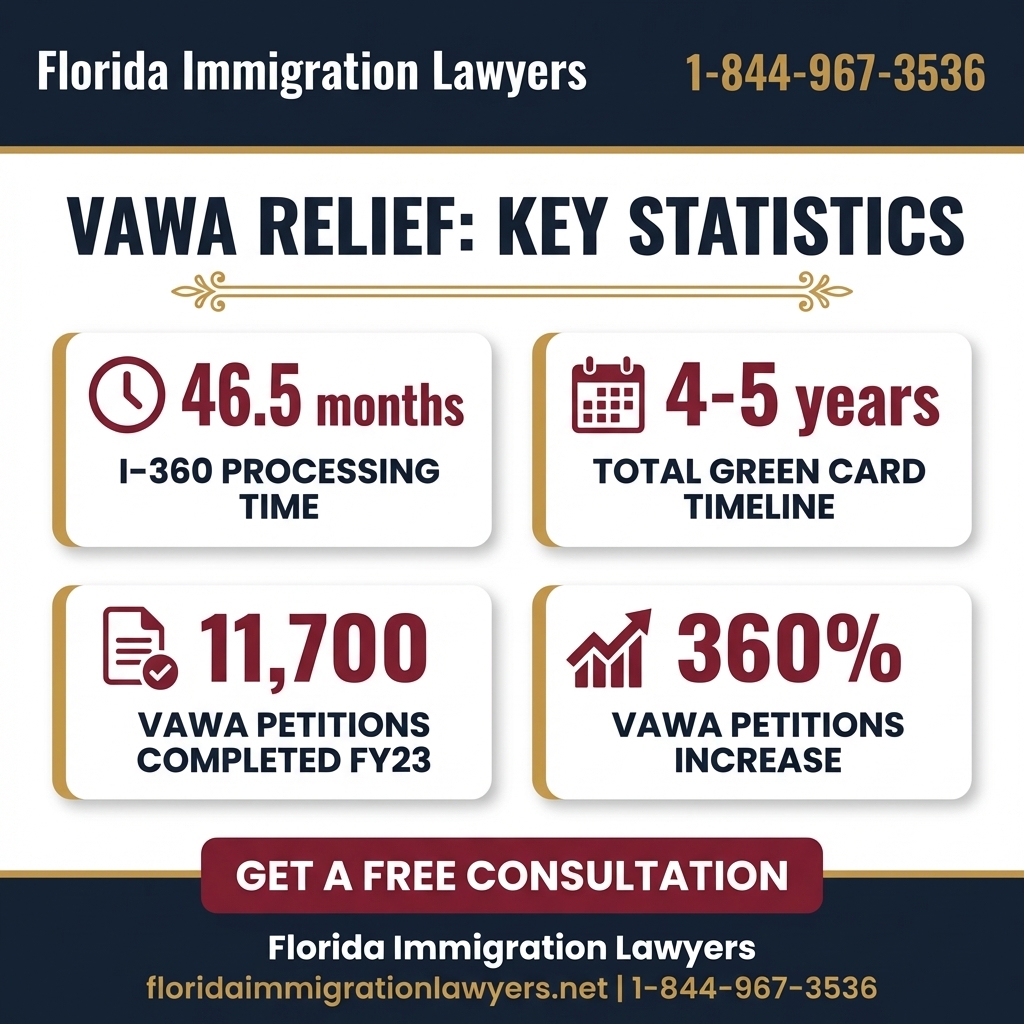
VAWA - Step-by-Step Process - Proof of Cohabitation: Joint bank statements, utility bills, leases, mortgages, insurance policies, or other documents showing you lived with the abuser.
- Evidence of Good Moral Character: Police clearance certificates from all residences in the U.S. and abroad for the past three years, criminal records (if any) and disposition documents.
- Birth Certificate and Passport: Copy of your birth certificate and current passport (if available).
- Photographs: Passport-style photographs of yourself.
Timeline and Processing Expectations for VAWA Self-Petitioners
The processing time for VAWA immigration relief Florida can vary significantly. USCIS processing times are subject to change and depend on various factors, including caseloads and the complexity of individual cases. Generally, you can expect the following:
- I-360 Petition Processing: Initial review and prima facie determination can take several months. Full processing of Form I-360 can range from 12 to 24 months, or sometimes longer. You can check current processing times on the USCIS website.
- Adjustment of Status (I-485): Once the I-360 is approved, if you are eligible to adjust status, the I-485 processing can take another 6 to 18 months. This includes biometrics appointments and potentially an interview.
- Work Authorization: You may be eligible to apply for work authorization (Employment Authorization Document, EAD) once your I-360 is filed and you have a pending I-485, or in some cases, after a prima facie determination. This can provide crucial financial independence.
It is important to remember that these are estimates. An experienced immigration attorney can help manage expectations and keep you informed about your case's progress.
Cost Factors and Fee Breakdown for VAWA Cases
One significant benefit of VAWA immigration relief Florida is that there are typically no government filing fees for the I-360 petition itself. This provision is designed to ensure that financial hardship does not prevent abuse victims from seeking protection.
However, there may be other costs involved:
- Biometrics Fee: There is a fee for the biometrics appointment when filing for adjustment of status (Form I-485).
- Adjustment of Status Fee: If you are filing Form I-485, there is a separate government filing fee.
- Medical Examination Fee: You will need to undergo a medical examination by a USCIS-approved civil surgeon, which incurs a separate fee paid directly to the doctor.
- Attorney Fees: Legal fees for an experienced immigration attorney are a significant cost factor. However, the investment in legal representation can be invaluable, ensuring your application is strong and correctly filed, minimizing errors and delays. Florida Immigration Lawyers offers free consultations to discuss your case.
- Translation Costs: If any of your supporting documents are not in English, they must be translated by a certified translator, incurring additional costs.
While some fees can be waived in cases of extreme poverty, it is best to discuss all potential costs and waivers with your attorney.
Do not navigate this complex process alone. The stakes are too high. Contact Florida Immigration Lawyers today at 1-844-YO-PELEO to secure compassionate and legal representation for your VAWA immigration relief in Florida. You can also contact us online.
Common Mistakes to Avoid When Seeking VAWA Immigration Relief
Seeking VAWA immigration relief Florida requires careful attention to detail. Avoiding common pitfalls can significantly improve your chances of success.
- Failing to Provide Sufficient Evidence of Abuse: Many victims minimize the abuse or lack "concrete" evidence like police reports. Remember, extreme cruelty includes emotional, financial, and psychological abuse. A detailed personal declaration is crucial. Without enough compelling evidence, USCIS may deny your I-360 petition.
- Not Demonstrating a Qualifying Relationship: You must clearly prove your relationship (spouse, parent, child) to the U.S. citizen or LPR abuser. Missing marriage certificates, birth certificates, or proof of a bona fide marriage can lead to questions about eligibility.
- Lacking Proof of Cohabitation: You typically need to show that you lived with the abuser. Providing joint utility bills, leases, or other documents demonstrating shared residency is important. If you were forced to leave, explain the circumstances clearly.
- Misrepresenting Good Moral Character: Any past criminal history, even minor offenses, must be disclosed. Attempting to hide information can severely damage your credibility and result in a denial. An attorney can advise on potential waivers.
- Missing Deadlines or Incomplete Applications: USCIS is strict with deadlines for RFEs and the completeness of applications. Submitting an incomplete application or failing to respond promptly can lead to delays or outright denial.
- Not Seeking Legal Counsel: The VAWA process is intricate and highly personal. Attempting to navigate it without an experienced immigration attorney can lead to critical errors, missed opportunities, and increased stress. An attorney provides strategic guidance and protection.
- Communicating with the Abuser: While not always a mistake, continued communication with an abuser, especially if it contradicts claims of separation due to abuse, can raise red flags. Your attorney can advise on appropriate boundaries during the process.
When to Call a Lawyer for VAWA Immigration Relief Florida
The decision to seek VAWA immigration relief Florida is a significant step towards safety and independence. Partnering with a knowledgeable legal team like Florida Immigration Lawyers can make all the difference. You should contact an attorney immediately if:
- You are experiencing domestic violence or extreme cruelty and are unsure about your immigration options. We can help you understand if VAWA applies to your situation.
- Your abuser is threatening to withdraw an immigration petition or report you to immigration authorities. This is a common tactic of control that VAWA is designed to counteract.
Do Not Navigate This Process Alone
Our experienced immigration attorneys are ready to fight for you. Get a free, confidential case review today.
Se Habla Español
Or leave your details and we’ll call you:
Free Evaluation in 24 Hours
Or talk to us right now
AI voice assistant — available 24/7
FreeFrequently Asked Questions

William J. Vásquez
Founding Attorney · Vasquez Law Firm
U.S. Air Force veteran and immigration attorney with years of hands-on U.S. immigration experience. J.D., NCCU School of Law. AILA member. Admitted to the 4th, 5th, and 11th Circuit Courts.
Available 24/7 - Free Evaluations
Reviewed for legal accuracy by William J. Vásquez
Licensed in North Carolina; U.S. immigration is federal practice.
Related Legal Services
Our Florida immigration attorneys can help you with citizenship and naturalization, immigration practice areas and free immigration consultation. Call today at 1-844-YO-PELEO for a free case review.
Related Links
Related Topics
Free Legal Case Review
Discuss your case with our experienced attorneys. We're available 24/7.
Se Habla Español - Estamos aquí para ayudarle.
Related Articles
DUI Immigration Consequences in Florida 2026
A DUI conviction in Florida can have severe immigration consequences, potentially leading to inadmissibility, deportation, or denial of immigration benefits. For non-citizens, a DUI is not just a traffic offense but a serious criminal matter that federal immigration law scrutinizes closely. Factors like multiple offenses, injury, or property damage can escalate a simple DUI to a Crime Involving Moral Turpitude (CIMT) or even an aggravated felony, triggering mandatory detention and removal proceedings. Understanding the specific nature of your Florida conviction and its interpretation under the Immigration and Nationality Act (INA) is crucial. This article outlines how DUIs impact immigration status, the grounds for inadmissibility and deportation, a step-by-step guide to navigating the process, essential documentation, and expected timelines for 2026. We also highlight common mistakes to avoid and when to seek legal counsel from an experienced immigration attorney. Florida Immigration Lawyers offers comprehensive support for individuals facing these challenging situations, providing expert guidance through complex legal landscapes.
Dual Citizenship Lawyer in Florida: What You Need to Know
For Florida residents, the concept of dual citizenship, or holding two passports, offers a compelling blend of opportunities and challenges. While the U.S. generally permits dual nationality, the path to achieving this status requires a meticulous understanding of both U.S. immigration laws and the citizenship policies of your country of origin. This guide explores the definition of dual citizenship, the detailed step-by-step process for U.S. naturalization, and the significant benefits and potential pitfalls involved. We cover essential documentation, typical timelines, and cost considerations for 2026, providing crucial insights for anyone in Orlando, Miami, or across Florida considering this important legal step. Learn about common mistakes to avoid and understand when to seek professional legal counsel to navigate this complex process successfully. Florida Immigration Lawyers is here to provide expert, bilingual support for your dual citizenship journey.
EAD Advance Parole Combo Card in Florida 2026
For individuals with a pending Form I-485, Application to Register Permanent Residence or Adjust Status, the EAD Advance Parole Combo Card is an essential document. This single card combines the authorization to work legally in the U.S. (Employment Authorization Document - EAD) with permission to travel internationally and re-enter without abandoning your green card application (Advance Parole). This guide from Florida Immigration Lawyers provides a comprehensive overview for applicants in Florida in 2026, covering eligibility, the step-by-step application process, required documents, expected processing times, and associated costs. We also highlight common mistakes to avoid and when to seek legal counsel to ensure a smooth and successful immigration journey. Understanding this vital card is key to maintaining stability while awaiting your permanent residency approval.
Immigration Lawyer Orlando Free Consultation in Florida
For individuals and families in Orlando, Florida, navigating the complexities of U.S. immigration law requires expert guidance. An immigration lawyer in Orlando offers crucial support for everything from visa applications and green card processes to naturalization and deportation defense. This comprehensive guide details what a free consultation covers, providing a step-by-step overview of immigration pathways, essential document checklists, and expected timelines in 2026. We also highlight common mistakes to avoid, discuss the critical role of legal counsel in deportation and asylum cases, and explain why choosing a local Orlando immigration attorney is beneficial. Florida Immigration Lawyers is dedicated to serving the diverse community of Orlando with compassionate, effective legal solutions, ensuring you receive personalized advice and robust representation for a successful immigration journey.