Immediate Relative Petition Florida: Your 2026 Guide
Uniting with family in Florida as a U.S. citizen often involves an immediate relative petition. This 2026 guide from Florida Immigration Lawyers details the Form I-130 process, eligibility for spouses, minor children, and parents, and crucial steps for a green card. Learn about required documents, processing timelines, and cost factors specific to Florida. We also highlight common mistakes to avoid and explain when legal counsel is indispensable, especially for complex cases or navigating USCIS interviews in Gainesville, Orlando, or Miami. Secure your family's future with expert legal support. Contact us for a free consultation.

An immediate relative petition Florida allows U.S. citizens to sponsor close family members for a green card without annual visa quotas or long waiting lists. This category includes spouses, unmarried children under 21, and parents of U.S. citizens aged 21 or older. The process typically begins with filing Form I-130, Petition for Alien Relative, with USCIS, followed by adjustment of status or consular processing. Understanding the specific requirements, gathering comprehensive documentation, and navigating interviews are crucial steps. Given the complexities, especially in diverse Florida communities like Gainesville, seeking legal guidance from experienced immigration attorneys is highly recommended to ensure a smooth and successful application.
- Immediate relatives (spouses, minor children, parents) have no visa backlog.
- The process starts with Form I-130 filed by a U.S. citizen petitioner.
- Requires substantial documentation to prove the bona fide relationship.
- Can involve adjustment of status within the U.S. or consular processing abroad.
- Legal assistance is vital to avoid common pitfalls and delays.
For many, the dream of uniting with family in the United States is a powerful motivator. In Florida, with its vibrant multicultural communities and high immigrant population, family unity is particularly cherished. If you are a U.S. citizen living in Gainesville or anywhere across the Sunshine State and wish to bring your closest family members to live with you, an immediate relative petition Florida is often the most direct path.
This comprehensive guide for 2026 will demystify the process of sponsoring your immediate relatives for a U.S. green card. We will cover everything from understanding who qualifies as an immediate relative to navigating the intricate steps of filing Form I-130, gathering essential documents, and preparing for interviews. Our goal is to provide clear, actionable information to help you understand this vital aspect of family immigration.
The journey can be complex, filled with specific requirements and potential challenges. However, with the right information and legal support, you can successfully navigate this path. Do not hesitate to seek professional guidance when embarking on such an important journey. Call Florida Immigration Lawyers at 1-844-967-3536 for a free consultation to discuss your specific immediate relative petition in Florida.
Understanding Immediate Relative Petitions in Florida
The immediate relative category is a cornerstone of U.S. immigration law, designed to prioritize the reunification of American citizens with their closest family members. Unlike other family-based immigration categories, immediate relatives are not subject to annual visa quotas. This means there is no numerical limit on the number of visas issued each year, potentially leading to faster processing times compared to other preference categories that often involve long waiting lists. This distinction is crucial for many families in Florida seeking timely reunification.
Under Section 201(b)(2)(A)(i) of the Immigration and Nationality Act (INA), immediate relatives are specifically defined as:
- Spouses of U.S. citizens.
- Unmarried children under 21 years of age of U.S. citizens.
- Parents of U.S. citizens, provided the U.S. citizen petitioner is at least 21 years old.
It is important to note that only U.S. citizens can petition for immediate relatives. Lawful Permanent Residents (green card holders) can petition for certain family members, but those categories are subject to visa bulletin backlogs. For residents of Florida, whether you are in Gainesville, Orlando, or Miami, understanding this fundamental difference is the first step in assessing your eligibility for an immediate relative petition Florida. Our firm specializes in helping families understand these nuances and navigate the entire family immigration process efficiently.
The I-130 Petition Process: A Step-by-Step Guide for Florida Residents
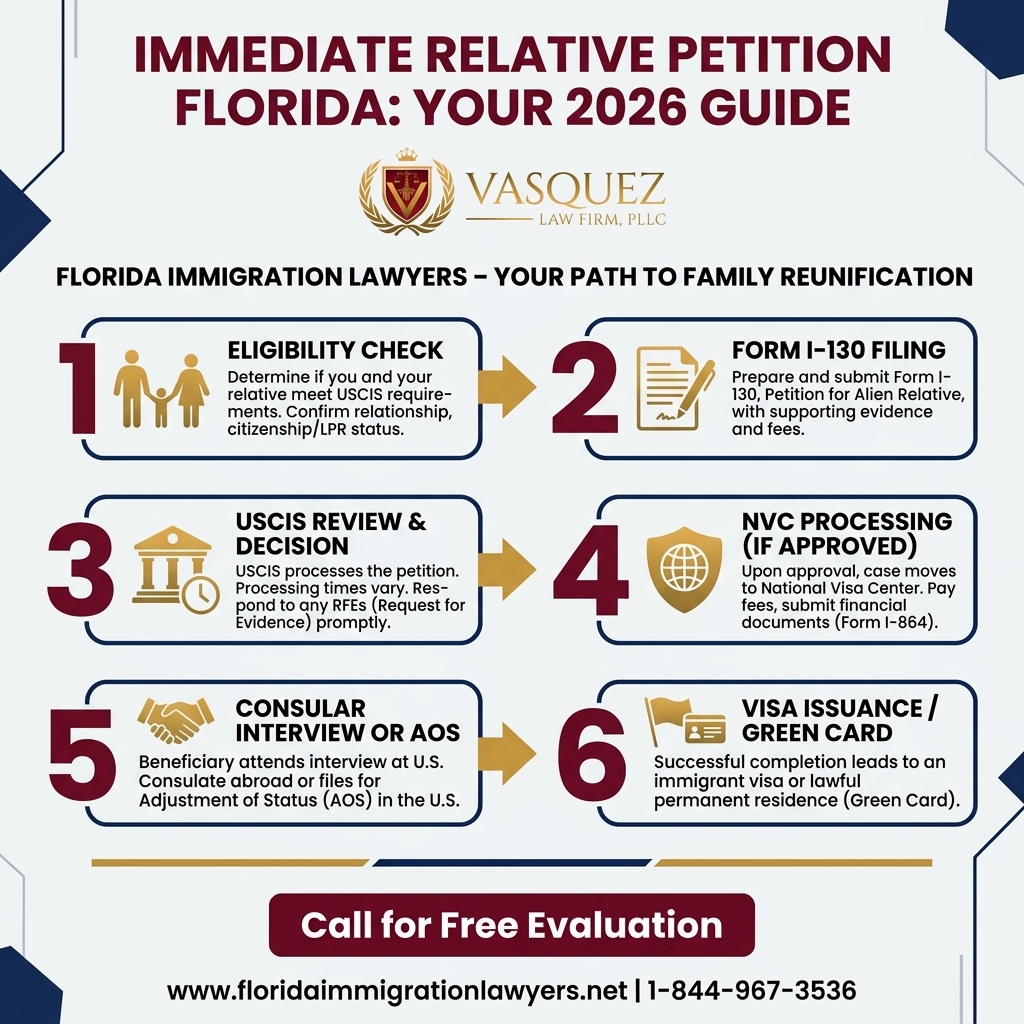
The journey to obtaining a green card for an immediate relative in Florida typically begins with filing Form I-130, Petition for Alien Relative. This form establishes the qualifying relationship between the U.S. citizen petitioner and their foreign national beneficiary. Understanding each step is vital for a successful application. Here is a detailed guide:
- Determine Eligibility: Before filing, ensure that the relationship falls within the immediate relative definition (spouse, unmarried child under 21, or parent of a U.S. citizen 21 or older). Confirm the petitioner is indeed a U.S. citizen with proper documentation.
- File Form I-130 with USCIS: The U.S. citizen petitioner must complete and sign Form I-130, along with all required supporting documentation. This package is then mailed to the appropriate USCIS Lockbox facility. The filing fee must also be included. You can find detailed instructions and the form on the official USCIS website.
- Receive Receipt Notice and Biometrics Appointment: After USCIS accepts the petition, you will receive a Form I-797C, Notice of Action, confirming receipt. Subsequently, the beneficiary (if residing in the U.S.) will receive an appointment notice for biometrics (fingerprints, photos, signature) at a local Application Support Center, often in cities like Orlando, Tampa, or Miami.
- USCIS Review and Interview: USCIS will review the petition and supporting evidence. For beneficiaries in the U.S. seeking Adjustment of Status (AOS), an interview at a local USCIS field office (e.g., Orlando, Miami) is typically required. For those outside the U.S. undergoing Consular Processing, the approved I-130 is sent to the National Visa Center (NVC).
- Adjustment of Status (AOS) or Consular Processing: If the beneficiary is already in the U.S. and entered lawfully, they may be eligible to file Form I-485, Application to Register Permanent Residence or Adjust Status, concurrently with or after the I-130 approval. If the beneficiary is abroad, they will complete Consular Processing through a U.S. embassy or consulate in their home country. This phase requires additional forms and documentation, including an Affidavit of Support.
Each step requires meticulous attention to detail as outlined in 8 CFR 204.1. Navigating these processes in Florida, especially with different USCIS offices and their specific procedures, can be challenging. Our legal team can guide you through every stage, ensuring compliance and efficiency.
Essential Documents for Your Immediate Relative Petition in Florida
The success of an immediate relative petition Florida largely hinges on providing comprehensive and accurate documentation. USCIS requires substantial evidence to verify both the petitioner's U.S. citizenship and the bona fide nature of the relationship. Missing or incorrect documents can lead to delays, Requests for Evidence (RFEs), or even denial. Here is a checklist of commonly required documents:
- Proof of Petitioner's U.S. Citizenship:
- Copy of U.S. birth certificate (for those born in the U.S.).
- Copy of U.S. passport (current and valid).
- Copy of naturalization certificate (if naturalized).
- Copy of Consular Report of Birth Abroad (FS-240, if born abroad to U.S. citizen parents).
- Proof of Relationship:
- For Spouses: Copy of marriage certificate (Florida marriage licenses are accepted). Evidence of bona fide marriage such as joint bank statements, joint utility bills, joint leases or mortgage documents, birth certificates of children born to the marriage, photos together over time, affidavits from friends/family.
- For Children: Copy of the child's birth certificate showing the U.S. citizen parent's name. If applicable, marriage certificate of parents.
- For Parents: Copy of the U.S. citizen child's birth certificate showing the parent's name. If applicable, marriage certificate of parents.
- Proof of Termination of Prior Marriages (if applicable): Copies of divorce decrees, annulment decrees, or death certificates for both petitioner and beneficiary.
- Identity Documents: Copies of government-issued photo IDs for both petitioner and beneficiary.
- Photographs: Passport-style photos for both petitioner and beneficiary.
- Affidavit of Support (Form I-864): Required for most immediate relative petitions to demonstrate the petitioner's financial ability to support the beneficiary. This includes tax returns, employment letters, and pay stubs.
- Medical Examination Report: For beneficiaries adjusting status in the U.S., a Form I-693, Report of Medical Examination and Vaccination Record, completed by a USCIS-approved civil surgeon.
- Police Clearances: For beneficiaries undergoing consular processing, police certificates from all countries where they have lived.
Ensure all foreign language documents are accompanied by certified English translations. Organizing these documents meticulously is a critical step that Florida Immigration Lawyers can assist you with, ensuring your application is complete and compelling.
Timelines and Processing Expectations for Immediate Relative Green Cards in Florida
Understanding the potential timelines for your immediate relative petition Florida is essential for planning and managing expectations. While immediate relatives are exempt from visa backlogs, the administrative processing of petitions and applications still takes time. Processing times can vary significantly based on several factors, including the specific USCIS service center, the volume of applications, the completeness of your submission, and whether you are pursuing Adjustment of Status (AOS) or Consular Processing.
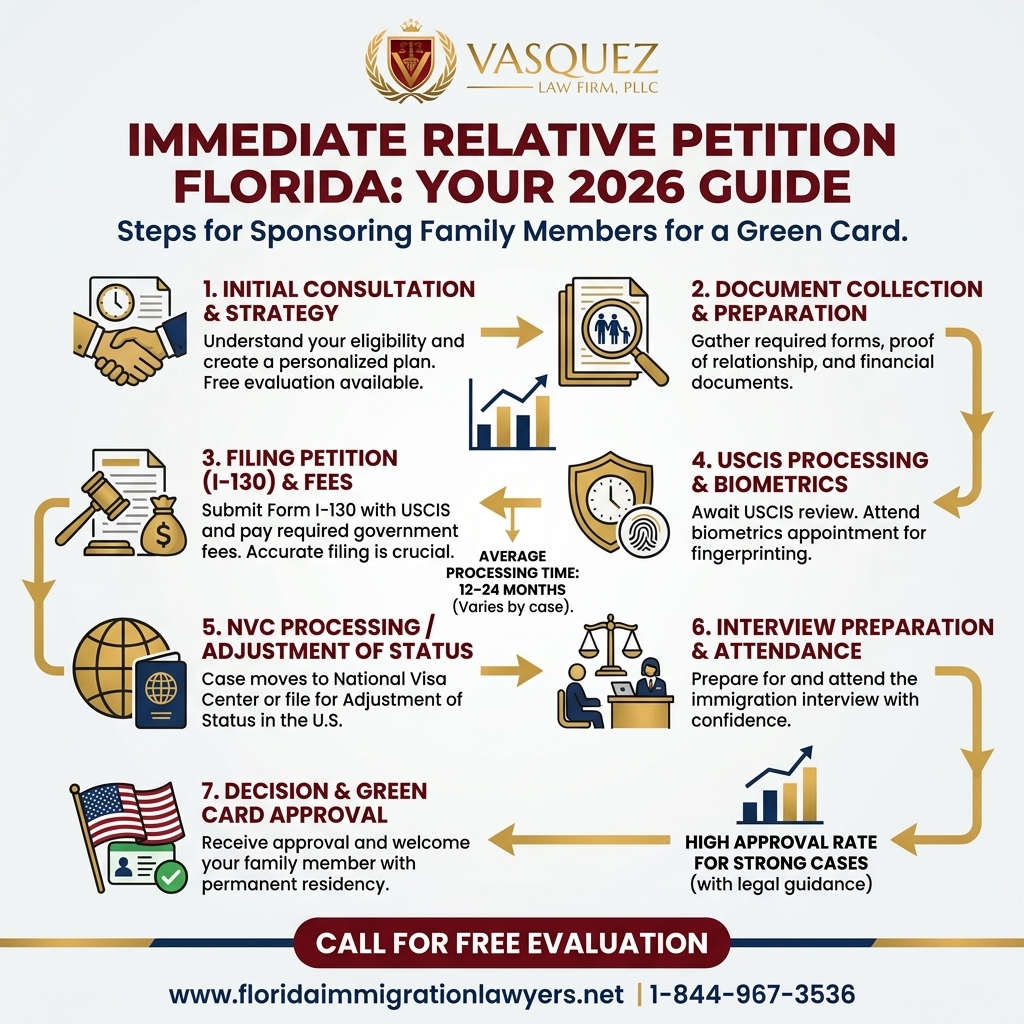
Typical Timeline Breakdown (Estimated for 2026):
- I-130 Petition Processing: After filing Form I-130, USCIS generally takes 7 to 15 months to process and approve the petition. You can check the most current processing times on the USCIS website by selecting the form type and the service center that handles your petition. For Florida residents, this might be the California, Nebraska, Texas, or Vermont Service Center, depending on your state of residence and the type of petition.
- Biometrics Appointment: If the beneficiary is in the U.S. and adjusting status, a biometrics appointment typically occurs 3-6 weeks after USCIS accepts the I-485 application.
- Interview Scheduling (AOS in Florida): For Adjustment of Status cases in Florida, once the I-130 is approved (or if filed concurrently with I-485), the local USCIS field office (e.g., Orlando, Miami, Tampa) will schedule an interview. Wait times for interviews can range from 8 to 20 months, influenced by the specific field office's workload.
- Consular Processing (Outside U.S.): If the beneficiary is abroad, once the I-130 is approved, it moves to the National Visa Center (NVC) for processing. This NVC stage can take 3-6 months to gather all necessary documents and fees. After NVC completes its review, the case is forwarded to the U.S. embassy or consulate in the beneficiary's home country for an interview. Embassy wait times vary widely but typically add another 2-4 months. For up-to-date consular processing information, refer to the State Department website.
- Decision and Green Card Issuance: After a successful interview, the green card is usually mailed within a few weeks for AOS cases, or issued upon entry for consular processing.
These timelines are estimates and can change. Factors like Requests for Evidence (RFEs) or issues during background checks can significantly extend the process. Our firm helps clients in Gainesville and across Florida monitor their case status and prepare for each stage.
Do not navigate this process alone. Contact Florida Immigration Lawyers today.
Cost Factors and Fee Breakdown for Immediate Relative Petitions
Pursuing an immediate relative petition Florida involves various fees that petitioners must be prepared to cover. These costs are subject to change, so it is always essential to verify the most current amounts directly on the USCIS website before filing. Understanding the potential expenses upfront allows for better financial planning.
Here is a breakdown of common cost factors:
- USCIS Filing Fees:
- Form I-130, Petition for Alien Relative: This is the initial filing fee for establishing the family relationship.
- Form I-485, Application to Register Permanent Residence or Adjust Status: If the beneficiary is adjusting status in the U.S., this fee applies. It often includes the biometrics fee.
- Biometrics Services Fee: A separate fee for fingerprinting and background checks, sometimes included with Form I-485.
- Form I-864, Affidavit of Support: While there is no separate USCIS fee for filing this form, it is a crucial component.
- Form I-765, Application for Employment Authorization (EAD): Often filed concurrently with I-485, allowing the beneficiary to work while the green card application is pending.
- Form I-131, Application for Travel Document (Advance Parole): Often filed concurrently with I-485, allowing the beneficiary to travel outside the U.S. while the green card application is pending.
- Medical Examination Fees: All beneficiaries applying for a green card must undergo a medical examination by a USCIS-approved civil surgeon. The cost for this exam varies by provider and is not included in USCIS filing fees.
- Translation Fees: If any supporting documents are not in English, they must be translated by a certified translator. These translation services incur separate costs.
- Attorney Fees: Retaining an experienced immigration attorney, such as those at Florida Immigration Lawyers, is an additional cost but provides invaluable guidance. Attorney fees cover preparing forms, organizing documents, responding to RFEs, and preparing for interviews. While it is an investment, it can save significant time, stress, and potential pitfalls, especially for complex cases or those involving previous immigration issues in Florida. Our firm offers free consultations to discuss your case and provide a transparent fee structure.
- Miscellaneous Costs: These can include postage, photocopying, and travel expenses for interviews or biometrics appointments.
It is important to budget for all these potential expenses. Financial waivers for some USCIS fees may be available for eligible low-income applicants, but eligibility criteria are strict. Always consult with a legal professional to understand the full financial implications for your specific immediate relative petition.
Navigating Immediate Relative Interviews in Florida
For many immediate relative petitions, an interview with a USCIS officer is a mandatory step, particularly for those adjusting status within the United States. These interviews typically take place at a local USCIS field office in Florida, such as in Orlando, Miami, or Tampa. The primary purpose of the interview is for the immigration officer to verify the information provided in your petition and application, confirm the bona fide nature of your relationship, and ensure the beneficiary is not inadmissible to the U.S. under INA 212.
What to Expect During the Interview:
- Both Petitioner and Beneficiary Must Attend: In most marriage-based green card interviews, both the U.S. citizen petitioner and the immigrant spouse must attend. For parent-child petitions, the petitioner and beneficiary will attend.
- Review of Documents: The officer will review all submitted documents. It is crucial to bring the originals of all documents you submitted, along with any additional evidence that supports your relationship or strengthens your case.
- Questions About Your Relationship: Expect detailed questions about how you met, your daily life together, shared experiences, future plans, and other aspects that demonstrate your relationship is genuine and not solely for immigration purposes. Be consistent and honest in your answers.
- Questions About Immigration History: The officer may also ask about your immigration history, including entries, exits, previous visas, and any prior interactions with immigration authorities.
- Oath and Decision: You will be asked to swear an oath to tell the truth. At the end of the interview, the officer may approve your case on the spot, issue a Request for Evidence (RFE), or state that a decision will be mailed.
Preparing thoroughly for the interview is paramount. This includes organizing all your documents, reviewing your initial application, and practicing answers to common questions. Our experienced attorneys at Florida Immigration Lawyers frequently assist clients in Gainesville and across Florida with interview preparation. We can help you anticipate questions, organize your evidence, and provide crucial advice to ensure you feel confident and ready to present your case effectively to the USCIS officer.
Common Mistakes to Avoid in Your Immediate Relative Petition
Navigating the immediate relative petition process can be complex, and even minor errors can lead to significant delays or even denial. Avoiding these common mistakes is crucial for a successful outcome in Florida:
- Incomplete or Inaccurate Forms: Failing to fill out every section of Form I-130 and other associated forms completely and accurately is a frequent error. Even small omissions or inconsistencies can result in a Request for Evidence (RFE) or outright rejection, delaying your case significantly.
- Insufficient Evidence of Bona Fide Relationship: For marriage-based petitions, providing too little evidence that your marriage is real and not just for immigration purposes is a major pitfall. USCIS requires substantial proof, such as joint financial accounts, leases, utility bills, photos, and affidavits from friends and family.
- Failure to Disclose Full Immigration History: Attempting to conceal or misrepresent past immigration violations, criminal history, or previous marriages can lead to severe consequences, including findings of misrepresentation or fraud, which can result in denial and future bars to immigration.
- Missing Deadlines or Ignoring RFEs: USCIS provides specific deadlines for responding to Requests for Evidence or other notices. Failing to meet these deadlines, or not fully addressing the RFE's requests, will almost certainly lead to a denial of your petition.
- Not Updating Address with USCIS: If you move, failing to update your address with USCIS promptly can result in missed notices, interview appointments, or RFEs. This can cause significant delays or even lead to your case being closed without a decision.
- Inadequate Affidavit of Support (Form I-864): The petitioner must demonstrate sufficient financial means to support the beneficiary. Providing incomplete financial documentation, failing to meet income requirements, or not having a qualified co-sponsor can lead to petition denial.
- Overlooking Criminal History or Inadmissibility Grounds: Any past criminal convictions, certain health issues, or previous immigration violations (like overstays or unlawful presence) can make a beneficiary inadmissible. Failing to address these issues proactively or seeking waivers where possible can result in denial.
- Submitting Uncertified Translations: Any document not in English must be accompanied by a certified English translation. Submitting uncertified translations will lead to an RFE and delay.
- Not Retaining Copies of All Submitted Documents: Always keep a complete copy of every form, document, and piece of evidence you submit to USCIS. This is crucial for your records, for interview preparation, and for responding to any future inquiries.
- Believing Misinformation from Non-Attorneys: Relying on advice from friends, family, or unqualified notaries (notarios) who are not licensed attorneys can lead to critical errors based on outdated or incorrect information. Immigration law is complex and constantly evolving.
- Traveling Outside the U.S. While Adjusting Status Without Advance Parole: If you are adjusting status in the U.S. and leave the country without obtaining Advance Parole (Form I-131), your I-485 application will be considered abandoned, and you may be barred from re-entry.
Avoiding these common mistakes requires careful attention to detail and a thorough understanding of immigration procedures. Consulting with Florida Immigration Lawyers can help you prepare a robust and error-free petition.
When to Call a Lawyer for Your Immediate Relative Petition
While the immediate relative petition process appears straightforward for some, many cases present complexities that warrant professional legal assistance. Engaging an experienced immigration attorney from Florida Immigration Lawyers can significantly improve your chances of a successful outcome, especially if you encounter any of the following scenarios:
- Complex Relationship Dynamics: If there are questions about the validity of your marriage, previous marriages, or complex family structures (e.g., adoptions, step-relationships), an attorney can help present your case clearly and compellingly.
- Beneficiary Has Prior Immigration Issues: If your immediate relative has a history of visa overstays, unlawful presence, previous deportations, criminal convictions, or other immigration violations, they may be subject to grounds of inadmissibility under INA 212. An attorney can assess potential waivers or provide deportation defense strategies.
- Received a Request for Evidence (RFE) or Notice of Intent to Deny (NOID): These notices indicate that USCIS requires more information or intends to deny your petition. Responding effectively to an RFE or NOID is critical and often requires legal expertise to address the specific concerns raised by USCIS.
- Financial Sponsorship Concerns: If the petitioner does not meet the income requirements for the Affidavit of Support (Form I-864), an attorney can help explore options for a joint sponsor or present additional assets.
- Fear or Anxiety About the Interview: Many applicants feel nervous about the USCIS interview. An attorney can provide thorough preparation, including mock interviews, to ensure you are confident and well-prepared to answer questions accurately and consistently.
- Previous Denials: If a prior immediate relative petition was denied, an attorney can review the reasons for denial and advise on the best course of action, which may include refiling or appealing the decision.
- Need for Expedited Processing: In rare, compelling circumstances, an attorney can help request expedited processing, though USCIS grants these sparingly.
- General Confusion About the Process: Immigration law is intricate and constantly changing. If you feel overwhelmed or unsure about any step of the process, a lawyer can provide clarity and peace of mind.
Don't leave your family's future to chance. Our attorneys serve clients throughout Florida, including Gainesville, and are ready to provide the guidance you need. Contact Florida Immigration Lawyers for a free consultation to discuss your specific situation.
About Florida Immigration Lawyers
Florida Immigration Lawyers is a leading law firm dedicated to providing exceptional immigration legal services to individuals and families across the entire state of Florida. With a deep understanding of U.S. immigration law and a compassionate approach, our experienced attorneys are committed to helping clients navigate complex legal challenges and achieve their immigration goals. From family-based petitions like the immediate relative petition Florida to complex deportation defense cases, we offer comprehensive legal representation tailored to your unique needs.
Our firm is built on a foundation of integrity, expertise, and client-focused service. We pride ourselves on offering personalized attention, clear communication, and strategic advocacy for every case. We understand the profound impact immigration matters have on lives and families, which is why we are available 24/7 to provide support and guidance. We offer free consultations, ensuring you can discuss your situation without financial obligation. Trust Florida Immigration Lawyers to be your dedicated partner in your immigration journey. Call us today at 1-844-967-3536 or visit our website at https://www.floridaimmigrationlawyers.net.
Sources and References
- U.S. Citizenship and Immigration Services (USCIS)
- Form I-130, Petition for Alien Relative
- U.S. Department of State (for Consular Processing)
- Executive Office for Immigration Review (EOIR)
- 8 U.S.C. Chapter 12 - Immigration and Nationality Act (INA)
- INA Section 201(b)(2)(A)(i) - Definition of Immediate Relatives
- 8 CFR Section 204.1 - Petitions for Alien Relatives
- INA Section 212 - Grounds of Inadmissibility
- USCIS Policy Manual
Related services: family petition process, family-based green cards, fiancé visa (K-1), marriage-based immigration.
This article provides general legal information and is not intended as legal advice. Every case is unique, and outcomes depend on specific facts and circumstances. Contact an attorney for advice about your particular situation.
Your family's future in Florida is too important to leave to chance. Whether you're in Gainesville, Jacksonville, Orlando, or Miami, our dedicated team is here to assist you with every aspect of your immediate relative petition Florida. We offer free consultations to evaluate your case and provide clear, actionable legal advice. Get the peace of mind you deserve.
Contact Florida Immigration Lawyers today at 1-844-967-3536. Se Habla Español - Estamos aquí para ayudarle.
Do Not Navigate This Process Alone
Our experienced immigration attorneys are ready to fight for you. Get a free, confidential consultation today.
Se Habla Español
Or leave your details and we’ll call you:
Free Evaluation in 24 Hours
Or talk to us right now

AI voice assistant — available 24/7
FreeFrequently Asked Questions

William J. Vásquez
Founding Attorney · Vasquez Law Firm
U.S. Air Force veteran and immigration attorney with years of hands-on U.S. immigration experience. J.D., NCCU School of Law. AILA member. Admitted to the 4th, 5th, and 11th Circuit Courts.
Available 24/7 - Free Evaluations
Reviewed for legal accuracy by William J. Vásquez
Licensed in North Carolina; U.S. immigration is federal practice.
Related Legal Services
Our Florida immigration attorneys can help you with asylum protection, deportation defense and citizenship and naturalization. Call today at 1-844-967-3536 for a free consultation.
Related Links
Related Topics
Free Legal Consultation
Discuss your case with our experienced attorneys. We're available 24/7.
Se Habla Español - Estamos aquí para ayudarle.
Related Articles
I-601 Waiver Lawyer Florida: Comprehensive Guide 2026
For many immigrants in Florida, overcoming grounds of inadmissibility is a critical step towards securing their future in the U.S. An I-601 waiver provides a pathway to address issues like unlawful presence, certain criminal convictions, or immigration fraud. This comprehensive guide, relevant for 2026, explains who needs an I-601 waiver, how to prove "extreme hardship" to a qualifying U.S. citizen or lawful permanent resident relative, and the step-by-step application process. We also cover typical timelines, cost factors, and crucial mistakes to avoid. Florida Immigration Lawyers offers expert guidance for I-601 waiver applications across the state, ensuring you build the strongest possible case and navigate the complex legal requirements effectively. Contact us for a free consultation to discuss your specific situation.
Immigration Lawyer Orlando Free Consultation in 2026
Navigating the complexities of U.S. immigration law requires expert guidance. For those in Orlando and across Florida, a free consultation with an immigration lawyer can provide crucial insights into your legal options without financial commitment. This comprehensive guide from Florida Immigration Lawyers details why an initial consultation is essential, what services immigration attorneys offer, the step-by-step process, typical timelines, and associated costs. We also highlight common mistakes to avoid and when it's critical to seek professional legal assistance. Our firm serves all of Florida, including Naples and Collier County, ensuring accessible, high-quality representation for families, businesses, asylum seekers, and individuals facing deportation. Understand your rights and build a strong case with trusted legal partners.
Stem OPT Immigration Lawyer: 2026 Florida Guide
For F-1 students in Florida, the STEM OPT extension offers a vital 24-month work authorization after their initial OPT. This guide, updated for 2026, covers eligibility, the step-by-step application process, required documents, and critical timelines. Graduates from Florida universities in STEM fields must navigate strict USCIS regulations, including the E-Verify employer requirement. Learn how to avoid common mistakes and when to seek professional legal assistance from a dedicated stem OPT immigration lawyer to ensure a successful application and continued career growth in the U.S. Florida Immigration Lawyers offers expert guidance for students across the state.
Dual Citizenship Lawyer: Navigating Delays in Florida
Facing citizenship delays in Florida can be challenging, but understanding the process and knowing your options is key. Learn how a dual citizenship lawyer can assist you in navigating N-400 processing and USCIS backlogs in Hialeah.