U Visa for Crime Victims Florida: Your Guide to Immigration Relief
For crime victims in Florida, the U visa offers a pathway to immigration relief and protection. This guide details the U visa requirements, the step-by-step application process, essential documents, and what to expect regarding processing times and costs. Learn how to secure law enforcement certification and navigate complex USCIS procedures. Florida Immigration Lawyers provides expert assistance for U visa applicants, ensuring you avoid common mistakes and maximize your chances for approval. If you are a victim of a qualifying crime in Florida, contact us for a free consultation to explore your options.
The U visa offers vital immigration relief for crime victims Florida who have suffered substantial physical or mental abuse and are helpful to law enforcement in investigating or prosecuting certain criminal activities. This nonimmigrant status provides temporary legal residency and a path to a Green Card for eligible individuals and their qualifying family members. It is a critical tool for ensuring justice and protecting vulnerable individuals in our communities.
- U visa protects crime victims who assist law enforcement.
- Eligibility requires substantial harm and cooperation with authorities.
- The process involves law enforcement certification and USCIS petition.
- A U visa can lead to lawful permanent residency in the U.S.
- Consulting an experienced immigration attorney is highly recommended.
Imagine enduring a traumatic crime in Florida, a crime that leaves you feeling vulnerable and uncertain about your future in the United States. Many immigrant crime victims Florida face this daunting reality, often fearing deportation if they report what happened. However, U.S. immigration law provides a beacon of hope: the U nonimmigrant status, commonly known as the U visa.
This comprehensive guide from Florida Immigration Lawyers will walk you through everything you need to know about the U visa for crime victims Florida. We will cover eligibility criteria, the application process, required documentation, and what to expect during this journey. Our goal is to empower you with information and demonstrate how our experienced legal team can support you. If you or a loved one is a victim of a qualifying crime, do not hesitate to seek help. Call Florida Immigration Lawyers at 1-844-967-3536 for a free consultation and let us help you understand your options for immigration relief.
Understanding the U Visa for Crime Victims in Florida
The U visa was created by Congress to strengthen the ability of law enforcement agencies to investigate and prosecute serious crimes while offering protection to immigrant victims. It provides temporary legal status, work authorization, and a pathway to lawful permanent residency for victims who cooperate with authorities. This humanitarian visa is crucial for ensuring that fear of immigration consequences does not prevent victims from coming forward.
For crime victims Florida, the U visa represents a critical opportunity for safety and stability. It applies to a broad range of criminal activities, from domestic violence and sexual assault to human trafficking and felonious assault. The unique aspect of the U visa is its focus on collaboration between victims and the justice system, making our communities safer for everyone.
Who Qualifies for U Visa Status?
To be eligible for a U visa, an applicant must meet several key criteria. First, you must have been a victim of a qualifying criminal activity. This list, defined in 8 U.S.C. 1101(a)(15)(U), includes crimes such as rape, torture, trafficking, domestic violence, sexual assault, abusive sexual contact, prostitution, female genital mutilation, hostage taking, peonage, involuntary servitude, kidnapping, abduction, unlawful criminal restraint, blackmail, extortion, murder, manslaughter, felonious assault, witness tampering, obstruction of justice, perjury, or attempt, conspiracy, or solicitation to commit any of these crimes.
Second, you must have suffered substantial physical or mental abuse as a result of the criminal activity. This abuse can be severe and long-lasting, impacting your well-being. Third, you must possess information concerning the criminal activity and have been, are being, or are likely to be helpful to a federal, state, or local law enforcement official in the investigation or prosecution of that crime. This cooperation is a cornerstone of the U visa requirements.
Finally, the crime must have occurred in the United States or violated U.S. laws. The U visa is available to individuals regardless of their current immigration status, making it a vital form of immigration relief for many vulnerable residents across Florida, including those in West Palm Beach and surrounding areas.
The Role of Law Enforcement Certification in Florida
A crucial component of the U visa application is obtaining a certification from a qualifying law enforcement agency. This certification, typically Form I-918 Supplement B, is signed by an authorized official who confirms that you were a victim of a qualifying crime and were, are, or will be helpful in the investigation or prosecution. This can be a police department, sheriff's office, prosecutor's office, or even certain judges or federal agencies like the FBI or ICE.
In Florida, like other states, local law enforcement agencies play a vital role in this process. Agencies in West Palm Beach, Miami, Orlando, and across the state are increasingly aware of the importance of the U visa certification. They understand that encouraging immigrant victims to come forward is essential for public safety. Securing this certification can sometimes be challenging, requiring diligent follow-up and clear communication. Our firm, Florida Immigration Lawyers, regularly assists clients in navigating this critical step.
The U Visa Application Process: A Step-by-Step Guide for Florida Residents
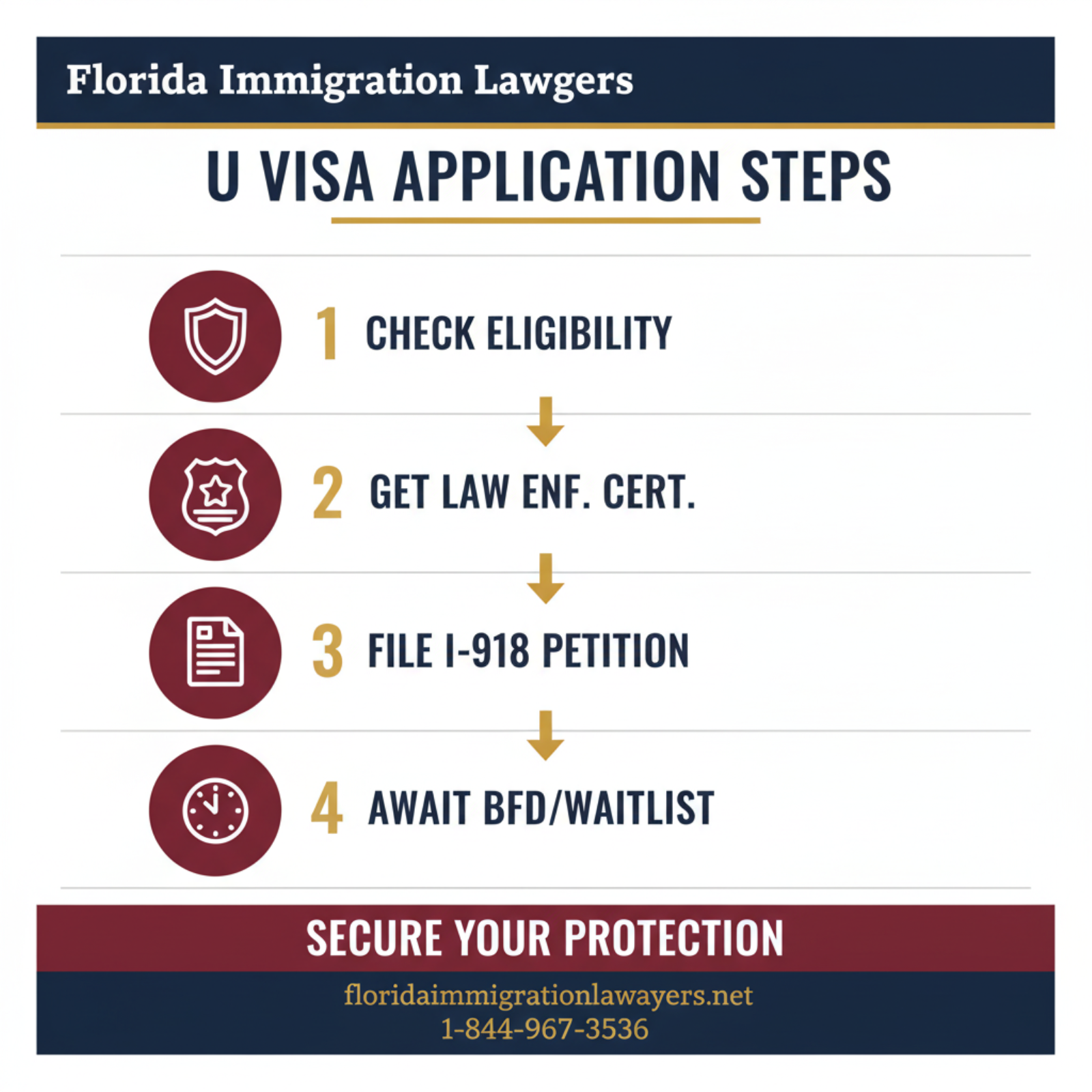
Applying for a U visa involves several detailed steps, and precision is paramount. Navigating this complex process successfully often requires the guidance of an experienced immigration attorney. Here is a general overview of the steps involved:
-
Obtain Law Enforcement Certification (Form I-918 Supplement B): This is often the first and most critical step. You must obtain a signed certification from a qualifying law enforcement agency confirming your victimization and cooperation. This form is typically completed by the agency you assisted, such as the West Palm Beach Police Department or the Palm Beach County Sheriff's Office.
-
File Form I-918, Petition for U Nonimmigrant Status: Once you have the certification, you will file Form I-918 with U.S. Citizenship and Immigration Services (USCIS). This form is the core of your U visa application. You will include your personal information, details about the crime, and how you meet the eligibility criteria.
-
Submit Supporting Evidence: Along with Form I-918, you must include a comprehensive packet of supporting documents. This includes a personal statement detailing the crime and its impact, evidence of the criminal activity (police reports, medical records), evidence of your helpfulness (affidavits from law enforcement, court documents), and identity documents. If you have any inadmissibility issues, you will also file Form I-192, Application for Advance Permission to Enter as a Nonimmigrant.
-
Biometrics Appointment: After submitting your petition, USCIS will send you a notice to attend a biometrics appointment at an Application Support Center (ASC). Here, your fingerprints, photograph, and signature will be collected for background checks. This is a standard part of most immigration applications.
-
Bona Fide Determination and Work Authorization: Due to the annual cap on U visas (10,000 per fiscal year), USCIS often places eligible applicants on a waiting list. However, if USCIS determines your petition is bona fide (meritorious and properly filed), you may receive deferred action and work authorization while you wait for a U visa to become available. This can provide significant relief for U visa crime victims Florida.
-
Interview (If Required): While not all U visa applicants are interviewed, USCIS may schedule one to clarify information or verify details. If an interview is required, it typically takes place at a local USCIS office. An attorney can prepare you thoroughly for this step.
-
Decision and Potential Adjustment of Status: If your U visa petition is approved, you will be granted U nonimmigrant status for up to four years. After three years in U status, you may be eligible to apply for lawful permanent residency (a Green Card) by filing Form I-485, Application to Register Permanent Residence or Adjust Status, provided you meet all additional requirements. This is a critical pathway to long-term stability in the U.S.
Essential Documents for Your U Visa Application in Florida
A well-prepared application package is crucial for a successful U visa petition. Missing or incomplete documents can lead to delays or even denial. Here is a checklist of common documents required:
- Form I-918, Petition for U Nonimmigrant Status: The primary application form.
- Form I-918 Supplement B, U Nonimmigrant Status Certification: Signed by a qualifying law enforcement official. This is the cornerstone of your application as a U visa victim of crime.
- Personal Statement: A detailed narrative describing the crime, your suffering, and your helpfulness to law enforcement.
- Evidence of the Qualifying Criminal Activity: Police reports, court documents, charging documents, news articles, or affidavits from witnesses.
- Evidence of Substantial Physical or Mental Abuse: Medical records, psychological evaluations, photographs of injuries, or affidavits from therapists or counselors.
- Evidence of Helpfulness to Law Enforcement: Letters from law enforcement, court transcripts, testimony records, or proof of cooperation in interviews.
- Identity Documents: Passport, birth certificate, national identity card, or other official identification.
- Proof of Relationship for Derivative Family Members: Birth certificates, marriage certificates, or other official documents for spouses, children, or parents included in your petition. This is important for family immigration.
- Form I-192, Application for Advance Permission to Enter as Nonimmigrant: Required if you have certain grounds of inadmissibility.
- Form I-765, Application for Employment Authorization: If you wish to apply for work authorization while your U visa is pending or after approval.
- Any other supporting evidence relevant to your case: This could include expert opinions or additional affidavits.
All documents not in English must be accompanied by a certified English translation. It is vital to organize your documents clearly and provide certified copies rather than originals unless specifically requested by USCIS.
U Visa Processing Times and Expectations for Florida Applicants
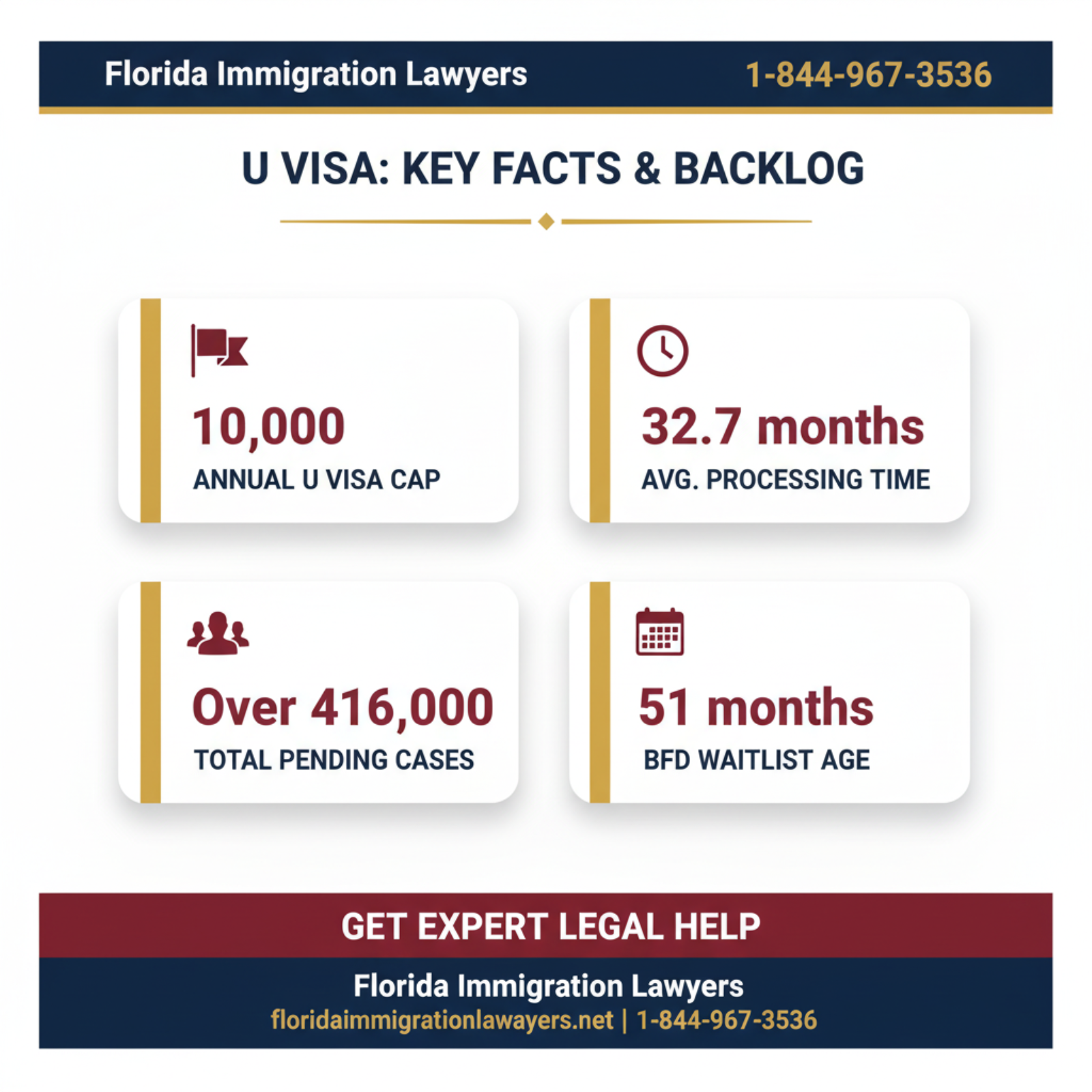
The U visa processing time can be lengthy, primarily due to the annual cap of 10,000 U visas issued each fiscal year. This cap applies to principal applicants only, not to derivative family members. USCIS receives far more U visa petitions than it can approve annually, leading to significant backlogs.
Currently, after filing, applicants typically wait several years for USCIS to reach their petition for a full review. During this waiting period, if your petition is deemed bona fide (meritorious), you may be granted deferred action and receive work authorization (EAD). This allows crime victims Florida to legally work and live in the U.S. while awaiting final adjudication. The wait for final approval to U nonimmigrant status can extend to five years or more.
Once U nonimmigrant status is granted, you can reside in the U.S. for up to four years. After three years in U status, and provided you meet specific conditions, you become eligible to apply for adjustment of status to a lawful permanent resident. While the process requires patience, the benefits of the U visa make it a highly sought-after form of immigration relief.
Understanding U Visa Costs and Fees for Florida Crime Victims
When considering a U visa application, it is important to understand the associated costs. While the direct USCIS filing fees for Form I-918 and Form I-918 Supplement B are generally waived for U visa applicants, other expenses may apply. This fee waiver is a significant benefit for vulnerable crime victims Florida.
However, applicants may still incur costs for other related applications, such as Form I-765 for employment authorization or Form I-192 for waivers of inadmissibility, though fee waivers may also be available for these forms if filed concurrently with or after the U visa petition. It is essential to consult the most current USCIS fee schedule and fee waiver guidelines, as these can change. You can find detailed information on the USCIS website.
Additional potential costs include attorney fees for legal representation, which can vary based on the complexity of your case. Translation services for non-English documents, costs for obtaining police reports or medical records, and potentially fees for medical examinations (if adjusting status later) are also factors to consider. Investing in legal assistance from Florida Immigration Lawyers can help ensure your application is thoroughly prepared, potentially saving you time and money in the long run.
Do not navigate this process alone. Contact Florida Immigration Lawyers today to discuss your specific situation and understand the potential costs involved.
Common Mistakes to Avoid in Your U Visa Application
Applying for a U visa is a complex undertaking, and even minor errors can lead to significant delays or even denial. Being aware of common pitfalls can help crime victims Florida avoid unnecessary complications.
-
Incomplete or Incorrect Law Enforcement Certification: The Form I-918 Supplement B must be correctly filled out and signed by an authorized official. An incomplete or improperly signed certification is a frequent reason for rejection, making it impossible to proceed with the U visa petition. Ensure all required fields are addressed.
-
Insufficient Evidence of Suffering or Helpfulness: Simply stating you were a victim is not enough. You must provide compelling evidence of substantial physical or mental abuse and demonstrate how you were, are, or will be helpful to law enforcement. Lack of detailed police reports, medical records, or a strong personal statement can weaken your claim significantly.
-
Failing to Disclose All Criminal History or Immigration Violations: Attempting to conceal past arrests, convictions, or previous immigration violations, even minor ones, can be detrimental. USCIS conducts thorough background checks, and any undisclosed information can lead to a finding of misrepresentation, potentially resulting in a denial and future bars to immigration benefits. Transparency is key, especially when dealing with deportation defense implications.
-
Missing Deadlines or Ignoring Requests for Evidence (RFEs): USCIS operates on strict timelines. Failing to respond to an RFE or a Notice of Intent to Deny (NOID) within the specified timeframe will almost certainly lead to a denial. Keep meticulous records and respond promptly to all communications from USCIS.
-
Submitting Uncertified Translations: Any document not in English must be accompanied by a complete and certified English translation. An uncertified or incomplete translation will render the document unusable and delay your application.
-
Not Filing Necessary Waivers of Inadmissibility: Many U visa applicants may have prior immigration violations or certain criminal histories that make them inadmissible to the U.S. Failing to file Form I-192, Application for Advance Permission to Enter as Nonimmigrant, to waive these grounds of inadmissibility can result in denial. These waivers are critical for many immigration relief cases.
-
Poorly Written Personal Statement: Your personal statement is your opportunity to tell your story. A vague, unorganized, or emotionally detached statement may not convey the true extent of your suffering or your helpfulness. It should be detailed, coherent, and impactful.
-
Including Derivative Family Members Who Do Not Qualify: While the U visa allows for derivative family members, strict rules apply regarding who can be included (e.g., spouses, unmarried children under 21, parents for principal applicants under 21, and unmarried siblings under 18 for principal applicants under 21). Including ineligible relatives will complicate the application.
-
Assuming Law Enforcement Will Automatically Certify: Law enforcement agencies are not obligated to sign Form I-918 Supplement B. You must actively demonstrate your helpfulness and clearly communicate the purpose of the certification. Some agencies may have specific internal policies or processes for handling these requests.
-
Failing to Keep USCIS Updated on Address Changes: If you move while your U visa application is pending, you must notify USCIS of your new address within 10 days using Form AR-11. Failing to do so can result in important notices being sent to the wrong address, potentially leading to missed appointments or RFEs and jeopardizing your case.
Frequently Asked Questions About the U Visa in Florida
Many crime victims Florida have questions about the U visa process. Here, we address some common inquiries to provide clarity.
What crimes disqualify you from a U visa?
There isn't a list of crimes that specifically disqualify you from a U visa based on your own actions, but rather certain grounds of inadmissibility. However, committing certain crimes yourself could make you inadmissible to the U.S. and require a waiver. The U visa is designed for victims of specific crimes, not for individuals who have committed serious offenses. If you have a criminal record, it is crucial to consult with an attorney to determine if a waiver is available or if your history impacts your eligibility. Additionally, misrepresenting facts on your application or failing to disclose a criminal record can lead to a denial.
Who is eligible for victim compensation in Florida?
In Florida, the Office of the Attorney General administers the Florida Crime Victims' Compensation Program. This program provides financial assistance to victims of crime for expenses such as medical treatment, mental health counseling, lost wages, and funeral costs. Eligibility generally requires that the crime occurred in Florida, was reported to law enforcement within 72 hours, and the application is filed within one year of the crime. Immigration status is typically not a barrier to applying for victim compensation. For detailed information, you can visit the Florida Attorney General's website. This is separate from the U visa process but can offer crucial support for crime victims Florida.
Can you be deported if you have a U visa?
Once you are granted U nonimmigrant status, you are generally protected from deportation. The U visa provides temporary legal status and deferred action, meaning you are authorized to remain in the U.S. and work. However, this protection is not absolute. If you commit serious crimes after receiving U status, engage in fraud, or violate the terms of your nonimmigrant status, you could potentially lose your U visa and face deportation proceedings. It is essential to maintain good conduct and comply with all immigration laws while holding U nonimmigrant status.
What is the difference between a U visa and a VAWA?
Both the U visa and VAWA (Violence Against Women Act) provide immigration relief for victims of abuse, but they apply to different circumstances. The U visa is for victims of a wide range of qualifying crimes who have suffered substantial abuse and are helpful to law enforcement in the investigation or prosecution of those crimes. The abuser's immigration status is irrelevant.
VAWA, on the other hand, is specifically for victims of battery or extreme cruelty by a U.S. citizen or lawful permanent resident spouse, parent, or child. VAWA allows these victims to self-petition for a Green Card without the abuser's knowledge or cooperation, focusing on family-based abuse. While there can be overlap (e.g., domestic violence victims), the legal pathways and eligibility criteria are distinct. An attorney can help you determine which option, or both, may be suitable for your situation.
When to Call a Florida Immigration Lawyer for Your U Visa
While the prospect of obtaining a U visa offers immense hope, the application process is incredibly intricate. It is not advisable for crime victims Florida to navigate this journey alone. Florida Immigration Lawyers is here to provide the expert guidance you need. You should contact us immediately if any of the following scenarios apply to you:
- You are a victim of a crime and unsure if it qualifies for a U visa. We can assess your situation and determine if your experience aligns with the specific U visa requirements.
- You are struggling to obtain law enforcement certification. Our attorneys have experience communicating with various agencies, including local police departments in West Palm Beach and across Florida, to advocate for your certification.
- You have a complex criminal history or prior immigration violations. These issues can trigger inadmissibility grounds, requiring a waiver (Form I-192). We can evaluate your record and prepare the necessary waivers to protect your case.
- You are currently in deportation proceedings. A U visa can offer protection from deportation and provide a path to legal status. Time is critical in these situations.
- You need assistance gathering compelling evidence. We can help you identify, collect, and organize all necessary documents, including police reports, medical records, and detailed personal statements.
- You wish to include family members in your U visa petition. We can ensure all eligible derivative family members are correctly included and their relationships properly documented, which is crucial for family immigration.
- You have received a Request for Evidence (RFE) or a Notice of Intent to Deny (NOID) from USCIS. These notices require a timely and comprehensive response, which an attorney is best equipped to provide.
- You simply want peace of mind and the highest chance of success. Our dedicated attorneys will meticulously prepare your application, ensuring every detail is accurate and complete, maximizing your chances for approval.
The journey to obtaining a U visa can be long and emotionally taxing. Let Florida Immigration Lawyers lighten your burden. We are committed to protecting the rights and futures of crime victims Florida, offering compassionate and effective legal representation.
About Florida Immigration Lawyers
Florida Immigration Lawyers is a leading immigration law firm dedicated to serving individuals and families across the entire state of Florida. With a deep understanding of U.S. immigration laws and a compassionate approach, we strive to provide exceptional legal representation to our diverse clientele. Our firm specializes in a wide range of immigration matters, including humanitarian relief such as the U visa.
We believe that every individual deserves a chance at a safer, more secure future. Our services include assistance with U visas, VAWA petitions, asylum claims, deportation defense, family-based petitions, business immigration, naturalization, and more. We pride ourselves on our client-focused approach, ensuring that you receive personalized attention and strategic advice tailored to your unique circumstances.
Why choose Florida Immigration Lawyers? We offer a team of highly experienced and dedicated attorneys who are passionate about immigration law. We are available 24/7 to address your urgent needs and provide free consultations to help you understand your legal options without financial commitment. Our firm is committed to transparency, integrity, and achieving the best possible outcomes for our clients. We serve all of Florida, including West Palm Beach, Miami, Orlando, Tampa, Jacksonville, and beyond. Your future is our priority.
Sources and References
- U.S. Citizenship and Immigration Services (USCIS) - U Nonimmigrant Status
- U.S. Citizenship and Immigration Services (USCIS) - Filing Fees
- Executive Office for Immigration Review (EOIR)
- Florida Attorney General's Office - Victim Compensation
- 8 U.S.C. § 1101(a)(15)(U) - Immigration and Nationality Act (INA) Section 101(a)(15)(U)
- 8 CFR § 214.14 - Regulations Governing U Nonimmigrant Status
This article provides general legal information and is not intended as legal advice. Every case is unique, and outcomes depend on specific facts and circumstances. Contact an attorney for advice about your particular situation.
If you are a crime victim Florida and believe you may be eligible for a U visa, do not delay. Your safety and future are important. Call Florida Immigration Lawyers today at 1-844-967-3536 for a free consultation. Se Habla Español - Estamos aquí para ayudarle.
Need help with Immigration?
Our Florida immigration attorneys offer free consultations. Call today or schedule online.
Frequently Asked Questions
Florida Immigration Lawyers
Legal Team
Our experienced attorneys at Florida Immigration Lawyers have been serving clients across Florida for over 20 years. We specialize in immigration, personal injury, criminal defense, workers compensation, and family law.