UK Immigration Reform Denmark Model: Florida Immigration Law Impact
The discussion surrounding the UK immigration reform Denmark model has significant implications for global immigration policies. While focused on Europe, these debates often influence broader trends, affecting immigrants and communities in Florida. Understanding these potential shifts and their relevance to U.S. immigration law is crucial. This article explores the Danish model, its proposed adoption in the UK, and how these discussions might indirectly shape the future of immigration in Florida, emphasizing the importance of expert legal guidance.
The UK immigration reform Denmark model refers to proposals for the United Kingdom to adopt stricter immigration and asylum policies, drawing inspiration from Denmark's approach. While these reforms are specific to the UK, global discussions on immigration policy can influence trends and legal frameworks worldwide, including in the United States and Florida. Understanding these international models helps us anticipate potential shifts and prepare for future immigration landscapes.
- The Denmark model emphasizes stricter asylum processing and integration requirements.
- UK reform proposals aim to reduce irregular migration and tighten legal pathways.
- These international discussions highlight a global trend towards more controlled immigration.
- While not directly applicable, such models can inform U.S. policy debates.
- Consulting a Florida immigration lawyer is vital to navigate any future changes.
UK Immigration Reform Denmark Model: Florida Immigration Law Impact
Are you an immigrant or a family member of an immigrant living in Florida? Do you wonder how global immigration policy discussions, like the proposed UK immigration reform Denmark model, might affect your future here? The landscape of immigration law is constantly evolving, influenced by political shifts and reforms worldwide. While the United Kingdom's potential adoption of Denmark's strict immigration model may seem distant, its underlying principles and outcomes can resonate globally, indirectly impacting dialogues and approaches to immigration in the United States and specifically in our diverse state of Florida.
At Florida Immigration Lawyers, we understand your concerns about the future of immigration. Our goal is to provide clarity and guidance amidst complex legal discussions. This comprehensive guide will explore the Danish immigration model, the UK's interest in it, and what these international developments could mean for immigrants and families across Florida. We are here to help you understand how these discussions might influence U.S. immigration policy and how to best prepare. For immediate assistance and personalized advice, do not hesitate to call Florida Immigration Lawyers at 1-844-967-3536 for a free consultation.
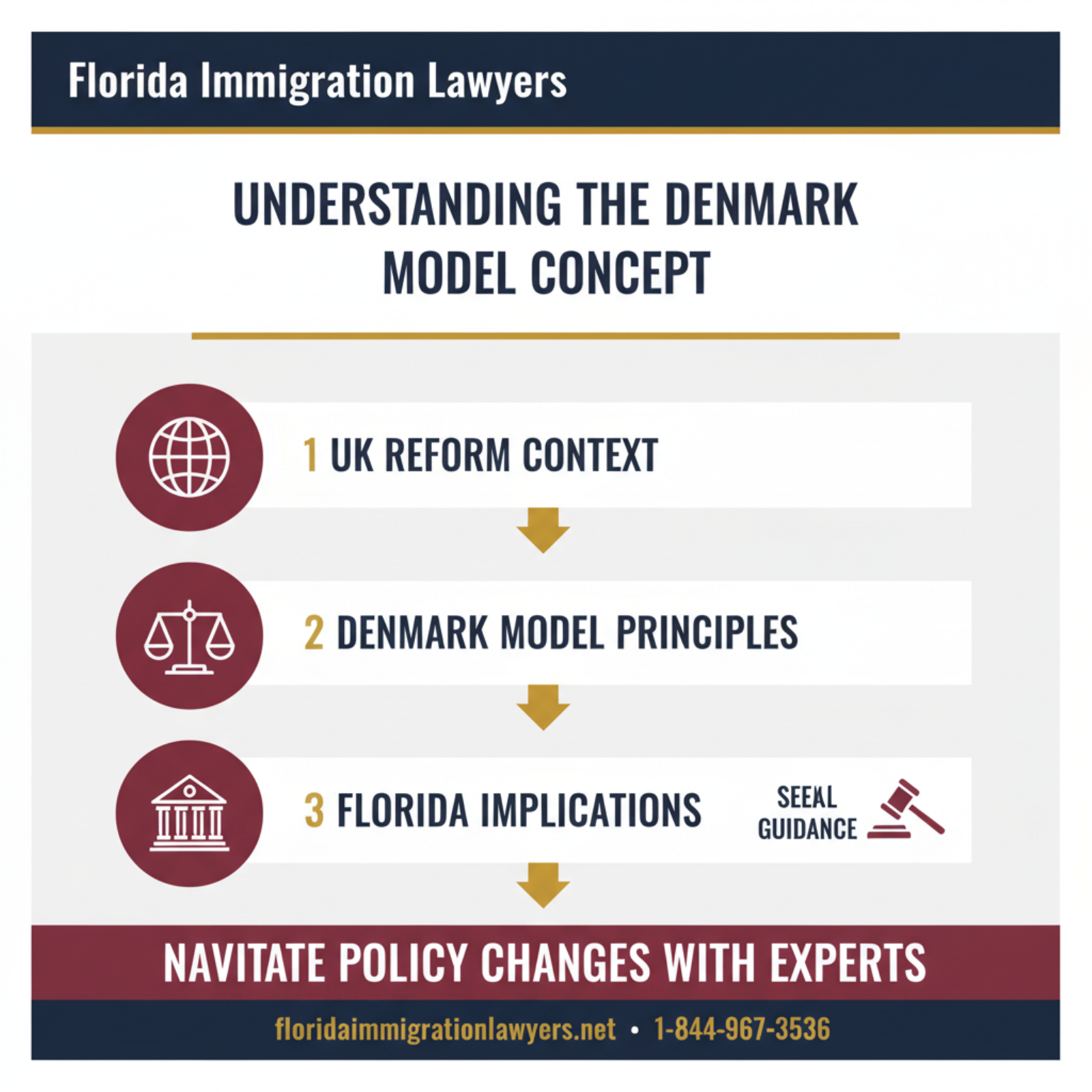
Understanding the UK Immigration Reform Denmark Model
The "Denmark model" of immigration policy has garnered significant attention globally, especially in countries seeking to implement stricter controls over immigration and asylum. Denmark has progressively tightened its immigration laws over the past two decades, aiming to reduce the number of asylum seekers and make it more challenging for immigrants to settle permanently and integrate into Danish society. This approach involves a multi-faceted strategy that the United Kingdom has expressed interest in emulating as part of its own UK immigration reform Denmark model initiatives.
Key tenets of the Danish immigration model include stringent requirements for family reunification, a focus on temporary protection over permanent residency for refugees, and policies designed to deter asylum seekers. For instance, Denmark has pursued agreements to process asylum claims outside its borders, a controversial but defining aspect of its strategy. These immigration policy changes reflect a broader European trend towards more restrictive approaches.
The UK government, facing its own challenges with irregular migration and seeking to assert greater control post-Brexit, has openly explored the Danish approach. Discussions around the UK immigration reform Denmark model suggest a desire to similarly reduce asylum applications, expedite deportations, and introduce more restrictive pathways for legal migration. While the specifics of any UK adoption would differ, the overarching goal mirrors Denmark's philosophy of tighter borders and reduced immigration numbers.
What Does the Danish Model Entail?
The Danish immigration model is characterized by several pillars. Firstly, it focuses on externalizing asylum processing, meaning asylum claims would ideally be handled in third countries rather than on Danish soil. Secondly, it prioritizes temporary protection for refugees, rather than immediate pathways to permanent residency or citizenship. This contrasts with traditional international norms that often emphasize integration.
Moreover, the model includes strict rules on family reunification, requiring high thresholds for financial self-sufficiency and integration before family members can join a resident. Language proficiency and cultural assimilation are also heavily emphasized. These measures are intended to signal that Denmark is not an attractive destination for asylum seekers and to limit the overall number of new arrivals.
Potential Global Ripple Effects on Florida Immigration
While the UK immigration reform Denmark model directly targets European immigration challenges, its influence can extend far beyond the continent. Global immigration policies are interconnected; shifts in one major region can inspire or inform policy debates in others. The United States, with its unique immigration system and diverse population, is not immune to these international trends. Florida, as a gateway state with a significant immigrant population, is particularly attentive to any immigration policy changes that could emerge from such global discussions.
In Florida, we see a constant influx of individuals seeking new opportunities, family reunification, or refuge. St. Petersburg, Tampa, and Miami are vibrant hubs for immigrant communities. Any discussions about stricter models, even if initially applied elsewhere, can fuel domestic debates about border security, asylum processes, and legal immigration pathways. This makes staying informed about global trends, such as the Danish immigration model, crucially important for our communities.
For individuals and families in Florida, understanding these international conversations is key to anticipating potential shifts in U.S. policy. While the U.S. immigration system operates under its own distinct legal framework, public discourse and political pressures can lead to proposals for reform that echo themes seen in European models. This emphasizes the need for proactive engagement with experienced legal professionals.
How International Policies Influence U.S. Immigration Debates
The debate surrounding the UK immigration reform Denmark model contributes to a global conversation about the balance between national sovereignty, humanitarian obligations, and economic needs. In the U.S., these discussions often revolve around issues such as border enforcement, the backlog in immigration courts, and the criteria for obtaining visas or asylum. The focus on "tough" immigration stances abroad can empower similar arguments domestically.
Furthermore, international agreements and diplomatic relations can sometimes play a role in shaping U.S. immigration policy. For example, if several allied nations adopt similar restrictive policies, it could create an environment where the U.S. feels pressure to review its own approaches. This is why staying updated on developments like the UK immigration reform Denmark model is essential for anyone involved in immigration matters in Florida.
Navigating the U.S. Immigration System in a Changing World
Understanding the implications of global policy shifts, such as the UK immigration reform Denmark model, requires a clear grasp of the existing U.S. immigration system. For immigrants in Florida, navigating this complex legal landscape is paramount, regardless of international trends. The U.S. Citizenship and Immigration Services (USCIS Florida) oversees many crucial processes, from visa applications to naturalization.
The U.S. immigration system is primarily governed by the Immigration and Nationality Act (INA), codified in 8 U.S.C. Chapter 12. This comprehensive law outlines eligibility for various immigration benefits, including family-based visas, employment-based visas, asylum, and citizenship. While international models like Denmark's might influence future policy debates, current U.S. law remains the guiding framework for all immigration matters in Florida.
It is important for individuals seeking to immigrate to the U.S. or adjust their status within Florida to follow established procedures meticulously. Any changes to U.S. law would typically undergo a legislative process, allowing time for public comment and legal adaptation. However, administrative policies and enforcement priorities can shift more rapidly, making expert legal counsel invaluable.
Step-by-Step Guide to Common U.S. Immigration Processes
While the UK immigration reform Denmark model highlights global policy trends, for those in Florida, the immediate concern is often understanding and navigating current U.S. immigration pathways. Here is a general guide to common processes, emphasizing the importance of legal assistance:
- Identify Your Immigration Goal: Determine if you are seeking a family-based visa, employment visa, asylum, or citizenship. Each path has distinct requirements. For example, family-based petitions (Form I-130) often begin with a U.S. citizen or lawful permanent resident sponsoring a relative.
- Gather Required Documentation: Collect all necessary personal documents, such as birth certificates, marriage certificates, passports, and financial records. These must be accurate and often translated into English by certified translators.
- File the Correct Forms with USCIS: Submit the appropriate application forms to USCIS Florida or the relevant USCIS service center. This could include Form I-485 for adjustment of status, Form I-130 for family petitions, or Form I-765 for employment authorization. Ensure all forms are filled out completely and accurately.
- Attend Biometrics Appointment: Most applicants will be required to attend a biometrics appointment at a local Application Support Center. Here, fingerprints, photographs, and signatures are collected for background checks.
- Prepare for Interviews (if required): Depending on your application type, you may need to attend an interview with a USCIS officer. This is common for adjustment of status and naturalization applications. A Florida immigration lawyer can help you prepare thoroughly.
- Receive a Decision: After all steps are completed and your case is reviewed, USCIS will issue a decision on your application. This could be an approval, a request for more evidence, or a denial.
- Maintain Your Status: If approved, ensure you understand the terms of your new status and comply with all U.S. immigration laws. For example, lawful permanent residents must renew their Green Card periodically.
Essential Document Checklist for Florida Immigrants
Regardless of global immigration policy discussions like the UK immigration reform Denmark model, having your documents in order is fundamental to any U.S. immigration application. The specific documents you need will vary based on your case type, but here is a general list of commonly required items for individuals in Florida:
- Proof of Identity and Nationality: Valid passport, birth certificate, national identity card.
- Proof of Marital Status: Marriage certificates, divorce decrees, death certificates of former spouses (if applicable).
- Financial Documentation: Bank statements, tax returns (Form W-2, Form 1099), employment verification letters, affidavits of support (Form I-864).
- Police Clearances/Criminal Records: Certificates from police authorities in all countries you have lived in for certain periods.
- Medical Examination Records: Report of Medical Examination and Vaccination Record (Form I-693) completed by a USCIS-approved civil surgeon.
- Photographs: Passport-style photographs meeting USCIS specifications.
- Proof of Relationship (for family-based petitions): Birth certificates of children, marriage certificates, photographs, correspondence, joint financial accounts.
- Educational and Professional Credentials (for employment-based petitions): Diplomas, degrees, transcripts, professional licenses, letters of recommendation.
- Asylum-Specific Documents: Personal declarations, evidence of persecution (e.g., police reports, news articles, medical records).
- Prior Immigration Documents: Copies of previous visas, I-94 records, approval notices, EAD cards.
Always ensure all foreign-language documents are accompanied by certified English translations. A small error or missing document can significantly delay your case with USCIS Florida.
Timeline and Processing Expectations for U.S. Immigration
The processing times for U.S. immigration applications can vary significantly, often influenced by factors such as the type of application, the specific USCIS service center or field office handling the case, and current caseloads. While global debates like the UK immigration reform Denmark model do not directly alter U.S. processing times, they underscore the dynamic nature of immigration systems worldwide. Patience and proactive monitoring are key for applicants in Florida.
For example, processing times for family-based petitions can range from several months to several years, depending on the visa category and country of origin. Employment-based petitions also have varying timelines, often influenced by visa bulletin availability. Naturalization applications typically take several months to over a year. You can check estimated processing times on the official USCIS website.
Delays can occur due to requests for additional evidence (RFEs), interviews, or background checks. It is crucial to respond promptly and thoroughly to any USCIS requests. An experienced Florida immigration lawyer can help you track your case and address any unforeseen issues, providing peace of mind during these often-stressful periods.
Cost Factors and Fee Breakdown for Immigration Applications
Pursuing an immigration benefit in the United States involves various fees, which are subject to change and vary depending on the specific application. These costs are separate from any legal fees you might incur when hiring a Florida immigration lawyer. Understanding these financial aspects is crucial for planning your immigration journey, regardless of international policy discussions like the UK immigration reform Denmark model.
Typically, applicants will encounter fees for:
- USCIS Filing Fees: Each form (e.g., I-130, I-485, N-400) has an associated filing fee. These fees are set by USCIS and are non-refundable.
- Biometrics Fee: A separate fee is often required for the biometrics appointment.
- Medical Examination Fee: Paid directly to the USCIS-approved civil surgeon. This fee varies by provider.
- Translation Fees: If any documents are not in English, you will need to pay for certified translations.
- Attorney Fees: Legal fees for representation by a Florida immigration lawyer will vary based on the complexity of your case and the services provided.
- Other Costs: This may include postage, travel expenses for interviews, or fees for obtaining supporting documents.
It is important to check the most current fee schedule on the USCIS website before filing any application. Fee waivers may be available for certain low-income applicants for some forms. Your legal team at Florida Immigration Lawyers can help you understand the full scope of costs involved in your particular case.
Do not navigate this process alone. The complexities of U.S. immigration law, especially with the backdrop of global policy discussions like the UK immigration reform Denmark model, require expert guidance. Contact Florida Immigration Lawyers today to ensure your application is handled correctly and efficiently. We are dedicated to serving the immigrant communities of St. Petersburg, Tampa, and all of Florida.
Common Mistakes to Avoid in Your Immigration Journey
Navigating the U.S. immigration system can be challenging, and even minor errors can lead to significant delays or denials. Being aware of these common pitfalls can save you time, stress, and potential heartbreak, especially when considering the broader context of immigration policy changes globally.
- Filing Incomplete or Inaccurate Forms: Submitting forms with missing information or errors is a leading cause of rejection or requests for evidence, prolonging your case. Ensure every field is addressed truthfully and completely.
- Missing Deadlines: Failing to respond to USCIS requests for evidence or attend appointments by the specified date can result in your application being denied or abandoned. Always mark crucial dates on your calendar.
- Not Disclosing All Relevant Information: Hiding past arrests, immigration violations, or other pertinent details can lead to accusations of misrepresentation, which carries severe consequences, including bans from future immigration benefits.
- Providing Uncertified Translations: Any document not in English must be accompanied by a certified English translation. Submitting uncertified translations will cause delays.
- Ignoring Public Charge Rule Changes: The "public charge" rule can impact eligibility for green cards. Understanding how it applies to your situation is vital. Seek legal advice if you have concerns about this rule.
- Traveling Without Proper Authorization: Leaving the U.S. while an application like adjustment of status is pending without obtaining advance parole can lead to the abandonment of your application.
- Not Updating Address with USCIS: Failing to inform USCIS of a change of address (Form AR-11) can result in missed notices, interview appointments, or requests for evidence, jeopardizing your case.
- Assuming Laws Remain Static: Immigration laws and policies can change, sometimes rapidly. Relying on outdated information or advice can be detrimental. Stay updated through reliable sources or legal counsel.
- Attempting to Navigate Complex Cases Alone: Cases involving criminal history, previous deportations, or asylum claims are highly complex. Attempting to manage them without a Florida immigration lawyer significantly increases the risk of denial.
- Not Preparing for Interviews: Underestimating the importance of an interview can lead to poor performance. Practice answering potential questions and understand the purpose of the interview.
- Submitting Insufficient Evidence: For many applications, particularly family-based or asylum claims, robust evidence is crucial. Lack of sufficient proof can lead to denials.
- Falling Victim to Notario Fraud: "Notarios" are not attorneys and cannot provide legal advice. Seeking help from unauthorized individuals can lead to serious legal problems and even deportation. Always consult a licensed Florida immigration lawyer.
When to Call a Florida Immigration Lawyer
While this article provides general information about global immigration trends like the UK immigration reform Denmark model and U.S. immigration processes, it is crucial to recognize when your specific situation demands professional legal expertise. Immigration law is incredibly intricate, and a single misstep can have profound, long-lasting consequences. Florida Immigration Lawyers are here to offer the guidance you need.
You should consider contacting a Florida immigration lawyer immediately if:
- You have received a Notice to Appear (NTA) in immigration court or are facing deportation defense proceedings.
- Your application has been denied, or you have received a Request for Evidence (RFE) or Notice of Intent to Deny (NOID).
- You have a complex immigration history, including previous visa overstays, denials, or criminal records.
- You are seeking asylum or refugee status, as these cases require detailed legal arguments and strong evidence.
- You are navigating family-based immigration petitions with unusual circumstances, such as complex familial relationships or issues with an affidavit of support.
- You are an employer seeking to sponsor foreign workers through business immigration visas and need to ensure compliance with all labor laws.
- You are considering citizenship or naturalization and have questions about eligibility, continuous residence, or good moral character.
- You are unsure which immigration pathway is best for your unique situation.
- You are concerned about the impact of potential immigration policy changes on your case.
Our experienced attorneys at Florida Immigration Lawyers are well-versed in all aspects of U.S. immigration law. We provide comprehensive services, from initial consultations to representation in court. We serve clients across St. Petersburg, Tampa, Orlando, Miami, and throughout Florida. Let us protect your rights and guide you through every step of your immigration journey. Visit our contact page or call us directly.
About Florida Immigration Lawyers
Florida Immigration Lawyers is a leading law firm dedicated to providing exceptional legal representation to immigrants and their families across the entire state of Florida. With a deep understanding of U.S. immigration law and a compassionate approach, we stand ready to assist you with a wide range of immigration matters, from simple visa applications to complex deportation defense cases. We pride ourselves on offering personalized attention and strategic solutions tailored to your unique circumstances.
Our firm handles various practice areas, including general immigration, asylum, deportation defense, citizenship, family immigration, and business immigration. We understand the challenges and anxieties that come with navigating the immigration system, and our dedicated team is committed to achieving the best possible outcomes for our clients.
Why choose Florida Immigration Lawyers? We offer free consultations, are available 24/7 to address your urgent needs, and serve clients in St. Petersburg, Tampa, Orlando, Miami, and all communities throughout Florida. Our commitment to excellence and client satisfaction is unwavering. When you need expert legal advice and steadfast advocacy, trust Florida Immigration Lawyers. Call us today at 1-844-967-3536 or visit our website at https://www.floridaimmigrationlawyers.net.
Frequently Asked Questions About Global Immigration Models
The discussion around the UK immigration reform Denmark model often raises broader questions about global immigration policies. Here, we address some common inquiries related to these international approaches and their general context.
What is the Denmark immigration model?
The Denmark immigration model refers to a set of increasingly restrictive policies implemented by Denmark over the past two decades. Its core principles include prioritizing temporary protection over permanent residency for refugees, stringent requirements for family reunification, and efforts to process asylum claims outside its borders. The goal is to deter asylum seekers and significantly reduce overall immigration numbers.
What country has the toughest immigration laws?
Determining which country has the "toughest" immigration laws is subjective and depends on specific criteria. However, countries like Denmark and Australia are often cited for their highly restrictive asylum policies, including offshore processing and strong deterrent measures. Other nations, such as Japan, have historically had very low immigration rates due to strict entry requirements. The proposed UK immigration reform Denmark model aims to place the UK among these countries.
What is the 24-year rule in Denmark?
The "24-year rule" in Denmark, also known as the "attachment requirement," was a highly debated policy that required both spouses in a family reunification case to be at least 24 years old. This rule was primarily aimed at preventing forced marriages and limiting family reunification for individuals from certain countries. While it has undergone revisions and is subject to European Union law challenges, it exemplifies Denmark's approach to tightening family immigration rules.
Where do most of Denmark's immigrants come from?
Historically, Denmark's immigrant population has been diverse. While in recent decades many asylum seekers came from war-torn regions in the Middle East and Africa, significant numbers of immigrants and descendants of immigrants in Denmark also originate from other European Union countries, Turkey, and various non-Western countries. The Danish immigration model has specifically targeted reducing immigration from non-Western countries.
Sources and References
- U.S. Citizenship and Immigration Services (USCIS)
- Executive Office for Immigration Review (EOIR)
- U.S. Department of State - Bureau of Consular Affairs
- 8 U.S.C. Chapter 12 - Immigration and Nationality Act (INA)
- 8 CFR Part 204 - Petitions to Classify Alien Relatives for Issuance of Immigrant Visas
- USCIS Policy Manual
This article provides general legal information and is not intended as legal advice. Every case is unique, and outcomes depend on specific facts and circumstances. Contact an attorney for advice about your particular situation.
The complexities of immigration law require expert guidance. Whether you are concerned about international policy shifts like the UK immigration reform Denmark model or need assistance with a current U.S. immigration application, Florida Immigration Lawyers is here to help. We offer free consultations to discuss your specific needs. Call us today at 1-844-967-3536 to schedule your appointment. Se Habla Español - Estamos aquí para ayudarle.
Need help with Immigration?
Our Florida immigration attorneys offer free consultations. Call today or schedule online.
Frequently Asked Questions
Florida Immigration Lawyers
Legal Team
Our experienced attorneys at Florida Immigration Lawyers have been serving clients across Florida for over 20 years. We specialize in immigration, personal injury, criminal defense, workers compensation, and family law.