TPS Nepal Honduras Nicaragua: Florida Immigration Update
For TPS holders from Nepal, Honduras, and Nicaragua in Florida, 2026 brings continued legal complexities. This guide clarifies the current status, eligibility requirements, and the step-by-step application or re-registration process. Learn about the impact of federal court decisions like <em>Ramos v. Mayorkas</em> and <em>Bhattarai v. Mayorkas</em> on your status. We detail essential documents, processing timelines, and cost factors. Discover common mistakes to avoid and when to seek professional legal assistance to protect your Temporary Protected Status. Florida Immigration Lawyers offers free consultations to guide you through this intricate process.
Temporary Protected Status (TPS) for eligible individuals from Nepal, Honduras, and Nicaragua continues to be affected by ongoing legal challenges in 2026. While some protections remain, navigating the specific requirements for re-registration or initial application in Florida is complex. It is crucial to understand current deadlines and eligibility criteria to maintain your status.
- TPS status for these nations is subject to judicial orders and ongoing review.
- Eligibility depends on continuous residence and physical presence from specific dates.
- Re-registration is essential to maintain employment authorization and protection from deportation.
- Seek legal counsel to ensure compliance with evolving regulations and deadlines.
TPS Nepal Honduras Nicaragua: Florida Immigration Update 2026
Are you a TPS holder from Nepal, Honduras, or Nicaragua living in Florida? The status of your Temporary Protected Status (TPS) has been a source of significant concern and confusion for many years. As we move into 2026, understanding the current legal landscape and your options is more critical than ever.
This comprehensive guide will explain the current situation for TPS Nepal Honduras Nicaragua, outline eligibility requirements, detail the application process, and highlight common mistakes to avoid. Our goal is to provide clarity and empower you with the information you need to protect your status in Florida. If you have questions or need personalized legal advice, do not hesitate. Call Florida Immigration Lawyers at 1-844-YO-PELEO for a free consultation today.
Understanding Temporary Protected Status (TPS) for Nepal, Honduras, and Nicaragua in Florida
Temporary Protected Status (TPS) offers a lifeline to individuals from designated countries who cannot safely return home due to armed conflict, environmental disaster, or other extraordinary and temporary conditions. This humanitarian program provides work authorization and protection from deportation for eligible foreign nationals already in the United States. The Immigration and Nationality Act (INA) Section 244, codified at 8 U.S.C. § 1254a, establishes the framework for TPS designations.
What is Temporary Protected Status (TPS)?
TPS is a temporary immigration benefit granted to eligible nationals of designated countries. It allows individuals to live and work legally in the U.S. for a specific period, which can be extended. While TPS does not lead directly to permanent residency, it provides crucial stability and protection.
The Secretary of Homeland Security designates countries for TPS based on specific conditions. These conditions must prevent nationals from returning safely. Such circumstances include ongoing armed conflict, environmental disasters, or other extraordinary and temporary conditions.
A Complex History: TPS Designations and Legal Battles for Nepal, Honduras, and Nicaragua
The history of TPS Nepal Honduras Nicaragua is marked by initial designations due to severe crises, followed by attempts at termination and subsequent legal challenges. Honduras and Nicaragua were first designated for TPS in 1999 following Hurricane Mitch. Nepal received its designation in 2015 after a devastating earthquake.
In recent years, the U.S. government announced the termination of TPS for these countries, leading to widespread concern among beneficiaries. However, federal court decisions, particularly in cases like Ramos v. Mayorkas and Bhattarai v. Mayorkas, have significantly impacted these terminations. These legal challenges have, for many, temporarily enjoined the terminations, allowing thousands of TPS holders to maintain their status.
For example, the Ramos settlement agreement has provided an administrative stay of termination for certain TPS beneficiaries from Honduras and Nicaragua. This means that while termination was announced, many individuals may continue to hold TPS and work authorization through specific validity dates in 2026 and beyond, depending on court orders and subsequent government actions. This directly addresses questions like, "Has TPS for Honduras been cancelled?" For many, the answer is not yet, due to these legal stays.
The situation remains fluid. USCIS continues to issue notices regarding re-registration periods and Employment Authorization Document (EAD) extensions based on these judicial orders. It is vital for Florida residents with TPS Nepal Honduras Nicaragua to stay informed and seek legal guidance to understand how these complex legal developments apply to their individual circumstances. Regular updates are posted on USCIS.gov/TPS.
Eligibility Requirements for TPS Holders in Florida
To be eligible for TPS, whether for an initial application (if a country is newly designated or re-designated) or for re-registration, you must meet specific criteria. These requirements are outlined in 8 CFR Part 244. For those with TPS Nepal Honduras Nicaragua in Florida, understanding these rules is crucial.
General Criteria for TPS Eligibility
Generally, to be eligible for TPS, you must:
- Be a national of a country designated for TPS, or a person without nationality who last habitually resided in that country.
- Have been continuously physically present (CPP) in the U.S. since the effective date of the most recent designation.
- Have continuously resided (CR) in the U.S. since the date specified for your country's designation.
- Apply for TPS within the registration period announced by USCIS.
- Not have been convicted of any felony or two or more misdemeanors committed in the U.S.
- Not be inadmissible under certain grounds, such as those related to terrorism or certain criminal offenses, unless a waiver is available and granted.
- Not be subject to any of the mandatory bars to asylum.
Maintaining continuous residence and physical presence is critical. Short, infrequent trips outside the U.S. may not break CPP or CR, but prolonged absences typically will. Always consult with an experienced immigration lawyer before traveling internationally if you hold TPS.
Special Considerations from Legal Settlements for Nepal, Honduras, and Nicaragua
Due to the aforementioned legal challenges, specific provisions apply to individuals from Nepal, Honduras, and Nicaragua. The Ramos v. Mayorkas and Bhattarai v. Mayorkas settlements have created unique eligibility parameters for certain groups of beneficiaries. For example, some individuals may be covered by the administrative stay of termination, allowing them to retain their TPS status and work authorization, even if their country's designation was previously announced as terminated.
It is essential to determine if you fall under the protective umbrella of these settlements. USCIS provides specific guidance and re-registration periods for affected individuals. "Will TPS for Honduras be extended in 2026?" For many, the answer is yes, due to these legal injunctions, but these extensions are administrative and not a new designation. Understanding your specific dates and requirements is paramount to avoid gaps in status or employment authorization. A Florida immigration lawyer can help you navigate these complex details, especially if you reside in areas like Miami, Orlando, or Tampa.
Step-by-Step Guide to Applying for TPS or Re-registration in Florida
The process for applying for initial TPS or re-registering your existing TPS Nepal Honduras Nicaragua in Florida involves several key steps. Precision and attention to detail are vital to ensure a successful outcome.
- Determine Your Eligibility: Carefully review the specific criteria for your country and the current re-registration period. This includes continuous physical presence (CPP) and continuous residence (CR) dates, and any criminal history.
- Gather Required Documents: Collect all necessary evidence to prove your identity, nationality, continuous residence, and continuous physical presence. A detailed checklist is provided in the next section.
- Complete USCIS Forms: You will typically need to file Form I-821, Application for Temporary Protected Status. If you wish to work, you must also file Form I-765, Application for Employment Authorization. If you have any grounds of inadmissibility, you might need to file Form I-601, Application for Waiver of Grounds of Inadmissibility. Ensure all forms are filled out completely and accurately.
- Pay Required Fees: Submit the correct filing fees for Form I-821, Form I-765, and the biometrics services fee. USCIS fees can change, so always check the most current fee schedule on USCIS.gov. Fee waivers may be available for eligible applicants.
- Submit Your Application Package: Mail your completed forms, supporting documents, and fees to the designated USCIS lockbox facility. Ensure you send it to the correct address, which varies based on your state of residence (e.g., Florida residents often send to specific lockboxes). Make copies of everything for your records.
- Attend Biometrics Appointment: After filing, you will receive a notice to attend a biometrics appointment at a local Application Support Center (ASC). This appointment is for collecting your fingerprints, photograph, and signature. It is mandatory.
- Respond to Requests for Evidence (RFEs): USCIS may send you an RFE if they need more information or clarification. Respond promptly and thoroughly to avoid delays or denial.
- Receive a Decision: USCIS will mail you a decision notice once your application is processed. If approved, you will receive your I-797 approval notice and, if requested, your Employment Authorization Document (EAD).
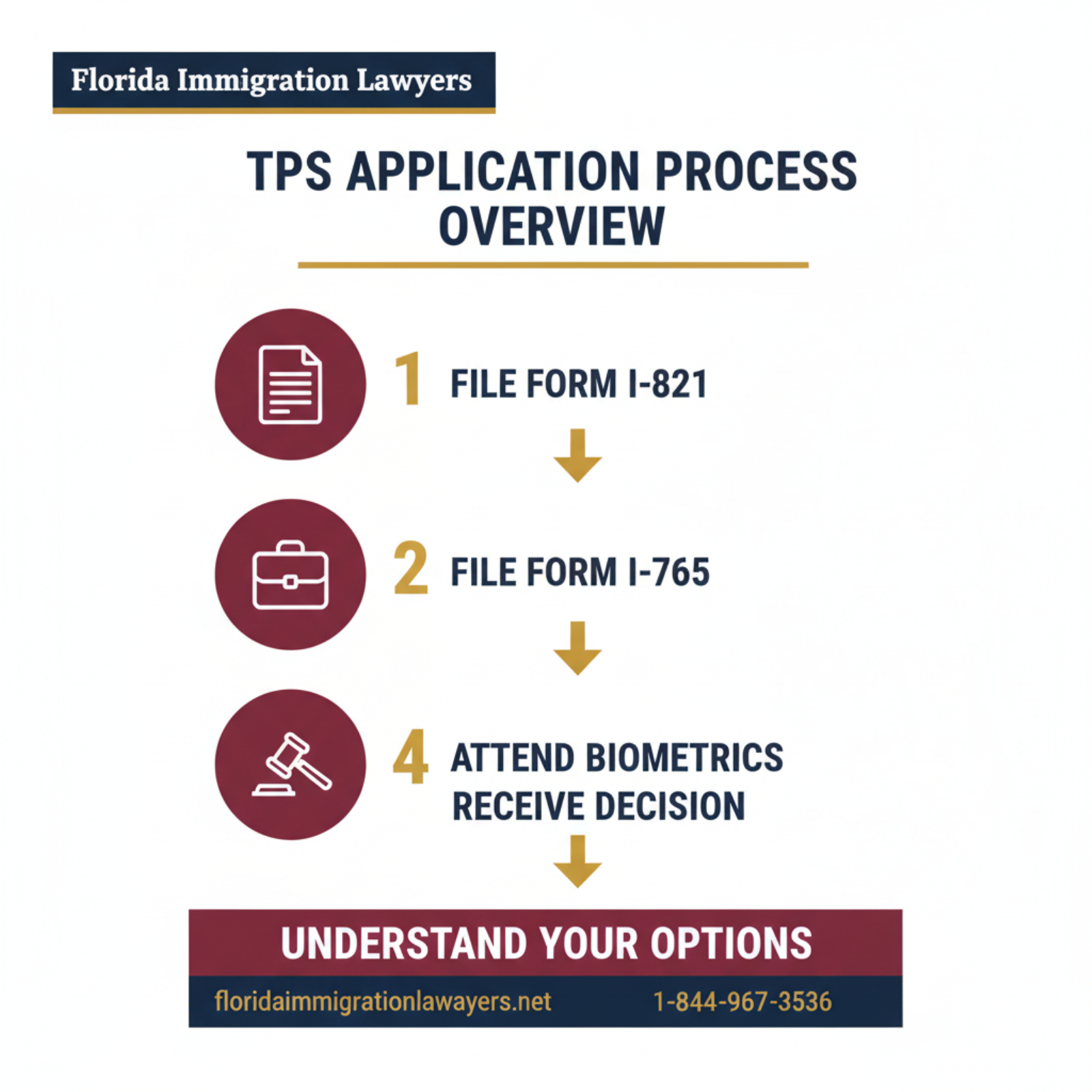
Navigating these steps, especially with the evolving legal landscape for TPS Nepal Honduras Nicaragua, can be challenging. Many Floridians seek assistance from experienced immigration attorneys to ensure everything is filed correctly.
Essential Document Checklist for Your TPS Application
A complete application package is vital for a smooth TPS process. Missing or incorrect documents can lead to delays or denial. Here is a general checklist of documents you will typically need to submit for TPS Nepal Honduras Nicaragua.
- Proof of Identity and Nationality:
- Copy of your passport from Nepal, Honduras, or Nicaragua.
- Copy of your birth certificate with photo identification.
- Any national identity document from your country of origin.
- Proof of Continuous Residence (CR) in the U.S. from the specified date:
- Rent receipts, utility bills (electric, water, gas) in your name.
- Employment records (pay stubs, W-2s, employment letters).
- School records (transcripts, enrollment letters).
- Medical records (hospital bills, vaccination records).
- Bank statements, credit card statements.
- Affidavits from friends, family, or employers attesting to your residence.
- Any dated receipts or correspondence with your name and U.S. address.
- Proof of Continuous Physical Presence (CPP) in the U.S. from the specified date:
- Entry stamps in your passport.
- I-94 Arrival/Departure Record.
- Copies of any previous immigration documents (e.g., I-797 approval notices).
- Travel records proving you have not departed the U.S. for extended periods.
- Photographs:
- Two identical passport-style color photographs taken recently.
- Criminal History Records (if applicable):
- Certified copies of all court dispositions for any arrests or convictions, even if expunged.
- Police clearance certificates.
- Proof of Relationship (if applying as a dependent):
- Marriage certificates for spouses.
- Birth certificates for children.
Organizing these documents can be overwhelming. A seasoned family immigration lawyer in Florida can help you compile a robust application package.
TPS Processing Times and Expectations for Florida Applicants
Processing times for TPS applications and Employment Authorization Documents (EADs) can vary significantly. USCIS processing times are influenced by factors such as the volume of applications, staffing levels, and the complexity of individual cases. For individuals with TPS Nepal Honduras Nicaragua, the ongoing legal situation can add another layer of unpredictability.
Typically, you can expect Form I-821 processing to take several months, and Form I-765 (EAD) processing can also range from a few months to over a year. USCIS often provides automatic extensions of EADs for specific TPS designations, which is crucial for maintaining employment authorization while your re-registration is pending. Always check the official USCIS website for the latest automatic extension validity dates.
You can monitor the approximate processing times for your specific USCIS service center or field office by visiting the USCIS Processing Times page. It is essential to remember that these are estimates, and actual processing times may differ. For those in Florida, whether you filed through the Vermont or Texas Service Center, keeping track of your case status online using your receipt number is highly recommended. Delays can be frustrating, but patience is key, along with ensuring you respond to any USCIS requests promptly.
Cost Factors and USCIS Fee Breakdown
Applying for or re-registering for TPS involves several fees payable to USCIS. These fees are subject to change, so always verify the current amounts on the official USCIS website before filing. It is important to budget for these costs, which can include:
- Form I-821, Application for Temporary Protected Status: There is generally a filing fee for this form, though in some re-registration periods, it may be waived for certain applicants.
- Form I-765, Application for Employment Authorization: If you wish to receive an Employment Authorization Document (EAD), this form requires a separate filing fee.
- Biometrics Services Fee: This fee covers the cost of fingerprinting and background checks. Most TPS applicants are required to pay this fee.
- Form I-601, Application for Waiver of Grounds of Inadmissibility: If you require a waiver for certain inadmissibility grounds, this form has a significant filing fee.
USCIS offers fee waivers for certain low-income applicants who meet specific guidelines. If you believe you may be eligible for a fee waiver, you should submit Form I-912, Request for Fee Waiver, along with your application package. Remember, legal fees for attorney assistance are separate from USCIS filing fees. Investing in legal counsel, especially for complex cases involving TPS Nepal Honduras Nicaragua, can prevent costly mistakes and provide peace of mind.
Do not navigate this complex immigration process alone. The stakes are too high for your future in Florida. Contact Florida Immigration Lawyers today to schedule your free consultation and get the guidance you deserve.
Common Mistakes Florida TPS Applicants Must Avoid
Applying for TPS, especially with the unique circumstances surrounding TPS Nepal Honduras Nicaragua, can be fraught with potential pitfalls. Avoiding these common mistakes is crucial for a successful outcome. Many of these errors can lead to delays, Requests for Evidence (RFEs), or even denial of your application.
- Missing Deadlines: Failing to file your application or re-registration within the specified USCIS window is one of the most common and detrimental mistakes. Always mark your calendar and aim to submit well before the deadline.
- Incomplete or Inaccurate Forms: Every question on the USCIS forms must be answered truthfully and completely. Leaving fields blank or providing incorrect information can trigger an RFE or outright denial.
- Failing to Provide Sufficient Evidence: You must submit clear, credible, and sufficient documentation to prove your continuous residence and physical presence. Generic or weak evidence can jeopardize your application.
- Not Disclosing Criminal History: Even minor arrests or convictions, including those expunged, must be disclosed. Failing to do so is a serious misrepresentation and can lead to permanent bars from immigration benefits.
- Failing to File for EAD: If you need to work legally, you must file Form I-765 concurrently with your I-821. A delay in filing means a delay in receiving your work permit.
- Not Keeping Copies of Everything: Always make and retain copies of your entire application package, including forms, supporting documents, and proof of mailing. This is vital for your records and if USCIS requests additional information.
- Ignoring USCIS Requests: If you receive an RFE or a Notice of Intent to Deny, respond promptly and thoroughly. Ignoring these notices will almost certainly lead to a denial.
- Traveling Internationally Without Advance Parole: Leaving the U.S. without first obtaining Advance Parole (Form I-131) can terminate your TPS status and make you inadmissible upon return. This is a critical error.
- Assuming Automatic Extension: While many EADs for TPS holders are automatically extended, you must still re-register for TPS when required. Do not assume your status is automatically renewed indefinitely.
- Misunderstanding the Ramos or Bhattarai Settlements: These legal decisions have specific nuances that apply to certain groups. Misinterpreting their scope can lead to incorrect assumptions about your eligibility or re-registration requirements.
- Not Seeking Legal Counsel: The complexities of immigration law, especially with the ongoing legal challenges for TPS Nepal Honduras Nicaragua, make professional legal guidance invaluable. Trying to navigate it alone often leads to preventable errors.
When to Call a Florida Immigration Lawyer for TPS Assistance
While some TPS applications may seem straightforward, the unique and evolving situation for TPS Nepal Honduras Nicaragua often warrants legal assistance. Florida Immigration Lawyers are here to help protect your future.
You should strongly consider contacting an attorney if:
- You have a criminal record: Even minor offenses can complicate TPS eligibility. An attorney can assess your record and advise on potential waivers or inadmissibility issues, especially relevant to 8 U.S.C. § 1182.
- You have previously been placed in deportation proceedings: If you have an existing case with an immigration court in Florida (e.g., Miami Immigration Court, Orlando Immigration Court) or have received a Notice to Appear (NTA), an attorney can help ensure your TPS application does not negatively impact your deportation defense.
- You have gaps in your continuous residence or physical presence: Proving these requirements can be challenging. An attorney can help you gather compelling evidence and prepare a strong argument.
- You received a Request for Evidence (RFE) or Notice of Intent to Deny (NOID): These notices indicate a problem with your application. An attorney can help you formulate a comprehensive and timely response.
- You are unsure about re-registration deadlines or the impact of legal settlements: The precise validity dates and re-registration periods for TPS Nepal Honduras Nicaragua are complex due to court orders. An attorney can clarify your specific situation.
- You wish to explore other immigration pathways: TPS is temporary. An attorney can discuss options for permanent residency, such as family-based petitions, asylum, or citizenship, if applicable.
- You are concerned about deportation: "Can people with TPS still get deported?" Yes, if your TPS is terminated, if you commit certain crimes, or if you violate other immigration laws. An attorney can provide crucial defense and guidance.
Florida Immigration Lawyers has extensive experience assisting individuals across Florida, including in Miami, Hialeah, Orlando, and Tampa. We understand the local nuances and federal complexities of TPS law. Let us be your trusted advocate.
About Florida Immigration Lawyers
Florida Immigration Lawyers is an immigration law firm dedicated to serving individuals and families throughout Florida. We understand the profound impact immigration matters have on your life. Our firm is committed to providing compassionate, effective, and results-driven legal representation.
Our experienced attorneys focus on a wide range of immigration services, including Temporary Protected Status (TPS), asylum, deportation defense, family-based immigration, business immigration, and naturalization. We pride ourselves on clear communication, strategic advocacy, and a deep understanding of U.S. immigration law.
We believe that everyone deserves high-quality legal representation, regardless of their background or current situation. When you choose Florida Immigration Lawyers, you gain a dedicated team committed to protecting your rights and achieving your immigration goals. We offer free consultations to discuss your case and provide honest assessments of your options.
Do not face the U.S. immigration system alone. Contact us today. We are available 24/7 to answer your questions and provide the support you need. Call us at 1-844-YO-PELEO or visit our website at https://www.floridaimmigrationlawyers.net. Serving all of Florida, we are here to help you navigate your immigration journey with confidence.
Sources and References
- U.S. Citizenship and Immigration Services (USCIS) - Temporary Protected Status
- U.S. Citizenship and Immigration Services (USCIS) - Filing Fees
- U.S. Department of Justice - Executive Office for Immigration Review (EOIR)
- 8 U.S.C. Chapter 12 - Immigration and Nationality Act (INA), specifically 8 U.S.C. § 1254a (INA 244)
- 8 CFR Part 244 - Temporary Protected Status
- Ramos v. Mayorkas, No. 18-cv-03467-LB (N.D. Cal.)
- Bhattarai v. Mayorkas, No. 19-cv-07313-EMC (N.D. Cal.)
This article provides general legal information and is not intended as legal advice. Every case is unique, and outcomes depend on specific facts and circumstances. Contact an attorney for advice about your particular situation. Immigration laws are subject to frequent change.
The path to maintaining your TPS status for Nepal, Honduras, or Nicaragua in Florida can be full of challenges, but you don't have to face them alone. Florida Immigration Lawyers is committed to providing the legal support you need. Our team is ready to guide you through every step of the process with care and professionalism. Take the first step towards securing your future. Call us for a free, confidential consultation at 1-844-YO-PELEO today. Se Habla Español - Estamos aquí para ayudarle.
Do Not Navigate This Process Alone
Our experienced immigration attorneys are ready to fight for you. Get a free, confidential case review today.
Se Habla Español
Or leave your details and we’ll call you:
Free Evaluation in 24 Hours
Or talk to us right now

AI voice assistant — available 24/7
FreeFrequently Asked Questions

William J. Vásquez
Founding Attorney · Vasquez Law Firm
U.S. Air Force veteran and immigration attorney with years of hands-on U.S. immigration experience. J.D., NCCU School of Law. AILA member. Admitted to the 4th, 5th, and 11th Circuit Courts.
Available 24/7 - Free Evaluations
Reviewed for legal accuracy by William J. Vásquez
Licensed in North Carolina; U.S. immigration is federal practice.
Related Legal Services
Our Florida immigration attorneys can help you with family immigration services, immigration lawyer cost in Florida and experienced immigration attorneys. Call today at 1-844-YO-PELEO for a free case review.
Related Links
Related Topics
Free Legal Case Review
Discuss your case with our experienced attorneys. We're available 24/7.
Se Habla Español - Estamos aquí para ayudarle.
Related Articles
Dual Citizenship Lawyer in Florida: What You Need to Know
For Florida residents, the concept of dual citizenship, or holding two passports, offers a compelling blend of opportunities and challenges. While the U.S. generally permits dual nationality, the path to achieving this status requires a meticulous understanding of both U.S. immigration laws and the citizenship policies of your country of origin. This guide explores the definition of dual citizenship, the detailed step-by-step process for U.S. naturalization, and the significant benefits and potential pitfalls involved. We cover essential documentation, typical timelines, and cost considerations for 2026, providing crucial insights for anyone in Orlando, Miami, or across Florida considering this important legal step. Learn about common mistakes to avoid and understand when to seek professional legal counsel to navigate this complex process successfully. Florida Immigration Lawyers is here to provide expert, bilingual support for your dual citizenship journey.
Immigration Lawyer Orlando Free Consultation in Florida
For individuals and families in Orlando, Florida, navigating the complexities of U.S. immigration law requires expert guidance. An immigration lawyer in Orlando offers crucial support for everything from visa applications and green card processes to naturalization and deportation defense. This comprehensive guide details what a free consultation covers, providing a step-by-step overview of immigration pathways, essential document checklists, and expected timelines in 2026. We also highlight common mistakes to avoid, discuss the critical role of legal counsel in deportation and asylum cases, and explain why choosing a local Orlando immigration attorney is beneficial. Florida Immigration Lawyers is dedicated to serving the diverse community of Orlando with compassionate, effective legal solutions, ensuring you receive personalized advice and robust representation for a successful immigration journey.
EAD Advance Parole Combo Card in Florida 2026
For individuals with a pending Form I-485, Application to Register Permanent Residence or Adjust Status, the EAD Advance Parole Combo Card is an essential document. This single card combines the authorization to work legally in the U.S. (Employment Authorization Document - EAD) with permission to travel internationally and re-enter without abandoning your green card application (Advance Parole). This guide from Florida Immigration Lawyers provides a comprehensive overview for applicants in Florida in 2026, covering eligibility, the step-by-step application process, required documents, expected processing times, and associated costs. We also highlight common mistakes to avoid and when to seek legal counsel to ensure a smooth and successful immigration journey. Understanding this vital card is key to maintaining stability while awaiting your permanent residency approval.
TPS Re-Registration 2026 Deadlines in Florida
Stay informed about TPS re-registration deadlines in Florida for 2026. This article covers essential steps, timelines, and common mistakes to avoid. If you need help, Florida Immigration Lawyers is here to assist you with your immigration needs. Call 1-844-YO-PELEO for a free case review.