TPS Honduras Extension 2026 Florida: Your Essential Guide
For many Honduran nationals in Florida, the status of Temporary Protected Status (TPS) is a critical concern, especially regarding the <b>TPS Honduras extension 2026</b>. This article provides a comprehensive overview of the current legal landscape, including the impact of ongoing litigation that has paused the termination of TPS for Honduras. We will guide you through the eligibility requirements, application process, and what you can expect concerning timelines and costs. Understanding these complexities is vital for maintaining your protected status. Florida Immigration Lawyers is here to help you navigate these intricate details.

The TPS Honduras extension 2026 is currently impacted by ongoing litigation, specifically the Ramos v. Mayorkas settlement agreement, which continues to pause the termination of Temporary Protected Status for eligible Honduran nationals. Beneficiaries in Florida can generally maintain their status and work authorization, but specific re-registration periods and expiration dates are subject to official USCIS announcements. Always consult an immigration attorney for personalized guidance on your unique situation.
- TPS for Honduras remains extended due to litigation.
- Eligible beneficiaries must follow USCIS re-registration guidelines.
- Work authorization documents are typically auto-extended.
- It is crucial to stay informed about official USCIS updates.
- Legal counsel is highly recommended for navigating renewals.
TPS Honduras Extension 2026 Florida: Your Essential Guide
Are you a Honduran national in Florida concerned about your Temporary Protected Status (TPS)? The prospect of a TPS Honduras extension 2026 is a significant topic for many families across our state. Understanding the nuances of this immigration benefit, especially with ongoing legal developments, is crucial for maintaining your status and peace of mind.
Florida Immigration Lawyers understands the anxieties and questions you may have regarding your future. We are dedicated to providing clear, reliable information and robust legal support. This comprehensive guide will delve into the current status of TPS for Honduras, outline the application process, and address common concerns for those living in Florida.
Do not let uncertainty jeopardize your immigration status. For personalized advice and to ensure you meet all requirements, we encourage you to seek expert legal assistance. Call Florida Immigration Lawyers at 1-844-967-3536 for a free consultation and let our experienced team help you navigate the complexities of your TPS.
Understanding TPS Honduras Extension 2026 in Florida
Temporary Protected Status (TPS) offers protection to eligible foreign nationals from designated countries facing temporary conditions like armed conflict or natural disaster. Honduras was initially designated for TPS in 1999 following Hurricane Mitch. Since then, its designation has been extended multiple times.
The current situation regarding the TPS Honduras extension 2026 is primarily shaped by federal court litigation. While the Department of Homeland Security (DHS) had previously announced termination for several TPS countries, including Honduras, court orders have paused these terminations. This means that TPS for Honduras continues to be in effect for eligible beneficiaries.
Specifically, the Ramos v. Mayorkas settlement agreement has played a pivotal role. This agreement provides a pathway for certain TPS beneficiaries, including those from Honduras, to maintain their status and work authorization documents. It is vital for all eligible individuals in Florida to understand how these legal developments impact their specific situation.
Florida has a substantial Honduran population, particularly in areas like Miami, Orlando, and St. Petersburg. For these communities, the continuation of TPS is a lifeline, offering stability and the ability to work legally. Our firm, Florida Immigration Lawyers, is well-versed in the unique needs of immigrants across the state, from Jacksonville to the Florida Keys.
The Immigration and Nationality Act (INA) Section 244 and 8 CFR Part 244 govern the TPS program. These legal frameworks outline the criteria for designation, eligibility, and the application process. Staying informed about any changes to these regulations or new court rulings is paramount for TPS holders.
USCIS regularly issues Federal Register Notices (FRNs) to provide official updates on TPS designations and extensions. These notices are the authoritative source for re-registration periods and validity dates for Employment Authorization Documents (EADs). You can find more information directly from U.S. Citizenship and Immigration Services (USCIS).
Impact of Litigation on TPS Honduras
The termination of TPS for Honduras, initially scheduled to take effect, was enjoined by federal courts. This legal intervention has allowed hundreds of thousands of beneficiaries to retain their status. The Ramos v. Mayorkas settlement, along with other related cases like Bhattarai v. Mayorkas and Sanchez v. Mayorkas, effectively extended the validity of TPS and related work permits.
This means that while a new, definitive TPS Honduras extension 2026 beyond the current litigation-driven extensions has not been formally announced by Congress or DHS, the existing court orders provide continued protection. Beneficiaries should monitor USCIS announcements closely for specific re-registration periods and automatic EAD extensions.
For those residing in St. Petersburg and other Florida cities, understanding these legal safeguards is essential. It ensures you continue to live and work without fear of immediate termination of your status. Our attorneys at Florida Immigration Lawyers regularly track these legal developments to provide our clients with the most up-to-date guidance.
Eligibility and Application Process for TPS Honduras Beneficiaries
To be eligible for TPS, individuals must meet several criteria. These generally include being a national of the designated country, having been continuously physically present in the U.S. since the effective date of the most recent designation, and having continuously resided in the U.S. since a specified date. Certain criminal or security bars can make an applicant ineligible.
Renewing your TPS, especially with the TPS Honduras extension 2026 considerations, involves specific steps. Even with automatic extensions, re-registration is often required to maintain your status and receive new documentation. Failing to re-register on time can lead to a lapse in your protection and work authorization.
Step-by-Step Guide to TPS Honduras Renewal
Renewing your TPS status involves careful attention to detail and adherence to USCIS guidelines. Follow these steps to ensure a smooth re-registration process:
- Determine Your Eligibility: Confirm you meet the continuous physical presence and continuous residence requirements for Honduras's TPS designation. Ensure no disqualifying factors, such as certain criminal convictions, apply to your case.
- Gather Necessary Documents: Collect all required supporting documentation. This includes proof of identity, nationality, residence, and any previous TPS approvals or EADs. A detailed checklist is provided below.
- Complete Required Forms: Fill out Form I-821, Application for Temporary Protected Status. If you need a new Employment Authorization Document (EAD), you must also file Form I-765, Application for Employment Authorization. If you have any grounds of inadmissibility, you may need to file Form I-601, Application for Waiver of Grounds of Inadmissibility.
- Pay Applicable Fees or Request a Fee Waiver: Review the USCIS website for the latest fee schedule. You may be required to pay fees for Form I-821, Form I-765, and biometric services. If you cannot afford the fees, you may be eligible to apply for a fee waiver using Form I-912, Request for Fee Waiver.
- Submit Your Application Package: Mail your completed forms and all supporting documents to the correct USCIS filing address. Ensure your package is complete and organized to avoid delays. Keep copies of everything you submit.
- Attend Biometrics Appointment: After filing, USCIS will send you a notice for a biometrics appointment at an Application Support Center (ASC). It is mandatory to attend this appointment, where your fingerprints, photograph, and signature will be collected.
- Receive Decision: USCIS will process your application and send you a written decision. If approved, you will receive an approval notice and, if requested, a new EAD.
Document Checklist for TPS Honduras Renewal
Having all your documents in order is critical for a successful TPS renewal. Here is a general list of documents you will typically need:
- Proof of identity and nationality (e.g., birth certificate, national identity document with photo, Honduran passport).
- Proof of continuous residence in the U.S. since the specified date for Honduras's TPS designation (e.g., utility bills, rent receipts, school records, employment records, medical records).
- Proof of continuous physical presence in the U.S. since the specified date (e.g., passport entries, I-94 records, travel itineraries).
- Any previous USCIS notices or documents related to your TPS status (e.g., I-797 approval notices, previous EADs).
- Marriage certificate (if applicable, for name changes or derivative status).
- Birth certificates of dependents (if applying for derivative TPS, though generally not applicable for renewals).
- Two passport-style photos (if required by the forms).
- Receipts of any previous fee payments to USCIS.
Please note that this is a general checklist. Your specific situation may require additional documents. Consulting with an experienced immigration lawyer at Florida Immigration Lawyers can help you prepare a complete and accurate application package.
Navigating the TPS Honduras Extension 2026 Timeline and Processing
The timeline for TPS Honduras extension 2026 processing can vary significantly. USCIS processing times are subject to various factors, including the volume of applications, staffing levels, and the complexity of individual cases. While some extensions may be automatic due to litigation, formal re-registration periods are still announced by USCIS.
Historically, USCIS has issued Federal Register Notices that automatically extend the validity of EADs and other TPS-related documents for a period. This provides continuity of work authorization while new applications are processed. However, it is crucial to verify the specific dates and instructions in the most recent FRN.
You can check the current processing times for Form I-821 and Form I-765 on the USCIS website. It is important to remember that these are estimates and actual processing can take longer. Delays can be particularly frustrating, but patience and proactive follow-up are key.
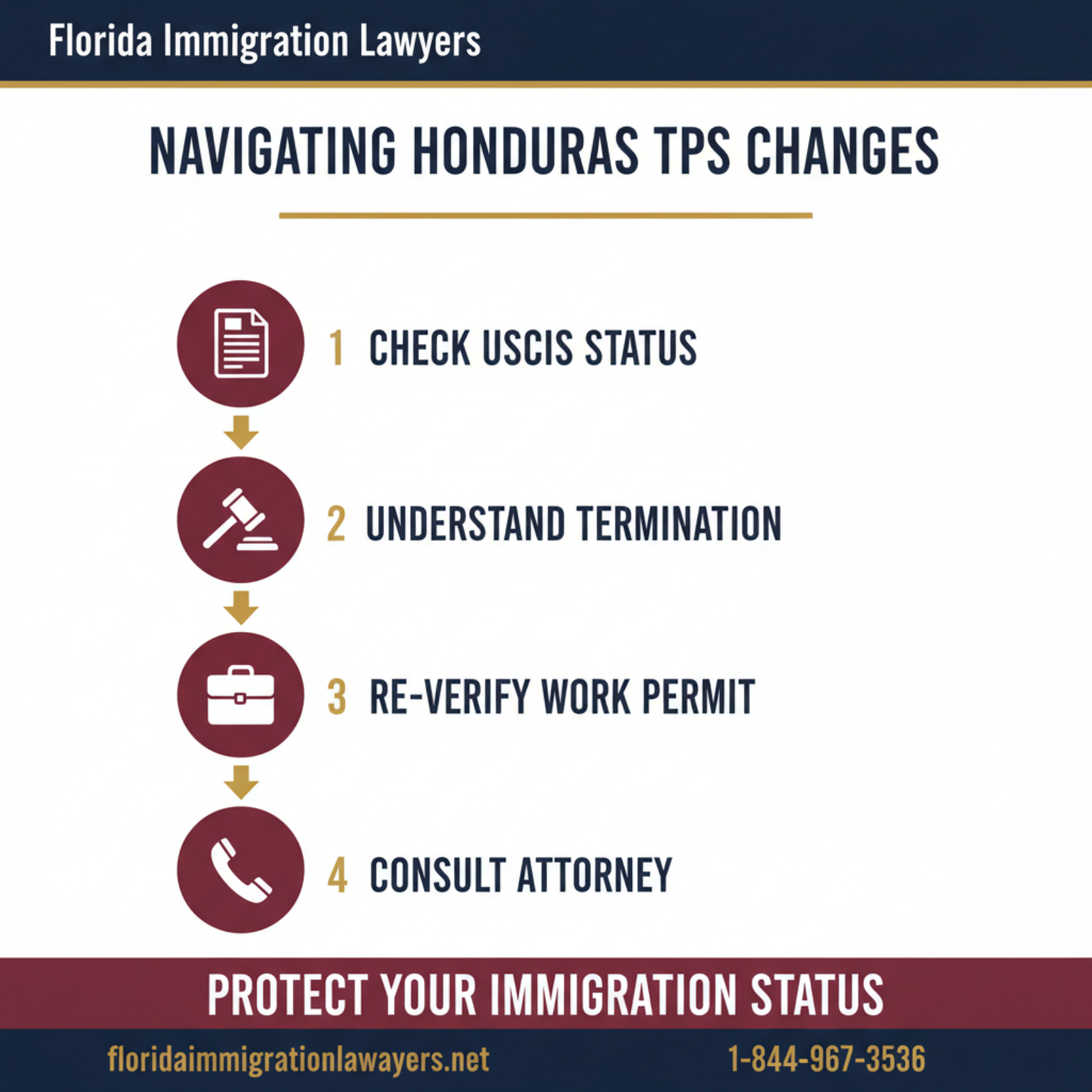
For those in Florida, monitoring these timelines is critical to maintaining employment and legal status. If your EAD is auto-extended, ensure your employer is aware of the official USCIS notices regarding the extension to avoid any issues with employment verification.
The legal landscape surrounding TPS, especially for Honduras, has been dynamic. While the Ramos settlement has provided stability, future legislative or judicial actions could impact the program. Staying updated through reliable sources, such as our legal team, is the best approach.
Cost Factors and Fee Breakdown for TPS Honduras Renewals
Understanding the costs associated with your TPS Honduras extension 2026 renewal is an important part of the process. USCIS charges fees for various forms, and these fees are subject to change. It is essential to refer to the official USCIS website or consult with an attorney for the most current fee schedule.
Typically, fees include the filing fee for Form I-821, Application for Temporary Protected Status, and Form I-765, Application for Employment Authorization (if you are requesting an EAD). There is also a biometric services fee, which covers the cost of fingerprinting and background checks.
USCIS offers fee waivers for individuals who can demonstrate an inability to pay. To apply for a fee waiver, you must file Form I-912, Request for Fee Waiver, along with supporting documentation of your financial hardship. Eligibility for a fee waiver depends on meeting specific income guidelines or receiving certain public benefits.
Beyond USCIS fees, you may also incur costs for obtaining necessary documents, such as birth certificates or translation services. Legal fees for attorney assistance are an additional consideration. While you can file TPS applications yourself, the complexity of the process, especially with ongoing litigation, often warrants professional legal help.
Investing in legal counsel can save you time, reduce stress, and prevent costly mistakes that could jeopardize your status. Florida Immigration Lawyers offers transparent fee structures and can discuss payment options during your free consultation. We believe everyone deserves access to quality legal representation.
Common Mistakes to Avoid with TPS Honduras Renewal
Renewing your TPS can be a complex process, and even minor errors can lead to delays or denials. Being aware of common pitfalls can help you avoid them, especially with the ongoing TPS Honduras extension 2026 considerations.
- Failing to Re-Register on Time: Even with automatic EAD extensions, USCIS typically requires re-registration within a specific window. Missing this deadline can lead to a lapse in your status and work authorization, requiring you to file a late application with a valid reason.
- Submitting Incomplete or Incorrect Forms: Omitting information, failing to sign forms, or making errors can cause your application to be rejected or significantly delayed. Always double-check all fields and ensure all necessary forms are included.
- Not Providing Sufficient Supporting Documentation: Your application must be supported by adequate proof of identity, nationality, continuous residence, and continuous physical presence. A lack of evidence can lead to requests for evidence (RFEs) or denial.
- Failing to Disclose Criminal History: Any criminal convictions, even minor ones, must be disclosed. Failure to do so can be considered misrepresentation and may lead to severe immigration consequences, including deportation. Consult an attorney if you have any criminal history.
- Ignoring Biometrics Appointment Notices: Missing your biometrics appointment without rescheduling can result in the denial of your application. These appointments are mandatory for identity verification and background checks.
- Assuming Automatic Extension Covers Everything: While EADs may be auto-extended, this does not always negate the need to re-register for TPS. Always refer to the latest Federal Register Notice for specific instructions regarding both EADs and TPS status itself.
- Not Updating USCIS with Change of Address: If you move, you must inform USCIS within 10 days by filing Form AR-11, Alien's Change of Address Card. Failure to do so can result in missed notices and critical communications.
- Attempting to Travel Internationally Without Authorization: Leaving the U.S. without an approved Form I-131, Application for Travel Document (Advance Parole), can lead to your TPS being terminated and potential inadmissibility upon return.
- Not Seeking Legal Counsel for Complex Cases: If you have a criminal history, previous immigration violations, or other complicating factors, attempting to navigate the renewal process alone can be risky. An immigration attorney can identify potential issues and help strategize your application.
- Relying on Unofficial Information: Always verify information from official USCIS sources or reputable immigration attorneys. Misinformation can lead to critical errors in your application.
When to Call a Lawyer for TPS Honduras Assistance
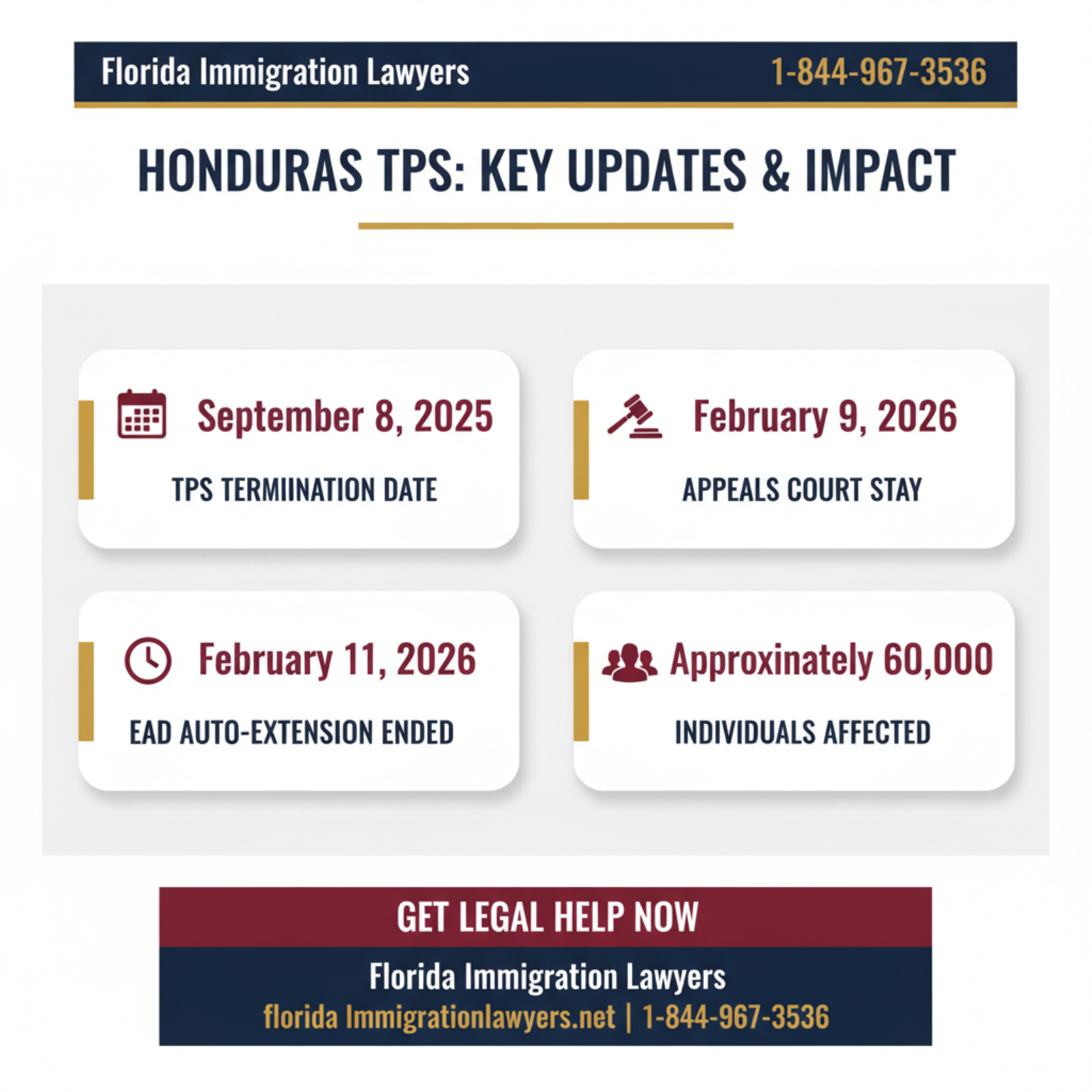
While some TPS renewals may seem straightforward, the complexities surrounding the TPS Honduras extension 2026 due to ongoing litigation make legal counsel invaluable. You should consider contacting an immigration lawyer from Florida Immigration Lawyers in several specific scenarios.
If you have any criminal history, no matter how minor, it is critical to consult an attorney. Certain convictions can make you ineligible for TPS or other immigration benefits, and attempting to conceal them can have severe consequences. Our asylum and deportation defense attorneys are skilled in handling such delicate matters.
If you have traveled outside the U.S. without proper authorization (Advance Parole) since receiving TPS, your status may be jeopardized. An attorney can assess the impact of your travel and advise on the best course of action. This is a common red flag that requires expert guidance.
Furthermore, if you have previously been denied any immigration benefit, or if you have an order of removal or deportation, your case is highly complex. Attempting to file for TPS renewal without legal representation in these situations could lead to further complications or even trigger enforcement actions.
Our firm also assists with related immigration matters, such as pursuing family-based immigration or exploring pathways to U.S. citizenship. If you are considering other immigration options alongside your TPS, our attorneys can provide a comprehensive strategy tailored to your goals.
Even if your case seems simple, having an attorney review your application before submission can prevent costly mistakes and ensure all documentation is correct and complete. The peace of mind that comes with professional guidance is invaluable. Our attorneys are available to discuss your case and provide the clarity you need. Visit our attorneys page to learn more about our dedicated team.
About Florida Immigration Lawyers
Florida Immigration Lawyers is a leading law firm dedicated to serving the diverse immigration needs of individuals and families across Florida. With years of specialized experience, our team of compassionate and knowledgeable attorneys is committed to providing exceptional legal representation and personalized service.
We understand that navigating the U.S. immigration system can be daunting. Our firm offers a comprehensive range of immigration services, including assistance with Temporary Protected Status (TPS) renewals, family-based petitions, employment visas, asylum claims, deportation defense, and naturalization. We are here to guide you through every step of your immigration journey.
Why choose Florida Immigration Lawyers? We pride ourselves on our client-focused approach, deep understanding of immigration law, and unwavering dedication to achieving the best possible outcomes for our clients. Our attorneys are accessible, responsive, and always ready to fight for your rights.
We serve clients in St. Petersburg, Miami, Orlando, Jacksonville, and all other communities throughout Florida. Our team is available 24/7 to answer your questions and provide support. For a free consultation to discuss your immigration needs, call us today at 1-844-967-3536 or visit our website at https://www.floridaimmigrationlawyers.net. Let us be your trusted legal partners in Florida.
Sources and References
- U.S. Citizenship and Immigration Services (USCIS) - TPS Honduras
- U.S. Citizenship and Immigration Services (USCIS) - Check Processing Times
- Executive Office for Immigration Review (EOIR)
- 8 U.S.C. Chapter 12 - Immigration and Nationality Act (INA) Section 244
- 8 Code of Federal Regulations (CFR) Part 244 - Temporary Protected Status
- Federal Register Notices (FRN) - Various publications regarding TPS extensions.
- Ramos v. Mayorkas, No. 18-cv-03290-EMC (N.D. Cal.) - Settlement Agreement
This article provides general legal information and is not intended as legal advice. Every case is unique, and outcomes depend on specific facts and circumstances. Contact an attorney for advice about your particular situation.
The TPS Honduras extension 2026 continues to be a evolving area of immigration law. Ensuring your application is prepared correctly and submitted on time is paramount to protecting your status. Do not risk your future by navigating this complex process alone.
Our experienced team at Florida Immigration Lawyers is ready to provide the compassionate and expert legal assistance you deserve. We are committed to helping you understand your options and achieve a favorable outcome. Call us today at 1-844-967-3536 for a free consultation. Se Habla Español - Estamos aquí para ayudarle.
Do Not Navigate This Process Alone
Our experienced immigration attorneys are ready to fight for you. Get a free, confidential consultation today.
Se Habla Español
Frequently Asked Questions
Florida Immigration Lawyers
Immigration Attorney | Founder, Vasquez Law Firm
U.S. Air Force veteran and immigration attorney with 30,000+ cases resolved. J.D., NCCU School of Law. AILA member. Admitted to the 4th, 5th, and 11th Circuit Courts.
Available 24/7 - Free Evaluations
Related Legal Services
Our Florida immigration attorneys can help you with business immigration, asylum protection and deportation defense. Call today at 1-844-967-3536 for a free consultation.
Related Links
Related Topics
Free Legal Consultation
Discuss your case with our experienced attorneys. We're available 24/7.
Se Habla Español - Estamos aquí para ayudarle.
Related Articles
RFE Florida Response: Expert Guide for USCIS Requests
Receiving a Request for Evidence (RFE) from USCIS can be a critical moment for your immigration application in Florida. This guide breaks down what an RFE means, why USCIS issues them, and how to prepare a robust <strong>RFE Florida response</strong>. From understanding specific requirements and compiling essential documents to navigating processing timelines and avoiding common mistakes, we provide actionable advice. Whether you are in West Palm Beach or elsewhere in Florida, a well-crafted response is crucial. Learn when to seek expert legal assistance to ensure your application has the best chance of approval. Contact Florida Immigration Lawyers for comprehensive support.
Understanding Citizenship Delay in Florida Applications
Facing delays with your citizenship application in Florida? Learn about the N-400 processing, USCIS backlogs, and steps to mitigate issues. Call Florida Immigration Lawyers at 1-844-967-3536 for a free consultation.
Citizenship Delay Florida: Navigating N-400 Processing
Experiencing a citizenship delay in Florida, particularly with N-400 processing, can be a source of significant stress and uncertainty. Understanding the reasons behind USCIS backlogs, knowing how to check your case status, and exploring options like expedite requests are crucial steps. This comprehensive guide from Florida Immigration Lawyers details the naturalization process, essential documents, common mistakes to avoid, and when to seek professional legal assistance. Whether you are in Hialeah, Miami, or anywhere in Florida, our firm offers expert guidance to navigate the complexities of your citizenship application and help you achieve your goal of becoming a U.S. citizen.
Dual Citizenship Florida: Get Two Passports in 2026
Dreaming of holding two passports and enjoying the benefits of dual citizenship in Florida? This comprehensive guide explains the naturalization process, required documents, timelines, and costs for obtaining dual citizenship. Learn about U.S. policy regarding dual nationality, common mistakes to avoid, and when to seek legal counsel from Florida Immigration Lawyers. We cover everything from eligibility requirements to the oath ceremony, with a focus on residents in Orlando and across Florida. Understand the advantages and potential challenges of having two passports and how our firm can provide expert guidance for a smooth application process. Contact us for a free consultation.