Schedule A Nurse Immigration: Florida Hospitals 2026
Schedule A nurse immigration is essential for Florida hospitals, offering a streamlined pathway for foreign nurses to work in Pembroke Pines. Learn about the EB-3 process and how Florida Immigration Lawyers can assist you.

- Understanding Schedule A designation
- EB-3 visa requirements
- Florida-specific resources
- Timeline and costs involved
Introduction
As Florida's healthcare industry continues to expand, the demand for qualified nurses grows exponentially. Schedule A nurse immigration is a vital pathway for foreign nurses looking to work in Pembroke Pines and other Florida areas. This article explores the steps involved in obtaining an EB-3 visa under the Schedule A designation, providing valuable information for prospective immigrants and employers alike.
Florida, a state known for its growing population and significant retiree community, faces an ever-increasing need for skilled healthcare professionals. Hospitals and clinics, particularly in rapidly developing areas like Pembroke Pines, are actively seeking dedicated nurses to maintain high standards of patient care. The Schedule A designation offers a streamlined route for international nurses to fill these crucial roles, contributing significantly to the local economy and community well-being.
Navigating the U.S. immigration system can be daunting, but with the right guidance, the journey to a rewarding nursing career in Florida is achievable. Understanding each phase of the EB-3 visa process, from initial certification to the final visa interview, is key to a successful application. Florida Immigration Lawyers are committed to assisting both nurses and healthcare employers through every step, ensuring compliance and efficiency. Call us at 1-844-967-3536 for a free consultation and expert guidance through this complex process.
What is Schedule A Nurse Immigration?
Schedule A is a U.S. Department of Labor designation that pre-certifies certain occupations, including registered nurses, as having a shortage of U.S. workers. This means that employers do not need to undergo the lengthy labor certification process when hiring foreign nurses.
As of 2026, this designation continues to streamline the immigration process for qualified nurses, making it quicker and more efficient to secure employment in U.S. healthcare facilities. Nurses under Schedule A can apply for an EB-3 visa, which is a third preference employment-based visa.
The Schedule A designation was established to address critical labor shortages in specific professions deemed vital to the U.S. economy and public welfare. For registered nurses, this designation acknowledges the persistent national shortage, allowing healthcare providers to recruit international talent without the extensive recruitment efforts typically required for other employment-based visas. This significantly reduces the processing time and administrative burden for both the employer and the prospective immigrant nurse.
This pre-certification is a significant advantage, as it bypasses the PERM labor certification process, which can add many months, if not over a year, to the immigration timeline. For nurses and their families, an approved EB-3 visa under Schedule A leads to permanent resident status (Green Card), offering stability, the ability to live and work indefinitely in the U.S., and a pathway to U.S. citizenship. It represents a long-term commitment from both the U.S. government and the sponsoring employer to integrate these essential healthcare professionals into the American workforce.
For more information on the EB-3 visa, visit USCIS. For personalized assistance with your Schedule A nurse immigration process, contact Florida Immigration Lawyers at 1-844-967-3536.
How Does the EB-3 Visa Process Work for Nurses?
To obtain an EB-3 visa under Schedule A, nurses must meet specific requirements and follow a detailed application process. The steps include:
- Obtaining a VisaScreen Certificate from the Commission on Graduates of Foreign Nursing Schools (CGFNS)
- Securing a job offer from a U.S. employer
- Submitting Form I-140, Immigrant Petition for Alien Worker, through your employer
- Attending a visa interview at a U.S. consulate or embassy
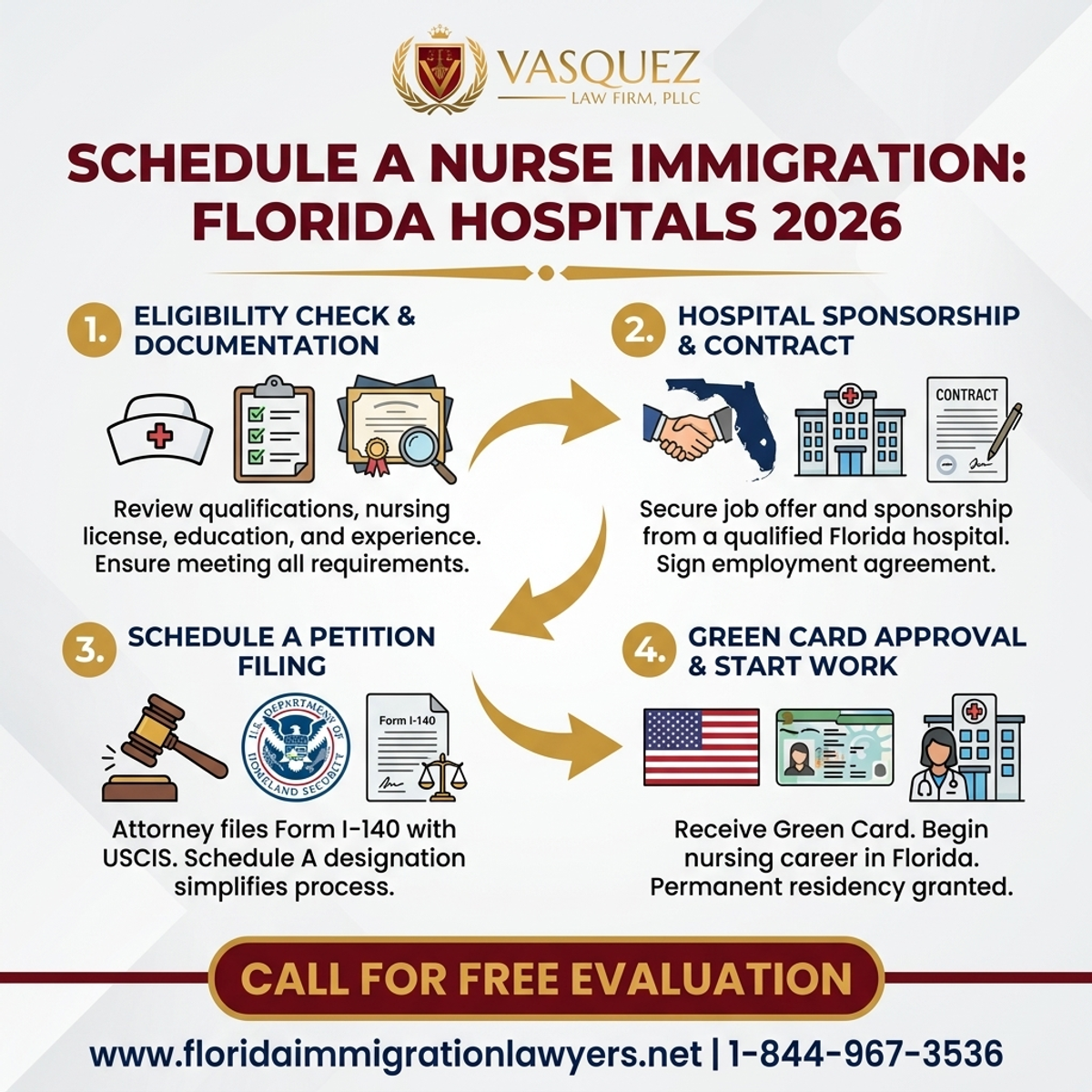
Step-by-Step Process — Schedule A Nurse Immigration: Florida Hospitals 2026
The journey begins with the **VisaScreen Certificate**, a crucial evaluation by CGFNS that verifies your nursing education, license, and English language proficiency meet U.S. standards. This step is foundational, as without it, the subsequent visa application cannot proceed. Nurses should start this process early, as it can involve credential evaluation and language testing that takes time to complete.
Next, securing a **bona fide job offer** from a U.S. healthcare facility, such as a hospital in Pembroke Pines, is essential. The employer must be willing to sponsor your EB-3 visa. This typically involves a full-time position that meets the prevailing wage requirements for registered nurses in that geographic area. A clear employment contract outlining terms, duties, and compensation is vital at this stage.
Once a job offer is secured and VisaScreen is complete, your U.S. employer will file **Form I-140, Immigrant Petition for Alien Worker**, on your behalf with U.S. Citizenship and Immigration Services (USCIS). This petition establishes your eligibility for the EB-3 visa under the Schedule A designation. USCIS will review the petition, your qualifications, and the employer's ability to pay the offered wage. An experienced immigration attorney from Florida Immigration Lawyers can help ensure this petition is meticulously prepared, reducing the likelihood of Requests for Evidence (RFEs) or delays.
After the I-140 is approved and your priority date becomes current (if applicable), the final stage involves either **consular processing** (if you are outside the U.S.) or **adjustment of status** (if you are already in the U.S. on a valid non-immigrant visa). Consular processing involves an interview at a U.S. embassy or consulate in your home country. Adjustment of status involves filing Form I-485 with USCIS. Both paths culminate in a medical examination and an interview where your eligibility and admissibility to the U.S. are determined.
The process can be complex, but with the right preparation and legal assistance, it is manageable. For assistance, contact our firm.
Documents Needed for Schedule A Nurse Immigration
- **VisaScreen Certificate:** This comprehensive certificate from CGFNS confirms your foreign nursing credentials are equivalent to U.S. standards, including education, licensure, and English language proficiency. It is a non-negotiable requirement for Schedule A nurses.
- **Valid RN license from the state of intended employment:** Before your EB-3 visa can be finalized, you must hold a valid, unencumbered registered nurse license from the U.S. state where you intend to work, such as Florida. This often requires passing the NCLEX-RN examination.
- **Passport:** A valid passport from your country of origin is required for identification and travel purposes. Ensure it has sufficient validity remaining, ideally at least six months beyond your anticipated entry into the U.S.
- **Employment offer letter:** This official document from your U.S. employer must detail your full-time nursing position, salary, duties, and the employer's commitment to sponsor your EB-3 visa. It serves as proof of a legitimate job offer.
- **Completed Form I-140:** While your employer files this, you are responsible for providing all necessary personal information and supporting documents. This petition formally requests an immigrant visa for you based on your employment.
- **Educational Transcripts and Diplomas:** While covered by VisaScreen, having original or certified copies of your nursing school transcripts and diplomas readily available is always prudent.
- **Birth Certificate and Marriage Certificate (if applicable):** These are needed for identity verification and to include eligible family members (spouse and unmarried children under 21) in your application.
Ensure all documents are current and properly certified. Missing or incorrect documentation can delay the process significantly.
Meticulous organization and verification of all required documents are paramount. Any discrepancies or omissions can lead to Requests for Evidence (RFEs) from USCIS, significantly prolonging your application timeline. It is highly recommended to work with an experienced immigration attorney, like those at Florida Immigration Lawyers, to review and prepare your documentation package, minimizing potential pitfalls.
Timeline and Processing Expectations
| Stage | Typical Timeframe | Notes |
|---|---|---|
| VisaScreen Certification | 3-6 months | Prepare early to avoid delays |
| Form I-140 Approval | 6-12 months | Depends on USCIS processing times |
| Visa Interview | 1-2 months | Schedule at nearest embassy or consulate |
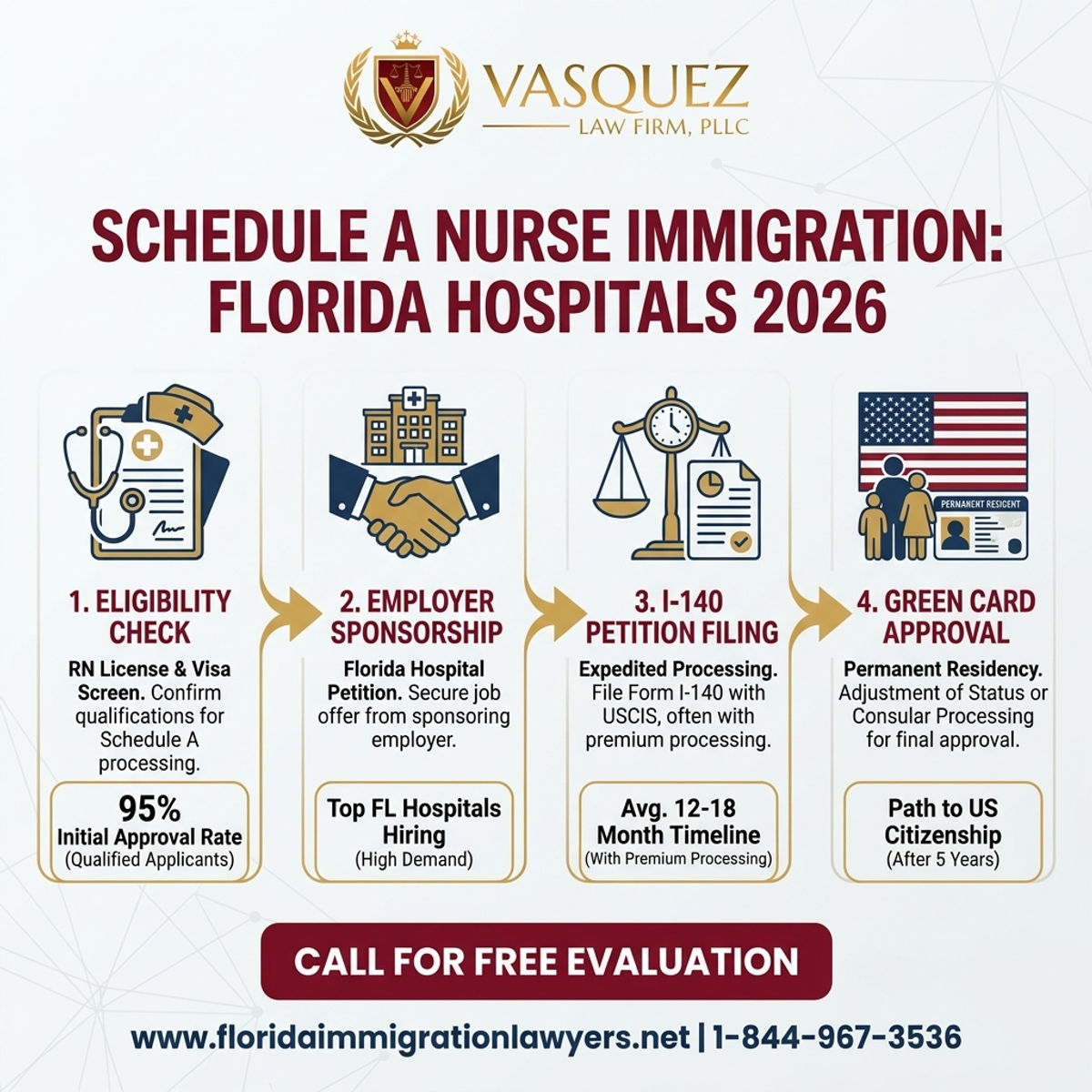
Key Statistics — Schedule A Nurse Immigration: Florida Hospitals 2026
Be aware that processing times can vary based on individual circumstances and current immigration policies.
While the provided table offers typical timeframes, it's crucial to understand that these are estimates. Actual processing times can fluctuate significantly due to various factors, including the volume of applications USCIS receives, government shutdowns, changes in immigration policy, and the specific service center handling your case. For instance, a Request for Evidence (RFE) from USCIS can add several months to the I-140 processing time.
Furthermore, the availability of immigrant visas (Green Cards) is subject to annual quotas and per-country limits. While Schedule A nurses generally have favorable priority dates, it's essential to monitor the U.S. Department of State's monthly Visa Bulletin to track the "priority date" for your country of charge. Your priority date is established when your Form I-140 is properly filed. An experienced immigration lawyer from Florida Immigration Lawyers can help you interpret the Visa Bulletin and understand its implications for your specific timeline.
Patience and proactive follow-up are key throughout this process. Maintaining open communication with your employer and legal counsel will help you stay informed about any developments or potential delays. Planning for a comprehensive timeline, potentially extending beyond the typical estimates, will help manage expectations and reduce stress during this significant life transition.
Cost Factors and Fee Breakdown
| Item | Typical Fee | Notes |
|---|---|---|
| VisaScreen Certification | Variable | Check with CGFNS for current rates |
| Form I-140 Filing Fee | Variable | Consult USCIS for updated fees |
| Medical Examination | Variable | Cost varies by provider |
Costs can fluctuate, so it is important to verify current fees with relevant agencies.
Beyond the primary government filing fees, prospective Schedule A nurses should budget for several other significant expenses. The CGFNS VisaScreen Certification typically ranges from $500 to $700. The USCIS Form I-140 filing fee is currently $715 (as of early 2024, subject to change). Additionally, there are fees for the medical examination, which can range from $200 to $500 depending on the physician and required vaccinations.
Other potential costs include: attorney fees for expert legal guidance and representation (which vary based on the complexity of the case and services provided), translation fees for foreign documents, courier services, travel expenses for the visa interview, and potentially fees for state nursing licensure applications and the NCLEX-RN exam. It is vital to obtain a detailed breakdown of all anticipated costs from your employer and legal counsel to ensure adequate financial preparation. Florida Immigration Lawyers provides transparent information regarding legal fees during your free consultation.
Do not navigate this process alone. Contact Florida Immigration Lawyers today.
Common Mistakes to Avoid
Embarking on the Schedule A nurse immigration journey requires meticulous attention to detail and a thorough understanding of U.S. immigration law. Even minor errors can lead to significant delays, requests for evidence (RFEs), or even outright denials. Being aware of common pitfalls can help you proactively safeguard your application and ensure a smoother process.
- Failing to obtain a VisaScreen Certificate: Without this, you cannot proceed with the EB-3 visa application. This is the foundational step that verifies your credentials.
- Submitting incomplete documentation: This can lead to delays or denials. Always double-check that every required form and supporting document is included and correctly filled out.
- Not verifying state licensing requirements: Each state has its own licensing process for nurses. Ensure you meet Florida's specific requirements for RN licensure, including passing the NCLEX-RN.
- Ignoring the importance of legal representation: A lawyer can help navigate complex regulations. Immigration law is constantly evolving, and professional guidance is invaluable.
- Waiting too long to start the process: Early preparation is crucial. The entire process can take over a year, so begin gathering documents and initiating certifications well in advance.
- Not keeping copies of all submitted documents: Always maintain a personal record. This practice is essential for your own records and for responding to any inquiries from USCIS or the Department of State.
- Overlooking updates in immigration law: Policies can change, affecting your application. Staying informed, often through legal counsel, is vital.
- Assuming all foreign nursing qualifications are accepted: Verify that your credentials meet U.S. standards. The VisaScreen process specifically addresses this equivalency.
Avoiding these common mistakes is paramount for a successful immigration journey. Partnering with experienced legal professionals, such as Florida Immigration Lawyers, can provide the critical oversight and expertise needed to prevent these errors and streamline your path to working as a registered nurse in Florida.
When to Call a Lawyer
Immigration law can be intricate, and the stakes are high. You should consider consulting with an immigration lawyer if you encounter any of the following:
- **Uncertainty about eligibility criteria:** If you're unsure whether your educational background, licensure, or work experience aligns with Schedule A and EB-3 visa requirements, an attorney can provide a clear assessment and strategy.
- **Complications with documentation:** Gathering and preparing the extensive documentation can be overwhelming. A lawyer can ensure all forms are correctly filled, supporting documents are properly certified, and nothing is missed, preventing costly delays.
- **Rejections or delays in your application:** If you receive a Request for Evidence (RFE), a Notice of Intent to Deny (NOID), or experience unexplained delays, legal intervention is often critical to address the issues effectively and appeal decisions if necessary.
- **Changes in employment status:** If your job offer changes, or if there are any modifications to your sponsoring employer's situation, an attorney can advise on how this impacts your visa application and what steps need to be taken to maintain eligibility.
- **Family immigration concerns:** If you plan to bring your spouse and children with you, a lawyer can guide you through the concurrent filing process for derivative visas and ensure all family members' applications are handled correctly.
Florida Immigration Lawyers offer expert guidance and representation to ensure your immigration journey is as smooth as possible. Our team specializes in employment-based visas for healthcare professionals and is equipped to handle even the most complex cases, providing peace of mind throughout the process. Contact us for a consultation at 1-844-967-3536.
About Florida Immigration Lawyers
Florida Immigration Lawyers is dedicated to providing expert legal services to immigrants across Florida. Our experienced attorneys specialize in all areas of immigration law, including employment-based visas, family immigration, and deportation defense. Available 24/7, we offer free consultations to help you navigate your immigration journey with confidence. Phone: 1-844-967-3536. Website: www.floridaimmigrationlawyers.net.
Our firm understands the critical role foreign nurses play in strengthening Florida's healthcare system. We pride ourselves on a client-centered approach, offering personalized strategies tailored to each nurse's unique qualifications and circumstances. From the initial VisaScreen evaluation to the final visa interview, our team provides comprehensive support, ensuring that every detail is handled with precision and care. We are passionate about helping healthcare professionals achieve their dream of working and living in the U.S.
With a deep commitment to our community and clients, Florida Immigration Lawyers stands as a trusted resource for navigating the complexities of U.S. immigration law. We offer services in multiple languages, including Spanish (Se Habla Español), ensuring effective communication and understanding. Our goal is to make your immigration experience as straightforward and successful as possible, allowing you to focus on your vital work as a nurse.
Frequently Asked Questions About Schedule A Nurse Immigration
To further assist you in understanding the Schedule A nurse immigration process, here are answers to some commonly asked questions:
Q: What is the primary advantage of Schedule A for nurses compared to other employment-based visas?
A: The primary advantage is bypassing the lengthy PERM Labor Certification process. For most other employment-based visas, employers must prove they couldn't find a qualified U.S. worker for the position. Schedule A pre-certifies a shortage of U.S. nurses, streamlining the application significantly and reducing overall processing time, making it a much faster route to a Green Card for eligible nurses.
Q: Can my family members also immigrate with me under the EB-3 visa?
A: Yes, your spouse and unmarried children under the age of 21 are eligible to apply for derivative EB-3 visas. They can apply concurrently with your Form I-485 (Adjustment of Status) or through consular processing. This allows families to stay together as they build a new life in the United States, offering a complete immigration solution for the entire household.
Q: What happens if my priority date is not current?
A: If your priority date is not current, it means there are more visa applicants than available visas for your category and country of charge. You must wait for your priority date to become current according to the U.S. Department of State's monthly Visa Bulletin before you can proceed with filing Form I-485 or attending a visa interview. During this waiting period, your I-140 petition remains valid.
Q: Do I need to have a job offer before starting the Schedule A EB-3 process?
A: Yes, securing a bona fide, full-time job offer from a U.S. employer willing to sponsor your EB-3 visa is a mandatory first step after obtaining your VisaScreen Certificate. The employer files the Form I-140 petition on your behalf, demonstrating a commitment to your employment. Without a sponsoring employer, you cannot initiate the employment-based immigration process.
Q: What are the English proficiency requirements for nurses under Schedule A?
A: English proficiency is a critical component of the VisaScreen Certificate. Nurses must demonstrate competency through a recognized English language test, such as IELTS, TOEFL iBT, or Pearson PTE Academic. There are specific minimum scores required for each section of the test. Exemptions may apply if your nursing education was conducted entirely in English in certain countries, but this must be verified by CGFNS.
Sources and References
- U.S. Citizenship and Immigration Services (USCIS)
- Executive Office for Immigration Review (EOIR)
- 8 U.S.C. Chapter 12 - Immigration and Nationality Act
Related services: immigration practice areas, family immigration services, citizenship and naturalization.
This article provides general legal information and is not intended as legal advice. Every case is unique, and outcomes depend on specific facts and circumstances. Contact an attorney for advice about your particular situation.
Do Not Navigate This Process Alone
Our experienced immigration attorneys are ready to fight for you. Get a free, confidential consultation today.
Se Habla Español
Or leave your details and we’ll call you:
Free Evaluation in 24 Hours
Or talk to us right now
AI voice assistant — available 24/7
FreeFrequently Asked Questions

William J. Vásquez
Founding Attorney · Vasquez Law Firm
U.S. Air Force veteran and immigration attorney with years of hands-on U.S. immigration experience. J.D., NCCU School of Law. AILA member. Admitted to the 4th, 5th, and 11th Circuit Courts.
Available 24/7 - Free Evaluations
Reviewed for legal accuracy by William J. Vásquez
Licensed in North Carolina; U.S. immigration is federal practice.
Related Legal Services
Our Florida immigration attorneys can help you with citizenship and naturalization, family immigration services and immigration practice areas. Call today at 1-844-967-3536 for a free consultation.
Related Links
Related Topics
Free Legal Consultation
Discuss your case with our experienced attorneys. We're available 24/7.
Se Habla Español - Estamos aquí para ayudarle.
Related Articles
Immigration Lawyer Orlando Free Consultation 2026
Discover how to find an immigration lawyer in Orlando offering a free consultation. Understand the services available and why choosing Florida Immigration Lawyers can make a difference in your case.
Military Naturalization Expedited in Florida Bases
Explore military naturalization options for families at Florida bases, including parole in place benefits in Miami. Learn how to expedite your application with expert guidance from Florida Immigration Lawyers.
K-3 Visa Timeline in Florida: What to Expect
Learn the K-3 visa timeline process in Florida, including steps, costs, and documentation. Understand your options in 2026 with guidance from Florida Immigration Lawyers.
ead advance parole combo card: What to Expect in 2026
For individuals in Florida with a pending I-485 application, an ead advance parole combo card is essential. This single document allows you to work legally in the U.S. and travel internationally without abandoning your green card application. Understanding eligibility, the application process, required documents, and current processing times in 2026 is critical. This comprehensive guide from Florida Immigration Lawyers provides detailed insights into securing your combo card, covering everything from filing Forms I-765 and I-131 to avoiding common mistakes. Learn how to maintain your stability and mobility while you await your permanent residency decision in St. Petersburg and across Florida. We offer expert legal guidance to navigate this crucial immigration benefit.